GENETIC ALGORITHM APPROACH FOR FABRIC PATTERN
GENERATION IN TEXTILE INDUSTRIES
1
Obe O.,
2Egwuche O. S.
1
Department of Computer Science, Federal University of Technology, Akure, Nigeria
2
Department of Computer Science, Federal Polytechnic Ile-Oluji, Ondo State, Nigeria
Corresponding Author: Egwuche O. S., [email protected]
ABSTRACT: It is a known fact that there are more possibilities in nature than human brain can conceive. This phenomenon is more pronounced in fabric industry where experts struggle daily for creation of new fabric patterns when in reality the number of patterns seems infinite. In this research, we developed a system that will complements human reasoning in creation of more possible fabric patterns in locally made fabric in Nigeria. The possibility of Genetic Algorithm for pattern generation in textile production processes is investigated. The system has good credibility and ability to generate fabric patterns faster, easier and in more quantities than team of fabric designers. The system developed is able to save this cultural heritage from extinction as there are more patterns to produce.
KEYWORDS: Genetic Algorithm, Textiles, Pattern Generation.
1. INTRODUCTION
Textile industries are highly competitive in the current day global market. Prevention of the extinction of a culture of a society has always been a source of concern to many communities. However, to preserve the culture of a nation from extinction, it is important that the uniqueness of the culture should always be transferred from one generation to another generation. Nigeria is a heterogeneous society, with diverse cultural heritage hinged by specific traditional norms. Globally, the social compasses (attitude, belief, clothing and housing style among others) of any society are built on these norms ([Aji16]).
It is welcoming in any sector of human life to embrace technologies and methodologies that make production processes better and that offer quality output. The Nigerian textile industries (indigenous and modern) which have sustained the national economy for more than three decades are dying by the day without any hope of resurrection (David O. et al., [DMO15]). Textile production and its pattern fitting can be enhanced by the advancement in technology if large variety for the commodity is to be achieved. The application of information technology in the field of textile industry is growing rapidly. Take for example; the production process of
the machine used for the production of apparel can be controlled by computers. Conversely, most of the applications of information technology in textile industry has been on quality improvement and manufacturing processes. Previously, conventional methods of drawing and skills were used by designers to transform their ideas into concrete works. But in the market today, a simulation system that can be used for colour matching has gained acceptance. From the screen of the computer monitor, users can change the pattern of the weave structure in order to confirm the colour matching of yarns. ([Jen08])
Information Technology is a branch of science that uses the computer system and applications to solve problems in various field of life or minimally, finding best feasible solution to a problem
In this research, we proposed fabric pattern generation software which generates sufficient number of pattern for fabric designer given set of constraints. The system generates pattern from the given constraints such all generated pattern observe all the set of constraint given. This system proved to be faster, cheaper and of lasting benefits to the culture of a society from their clothing perspective.
2. LITERATURE REVIEW
In research and industrial communities, it is common to adopt evolving technologies that aid customers in the selection of their choice. Standard and quality control in production process of textile industries is necessary for market growth. Automated textile production patterns are more accurate and take less time during production of large scale textiles. Jeyaraj et al. ([J+13]) presented the application of intelligent control system to optimize the processing conditions of textiles
Genetic algorithms can be used to solve many problems and complexities in the production processes of textile industries. It can range from the production of textile fibres to apparel design and manufacturing ([A+07]).
[HC03] noted that there exist unconventional methods that have been used for the detection of textile errors. Knit-structure in textile can be determined using distorted grid structures.
Many attempts have been made and many techniques have been used for automated textile defect inspection. Most of them have concentrated on defect detection, while very few have looked into pattern generation for qualitative output ([S+06]). Currently, the attention on investigating the development cycle of textile products does not commensurate with the increasing demands of the product in the market place and the fashion industry is dynamic with much expectation on the stakeholders of the industry in producing new patterns of fabrics for the changing societies ([Che05]).
It is imperative to harness soft computing tools for accurate pattern generation that guarantee quality output in textile industries. In the existing literature, many published articles considered how knit units or textural defects can be detected in textile fabrics. The purpose is to locate blocks of grid nodes misplaced and to underline the different categories of errors. A set of images are used to identify and classify these errors which also involves pre-processing ([DB07]).
Any designer can come up with a weave structure design through inspiration. However, there are tendencies for the designer to run out of creativity for pattern generation at some times interval. Though, Computer Aided Design is becoming more applicable to pattern generation in the design of fabrics yet, it has not become a complete tool for the textile designer because of its noticeable limitations in automatic colour creation ([Hu09, ZBK10, PSB09]). Prajakta et al. ([PB14]) presented a wavelet based features for defect detection in fabric using genetic algorithm that is anchored on three parts methods. In the first part, the coefficient of subset is obtained using the wavelet transform. In the second part, the suitable subsets are selected through genetic algorithm processes. In the third part, the obtained suitable subsets are applied to other images then defects are detected through genetic algorithm. Kurniawan et al. ([K+14]) carried out a localized study that addressed scheduling problem in textile industries. The study leveraged on the ability of Genetic Algorithm to generate minimum production schedules in the production of fabrics. The level of patronage of any finished fabric products is determined by the production process. Therefore, the scheduling of the production process by the textile
industries is very important as getting market for the finished product. Customer satisfaction cannot be maintained if customers’ demands are not fulfilled before the time. Making using of good scheduling system will assist producers in textile industries to beat agreed deadline with customers.
[HS08] identified that high utilization of machine and minimum average cycle time can be achieved if the production process in textile industries is well scheduled with low inventory level particularly in high capacity production factories. Nevertheless, the current conventional production development system is not near satisfaction in the current market demands. The study noted that Genetic Algorithm (GA) can serve as an alternative method in managing production scheduling for maximum output. Kleinheinz ([Kle13]) highlighted that the production process in textile factories basically works in two main processes that include tubular process but with different working flows and open width process. In tubular process, the fabric remains in tubular form throughout the entire production line while in open width process, the fabric is slit open immediately it leaves the knitting unit for energy and chemical conservation. Guruprasad and Behera ([GB10]) presented the application of soft computing tools to the enhancement of textile processes and products. The paper noted that with soft computing techniques, fibre classification, colour grading, yarn and property prediction, and classical garment design and manufacturing become more flexible and easier.
3. SYSTEM DESIGN
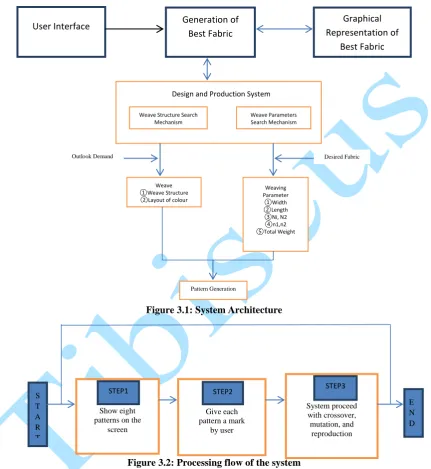
The System Architecture consists of three major modules which are User Interface, Fabric Feature Production by Genetic Algorithm and Graphics Representation of Pattern Generated.
Figure 3.1 is the architecture that illustrates the production schemes of fabric design. The architecture comprises two search mechanisms; one is used to determine the weaving parameters and the other one is used to search for the weave structure. The search for the combination of unknown weaving parameters (e.g., N1, N2, n1, and n2) based on the cost considerations earlier defined (i.e., total weight of material yarn) can proceed under both known width and length of a loom. The expected output presented by the weave structure and the colour layout of yarns can be generated and determined by using components of the weave structure.
iteration (in GA, number of generation) and user preferences about basic setting of the software. The choice of constraint of the user makes up the initialize population of the individuals which will be used in the Genetic Algorithm for the best fabric feature generation.
From the system interface, user can select any of the eight chromosomes for which the pattern is to be generated and also attributes weight to the chromosomes. Each chromosome has list of possible genes which are indexed from 1 to n where n is the number of gene for a chromosome.
Figure 3.1: System Architecture
Figure 3.2: Processing flow of the system
The processing flow of the proposed system is shown in Figure 3.2. The proposed GA integrated system can facilitate the tasks of fabric patterns designers in the production of new and appropriate solutions that suit the demands of the end users of the products.
3.1 Generation of Best Fabric
Genetic algorithm is used to generate the best fabric that is suitable for the users’ preference.
The basic steps of the GA algorithm used for these design can be described as follows:
i. Initialize population: The generation of initial population through the set of constraints that the user chooses in form-fill interface.
ii. Birth of new Individuals from the current populations: The two basic process of birth of new individual is via Mutation or Crossover.
a. Crossover: 2-point crossover was performed on the parents to create new individuals.
Show eight patterns on the
screen STEP1
Give each pattern a mark
by user STEP2
System proceed with crossover, mutation, and
reproduction STEP3 S
T A R T
E N D
User Interface Generation of
Best Fabric
Graphical Representation of
Best Fabric
Weave Structure Search Mechanism
Weave ①Weave Structure ②Layout of colour
Pattern Generation
Weave Parameters Search Mechanism
Weaving Parameter
①Width ②Length ③Ni, N2 ④n1,n2 ⑤Total Weight
Design and Production System
b. Mutation: it produces new individual by changing the gene of a particular chromosome randomly.
iii. Evaluate: calculate the fitness of each individuals in the population. The fitness function used for this research is given by:
(3.1)
Where F= fitness of the individual N= Number of chromosomes Wi= Weight of chromosome i
Vi= Index of gene i
iv. Choice parents: select individuals with best fitness from the population to be the parents of the next generation.
v. If number of iteration not reached go to step 2 vi. Exit and return best individual so far.
In order to identify the error, the GA algorithm used a special fitness function based on a template matching score. The k-th chromosome was expressed by using the form:
(3.2)
The chromosomes encode both, the angle (α) of rotation and the centre position (x, y) of the template. In this template the background takes the value 0 and the pattern takes the value 1. The appearance of the individual chromosomes will be in two dimensional matrices represented in the equation given below.
(3.3)
The smaller values of total make span indicates better result. In minimizing the objective function and maximizing the fitness function, equation 3.4 is used to establish the relationship between the objective function and the fitness function.
(3.4)
Where:
F(x) = fitness function. f(x)' = the objective function.
At the early stage, the application will create several parents whose chromosomes are randomly taken from the task matrix. Parents with low fitness value (defect) will be eliminated and will not be used to breed new offspring (pattern) based on its fitness function.
4. RESULT AND DISCUSSION
Selection operator was used to simulate the natural evolution. Chromosomes with high fitness were selected for crossover for faster convergence to best solution but chromosomes with low fitness were selected for mutation. In this paper, Roulette wheel selection was used to select the individuals
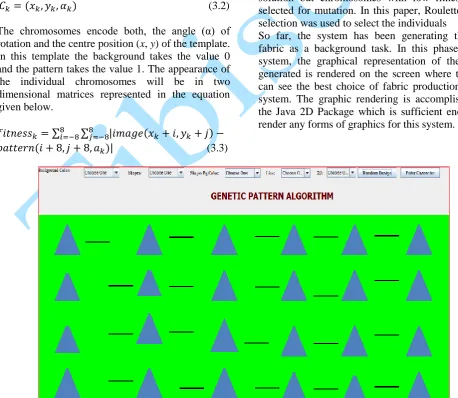
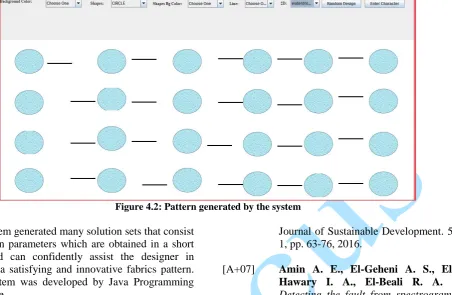
So far, the system has been generating the best fabric as a background task. In this phase of the system, the graphical representation of the fabric generated is rendered on the screen where the user can see the best choice of fabric production of the system. The graphic rendering is accomplished by the Java 2D Package which is sufficient enough to render any forms of graphics for this system.
Figure 4.2: Pattern generated by the system
The system generated many solution sets that consist of pattern parameters which are obtained in a short time and can confidently assist the designer in creating a satisfying and innovative fabrics pattern. The System was developed by Java Programming Language.
CONCLUSION
In improving the quality of final products manufacture in textile industry, there is a need to embrace opportunities that information technology revolution offers for enhanced quality production. With the manipulation of similarities (schemas), genetic algorithm has reduced the complexity of pattern generation problem. In the implementation process, short schemas with low rank and with good fitness were selected, recombined and re-selected again for improve performance. With this system, a fabric designer can efficiently determine the best fit for colours and patterns. During pattern design, the GA mechanism would facilitate a user to obtain the best combinations of pattern parameters during design stage. The cost and time used to produce samples at design stage before the final products is pretty eliminated. The creativity of designers for large scale production of patterns is enhanced with the system. Therefore, manufacturers that make use of the system can rarely run out of inspirations. Fabric designers can obtain the best combination with GA integrated pattern generation if appropriate combination sets of the pattern parameters are selected.
REFERENCES
[Aji16] Ajila K. O. - An Appraisal of Traditional Woven Fabric Production in South-western Nigeria. European
Journal of Sustainable Development. 5, 1, pp. 63-76, 2016.
[A+07] Amin A. E., Geheni A. S.,
El-Hawary I. A., El-Beali R. A. -
Detecting the fault from spectrograms by using genetic algorithms techniques. AUTEX research journal. 7(2). 80-88, 2007.
[Che05] Chen Z. - Fashion clothing supply chain management, Britain to China, Textile Asia, Vol. 36, pp. 53-56, 2005.
[DB07] Dobrea D. M., Blaga M. - Genetic Algorithm for Textile Pattern Recognition. 34th Aachen International Textile Conference, 2007.
[DMO15] David O. M., Michael O. F., Olusegun J. A. - Nigeria Textile Industry: A Tool for Actualising Economic Stability and National Development, European Journal of Business and Social Sciences, Vol. 4, No. 08, November. P.P. 331 – 344, 2015.
[GB10] Guruprasad R., Behera B. K. - Soft Computing in Textiles. Indian Journal of Fibre and Textile Research, 2010.
[HC03] Hartelius K., Carstensen J. M. - Bayesian Grid Matching; IEEE Transactions on Pattern Analysis and Machine Intelligence, 25(2), p. 162-173, 2003.
[HS08] Hopp W. J., Spearman M. L. - Factory Physics. Third Edition. New York: MC Graw Hill, 2008.
[Jen08] Jeng-Jong L. - A GA-Based Search Approach to Creative Weave Structure, Design Journal of Information Science and Engineering, Issue 24, p. 949-963, 2008.
[J+13] Jeyaraj J. L., Muralidharan C.,
Senthilvelan T., Deshmukh S. G. -
Genetic Algortithm Based Multi-Objective Optimization of Process Parameters in Color Fast Finish Process. A Textile Case Study. Journal of Textile and Apparel, Technology and Management. Volume 8, Issue 3, 2013.
[Kle13] Kleinheinz J. - Open-width treatment of knitwear. Pakistan Textile Journal, 54-55, 2013.
[K+14] Kurniawan H., Tanika D. S., Aditya T. P., Prianggada I. T. - Optimizing Production Scheduling Using Genetic Algorithm in Textile Factory. Journal of System and Management Sciences Vol. 4, No. 4, pp. 27-44, 2014.
[LY05] Luo Z. G., Yuen M. M. F. - Reactive 2D/3D garment pattern design modification, CAD Computer Aided Design, Vol.37, pp. 623-630, 2005.
[PB14] Prajakta A. J., Biradar M. S. - Wavelet Based Features for Defect Detection in Fabric using Genetic Algorithm. IOSR Journal of Computer Engineering (IOSR-JCE). Volume 16, Issue 3. PP 116-120, 2014.
[PSB09] Penava Z., Sukser T., Basch D. - Computer aided construction of reinforced weaves using matrix calculus, Fibres and Textiles in Eastern Europe, Vol. 76, No. 5, pp. 43-48, 2009.
[S+06] Shady E., Gowayed Y., Abouiiana M., Youssef S., Pastore C. - Detection and Classification of Defects in Knitted Fabric Structures, Textile Research Journal, vol. 76, No. 4, 295-300, 2006.
[TC05] Teodorescu T.-D., Chirita R. - Automatic feature selection for textile defects discrimination; Symposium on Signals, Circuits and Systems, 14-15 July, 2, p. 481-484, (2005).