A
A
P
P
P
P
L
L
I
I
C
C
A
A
T
T
I
I
O
O
N
N
O
O
F
F
F
F
I
I
R
R
S
S
T
T
O
O
R
R
D
D
E
E
R
R
D
D
I
I
F
F
F
F
E
E
R
R
E
E
N
N
T
T
I
I
A
A
L
L
E
E
Q
Q
U
U
A
A
T
T
I
I
O
O
N
N
I
I
N
N
T
T
E
E
M
M
P
P
E
E
R
R
A
A
T
T
U
U
R
R
E
E
P
P
R
R
O
O
B
B
L
L
E
E
M
M
S
S
A
A.
.
H
Ha
as
ss
sa
an
n,
,
Y
Y.
.
Z
Za
ak
ka
ar
ri
i
Department of Mathematics, Usmanu Danfodiyo University, Sokoto. Nigeria
Corresponding Author: A. Hassan, [email protected]
ABSTRACT: Abstract world of mathematical concept,
which is where the model is built. We then manipulate the model using techniques or computer aided numerical computation. Finally we re-enter the real world, taking with us the solution to the mathematical problems, which is translated into a useful solution to the real problems. The application of first order differential equation in temperature have been studied the method of separation of variables Newton’s law of cooling were used to find the solution of the temperature problems that requires the use of first order differential equation and these solution are very useful in mathematics, biology, and physics especially in analyzing problems involving temperature which requires the use of Newton’s law of cooling.
KEYWORDS: Differential equation, temperature.
1. INTRODUCTION
A first order differential equations is an equation that contain only first derivative, and it has many application in mathematics, physics, engineering and many other subjects.
In some of the applications that are in mathematics, a first order differential equation plays a vital role in physics that includes a temperature problem which requires the use of Newton’s law of cooling of a particular substance.
According to some historians of mathematics the study of differential equations began in 1675, when Gottfried Wilhelm von Leibniz wrote the equation:
(1)
The research for general methods of integrating differential equation began when Isaac Newton classified first order differential equations into three classes.
(2)
The first two classes contain only ordinary derivatives of one or more dependent variables with respect to single Independent variable and are known today as ordinary differential equations. The Newton would express the right side of the equation in powers of the dependent an infinite series. The coefficients of the infinite number of particular solutions, it wasn’t until the middle of 18th
century that the full significance of this fact, i.e. that the general solution of a first order equation depends upon an arbitrary constant was realized.
Only in special cases can a particular differential equation be integrable in a finite form i.e. be finitely expressed in terms of known functions. In the general case one must upon solutions expressed in infinite series in which the coefficients are determined by recurrence formulae.
Michael et al., ([M+95]) stated that “the range of water temperature found on the earth encompasses both the freezing point (00
C for fresh water and -1.9 0
C for sea water) and boiling point (1000
C for fresh water, 1020C for sea water). Much of the earth’s free water is contained in the oceans at temperatures toward the low end of this range, remaining nearly frozen at an average temperature of approximately 1
0
C. Very warm waters are found at a few locations on the point. A small amount of the earth’s water, around 0.5 %, is contained in ground water with typical temperatures similar to local average annual air temperatures. Lakes and rivers containing only around 0.01% of the earth free water have temperature ranges between 0 and 400
C, in which most biological activity occur, shallow lakes and rivers in one climate can reach temperature of 400
C , however, maximum temperature of most lakes and rivers in one climate can reach temperatures of 40
population, and an influence death rate of 0.58 per one thousand persons will occur but with targeted antiviral prophylaxis if 80% of the exposed population is maintained on prophylaxis for up to eight weeks the pandemic will be contained the virus.
Colizza et al., ([C+07]) in the work: modeling the world wide spread of pandemic influenza baseline case containment intervention, stated that in the face of the very potent threat of a new influenza pandemics due to the HsNi avian flu virus now found in bird, and the fact that to develop a new vaccine if the pandemic occurs can take about 6-8 months. There is need to develop alternative on how to control the spread of the virus before the vaccine is ready. By incorporating data on worldwide air travel and data from urban centers into mathematical model of the spread of influenza they were able to shoe that the rate of spread of the flu pandemic will depend among other factors on region then it arises from, the reproductive rate of the virus, if the reproductive of the virus rate (growth rate) is greater than 1.5 it will cause a severe pandemic. They also used their model to show that strict restriction on air travel will have little effect on the spread of the virus. They were also able to predict that if the R0 of the virus is up to 1.9 and a country stock provide enough antiviral drugs, enough to treat 5% of its population, the pandemic will be controlled.
Kozhanov ([Koz12]) on the conference on mathematical modeling in continuum mechanics and inverse problems of finding the solutions of differential equations together with one or several coefficients of the equations or the coefficients and an unknown external force; similar problems are considered for the elliptic, parabolic and hyperbolic equations the equations with multiple characteristics and sobolev type of equations”.
The aim and objective of this research is to use first order deferential equation in solving some problems that are in Temperature.
The scope of this research is to give an insight in to the application of first order differential equations in temperature problems.
This research is limited to the first order differential equation only.
2. DIFFERENTIAL EQUATION
A differential equation is an equation that involves one or more derivates of differentials that is any equation containing differential coefficients is called a differential equation. It is also defined as an equation containing the derivatives or differentials of one or more dependent variables, with respect to one or more independent variables.
Examples are:
(3)
Classification of Differential Equation
Differential equation is classified according to three properties which include;
i. Classification by type
ii. Classification by order and degree
iii. Classification as linear or non linear differential equation.
i. Classification by type
If an equation contains only ordinary derivatives of one or more dependent variables, with resects to a single independent variable is then called ordinary differential equation, ordinary differential equation in general any function of x1 and the derivatives of
y up to any order such that:
(4)
Defines an ordinary differential equation for y (the dependent variable) in terms of x (the independent variable). For example
(5)
is an example of ordinary differential equations.
ii. Classification by order and degree
The order of differential equation is the highest differential coefficients contained in it.
Example:
(6)
are examples of first order ordinary differential equations.
Equations of the form
(7)
are examples of second order ordinary differential equations. Similarly equations
(8)
The degree of a differential equation is the power to which the highest order differential coefficient is raised when the equation is rationalized (i.e. fractional power removed). In other words, the degree of any differential equation is the exponent of the highest powers for example the equation;
(9)
are of degree 4 and 2 respectively.
iii. Classification as linear or nonlinear
Differential equations
Generally a linear differential equation has the form:
(10)
It should be noted that linear differential equations are characterized by two properties:
(i) The dependent variable y and all its derivatives are of the first degree that is the power of each term involving y is 1.
(ii) Each coefficient depends only on the dependent variable x.
Differential equation is said to be non-linear if the equation (10) together with the two given properties are not satisfied.
Examples of linear deferential equations are equations of the forms;
(11)
Examples of non-linear differential equations are equation of the forms:
(12)
are non linear ordinary differential equations.
Solution of Differential Equation
The first order differential equation has a variety of methods in finding the solution of equation which include.
i. Variable Separable
ii. Equation Reducible to variable separable iii. Homogenous Equations.
iv. First Order Exact Differentia Equations v. Linear Equations
(i). Variable Separable
A first order differential equation can be solved by integration if it’s possible to collect all y terms with dy and all x terms with dx. That is if it is possible to write the equation in the form
(13)
Then the general solution is
(14)
where c is an arbitrary constant.
Example 1:
Solve the differential equation
(15)
Solution:
Arrange the equation in the form
(16)
Multiply both sides by y.
(17)
Now we’ve
(18)
Therefore
and (19)
3. TEMPERATURE PROBLEMS IN DIFFERENTIAL EQUATION
The study of differential equations is full of surprising connectors because, an understanding of differential equations provides you with essential tools to analyze many important phenomena beginning with basic physical principles. In this chapter, we are going to look at a few common applications of some elementary differential equations in Temperature problems. For these type of problems we will be assuming that the question involves the temperature (T) of a certain body placed in a medium of constant temperature (M) and as time (t) varies, so does T, (so T has a rate of change with respect to t ) in this case Newton’s law of cooling tells us the following,
dT
k T M
dt For some constant k >0 (20)
Equation 20 is the Newton’s law of cooling.
Another way of saying this is that “the rate of change of temperature of the body is proportional to the difference in temperature of the body and the medium in which it is placed”. This law is the source of a popular misconception namely that when placed in freezer, warm water will freeze into ice cubes faster than cold water this is not true (of course) but what is true is that the “rate of change” of temperature of the warm water is much faster than that of the cold water since the difference in temperature (between the water and freezer) is much greater for the warm water thus the warm water will cool at a much faster rate, but the cold water still freeze sooner.
4. APPLICATION OF FIRST ORDER DIFFERENTIAL EQUATION IN TEMPERATURE PROBLEMS
For these type of problem we will be assuming that the question involves the temperature (T) of a certain body placed in a medium of constant temperature (M) and as time (t) varies so does T. (So T has a rate of change with respect to t). In this case Newton’s law of cooling tells us the following.”The rate of change of temperature of the body is proportional to the difference in temperature of the body and the medium in which it is placed”.
For some constant k. (21)
Example 1
A metal bar at a temperature of is placed in a room at constant temperature of , if after 20 minutes the temperature of the bar is find (a) The time it will take the bar to reach the
temperature of , and
(b) The temperature of the bar after 10 minutes.
Solution
,
Using equation 21
Now,
(22)
Since at (the temperature of the bar is initially ) and it follows from equation 22 above
This implies that
And so equation 22 becomes
(23)
And at , we are given that , hence from equation (1) we’ve,
Now substituting the value of k into equation 21, we’ve
(24)
Equation 24 represent the temperature of the bar at any time,
(a) We are required to find , now from equation 24
(b) We require In equation 24,
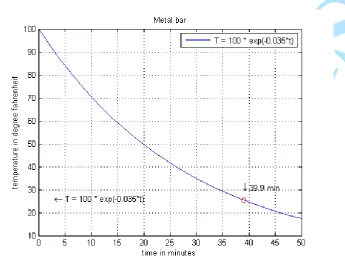
We can also us the graph to demonstrate the above situation as in figure below,
Figure 1: The above graph represents a graphical solution of the problem
The above graph explains the change of temperature of a metal bar in a room, at time (t), it also shows that it takes the temperature of the metal bar approximately 39.9 minutes to drops down to , while the ambient temperature remains steady at
Example 2; A boiling (100oC) solution is set on a table where the room temperature is assumed to be constant at 20oC, the solution cooled to 60oC after five minutes
(a) Find a formula for the temperature (T) of the solution, t minutes after it is placed on the table. (b) Determine how long it will takes for the
solution to cool to 22oC.
Solution
(a) We are asked to find an explicit formula for T in terms of t, but this kind of problem requires the use of Newton’s law of cooling which states that
dT
k T M
dt For some constant K
where M is the constant temperature.
Solving the equations using variable separable we have
20
dT
k T
dt
For some constant K
Integrate both sides of the equation
where Aec
Since the initial temperature of the solution was 100oC, we know that at T = 100oC
Substituting T = 100 and t = 0,
100 = Aek(0) + 20 A = 80
So we have
T(t) = 80ekt + 20
Now using t = 5mins and T=600C we’ve to find K.
60 = 80 ek(5) + 20 40 = 80e5k
40 80= e
5k
1 2= e
5k
Take ln of both sides
5k = ln (1/2)
K = 1/5 ln ( 1
/2)
K = -0.139
T(t) = 80e(-0.139) t + 20 25
(b) We wish to find out what is t when T is 22oC, using equation 25
T(t) = 80e(-0.139) t + 20
At T = 22oC we have
22 = 80e-0.139 t + 20
Collecting like terms together we have,
22-20 = 80 e-0.139 t 2=80e-0.139 t
0.139
2 80
t
e
1 40= e
-0.139 t
Take ln of both sides
t = 27 minutes
Therefore after 27 minutes the temperature will reduce to 22oC.
CONCLUSION
We have seen that the application of first order differential equation in temperature problems are
useful in mathematics and physics for instance in analyzing problems involving temperature problems which requires the use of Newton’s Law of cooling. When dealing with temperature problem it is recommended to use Newton’s law of cooling, and the most appropriate method in solving Newton’s law of cooling is variable separable.
REFERENCES
[Bir02] Bird J. O. - High Engineering Mathematics. Third Edition. Great Britain by Martins the Printers Ltd, India. 532-542, 2002.
[C+07] Colizza V., Barrat A., Barthelemy
M., Valleron A. J., Vespignani A. -
Modeling the World Wide Spread of Pendemics Influenza: Baseline Case and Containment Intervention. Plosmedicine, 2007.
[Koz12] Kozhanov A. I. - First Russian-French Conference on Mathematical Geophysics, Mathematical Modeling in Continuum Mechanics and Inverse Problems, 2012.
[L+04] Longini I. M., Halloran M. E., Nizam
A, Yang Y. - Containing pandemic
influenza with antiviral agents. Am J Epidemiol 159: 623–633, 2004.
[M+95] Micheal et al. - Bay Delta forum in Importance of Water Temperature in Aquatic Systems. Delta, 1995.
[Sas05] Sasser J. E. - History of Ordinary Differential Equation First Hundred Years, 2005.
[Sta81] Stanley I. G. - Elementary Differential with Application, Addison Wesley Publishing Company, Canada.231-234, 1981.
[Uba10] Ubah A. A. - Elementary Differential Equation Mat 202. Lecture Note unpublished. 6-20, 2010.