dialogues between theory and practice
A thesis submitted to the University of Trento, Italy for the degree of Doctor of Philosophy in the Department of Information Engineering and Computer Science,
International Doctoral School in Information and Communication Technologies
Max Willis
University of Trento, Department of Information and Communication Technology TIM – Telecom Italia Semantics and Knowledge Innovation Lab SKIL
31st Ph.D. cycle
Supervisors:
Antonella De Angeli, University of Bolzano
Chiara Bassetti, Consiglio Nazionale delle Ricerche CNR Massimo Zancanaro, Fondazione Bruno Kessler FBK
Industrial Advisor: Michele Vescovi, TIM Joint Open Lab SKIL
Examiners:
Ilpo Koskinen, University of New South Wales
Martijn de Waal, Amsterdam University of Applied Sciences Vincenzo D’Andrea, University of Trento
Rosella Gennari, University of Bolzano
Research Report
Publications:Adamo, Greta., Mushiva. Mark, Willis. Max. (2017). Persuasion and Empathy in Computer Games, An Ontological Perspective, In The 12th International Conference on the Philosophy of Computer Games. Kraków.
Willis, Max, de Angeli, Aantonella, Zancanaro, Massimo. (2017). Experience Probes: Immersion and Reflection, Between Reality and Virtuality. In INTERACT2017 (pp. 10). Mumbai, India.
Willis, Max. & Cate Christ, Melissa (2016). Listening to the Walkable City. In A. De Angeli, L. Ban-non, P. Marti & S. Bordin (Eds.), COOP 2016: Proceedings of the 12th International Conference on the Design of Cooperative Systems, 23-27 May 2016, Trento, Italy (pp. 321-325). Springer Interna-tional Publishing.
Conferences and Seminars: COOP 2016 Trento, IT
INTERACT Mumbai, IN 2016 (student helper) Games For Cities, Rotterdam, NL 2017
ISAGA 2017 Delft, NL
CHIPlay 2017 Amsterdam, NL (student helper) Philosophy of Computer Games 2017, Krakow, PL
Researching the Transgressive Aspects of Gaming and Play Seminar, University of Bologna, IT 2017
Summer- and Training Schools
Theater in Design 2016, University of Southern Denmark, Kolding, DK Games for Cities 2016, COST Training Schools, Amsterdam, NL
PhD Research Abroad
Designing Game and Play Interventions for Civic Engagement University of Lincoln, UK 05/03/2018 to 05/04/2018
Abstract
Contents
ReseARCh RepoRt
2
AbstRACt
3
1 IntRoduCtIon
7
2 ReseARCh questIons
9
3 stAte of the ARt / RelAted woRk
10
3.1 S
ocialD
eSign anD conflict10
3.2 a
goniSm11
3.2.1 P
oliticalagoniSm12
3.2.2 a
goniSmin DeSign13
3.3 e
mPathy14
3.4 i
nterSubjectivity16
3.5 c
ritical anD reflective Practice18
4 ReseARCh Methodology
20
4.1 c
onStructiveD
eSignr
eSearch20
4.1.1 f
ramework21
4.1.2 c
riticiSmS21
4.1.3 a
PProach22
4.2 i
nveStigativet
echniqueS24
4.2.1 e
thnograPhic fielDwork24
4.2.2 D
ialogicS
yntaxa
nalySiS25
4.2.3 c
riticalD
iScourSea
nalySiS25
4.2.4 g
ameanD Play26
4.2.5 P
laying outPotential futureS27
5 AgonIsM And desIgn
28
5.1 P
rinciPleS of agoniSm28
5.1.1 i
DentitieS, D
ialogueS anDa
goniSticS
Pace28
5.2 D
eSign StrategieS for agoniSm29
5.2.1 g
ameanDP
laym
echanicS29
6.2.2 c
44
6.2.3 c
ritical reflectionSon Practice49
6.3 lab: i
mProviSationalt
heatre forS
ocialD
eSign51
6.3.1 e
nactingPotential futureS52
6.3.2 P
erformingreSearch54
6.3.3 r
eflectionS on culturalSituation56
6.4 lab: g
ameS forc
itieScoSt t
rainingS
chool58
6.4.1 c
irculare
conomy challenge:
urban mineS59
6.4.2 u
rban gamePlay concePt: m
etalk
ong61
6.4.3 c
ritical reflectionSanD ethicalconcernS63
7 theoRy to pRACtICe: InteRventIons
65
7.1 i
ntervention: g
enDer gaP inict
anDStem
66
7.1.1 D
eSignc
onStruction: m
inD theg
aP66
7.1.2 e
viDence of emergent agoniSm71
7.1.3 i
DentitieS72
7.1.4 D
ialogueS75
7.1.5 a
goniSticS
Pace77
7.1.6 D
iScuSSionanD reflectionS on agoniSm78
7.2 i
ntervention: n
eighborhooD revitalization80
7.2.1 l
ocal Situation anD narrativeanalySiS81
7.2.2 t
he city anD the automobile85
7.2.3 c
reativeinquiry:
urban DriftS87
7.2.5 P
eoPleDrink alcoholanD hang out on the StreetS93
7.2.6 r
eflectionS on antagoniSm94
7.3 i
ntervention:
commonfare.
net96
7.3.1 Pien
ewS anD commonfare96
7.3.2 t
he gamefulSurvey97
7.3.3 r
eflectionS on aPProaching community103
7.3.4 i
DentitieS105
7.3.5 D
ialogueS107
7.3.6 a
goniSticS
Pace107
Acknowledgments
This work was supported by a fellowship grant from TIM-Telecom Italia at the Joint Open Lab SKIL of Trento, Italy.
Further support was received from PIENews, Horizon 2020 ref. 687922
8 dIsCussIon: on AgonIsM And desIgn
110
8.1 rq1: w
hat are Some of the key PrinciPleS of agoniSm?
110
8.1.1 i
DentitieS111
8.1.2 D
ialogueS111
8.1.3 a
goniSticS
Pace112
8.2 rq2: h
ow can agoniSm be inStantiateD in DeSign Practice?
112
8.2.1 i
DentitieSaSr
ole-P
lay112
8.2.2 D
ialogueS through Storytelling114
8.2.3 a
goniSticS
Pace aS at
hirDP
lace114
8.3 rq3: h
ow can agoniSm in DeSign be evaluateD?
115
8.3.1 S
ignS ofi
nterSubjectivity115
8.3.2 e
mergentagoniStic PracticeS116
8.4 c
hallenging DeSign reSearch StatuS quo118
8.5 a
moDel of agoniSm120
8.6 t
hree communitieS122
8.6.1 c
ommunitieS of Practice: ict
anDStem
122
8.6.2 u
rban community:
material,
Social anDPolitical124
8.6.3 P
latform community:
commonfare.
net124
8.7 l
imitationS125
8.7.1 D
iScourSea
nalySiS125
8.7.2 g
ame DataaS real Data126
8.7.3 f
ace-
to-f
ace engagement126
9 ReseARCh As A dIAlogue
127
9.1 a
goniSm for DeSign127
9.2 g
ame anD Play aS DeSign SPeculation127
9.3 m
inD theg
aP128
9.4 c
oncluSion129
10 bIblIogRAphy
130
What is required to enact this Social Design are tools for citizens to disrupt, and reconfigure the public domain, develop inter-group communications and foster cross-cultural engagement in service of this doctrine (Menendez-Blanco, Bjorn, & De Angeli, 2017). These tools must redress hegemonic power, foster diversity and inclusion, incite collectivity and collaboration, and re-balance relations among stakeholders, all major challenges with no simple solutions (Keshavarz & Maze, 2013). One of the primary activities of design for social innovation is the search for new ways to address the seemingly intractable social, political and environmental challenges of our times. To approach strongly polarizing issues, including the voices of all potential stakeholders, particularly those of marginalized or disenfranchised social groupings, while accommodating those in more powerful positions and those whose perspectives may lie outside the majority is of utmost importance. Yet socially-orientated design studies do not well accommodate voices from the extremes, nor do they sufficiently value dissonance, conflict or non-participation (DiSalvo & Dantec, 2017; Keshavarz & Maze, 2013).
Civic and public design spaces are gradually shifting to address these challenges (Foth, Agudelo, & Palleis, 2013) and where previously attention was on the artifacts and systems being created to address social issues, increasingly design research investigates emergent social interactions, communities of practice and infrastructuring as facilitated through design (Hillgren, et al., 2011; Koskinen, 2016a; Manzini, 2013). Yet the disruption caused by these new movements inevitably creates more conflict and design research must imagine new practices to transform this conflict and empower citizens, stakeholders and participants to challenge the status quo and collaboratively negotiate for change (Koskinen & Hush, 2016). In search of these new practices, design research is revisiting political debates (Teli, De Angeli, & Menéndez-Blanco, 2018) that query how our societies are ordered, and examining the systems that guide and shape intergroup exchanges to effect transformation and empowerment. These political debates are of themselves conflicted, yet arguing between disparate political systems and theories is certainly fertile ground for design (DiSalvo, 2012).
This thesis puts the theory of agonism into practice, and develops strategies to foster agonism
through design. It undertakes an investigation of agonism as Design Activism (Markussen, 2013) and demonstrates its potential utility for Social Design. The research begins with an exploration of agonism, in particular its situation in design and political discourse as a critique of liberal democracy (DiSalvo, 2012; Mouffe, 2009). Several constituent principles of agonism are isolated from the political theories then elaborated through game, play and Interaction Design techniques to define three main design strategies. Identities are examined through Role-Play, Dialogues are encouraged through Storytelling, and Agonistic Spaces are created as the Third Place. Accompanying evaluation methods are developed based on concepts of interactional negotiated identity (Bucholtz & Hall, 2005), dialogic approaches to intersubjectivity (Gillespie & Cornish, 2010), and the identification of agonistic space through observation of participant behavior and the imprints of agonistic encounters left in design artifacts.
This operationalization of agonism is achieved through Constructive Design Research (CDR) or Research through Design (RtD) that employs a cyclical process of design and reflection through which theory and practice evolve recursively (Koskinen, Zimmerman, Binder, Redstrom, & Wensveen, 2011). A general framework for the practice of CDR is derived from various design and Human Computer Interaction (HCI) discourses. This framework is reflected in a detailed description of the research trajectories that traces the concretization of theory through design practice. The design strategies that emerged from the research trajectories are then applied in three interventions that examine contentious issues, each in a distinct community. The gender gap is investigated in the academic community of ICT and STEM (Science Technology, Engineering and Mathematics). European migration and the pressures of urban materiality are investigated in an actual neighborhood in Lincoln, UK, and the challenges of addressing and knowing a community without physical presence are investigated on the digital platform commonfare.net.
Each intervention incorporates creative inquiry and design speculation (Auger, 2013; Dunne & Raby, 2013) that is enacted through game, play and Interaction Design modalities. This use of playful engagements to elaborate preferred, potential futures is an emerging games research practice that combines pragmatic CDR techniques and imaginary, fictional and futures-focused creativity similar to Critical Design (Coulton, Burnett, & Gradinar, 2016; Elsden, et al., 2017; Korte & Ferri, 2018; Schouten, Ferri, de Lange, & Millenaar, 2017). Game instances are developed through which participating players imagine and act out possible future states and explore social activist themes. Imaginary games are sketched to shed light on complex situations by engaging the social and cognitive peculiarities of game and play. And future, potential game design research is proposed to elaborate the initial findings of this research. These game design techniques differ in each of their origin communities; each is situated in a particular social, political and material space, and is enacted with different
some solutions, by embracing conflict, rather than trying to eradicate it. The potential transformation offered by agonism could be fundamental to re-imagining political processes, but also the social, lived experience. To discover how to harness this, the first task is to better understand what is agonism. What do the theorists, historians, scientists and designers say about agonism, and what can be derived from the cacophony of voices that speak on agonism? This first research question, however is not asking simply what is agonism, but what meaningful application can it have as a design form. As such, this is a question about the future, a future form, and this thesis intends to discover, instantiate, critique and present useful insights on agonism that can further inform the practices of Social Design.
RQ2: How can agonism be instantiated in design practice?
Having examined in depth the political theories of agonism and the concept’s various implications, a general sense of its utility to Interaction Design and social innovation can be discerned. Yet the challenge remains, how to instantiate these principles into, and through design practices. Design requires specific forms, tools and methods with which to construct the systems and artifacts that embody design principles. Strategies need be developed to initiate agonism and stimulate publics to engage with that making, to extend it with their own intuitions and knowledge. This research question is asking how could design be enacted differently, if agonism were core to its practice. As such, this question is reflexive, and asks also how the principles of agonism can be relevant to design research. How do the lessons learned in uncovering agonism as a design practice apply to the tensions and conflicts inherent in bridging technology studies and the humanities? In the process of answering this question, I am inspired also to query how, if agonism can initiate new forms of design, can it also initiate new forms of research.
RQ3: How can agonism in design be evaluated?
Once some of the principles of agonism have been aligned and strategies devised for their
3 state of the art / related work
The following section describes the state of the art and related work related and is broken down into three main subsections. The first introduces Social Design and conflict, examining the cultural-historical crossovers of democratic participation, design and research. The next section regards agonism and the political underpinnings of the thesis, introducing its etymology and the various arguments that applying it to political theory. This is followed by a challenge to the predominance of empathy-related practices in contemporary design, which subsequently grounds my alternative focus on intersubjectivity and informs the operationalization of agonism while serving as a primary measure for its evaluation. The final section introduces essential aspects of critical reflection in design, its reciprocal role in agonism that led to the eventual transformation of my design practices and research perspectives that is central to this thesis.
3.1 Social Design and conflict
Social Design offers a frame of reference for design that approaches issues of community, neighborhood and social services, attends to marginalized groups or communities and addresses myriad interpersonal, intergroup, and inter-cultural concerns (Mulgan, 2006). It reflects an activist, interventionist approach (Markussen, 2013) and carries forward the original proposal of ‘classic’ Participatory Design that goes beyond engaging users in a design process to actually intervening in conflict situations by promoting democratic participation (L. Bannon, Bardzell, Bødker, 2018; Björgvinsson, Ehn, & Hillgren, 2010). Social Design correlates with contemporary transformations in HCI which acknowledge the central importance of participation and co-creation together with stakeholders in design, and tend towards social, cultural and technical synthesis through design research (Sengers, Boehner, & Knouf, 2009). Central to this transformation are the re-evaluation of the roles and agency of designers (E. B.-N. Sanders & Stappers, 2008), a renewed focus on the research value of tacit knowledge unique to the practitioner (Gaver, Boucher, Pennington, & Walker, 2004; Valentine, 2011) and increasingly, the incorporation of artistic and creative practices in research (Auger, 2013; Blythe, 2014; Candy, Edmonds, & Ascott, 2011; Gaver, et al., 2004).
HCI and engineering disciplines are in a curious position as research fields in that they examine the state of the world even as they imagine and shape its future state, designing new technologies that in turn, afford new ways of being and communicating, for better or for worse (Light, 2015). As such, the intentions of the design practitioner, and the agendas of research institutions have the potential to exert untoward influence on the future shape of the world. In Social Design this happens explicitly in terms of incorporating social activism, for example in games, urban investigations, and the development of collaboration systems (Flanagan & Nissenbaum, 2007; Markussen, 2013; Menendez-Blanco, Bjorn, & Angeli, 2017). This also happens implicitly, as in the perpetuation of legacy engineering thinking that constrains designers’ imagination and construction of potential futures (Auger, Hanna, & Encinas, 2017) or the reification of social psychology concepts in design practices and artifacts (Siegel & Dray, 2019).
3.2 Agonism
The linguistic root of agonism is ‘agon’ from the Classical Greek /ἀγών/ that has been variously
translated as a contest, competition at games, or a gathering. An agon for the ancient Greeks represented conflict that ranged from the existential struggle to get out of bed in the morning, in increasing degrees of complexity, to a public discussion, a game or sporting event, even to much more elaborate agon such as a war between nations (K. E. Carr, 2017). The agon of classical Greek theatre refers to a debate or dialogue between characters representing opposing viewpoints (Britannica, 2008). This structuring of dialogues within performance, and the potential for a play to transpire as a contest is an integral part of Old Comedy (Humphreys, 1887).
In design, agonism is largely presented as relating to conflict, challenging the status quo and examining power relations (Foucault, 1982). This is primarily derived from the use of the term agonism in
democratic political discourse and the critique of deliberative democracy (Knops, 2007). Agonism in this sense acknowledges that conflict can never be, nor should be, eliminated from politics (Rancière, 1999) and it proposes a counter to consensus in participatory decision-making: wherein consensus is seen as attempting to eradicate the conflictual nature of everyday life (Rancière, 2004), agonism supposes to embrace conflict and dissensus as creative resources. In this view, agonism is a promising concept in designing for social innovation and indeed is often discussed as a means by which conflict which could potentially derail communication between competing individuals or groups can be tamed or tempered.
3.2.1 political agonism
Chantal Mouffe’s The Democratic Paradox (Mouffe, 2009) is perhaps the most widely cited treatise on agonistic political thought referenced in design literature, and it comprises a series of articles elaborating her hard critique of liberal democracy and her calls for an agonistic pluralism. The idea is that liberalism, with its reliance for example, on market capitalism and universal human rights, is incompatible with democracy, that is true rule by the people (Mouffe, 2009). The inescapable contradiction of liberal democracy is exposed when the popular vote empowers politicians whose intentions run contrary to liberalism. For Mouffe, deliberative democracy is an illusion, as there are always winners and losers in so-called consensus, and democratic politics must be exposed, even embraced as an ever-conflicted mess of competing positions that can never be fully integrated.
In fact, Mouffe’s extended debate on agonism and the development of the concept of agonistic pluralism is rarely examined thoroughly when presented in design literature. More easily digested material from pp95-110 in the chapter “For an Agonistic Model of Democracy” appears most often, and recent design scholarship often seems to reference other authors’ interpretations of the material found in these pages. A handful of concepts now attributed to Mouffe are repeated and recycled, the origins of which she herself points out, often lie elsewhere. The Democratic Paradox is but one treatise among many (Deveaux, 1999; Honig, 1992, 1993) that offer a window onto the exceedingly complex discourse on agonism, one that is in fact quite radical and often repudiates valuable and valued concepts of participation, citizen engagement and different modes of democratic thinking (Roskamm, 2015; Yamamoto, 2017). As a whole the literature on agonism must be approached in true agonistic and critical fashion, examining the various authors’ perspectives as themselves newly erected hegemonies which need be challenged. Indeed, we may find more value in the dialogue generated around these ideas than in any literal application of agonistic pluralism itself.
Core to Mouffe’s agonism is the need in conflict situations for participants to engage each other not as enemies, whose ideas must be overcome and destroyed, but as adversaries, whose ideas one strives to overcome, yet their right to those ideas each contestant accepts on principle. This adversary-not-enemy strategy relates to William E. Conolloy’s call for “agonistic respect,” an essential framing of confrontation as between equal-others that is necessary for fruitful political discourse (Connolly, 2013), and Carl Schmitt’s earlier theory of politics defined by identities of friend and enemy (Schmitt, 2008). This is succinctly related in contemporary human terms in the conceptualization of an ‘alien other’(Neuman, 2001). The changes in identity and perspective proposed by agonism aim at an ideal discourse, a state change in communication not to be confused with the Habermasian ‘ideal speech situation’ with its rules shaped by rationality and whose eventual outcome is consensus (Habermas, 1990; Mouffe, 2000). Rather, an agonistic ideal discourse is one which participants are free and enabled to contribute, act, question and initiate dialogue, to challenge the subject, topic or direction of debate, even question, disrupt, or reinterpret the rules of dialogic engagement (Benhabib, 1992; Mummery, 2016).
democratic discourse, or they attempt to instate some minimal standard, for example one that recognizes freedom and liberty as inalienable rights, without actually defining what these two concepts entail (Westphal, 2014). The reality is, as Mouffe eventually concedes, that “some limits need to be put to the kind of confrontation that is going to be seen as legitimate in the public sphere.” (p. 93 The Democratic Paradox) and an agonism that allows for the challenge of everything cannot be a productive resource or an alternative to deliberative, consensual democracy. The realities of interpersonal, intergroup and inter-cultural conflicts, the tendency for emotions to overrule reason in political debates, and the ever contentious negotiation between individual and social identities (J. C. Turner, Hogg, Oakes, Reicher, & Wetherell, 1987) are not easily overcome through design. To encourage agonism, theorists point to so-called agonistic spaces, socio-material configurations that can transform conflict into a creative, productive force (Mouffe, 2007). Agonistic spaces can be physical, conceptual, or representative; they are transformative and disruptive, spaces in which power relations can be mitigated, resisted, and where new knowledge is produced (Topinka, 2010). As such, agonistic space can be said to roughly resemble a Foucaultian heterotopia (Foucault & Miskowiec, 1986). Yet the establishment of any space itself initiates new hegemonies, with their own dominant and submissive forces or ideas (Lefebvre, 1974), and therefore an agonistic space itself may only be possible as a transient proxy, ready at all times to be overthrown.
3.2.2 Agonism in design
Perhaps the most overt proponent of agonism in design is Carl Di Salvo, who promotes an interpretation of the utility of spaces of conflict (DiSalvo, 2010), calling it design that accomplishes the work of agonism, Adversarial Design. This however is framed as “a theoretically informed construct for understanding, describing and analyzing a range of objects and practices” (DiSalvo, 2012)(p.20) and mirrors the majority of design writing that discusses agonistic space and agonism, without establishing what is in fact an agonistic practice or how it might be initiated through design. DiSalvo instead co-opts parallel practices of Critical Design (J. Bardzell & Bardzell, 2013; Dunne, 2008) and Design Fiction (Blythe, 2014) as having the potential to initiate agonistic discussion or generate agonistic space. Yet he confines the concept of activism through design as an explicitly political act of a design or designer challenging an authority (Markussen, 2013) with little reflection on concrete measures or techniques through which design could engage actual people, places, spaces and contests of the everyday community.
3.3 empathy
Agonism is wholly shaped by engagements with others, and in the contested spaces of politics, this means navigating one central issue of humanity, between cooperation and conflict. In attending to social interactions, conflicts between people, inter-group dynamics and contested spaces, contemporary design trends have increasingly focused on empathy. Design scholarship around the turn of the millennium made explicit that designers must develop empathy for their users (E. B.-N. Sanders, 2003; Stephan & Finlay, 1999) in order to understand the experiences, emotions, and needs of people, and to deal with conflict among stakeholders in Participatory Design processes. A set of practices collectively known as Empathic Design emerged (Mattelmäki, Vaajakallio, & Koskinen, 2014), suggesting this closer emotional alignment between designer and user is possible for example through face to face dialogue. Human-Centered Design (IDEO, 2009) and Design Thinking (Gasparini, 2015; Köppen & Meinel, 2015) also contemporaneously embraced empathy within design practices, if not necessarily design strategies. In the emerging frameworks of Co-creation (Prahalad & Ramaswamy, 2004; Rill, 2016; L. Sanders, 2001) a focus on emotional alignment takes this even further, giving way to presencing and other methods of connecting people and generating new forms of shared knowledge (Peschl & Fundneider, 2014) through situated, mediated engagements (Riva & Mantovani, 2014).
However, while it is widely accepted that empathy can be party to the investigation of self-other identities, the encouragement of pro-social behavior and moderation of antisocial tendencies (D. Grynberg & Konrath, 2013b), many design-orientated approaches to empathy are grounded on overly simplistic interpretations of empathy and fail to grasp its complexity (Kouprie & Visser, 2009). Extensive prior research in social sciences and psychology have in fact unearthed diverse, sometimes conflicting perspectives on the implications, required antecedents, measurement and impact of empathy (Cuff, Brown, Taylor, & Howat, 2016; Zhou, Valiente, & Eisenberg, 2003).
Kaufman, Flanagan, & Seidman, 2016). In light of these inconsistencies, it is essential for design to critically examine the presuppositions about empathy and its supposed influence on people’s actions and intentions (Adamo, Mushiva, & Willis, 2017).
The exploration of agonism lends to this critical approach, and presents several contradictions to shaping design around empathy. First, agonism is not seeking to align participants’ perspectives, rather to embrace conflict and disagreement as agonistic pluralism (Little, 2007). It seeks to reconcile rational deliberation that eschews emotion with disruptive radicalism that accepts emotion and passion as the main drivers of political action (Mihai, 2014). This reconciliation is not intended as a consensus, or alignment, but as something more akin to oscillation. In some situations empathy can increase emotional attention to the other, facilitate understanding and acceptance of their positions; in other situations that concerted attention can lead to deeper divisions, ambivalence, and counterproductive responding (Beersma, Bechtoldt, & Schouten, 2018; D. Grynberg & Konrath, 2013b; Kaufman, et al., 2016). Thus attempts at unification of emotional perspectives between parties could potentially work contrary to agonism.
A second contradiction arises from the requirement in design literature that the designer empathize with their user (Heimgärtner, Tiede, & Windl, 2011; Wright & McCarthy, 2008), a directive that reiterates the power relations of designer over user: the user is a subject that needs be studied (Gasparini, 2015; E. B.-N. Sanders, 2005). Critical approaches to design, and in particular those focused on social innovation design, are directly concerned with dismantling hierarchies, equalizing the field upon which stakeholders play out the act of design (Hillgren, Seravalli, & Agger Eriksen, 2016). An agonistic perspective on the privileging of designer with empathic tools over the other stakeholders (Kimbell, 2011) suggests that some empathic design practices may actually perpetuate the hegemony that rules over designer and user, rather than empowering the user, as for example Participatory Design often intends (Ertner, Kragelund, & Malmborg, 2010).
3.4 Intersubjectivity
Agonism takes the approach that conflict cannot, and should not be eradicated from the political, and acknowledges that social, political interactions are always between individuals and groups with distinctively separate and potentially conflicted experiences of the world. Consensus or the elimination of differences is not the objective (Little, 2007), and this regards emotional conflicts as well. Seeking to engage people in cooperation and collaboration without disregarding their potentially contradictory perspectives, this thesis work shifts attention to the underlying framework of intersubjectivity (Fuchs & De Jaegher, 2009). As empathy can be understood as a behavioral manifestation of intersubjectivity (Gallese, 2003; Zahavi, 2001); so too are conflict and dissent grounded in intersubjective engagements (Matusov, 1996).
Intersubjectivity is commonly approached quite narrowly, as the shared understanding of meanings (Dennen & Wieland, 2007), or a form of social cognition, an alignment of subjectivities akin to participatory sense-making (Gallagher, 2009). However as is clearly the case in political discourse, people interact even as they hold vastly divergent understandings of the world, and conflict is essentially engagement with the other that, lacking synergy, becomes detrimental. Mutual understanding is
certainly a potential outcome of strengthened intersubjectivity, but it does not completely explain the phenomenon (Duranti, 2010). Intersubjectivity is active long before cognitive representations of others’ perceptions can be compared and agreed or disagreed with, before reaching any mutual understanding (Gallese, 2003).
The root of intersubjectivity is much more primal, an innate facet of human existence (Duranti, 2010) born from the tacit understanding that the world which one inhabits is in fact a shared world. This most basic level of being reflects the fact that from birth one encounters the bodies of others and is surrounded by artifacts that are clear signs of the presence and agency of others (Schutz, 1967). As such, intersubjectivity is a priori to engagement with others, independent of co-presence, and grounds one’s entire conception of existence as encapsulated in a social, or cultural world (Husserl, 1931; Merleau-Ponty, 1942, 1945). The material forms of the world, its spaces, are perceived and encountered through lived experiences, and given meaning as places that are enacted and performed through social and cultural processes (Casey, 1996; Lefebvre, 1974). Whether they are physical or conceptual, spaces are built, created, and contributed to by others and are thus entwined with intersubjectivity even before one ‘enters’ them (Dahlberg, 2005; Habermas, Lennox, & Lennox, 1974). Representations of space, and representational space are translations, ciphers of material and conceptual positions shaped from language and interaction that is shared with others (Lefebvre, 1974). Hence space, and its social performance as place, is inherently intersubjective, a socio-material configuration that embodies and directs meanings, norms of behavior, social orders and hierarchies that are derived from the similarities and differences of self and other.
contexts (J. C. Turner, et al., 1987). One of those contexts is a conception of self relative to the social groups we feel we belong to (J. Turner, 1999). This social identity evolves momentarily, emerging within, dependent upon and constantly reformed momentarily through social interactions, and in particular in dialogue with others (Bucholtz & Hall, 2005; Märtsin, 2010). As such, intersubjectivity is instrumental in shaping the self (Kögler, 2012), as well as shaping social relations; it can be diminished just as it can be repaired and defended (Schegloff, 1992), yet it stays always in both foreground and background of the lived experience.
Taking these various aspects and dimensions of intersubjectivity into account, intersubjectivity can be understood not strictly as mutual understanding but more broadly as the variety of relations between perspectives (Gillespie & Cornish, 2010) or more explicitly, as the complex interplay between self and other which bodily and mentally connects and differentiates people (May, 2017).
It is notable that though intersubjectivity is widely investigated in social, psychological and political sciences, it has been only tentatively touched upon directly as a design strategy (Ho & Lee, 2012). There is, however widespread agreement among the various communities of research that the outward manifestations of intersubjectivity are closely related to interaction (Fuchs & De Jaegher, 2009), narrative (Gallagher, 2006; Jackson, 2002) and dialogues (Nir & Zima, 2017) all of which play significant roles in design. A reiteration of the principles of agonism within political discourse draws close parallels. Agonism at its simplest is reformulating a politics derived from the identities of friend and enemy, changing one’s perspective of the other from enemy to adversary. Intersubjectivity is clearly central to the agonistic task of re-framing perceptions of the other. Similarly, in calling for an ideal discourse and the acknowledgment of debate partners as equals, agonism again refers to intersubjectivity. A considerable body of research has linked conversation and dialogue to intersubjectivity (Kärkkäinen, 2006); dialogues contain markers of stance-taking, expressions of
emergent intersubjectivity (Nir & Zima, 2017) that position the self and an other, to articulate and digest our own and others’ points of view (Gillespie & Cornish, 2010). And the agonistic space described in political literature, the socially constructed places of creative confrontation that embody agonism, are derived from intersubjectivity.
The intimate connection between agonism and intersubjectivity cannot be overstated. The unpacking of political agonism provides the ground for approaching conflict between people and groups; the focus on intersubjectivity offers insights into the underlying mechanisms of identity formation and interpersonal engagement. That these two perspectives could be combined to inform a design practice and its
3.5 Critical and reflective practice
Agonism calls for the challenging of the status quo, the identification and overthrow of hierarchies and hegemony, and the imagination of potential futures free from oppression. At the core of this is a critical and reflective practice focused on examining the state of things, a desire for change, and an active operationalization of this desire through practical means. As such, agonism clearly intones a critical and reflective practice. The use of ‘critical’ throughout this thesis intentionally scopes the discussion of design agonism within Critical Theory, which in its most easily digestible parameters is seeking emancipation and liberation from all forms of oppression, and working towards a world that satisfies the exigencies of all people (Horkheimer, 1972). Agonism does align these principles, and the design strategies suggested here follow the three tacks of the original Frankfurt School: they seeks to elaborate the problems of current social reality, identify the agents and actors that can potentially initiate change, and establish norms of criticism and practical, achievable goals to effect social transformation. (Horkheimer, 1972). Yet agonism deviates from Critical Theory’s original insistence on consensus and democracy as the primary tools for achieving such a world. A later interpretation of Critical Theory, one that does not compete with other predominant social theories, but rather seeks to elaborate on a plurality and examine their relative limitations and potentialities (Habermas, McCarthy, & McCarthy, 1984) is perhaps more relevant to agonism and design.
The adaptation of Critical Theory to design practice has become a permanent fixture in the discourses of design research in the past two decades, and a critical design form was initially proposed as design that aims at provoking thought, as opposed to finding answers or solving problems, in particular through the design of technologies (Dunne & Raby, 2001). This was and is a deviation from industry-driven design practices focused on creating new, more efficient products, and into the territory of social-psychological discourse, aiming to initiate dialogue around the values embedded in design, foster meaningful
Design is foregrounded by its earlier interpretation as a component of Emotional Design, in the sense of designing products that reflect the user’s values and identity, and facilitate ‘belonging’ to one or another community through their use (D. A. Norman, 2004). This reflective capacity of design has been widely embraced, both implicitly and explicitly, in Product- Interaction-, and in particular User Experience Design, with instantiations that aim to reflect users’ values and drive product uptake or brand loyalty rather than implying any deeper introspection on technology, research or society.
4 Research Methodology
The following section on research methodology and practices first outlines the overarching Constructive Design Research (CDR) methodology that produced this thesis. A framework is derived from a plurality of design research concepts, taking into account extensive criticisms of this particular form that relies on design practice to elaborate design theory. A detailed description of the approach to CDR as applied in this thesis is presented, followed by the investigative techniques which include ethnographic fieldwork, Dialogic Syntax Analysis, Critical Discourse Analysis, Game and Play, and Speculative Design.
4.1 Constructive design Research
Constructive Design Research (CDR), also known as Research through Design (RtD) is an
interdisciplinary approach to investigating wicked problems (Rittel & Webber, 1973) that incorporates design practices into research, and practices design towards the development of theory. Though several prominent researchers have introduced this as a methodology (Gaver, 2012; John Zimmerman, Jodi Forlizzi, & Evenson, 2007; Zimmerman, Stolterman, & Forlizzi, 2010), the concepts of design as a form of research, and the intuitive, creative practices of design as legitimate forms of scientific inquiry project an enigmatic presence on the methodological pantheon. Constructive Design Research advocates for a radical rethinking of rationalism as the basis for scientific inquiry and expressly fosters individual, social and experiential creativities to contribute intuitively in the development of theory. This reflects a central struggle in agonism, the juxtaposition of reason and emotion, of politics and the political.
CDR is designing for the future, to elicit and examine preferred, potential realities that design researchers instantiate and then study through an iterative process of participatory construction and co-creative reflection. Its focus on uncovering future realities is consistent with the framing of agonistic space as a place that encourages participants to imagine and actively shape potential futures. This constructive aspect, the making, opens up investigation beyond laboratory and field work to include gallery, showroom and artistic spaces as distinct sites of emergent theory (Koskinen, Binder, &
Redström, 2008; Koskinen, et al., 2011; Zimmerman & Forlizzi, 2008) and brings together an extensive literature on the convergence of Interaction Design and artistic inquiry under one umbrella (Barry, 2014; Candy & Ferguson, 2014; Forlizzi & Battarbee, 2004; Höök, Sengers, & Andersson, 2003; Giulio Jacucci, et al., 2009).
or synthesize new knowledge of the world, research voices that are in coherent dialogue within Constructive Design Research.
4.1.1 framework
The amorphous nature of CDR, its iterative development style and elicitation of theory from within less-than-standardized design activities make it a particularly useful investigative tool for wicked problems and the contested spaces of agonism. However its lack of formally proofed and accepted methodological process can be misconstrued as less-than-legitimate in terms of scientific inquiry. To bring some clarity to this necessarily experimental methodology, this thesis implements a self-reflexive framework that explores, and critiques its own evaluation, building on Interaction Design studies (John Zimmerman, et al., 2007).
Given the diversity of the problem-spaces and the context-sensitive nature of each community or site of inquiry, results of at each stage are varied. For this reason strong attention is given to the documentation of the research process. The methods used and the rationales for their selection are described so that the process can be reproduced, or re-purposed in another form to achieve similarly meaningful results. The integration of different materials and approaches to addressing the specific situation are also made clear. The research is grounded in literature review, where appropriate, as well as ethnographic investigations and analysis of discourse and narratives to support assumptions. The research is framed as work within the real world, making clear to identify the current status quo and the motivation to address it. Preferred states are articulated and research documentation demonstrates how the design achieves results. Through the process of documentation, the intention is to elaborate how other researchers can build on these research outcomes and how to implement the process described to other or future design challenges. The significance of the new knowledge created, or captured within the artifacts and practices is presented in a manner that communicates the knowledge derived from the work, and how the community can leverage that.
4.1.2 Criticisms
The second criticism of CDR also concerns researchers’ insufficient critique of theory in project outcomes. It is understood that CDR practitioners need to be the harshest and most unyielding critics of the technique, in order that it will be eventually accepted as viable scientific research process. This is related to another criticism, the lack of established evaluation criteria in many CDR projects. Of course, the evaluation metrics for the CDR evolve over the time-frame of the research in tandem with the theory, as the nature and direction of the research is itself transformed through design practice. In this thesis, for each phase of the CDR the evaluation criteria are defined, or redefined, yet always in some way examine the emergence of agonistic practices and behaviors. A fourth criticism of CDR is that design and research communities lack sufficient and substantial examples of successful projects upon which to gauge prior art, in part owing to the fact that few venues publish such experimental design studies. While this may be gradually changing, there is also the perception that few CDR projects set out expressly to develop theory, and that theoretical contributions of the researches appear to be realized and described after the fact.
Such a critical, self-evaluative approach is essential if we are to answer calls to push forward the boundaries of what is considered research (L. Bannon, Bardzell, J., and Bødker, S., 2018). In the spirit of this, the reporting of trajectories and interventions attempts at each stage to peel apart the layers of developing theory and practice to examine the efficacy of CDR. At the same time, the research establishes how and when agonism is emerging through the design activities and interventions.
Although some drawbacks and difficulties encountered within CDR are made clear, these are couched in terms of lessons learned in full awareness of the challenges and potential pitfalls of claiming that a new design theory is indeed manifest.
4.1.3 Approach
The processes and practices that make up Constructive Design Research are widely variable, and as it by is default interdisciplinary, it is not possible, and perhaps not preferable to concretely systematize its implementation as a singular methodology that is applicable to other design challenges or domains. The trajectories and interventions of this thesis have been developed and enacted in very different ways, using a variety of investigative techniques that may or may not provide meaningful results when applied by others to their particular design and research situations. And while there are a number of practices found throughout the Constructive Design Research and Research through Design literature that could be considered essential, the myriad individual projects and publications claiming these as their guiding research methodology are incredibly diverse and a standard practice is difficult to discern. While no attempt is being made in this thesis to provide its definition, the following detailed description offers an insight into the approach as applied in this thesis, that can serve as a practicable, reproducible and extensible process description for Constructive Design Research, or Research through Design.
can include any and all design practices, whether it is infrastructuring for a social, service orientated application, the examination of materials and components for a physical object or experimentation with the code and communication elements of a technological artifact. Social and participatory aspects of design, as well as consideration of environment, affordances, situation, use and any other design factor are part of the concept creation.
Construction – involves the actual creation of the system or artifact, as performed by designer,
contractor, individual, group or public. Construction is the making of the thing and includes any and all processes related to both real and imagined embodiment of the concept in the world.
Field test – is the use, actualization and enactment of the designed thing, the individual or social, private or public, exclusive or shared performance of the design construction.
Evaluation – requires that some form of information derived from the processes and enactment of the design construction can be meaningfully made sense of, utilizing, but not limited to, established evaluation metrics. These metrics need not be defined beforehand, yet need to be clearly described to validate any assumptions derived from the CDR.
Documentation – this is the codification of the design research process and outcomes, an illustration of the thing be it textual or visual that can communicate with others: what it is, how and why it was undertaken, what are the outcome of its use, what is its potential value, and many more questions that need to be clearly answered to provide an holistic representation of the CDR. In particular a constant referral is required in the documentation to the elicitation of knowledge at each stage, and evolution of theory as it emerges from the other activities of the CDR and especially the field testing design construction.
Critical reflection – is enforced throughout a Research through Design, picking apart design commitments, reflection on the process, participation, successes and failures, attention to legacy vs. innovative thinking, re-evaluation of assumptions in the literature, honest self-critical review of the relevance and significance of actions and outcomes, the intentions of designer and role of funding institutions, and potential unintended instantiation of systems of power and control that can potentially result from the work. This is the unending beginning of Constructive Design Research, and an active focus at every stage of research through design.
4.2 Investigative techniques
4.2.1 Ethnographic fieldwork
This thesis has relied heavily on aspects of ethnographic fieldwork, the study of cultures through participation in situ. At various stages the research applied so-called quick and dirty fieldwork, visiting the communities under investigation and interacting with people and places to construct a basic understanding of their social actors, practices and social order. Also undertaken were cyber-ethnographies, the examination of online communications, such as web and email, as well as the interactions on a digital platform. These interactions included participation in design workshops, stakeholder discussions and the construction of interface and gameplay concepts towards the development of said platform. As such these investigations were influenced by design ethnography, in particular a style of participant observation focused on the imagination and elaboration of potential futures (Halse, et al., 2010).
The field investigations of this thesis have also been inspired by performative ethnography which phrase identity and interaction as forms as cultural performance and production (Pollock, 2006) that can be investigated through performance and theatrical engagements (Boal, 2000). These influences promote performance as a mode of social activism (Park-Fuller, 2003) and open the possibility to study, and potentially influence culture through improvisation and role-play, but also to express new knowledge about cultures through performative acts such as drawing, mapping, and playing games. Another related form of cultural inquiry that informed the fieldwork is sensory ethnography (Pink, 2009, 2011), for example where sound recording, photography and visual arts are used as tools of inquiry to develop multimedia interpretations of culture for study.
Throughout the varied implementations of ethnographic fieldwork undertaken in the thesis, particular attention has been paid to my role as a researcher, my presence and influence within the engagement. The role that I played varied in different contexts, and included artist, activist, tourist, cyclist,
documentarian as well as design researcher. The influence of these roles pointed out the challenging crossovers between ethnographic field work and Action Research (Lovett, 2008). While attempting to retain some reflexivity and awareness of the impact that taking a political stance would have on the research, I have embraced the roles of activist and artist, designer and researcher as essential partners in practice.
The social activist stance adopted in this work responds to ethnography, as the main methods of ethnography are participation and observation, and the field itself is historically grounded in the elaboration of deviant, marginalized identities, through the study of poor, unrecognized or
identified as essential component of agonism. Intersubjectivity has likewise been implicated in the formation and performance of identity (Bucholtz & Hall, 2005; Kögler, 2012), as influenced and facilitated through dialogue and interaction with others (Gillespie & Cornish, 2010), and identified as a significant factor in the social activation of material spaces as places (Harrison & Dourish, 1996; Simonsen, 2007). Therefore attention to language and its intersubjective underpinning is essential to evaluating the agonistic outcomes through each of the design principles.
Dialogic syntax (Du Bois, 2014; Du Bois & Giora, 2014) and resonances in particular were used to examine emergent intersubjectivity. Resonance is the repetition of phrases and active reformulation of prior utterances in conversation point to one partner’s socio-psychological engagement with the thinking of the other, an essential aspect of intersubjectivity (Nir & Zima, 2017). These resonances and associated stance-taking among participants are examined and understood as being situated in conversations and storytelling (Valsecchi, 2016) as well as in collective narratives that emerge through agonistic design interventions (Nir, 2017).
Analysis here attends to language as discursive practice, as not only what is being spoken or written is important, but also how that is used in a situation to convey, enact and collaboratively construct meanings. The examination of these structures of interaction reveals instances wherein participants are actively engaging with the perspectives of others, and in forming their own responses they leave behind signs of that intersubjectivity.
4.2.3 Critical discourse Analysis
A second form of textual analysis used in this research explores design spaces and their conflicts in addition to pinpointing emergent agonism, as a metric of functional strategies, Critical Discourse Analysis (Fairclough, 2001). Its interpretation in this thesis derives from media studies and in particular media archaeology (Zwaan, 2014) to approach discourse as a continually updating archive which includes any and all symbolic representations that reference, are associated with or contribute knowledge to the subject. Analysis of such a discourse takes into account conversations and textual representations, but also media documents such as maps, fictions, political rhetoric, advertising, artworks, design forms, tropes, and many other sources.
several approaches to narratives, which are used both to frame investigative priorities as well as to examine social interactions. The first application examines various media to expose conflicts with power structures and generate, or distill micro-narratives from the archive. This is a practice of creative inquiry intended to focus attention on particular issues. The second application elaborates on individually and collectively expressed stances within and regarding the archive, to understand people’s participation in and positioning vis-à-vis those issues (Herman, 2008; Jaffe, 2009). As narrative is variously understood to be fundamental to the development and conception of the self (Gallagher, 2006), replete with its own unique capacity to facilitate the intersubjective manifestation of empathy (Keen, 2006), the focus on narrative in discourse is not arbitrary. What initially was approached as thematic analysis, on reflection was closer to the elicitation of social, political and material stances, which when examined through Critical Discourse Analysis illuminate the positions of social actors, social practices and the social order (Fairclough, 2001).
4.2.4 game and play
As the underlying premises of Agonism and Design begins to crystallize, the path to enacting
agonism becomes more clear: by staging interventions, facilitating interactions and shaping the social environment, the mechanisms of intersubjectivity can be leveraged to influence participants towards collectivism, cooperation and open communication. And in pursuit of techniques that can facilitate the interventions and interactions required, we turn to game and play. Games are fundamental mediators of opposing forces, socially informed collaborations that elaborate and illuminate rules and norms. From an Interaction Design perspective, games offer established pathways to create agonistic structures; and the agon itself, at its root, is akin to a contest, a competition at games.
Elements of play lie at the heart of human culture and civilization and those traced from the remnants of ancient cultures suggest that play has a duplicitous role in society: it helps us makes sense of the world, and simultaneously shapes the world. For example the role-playing of shamanic mask-dancing (Schechner, 2004) and various forms of ancient Greek theatre (Aristotle, 330 BC) encapsulate, and transmit the values of the cultures they represent, through both action and word. The agon itself represented a particular form of enacted dialogue, a scripted interaction, in Old Comedy (Humphreys, 1887). Play and games address the contemporary cultural situation and simultaneously perpetuate its existence through the transmission of mythologies and world-view. (Majkowski, 2016) As playfulness becomes a shared activity, it is structured as play, and these shared forms are further codified in social interactions as games (Stenros, 2014). Engaging in social play requires an acceptance, or at least acknowledgment, on the part of participants of rules, and agreeing to play a game establishes a willingness to undertake a cooperative behavior (Stenros, 2014). Game as such embodies the foundational participatory behaviors of cooperation and social engagement, and an extensive body of research that investigates game and social innovation (Arnab & Clarke, 2017; Bronack, 2011; Flanagan & Nissenbaum, 2007; Kaufman, et al., 2016; Mitgutsch & Alvarado, 2012; Sanchez, 2011; Stokes, 2016; Swain, 2007; Winn, 2007) informs the agonistic approaches to design.
In the development and realization of design forms for agonism, Wittgenstein’s concept of the language-game (Wittgenstein, 2010) has manifested both figuratively and literally. This new design form is established with descriptions, simplifications of theory, and references to prior art that create a language-game that can be used to communicate, what is agonistic design. At the same time, agonism is embodied
4.2.5 playing out potential futures
The imagination and elaboration of potential or preferred futures is key to agonism and design; as such the research trajectories and interventions presented in this thesis have much in common with speculative approaches to design, both in terms of designing to stimulate imaginations of potential futures, and as a means to examine and evaluate a current state of affairs (Auger, 2013). Indeed speculative concepts may offer a bridge between Constructive Design Research and the application of Critical Theory to design, as these traverse the same territories of HCI and Interaction Design yet at times follow divergent paths (J. Bardzell, 2019; Forlizzi, et al., 2018). Constructive approaches, in short, are seen as pragmatic, elaborating theory through the practice and still dependent to some extent on hypothesis. Critical, speculative and fictional approaches can appear as wholly imaginary, focused more on envisioning design futures than on making things in an attempt to arrive there. These perspectives are not mutually exclusive and the discourse between them may well be manufactured to incite precisely this questioning. In pursuit of both constructive and critical strategies, this research has instituted a hybrid practice that utilizes aspects of game and play to facilitate speculations on a future, preferred state. Similar interpretations of games as research constructions to bridge disciplines are beginning to appear in design literature (Coulton, et al., 2016; Korte & Ferri, 2018; Schouten, et al., 2017), in particular extending game and play approaches as transformational methods for urban contexts (Brynskov, et al., 2014; Cristina Ampatzidou, 2015) where actual construction of alternate futures by citizens is tightly constrained (Tan, 2017).
5 Agonism and design
Political concepts of agonism call for the balancing of rationality and emotion, and a change in perspectives to approach political opponents as adversaries, not enemies
(Mouffe, 2009). This in theory is made possible by altering the nature of discourse to one in which participants to engage their other and accept differing identities and divergent perspectives (Mummery, 2016). To facilitate this communication shift, particular socio-material configurations, or agonistic spaces are needed. Such agonistic spaces should engage people in creative confrontations, incorporate dissent, reconfigure power relations, and embody the agonism through which participants collectively imagine potential, preferred futures. (Mouffe, 2007). Agonism can thus be understood as a social process of reconfiguring the status quo.
5.1 principles of agonism
Examining the contested discourse of politics and political engagement, several core principles of agonism can be isolated. First, the principle of Identities elaborates on the self and its engagements with others. Agonism asks people to re-evaluate their perceptions, to think of others as ‘adversaries not enemies’. Second, the Dialogues principle calls for open exchange of ideas among equals, and invites the sharing of one’s experiences and reflection on the experiences of others. Third, the principle of Agonistic Spaces envisions socio-material configurations that support creative confrontations and challenge the status quo. A fourth concept of agonism derived from the political discourse, the ‘transformation of antagonism to agonism’ was initially taken as the guiding focus, yet at various junctures in the research this proved to be problematic and is not included as a potential actionable principle nor did it survive in its initially stated role as the overall objective of agonism. To implement the three principles that did prove their merit and utility, a framework was built around agonism as a competition or game, to structure interactions that establish rules of engagement and behavioral norms but nevertheless allow for improvisation and transgressive play.
It follows that Agonism can be defined as the provision of frames for interaction around
individual, social and spatial transformations, and its role in design is to enable new and different ways of participation and collaboration through dialogue and intersubjective engagement.
5.1.1 Identities, dialogues and Agonistic space
Central to several core treatises on agonistic political thought (Honig, 1993; Mouffe, 2009) is the idea that in a conflict situation, participants should engage each other not as enemies, whose ideas need be overcome and destroyed, but as adversaries, whose ideas one strives to overcome yet whose right to hold those ideas is accepted on principle. The framing of confrontations between equals, also called agonistic respect, is then necessary to fruitful political discourse (Connolly, 2013), and is rooted in a concept of political engagement that identifies others as either friend or enemy (Schmitt, 2008). Agonism is proposed as an adversary-not-enemy strategy (Björgvinsson, et al., 2012), to transform antagonism into agonism and foster productive debate and problem solving.
Agonistic space is the primary mechanism, that should encourage agonism and transform conflict into a creative, productive force (Mouffe, 2007). Such spaces would be physical, conceptual, or representative, transformative and disruptive, spaces in which power relations can be mitigated,
resisted, and where new knowledge is produced (Topinka, 2010). Agonistic Space has been examined in the contestation and conflict that shape political and public spaces (Honig, 1993), community planning (Frögård, 2016; Yamamoto, 2017), urban practice (Hadjilouca, 2015; Munthe-Kaas, 2015), games (Holland & Roudavski, 2016), technology design (DiSalvo, 2012), even design activism (Markussen, 2013). However, agonistic spaces are largely identified after-the-fact, and design research for the most part identifies agonistic potentialities in project outcomes (Björgvinsson, et al., 2012) or emergent practices (Manfredini, et al., 2017). Missing in both political and design discourse is the definition and execution of any design strategy that can manifest agonistic space.
5.2 design strategies for agonism
The analysis of agonistic political theory and its application to design produced the three main principles of agonism, which were explored and elaborated through four research trajectories. At each site of investigation a variety of techniques were employed to expand on these three principles and imagine how they could inform design strategies to enact agonism. The first showroom work suggested that the immersion and reflection aspects of a magic circle could be viable as a frame within which to explore agonism. The subsequent field study in Lampedusa suggested that dialogues, and face-to-face, situated interactions were some of the most pressing needs in the contested space. The dramaturgical investigation techniques explored in the summer school elaborated on role-playing as a transformative and empowering tool for examining identities. The Games for Cities training school brought into focus the imagination and enactment of potential futures within the material, social and political constraints of the urban environment. The constructions, practices and reflections from each phase of the grounding research thus contributed to the evolution of a theory of agonism that can inform design.
5.2.1 game and play Mechanics
The unique situation of a multi-player game, in which participants are engaging with each other as well as navigating different aspects of their own identities was then taken as central to an agonistic design. Engaging in the social play of a game requires an acknowledgment by all participants of rules, and signals a willingness to undertake a cooperative behavior (Stenros, 2014). Dissent, another important element of agonism, should be articulated directly by game mechanics or allowed to emerge spontaneously as transgressive play, the symbolic acts of subversion and resistance perpetrated through the game’s own mechanisms (Aarseth, 2014). Approaching agonism as game and play revealed the methods, or mechanics for implementing each of the principles of Identities, Dialogues and Agonistic Spaces.
5.2.2 Role-play, storytelling and the third place
The psychological principle of identities can be enacted in game design by role-playing, which initiates perspective-taking (Davis, Conklin, Smith, & Luce, 1996) and can expose the negotiation between self and other, a fundamental dimension to initiate agonistic behavior. By allowing participants to imagine and act as others, the design of role-playing interactions makes visible the conflicts of identities, drawing participants to reflect on the emotional and sensory experiences that shape identity, and possibly switching their out-group perception from that of the enemy to that of an adversary.
The behavioral principle of dialogues can be structured as storytelling (Valsecchi, 2016). Storytelling encourages interactional negotiation and highlights the socio-cultural linguistic aspects of dialogue and identity formation (Bucholtz & Hall, 2005) and allows both storyteller and audience to reflect on and articulate their personal experiences and those of others (Valsecchi, 2016). Making sense of the dialogues initiated by storytelling evokes intersubjectivity, as the interplay between the participant self and a perceived other, as audience and storyteller (Jackson, 2002). Storytelling dialogues can be textual, enacted through utterance, but also include any symbolic communications (Du Bois, 2014) or performative acts that are sequential, reflexive and/or responsive to speaking or acting partners.
research, a variety of contexts and sites were investigated, and each phase of research improved on issues that were brought into the study at the beginning, and expanded on the central themes derived from the very first engagement. As the many facets of agonism emerged from the literature, these were explored through the research investigations that in turn further refined the theory in practice, testing the strategies for its implementation and adding new sources to the literature review at each turn.
As CDR is an evolutionary methodology, in which theory is developed as the research practices proceed, a traditional definition of the practice and its requisite processes is not available. The research and evolving theory, while grounded in the literature review, is elaborated through its practice; each stage is documented as a set of approaches and activities and results are presented in terms of their contributions to understanding of agonism and reflections on its potential instantiation through design.
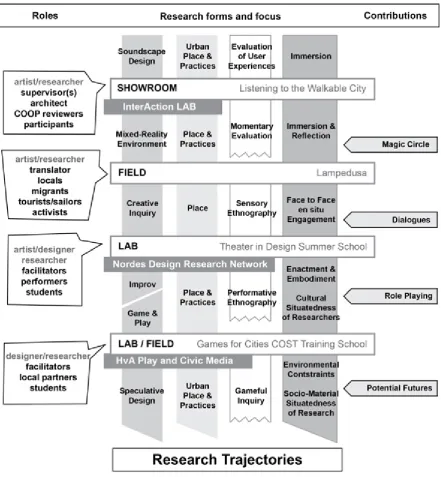
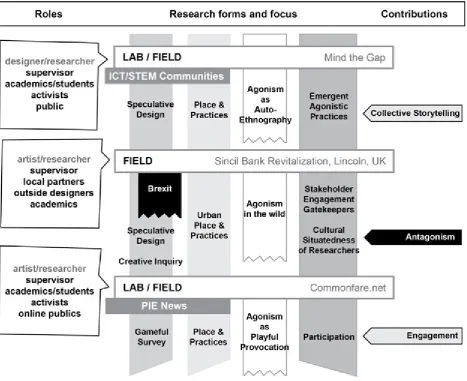
To help clarify this, each stage of inquiry is introduced with a diagram (Figure 6.1), categorized by the three CDR contexts of Lab, Field and Showroom and visualized as in (Koskinen, et al., 2011), noting the roles played by myself and other participants, the research forms and focus and the contributions to the developing understanding of agonism and its instantiation through design. This interpretation of Lab, Field and Showroom does not expect that for a given design challenge, investigations must be undertaken in each of the three contexts. Rather these contexts are taken as general framings of the research, constructions and situations to aid in analysis.
Figure 6.1: CDR diagram
Reporting begins at the start of the PhD undertaking when my established media arts practice of
Figure 6.2 Constructive Design Research Trajectories
The following diagram describes the four research trajectories (Figure 6.2).
environments.
Figure 6.3 outlines the first investigation that was based on soundscape design. My role in this was as media artist, generating a unique place of a Mixed-Reality Environment, and as researcher, initially explori