Through Rubrics and
Scaffolded Instruction:
A Programmatic Self-Study of
Writing Expectations
Cynthia A. Lassonde
State University of New York College at Oneonta
Alison Black
State Universityof New York College at Oneonta
Jane Miller
State University of New York College at Oneonta
Hanfu Mi
State University of New York College at Oneonta
Abstract
Colleagues in a teacher education program describe their journey of programmatic self-study as they examine how they teach and assess teacher candidates’ writing in a series of three required and sequenced undergraduate literacy courses. They lead the reader through the questions they asked themselves about their instruction and their reflective process with a goal of improving teacher candidates’ technical, reflective, and creative writing. Readers are encouraged to reflect on their expectations for teacher candidates’ writing in light of instruction and assessment. Implications for teacher education are explored.
Keywords: writing, assessment, teacher education, rubrics, teacher candidates, teaching expectations
Cindy Lassonde is an associate professor in the Elementary Education and Reading Department at the State University of New York College at Oneonta. Her research interests include collaboration, teacher research, and writing pedagogy. Email:[email protected]
Alison Black is an associate professor in the Division of Education at the State University of New York College at Oneonta. Her research interests include children’s writing, the creative arts, and issues of teacher education. Email: [email protected]
Jane Miller is a lecturer in the Elementary Education and Reading Department of the Division of Education at the State University of New York College at Oneonta. Her areas of research include the development of writing skills of children and teacher candidates. Email: [email protected]
Hanfu Mi is an associate professor in the Faculty of Education at the State University of New York College at Oneonta. His areas of research include language acquisition and vocabulary development with an emphasis on socio-cultural perspectives. Email: [email protected]
C. A. Lassonde, A. Black, J. Miller, and M. Hanfu Rubrics and Scaffolded Instruction
30 Students learn to write when we surround them with examples and models….
(Bromley, 2003, p. 144)
What better model is there for a student learning to write but a teacher who is a confident and competent writer? Aren’t all teachers writing teachers, regardless of the grade level or content area they teach? This was the premise with which we—four literacy faculty from a teacher education college in mid-state New York—began the programmatic self-study presented in this paper.
For years we have been concerned about our undergraduate teacher candidates’
preparedness to go out into schools as competent and confident writers. We had been integrating writing instruction into our literacy courses in implicit and explicit ways, such as the classroom methods we modeled and taught, our expectations for written assignments, direct instruction of problematic skills, and the introduction of writing best practices. We strongly believed that all teachers should surround their students with exemplary writing models as Bromley (2003) prescribes and should express content and ideas effectively to families and colleagues. How effective were we in helping our graduates achieve this objective? Although assessment was already integrated within each instructor’s course, we wanted to confirm our assumptions of effectiveness of our teaching. It seemed a systematic and organized study of how we were attempting to facilitate teacher candidates’ achievement of effective writing skills was in order.
Setting out to follow a cohort of teacher candidates as they moved through a series of three sequenced literacy courses required for our childhood education programs, we wanted to study how our teacher candidates develop as writers as a result of participation in three required, sequenced, writing-intensive undergraduate literacy courses. As we collected and analyzed our data, our work together turned into a dynamic interchange and meshing of philosophies and ideas that have resulted in changes in our literacy courses and program. We found that as we studied teacher candidates’ learning in our classes, both our instruction and expectations came into the spotlight. This paper shares the story of what we discovered while in that spotlight and the ensuing journey we took. This article does not share the findings of our study of teacher candidates’ development as writers. Instead, we plan to outline and reflect upon the strategies and tools our group developed while we engaged in the research process and examined our instruction and expectations under the spotlight. Our work together developed into a collaborative programmatic self-study that asked
How do we as instructors shape our courses and program to influence the development of writing of our teacher candidates?
We are pleased to share our journey’s story with what we believe are valuable resources for other educators to use to analyze their instruction of writing with their students. We believe educators who assign written tasks with the intent of improving students’ writing will benefit from the ideas presented in this article. While our work is with teacher candidates, we see this journey’s story as relating to any classroom that teaches writing, from elementary and high-school classrooms to adult learning and the teaching of English to speakers of other languages. Sharing our research and self-study process may guide diverse groups of educators as they think about
• Their expectations for candidates’ writing. (With what writing skills and attitudes do they
C. A. Lassonde, A. Black, J. Miller, and M. Hanfu Rubrics and Scaffolded Instruction
31
• How they model, scaffold, and teach writing in their courses. (Do they teach writing or
merely assign writing tasks? Which do they need to do to meet candidates’ needs?)
• How they assess writing tasks and determine writing development.
To begin, first let us explain the theory and current literature that support and shape our philosophy of teaching writing and, therefore, our work.
Theoretical Background
Our work draws from classic perspectives of writing as social and personal and from current literature on writing pedagogy. We view writing as a social process (Vygotsky, 1978). It is a way to communicate cultural understandings. In interactive classrooms, such as when children are engaged in writing workshop, teachers are part of the social environment. They model and coach writing attitudes and skills for students through their social interactions as they respond to students’ writing, share ideas and resources, and exchange writing successes and frustrations. When teachers model and participate in the writing process with students, they demonstrate personal and authentic engagement and immersion that result in students’ learning skills and developing personal perceptions of writing (Cambourne, 1988; Graves, 1983). Therefore, we propose, it is important for writing teachers—including teacher educators—to demonstrate, model, and coach authentic, productive, and positive attitudes about and skills in writing.
We also see writing as a cognitive process (Sperling & Freedman, 2001) in that students can learn to be better writers through instruction and practice. We expected our teacher
candidates to learn from our modeling and direct instruction of writing. In addition, we expected them to take on the discourse of literacy—the constructs, the vocabulary, the voice—as a way of growing in their understanding of literacy through writing (Flower, 1994).
Our study also draws from Elbow and Belanoff’s (2003) view of genre. They see genre as a way of helping writers create content. While others may see the structures and characteristics of writing genres as constricting and restraining, Elbow and Belanoff say these structures and characteristics help writers expand their thinking and look at a topic in new and interesting ways. The reader might relate this to the mirrors in the fun house at a carnival. When you stand in front of various mirrors, you look different. Your head might be expanded in one mirror while your stomach is in another. Writing about the same topic using different genres helps the writer think about the topic in ways that meet the structural needs and characteristics of a particular genre. By introducing multiple writing genres in our program, we intend to stretch and expand—like the mirrors in a fun house—our teacher candidates’ thinking as they learn content.
Furthermore, we believe that critical reading emphasizes skill-based tasks such as distinguishing fact from opinion and recognizing propaganda in texts. At an advanced level, critical reading becomes a part of critical literacy (Cervetti, Damico, & Pardeles, 2001). The reciprocity of critical reading and writing occurs when individuals work cooperatively to apply metacognitive strategies to create meaning of text through reading and writing (Stevens & Bean, 2007).
C. A. Lassonde, A. Black, J. Miller, and M. Hanfu Rubrics and Scaffolded Instruction
32 Our work is grounded by Ivanic’s (1998) ideas on writing identities. Through writing, individuals develop writing identities that fit the academic community in which each
participates. In our literacy courses, we believe teacher candidates work toward bridging the gap from thinking and writing like students to thinking and writing like teachers.
Finally, this work is a result of a programmatic self-study in the field of teacher education. This paper represents a collaborative, systematic study of our work together, our expectations for teacher candidates’ writing, and our evaluation of writing. Underlying the various forms of self-study in teacher education is the “analysis of one’s own practice with all the attendant challenges and celebrations associated with such scrutiny” (Clarke & Erickson, 2007, p. 55). One of the prominent outcomes of self-study tends to be “teacher knowing” or “learning that is in a state of evolution” (p. 55). We propose that our analyses have added to our teacher knowing and this knowing has shaped and defined our practices as a result.
The Literacy Sequence
The Elementary Education and Reading Department offers a program in Childhood Education, which leads to teacher certification to teach grades 1 through 6. The program requires candidates complete a 30-hour concentration in one area consistent with the New York State Learning Standards. Concentrations include Biology, Chemistry, Computer Science and Technology, Earth Science, English, French, Spanish, General Science, Geography, Liberal Arts and Science, Mathematics, Political Science, and Social Studies. SUNY College at Oneonta’s education programs are accredited by the National Council for Accreditation of Teacher Education and approved by the New York State Regents and the New York State Education Department.
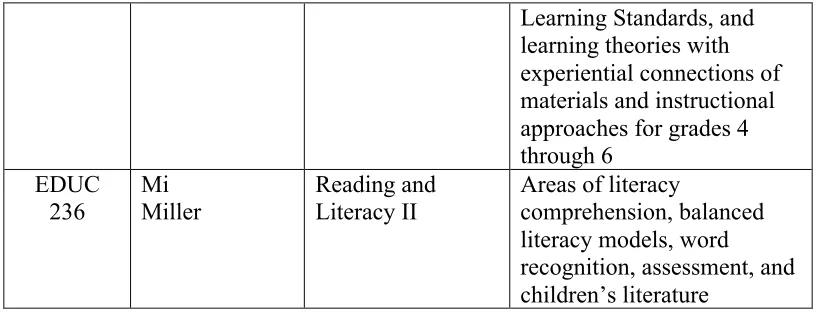
Teacher candidates studying in the Childhood Education program take the first in the series of three required literacy courses, EDUC 284 Development of Language and Literacy, as undergraduates in their sophomore or junior year. The second course, EDUC 235 Reading and Literacy I, is taken the semester after EDUC 284. The third course, EDUC 236 Reading and Literacy II, is usually taken the semester after EDUC 235, which is typically the semester before they student teach. The courses cover major reading and literacy theories and practices in
teaching and learning. Figure 1 describes each course’s focus.
Course
Number Instructor(s) Course Title Course Focus
EDUC
284 Lassonde The Development of Language and
Literacy
Language acquisition
theories, linguistic diversity, the impact of home
environment on language acquisition, and the stages of oral and written language development; experiential connections of materials and instructional approaches for birth through grade 3 EDUC
235
Black Miller
Reading and Literacy I
C. A. Lassonde, A. Black, J. Miller, and M. Hanfu Rubrics and Scaffolded Instruction
33 Learning Standards, and
learning theories with experiential connections of materials and instructional approaches for grades 4 through 6
EDUC
236 Mi Miller Reading and Literacy II Areas of literacy comprehension, balanced
literacy models, word recognition, assessment, and children’s literature
Figure 1. These are the three required literacy courses in the Childhood Education Program.
Who Are Our Teacher Candidates as Writers?
Most of our candidates are from New York State. The majority come from either the Long Island/New York City area or the local area. Our teacher candidates’ writing proficiency has been established by these achievements:
• They come to the first course (EDUC 284) having already satisfactorily passed the New
York State English Language Arts Regents’ Examination in high school.
• They have passed the college’s required Writing Examination.
• They have already completed Composition 100 and Education 106 Issues in Education,
which are designated in the program as writing-intensive courses.
• They have also successfully completed a number of other general education courses and
courses within their concentrations in which they were expected to complete assignments requiring them to write in a variety of genres.
Those with a concentration in English have completed several extra courses focusing on English language usage. One to two percent of our candidates come to us with academic
accommodations. We are unable to determine without further study how these candidates’ accommodations (i.e., extended time to complete tests, the use of a notetaker in class, and alternative testing location) may influence their writing performance in our courses.
What Are Our Writing Expectations?
After much discussion, we decided our graduates should be confident writers in three areas:
1. Technical writing—writing professional reports such as a case study and lesson plans,
letter to a child’s family or classroom teacher.
2. Reflective writing—writing that provides evidence of their ability to think
metacognitively about their profession and teaching that would develop a deeply conceptual understanding and also provide a basis for making more informed instructional decisions.
3. Creative writing—writing poems and stories to share with and model for students.
C. A. Lassonde, A. Black, J. Miller, and M. Hanfu Rubrics and Scaffolded Instruction
34 candidates should be capable of writing on-demand works, which are those created in front of or interactively with students, as strategies and expectations are modeled. Also, we expect
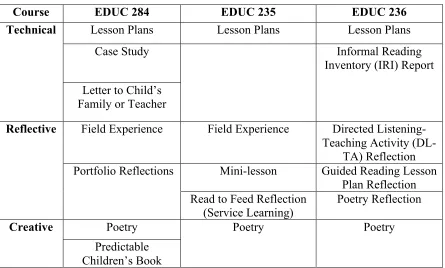
candidates should be able to write prepared works that include time for process writing before being shared. Therefore, writing tasks across courses include creation of both types of works. In this study, we did not look at the ability to effectively respond in writing to students’ work. Although we know that this is also an important writing skill for teachers, this sequence of literacy courses does not include these opportunities in its curricula. Our teacher candidates perform a variety of writing tasks in the three literacy courses (Figure 2).
Course EDUC 284 EDUC 235 EDUC 236
Lesson Plans Lesson Plans Lesson Plans
Case Study
Technical
Letter to Child’s Family or Teacher
Informal Reading Inventory (IRI) Report
Field Experience Field Experience Directed
Listening-Teaching Activity (DL-TA) Reflection
Mini-lesson Guided Reading Lesson
Plan Reflection
Reflective
Portfolio Reflections
Read to Feed Reflection
(Service Learning) Poetry Reflection
Poetry
Creative
Predictable Children’s Book
Poetry Poetry
Figure 2. These are the technical, reflective, and creative writing tasks assigned to candidates in each of the three required literacy courses in our program.
How Do We Communicate Our Expectations?
We generated the following list of ways we attempt to communicate our expectations for
candidates’ writing. The items are supported by our beliefs that when learners are surrounded by positive writing models and attitudes about writing and are taught through modeling and direct instruction, they will learn to write and take on the discourse of literacy (Bromley, 2003; Sperling & Freedman, 2001).
1. We affirm that candidates are capable of achieving their goals and our expectations.
Positive reinforcement is grounded in personal relationships in which instructors communicate these principles to candidates: Writing is important; I know you can do it; I won't give up on you.
2. We structure and organize learning in ways that communicate that we value the
C. A. Lassonde, A. Black, J. Miller, and M. Hanfu Rubrics and Scaffolded Instruction
35
3. We use several approaches to assess writing, including authentic assessments that
promote reflection, critical inquiry, and problem-solving, and assessments that validate different intelligences, strengths, and learning styles (Smith, 2005; Totten, 2005; Vygotsky, 1978).
4. We motivate candidates and instill within them a responsibility for improving their
writing. We engage candidates in a variety of writing activities that connect to their interests, strengths, and real-world activities. Candidates are expected to participate actively and make decisions in the daily life of the classroom to build responsibility and ownership for learning (Ivanic, 1998; Vygotsky, 1978). For example, we discuss, What kind of teacher would you want to teach your child? Would you want someone who was a competent writer or someone who just got by?
5. We consider the wording in our syllabi and assignments. We attempt to be specific
and clear, and provide opportunities for candidates to ask questions in and outside of class.
6. We break extensive writing assignments, such as the field experience case study,
down into components with separate deadlines and discuss with the candidates the expectations for each component.
7. Writing samples, checklists, and rubrics (see Appendices A, B, and C) are provided
ahead of time when possible and appropriate, so candidates have a clear
understanding of our expectations (Banta, 2008; Cervetti, Damico, & Pardeles, 2001; Moriarty & Garrett, 2008; Stevens & Bean, 2007). These are analyzed with
candidates.
8. Goals for each week are provided, discussed, and set with candidates when possible.
Providing Threads of Consistency
With these points on the table, we then decided we wanted to provide threads of consistency in our expectations that wove the three courses together for the candidates in a very concrete and visible way. Through a forum of dialogue and reflection (Clarke & Erickson, 2007), we created three writing rubrics: technical, reflective, and creative writing (see Appendices A, B, and C). These allowed us to see evidence of growth and skills as candidates progressed through the courses.
To begin, we discussed what components we valued most for our candidates as technical, reflective, and creative writers. We drew from the genre work of Elbow and Belanoff (2003). We based our decisions on our familiarity with the International Reading Association’s standards and the New York State English Language Arts standards for teaching and learning.
Technical Writers. We said that, as technical writers, candidates should be able to
• Use professional language
• Portray an unbiased objectivity and sensitivity to content
• Write for a purpose to a particular audience
• Follow certain specific formats
• Be concise and clear; and
C. A. Lassonde, A. Black, J. Miller, and M. Hanfu Rubrics and Scaffolded Instruction
36 Reflective Writers. In creating a rubric for reflective writing, we first considered the specific components of this type of writing used in the classroom. They include the following:
• Maintaining a strong “I” voice when responding (text to self);
• Using metacognitive understanding;
• Demonstrating analysis, synthesis, and evaluation; and
• Basing insight upon course content and real world experience (text to text, text to world).
Creative Writers. As creative writers we wanted our candidates to
• Use sensory images,
• Provide focus and continuity within each piece,
• Consider word choices and uses of language,
• Use the expected form or structure when appropriate (i.e., haikus and other forms of
poetry);
• Demonstrate creativity.
And, of course, for all writing, we highly valued strong skills with mechanics and spelling.
Drafting the Three Rubrics
As a result of our dialogue about our expectations for technical, reflective, and creative writing, we drafted three writing rubrics. Initially, we drafted the rubrics separately using the bulleted expectations we had generated so we would have time to think about how to construct the categories and the rubrics themselves. We also researched similar writing rubrics online, such as those found at www.rubistar.com. Next, we used the rubrics with sets of teacher candidates’ writing to give the rubrics a test run. We used the rubrics to score each genre of writing. After individually scoring, we shared comments as we critically reviewed what we were learning from the application of the rubrics. We discussed the effectiveness of each rubric on various genres within our three categories. For example, we asked, Was the technical writing rubric equally useful for assessing a case study as it was a lesson plan? We also talked about the uses of
specific language in each category. What was, for instance, the difference between using or, and, and and/or in our wording and how measurable and consistently interpreted were phrases such as extensive use, clearly recognizable, and readily comprehensible?
Field Testing the Rubrics
C. A. Lassonde, A. Black, J. Miller, and M. Hanfu Rubrics and Scaffolded Instruction
37
How Do We Model, Scaffold, and Teach Writing?
After the rubrics were developed, tested, and finalized, we realized that while they would work as threads to weave the writing expectations together for the three courses and they would be assessing similar writing genres, each course and instructor provided varying levels of assistance and support for writing within their courses. For example, in EDUC 284 (the first course), Lassonde introduced lesson planning and provided candidates with opportunities to write lesson objectives in class, discuss them with their peers, and refer to models of objectives from past semesters. However, because candidates were expected to have gained experience in writing lesson plans in EDUC 284, the instructors of EDUC 235, Black and Miller, provided less support in an effort to scaffold candidates’ learning and allow them to work toward independence. We decided to analyze how we were scaffolding tasks from one course to another.
Determining Scaffolding of Writing Skills
We devised a chart that allowed us to visualize our thoughts. We developed three levels of scaffolding and agreed upon the following degrees of support that should be available at each level. Here are the levels.
Scaffold Level 1—Resource only
Scaffold Level 2—Resource and support from instructor
Scaffold Level 3—Resource, support from instructor, modeling by peer or instructor, and social interaction among peers
The resource might be text such as an article or a website that provided instructions or a model. Support from instructor could be class or online support including reviewing drafts and
providing feedback online. Modeling would be interactive writing or some type of
demonstration. Social interaction among peers would include writing or computer workshop forums in which candidates wrote collaboratively or brought in drafts to share and discuss.
Generally, we saw Level 3 as needed most when candidates were introduced to a new genre. Levels 2 and 1 helped the candidates move toward independence. There were tasks that we could expect candidates to perform at the next level of scaffolding because they were familiar with the general writing genre such as writing a business or professional letter. The genre was so familiar that we expected candidates could plug in the content with less scaffolding support than less familiar genres.
Scaffolding of Genre Work
Next, we determined that we needed to analyze the scaffolding levels we used across the courses for our writing assignments. Below are the courses, assignments, and scaffolding level
represented by SL-1, 2, or 3. SL stands for scaffolding level. EDUC 284
Technical: read-aloud lesson plan (pretest)
emergent guided reading lesson plan (SL-3) case study (SL-3)
letter to child’s family or teacher (SL-2) Reflective: field experience reflection (SL-3)
C. A. Lassonde, A. Black, J. Miller, and M. Hanfu Rubrics and Scaffolded Instruction
38 Creative: children’s poetry (SL-2)
predictable children’s book (SL-3) EDUC 235
Technical: phonics lesson plan (grade 1; review of phonics concepts and lesson planning) (SL-3)
read-aloud lesson plan (4-6 level) (SL-3) Reflective: field experience reflection (SL-2)
Creative: poem for two voices (SL-2) EDUC 236
Technical: DL-TA lesson plan (SL-2)
guided reading lesson plan (both primary and intermediate) (SL- 2);
IRI report (SL-3)
Reflective: DL-TA reflection (SL-1)
guided reading lesson plan reflection (SL-1) poetry reflection (SL-1)
Creative: poetry (biopoem) (SL-3)
The process of creating these scaffolding levels and plugging in our assignments across the course sequence opened spaces for us to re-evaluate our expectations. Our awareness of each others’ expectations for candidates was heightened, and we became acutely aware of candidates’ needs and the implications for our instruction. It was a revealing way to look at learning and instruction. We realized, for example, that it wasn’t as simple as saying all tasks in the first course should be at SL-3; all in the second course should be SL-2; and all in the final course should be SL-1 leading candidates’ toward independence. There were factors that justified candidates’ need to discuss their writing or to use a model.
The conversations we had explaining our rationale provided valuable insight. They led to discussions about how each of us taught writing in our classes. We were already keenly aware of each others’ teaching styles and curriculum based on several years of working together. Through the years, we had worked together to hone the scope and sequence of our three courses, and we had shared the responsibility of developing candidates who were skilled and knowledgeable about students’ literacy needs. We respected each others’ work and talents. Therefore, when new, effective ideas and approaches were described, we carefully listened to each other and considered updating applications to our own courses. We noticed that as we shared the strategies we used, the strategies informed our practices. We began to blend our ideas.
Teaching Technical Writing
Learning to write reports, letters to family members, lesson plans, and other technical products for which a teacher is responsible is a complex process. Teacher candidates are not only trying out professional language and vocabulary and incorporating unfamiliar concepts, they are experiencing genres of writing—some unique to education—that they have never had to master previously (Elbow & Belanoff, 2003). Due to the complexity of the task and our high
C. A. Lassonde, A. Black, J. Miller, and M. Hanfu Rubrics and Scaffolded Instruction
39 One of the ways we do this is by providing writing workshop time during class in which candidates write, share, and discuss writing pieces. As they write, they interact. Writing becomes part of an intricate social process as they critically read and apply metacognitive strategies to create meaning in the text they are writing (Cervetti, Damico, & Pardeles, 2001; Vygotsky, 1978). Some of these workshop times take place in the computer laboratory on campus so
candidates can access helpful resources on the Internet to assist them in their writing. We discuss language use and appropriate voice and style. They are taught how to avoid the reflection of the deficit model in their writing by replacing phrases like has trouble with and the child cannot with is progressing in his ability to, is working on, and should work next on.
Another method we use to support candidates’ development as technical writers is through the use of writing frames. Within the use of best practices, writing frames are frequently used at the elementary level to provide support for developing writers. Frames may be used to model—to name a few examples—sentence structure and syntax, paragraph construction, story sequence, and even the format for a particular genre. Following is an example of a simple paragraph frame.
My favorite animals are ____________________________. I like them because _______________________. They live in _______________________ and eat _______________________.
Can advanced writing frames be valuable in helping teacher candidates learn to write technical genres professionally? Teachers are expected to produce reports and lesson plans as part of the responsibility and expectations of their position. Therefore, teacher candidates need experience in using the appropriate language, voice, and format for the genre. They also need practice and instruction in effective ways to support evaluative remarks with evidence in their use of technical writing. We also provide writing frames that explicitly outline the structure and content of a particular genre, such as a case study or a lesson plan. See Figure 3 for an excerpt. We see the use of writing frames as supported by Elbow and Belanoff’s (2003) view of genre as a way to help writers create and shape content. In the case study assignment, for instance, we have found that providing the overall structure of the report through the headings and subheadings helps our candidates categorize the assessments and lessons they do in the field with a kindergarten
student. The headings help the candidates visualize the components of literacy within the context of their field experience. This ability to visualize the components of literacy pushes them to think about precisely what they have observed in the field.
(child’s first name)’s Reading Development
(Write an introductory paragraph here. Go to pages 50-51 of the ELP. Highlight the behaviors you observed in each of the four developmental stages and each of the three categories.
Generally, which stage has the most bullets highlighted? Write about this here. Explain why you have chosen this stage. Mention also if some bullets in other stages were highlighted. This is common.)
Characteristics of Texts That Are Appropriate for (child’s first name)
C. A. Lassonde, A. Black, J. Miller, and M. Hanfu Rubrics and Scaffolded Instruction
40 he/she can read independently, and what type the child would be frustrated with. Also, what type would the child understand if read to him/her? Then specifically tell how you observed this. Was it while you were reading I Went Walking with the child, while you were doing guided
reading…? Back up whatever you say with a specific observation or response of the child’s. Include the stages from the scale.)
Reading Strategies (child’s first name) Demonstrates
(As you write this section, use the language in this scale to describe explicitly what the child’s strengths and needs in this area are….
Figure 3. This is an excerpt from the case study writing frame.
Teaching Reflective Writing
For teachers to become education professionals committed to excellence, they need to be reflective practitioners. Embedded within the Conceptual Framework of our Division of Education, reflection enhances understanding of content as well as instruction. It provides a forum for teacher candidates to go beyond description and consider how and why: “this is what I did; this is what occurred; therefore, why was it successful or not and how can I improve it or not?” The reflective process requires a critical analysis of what was done during instruction.
This component of critical thinking needs scaffolding for teacher candidates to look beyond a description of what happened (Cervetti, Damico, & Pardeles, 2001). We provide this scaffolding through modeling, thinking aloud, handouts providing directions, and discussion. Our expectations for reflection are made clear in the specific questions we ask teacher candidates to address. An example would be
How did the peer feedback in class from your read aloud of the book we were reading during Literature Circle influence your preparation for and reading to students?
The explanation and modeling of reflection is essential, and providing relevance and allowing teacher candidates to participate or have first-hand experience helps to develop their reflective capabilities.
Teaching Creative Writing
According to Bruner (1962), a creative act is one that “produces effective surprise…that strikes with wonder or astonishment.” Therefore, creative writing should address
• Vivid sensory images that writers paint so that readers can see in their mind’s eye, • A clear focus expressed through either one perspective or multiple perspectives, • Wordplay with verbal contortions, surprising juxtapositions, great puns, etc.,
• Structure through which writers can see patterns and find order in their thoughts, and
• Original and imaginative thoughts that value the writers’ identities.
C. A. Lassonde, A. Black, J. Miller, and M. Hanfu Rubrics and Scaffolded Instruction
41
Our Findings from the Self-Study
This programmatic self-study developed as a branch of our original study of candidates’ writing development. Writing this article helped us to formalize our thoughts through reflection and revision. In many ways Ivanic’s (1998) theory of creating identities through writing came true for us. Our writing became a tool to help us clarify our thoughts about writing and our academic community and who we were as writing teachers. In the following sections, we share our final thoughts based on our discussions, the creation of the three rubrics, our collaborative sharing and blending of strategies and expectations, and our reflections of how to best develop and assess our candidates’ writing.
How Do We Assess Writing Tasks?
Prior to our study of teacher candidates’ writing, we each assessed writing in different ways. There was little continuity in expectations; therefore, there was little consistency and
predictability for the teacher candidates. When they moved from course to course, they voiced their confusion with the discrepancies among instructors’ expectations.
With the development of our writing rubrics, that has changed. In the first literacy course, candidates are introduced to the three rubrics: Technical Writing (Appendix A), Reflective Practice (Appendix B), and Creative Writing (Appendix C). Candidates review the language, categories, and concepts each semester. Instructors have the option of inserting task-specific language into each rubric to tailor it to each course’s syllabus. For example, in EDUC 284, Dr. Lassonde inserts language in the technical writing rubric to ensure candidates include specific information within their case study report on the literacy assessments used in their field experience. The rubrics have become not just a tool for assessment but a guide to facilitate candidates’ writing as proposed by Banta (2008) and Moriarity and Garrett (2008). They experience the characteristics of and learn to format a particular genre through the rubrics’ criteria (Elbow & Belanoff, 2003).
How Do We Determine Writing Development?
As we continue to study candidates’ writing and our instruction, we plan to research how candidates’ writing develops in our three literacy courses. We are currently collecting data from a cohort of candidates who have already taken the first two courses and are enrolled in their final literacy course at our college. We plan to be able to report findings about the candidates’
attitudes and skills in writing as a result of our scaffolding and instruction.
Implications
C. A. Lassonde, A. Black, J. Miller, and M. Hanfu Rubrics and Scaffolded Instruction
42 To promote writing growth, teacher educators should model writing; provide experiences and opportunities for teacher candidates to develop positive attitudes about and competent skills in writing; discuss the importance of metacognition; and share their own writing processes, frustrations, and accomplishments. In our courses, we often describe how we would approach a particular writing assignment, share texts we are writing ourselves, and continually reiterate the professional importance of developing as competent and confident writers and writing teachers. Reflecting upon their own writing instruction, teacher educators should consider how they foster teacher candidates’ development as writers in their courses, what layered expectations their writing assignments carry, and how they may effectively and explicitly teach writing genres as “a way to generate or invent content” (Elbow & Belanoff, 2003, p. 73).
Programmatic Recommendations
Our work thus far implies that self-study can fuel advocacy for programmatic concerns. When we were each busy going about fulfilling our daily obligations and responsibilities, we often voiced our concerns about candidates’ writing. However, this focused systematic study and reflection caused us to discuss in detail exactly what our concerns were. And, our work provided evidence that we eventually took to our Department Chair and Associate Dean. As a result, the Division of Education is taking a close look at the development of candidates’ writing skills and attitudes and how we teach writing across all courses.
We obviously found this process very productive and rewarding. We highly recommend all teacher education programs examine their literacy objectives and determine how effectively they are meeting candidates’ writing needs. Often as instructors we take for granted the work we do and the work our candidates do. We recommend program reviewers examine the bulleted list provided at the very beginning of this article. That is, we recommend they examine
• Their expectations for candidates’ writing;
• How they model, scaffold, and teach writing in their courses; and
• How they assess writing tasks and determine writing development.
Based on our experiences, we suggest action: Set into motion a systematic, programmatic self-study as we did. Make the time to have collegial conversations with each other to analyze candidates’ writing skills and needs, take ownership in your courses, and set specific goals for writing within each of your assignments. Get to know what your colleagues are doing in their classrooms to meet candidates’ writing needs and consider ways to scaffold writing within the program. In two words: Teach writing.
Instructional Recommendations
C. A. Lassonde, A. Black, J. Miller, and M. Hanfu Rubrics and Scaffolded Instruction
43 faculty is vital. This may be accomplished through regular meetings, email, and even office proximity.
In many ways the relationships we have established with each other in our collaborative literacy group are the core of our work together. We each feel confident in sharing our triumphs and our challenges. When we are unsure of ourselves or perhaps the way we are presenting a certain concept, we talk openly about our concerns. We rely on each others’ expert and varied experiences to enrich and clarify our own foundations. We share not only our expertise we also share our vulnerabilities. Therefore, our final recommendation is that the reader find such a cohesive group of colleagues with whom to work. Seek out comrades within your faculty with whom you feel safe and grow with them. Your work together “is likely to promote rich
C. A. Lassonde, A. Black, J. Miller, and M. Hanfu Rubrics and Scaffolded Instruction
44
References
Banta, T. W. (2008). Sadly, rubrics are not for everyone. Assessment Update, 20(4), p. 3.
Bromley, K. (2003). Building a sound writing program. In L. M. Morrow, L. B. Gambrell, & M.
Pressley (Eds.). Best Practices in Literacy Instruction (2nd ed.). New York: Guilford
Press.
Bruner, J. (1962). On knowing. Cambridge, Mass.: Harvard University Press. Cambourne, B. (1988). The whole story: Natural learning and the acquisition of literacy in the
classroom. Auckland, NZ: Scholastic.
Cervetti, G., Damico, J. S., & Pardeles, M. J. (2001). A tale of differences: Comparing the traditions, perspectives, and educational goals of critical reading and critical literacy. Reading Online. Retrieved March 1, 2009, from www.readingonline.org.
Clarke, A., & Erickson, G. (2007). The nature of teaching and learning in self-study. In J. J. Loughran, M. L. Hamilton, V. K. LaBoskey, & T. Russell (Eds.), International
Handbook of Self-Study of Teaching and Teacher Education Practices (pp. 41-67), The Netherlands: Springer.
Dowdy, J. K. (2008). From poems to video script. Excelsior, 3(2), 61-76.
Elbow, P., & Belanoff, P. (2003). Being a writer: A community of writers revisited. Boston: McGraw-Hill.
Flower, L. S. (1994). The construction of negotiated meaning: A social cognitive theory of writing. Carbondale, IL: Southern Illinois University Press.
Graves, D. (1983). Writing: Teacher and children at work. Portsmouth, NH: Heinemann.
Ivanic, R. (1998). Writing and identity: The discoursal construction of identity in academic writing. Amsterdam: John Benjamins Publishing Company.
Moriarty, L. J., & Garrett, J. J. (2008). Criminal justice assessment: Staying ahead of the bullet. Criminal Justice Studies, 21(3), 217-222.
Smith, M. A. (2005). Are you ready for college writing? The Voice, 10(3). Retrieved 2/10/09. Available online at http://www.nwp.org/cs/public/print/resource/2254.
Sperling, M., & Freedman, S. W. (2001). Research on writing. In V. Richardson (Ed.). Handbook of research on teaching (4th ed.). (pp. 370-389). Washington, DC: American Educational Research Association.
C. A. Lassonde, A. Black, J. Miller, and M. Hanfu Rubrics and Scaffolded Instruction
45 Totten, S. (2005). Writing to learn for preservice teachers. The Quarterly, 27(2). Retrieved
2/10/09. Available online at http://www.nwp.org/cs/public/ print/resource/2231.
C. A. Lassonde, A. Black, J. Miller, and M. Hanfu Rubrics and Scaffolded Instruction
46 Appendix A
Rubric for Technical Writing
CATEGORY (4) (3) (2) (1)
Organization Structure establishes relationship between/among ideas/events. Organization is a logical progression of ideas/events and is unified and complete.
Structure establishes relationships between ideas/events, although minor lapses may be present. There is a logical progression of ideas/events and is reasonably complete, although minor lapses may be present.
Structure establishes some relationship between/among some of the ideas/events. The structure is minimally complete. One or more major lapses in the logical progression of ideas/events are evident.
Structure does not establish connection between/among ideas/events. The overall structure is incomplete or confusing. Ideas/events are presented in a random fashion.
Voice Consistently
demonstrates sensitivity to readers’ point of view; consistent use of professional tone/authority.
Usually demonstrates sensitivity to readers’ point of view and uses a professional tone/authority.
Demonstrates minimal sensitivity to readers' point of view and needs and sometimes uses a professional tone/authority.
Lacks sensitivity to readers' point of view, lacks professional tone and authoritative stance, or expresses a deficit model of learning.
Elaboration
(as appropriate for piece and genre)
Elaboration consists of specific, developed details that show highly developed understanding of literacy theory and practice.
Elaboration consists of some specific details that show well developed understanding of literacy theory and practice.
Elaboration consists of general and/or undeveloped details, which may be presented in a list-like fashion. Shows some evidence of understanding of literacy theory and practice.
Elaboration is sparse; almost no details. Shows little understanding or misunderstanding of literacy theory and practice. Level of Discourse Demonstrates writer can synthesize language & vocabulary learned; creates with the language of a teacher; uses variety of vocabulary and expressions.
Demonstrates some creative use of teacher language; may include some repetition of vocabulary and expressions.
Repeats vocabulary and language of teacher; repeats memorized utterances.
Doesn't use language of teaching or uses it inaccurately.
Composition Readily
comprehendible; clear; flows; provides support for ideas.
Reader has to pause or reread to understand text; ideas flow; some support.
Text requires interpretation on part of reader; mostly comprehendible; lacks support.
C. A. Lassonde, A. Black, J. Miller, and M. Hanfu Rubrics and Scaffolded Instruction
47 Appendix B
Rubric for Reflective Writing
CATEGORY (4) (3) (2) (1) Personal
Response
(Text to self)
Conveys extensive evidence of personal response to issues raised
Use of Strong “I” voice Conveys evidence of personal response to issues raised
Use of “I voice” Conveys some evidence of personal response to issues raised Weak “I” voice Conveys little evidence of personal response to issues raised
No “I” voice
Personal Growth and Metacognition Demonstrates personal growth with metacognitive understanding of information supported with explicit examples Demonstrates beginning of personal growth with some metacognitive understanding of information with examples
Some personal growth but little metacog- nitive under-standing of information with or without examples
No sense of personal growth and/or no meta-cognitive understanding of information with or without examples
Critical Analysis
Strong ability to question and consider other perspectives Ability to question and consider other perspectives Weak ability to question and consider other perspectives
No ability to question or consider other perspectives
Connections
(Text to text, text to world)
Is able to explicitly relate what is heard and read to course content and real world and demonstrates insight
Is able to relate what is heard and read to course content and/or real world and demonstrates some insight Describes what is heard and read and/or demonstrates some insight
Makes minimal or no reference to what is heard and read with lack of insight
Comprehension Clearly and logically expresses arguments, opinions and responses All required elements are complete Clearly and/or logically expresses arguments, opinions and responses Most required elements are complete Learning to clearly and logically express arguments, opinions and responses Few required elements are complete
Not able to clearly and logically express arguments, opinions and responses
C. A. Lassonde, A. Black, J. Miller, and M. Hanfu Rubrics and Scaffolded Instruction
48 Appendix C
Rubric for Creative Writing
CATEGORY (4) (3) (2) (1)
Sensory Images Vivid, detailed images and/or intensely felt emotion.
Clear use of sensory images to portray ideas or emotions.
Some use of image, idea, or emotion.
Difficult to visualize image or emotion.
Focus and Continuity
Well focused and interests reader throughout, strong continuity, and rhythm.
Focused and interests reader throughout with some continuity and rhythm.
Some focus, but lacks continuity.
Unfocused; author seems unsure of direction.
Word Choice/Use of Language
Precise, original, fresh words. Creates vivid images.
Appropriate choice of words/language. Experiments with new and different words with some success.
General or ordinary words. Attempts new words with limited success.
Imprecise or inappropriate word choice.
Form Structure Effective, logical, follows rules.
Logical and follows rules.
May follow some form rules.
Does not fit poetry form.
Creativity Effectively presented in an original manner which supports deliverance and interpretation.
Presented in an original manner which supports interpretation.
Minimally presented