Changing the direction of Nurse Education: The
development and implementation of the first
Non-commissioned BSc (Hons) Nursing (Adult)
programme in England.
January 2017
Doctor of Philosophy: Professional Practice.
(Retrospective)
Changing the direction of Nurse Education: The
development and implementation of the first
Non-commissioned BSc (Hons) Nursing (Adult)
programme in England.
Patricia Adele Houghton
January 2017
“Portfolio of evidence submitted in partial fulfilment of the requirements
of the University of Bolton for the Doctor of Philosophy Professional
Practice”
Statement of Ownership Declaration
“I declare that no part of this Thesis has been taken from existing published or unpublished material without due acknowledgement and that all secondary material used herein has been fully referenced.”
Signed:
Contents
Page
Statement of Ownership
3
Contents Page 4
List of Figures and Tables
6
Abbreviations / Definitions
7
Acknowledgements 9
Justification 10
Abstract 11
Contribution to Knowledge
13
Chapter 1 Introduction / Background to self and professional practice.
14
Chapter 2 Critical analysis and review of nurse education: History of policy and curriculum changes.
22
Chapter 3 An innovative model of nurse education – ‘The
Bolton Model’. 47
Chapter 4 Critical personal reflection. 75
Recommendations for the future
94
Statement of Collaboration
96
Appendices
Appendix 1 Willis (2015) Raising the Bar – Acknowledgement - page 60 for good practice in the Lord Willis Report.
Other bound document Appendix 2 Nursing media articles – Coverage of the first
Non-Commissioned nursing programme.
Appendix 3 Lancashire Teaching Hospitals NHS Trust - Quality Award Winner & The Academy of Fabulous Stuff Nomination.
Appendix 4 Conference papers & abstracts. Appendix 5 Department of Health testimony.
Appendix 6 Requests from other – Higher Education Institutes and National Health Service Trusts.
Appendix 7 Curriculum Vitae. Appendix 8 List of publications.
Appendix 9 Table 1 – Brief summary of the main influential policy documents on nurse education.
Appendix 10 Political, Economical, Socio-Cultural, Technological (PEST) Analysis.
Appendix 11 ‘The Bolton Model’ (Visual Overview) & USP: Difference to other nursing programmes.
Appendix 12 Minutes from meetings & agendas – Steering group. Appendix 13 Presentation at the curriculum development focus
groups.
Appendix 14 Notable Practice by the Nursing and Midwifery Council, RE: Patient as Coach Team (PaCT).
Appendix 15 Curriculum document.
Appendix 16 Recruitment and marketing research survey results. Appendix 17 Presentation to key stakeholders.
Appendix 18 Testimonies.
List of Figures & Tables
Figure Title Page
Figure 1 Kotter’s (1996) 8 step model. 53
Figure 2 Visual overview of ‘The Bolton Model’. 58 Figure 3 Transition Pedagogy – 3rd generation FYE policy
and practice.
61
Table 1 Brief summary of the main influential policy documents on nurse education.
Abbreviations / Definitions
AI Appreciative Inquiry
AR Action Research
BSc Bachelor of Science
CT Clinical Tutor
DH Department of Health
DHSS Department of Health and Social Security
ENB English National Board
FYE First Year Experience
HCC Health Care Commission
HEE Health Education England
HEI Higher Education Institute
LTHTR Lancashire Teaching Hospitals NHS Foundation Trust
MAD Making a Difference (curriculum)
MSLAP Multi-professional Support for Learning and Assessment in Practice
NHS National Health Service
NHS Trust A National Health Service Trust is an organisation within the English NHS generally serving either a geographical area or a specialised function (such as, an ambulance service). In any particular
location there may be several trusts involved in the different aspects of healthcare for the local
population.
NMC Nursing and Midwifery Council
PaCT Patient as Coach Team
PEF Practice Education Facilitator
PEST Political, Economical, Socio-Cultural, Technological
RCN Royal College of Nursing
SFE Student Finance England
SLAiP Standards to Support Learning and Assessment in Practice
UKCC United Kingdom Central Council
UoB University of Bolton
Acknowledgments
The author would like to take this opportunity to express sincere thanks to the following people without whom this thesis would have never materialised.
The PhD Supervisors, Professor Jerome Carson and Dr Duncan Cross for their invaluable knowledge, guidance, continuing support, patience, along with recognising and adapting to the author’s individual learning and writing style.
My colleague, Jane Howarth for her words of wisdom, motivation, enthusiasm and spurring me on during the development and implementation of the project. Most importantly for her continued support as she maintained the author’s sanity throughout the project, supplying both emotional and practical support.
The participants, for volunteering to take part and giving their time and commitment, because without them there would have been no thesis.
Justification
Abstract
This critical commentary sets out the background to, and implementation of “The Bolton Model.” The model was developed by the researcher. The future health service will be constantly challenged, requiring a workforce built around the actual needs of the population (Willis, 2015).The ability of the NHS to deliver world class compassionate care is dependent on the quality of training and education of the healthcare workforce (DH, 2015a). ‘The Bolton Model’ of nurse education was designed, developed and implemented, so that NHS Partner Trusts could ensure the future supply of nurses to care for their service users. This innovative nursing degree programme is the first nurse education programme that is not funded by NHS commissioning bodies and has been approved by the Nursing and Midwifery Council, and the University of Bolton.
“The Bolton Model” features in Willis’s 2015 report ‘Raising the bar ’as good practice, and has led, influenced, trail-blazed the national debate on non-commissioned nursing programmes in England changing the face of nurse education. In addition, it has influenced other Higher Education Institutes to also develop similar programmes.
management model and theories of collaboration. A key influence in the design of ‘The Bolton Model’ was based around a number of principles from the Transition Pedagogy Handbook (Nelson et al, 2014).
A personal critical reflection of the main aspects encountered throughout the journey of the innovation from initial ideas through to the current stage of the programme is presented. This includes the personal learning in relation to the project itself, reflections on the innovations of the curriculum at this point in United Kingdom nursing history, along with reflections on the responses from within the community of nurse educations providers and practitioners. The implementation of ‘The Bolton Model’ required confidence, enthusiasm, motivation, self-belief and willingness to take the risk of developing a completely new module of nurse education. In addition, it was necessary to research all aspects thoroughly, to challenge, defend and share the vision explicitly ensuring it was clearly communicated to all key stakeholders to enable the project to come to fruition and create the desired impact.
Contribution to Knowledge
The innovative model / programme that I have developed is clearly known and recognised nationally as a contribution to knowledge.
• The programme and model has been recognised as good practice by Health Education England and features in the Willis (2015) report. Appendix 1.
• There has been huge media interest. The programme has featured in numerous articles in nursing and education journals including: the Nursing Standard and the Nursing Times, along with features in the local media. Appendix 2.
• I have received recognition and been nominated for a number of awards: Lancashire Teaching Hospital NHS Trusts - Quality Awards for Partnership Working and NHS Fab stuff. Appendix 3.
• Presented and published at a number of national and international conferences, for example, the RCN Education Forum National Conference and Exhibition, the NHS England and RCN Conference, and the NET 27th International
Networking for Healthcare Education Conference. Appendix 4.
• The Department of Health requested my advice, knowledge and experience in preparation for the parliamentary debate that took place in January 2015. Appendix 5.
• National Health Service Trusts, Higher Education Institutes and Health Education England are engaging and consulting with me on a regular basis in an advisory capacity. Appendix 6.
Chapter 1
Introduction / Background
“Begin at the beginning” the king said, very gravely, “and
go on until you come to the end; then stop” (Carroll, 1866,
p. 182).
Introduction of Self
I have been employed by the University of Bolton (UoB) since 2005 as a Senior Lecturer. Over the years I have designed, developed and updated curricula as appropriate and I have implemented and delivered a number of programmes. I have worked in partnership with National Health Service (NHS) Trust colleagues in order to meet workforce needs.
in developing and supporting mentors I have written a series of 11 articles for the Nursing Standard in relation to mentoring and supporting students in clinical practice. A list of the published series can be found in Appendix 8. Therefore, throughout my clinical and nursing academic career, I have been deeply involved in all aspects of pre-registration nurse education which thus led me to designing, writing, developing and implementing the innovative model of nurse education: BSc (Hons) Nursing (Adult) and referred to from here as the ‘The Bolton Model’.
The thesis presented consists of my critical analysis, evaluation and justification of the professional practice that I established during the creation of ‘The Bolton Model’ an innovative nurse education programme. The chapters within the critical commentary will include:
1. Introduction and background to self and the Professional Practice undertaken.
2. The historical background to nurse education including the policy drivers, along with a critical analysis and review of nurse education.
3. A model of nurse education – ‘The Bolton Model’. An innovative model of nurse education which will include a critical commentary on the why and how, along with a critical analysis and justification of the methodologies, theories and tools used to design, develop and implement the programme.
4. A critical personal reflection.
Introduction and background to the Professional Practice undertaken
The area of professional practice this thesis will present, is in relation to an innovative non-commissioned BSc (Hons) Nursing (Adult) Programme, ‘The Bolton Model’ in collaboration with local NHS Trusts. This is the first nurse education programme that is not funded by Health Education England (HEE) in the country and has been approved and validated by the NMC and the UoB. I commenced this project during 2013 and ‘The Bolton Model’ was approved in September / October 2014 following which I began implementation of the model from February 2015. Since then, in December 2015, the Government Spending Review took place and it was announced that the Bursary funding for nurse education was to be removed from August 2017. Thus, I had created, designed, developed and implemented this innovative model of nurse education more than a year ahead of the Government announcement.
During the initial planning and implementation stages it was agreed that 50 to 60 students per year (via two intakes of 25 to 30 per intake) would be recruited with the first partner NHS Trust. Since the launch of the programme and the huge interest from other local NHS Trusts, the programme has been through a NMC major modification which entailed the approval of two additional partner NHS Trusts. One of these Trust partners agreed to a similar intake of 25 to 30 students twice a year and the other Trust partner agreed to 25 students annually, therefore, taking the overall numbers per year to 145 per year. However, in keeping with the ethos of the model in relation to small cohort sizes, each intake per partner Trust is taught in discrete groups, thus, the group size is never more than 30. Although numbers are small in comparison to other Higher Education Institutes (HEIs), any additional contribution to the nursing workforce to fill the gap is good.
Many of the service improvements required of the NHS rely upon a well trained workforce with sufficient numbers to be able to deliver high quality care that is safe and effective. Hence, high quality nurse education curricula must reflect the needs and demands of healthcare delivery systems and service users (Ali and Watson, 2011). The main noticeable changes within nurse education over the past two decades have been the movement out of hospital based schools of nursing to university based education and an ‘All-Graduate’ profession.
This first major change in the last 30 years started with the Project 2000 curriculum (UKCC, 1987), followed by a further change of curriculum named the ‘Making a Difference’ (MAD) curriculum (NMC, 2004). The next change was in 2004 when the NMC published the NMC’s Standards of Proficiency for Pre-registration Nursing Education, and the most current nursing curriculum to date, is the ‘All-Graduate’ degree curriculum (NMC, 2010). However, despite attempts to restructure and refocus nurse education, criticisms remain (Glen, 2000; Willis, 2015). These will be critically discussed in more depth in Chapter 2.
2007). Moreover, some events have exposed some of the most vulnerable people in society to poor care. These have been demonstrated within the Winterbourne View Inquiry (DH, 2012) and the Francis Report (2013) following the Mid Staffordshire Foundation NHS Trust Inquiry. In addition to this, the NHS is faced with an ageing workforce, increased competition for nursing expertise along with financial difficulties. These have the potential to affect the commissioning of nurse education, due to the limited places and available funding from Health Education England. These issues will have an effect on the nursing workforce and in the future it may fall into difficulty (Longley et al, 2007). Longley et al (2007) go on to report that there is concern throughout the UK over the future recruitment and retention of nurses with applications for nursing courses increasing, but varying across the country and region.
Chapter 2
Critical analysis and review of nurse education: History of policy
and curriculum changes.
“The most powerful influences on the future of nurse education will be what happens to nursing, and the most powerful influences on nursing will be what happens to healthcare” (Longley et al, 2007, p. 7).
Introduction
The following chapter provides a timeline of the key changes within Pre-registration nurse education over the past three decades that have been influenced by the most pertinent relevant political documents. The most significant of them will be critically discussed in this chapter. The health care agenda is rapidly transforming and thus nursing is changing almost as quickly as the context in which it is practised (DH, 2006a; DH, 2007; DH, 2008; DH, 2010b: DH, 2010c: HEE, 2014). Moreover, an improvement in health, together with an associated ageing population means nurse education within the United Kingdom (UK) has undergone numerous significant revisions.
The NMC (2004; 2010) identified in the Standards for Pre-registration / Standards of Proficiency for Pre-registration nursing that in order for students to enter the ‘NMC Register’ on successful completion of their courses they must be assessed as ‘competent autonomous practitioners’. In contrast, according to Darbyshire and Fleming (2008) they assert that over the past 29 years nurse education has suffered from an hierarchical and asymmetrical approach to learning which does not support or foster autonomous student learning.
Since 1989, according to Glen (2009), there has been a constant discourse that pre-registration nurses are emerging from nurse education programmes without essential skills (While et al, 1995; Luker et al, 1996; Runciman et al, 2002). Since the 1980s, four models of nurse education can be identified:
The apprenticeship model or what is also known as the ‘traditional style of nurse training’,
The supernumerary / the ‘Project 2000’ model (post 1989),
The partnership model or the ‘Making a Difference’ model or the ‘Fitness to Practice’ model (post 2000) and finally,
The current ‘All-Graduate’ model (post 2010).
The NMC’s decision to have a provision of an ‘All-Graduate’ preparation programme (NMC, 2010) from September 2013 had emerged from previous revisions to the pre-registration nursing curriculum.
Brief History of Nursing Pre Apprentice Style.
duties were undertaken by religious women and their services sometimes were extended into people’s homes. At the time, no real training existed but clinical experience taught nurses valuable skills. The most significant figure in the history of professional nursing is Florence Nightingale. She helped to shape the nature of the profession following her illustrious career as a nurse during the Crimean War. There were no hospital training schools until 1846, when the first school opened in Germany. It was here where Florence Nightingale herself received training and she was then able to set up the ‘Nightingale Training School at St Thomas’ Hospital London, using donations provided by the general public. This formed the platform for professional nurse education in the UK and many other countries. Florence Nightingale was regarded as the founder of nurse education (Goodrick and Reay, 2010).
Apprentice style – (pre 1989)
Until 1989 registered nurse education was based on an apprenticeship model of training (Royal College of Nursing (RCN), 2007) and took place traditionally in hospitals which had Schools of Nursing. The requirements for nurse training at this time were overseen by the General Nursing Council. The apprentice model, or what is more commonly termed in the UK as, the ‘traditional style’ of nurse training was very much based around nurses learning their trade ’on the job’ (Longley et al, 2007) and learning the craft of nursing under the guidance of a skilled supervisor (Macalister-Smith, 2013). The emphasis of teaching was based around the ‘medical model’1, despite the 1977 syllabus stating, nursing should be viewed in terms of the
nursing process (Ousey, 2011). The gaining of knowledge was important but secondary to the understanding of ‘why’ not being a necessity, as long as, they could ‘do’ (Macalister-Smith, 2013).
Most nursing students undertook Universal State Final Examinations for the part of the register2 for which they were working towards. These exams were undertaken by
all nurses at the end of their programme on the same day. This model of training relied upon experience gained in the practice setting as a means of acquiring knowledge and skills. Students learned quickly and became more confident from observing role models and practising skills on-site rather than in the classroom (Glen, 2009). According to Glen (2000) the traditional pattern of nurse education relied heavily on teaching factual information and did not foster independent learning, critical reasoning
1 The traditional approach to the diagnosis and treatment of illness as practiced by physicians in the Western world. The
physician focuses on the defect, or dysfunction, within the patient, using a problem-solving approach. The medical model is focused on the physical and biologic aspects of specific diseases and conditions.
2 On completion of an NMC approved Pre-registration programme successful students can Register their relevant
or problem solving skills. Furthermore, it relied heavily on the assumption that all practice areas are staffed by highly competent and motivated staff to pass on their skills to a student nurse. Additionally, there was little or no research activity conducted by nurses or nurse academics and equally important, no professional development (UKCC, 1987).
The Briggs Committee was established in 1970 due to pressure from the RCN to consider issues around the quality and nature of nurse training and the place of nursing within the NHS. The Briggs Report (DH, 1972) recommended the first major radical overhaul of nurse education with a movement from ‘training’ to ‘professional’ education, suggesting degree preparation should increase recruitment of people with innovative flair and leadership qualities, along with nursing becoming a research based profession. This report questioned and criticised the preparation of nurses (at that time) to enable them to meet the needs of a changing healthcare service (Glen, 2000).
Nevertheless, the apprenticeship model of training enabled the student to acquire considerable experience and thus be perceived as skilled and experienced. Accordingly, Mannix et al (2000) have raised the question as to whether this model was abandoned too hastily. Conversely, McKenna et al (2006) assert that many have conveniently forgotten that nurses at this time were regarded as handmaidens, subservient, dependent, and unthinkingly carrying out routine practices that had been passed down without questioning. Moreover, Lathlean (1987) and Gerrish (1990) felt that the curricula in this model failed to provide the necessary knowledge and understanding of clinical skills for their roles once qualified.
Supernumerary Model / Project 2000 (Post 1990s) – Move to Higher Education
Institutes (HEIs).
The Project 2000 curriculum was implemented during the early 1990s and radically changed pre-registration nurse education in the UK (Farrand et al, 2006). It moved from the ‘apprenticeship style’ training of to an ‘education led’ approach proposing the development of a ‘knowledgeable doer’ (UKCC, 1987). It was named Project 2000 because by the year 2000 all nurses entering the register would have completed this type of preparation (Roxburgh et al, 2008). There was a rapid regrouping of hospital based ‘Schools of Nursing’ into ‘Colleges of Nursing’ and eventually into Higher Education Institutes (HEIs) (Watson et al, 2002). It was the first diploma for pre-registration nurse education and it located nurse education firmly in Higher Education.
raised along with its status (Gillespie and McFerridge, 2006). However, according to Willis (2012) the move to HEIs was not easy as the profession did not have a strong tradition of scholarship and research. In addition, Willis (2012) purports that some universities had doubts about hosting a practice discipline for fear it would dilute academic esteem.
The drive to give nursing ‘academic currency’ in order to push forwards towards professionalisation was seen politically as a positive move (Meerabeau, 2004). Likewise, Watson (2006) stated that by educating rather than training nurses, this would lead to them becoming accountable for their practice, which is the hall mark of a profession. The move to diploma level nurse education was believed to increase both the depth and breadth of the curriculum and also emphasised the need for nurse tutors to raise their own level of academic education (Kirk et al, 1997). This was also supported by Watson (2006) who asserted that nurse education should be taught by research active staff, who are at the leading edge of their subject. This curriculum brought about the four differing specialisms or branches of nursing (Adult, Child, Mental Health and Learning Disabilities3).
Project 2000 was implemented to meet the needs of a changing society by preparing nurses to meet healthcare needs in the 1990s and beyond (UKCC, 1999). Its aim was to introduce a more critical approach to nursing, increased emphasis on health promotion, focusing on the ‘wellness model’ (Watkins, 2000) to produce
3 In the UK students qualify in a specific field (Branch) of nursing practice and may apply to enter the NMC
knowledgeable, reflective, critical research-based practitioners who are able to function in a rapidly changing environment (Farrand et al, 2006). It aimed to provide a more rounded view of patient care, which included community nursing being run in parallel (Hart, 2004). In addition, Project 2000 was to enable more collaborative links with HEIs and service providers.
The English National Board (ENB) proposed a common core initial training of eighteen months known as the ‘Common Foundation’ programme. It aimed to give all nurses a common introduction to the basic sciences as well as nursing care and skills. This was then followed by a further eighteen month branch programme which equipped them to undertake the specialist branch of study. The ‘Common Foundation’ part of the programme spent more time on theoretical subjects and was intended to be equally applicable to all branches of nursing. However, according to Parker and Carlisle (1996), it appeared to be more focussed towards the adult branch.
Project 2000 attracted motivated university students with good ‘A’ levels (McKenna et al, 2006). Conversely, Davies et al (2000) stated that Project 2000 did not attract more academically qualified nurses nor did it lead to more rapid career progression. Project 2000 was to be a mechanism by which standards of care could be raised and McKenna et al (2006) believed that without the Project 2000 reform, recruitment to nursing would be much more difficult than today and the standards of care would be lower overall.
workforce and were to be regarded as supernumerary within the clinical setting. The main reason behind this review of nurse education was due to concerns over the large numbers of students requiring supervision in placements and the attrition rate of 15 to 20%, with a further 30% failing to meet the qualification criteria. However, figures from the Project 2000, MAD curriculum and ‘All-Graduate’ curriculum have shown little difference in attrition rates (DH, 2006b). The importance of supernumerary status was to enable students to focus on learning at every opportunity. This meant that rather than being supplemental to care delivery as ‘working learners’, their time in clinical practice would be better spent as surplus to the requirements of service demand. Therefore, this led to better supervision and the students were able to undertake activities which were more directly related to course learning outcomes (Macleod Clarke et al, 1997).
At the same time the introduction of experiences in a wide variety of settings and shorter placements were embedded into courses. However, this meant there was less time spent in the hospital setting developing those essential fundamental nursing skills (Studdy et al, 1994). There was also a greater emphasis on self-directed learning for both attaining the knowledge and practical skills required in the hope it would lead to expert clinical practitioners with a deeper background understanding of clinical situations (Rolfe, 1993).
of their clinical competence fell well below expectations which caused a great deal of anxiety (Carlisle et al, 1999). Conversely, studies showed that after a period of time, between three to six months post qualifying, the skills deficits disappeared (Kelly, 1996). However, many preceptorship programmes for newly qualified staff had begun and these helped to reduce these deficits.
The deliberation on the theory-practice divide was re-ignited with further debates on nurses as ‘knowledgeable doers’ (Carlisle et al, 1999; McCallum, 2007). In support of this Hislop et al (1996) commented that many believed that this model had more theory and too little practice. Likewise, While et al (1995) examined the implementation of Project 2000 and identified that the increased emphasis upon the academic components of the curricula led to shortfalls concerning the clinical skills of the newly qualified nurse. Similarly, Gerrish (2000) also found that newly qualified nurses felt they were ‘fumbling alone’ and thus felt inadequately prepared for their role which was similar to her findings in an earlier study (Gerrish, 1990). Subsequently, it was also identified that the shortfalls in the development and practice of clinical skills led to anxieties amongst student nurses (While el al, 1995; Luker et al, 1996; Runciman et al, 2002) with many students reporting that there was too little emphasis on the acquisition of practical skills (Elkan and Robinson, 1993).
left newly qualified nurses deficient in their practical skills. Farley and Hendry (1997) suggested that there was little empirical evidence to support these claims. Nevertheless, the ‘Fitness to Practice’ report recommended that nurse education needed to integrate the teaching of theory and practice more effectively and to place greater emphasis on clinical skills.
Fitness for Practice Report
There is an expectation by health care employers, the public and the government that newly qualified nurses are able to demonstrate fitness for practice, fitness for purpose and fitness for their awards (Flannagan et al, 2000). This is coupled with the greater demands upon nurses and midwives for technical and scientific rationality and expectations that nurses and midwives will provide holistic care. Sir Leonard Peach was asked by the UKCC to Chair the Commission for Education in April 1998. From this review of nurse education the ‘Fitness for Practice’ Report was published in 1999, which confirmed concerns regarding student nurses graduating from the diploma programmes, who did not possess the necessary skills for practice expected by future employers or the public (UKCC, 1999).
recommendations included increasing flexibility, achieving fitness for practice and working in partnership. There was a perceived imbalance of the common foundation programme (which was eighteen months in length), a perceived imbalance of theory and practice, variable nature of practice placements and variable support for student learning in practice.
As a consequence of these findings the DH (1999a) proposed a new pre- registration curriculum as part of its nursing strategy known as ‘Making a Difference’. This strategy launched proposals for an innovative model of nurse education based upon ‘outcomes based’ competency principles, with a stronger role for the NHS in the management of pre-registration nurse education. The emphasis was on the output, on the achievement of learning outcomes, workplace application and the provision of evidence to validate competence (Wolff, 1996). However, doubts were raised as to whether competency standards were appropriate for professional nursing practice as they have the potential to be reductionist and focussed on outcome orientated technical procedures (Redfer et al, 2002). The strategy emphasised that the assessment of performance in a practice context was essential with students developing evidenced based portfolios, along with self-assessment, due to this being an important feature of outcomes based education (UKCC, 1999).
particularly for under-represented groups and to create more flexible carer pathways into and within nursing and midwifery was seen as essential.
A further key policy document that influenced a change in nurse education was the NHS Plan (DH, 2000a). This was published with the aim of modernising the NHS, ensuring high quality patient-centred care and thus modernising the workforce. Another influential document, ‘Placement in Focus: guidance for education in practice for health care professions’, was published in 2001 by the Department of Health. This document was an integral part of the Government’s modernisation agenda and NHS Plan (DH, 2000a) which provided practical and contemporary guidance for education in clinical practice placements in order to enhance the quality of practice placements. From these major documents the Partnership Model of pre-registration nurse education known as the ‘Making a Difference Curriculum (MAD) was published by the NMC in 2004. In 2002 the UKCC ceased to exist and its functions were taken over by the Nursing and Midwifery Council (NMC). At the same time the National Boards were abolished and this quality assurance role was taken over by the NMC (Eaton, 2012).
Partnership Model (post 2000) – Making a Difference (MAD) Curriculum
as the Partnership Model of nurse education and known nationally as the MAD curriculum (Farrand et al 2006). This model of education was delivered at diploma and degree level, with the number of students on the diploma programme being in the majority.
This outcome based curriculum was student-centred and valued both learning in the workplace and in the academic setting (Farrand et al, 2006). It included a reduced theory component following the ‘Fitness to Practice’ Report (UKCC, 1999), to ensure students gained greater clinical exposure and experience, along with the clinical experience occurring earlier in the programme. The common foundation programme was reduced from eighteen months to twelve months in length. The course contained 50% theory and 50% practice with accreditation for both components defined. With this introduction, Carr (2007) identified that many felt this 50% split between theory and practice was both useful and worked well. In addition, part of the debate for more clinical experience to be embedded was as a result of the focus on nurse education in the UK, adhering to the European Union Legislation of a minimum 2,300 hours of clinical placement. This represents at least half of the total course learning (EU, 2005) of which the current pre-registration standards must comply (NMC, 2010).
the development and practice of clinical skills would improve self-confidence of nursing students in this area. Consequently, a quantitative study by Farrand et al (2006) during the time when Project 2000 was being phased out and the MAD curriculum being introduced did initially demonstrate that those on the MAD curriculum rated themselves as more confident in their abilities. However, on the basis of this study alone it was too premature to conclude that those on the MAD curriculum were more self-confident to those on Project 2000. Similarly, this lack of confidence in their abilities according to Roberts (2009) is often misapprehended as lack of competence, which is not always the case. Later studies have also highlighted that confidence is an important aspect of learning to become a nurse (Calman, 2006; Spouse, 2003).
The establishment of the Essential Skills Clusters (NMC, 2007) was launched to complement the existing proficiencies for entry to the NMC register. Alongside this was the development of the ‘Standards to Support Learning and Assessment in Practice (SLAiP) (NMC, 2006; 2008a) followed by a revised version in 2008. The NMC (2008a) SLAiP stipulated that students on an NMC approved pre-registration nurse education programme, leading to registration on the nurses’ part of the register, must be supported and assessed by mentors. A ‘sign-off’ mentor, who has met additional criteria, must make the final assessment of practice and confirm that the required proficiencies for entry to the register have been achieved
managers feeling that the move of nurse education to HEIs was a mistake (McKenna et al, 2006). Similarly, Higgins et al (2010) expressed concerns that developments in nurse education have supported a broader and deeper knowledge base for practice. However, there are variations in practical skills attained at the point of qualification. A study by Greenwood (2000) indicated the main areas that employers felt nursing students lacked ability in included: numeracy, time management, clinical skills, critical thinking and the ability to liaise appropriately with colleagues. Similarly, Ryan (2008) suggested that the role of modern nurse education was for nursing students to attain critical, analytical, problem solving, decision making and reflective skills which are essential to the art and science of nursing. However, these types of skills are complex and prove difficult to demonstrate and articulate in clinical practice.
In contrast, studies by Lauder et al (2008) and Roxburgh et al (2008) evaluated the ‘Fitness to Practice’ curriculum in Scotland and the predominant opinion amongst HEIs, NHS academics, clinical practitioners, managers, students and carers / service users, perceived that newly qualified nurses were fit for practice at the point of registration. This is a fundamental shift from findings of earlier studies (Willis, 2012). Previous concerns focussed on the perceived lack of clinical skills at the point of registration, not on competence to practice in general, therefore, the MAD curriculum has made some difference in improving clinical skills.
(DH, 2000a). This involved increasing student numbers to meet workforce needs, expansion of practice placements and provision of opportunities for inter-professional learning that linked to patient-centred care. However, these partnerships were tested by the impact of sudden financial constraints within the NHS occurring at a time when there was restructuring of the NHS Strategic Health Authorities.
During this same period 2000-2005 there had been many debates and policy documents concerned with recruitment and retention strategies, nurse education and moving nursing to an ‘All-Graduate’ profession with the aim of providing diversity in the workforce (Longley et al, 2007). In 2006, the Government published the blueprint for registered nurses which was one of the most radical and important initiatives for nursing (Taylor et al, 2010) named ‘Modernising Nursing Careers’ (DH, 2006a).
The delivery of an effective healthcare workforce is dependent on a radical rethink of education (Westwood et al, 2008). The priorities and vision for nursing published within this document included: a competent and flexible workforce, updated career pathways, preparation for nurses to lead a changed healthcare system and modernising the image of nursing and midwifery careers. This advocated a more flexible approach to recruitment onto nursing programmes and to widen the entry gates.
nurse education and the possibility of introducing a degree level programme, which, therefore, may present difficulties for some applicants. In support of this, McKenna et al (2006) stressed that people require and deserve to be cared for by intelligent, caring and skilled nurses whom have been educated where the best knowledge, skills and understanding is produced, challenged, tested and applied. Thus, nurses need to be educated within the HEI and attain a University qualification. They go on to stress that there is no evidence that degree qualified nurses are less caring. Similarly, Watson et al (2002) also support this but most importantly they found that graduate nurses remain in nursing longer, as well as in clinical practice and have superior decision making skills.
‘All-Graduate’ Curriculum
Cummings and Bennett (2012) assert that the nursing profession is always evolving, treatments and techniques develop; therefore, nurses need to build on their knowledge and skills. They went on to express that the role of the nurse 20 years ago has changed as nurses now administer treatment that is far more complex and thus have a greater professional responsibility and autonomy. There has been a move away from following a procedure book, to nurses applying more independent thinking and therefore, it was essential that nurse education also needed to evolve in order to support this.
recommendation was for nursing to become an ‘All-Graduate’ profession’ by 2013. The Commission was established in March 2009 to explore how the nursing and midwifery professions could take a central role in the design and delivery of 21st century services in England. It built on Lord Darzi’s 2008 Report of the NHS ‘High Quality Care for All’, and considered all branches of nursing as well as midwifery, in all settings, services and sectors within and outside the NHS. The ‘Front-Line’ Review discovered that negative perceptions of nursing were still held, in regards to nurses being poorly educated, and seen as lower down the hierarchy of health care professions (Fletcher, 2013). They were seen as handmaidens to doctors who might be kind hearted and hardworking but had limited knowledge or skills to make decisions or influence outcomes (DH, 2010a). Thus, confirming even further the need to raise the profile and recommend an ‘All-Graduate’ profession and academic recognition.
emphasised the need to develop those deeper analytical skills to use evidence to support their practice as well as more leadership abilities.
Additionally, Taylor et al (2010) asserted that to educate nurses to degree level is not an end in itself, rather it is a preparation for a career in which active learning will always be essential. However, findings from the NMC (2008b) Alpha Research Report demonstrated that Key Stakeholder organisations expressed the view that safe and effective clinical competence is more important than academic achievement and that nurses do not need to be academic to be a good nurse and to be able to understand complex needs. In addition, they felt that the diploma is valuable as it can be more vocational and place more emphasis on practice skills (NMC, 2008b). Moreover, the diploma course would retain emphasis on ‘caring’ rather than on academic skills.
Furthermore, unions in England, along with patients, did raise concerns regarding the closing of diploma courses. They felt potentially it could exclude willing recruits from varied backgrounds and may worsen existing nursing shortages (Spooner, 2010). In contrast, applications for nursing degree programmes in 2012 were up by 25% whilst the applications for the diploma programmes decreased (Willis, 2012). That said the NMC have clearly stated nurse education programmes must still remain accessible to those who may not have the traditional academic qualifications or who come to nursing later in their working lives (NMC, 2010).
students have less access to financial aid as it is means-tested, where as those on diploma programmes were eligible for annual grants of £7000 (Spooner, 2010).
It is worth noting that England was the last country in the UK to fully embrace the concept of an ‘All-Graduate’ profession. The other three countries had already moved to ‘All-Graduate’ profession before the launch of the current 2010 Pre-registration Standards. Wales began the transition in 2004 with an option to step-off at diploma level. Scotland at the same time had already made a commitment to move to an ‘All-Graduate’ profession and Northern Ireland moved to a degree only programme in 2012.
Willis Commission (2012)
quality of initial nurse education was at fault (Willis, 2012). Thus, the RCN called for an independent inquiry which was led by Lord Willis of Knaresborough.
The commission was launched in 2012 and published later that year. Since then a further review was undertaken named the ‘Shape of Caring’ Review (Willis, 2015) which was published in March 2015. However, at the time of the start of the initial review, it is important to note that the current NMC standards for pre-registration nurse education had only just been introduced in 2010 and started to roll out in 2011, with some universities yet to implement this by 2013. Nevertheless, according to Glasper (2012), the reason why the RCN decided to launch the commission was due to events being published at the time when registrants had been criticised for poor care delivery. Conversely, during his review Willis (2012) found that many nurses felt the move to an ‘All-Graduate’ profession was a cause for celebration and none of the evidence revealed any major shortcomings in nurse education that could be held directly responsible for the poor practice or perceived decline in standards of care. In addition, the commission saw no evidence to support that graduate nurses are less caring or competent than non-graduates (Willis, 2012). Willis alluded that many of the shortcomings of current education programmes stem from underfunding and over-rapid expansion of student numbers in the last decade, leading to placement capacity problems and shortage of suitable placements.
Nursing Education (NMC, 2010) and it is envisaged that the consultation of the new standards will take place in March 2017, followed by publication in 2018 and all HEIs implementing the new standards by 2019.
Many of the criticisms regarding the perceived deficits in nursing care appear to stem from the introduction of a more academic educational programme with the commencement of the diploma level Project 2000 policy in 1986 and the move of nurse education from ‘Schools of Nursing’ into Higher Education (Watson and Thompson, 2000; Meerabeau, 2004). However, it has been emphasised that although there were many criticisms of the Project 2000 curriculum this model undeniably increased the academic status of nursing.
Nursing has become ‘intensified’ with healthcare assistants carrying out procedures that were once the remit of a qualified nurse and nurses now undertaking roles that once belonged to the medical profession. In addition, modern healthcare is much more complex than it was two decades ago. Service users in many of the hospital settings are at the acute stage of their illness and as soon as they are stable they are discharged to community care. Therefore, nursing is no longer the common sense carrying out of uncomplicated tasks under the direction of others. According to McKenna et al (2006), it is a profession requiring highly qualified, knowledgeable nurses who often have to make decisions without a complete set of data and resources. Hence, an ‘All-Graduate’ profession is essential as otherwise the nurse of the 21st Century would be unprepared and overwhelmed if faced with the complexities
Summary
There have been almost three decades of professional and government policies that have brought about the drive and change of nurse education and with it associated problems. Many of the service improvements required of the NHS rely upon a well trained workforce with sufficient numbers to be able to deliver high quality care that is safe and effective. Thus, high quality nurse education curricula must reflect the needs and demands of the healthcare delivery system and services users (Ali and Watson, 2011). These constant changes have led to ongoing challenges for nurse education. There are concerns with the theory practice gap, continual pressures on practice placements and difficulties in ensuring appropriate learning environments for large numbers of students (Glen, 2000). In response to these consistent challenges, pre-registration training has evolved from an apprentice style model to a supernumerary model, then to a partnership model and more recently to an ‘All-Graduate’ model of education. However, despite attempts to restructure and refocus nurse education, criticisms remain (Glen, 2000).
Chapter 3
An innovative model of nurse education – ‘The Bolton Model’.
“All things are created twice; first mentally; then physically.
The key to creativity is to begin with the end in mind, with a
vision and a blue print of the desired result” (Covey, 1992,
p. 99).
Introduction
Shortages of nurses within the nursing workforce are a UK wide issue and cannot be solved with a single solution. This shortage is coupled with health care needs which are constantly shifting due to changes in demography, disease patterns and lifestyles. In order to keep up with these changes and challenges, the health care system requires intelligent, well educated, highly motivated caring and compassionate nurses (McKenna et al, 2006). Whilst working in partnership with a NHS provider, the Lancashire Teaching Hospital NHS Trust (LTHTR), to ensure the constant development and supply of mentors, the Head of Student Learning and Support approached me to discuss possible solutions to increasing the numbers of the nursing workforce. She asked for a programme of study that would ensure that students are ‘Practice Ready’ at the point of registration.
order to further contribute to increasing the supply of the nursing workforce was to develop the first self-funded (Non-Commissioned) Adult nursing programme; initially with the aforementioned local NHS partner with a view to working with more local NHS Trusts to also meet their workforce needs. This innovative model of nurse education (‘The Bolton Model’) was approved and has been in place since late 2014. The first cohort of students started in February 2015 and they will graduate in 2018. The following chapter will provide a critical analysis and critical justification of the journey taken from initial ideas, design, and development to implementation.
A Research Methodological Approach to Design ‘The Bolton Model’.
Following the growth in social constructivist and postmodern approaches to organisational change models (Dawson and Andriopoulos, 2014), a range of alternative approaches have emerged that still hold on to the organisational development label, but ones that adopt a more social constructionist methodology (Dawson and Andriopoulos, 2014). The project aim was to design and develop an alternative approach from the current commissioning of nurse education and thus through the principles of Action Research and in the main Participatory Action Research, the innovative model was designed.
participants are either researchers themselves or involved in democratic partnership with the research; the researcher is seen as agent of change; the data is generalised from the experiences of the research participants (Gray, 2014). Gray claims that participatory action research takes this latter feature seriously.
Participatory Action Research is a form of action research that involves empowering participants to have control over what they want to change and how this would happen (Parahoo, 2014). According to Kumar (2014), Participatory Action Research assumes inclusion will increase the possibility of accepting the findings and the willingness and involvement in solving the problems. Therefore, involving all key stakeholders was essential. It is about people working together to achieve a collective analysis and alliances being formed between people and others to make changes following research (Gerrish and Lacey, 2010).
In addition, AR involves an aspect of Appreciative Inquiry (AI) in order to engage people in the sharing and construction of meanings (Barrett and Fry, 2010; Cooperrider and Whitney, 2001). Many differing ways of doing AI have proliferated and according to Bushe (2011) it is inaccurate to say AI is done in any one way. The general outline of AI is the 4D method: 1) Discovery, 2) Dream, 3) Design, 4) Delivery, (Bushe, 2011).
getting all those involved to be motivated enough to see the project through to its successful completion can be tricky (Parahoo, 2014).Nonetheless, throughout the development and creation of this innovative model of nurse education that I designed, I adopted the use of participatory action research and AI to help me fact find, explore, interpret, construct and deconstruct in order to design and develop the model of nurse education required to meet the partner needs. I, as lead developer and programme leader, examined the interactions, along with the relationships in the social setting and sought opportunities for improvement. As the designer and also as a key stakeholder, I worked to propose a new course of action in the design, development and delivery of the programme.
but does not show how this should be achieved (Pfeifer et al, 2005). Nevertheless, no single model of change management can provide a one-size fits all solution to organisational change (Sidorko, 2008). Furthermore, this process has enabled me to design, develop and implement the innovative nurse education programme.
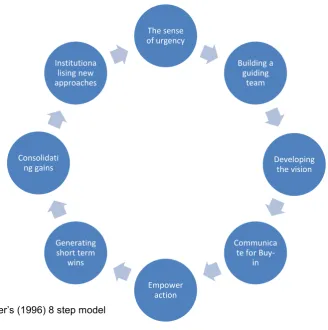
Figure 1 Kotter’s (1996) 8 step model
Kotter’s (1996) step 1 stage – Create a sense of urgency and AI 4D method 1 -
Initial scoping (discovery)
Establishing a sense of urgency is crucial in order to gain the needed co-operation (Pollack and Pollack, 2014) of all parties for change to happen. The first step of Kotter’s (1996) model centres on articulating a compelling rationale for the change and recognising the importance of speed in implementing the change (Calagari et al, 2015). As previously mentioned the need for more qualified nurses to meet the nursing
The sense of urgency
Building a guiding
team
Developing the vision
Communica te for
Buy-in Empower
action Generating
short term wins Consolidati
ng gains
workforce demand has been discussed. However, to reiterate the sense of urgency, in 2015 it had been reported that there was (and still is) a shortage of nurses. Nationally the vacancy rate was at 10% and at 7% within the North West (NHS Employers, 2015).
Nursing courses are normally three years in length and already at the same time as the initial ideas for the project, 93% of the Trusts who had participated in the NHS Employers (2015) survey reported registered nursing shortages. Moreover, 63% of these stated that they had recruited from outside of the United Kingdom. Thus, many NHS Trusts across the United Kingdom were and still are using agency and internationally recruited nurses to alleviate some of this demand. This is also compounded by an ageing population along with the predicted ageing workforce and potential loss of nurses in the next few years. This demonstrated that there was a need for additional trainee nurses to be in the system as soon as possible. Even though this sense of urgency was apparent to me and the Trust’s lead contact, it clearly needed to be disseminated to a much wider audience both within the Trusts and also within the HEI.
was communicated both at the Trusts and the HEI, at all levels including executive, directorate, manager and ward manager.
From this, an analysis of the current issues and areas that would support or may have been potential barriers to the creation of this innovative model was undertaken using the PEST analysis tool (Morrison, 2014). This includes appraising the Political factors, Economic factors, Socio – Cultural factors and Technological factors (PEST) (see appendix 10). The PEST analysis is a framework for examining a situation and can be used to revise a strategy or position, or idea. It is used to assess any external factors in relation to the situation. In this case it helped to analyse the situation and to review a strategy, the position and direction of the partnership / collaborative project. Following this I completed a thorough critical evaluation of the literature to ascertain the current issues within nurse education which assisted in formulating and designing of the innovative programme.
alternative funding. These applicants had previously or just completed a self-funded Foundation Degree in Health and Social Care.
Following the interviews I used a thematic analysis. This was an appropriate method of data analysis so that an exploration and description of key issues or concerns of the participants were revealed. This approach involves familiarisation with the data, developing a coding frame, categorising and coding the recurrent or common themes (Saks and Allsop, 2013; Green and Thorogood, 2007). It aims to report the key elements of the participants’ accounts. I explored with them the feasibility and willingness for students to be fee paying. These applicants had already self-funded two years of their studies and were committing themselves to a further year of fees in order to attain a full honours degree. It also became apparent that they were using the paid Foundation Degree and ‘Top Up’ programme as a way to increase their chances of gaining a place onto a commissioned nursing course the following year or later in their career. I then explored and investigated if this concept of fee paying students was possible. I contacted the Student Finance team, Student Finance England, the NMC and HEE (North West) to ascertain the feasibility of this. Therefore, through one to one interviews I proposed the concept of fee paying students and thus the first non-commissioned nursing course in England.
Kotter’s (1996) step 2 & step 3 stage – Building a guiding team; / – Getting the
vision right; & the AI 4D method 2 & 3 - (dreams / design)
Small cohorts of no more than 30 students per cohort
Intense tuition and support both in practice and theory
Employment of a clinical tutor
Clinical advisors linked to each module
Clinical skills weeks
Equal split of On campus and Off campus delivery of the theory sessions
Recruitment to the Trust of choice on application
Patient as Coach Team (PaCT).
The following will provide a critical overview of how I came to design ‘The Bolton Model’
Through the use of participatory action research I facilitated and led a number of focus groups. The focus groups consisted of the aforementioned small steering / development groups in order to develop concrete proposals to assist in designing ‘The Bolton Model’ (see appendix 12 for example minutes and agendas). A focus group interview is a ‘conversation with a purpose’ (Holloway, 1997 p. 94). Its aim is to elicit, explore, gain access to the participants views of their perceptions, attitudes, opinions, experiences, understandings, feelings and social worlds (Silverman, 2000; Fossey et al, 2002; Kumar, 2014). Moreover, it enables the understanding of how people experience certain phenomena and the best way to do this according to Holloway et al (1998) is to ask people about their experiences. I was the catalyst for achieving the change by stimulating people to review practices, experiences and offer possible solutions along with the consequences.
During the focus groups I adopted a form of AI. AI not only focuses on the best of what is, but engages all stakeholders in a process of reimagining what could be and taking ownership for what will be. (Bushe, 2011). I was able to identify, outline, compare, execute, construct and deconstruct the organisations’ needs and issues with the current demand, supply and skills required for the nursing workforce to then design and develop the innovative programme.
ownership of the students’ nurse education programme.
Step 3 involves creating a vision that clearly and concisely communicates the purpose of the change (Calegari et al, 2015). In addition, it involves developing a strategy for achieving that vision (Dawson and Andrioppoulos, 2014). Most importantly Kotter (1996) notes that it must appeal to both the “head and the heart”. In this case, it is about ensuring we are all working to the same vision, which is, to ensure we have the required sustainable workforce that meets the service user’s needs.
Figure 2: Transition Pedagogy – 3rd Generation FYE Policy and Practice
This figure outlines QUT’s FYE Program strategies that incorporate the first year curriculum principles
across the institution (Nelson et al 2014)
these required skills and therefore are not ‘practice ready’ (Wolfe et al, 2010: Teoh et al, 2013). Within organisations and institutions to date there are variable competency assessment procedures for specific clinical skills and thus many HEIs who work with numerous NHS partners are not able to prepare the student nurse to the specific level of skills that meet every organisational partner requirements. Consequently, this can be difficult for the student nurse to become ‘Practice Ready’ due to the continuously moving and ever changing face of healthcare (Kessier et al, 2014).
Still today there remains a tension for the public and nursing profession in relation to how best to prepare and educate ‘knowledgeable doers’ that reflects the need for nurses to maintain a wide knowledge base, technical ability and skills range to provide nursing care. During this stage I also asked the members of the focus groups to reflect and discuss the greatest aspects of the past and current nurse training programmes, i.e. the ‘positive core’ to bring out the signature strengths (Cooperrider and Whitney, 2011). I also asked them to discuss their own pre-eminent experiences from their own training, which is a key innovation of AI (Bushe, 2011).
throughout.
Another aspect of ‘The Bolton Model’ is the identification and allocation of ‘clinical advisors’ to each module. The clinical advisors are nominated Trust personnel who have the expertise, both clinical and theoretical, for the module that they are linked too. The clinical advisor is a specialist clinical practitioner who can either take a ‘light touch’ approach when they critically review the indicative content, learning outcomes, module handbooks and provide constructive advice to the module leader. Or depending on the type of module, the clinical advisor can be more involved and contribute more to the delivery of the module which is supported and overseen by an academic tutor. An effective accredited curriculum will succeed if there is input from employers to ensure the curriculum is relevant, up to date and matches the need of those employing successful graduates of the programme (Westwood et al, 2007).
in 2008, in the main due to the issues as a result of Duffy's (2003) report regarding ‘Failure to Fail’. Duffy (2003) found that mentors were assessing students’ competencies and passing the student as competent when they were not competent. PEFs support the quality of the clinical learning environment for all pre-registration healthcare students within the healthcare organisation they are employed in (Wells et al, 2014). However, the difference between the PEF and the CT in ‘The Bolton Model’ is that the CT supports a maximum of 30 students as opposed to 200 to 300. This small number is necessary to ensure each student feels secure, has direction (Westwood et al, 2007) and has timely access to support. The CTs work with mentors and students in practice to develop the student’s clinical skills and in particular they work with those whom appear to be struggling to attain the required skills for the stage of their programme. This role is not to replace the practice placement mentor, but is an additional support role for both the student and mentor. Through working closely with the student it is also envisaged that the CT will enable the Bolton students to increase their confidence throughout the course and thus be confident on qualifying.
and clinical skills booklet. The University has been approved by the NMC to offer a Postgraduate Certificate in Teaching and Learning for Higher and Professional Education. This programme is an essential criterion for all nursing academic tutors who teach on NMC approved programmes. Through the partnership working and agreement with the executive teams the CT have the opportunity to undertake this programme if they wish to develop in their career.
In order to ensure consistency and equity for all students the UoB team and CT teams from each partner Trust meet on a regular basis at various fora or meetings. These include, monthly programme team meetings, placement support meetings and assessment board three times a year. Furthermore, twice a year I plan, facilitate and deliver a programme development day for all academic tutors and CTs. The purpose of these development days is to share best practice, ensure consistency of module delivery, clinical skills delivery and discuss and debate any issues or concerns in order to improve the programme. The CTs have also arranged regular peer support meetings between themselves and invite an academic tutor to attend so that any issues or concerns in relation the academic aspect of the course can be discussed and clarified. In addition, I have arranged for the CTs to have an external account to access the UoB moodle site so they can populate a clinical skills moodle site to share resources and ensure consistency.
was used to design and develop the curriculum. As previously mentioned I arranged and led a number of focus groups with other key partners including: newly qualified nurses, potential applicants and service users in order to present the initial curriculum design and seek their views and ideas / suggestions to strengthen the curriculum, model and design. (See Appendix 13 for copies of the presentation used at each focus group).
Solvoll and Heggen (2010) highlight the continuous debate regarding the academic nature of nurse education, which illustrates the tension between the expectation that nurses will have both clinical skills, a good underpinning of technical and theoretical knowledge base, whilst maintaining a strong compassionate caring focus to their work. To assist in developing students with strong compassion and caring focus a notable key element embedded within ‘The Bolton Model’ is The Patient as Coach Team (PaCT) and one that has now been recognised as notable practice by the NMC (see appendix 14).
contribution to the student experience of placements through 'coaching' sessions. These sessions are held within two weeks after the student has completed each placement and consist of small action learning sets which are facilitated by the service user. The service user is a trained ‘coach’ and facilitates reflection and helps the students to focus upon themes related to the ‘6C’s; (Caring, Compassion, Communication, Commitment, Competence and Courage’ (Cummings and Bennett, 2012). Students evaluate this very well and the service users recognise that the students appear to be relaxed and willing to disclose within a safe learning group and thus the students seem to appreciate the neutrality of a facilitator. The service users are selected and fully briefed and debriefed for this undertaking. Students have six opportunities within the three-year programme to participate.