222
Volume-4, Issue-4, August-2014,
ISSN No.: 2250-0758
International Journal of Engineering and Management Research
Available at:
www.ijemr.net
Page Number: 222-228
Embedded Fuzzy Greenhouse Parameter Control and Central Monitoring
System
Atar K.D.1, Hanamane M.D.2, Patil A.R.3, Dr. Mudholkar R.R.4
1,4Department of Electronics, Shivaji University, Kolhapur, Maharashtra, INDIA 2Department of Electronics, Smt. K.W.C. Sangli, Maharashtra, INDIA 3New Model School and Junior College Kolhapur, Maharashtra, INDIA
ABSTRACT
The monitoring and control of greenhouse environment plays an important role in greenhouse yield. The objective of present work is to design a PIC microcontroller-based small scale greenhouse with central monitoring. The nonlinear dependency of temperature, humidity, soil moisture and light intensity are aimed to control through Embedded Fuzzy Control for creating and desirable climate in the greenhouse pertaining to the set values of parameters. The experimentation of the system reported over a day demonstrates the utility of approach for small scale greenhouse.
Keywords—Embedded System, Fuzzy Control,
Greenhouse, Environmental Parameters, Crop Growth
I.
INTRODUCTION
In last two decades the cultivation of crop under controlled environmental conditions has seen paradigm shifting with advent of newer technical developments. The Fuzzy controlled greenhouse is one of the techniques for agriculture development. The electronic-techniques are being implemented to monitor and control the environmental parameters for the crop of interest. The basic function of greenhouse is to offer a protective environment for growing plant. The greenhouse monitoring and control system renders the benefits like growing the plant of interest anywhere despite of unfavorable climate conditions, protect the plants from extreme weather conditions, longer and controlled growing season and keeping out pests, greater crop production. N. Benniset al [1] have developed various Simulink models for controlling two environmental parameters: the temperature and hygrometry into the greenhouse. He has also optimized the performance of designed model. Rodrigo Castan˜eda-Mirandaet al [2] have developed the greenhouse intelligent climate control system that uses a FPGA based fuzzy controller. They have presented the
simulation performance of temperature and relative humidity. The fuzzy technique of handling there non-linearity exhibited by Greenhouse is reported in [3]. X. Blascoet al [4] have focused on development of control algorithms by incorporating energy and water consumption and to maintain climatic conditions in the greenhouse. They have also implemented the Genetic Algorithm in controlling the environmental parameters of greenhouse.
Sensor system and actuation system interfaced through PIC programmed with fuzzy control algorithm is shown in the figure 1.The main function of PC is to store the data for further reference and support the Fuzzy Controller with past and present database. A separate keypad helps setting the set point bypassing the PC.
Fuzzy
Logic
Control
ler
(PIC)
Water Pump/ Sprinkler
Pesticides/ Nutrients Sprinkler LCD
Light
Fan
Heater
PC Light
Sensor
Humidity Sensor
Soil Moisture
Sensor
Temperatu re Sensor
Keypad
223
II.
GREENHOUSE PARAMETERS
The benefit of growing crops in a greenhouse is the ability to control all aspects of creating favorable environment for the crop to be cultivated. The greenhouse climate control is based on the principle of the energy exchange between the different parameters. The growth of crop on jointly depends on Light Intensity, Temperature, Humidity, Soil Moisture, Nutrients and Pesticides. The very aim of any Greenhouse Control System is to control these parameters and enhance the growth of crop.
A. Light intensity
Photosynthesis is the vital part in the crop growth period. The photosynthesis process decides the growth of crop that is directly proportional to light intensity. The photosynthesis rate is higher in violet, blue and in between orange and red ranges. The white lamps are rich in blue colour that is good for indoor seeding. Normally the light intensity present in the Greenhouse is about 70% of which only 30% is required. In traditional system the light panel is operated in ON or OFF condition offering either 0% or 100% light intensities leading to wastage light energy. The proposed Fuzzy based Embedded System that provides controlled light intensity and save the considerable amount of electricity. The setpoint pertaining to the desirable light intensity is given to the system either through keypad or computer.
B. Temperature
Another major factor growing the growth of crop is the temperature. In different crop species possess the different optimum growing temperatures and these temperatures can be different for the root and the shoot environment. For various growth stages during the life of the crop the desirable temperatures keep varying. Therefore there is a need to optimum temperature over entire crop growing cycle. The proposed Fuzzy based Embedded System aims to maintain the optimum temperature inside the Greenhouse with the help of Fuzzy logically controlled exhaust fan, Heater and Fogger Systems.
C. Humidity
Humidity is another supplementary parameter of greenhouse. Higher humidity encourages the diseases. The normal relative humidity lies between 25 to 70% during the day time, however the relative humidity rises up to generally to 90-100% during the night. The proposed system intends to modulate the humidity depending on the set value. In case the % relative humidity increases during day time the heating element and fans are put to ON to bring down the level of humidity. On the other if % humidity decreases, the fogger is system switched ON to maintain the relative humidity close to the set point.
D. Soil Moisture
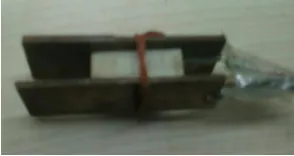
Soil moisture content measurement is useful for irrigation scheduling pertaining to the maximum amount of water that the soil can hold for longer time. A simple soil moisture sensor consisting of two metal plates separated by dielectric material and resistor is sufficient to get the
moisture contents in the soil. Either excess or scarcity of water even under other favorable conditions is harmful to the crop. Every crop demands different water contents. The proposed system aims to supply optimal water to the crop under cultivation through sprinkler system.
The soil moisture sensor consists of resister and two plates separated by non-conducting material. The arrangement of plates is shown in figure (2).
Figure 2: Soil-moisture sensor image
A. Pesticides and Nutrients
Pesticides and Nutrients are the integral part of recent agricultural production system. These are used to improve the production, and keep the diseases and insects in control. Therefore proper pesticide and nutrient management are critical to protect crop. The various growth stages during the life of the crop require nutrients regularly based on time scheduling.
PIC16F877A MCLR RA0 RA1 RA2 RA3 RA4 RA5 RE0 RE1 RE2 VDD VSS OSC1 OSC2 RC0 RC1 RC2 RC3 RD0 RD1 RB7 RB6 RB5 RB4 RB3 RB2 RB1 RB0 VDD_2 VSS_2 RD7 RD6 RD5 RD4 RC7 RC6 RC5 RC4 RD3 RD2 U1 PIC16F877A U 2 4 M H z C1 1u C2 1u S W -S P S T 1 R 1 4 .7 k S W -S P S T 2 R 2 3 3 0 S W -S P S T 3 R 3 3 3 0 V1 5 R4 1k V ss V d d
VoRS R/W EDB
0 D B 1 D B 2 D B 3 D B 4 D B 5 D B 6 D B 7 L E D + L E D -0 Label2 0 T1 2N6755 T2 2N6755 R5 2.2k R6 2.2k + -D C M 2 1 2 F D 1 B P 1 0 4 S D 2 1 N 1 1 8 3 RL2 SPNO-Default + -D C M 1 2 3 0 2 3 2 2 *_ 6 4 0 _ ( S p ri n k le r) T4 !NPN R7 2.2k V2 12 L 1 h e a ti n g e le m e n t + V G 1 + V G 2 V3 12 F D 2 B P 1 0 4 S R 8 4 .7 k RL3 SPNO-Default + -D C M 3 2 3 0 2 3 2 2 *_ 6 4 0 _ ( N u tr ie n ts /P e s ti c id e s ) T5 !NPN R9 2.2k
V4 12 +
V G 3 N1 N2 M1 1m U 3 2 N 1 5 9 5 T3 !NPN D 1 1 N 1 1 8 3 R10 2.2k MAX232 PC LM35 S-M sensor Humidity Sensor
Figure 3: Circuit Implementation diagram
set-224
point the Embedded Fuzzy Control Algorithm generates the PWM pulses. One more PWM mode available in PIC microcontroller is used for controlling the fan to regulate the temperature inside the Greenhouse. In case present temperature is low as compare to set point the Embedded Fuzzy Logic Control elongates the gate pulse period of thyristor and energizes the heater with greater current as shown in figure 3. The soil-moisture control circuit comprises of a relay, transistor drive circuit and a motor. If the present soil-moisture is below the set point level the RC4 pin goes high and starts the motor. The fogger control is similar to soil-moisture control circuit. The pesticides and nutrients are however manually. The two keys are used to provide a setting of the level of each parameter. The real-time data of the sensor is displayed on 2X16 LCD through 4bit interfacing. The same data goes to computer to create the database for further reference.
III.
FUZZY LOGIC
Fuzzy Logic is a problem solving control system methodology that lends itself the implementation in systems ranging from simple, embedded, networked, multi-channel PC based data acquisition and control systems. It can also be implemented in software, hardware, or in combination. Fuzzy Logic approach to control problems mimics how a person would make the decisions. Fuzzy Logic is conceived as a better method for sorting and handling of data, but it has proven to be an excellent choice for many control systems, since it mimics human thinking logic. It is very descriptive language to deal with input data more like an individual operator. The Embedded Fuzzy Logic has a great potential for use in agricultural technology development due to its linguistic approach [5].
A. Fuzzification of input light signal
Fuzzification means the process of changing a real scalar value into a Fuzzy value.
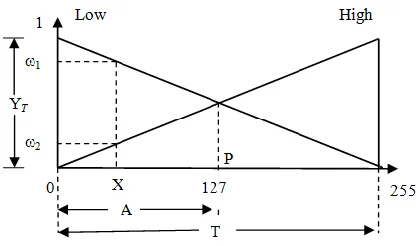
This is achieved by different types of Membership Functions such as triangular, Trapezoidal and Gaussian. In the present work the triangular membership function is used. The spread of input membership function ranges from decimal 0 to 255 that is partition into two regions: Low and High. 1 and 2are the degrees of truth (membership) function. The embedded fuzzification formulae are given by equations (1) and (2).
1=Y Axis total length (YT) × [(Given input (X) ˗ Initial
Value) / Defined Area (A)] (1)
2=Y Axis total length (YT) × [(Final Value (P) ˗ Given
input (X)) / Defined Area (A)] (2)
Figure 4 : (a) Fuzzification of Input Light Signal
Figure4. (a) shows the 1=0.8 and 2=0.2.The program code for computing the degrees of membership is as follows-
If(x>=0 && x<=127) // Defined slot is 0-127 {
1=0.1*[255*(X- 0)/127]; 2=0.1*[255*(127-X)/127]; }
B. Defuzzification of PWM signal
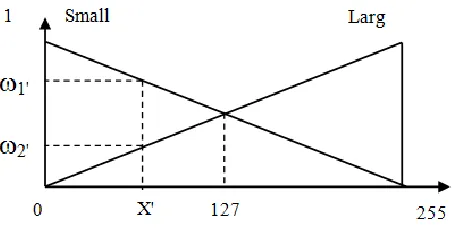
Fuzzy Logic is a rule based system in which the decision strategies are implemented by rules of IF-THEN format. The rules are stored in the knowledge base of the system. The set of rules is applied to the input scalar value and output of each rule is inferred by reasoning mechanism which is also a Fuzzy value. These Fuzzy outputs are converted into a scalar output quantity by the process of defuzzification. The Centroid defuzzification method returns the center of area under the curve. In the plate area of equal density, the centroid is a point by the side of the x axis about which shape would balance [6]. The defuzzification of PWM signal (Binary count) is divided into two regions: Small and Large lying in the range decimal 0 to 255. 1' and 2' are degree of output membership function shown in figure 4(b).The Centroid defuzzified scalar value is computed by equation (3).
V = [(Defined initial value × 2) + (Defined final Value ×
2)/ (1+w2)] (3)
The equation (3) is implanted into figure 4 (b) and the embedded defuzzification codes used is as follows-
225
Figure 4 : (b) Defuzzification of Output PWM Signal
C. Fuzzy Rules
In fuzzy inference method is rule base method and rules are in IF THEN format. The rules of each parameter is,
Parameter: Light Intensity
Rl1 : IF Input light signal is low THEN output PWM signal is Large
Rl2 : IF Input light signal is High THEN output PWM signal is Small
Parameter: Temperature
RT1 : IF Input Temperature is low THEN Gate pulse signal is Large
RT2 : IF Input Temperature is High THEN Gate pulse signal is Small
Parameter: Soil-moisture
Rs1 : IF Input light signal is low THEN output PWM signal is Large
Rs2 : IF Input light signal is High THEN output PWM signal is Small
Parameter: Humidity
RT1 : IF Input light signal is low THEN output PWM signal is Large
RT2 : IF Input light signal is High THEN output PWM signal is Small
IV.
MATLAB SIMULINK MODEL
MATLAB Program language is a high level programming language. In serial communication process there in need to set the parameters like baud rate, parity bit, data size etc for each sensor signal. Setting parameter values for each sensor signal is difficult, but MATLAB programming language helps user friendly in model designing. The proposed model consists of serial receive, serial configuration block and display unit. Serial configuration block is used to configure the data from micro-controller and computer. Gated individual sensor data is stored into the computer named as a, b, c, d, and e as shown in figure (5).
Figure: 5 MATLAB simulation model
V.
IMAGES OF GREENHOUSE
The sensor arrangement of greenhouse is shown in figure 6(a), electronic hardware implementation in figure6(b) and the complete system set-up is shown in figure 6(c).
Figure 6 : (a) Front View Image of Greenhouse
226
Figure 6: (c) Complete system set-up arrangements
VI.
RESULT
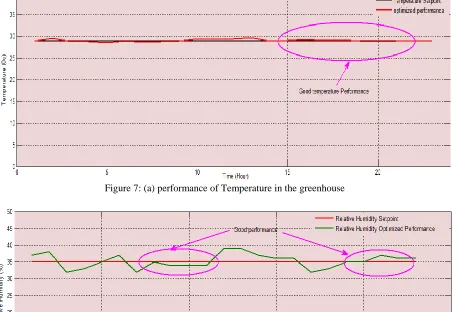
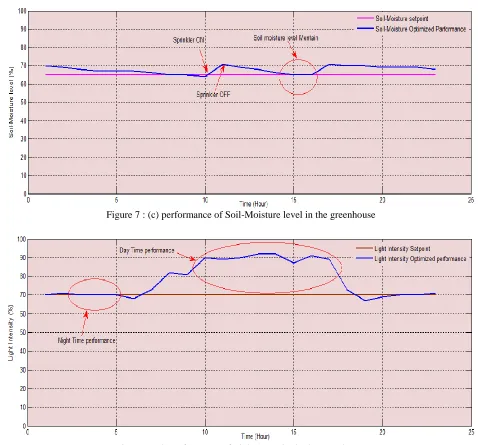
The results of Embedded Fuzzy applied to Greenhouse climate control with target controller PIC 16F877A are presented here. The fuzzy controller aimed at regulating the Light intensity, Temperature, Humidity and soil-moisture regulation in greenhouse. The composite climate in greenhouse is complex in nature and it is difficult task for a machine to control but simple for human operator. Since Fuzzy Logic can mimic the operators control action to a greater degree Fuzzy Logic based model can regulate the complex and highly nonlinear internal climate parameter of greenhouse quite efficiently. Observations taken over 24 hour cycle are shown in the figure-7.
Figure 7: (a) performance of Temperature in the greenhouse
227
Figure 7 : (c) performance of Soil-Moisture level in the greenhouse
Figure 7: (d) Performance of Light Intensity in the greenhouse
Over 24 hour performance temperature is shown in figure 7(a). During day time 15 hr to 24hr, present model maintains the good temperature. Humidity is inversely proportional to temperature. In the afternoon time around 11 hr to 15hr the relative humidity goes down as shown in figure 7(b). The fogger system going is put ON to raise and maintain the level of relative humidity. During 8hr to 11 hr and 18hr to 24hr relative humidity level is better stays near to the set-point of 35%. In every crop soil-moisture level required is different and further it depends on type of soil. When the level of water content goes below the set-point level, sprinkler motor is active. During 14hr to 21 hr the soil-moisture optimization performance is better as shown in figure 7(c). One more important parameter is Light intensity that initiates and enhances the photosynthesis. During day time 7 hr to 18 hr the light intensity become more than set point due external
environment light intensity. While during the night time artificial light maintains the constant intensity as shown in figure7 (d).
VII. CONCLUSION
228
feasibility of the approach to Greenhouse climate parameter control.
REFERENCES
[1] N. Bennisa, d, J. Duplaixb, G. Enéab, M. Halouac and H. Youlald “Greenhouse climate modelling and robust control” Computers and Electronics in Agriculture, Vol. 61, Issue 2, Pp: 96–107, May 2008
[2] Rodrigo Castañeda-Miranda, Eusebio Ventura-Ramos Jr., Rebeca del Rocío Peniche-Vera and Gilberto Herrera-Ruiz “Fuzzy Greenhouse Climate Control System based on a Field Programmable Gate Array” Biosystems Engineering Vol. 94, Issue 2, Pp: 165–177, June 2006 [3] Amine Trabelsia, Frederic Lafontb, Mohamed Kamouna and Gilles Eneab “Fuzzy identification of a greenhouse” Applied Soft Computing Vol. 7, Issue 3, , Pp: 1092–1101, June 2007
[4] X. Blasco, M. Martínez, J.M. Herrero, C. Ramos and J. Sanchis “Model-based predictive control of greenhouse climate for reducing energy and water consumption” Computers and Electronics in Agriculture Vol. 55, Issue 1, Pp: 49–70, January 2007
[5] P. A. Saudagar, D. S. Dhote, D. R. Solanke “Microcontroller based Intelligent Temperature Controller for Greenhouse” RESEARCH INVENTY: International Journal of Engineering and Science, Vol. 1, Issue 11, PP 40-44, 2012
[6] dd---Michio Sugino and Takahiro Yasukawa “A fuzzy Logic Bassed Apporoach to Qualitative Modeling” IEEE Transaction on Fuzzy Systems Vol. 1 NO.1 Feb 1993, Pp: 7-31
[7] M. Nachidi, A. Benzaouia and F. Tadeo “Temperature and humidity control in greenhouses using the Takagi-Sugeno fuzzy model” Proceedings of the 2006 IEEE, International Conference on Control Applications, Munich, Germany, Pp: 2150-2154, 2006
[8] Lishu Wang, Guanglin Yang, Qiang Fu and Xiangfeng Xu “Study On Sunlight Greenhouse Temperature And Humidity Fuzzy Control System” Nature and Science, Pp: 45-48, 2005.