ChrisTOPHER J.
monaghan
A
You can love or loathe Paul, but if
you want to understand the first
decades of the development of the
early Christian movement before
the Gospels were written you cannot
ignore him. For some he is a heroic
figure who looms like a colossus on
the horizon, courageously
establish-ing communities, goestablish-ing where no one
had gone before, sketching out for
the first time a distinctive Christian
theology in a way that would shape
Christian thought and language
down to the present day. For others
he was, and continues to be, a
fig-ure of controversy on many fronts.
Someone who was all too prepared
to cast his communities adrift from
their moorings in Jewish thought
and practice, to claim his own
au-thority in his many conflicts with
others—either within his developing
Christian communities, or with the
already recognized figures of James
and Peter in Jerusalem.
INTRODUCTION
Published in Australia byGarratt Publishing
32 Glenvale Crescent
Mulgrave, Vic. 3170
www.garrattpublishing.com.au
Copyright © Christopher J. Monaghan 2014
All rights reserved. Except as provided by the Australian copyright law,
no part of this book may be reproduced in any way without
permission in writing from the publisher.
Design by Lynne Muir
Images: www.thinkstock.com, Lynne Muir and Rosanna Morales
p.14, Conversion of Saint Paul, Caravaggio (Merisi, Michelangelo da (1571-1610) Church of Santa Maria del Popolo, Rome © 2012. Photo Scala, Florence
Printed in China by Tingleman
Scripture quotations are drawn from the New Revised Standard Version of the Bible, copyright © 1989 by the Division of Chris-tian Education of the National Council of the Churches of Christ in the USA. Used by permission.
All rights reserved.
Nihil Obstat: Reverend Gerard Diamond MA (Oxon), LSS, D.Theol Diocesan Censor Imprimatur: Monsignor Greg Bennet, Vicar General
Date: 4 August 2012
The Nihil Obstat and Imprimatur are official declarations that a book or pamphlet is free of doctrinal or moral error. No implication is contained therein that those who have granted the Nihil Obstat and Imprimatur agree with the contents, opinions or state-ments expressed. They do not necessarily signify that the work is approved as a basic text for catechetical instruction.
9781921946998
Cataloguing in Publication information for this title is available from the National Library of Australia.
www.nla.gov.au
Every effort has been made to race the original source of copyright material con-tained in this book. The publisher would be pleased to hear from copyright holders to rectify any errors or omissions.
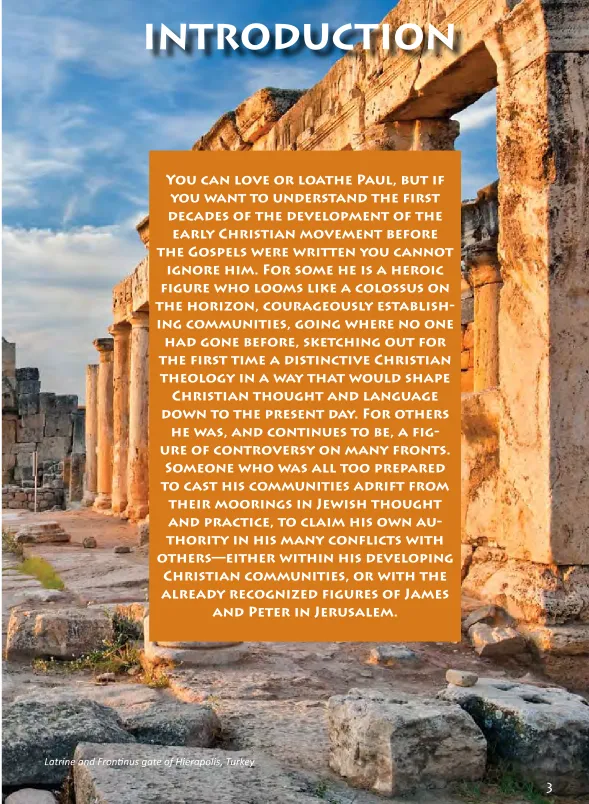
Latrine and Frontinus gate of Hierapolis, Turkey
Contents
Introduction 3
Paul’s Background 7
The Cities of Paul 8
The Journeys of Paul 9
Chronology 10
Paul’s missionary Journeys 12
Paul’s Conversion 14
Physical Description of Paul 16
How Many Letters did Paul Write? 17
Household Churches 18
Paul and his Co-Workers 21
Getting a Handle on Paul’s Thoughts:
Some Key Pauline Concepts 22
Paul and Community 28
The Importance of Women in the Pauline Communities 29
The Letters of Paul 31
authentically Jewish Christians than Paul himself. In responding to them Paul claims that they are ‘… false apostles, deceitful workers, disguising themselves as apostles of Christ.’(2 Cor 11:13)
From our perspective it is understandable that we cringe at the way these probably well-inten-tioned disciples are caricatured and their reputation maligned by Paul. From a cultural perspective we need to appreciate that Paul and his contemporaries lived in an honour and shame society in which every challenge to one’s honour was ex-pected to be defended; otherwise, one would be conceding the claims of one’s opponents. His honour had been challenged, and that he was
within his rights—his honour in fact demanded that—he defend himself by doubting the true motivations of his accusers.
This one example has many applications: Paul’s world is not our world, and his letters are not written for us, even though our Christian life has been shaped by them. There is a famous cartoon of Charles Shultz where Linus reflects on Paul’s letters after returning from Sunday school: ‘I MUST CEMIT IT MAKES ME FEEL A LITTLE GUILTY…. I ALWAYS FEEL LIKE I’M RECEING SOMEONE’S MAIL!’ This is exactly the
point. It is someone else’s mail; we are listening in on a conversa-tion between Paul and his converts that was never intended for us.
One cannot help but wonder what Paul would think knowing that two thousand years later his letters addressed to the communities of Corinth, Galatia, Macedonia and Rome would still be closely read and examined.
Another factor to keep in mind is that not only are we listening to someone else’s conversation, we also run the risk of not having ac-cess to the interpretation of the let-ter that the recipients of the letlet-ters had. Some of the unsung heroes and heroines of the Pauline com-munities were those who first read and explained the letters on Paul’s behalf. Imagine the diplomatic and communication skills required by the person entrusted to challenge
G
iven that this work is to be a friendly guide to Paul it’s important to state at the outset how this is to be under-stood. This does not so much indi-cate that the guide is one that will take a stance that is always friendly to Paul in the sense of defending him, so much as being a guide that sets out to be friendly to you the modern reader of his letters. Week after week we are invited to make sense of Paul’s writings in our cycle of readings, and often the modern reader laments that his letters are difficult to understand!If you have ever voiced such an opinion be of good cheer: even in the first century the author of 2 Peter was known to observe ‘There are some things in them hard to understand, which the ignorant and unstable twist to their own destruction, as they do the other scriptures.’(2 Pet 3:16) Whether the author meant writings or scriptures is open to debate, but what con-cerns us here is that, even then, Paul’s thought was not easy to un-derstand, even if his writings were already starting to be collected and preserved.
There are a number of reasons why the modern reader should experience some perplexity when reading the letters of Paul, and they are worth outlining. For a start, these letters were not written in English, but a dialect of Greek cur-rent in the Roman empire of Paul’s time called Koine. Paul, like his writ-ings, are works of a particular time; written from, and addressed to, a religious and social context that is not our own. It almost seems too simple a point to make, but it is one that our constant exposure to the letters of Paul as Christians tends
to obscure. There is the danger of thinking just because we have heard or read these letters from childhood we should have some natural capacity to follow their logic, understand the concepts, and then be moved to implement Paul’s instructions. To be sure, there is a great deal in these letters that tran-scend the boundaries of time and place and culture. 1 Cor 13:1–13 with its description of love is but one sublime example. On the other hand, there are many texts that demand a great deal more work on the part of the reader and for a number of reasons.
The ways that Paul expresses himself have been shaped by his context. In particular he expresses himself in the categories of a first century diaspora Jew who grows up immersed in Greek culture and living in the context of the Roman Empire.
So far so good, and I can hear some of you thinking, ‘What’s the big deal?’ Without wanting to la-bour the point: this is but the tip of the iceberg. Unless we understand something of the world of Paul we are not actually listening to Paul at all, but some other ‘construct’ of him.
We learn best by examples, so let’s begin with the claim that Paul says some very unflattering things about his various opponents from time to time. In Corinth there was a group of Christians who had come to Corinth after Paul and his co-workers had established this predominately Gentile com-munity that gathered in various household churches. They claimed that they had letters of recommen-dation from Jerusalem. It seems they claimed that they were more
1If I speak in the tongues of mortals and of angels, but do not have love, I am a noisy gong or a clanging cymbal. 2 And if I have prophetic powers, and understand all mysteries and all knowledge, and if I have all faith, so as to remove mountains, but do not have love, I am nothing. 3 If I give away all my possessions, and if I hand over my body so that I may boast,e but do not have love, I gain nothing.
4 Love is patient; love is kind; love is not envious or boastful or arrogant 5 or rude. It does not insist on its own way; it is not irritable or resentful; 6 it does not rejoice in wrongdoing, but rejoices in the truth. 7 It bears all things, believes all things, hopes all things, endures all things. 8 Love never ends. But as for prophecies, they will come to an end; as for tongues, they will cease; as for knowledge, it will come to an end. 9 For we know only in part, and we prophesy only in part; 10 but when the complete comes, the partial will come to an end. 11 When I was a child, I spoke like a child, I thought like a child, I reasoned like a child; when I became an adult, I put an end to childish ways. 12 For now we see in a mirror, dimly, but then we will see face to face. Now I know only in part; then I will know fully, even as I have been fully known. 13 And now faith, hope, and love abide, these three; and the greatest of these is love.
1 Cor 13:1–13
those Corinthians who were sup-porting a fellow Christian involved in an incestuous relationship (1 Cor 5), or those rich members who saw no problem with being drunk when the poorer members of the com-munity came to partake in the Eu-charistic celebration!(1 Cor 11:21) Paul’s letters were often writ-ten in response to problems that either Paul or members within the various communities had identified. For instance, Philemon was written to help a Christian slave (Onesi-mus) who had fled to Paul during one of his imprisonments. It aims to receive a fraternal homecoming from his Christian master Philemon. In order to understand such a letter, background information regarding the period is needed on such things as the rights of slaves and masters, the ways in which Christian house-holds were organised, the rights of Paul as friend and apostle to demand anything of Philemon, and the rights of a master and his slave.
We are fortunate indeed that the house churches in Corinth were at odds with each other and with Paul, otherwise Paul’s teach-ing on the scandal of the cross in 1 Cor 1–2 might have been lost to us: not because he would not have had the understanding, but that it would not have been preserved in a written form. If they had not been so caught up in competition with one another in terms of how the gift of tongues was to be used and appreciated within the community then his great commentary on love in 1 Cor 13 might never have been written.
Our communication is always shaped by our context and Paul is no exception. Paul’s patterns of speech, the examples he uses,
the ways that his arguments are expressed have all been shaped by his religious upbringing as a devout Pharisaic Jew, and by the religious and philosophical thought of the Greco-Roman world. Again, this might seem self-evident but I con-tinue to be amazed at how quickly this is forgotten when people start to read Paul’s letters. He uses the normal and well-known rhetorical practices of his time to convince his readers of a certain attitude or course of action.
These practices included: delib-erative rhetoric, which was con-cerned with convincing people to choose a certain course of action;
forensic rhetoric, the rhetoric of the law courts determining a person’s guilt or innocence; and ceremonial rhetoric, used to honour people in life or in death. In Paul’s letters these kinds of rhetoric abound, and are further enriched by Paul’s use of Jewish forms of rhetoric, par-ticularly in his use of the scriptures. The point being made here is that modern readers often have difficul-ty in following Paul’s line of argu-ment in certain passages, or letters e.g. The letter to the Galatians. This should not surprise us because we are listening to a style of persuasive communication that first century Christians of the Greco-Roman world were familiar with—the customary ways of communicating they all understood. So if we wish to understand Paul better, we need to take some time to become famil-iar with them to.
Paul’s Background
One of the reasons underlying the
success of Paul’s missionary activity
was that he was a devout and jealous
Pharisaic Jew who grew up in Tarsus
in the Roman province of Cilicia. His
mission in Syria, Asia Minor, Macedonia,
Achaia and Rome would rely for its
success not only on his
conviction, commitment and
enthusi-asm, but also on the fact that he was
a person in which worlds and cultures
met. The Greek dialect that he spoke
functioned much as English does today.
Geographically he was not from the
heart of the Roman Empire, even though
he was a citizen, and from a religious
perspective he was not from Jerusalem,
even though he was a devout Pharisee.
Ancient ruins in Philipi Pauline communities
It is customary to speak of the communities founded by Paul and his co-workers as Pauline communities. It is worth consid-ering what we mean by ‘Pauline.’ The communities that were founded by Paul and his co-work-ers represented a certain style of Christianity in terms of their practice and attitudes. While we may think of early Christianity as a single movement it would be more accurate to think of a number of communities and house churches - some predomi-nately Jewish in thought and practice, others Gentile, and oth-ers mixed communities of Jews and Gentiles. The communities established by Paul were deeply indebted, as Paul himself was, to the Jewish tradition, but circum-cision and obedience to all the precepts of the Jewish Law were not required to become a mem-ber of the Christian community.
W
hile we are used to think in terms of four mission-ary journeys undertaken by Paul, this is largely Luke’s recon-struction of Paul’s ministry written some twenty years or more after Paul had died. This is not to say that Luke’s portrayal in Acts of the Apostles doesn’t contain a good deal of reliable information, but it has been coloured to some degree by Luke’s own narrative agenda and concerns in describing the expansion of the early Christian communities in an orderly fashion.(cf. Luke 1:1–4) It has been said if Paul was asked what missionary journey he was on he wouldn’t have been able to tell you!This doesn’t mean that Paul didn’t undertake many journeys as an apostle—far from it—it is more a matter of knowing that our picture is always going to be incomplete. It is incomplete because Paul saw no reason to keep a diary of his travels. In 2 Cor 11:22–29 there is a catalogue of the many dangers Paul faced on the road, such as ship-wrecks, beatings, robbery, impris-onment, Jewish and Roman punish-ments. Galatians 1–2 provides a picture written after some seven-teen years of ministry in which cer-tain elements are well outlined: his initial ministry in Damascus, going to Jerusalem after three years to meet Peter, returning to Jerusalem after fourteen years of ministry, and confronting Peter in Antioch. The letters indicate that there was an intense period of activity when he was involved in not only preaching the Gospel and the care of com-munities, but also the collection for
the poor in Jerusalem that involved the churches of Corinth, Macedonia and Rome. When Paul writes to the community of Rome he intends to receive assistance from them and extend his mission as far as Spain. Paul mentions in Rom 15:19 that he had preached the Gospel from Jerusalem to Illyricum! There is a clearly expressed sense of pride that he has not spared any effort to preach the Gospel and establish as many communities as possible before the return of the Lord.(cf. Romans 10:15)
Given his efforts it is under-standable that he expresses some sense of frustration with other mis-sionaries who, from Paul’s perspec-tive, take advantage of the base that he has established, without going to new cities and establish-ing communities where the Gospel message had not been preached before.(2 Cor 10:14–16)
The letters of Paul attest the fact that there was a consider-able amount of movement, and that it was not isolated to Paul and his co-workers. Letters were sent by Paul to his communities with trusted co-workers like Timothy and Titus. Community members such as Chloe’s people (1 Cor 1:11) who came from Corinth to Ephesus cre-atively combined their business travel with opportunities to pass on news and ask Paul’s advice. The letters witness to Paul’s ef-forts to ensure that wandering missionaries would receive a warm welcome as they moved from one community to another. (cf. 1 Cor 16:10; Rom 16:1–2)
O
ne of the things that can be learned from the letters is that Paul lost no time in trying to spread the Good News of Jesus as far as he possibly could before the return of the Lord. He writes in Rom 10:14 ‘But how are they to call on one in whom they have not believed? And how are they to believe in one of whom they have never heard? And how are they to hear without someone to proclaim him?’The letters attest to a mission-ary strategy that involved going to as many major cities as possible, by sea and by foot—making use of the well-established system of Ro-man roads. Paul and his co-workers targeted major population centres, especially those that were
strategi-cally placed to serve as a base for on-going missionary endeavours. Cities such as Philippi and Thes-salonica were situated on the Via Egnatia, the major link between the Adriatic and Byzantium (later Constantinople).
Corinth’s location was such that this cosmopolitan city controlled trade and travel between southern and northern Greece by sea or road. Ephesus was the capital for Asia Minor and was accessible by sea or road. Even at the time of writing Romans, Paul’s intention is to move on to new mission opportunities in Spain.(Rom 15:24) Because he is so committed to establish new communities, he expresses great frustration with those who seem to take advantage of the communities
he has already established, with-out taking the risk of starting their own. His aim is to keep moving on ‘so that we may proclaim the good news in lands beyond you, without boasting of work already done in someone else’s sphere of action.’(2 Cor 10:16)
During this dynamic time of expansion, what is clear is that the Pauline communities were largely urban and, while they were Greek speaking, they were cities of the Ro-man Empire: as such they were di-verse culturally and religiously. Such diversity was both a blessing and a challenge, and the letters attest to the many issues that arose while these early Christian communities were developing, issues that some-times called for great creativity.
The Cities of Paul
The Journeys of Paul
Did you know?
How man
y times P
aul
was ship wr
ecked,
scourged, bea
ten, and
stoned
(2 Cor 11:24–25):
‘Five times I ha
ve received
from the Je
ws the forty
lashes minus one. Thr
ee
times I w
as beaten with
rods. Once I r
eceived a
stoning. Thr
ee times I w
as
shipwrecked; f
or a nigh
t and
a day I was adrift a
t sea.’
O
ur picture of Paul is a usu-ally a composite one pieced together from Luke’s por-trayal of Paul’s life and ministry in Acts of the Apostles, written some twenty years after Paul’s death, and what we can learn from his letters themselves. As a rule of thumb, whenever there is any conflict between the two sets of informa-tion, precedence has to be given to Paul’s own words, especially the sequence he provides in Gal 1:11–2:14. Much as we would like it, we have no indication from the letters as to his age when convert-ed, although Acts 7:58 introduces Paul into the narrative as a young man named Saul at the death ofStephen. There is probably no rea-son to doubt this particular detail, though it is itself imprecise.
As far as external dates are concerned, there is the reference in 2 Cor 11:32 to King Aretas of Damascus who tried to capture him. This would have occurred somewhere around 37–39 CE. This means that the latest that Paul can have begun his apostolic mission is within ten years of the death of Jesus. When writing his letters, Paul was not concerned to give a blow-by-blow description of his ministry, he was living his life rather than describing it for posterity. As a consequence there will always be gaps in the information that can
be gleaned from the letters. Acts makes mention of certain details that can be of assistance in placing Paul’s ministry within a framework of external events and people. Acts mentions the time of Gallio as proconsul in Corinth 51–52 CE(Acts 18:12), a famine in Judea (Acts 7:11), Festus’ arrival in Caesaria (Acts 25:1,6,13,23) around 55–60 CE, and the edict of Claudius in around 40–49 CE.(Acts 18:2) These details have to be used carefully, but they clearly show Luke’s efforts to place Paul within his contempo-rary world.
John Knox suggested the follow-ing chronology:
Chronology
An ancient road in Philippi
TRADITIONAL
EVENT
REVISIONIST
AD 36
Conversion to Christ
AD 30/34
39
Visit to Jerusalem after Damascus
33/37
40—44
44—45
In Cilicia
At Antioch
After 37
46—49
(First) Missionary Journey, beginning in Antioch, to
Cyprus and southern Asia Minor, returning to Antioch
(Second) Missionary Journey, beginning in Antioch,
through southern Asia Minor to N. Galatia, Macedonia,
CORINTH (I Thess), return to Jerusalem and Antioch
After 37
39—41/43
(41—43)
49
Jerusalem conference
47/51
50–52
(51—52)
(Second) Missionary Journey, beginning in Antioch,
through southern Asia Minor to N.
Galatia, Macedonia, CORINTH (I Thess), return to
Jerusalem and Antioch
see above
54—58
(54—57)
(summer 57)
(57/58)
(Third) Missionary Journey, beginning in Antioch,
through N. Galatia to EPHESUS; three-year stay there—
imprisoned? (Gal, Phil, Phlm, I Cor)
Paul goes through Macedonia toward Corinth (II Cor,
Gal?), winters at CORINTH (Rom), returns to Jerusalem
indistinct from
second (48/55)
(after 54)
58—60
60—61
Arrested in Jerusalem; imprisoned two years in
Caesarea (Phil?)
Sent to ROME ; long sea journey
52—55 or
56—58
61—63
Prisoner in ROME for two years (Phil? Phlm?)
after summer 64
Death in Rome under Nero
Table from AN INTRODUCTION TO THE NEW TESTAMENT Raymond E. Brown S.S. Doubleday 1977
P
aul’
sM
issionaryJ
ourneysPaul’s First Journey in Acts
Paul’s Second Journey
Paul’s Journey to Rome
City to which a New Testament
Epistle is addressed
❂
❂
❂
❂
Ephesus
Corinth
Thessalonica
Philippi
It needs to be understood that Paul may not have seen the point of our question—he was a Jew and remained so all his life—but his encounter with the Risen one led him to recast his appreciation of his own rich tradition. One of the points that Paul highlights is that the encounter with the Risen Lord was accompanied by a clear sense of mission to the Gentiles. This good news of Jesus was to be shared with all humanity, and it is here that he came into conflict with other early Christian leaders who would have shared in Paul’s vision of God’s saving plan for all human-ity, but would have differed in terms of how that would manifest itself in the lives of the communi-ties; in particular, with regard to the demands of the Jewish tradition for circumcision, acceptance of the purity codes, and other regulations of the Jewish Torah.
Our imagination of Paul’s call on the Damascus road has been influenced by many paintings that so often include horses, such as the dramatic one by Caravaggio. It is interesting to note that neither Luke nor Paul make any such men-tion! Luke will relate the event on a number of occasions in Acts of the Apostles (Acts 9:1–22; 22:3–21; 26:1–20) and, while it is clear that these are written with a view to legitimating Paul and his mission, they are second hand accounts. In his own letters Paul is somewhat circumspect and measured when he describes in Gal 1:16 how ‘God revealed his Son to me’ and gave him the mission to go to the Gen-tiles. He does claim this moment as one that legitimated him as an apostle and refers to it indirectly in 1 Cor 9:1 ‘have I not seen the
Lord?’, and in 1 Cor 15:8 ‘last of all, as to one untimely born, he ap-peared also to me.’ In 2 Cor 12:2–4, Paul speaks in a thinly veiled way about his own experience, as one who was taken up into paradise and heard things that cannot be told. He speaks of this happening some fourteen years earlier; it’s possible that this is the experience on the Damascus road.
Whatever else may be said, Paul’s encounter with the Risen Lord radically changed the direc-tion of his life from persecutor of the early Church to one of its strongest supporters. While it is natural to focus on that single event, there are other formative elements on Paul’s journey of faith that are worth considering. One can only speculate, but what was the effect of conversations with Christians he had encountered in his zealous efforts to eradicate
the Nazarene heresy? We will never know but how much of his later belief was shaped by these encounters with Chris-tians whose testimony and faithfulness were already preparing the soil for his later proclamation of Jesus as Messiah. Perhaps even more tantalising to ponder is the impact of his rela-tives Junia and Androni-cus becoming Christians before him.(Rom 16:7)
Whether we can describe Paul going through a conversion from one faith to an-other will continue to be debated, but one thing that is
abso-lutely certain is that
he went through a process of
assessment, and reconfiguring the way in which he saw the relation-ship of obedience to the Jewish law (Torah) and salvation. At least as far as Gentiles were concerned, the need for circumcision and faithful-ness to all the requirements of the Torah was not to be demanded of Gentile Christians. Paul was con-vinced that it was to Gentiles in particular that he was given a mis-sion to preach the Good News of Jesus Christ. It was his understand-ing of a mission to Gentiles with minimal adherence to the demands of the Torah that was to bring him into conflict with those Christians who shared his vision of Jesus’ message being for all humanity, but disagreed as to the status of the Torah and to what degree Gentile Christians would need to follow its laws.
Nazarene heresy
It can come as something of a shock for contemporary Christians to talk about the early Christian movement as the Nazarene heresy, but that is how it was considered by Paul, and those who commissioned him to eradicate belief in Jesus of Naza-reth. For them belief in Jesus as the promised Messiah was at the very least mistaken, and at worst it was a belief that threatened the unity and integrity of the Jewish community. Paul’s own response to the Christian move-ment was that of decisive action to gather believers and bring them before Jewish authori-ties to confront them with the error of their ways. They were forced to either abandon their mistaken belief in Jesus, or face punishment. The New Testament mentions on numerous occa-sions that Christians needed to prepare themselves for rejec-tion and being brought before Synagogues and other authori-ties, both religious and civil, on account of their belief in Jesus as the promised Messiah (Mark 4:17; 10:30; Matt 10:17-18,23).
Did you know?
That Paul pr
obably
wasn’t riding a hor
se
when he me
t the Risen
Lord on the Damascus
road:
No mention is made of a
horse by either Luk
e in Acts
9:1–9 or b
y Paul himself
in Gal 1:15–16. If an
ything
Paul is very guar
ded about
this encounter.(2 Cor 12:2–
4)
I
t might come as a surprise to learn that the conversion of Paul is a much debated conversation topic among Pauline scholars. No one would dispute that this encounter between Saul of Tarsus and the Risen Lord would cause him to radically change his life and direction. What is debated is more a matter of whether this radical shift should be called a conversion. The point at issue is whether Paul changed from one religion to another, that is, from Judaism to Christianity, or whether he simply came to see God’s promises of a Messiah to Israel to now be fulfilled in the crucified and risen Jesus of Nazareth.Caravaggio (1571-1610): Conversion of Saint Paul. Rome, Church of Santa Maria del Popolo.
P
aul gives us no description of himself, and we should expect none given that the recipients of the letters, other the one addressed to the community in Rome, knew Paul well. In 2 Cor 10:10 he is well aware of the claims of his detractors that ‘His letters are weighty and strong, but his bodily presence is weak, and his speech of no account.’In the Syriac text of the Acts of Paul and Thecla he is described as ‘a man of middling size, and his hair was scanty, and his legs were a little crooked, and his knees were projecting, and he had large eyes and his eyebrows met, and his nose was somewhat long, and he was full of grace and mercy; at one time he seemed like a man, and at another time he seemed like an angel.’
This tends to bear out the fact that Paul’s physical presence was such that he would not have fitted into any Greco-Roman models of at-tractiveness, or someone who had been blessed by the gods. In Gal 4:13–14 he admits that it was due to a physical infirmity that he first preached the Gospel message to the Galatians. Though he admits they would have been justified in treating him with scorn, the reverse was true; they treated him as a messenger sent from God.
This might indicate that his appearance belied his claims to be an apostle and servant of the living God. We also have to consider the mysterious reference to the ‘thorn in the flesh’
referred to in 2 Cor 12:7. This has been variously explained as epi-lepsy, malaria, a disfigurement, or some other kind of disease. Given Paul’s own description of imprison-ments, shipwrecks, beatings and other dangers that he endured for the sake of the Gospel in 2 Cor 11:24–27, it is possible that these have left their mark on him physi-cally. If that is true perhaps the description in the Acts of Paul and Thecla is more accurate than we might realize, as it speaks of Paul’s spirit and character transcending appearances! There must have been something about him that could lead to the gathering of companions, and the founding of communities from Jerusalem to Illyricum.(Rom 15:19)
How Many Letters did Paul Write?
Physical Description of Paul
F
or the most part the letters were not hand written by Paul but dictated. In Gal 6:11 he notes ‘See with what large letters I am writing to you with my own hand.’ There were good reasons for this since a scribe’s writing was smaller and much more cost effective given the price of writing materials. In Rom16:22 the Christian scribe Tertius adds his own greeting at the conclusion of the letter. Excep-tions often prove
the rule and the
shortest of the letters addressed to Philemon is one that he claims to have written in his own hand (Phlm 19). One can imag-ine him engrossed in arguing one position or anoth-er, pacing up and
down trying to articulate why his opponents were so patently wrong, or why his fledgling Christians in Corinth could still only be called babes in Christ! (cf. 1 Cor 3:1)
In the New Testament there are thirteen letters attributed to Paul; this testifies eloquently to how significant a figure he quickly became in the early growth and development of the Christian move-ment. It is likely that there are many more letters written by Paul than were preserved. 1 Cor 5:9 refers to advice given in an earlier letter, and 2 Cor 2:4 and 7:12 speak of the
contentious letter Paul wrote after 1 Corinthians that is now lost to us.
Of the letters that are attrib-uted to him there are seven that are universally agreed to have been Paul’s work: 1 Thessalonians, 1 Corinthians, 2 Corinthians, Romans, Galatians, Philippians, and the letter to Philemon.
So, what criteria are used to determine if Paul was the author of a letter? And what is the status of those letters not generally consid-ered to have been written by Paul?
All the letters have been in-cluded in the New Testament, which attests to their ongoing value as inspired and valued texts. To say that Ephesians, Colossians, 1 and 2 Timothy, Titus, 2 Thessalonians and Hebrews are disputed as coming
directly from Paul’s hand does not mean they were not influenced by Paul, or that they did not come from those influenced by Paul who wanted to preserve his vision, or the on-going development of his tradition. As has been observed from time to time, it is hard to know with precision where Paul ends and
his legacy begins. The grounds on which these judge-ments are based come down to testing whether the vocabulary, organi-zational structures, or theology would fit into what we know of the Church during the period of Paul’s ministry. Admittedly, this is an inexact
sci-ence and debates
about Ephesians, Colossians, and 2 Thessalonians will continue, as scholars continue to
test the criteria that have been used
to determine what is considered to have come from the hand of Paul.
There are strong indicators that ideas that were first expressed in Paul’s undisputed letters come to be further developed within the circle of those communities influenced by him. The fact that letters were at-tributed to him was not an unusual occurrence in the ancient world, and it provides ample proof of the esteem in which he was held, and his on-going influence within the early church.
Did you know?
That Paul was probably
hook-nosed and balding
:
In the Syriac t
ext of the Acts of
Paul and Thecla he is described
as ‘a man of middling siz
e, and
his hair w
as scanty, and his legs
were a little cr
ooked, and his
knees were pr
ojecting, and he
had large eyes and his e
yebrows
met, and his nose w
as some
what
long, and he w
as full of gr
ace and
mercy; at one time he seemed
like a man, and a
t another time
he seemed lik
e an ang
el.
Icon of Paul the Apostle
I
n a world like ours where there are basilicas like St Peter’s in Rome, Notre Dame in Paris, and countless cathedrals and churches built over centuries, it’s perhaps difficult to imagine what it was like in the first decades of the Christian movement. They had no buildings in which to gather, and they were not even considered a religion atall, but a potentially dangerous su-perstition from the Roman province of Syria. As far as having places to gather there were limited pos-sibilities: eating places of various kinds, shared spaces in apartment buildings (workshops or the like), or the households of rich patrons. The Pauline communities relied on the generosity of those
commu-nity members who had their own households. Given from what we know of the size of these house-holds, it would seem that com-munities might have been some-where up to fifty to sixty people. It emerges from letters, such as those written to the Corinthians, that they gathered in a number of households.(cf. Rom 16:5; 1 Cor
Household Churches
11:22,34; 14:15; 16:15; Phil 4:22)The Greco-Roman house-hold was a much more complex and dynamic structure than our twenty-first century homes. Such households were not like the nuclear families of our own made up of parents and their children. They were more like an extended family, one that included slaves, co-workers, freed men and women. In such households the head of the family (pater familias) held sway. It was clearly a patriarchal and
hierarchical structure, and it was felt that order in the household was a microcosm of the empire at large. If the household functioned in an orderly fashion, so too did the city and, ultimately, the Empire itself.
The Pauline and deutero Pauline letters at times makes use of what are known as household codes, a familiar form of instruc-tion regarding the good ordering of a household.(Col 3:18–4:1; Eph 5:22–33; 1 Tim 2:1–15) These instructions about husbands
left: An ancient Roman house
Deutero-Pauline
The term Deutero-Pauline may seem confusing and disconcert-ing at first because it leads the modern reader to confront the issue of whether all the letters attributed to Paul were written by him. For some time now it has been accepted that some of the Pauline letters in the New Testament were written by others - usually those who were followers of Paul - or those deeply influenced by his teach-ing. It was common practice in antiquity to attribute a later writing to a famous or honored person. Letters such as 1 and 2 Timothy and Titus witness to the development of the Pauline tradition, and the desire to honor his memory. For this reason they are called Deutero-Pauline, that is, a second stage of the Pauline
tradition.
and wives, parents and children, masters and slaves made use of a well-established literary form and are culturally conditioned. There is no doubt that some of this mate-rial is problematic viewed from a twenty-first century perspective, and it inevitably raises the ques-tion as to how such texts are to be used in our own context where the starting point is one of equality and co-responsibility, and where slavery should have no place. It is both
natural and necessary that these
texts be tested and it is instructive to note that even from the begin-nings of Christianity there were tensions with the existing patterns for the ordering of society. In Gal 3:28, the vision of a new humanity is outlined where there is no longer slave or free, woman or man, Jew or Greek. But how were Christians going to order their lives and man-age their households? It must have very difficult to establish new ways of thinking and acting that were consistent with their baptism into
the death and resurrection of Jesus.
It is fascinating to explore questions of how these communities were organized, and who exercised spiritual author-ity. At times, if the leader of the household became a Christian the rest of the household would have fol-lowed e.g. Lydia.(Acts 16:15) Within a polytheistic religious context this was perhaps not such a problem, but how many of the slaves and freed men and women really decided to become Christians at all, at least as far as we would understand it? This may partly explain some of the chaos
that accompanied the Eucharistic celebrations in Corinth where the rich were well fed and drunk before the slaves and others had finished their duties and were able to at-tend.(1 Cor 11:21–22)
In a world that was highly struc-tured along the lines of honour and shame, the building of Christian communities as an example of a new humanity would have been very difficult indeed. Dining rooms had limited capacity and places at a table were determined on the basis of power and prestige.(cf. Jesus’ instructions on this matter in Luke 14:7–13) Paul was offended by the lack of dignity afforded to the poor among the community and reminded the Corinthians in 1 Cor 8:11 that they were all brothers and sisters ‘for whom Christ died.’
Who would have led the Eucha-ristic celebrations? And who had spiritual authority? What happened if the person was a slave, a dea-con like Chloe, or someone who was normally seen as an inferior? It was one thing to speak of be-ing a new humanity made up of slaves and free, women and men, but it was another thing entirely to begin the process of becoming that new humanity and dealing with the practical consequences of such a belief. The annual pagan festival of Saturnalia enabled slaves and masters to change roles for a short time, but no one saw this as a model for a new society. The brutal suppression of the slave revolt of Spartacus in 73–71 BCE shows how dependent Rome was on slavery, and the measures that would be taken to ensure its continuance.
W
hile it is natural that wefocus our attention on Paul, the letters make obvious that he did not work in isolation, but in conjunction with many others in a quickly develop-ing network that extended across the newly formed communities. In the letters references are made to co-workers as brothers and sisters like Phoebe and Sosthenes (Rom 16:1; 1 Cor 1:1), or as apostles such as Junia and Silas.
(Rom 16:7; 1 Thess 2:7) Timothy is called at different times a brother (2 Cor 1:1), apostle (1 Thess 2:7), fellow slave (Phil 1:1) and co-worker.(Rom 16:21)
Paul worked
with husband and
wife teams such as Aquila and Prisca in Corinth and Asia Minor (Rom 16:3–5), and had a loose, and perhaps tense relation-ship at times with Apollos in Corinth
and elsewhere.(1 Cor 3:5,9; 4:9; 16:12) His long working relation-ship with Barnabas is clear in 1 Cor 9:6, and in Gal 2:1,9,13. Co-workers
such as Titus carried Paul’s severe
letter to Corinth, indicating that not only did Paul trust in his ability to convey his message, but that Titus had the capacity to build bridges that were very much in danger of being knocked down by mistrust
and misunderstanding.(2 Cor 2:13; 8:16–23) Delegates such as Titus were sent into the lions’ den when Paul was in conflict with various points of view and individuals in a community, and they were the ones entrusted with the duty of convinc-ing the communities to reassess their positions in the light of Paul’s advice.
People such as Sosthenes (1 Cor 1:1) and Timothy (2 Cor 1:1;
Philemon 1) are mentioned at the beginning of letters as co-senders and were clearly expected to be known and respected by the recipi-ents of the letters. The conclusion of some of the letters are helpful in providing the names of co-workers who were traveling from one city to another. In Rom 16:1–2 Phoebe, the deacon of Corinth traveling to Rome, is named as worthy of
sup-port and her kindness as a benefac-tor to Paul and others noted. In 1 Cor 16:10 Timothy is recommended so that when he arrives in Corinth he will be afforded the welcome and support that Paul consider ap-propriate for a trusted co-worker.
In each of the communities that Paul established patterns of leader-ship needed to be developed and leaders appointed in order for the communities to continue to grow
after Paul moved on to establish other com-munities. 1 Cor 15:16–17 urges the community to give support to people such as Stephanus,
Fortu-natus and Achai -cus who were
clearly leaders in
the community. An important group of Pauline co-workers were those wealthy Christians who made their house-holds available as meeting places for worship and other Christian gather-ings. As mentioned previously, their generosity was something that needed to be treated very carefully, since it ran the culturally condi-tioned risk of establishing patterns of indebtedness in terms of dealing with others as clients or patrons, patterns that would undermine the formation and development of vibrant Christian communities.
Paul and his Co-workers
Did you know?
That his c
ommunities
gathered in homes
(Rom. 16:3–5):
‘Greet Prisc
a and Aquila,
who work with me in Chris
t
Jesus, and who risk
ed their
necks for my lif
e, to whom
not only I giv
e thanks, but
also all the chur
ches of the
Gentiles. Gr
eet also the
church in their house.
G
iven that the letters were written to particular com-munities addressing quite specific questions, it would be too much to expect that we can accu-rately reconstruct all of the richness and complexity of Paul’s thought. This is not to say that there are not recurring themes, or that letters such as Romans do not go a long way towards providing some major indications as to the scope and depth of Paul’s theology, his under-standing of the death and resur-rection of Jesus, or the life of the Church. It is more a caution along the lines of not presuming that all that Paul’s communities, and his cir-cle of co-workers, thought and be-lieved is captured in the letters. In the end this is not so different from acknowledging that a few photos taken from a photo album will say all that can be said of a person’s life and experience. In a similar way the letters are snapshots of the life and belief of the first generations of Christians. It was a dynamic period when the foundations were being laid, when the very language that we consider to be typically Christian was being developed.These letters represent the first attempts to articulate their beliefs in written form decades before the Gospels were written. A consequence of this is that we should not expect them to have every concept or theme clearly or systematically formulated: that has come after centuries of reflection, study and debate that built on their foundation. Modern readers of these letters are often surprised to
find that events in the life of Jesus and his sayings that are so famil-iar to us from the Gospels are not mentioned in the letters of Paul. An exception is the tradition that Paul had received about words of the last supper in 1 Cor 11:23–26. In this instance, and in 1 Cor 15:3–4, dealing with the bodily resurrection of both Jesus and those who follow him, Paul explicitly refers to the tradition that he had received from others. In Gal 1:18 Paul makes men-tion of his first trip to Jerusalem to visit Peter for two weeks, and Gal 2:1 refers to a visit some fourteen years later when he was given the mandate to preach the Gospel to the Gentiles. These moments, and others when his path intersected with various apostles and evan-gelists on the road, would have provided opportunities to share the traditions of Jesus with other lead-ers within the communities. This is a roundabout way of saying that just because Paul does not refer to the sayings of Jesus it does not mean that he, and the communi-ties that he established and served, were not aware of them.
One of the things that is dis-tinctive about Paul is that he talks not so much about what Jesus said and did, as much as focus on the meaning of Jesus’ life, death and resurrection. In the letters we wit-ness Paul unpacking for his converts and readers the consequences of the life of Jesus as he struggles to articulate how the crucified and Risen one is the Lord, and how this one life that appeared to end in abject failure has the power to
literally change everything God has created. Paul is a big picture person and the big picture is one in which God is faithful to promises made to Israel and all creation. Scholars con-tinue to debate whether there is a key idea or theme in his thought, or whether the answer lies more in the narrative that underlies the many themes and images found within the letters.
Time is short
and Jesus is at
the heart of it
Paul’s framework for the life, death and resurrection of Jesus is that of the expectation of Second Temple Judaism, for a Messiah who would usher in the age to come. The Mes-siah’s coming would set to right injustices, and the powerlessness of the Jewish people in present time
would finally come to an end. Un-derstandably, many of Paul’s con-temporaries longed for this prom-ised Day of the Lord. It would be a time when their faithfulness to the demands of the Covenant would be vindicated, wounds healed, and justice established. God’s longed for reign would finally begin, not only for Israel, but for all people. While Paul does not speak of the Kingdom of God with the same frequency as is found in Jesus’ teachings and parables in the Gospels it is, none-theless, a theme that is present in the letters.(cf. Rom 14:17; 1 Cor 15:24; Col 1:13)
Getting a Handle on Paul’s Thought:
Some Key Pauline concepts
5
Let the same mind be
in you that wasi in Christ
Jesus,
6who, though he
was in the form of God,
did not regard equality
with God as something to
be exploited,
7but emptied
himself, taking the form
of a slave, being born in
human likeness.
And being found in
human form,
8he humbled
himself and became
obedient to the
point of death—even death
on a cross.
9Therefore
God also highly exalted
him and gave him the
name that is above every
name,
10so that at the
name of Jesus every knee
should bend, in heaven and
on earth and under the
earth,
11and every tongue
should confess that Jesus
Christ is Lord, to the glory
of God the Father.
PhiliPPians 2:5—11
Paul saw the dawning of that age was ushered in by the death and resurrection of Jesus. Now a new age had dawned, though it was not yet fully inaugurated, and Chris-tians awaited Jesus’ return at the end of time when Jesus would hand back all of creation to God having conquered sin, and even death itself. In 1 Cor 15:24 he describes it as: “Then comes the end, when he hands over the kingdom to God the Father, after he has destroyed every ruler and every authority and power.”
In Gal 4:4, the birth of Jesus is spoken of as coming at ‘the fullness of time’, indicating how this birth was understood to play a critical role in the unfolding of God’s saving history for the world. This present time Paul refers to in Gal 1:4 as an ‘evil age.’ This sort of terminology indicates the sense of struggle and turmoil that these early Christians experienced. In Phil 2:15, Paul exhorts the community to use the present moment as a time to wit-ness to their faith by the quality of their lives, to ‘shine like stars in the world’ in the midst of a world judged to be perverse and crooked. The letters attest to the under-standing of this present time as one where the ruler of this world con-tinues to battle against Christians.
While the new age had been inaugurated, it will not come in its fullness until the return of Jesus at the end of time. Until that moment, Paul and his Christians live in a world where sin and death contin-ued to be realities. It is in this con-text that Paul interprets opposition encountered as being the direct work of Satan. In 1 Thess 2:18, his inability to return to Thessalonica was seen to be the direct
conse-quence of the opposition provided by Satan. ‘For we wanted to come to you—certainly I, Paul, wanted to again and again—but Satan blocked our way.’ Even the opposition pro-vided by other Christians could at times be interpreted as due to the efforts of Satan. In 2 Cor 2:11 he urges the community to forgive the one who opposed him. He explains: ‘And we do this so that we may not be outwitted by Satan; for we are not ignorant of his designs.’
It is in this context too that one can appreciate Paul’s reference to powers, authorities and dominions. While Christians continued to live in the world, the old age remained, and it was not giving up without a fight. In 1 Cor 15:28 Paul looked for-ward to the day of Christ’s final vic-tory ‘When all things are subjected to him, then the Son himself will also be subjected to the one who put all things in subjection under him, so that God may be all in all.’
Paul and his communities ex-pected that the Lord’s return would come soon, and the letters attest to this in a number of ways. There are repeated references to the Day of the Lord. In 1 Thess 5:2 it is de-scribed as coming upon us upon us like a thief in the night.(cf. 1 Thess 5:4; 1 Cor 5:5; 2 Cor 1:14) There are also texts that witness to the belief that many of Paul’s community
would still be alive when the Lord returned. A well-known example of this is 1 Thess 4:14–17 where the Christians of Thessalonica are comforted concerning those Chris-tians who have already died. In this passage he makes clear what his own understanding of the sequence of events will be at the end of time. Those Christians who have died will be raised: ‘Then we who are alive, who are left, will be caught up in the clouds together with them to meet the Lord in the air; and so we will be with the Lord forever.’ (1 Thess 4:17)
Paul’s belief that time was short gives an intensity and urgency to his instructions to his communities that has naturally been dulled over nearly two millennia of Christian living. Keeping this view of time in mind is particularly helpful when reading his advice on marriage and slavery in 1 Cor 7, otherwise he can be wrongly understood to be condoning slavery and devaluing marriage. In Corinth the situation was that some Christians believed that they should split up existing marriages and stop newly engaged couples from getting married so that they could prepare for the Lord’s coming, as they saw it, in an appropriately focused manner. Having been asked for his advice on the matter it seems that Paul had some sympathy with their position. He couches his advice carefully say-ing that ‘I think that, in view of the impending crisis, it is well for you to remain as you are.’(1 Cor 7:26)
By this he means that—in the light of the imminent changes and suffering that would accompany Jesus’ return—slaves, married, and betrothed should not seek to change their state, but prepare for
the Day of the Lord. It is critical that we understood the context from which Paul is writing in order to be able to interpret these texts cor-rectly, and only then apply them to our own context. His advice was based on a certain understanding of time. It is not unreasonable to suppose that if his advice on mar-riage was requested today it would be quite different considering that after nearly two thousand years Jesus is yet to return.
Paul and
Judaism
One of the intensely debated areas in Pauline studies has been that of determining Paul’s relationship to Judaism, with its focus on where Paul stands with regard to his own tradition. Does he stand within his tradition or outside it? That there
is a debate indicates that there is
material from the letters of Paul that can be used to argue either side. There are texts that are nega-tive concerning Jewish practices, such as in Phil 3:2 where Paul talks about circumcision as mutilation, or in 2 Cor 3:7, where he speaks of the old covenant as a ministry of death carved on stone. On the other hand, Paul’s teaching contains quotations from the scriptures, and there are over one hundred explicit citations of Old Testament pas-sages, not to mention many other allusions.
It is here that the caution men-tioned earlier concerning looking at each letter in its own context comes home to roost. A case in point would be the letter to the Galatians: written for a group of Gentile Christians who are being encouraged by Jewish Christians to
be circumcised and follow some of the demands of the Jewish law. It is a letter in which Paul defends his own approach in which circumci-sion is not demanded for Gentiles who become Christians. Paul warns the Galatians that anyone who teaches another form of the Gospel message than the one he taught should be handed over for destruc-tion (a polite way of saying they could go to hell). One would not be surprised to learn that such a senti-ment has been used to argue that Paul no longer valued or adhered to the demands of his own Jewish tradition.
Here it is important to weigh matters carefully, particularly in light of the rhetorical purpose of this letter, that is, to get the Gala-tians to remain faithful to the form of Christianity to which they had been introduced by Paul. It is less a matter of Paul arguing against his own tradition, and more a matter of ensuring that the Galatians not ac-cept unnecessary burdens in order to continue to be members of the Christian community. It is true that in Phil 3:8 Paul says that he regards everything of his former life in Judaism as so much rubbish if only he can know Christ. Compared to Christ everything else pales. Howev-er, this is not to say that his tradition was no longer precious or valued. In Rom 9:1–5 Paul expresses power-fully his love and appreciation of the Jewish tradition and its privileged status: ‘They are Israelites, and to them belong the adoption, the glo-ry, the covenants, the giving of the law, the worship, and the promises; to them belong the patriarchs, and from them, according to the flesh, comes the Messiah, who is over all, God blessed forever. Amen.’
8 More than that, I regard everything
as loss because of the surpassing value of knowing Christ Jesus my Lord. For his sake I have suffered the loss of all things, and I regard them as rubbish, in order that I may gain Christ.
Phil 3:8
1I am speaking the truth in Christ—I
am not lying; my conscience confirms it by the Holy Spirit— 2 I have great
sorrow and unceasing anguish in my heart. 3 For I could wish that I myself
were accursed and cut off from Christ for the sake of my own people, my kindred according to the flesh. 4 They
are Israelites, and to them belong the adoption, the glory, the covenants, the giving of the law, the worship, and the promises; 5 to them belong the
patriarchs, and from them, according to the flesh, comes the Messiah, who is over all, God blessed forever. Amen.
Rom 9:1–5
The letters reveal time and time again that Paul continued to draw on the scriptures as a compass for right behaviour, and as a source for his teaching. He was, and continued to be, deeply steeped in his tradi-tion. Where he parted company with other Jewish Christians was in his judgement of what should be required of Gentile Christians. These were highly emotive and sen-sitive matters and needed to be ad-dressed so that Jewish and Gentile Christians were able to celebrate the Eucharist together. One only needs to look to Gal 2:11–14 where Paul refers to his public condemna-tion of Peter for his inconsistency in this matter. Formerly, Peter had engaged in table fellowship with Gentile Christians but, when mem-bers of the community came from Jerusalem, he changed his attitude and his evangelical practice.
I mean, brothers and sisters,
the appointed time has grown
short; from now on, let even
those who have wives
11 But when Cëphas came to Anti och,
I opposed him to his face, because he stood self-condemned; 12 for until
certain people came from James, he used to eat with the Gentiles. But after they came, he drew back
and
kept himself separate for fear of the circumcision faction. 13
And the other Jews joined him in this hypocrisy, so that even Barnabas was led astray by their hypocrisy. 14 But
when I saw that they were not acting consistently with the truth of the gospel, I said to Cëphas before them all, “If you, though a Jew, live like a Gentile and not like a Jew, how can you compel the Gentiles to live like Jews?”
Gal 2:11–14
For Paul this was too much and he publically challenged Peter about his behaviour. From Paul’s perspec-tive, the covenant with Moses had an important educational and custodial role to play until the com-ing of the Messiah.Gal 3:24) Paul’s co-religionists argued that the law had been given to Moses by God, and it was not to be changed under any circumstances. His response in Gal 3:17–18 is to remind them that there was an earlier covenant made
with Abraham that had not been repealed. After the coming of the Messiah it was now coming to its fulfilment, in particular, by means of the inclusion of the Gentiles.
Paul knew the scriptures well and uses the covenant with Abra-ham for two reasons. The first is that Gal 3:6 refers to Gen 15:6, where Abraham was declared to be righteous before God before the requirement for circumcision was brought into effect, thereby
showing that circumcision isn’t needed to be in right relationship
with God. The second reason is that God in Gen 12:3 had
prom-ised Abraham that all the na-tions would be blessed through
him, thereby bringing them into God’s saving plan, and this text is used by Paul in Gal 3:8. The model of Abraham clearly became an important part of Paul’s under-standing and justification for his mission, because what he devel-oped in the letter to the Galatians is then picked up and further devel-oped in Rom 4.
In 1 Cor 9:20–21, Paul makes the interesting remark that he is a Jew with Jews, and a Gentile with Gentiles, in order that he might by all means save people for Christ. This gives a glimpse into his mis-sionary strategy which would have been one sensitive to the particular audience—be it Jewish or Gentile— to whom he addressed his mes-sage. The more polemical passages in the letters have a context where communities that Paul and his co-workers have established were ones where many Jewish practices were not required of them in order to be Christian, and have now been visited by Jewish Christians who are questioning Paul’s minimal
require-ments. One suspects that they are saying that Paul had done well in establishing the community, but if a person really wants to complete the process of becoming a Chris-tian, then adherence to the law and circumcision was required. In the face of such teaching Paul reacted strongly and the modern reader needs to be careful in distinguishing between what is said in the midst of a heated debate, and what Paul would have said when asked about the beauty and richness of his tradi-tion that continued to shape his understanding of Jesus and Christi-anity till the day he died.
20 Where is the one who is wise? Where
is the scribe? Where is the debater of this age? Has not God made foolish the wisdom of the world? 21 For since,
in the wisdom of God, the world did not know God through wisdom, God decided, through the foolishness of our proclamation, to save those who believe.
1 CoR 9:20–21
The Death of
Jesus
The death and resurrection of Jesus is the foundational event that Paul referred to time and time again. Much of the language we generally consider to be distinctively Chris-tian—such as salvation, redemption and atonement—originally came to be used in response to the ques-tions that naturally arose in the process of preaching the message in various contexts. Paul turned to a wide range of images and language to answer a fundamental question, namely: what difference does the death and resurrection of Jesus make to us?
When he speaks of the death of Jesus as foolishness to Greeks and a stumbling block to Jews in 1 Cor 1:22–24 it was based on his sometimes bitter experience of teaching, and countless beatings and imprisonments suffered for the sake of the Gospel. The message of the Galilean carpenter who was killed and now claimed to be raised from the dead was an exceedingly challenging message to preach. Yet this remained the core of Paul’s Gospel and the letters attest to the variety of ways in which he set out to articulate for his fledgling communities the importance of the paschal mystery for all people and all times. It is in unpacking the consequences of the death and resurrection of Jesus that Paul was at his most creative.
22 For Jews demand signs and Greeks
desire wisdom, 23 but we proclaim Christ
crucified, a stumbling block to Jews and foolishness to Gentiles, 24 but to
those who are the called, both Jews and Greeks, Christ the power of God and the wisdom of God.
1 CoR 1:22–24
One of Paul’s great contributions to the development of Christian thought is that of the many ways in which the consequences of the death of Jesus are expressed in his letters. This brutal death is first of all seen through the filter of God’s faithful love to humanity and all of creation. A new beginning is now possible. Adam, through whom sin and death came into the world, is compared to Jesus who—as the new Adam—brings life.(Rom 5:12–21; 1 Cor 15:20–22) The death and resurrection of Jesus ushers in a new age and Paul speaks of this as a new creation.(2 Cor 5:17; Gal
6:15) Much of the rich tapestry of images used by Paul have a rela-tional focus and speak of reconcili-ation (Rom 5:11; 2 Cor 5:18–19), or justification (Rom 4:24; 5:18; Gal 2:21)—that is, being in right rela-tionship with God and others. The sacrificial language of atonement (Rom 3:25) so foreign to people of today is also used to express the belief that just as the sacrifice of animals in the Jewish Temple, and in the Temples of Greco-Roman religions, maintained or healed our relationship with God, so too, Jesus’ death brought humanity into right relationship with God. Paul also uses the language of redemption (Rom 3:24; 8:23; 1 Cor 1:30)—that is, the buying back of slaves—to speak of the death of Jesus.
In other contexts the language of salvation (1 Thess 5:8–9; Rom 1:16; 11:11; 13:11; 2 Cor 6:2)—that is, of rescuing someone—is used to capture something of the beauty of what has been achieved in the death of Jesus. To this day people ask the question: why did Jesus die? And why is it that a loving God makes the death of Jesus an atonement for human sin? These are profound questions and some of the Pauline language can give the impression of a vengeful and angry God demanding blood to heal the wounds caused by sin. In order to appreciate what Paul means when he speaks of the wrath of God (Rom 1:18; 5:9), it needs to be recognised that he does not refer so much to the feeling of anger on God’s part, as much as a commitment to eliminate what does not properly belong in God’s creative plan—that is: sin. This commitment is shown on God’s part by sending Jesus
to heal what humanity could not. In Rom 1–3, Paul outlines the plight of humanity that had lost its way, be it Jews or Gentiles: ‘all have
sinnedand fall short of the glory of God.’(Rom 3:23) But all is far from lost because ‘God proves his love for us in that while we still were sin-ners Christ died for us.’(Rom 5:8)
In other words God does for us what we cannot do for ourselves.
Jesus’ death becomes an ex-ample and model for all Christian living. The beautiful hymn from Phil 2:5–11 articulates the profound belief that Jesus’ humble outpour-ing of his life in service and love, even unto death, is the model for all Christian living. Everything is to be based on this extraordinary gift of love. As Paul puts it succinctly ‘And the life I now live in the flesh I live by faith in the Son of God, who loved me and gave himself for
me.’(Gal 2:20)