The Thirty-Third AAAI Conference on Artificial Intelligence (AAAI-19)
A Dual Attention Network with Semantic Embedding for Few-Shot Learning
Shipeng Yan,
∗Songyang Zhang,
∗Xuming He
†School of Information Science and Technology, ShanghaiTech University
{yanshp, zhangsy1, hexm}@shanghaitech.edu.cn
Abstract
Despite recent success of deep neural networks, it remains challenging to efficiently learn new visual concepts from lim-ited training data. To address this problem, a prevailing strat-egy is to build a meta-learner that learns prior knowledge on learning from a small set of annotated data. However, most of existing meta-learning approaches rely on a global representation of images and a meta-learner with complex model structures, which are sensitive to background clutter and difficult to interpret. We propose a novel meta-learning method for few-shot classification based on two simple at-tention mechanisms: one is a spatial atat-tention to localize relevant object regions and the other is a task attention to select similar training data for label prediction. We imple-ment our method via a dual-attention network and design a semantic-aware meta-learning loss to train the meta-learner network in an end-to-end manner. We validate our model on three few-shot image classification datasets with extensive ablative study, and our approach shows competitive perfor-mances over these datasets with fewer parameters. For facil-itating the future research, code and data split are available: https://github.com/tonysy/STANet-PyTorch
1
Introduction
A particular intriguing property of human cognition is be-ing able to learn a new concept from only a few exam-ples, which, despite recent success of deep learning, remains a challenging task for machine learning systems (Lake et al. 2017). Such a few-shot learning problem setting has at-tracted much attention recently, and in particular, for the task of classification (Lake, Salakhutdinov, and Tenenbaum 2015; Vinyals et al. 2016; Triantafillou, Zemel, and Urta-sun 2017). To tackle the issue of data deficiency, a pre-vailing strategy of few-shot classification is to formulate it as a meta-learning problem, aiming to learn a prior on the few-shot classifiers from a set of similar classification tasks (Vinyals et al. 2016; Mishra et al. 2018). Typically, a meta-learner learns an embedding that maps the input into a feature space and a predictor that transfers the label infor-mation from the training set of each task to its test instance.
∗
Authors contributed equally and are listed in alphabetical order
†
In part supported by the NSFC Grant No. 61703195.
Copyright c2019, Association for the Advancement of Artificial Intelligence (www.aaai.org). All rights reserved.
While this learning framework is capable of extracting ef-fective meta-level prediction strategy, it suffers several lim-itations in the task of image classification. First, the i.i.d as-sumption on tasks tends to ignore the semantic relations tween image classes that reflects the intrinsic similarity be-tween individual tasks. This can lead to inefficient embed-ding feature learning. Second, most of existing work rely on an off-the-shelf deep network to compute a holistic feature of each input image, which is sensitive to nuisance varia-tions, e.g, background clutter. This makes it challenging to learn an effective meta-learner, particularly for the methods based on feature similarity. Moreover, recent attempts typi-cally resort to learning complex prediction strategies to in-corporate the context of training set in each task (Santoro et al. 2016; Mishra et al. 2018), which are difficult to interpret in terms of the prior knowledge that has been learned.
In this work, we aim to address the aforementioned weak-nesses by a semantic-aware meta-learning framework, in which we explicitly incorporates class sharing across tasks and focuses on only semantically informative parts of input images in each task. To this end, we make use of attention mechanisms (Vaswani et al. 2017) to develop a novel mod-ularized deep network for the problem of few-shot classi-fication. Our deep network consists of two main modules: an embedding network that computes a semantic-aware fea-ture map for each image, and an meta-learning network that learns a similarity-based classification strategy to transfer the training label cues to a test example.
Embedding Network
3
Meta-learning Network
Conv Feature
1
2
3
5 4
T
a
sk
-t
ra
in
S
et
T
a
sk
-t
es
t
Im
a
g
e
?
Spatial Attention
Module
Spatial Attention
Module
Spatial Attention
Module Task
Attention Module
Task Attention
Module
Task Attention
Module
Concat
Linear Layer
Softmax
Meta Prediction
Softmax Linear
Layer
Semantic Prediction Semantic Branch Average
Pooling
Label
Label Label
Meta-Training Stage
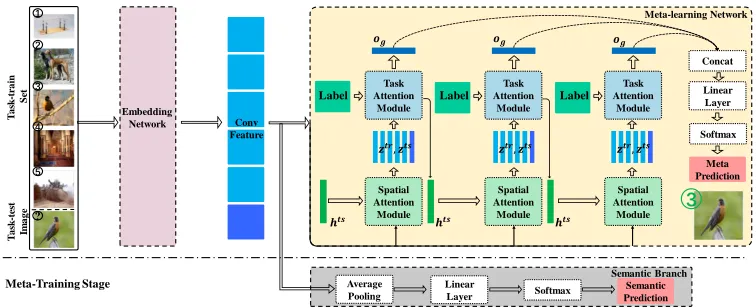
Figure 1: An illustration of few-shot classification via our attention-based network. See text for more details.
To improve its discriminative power, we can further refine the context-aware representation by stacking multiple lay-ers of two attention modules and the resulting deep network is referred as the Spatial-Task Attention Network (STANet). Figure 1 shows an overview of few-shot classification via our dual attention network.
For training our STANet, we design a multi-task loss to in-corporate the shared class semantics of all tasks and to learn a meta-level classification strategy. To this end, we introduce a semantic branch and integrate a semantic prediction loss for the embedding network with a meta-classification loss for the overall network.
We evaluate our STANet extensively on three challeng-ing few-shot image classification benchmarks, includchalleng-ing the Omniglot dataset, MiniImageNet and a new dataset based on the CIFAR-100. The empirical results and ablative study demonstrate the superior or comparable performance of our method over the prior state-of-the-art approaches. The main contributions of our work are two-fold:
• We develop an efficient attention-based deep network for
one-shot prediction, which is also easy to interpret in terms of learned knowledge for task-level generalization. Our network achieves the state-of-the-art accuracies with much fewer parameters and simpler network structure.
• We propose to learn a semantic-aware representation for
few-shot classification, which exploits the label correla-tion across tasks and locacorrela-tion of objects. Moreover, we build a new benchmark of few-shot classification based on CIFAR-100 to study the impact of task similarity and benefits of shared representations.
2
Related Work
Few-shot learning: Inspired by data-efficient learning in human cognition (Lake et al. 2011), few-shot learning aims to learn a new concept representation from only a few train-ing examples. Such a learntrain-ing paradigm has attracted much attention in the literature (Fei-Fei, Fergus, and Perona 2006; Vinyals et al. 2016; Ravi and Larochelle 2017) as the tra-ditional data-driven deep learning approaches, despite their recent success, have difficulty in handling new classes with
limited data annotation (LeCun, Bengio, and Hinton 2015). Existing few-shot learning approaches can be largely cat-egorized into three main groups: Bayesian learning based, metric learning based and meta-learner based methods.
Early works on few-shot learning aim to build a Bayesian prior model that can be transferred to new classes. Fei-Fei et al. (2003; 2006) utilized a hierarchical Bayesian model to represent the prior knowledge on visual classes for one-shot image classification. More recently, Lake et al. (2015) proposed a hierarchical Bayesian program learning (HBPL) to effectively learn the prior knowledge on object categories. A second strategy in few-shot learning learns to predict class-agnostic similarity between data instances. In particu-lar, deep siamese network (Koch, Zemel, and Salakhutdinov 2015) trains a convolutional network to embed data samples so that samples in the same class are close while samples in different classes are far away. Recent works (Vinyals et al. 2016; Shyam, Gupta, and Dukkipati 2017; Snell, Swersky, and Zemel 2017; Triantafillou, Zemel, and Urtasun 2017) re-fine this idea by introducing recurrent network structure, at-tention mechanisms, or novel learning objective to improve the similarity learning. Sung et al. (2018) propose to use relation networks to compare the images within episodes. However, these methods typically rely on a global feature representation of images and thus lack the capacity to choose relevant regions when embedding the images. In contrast, our approach employs dual attention mechanism to focus on object features in images.
In addition to the meta-optimizers, other complex deep network models have been adopted as meta-learners for few-shot learning, such as memory augmented neural net-works (Santoro et al. 2016), graph neural netnet-works (Sator-ras and Estrach 2018) and Meta networks (Munkhdalai and Yu 2017), which encode a meta-level inductive biases across tasks. Temporal convolution network (Mishra et al. 2018) models each classification task as a sequence prediction problem. Recently, (Qiao et al. 2018) propose to generate the parameters of the last network layer from the activations of a pre-trained feature embedding. (Gidaris and Komodakis 2018) use an attention kernel to produce a mixing of pre-trained linear weights for novel categories. In contrast to these models, our method is based on a simple attention-based neural network that has a compact structure and is easy to interpret in terms of learned prior knowledge.
Attention-based representation: Attention mechanism enables a deep network to attend relevant parts of input data, which is important for learning an object representation ro-bust toward cluttered background. Additive attention (Bah-danau, Cho, and Bengio 2015; Xu et al. 2015) and multi-plicative attention (Vaswani et al. 2017; Sukhbaatar et al. 2015) are the two most commonly used attention mecha-nism. We exploit the self-attention (Vaswani et al. 2017) to capture the data similarity in our method. The Matching Network (Vinyals et al. 2016) also uses an attention mecha-nism over a learned embedding of training examples to pre-dict classes for the test data. By contrast, our dual attention network further incorporates the spatial attention (Xu et al. 2015) to learn a better representation of input images.
3
Problem Setting and Overview
We aim to learn an image classification model that can pre-dict object classes using only a few annotated images per class as training data. To this end, we formulate the few-shot image classification as a meta-learning problem (Vinyals et al. 2016). Formally, we consider each instance of few-shot
classification as a taskT (also calledan episode) sampled
from a task distributionT. Each taskTis defined by a class
label setLT, a task-train setDtrT (also calledsupport set)
consisting ofN annotated images, and a task-test example
xts
T with its groundtruth class labely
ts
T ∈LT. The task-train
setDtrT ={(xT(1), y(1)T ),· · ·,(x(TN), yT(N))}, wherex(Ti) de-notes thei-th input image in task T, andy(Ti) ∈ LT is its
class labels,1≤i≤N.
The problem of meta-learning is to build a meta-learner
M, or a mapping from the task-train setDtrT and the
task-test dataxts
T to the task-test labelyTts. Its learning framework
typically consists of two phases: training and meta-test. In the meta-training phase, we train the meta-learner
M on a set of tasks {T = (LT,DtrT,x
ts T, y
ts
T)} sampled
fromT, denoted asSmeta
tr . The entire label set used in
meta-training is denoted byLtr=∪T∈Smeta
tr LT. In the meta-test
phase, we evaluate the meta-learner by testing it on a sepa-rate set of taskSmeta
ts with new classes only. In other words,
let the label set in the meta-test beLts=∪T∈Smeta
ts LT, and
we haveLtr∩ Lts=∅. We use the one-shot learning setting
throughout the model sections for notation clarity.
In this work, we address the meta-learning problem in the context of image classification by explicitly incorporating spatial and semantic cues of object categories and develop an easy-to-interpret deep network architecture for few-shot classification. Our approach is motivated by three key ob-servations: 1) Object categories are mostly localized in the images and using only relevant features allows us to learn an object representation robust toward background clutters; 2) A simple attention mechanism can be used to find semanti-cally similar images and encode the context of task-train set
Dtr
T for label prediction; and 3) A good image
representa-tion is critical for building an effective meta-learner and can be learned by incorporating the semantic class information
across the individual tasks (i.e., Ltr) in the meta-learning
setting. We instantiate these ideas by designing a deep dual-attention neural network for the few-shot image classifica-tion problem, which is detailed in the following secclassifica-tion.
4
Model Architecture
We now introduce our deep neural network based meta-learner, which learns a class-relevant feature representation of images based on a spatial attention and a context-aware representation of test instances using a task attention. To ef-fectively train the dual-attention network, we also propose a meta-learning loss with novel semantic regularization.
Specifically, our deep network consists of two main
net-work modules: anembedding network module that
com-putes convolutional feature maps for all the images in the input(Dtr
T,xtsT)and ameta-learning networkthat uses a
dual spatial-task attention mechanism to predict the task-test labelyts
T. To facilitate the network learning, we also
in-troduce an auxiliarysemantic branchin the meta-training
stage. We refer to our deep meta-learner as the Spatial-Task Attention Network (STANet). An overview of our entire model pipeline with two attention layers is shown in Figure 1 and we will describe each module in details below.
4.1
Embedding network
Given a task (or episode), the first stage of our STANet is an embedding network module that extracts convolutional feature maps of every training and test image in this task. The embedding module consists of a series of convolution layers with residual connections and multiple strides (He et al. 2016). Unlike prior work, we do not collapse the image feature maps into a feature vector with full-connected layers. By maintaining the spatial structure of the feature maps, we are able to select regions relevant to the image categories, and ignore the background clutters in the next stage.
Formally, denoting the embedding network as F and a
taskT = (L,Dtr,xts, yts), we compute the feature maps
of images inTas,
Ctri =F(x(i)), x(i)∈Dtr,1≤i≤N, (1)
Cts=F(xts) (2)
whereCtr
i andCtsare feature representations of task-train
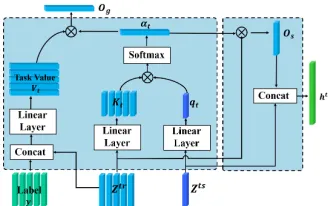
in-Figure 2: Spatial attention module of meta-learning branch, which generates object-aware representations of images.
dexT for clarity. Let(Hf, Wf)be the height and width of
the feature maps. We represent the features as a matrix in Rnch×nloc, wheren
chis the number of feature channels and
nloc=Hf×Wf.
4.2
Meta-learning network
Taking as input the conv features and task-train labels (Dtr,xts), the second component of the STANet is a meta-learning network that builds a classifier to predict the class
label yts. To achieve this, we introduce a dual-attention
mechanism to locate the relevant image regions and produce a context-aware representation of task-test image for trans-ferring task-train labels.
We implement the dual-attention mechanism as a spatial-task attention (STA) layer, composed of a spatial attention and a task attention module. The STA layer takes the
im-age features and task-train labels inT to produce a
context-aware representation of the test examplexts, which also
al-lows us to stack multiple STA layers to generate a set of refined task-test image features for classification. Below we will introduce those two attention modules and an one-layer STA network first, followed by the multi-layer STA network.
Spatial attention module To focus on the regions related to their semantic class, we introduce a spatial attention mod-ule to generate object-centric representations of images in a task by exploiting spatial information in the conv features.
Specifically, we derive a spatial attention mapas for each
conv feature mapC∈ {Ctr
i }Ni=1∪ {Cts}based on the task-test feature, which will be detailed below. Here the attention
as ∈ ∆nloc,∆nloc = {as ∈ Rnloc,a
s 0,1|as = 1},
indicating the relevance of each spatial site w.r.t. the
tar-get class yts. Given the attention map a
s, we can take a
weighted average of the feature map to obtain an
object-centric representationz=a|
sC, wherez∈Rnch.
To compute the attention maps, we first estimate a
task-test representationhts ∈
Rdh that captures distinctive
fea-tures of the test class of the task. We initializehtsby taking
an average pooling of the test feature mapCts, which
typ-ically generates a global semantic feature descriptor for the
test image. We use the task-test representationhtsas a query
and search for the relevant spatial sites on the conv feature maps. Formally, we adopt the attention mechanism proposed
in (Vaswani et al. 2017), which maps the query feature (hts)
and the conv features ({Ctri }N i=1∪ {C
ts}) into a key space,
and measures the key similarities based on their inner
prod-uct. To this end, we apply an1×1convolution to each conv
Figure 3: Task attention module produces context-aware rep-resentations for few-shot classification via task attention.
feature mapCto compute its key representationKs, and a
linear transform to the queryhtsto compute its keyq
s:
qs=Wqsh ts, K
s=WKsC (3)
where Wqs ∈ R
dks×dh, W
Ks ∈ R
dks×nch, and the
di-mensions of the resulting keys are qs ∈ Rdks andKs ∈
Rdks×nloc. The spatial attention map on Cis then derived
by a weighted inner product between the query and the conv feature keys, followed by a softmax function:
as=softmax
qsKs
p
dks
!
(4)
Such an attention map will have larger weights on the loca-tions sharing similar features as the task-test representation. For each task, the spatial attention module generates an at-tention map for every task-train and task-test image, and we denote them as{a(si)}Ni=1 andatss respectively. Given those
attention maps, we compute an object-aware feature repre-sentation for each image as follows:
zts=atss|Cts, ztri =as(i)|Ctri , 1≤i≤N, (5) wherezts,ztr
i ’s∈Rnch. Figure 2 shows the structure of the
spatial attention module.
Task attention module Given the object-centric image features zts,{ztr
i }Ni=1 of a task, the second module of the
meta-learning network aims to produce a context-aware test feature for predicting the test classyts. Our goal is to find the
task-train instances that are semantically similar to the test one for label transfer. To this end, we implement a task atten-tion mechanism inspired by (Mishra et al. 2018) to compute the context-aware test feature.
Concretely, we use the task-test image feature zts as a
query and produce a task attention vector at ∈ ∆N (here
∆ denotes a simplex). Each element of the task attention
vector encodes the similarity between the task-test feature and the corresponding training feature. We adopt a similar strategy as in the spatial attention module: First, we
com-pute the key representations as qt = Wqtzts, Kt =
WKt
ztr
1,ztr2,· · ·,ztrN
, whereWqt ∈R
dkt×nch,W
Kt ∈
Rdkt×nch, and the dimensions of the resulting keys areq t∈
Rdkt andKt∈Rdkt×N. The task attention on the task-train
set is then calculated byat=softmax
qtKt
√
dkt
Given the task attention, we compute a context-aware rep-resentation to encode the task-train examples that are simi-lar to the test instance, which is then used to predict the test label. Specifically, we compute a linear embedding of the training features and labels, and take the weighted average
of the embedded features based on the task attentionat:
Vt=Wvt
ztr
1
y1
,
ztr
2
y2
,· · · ,
ztr N
yN
(6)
og=a|tVt, (7)
where yi are the one-hot encoding of label y(i) for a
given task, and y(i) ∈ {1, . . . ,|L|}. The embedding
ma-trixWvt ∈ R
dvt×(nch+|L|), the embedded feature V t ∈
Rdvt×N, and the context-aware representationog ∈ Rdvt.
Hereogcan be viewed as a summary of the task-train
infor-mation relevant for predicting the test class in the task. The computation flow of this module is illustrated in Figure 3.
Based on the context-aware feature, we predict the label of the task-test instance by a fully connected layer followed by a softmax function as follows,
Pmeta=softmax(Woog) (8)
wherePmeta ∈∆|L|is the probability vector over the label
space of the task,Wo∈R|L|×dvtis the weight for the fully
connected layer, andyˆts
meta = argmaxl∈{1,...,|L|}Pmeta(l)
is the predicted label.
Multi-layer STA Net Our one-layer STA network relies
on an estimated task-test representationhtsto initialize the
first spatial attention module and hence the efficacy of our
dual attention mechanism depends on the quality of hts .
While the average pooling provides a good initial estimate,
our task context featureogcan be further improved given a
better task-test representation. Specifically, we re-estimate
the task-test representation hts at the end of the task
at-tention module based on the featureszts and an
attention-weighted average of{ztri }N i=1:
os=a|t
ztr1,ztr2, . . . ,ztrN
, hts= [zts|,o|s]| (9)
whereos ∈ Rnch encodes the task context and is used to
enrich the test featurezts.
Using the newhts, we stack a second STA-layer into the
meta-learning module and generate a new task context
pre-sentationog. Such process can be repeated and produceM
outputs{o(0)g ,o(1)g ,· · · ,o(gM−1)}with anM-layer STA
net-work. We concatenateo(gm)s from all the STA layers to form
a multi-level task-context representation, which is then pass through a logistic regressor to predict the final label.
4.3
Meta-training with semantic regularization
To estimate the model parameters, we train our STANet in the meta-learning framework. Specifically, we assume a
meta-train datasetSmeta
tr = {T = (LT,DTtr,xtsT, ytsT)} is
provided in the meta-train stage, which is sampled from the
task distribution T. Our goal is to minimize the expected
task loss by learning an image representation through the embedding network and a spatial-task attention mechanism
through the meta-learning network. To this end, we propose a novel meta-learning loss that consists of the empirical task loss on the meta-train dataset and a semantic loss that ex-ploits the class correlation between different tasks.
The empirical task loss is the average log-loss of the net-work predictions on the task-test instances, defined as,
Ltask(Θ) =
X
T∈Smeta tr
−logPmeta(ytsT|DtrT,xtsT; Θ)
|Smeta tr |
(10)
whereΘdenotes all the model parameters.
To learn a better embedded feature representation, we fur-ther introduce a semantic loss defined on a shared class space across different tasks. To achieve this, we augment the embedding network with a Semantic Branch that
pre-dicts a label distribution in the global label spaceLtr. This
allows us to inject additional supervisory signal into the em-bedding network training. Specifically, our semantic branch
takes average pooling on each convolutional feature mapC
and passes the resulting features through a logistic
regres-sor, which predicts a label distributionPsem ∈ ∆|Ltr|over
the global label set,
Psem=softmax(Wsem1|C) (11)
whereWsem is the weight for the logistic regression. The
semantic loss is defined by the average log-loss of the se-mantic branch prediction:
Lsem(Θ) =
X
T∈Smeta tr
X
(xT,yT)
−logPsem(yT|xT; Θ)
|Smeta
tr |(|Dtr|+ 1)
(12)
where the dataset size equals to the number of task-train data
|Dtr
T|plus the number of task-test examples. And the overall
meta-train loss is defined as,
Lf ull=Ltask(Θ) +λLsem(Θ) (13)
whereλis a weight balancing the regularization from the
se-mantic loss. As the sese-mantic loss is closer to the embedding network and shared across different training tasks, it enables us to significantly speedup the feature learning, and learn a better convolutional feature representation for the meta-learning network.
5
Experiments
We evaluate our STANet method on the task of few-shot image classification by conducting a set of experiments on three datasets. In addition to two publicly-available datasets, MiniImageNet (Krizhevsky, Sutskever, and Hinton 2012) and Omniglot (Lake, Salakhutdinov, and Tenenbaum 2015), we propose a new few-shot learning benchmark using real-world images from CIFAR100 (Krizhevsky and Hinton 2009), which is referred to as Meta-CIFAR100 dataset. In this section, we introduce the datasets and report detailed
experimental results. We perform differentN-waym-shot
experiments on the three datasets, with 95% confidence in-terval in the meta-test phase1.
1
Table 1: MiniImageNet Performance. STANet-S refers to shallow embedding network.
Method # Params Feature 5-way Accuracy Extractor 1-shot 5-shot Matching Net (Vinyals et al. 2016) 0.1M Conv64 43.56±0.84% 55.31±0.73%
Prototypical Net(Snell et al. 2017) 0.1M Conv64 49.42±0.78% 68.20±0.66%
MAML (Finn et al. 2017) 0.1M Conv64 48.70±1.84% 63.11±0.92%
RelationNet(Sung et al. 2018) 0.23M Conv64 50.44±0.82% 65.32±0.70%
(Gidaris et al. 2018) 0.24M Conv64 56.20±0.86% 72.81±0.62%
GNN (Satorras et al. 2018) 1.6M Conv64 50.33±0.36% 66.41±0.63%
STANet-S(1-Layer) 0.24M Conv64 50.38±0.65% 65.67±0.66%
STANet-S(3-Layer) 0.24M Conv64 53.11±0.60% 67.16±0.66%
SNAIL (Mishra et al. 2018) 6.1M ResNet-12 55.71±0.99% 68.88±0.92%
(Gidaris et al. 2018) 2.6M ResNet-12 55.45±0.86% 70.13±0.68%
(Qiao et al. 2018) 40.5M WRN-28 59.60±0.41% 73.74±0.19%
STANet(1-Layer) 2.6M ResNet-12 57.25±0.40% 69.45±0.50%
STANet(3-Layer) 2.6M ResNet-12 58.35±0.57% 71.07±0.39%
Table 2: Ablation study for STANet on MiniImageNet using 3 layers dual-attention. SR-Semantic Regularization, SA-Spatial Attention, TA-Task Attention.
Components 5-way(Normal)
SR. SA. TA. 1-shot 5-shot
7 Uniform 3 53.41±0.61% 64.32±0.57%
7 Gaussian 3 54.29±0.66% 65.41±0.55%
7 3 3 55.52±0.64% 66.75±0.62%
3 3 3 58.35±0.57% 71.07±0.39%
5.1
MiniImageNet
Dataset. MiniImageNet is a subset of the ILSVRC-12
dataset (Russakovsky et al. 2015), consisting of84×84RGB
images from 100 different classes with 600 examples per class. We adopted the splits proposed by (Vinyals et al. 2016; Ravi and Larochelle 2017) with 64 classes for training, 16 for validation, 20 for testing in the meta-learning setting.
Quantitative Results. We compare the performance of our STANet with previous state-of-the-art meta-learning methods in Table 1. The top section compares our networks with other methods using the same shallow embedding net-work, while the bottom section shows comparison results with deeper embedding networks. In both settings, our 3-Layer STANet outperforms the previous approaches that use the same type of embedding networks by a sizable margin. Moreover, our network achieves comparable accuracies to (Qiao et al. 2018)’s method but has a much simpler architec-ture: only 6% of their model in parameter size.
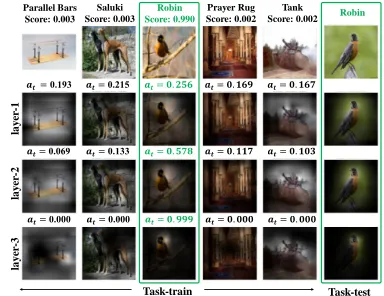
Visualizing Results. To understand the dual attention mechanism, we visualize the spatial attentions of the 3-Layer STANet by overlaying them on the images and the task attentions in Figure 4. We can see that spatial atten-tion helps the model locate salient region of task-test image (e.g., the foreground objects), and the matching regions in the task-train set. Based on the localized features, the task attention weight for each task-train image indicates how rel-evant an image is for predicting the label of the task-test im-age. Moreover, Figure 4 shows that spatial attention gener-ates sharper focuses on salient regions with increasing num-ber of layers, while task attention also concentrates more on
Parallel Bars Score: 0.003
Saluki Score: 0.003
Robin Score: 0.990
Prayer Rug
Score: 0.002 Robin Tank Score: 0.002
Task-train Task-test
la
y
er
-3
la
y
er
-2
la
y
er
-1
Figure 4: Visualization of attention maps in the 3-Layer STANet on one-shot classification (MiniImageNet). Green indicates the correct class for the test image. First row: input images, classes and predicted scores. Second-Fourth row:
spatial attention-masked images.atdenotes the task
atten-tion values.
Figure 5: Validation curves of the STANet with and with-out the semantic branch. Green curve shows the training of the full STA-Net and Red curve is for the STA-Net without semantic branch.
the task-train image in the same class as the task-test ones.
Ablation Study. We conduct a series of ablation studies to evaluate the importance of each component used in our STANet model. Table 1 and Table 2 summarize the results of our ablative experiments, in which we compare our full model with several partial model settings.
First, we compare the single-layer STANet with the multi-layer model in Table 1 (last two rows). We can see that the multi-layer STANet further promotes the accuracies in both few-shot settings. While the improvement seems mild, it demonstrates that more STA layers can refine the image representations to achieve better performance.
Second, in Table 2, we create three baseline models by removing the semantic branch or the spatial attention. By comparing with the full model, we show that adding the se-mantic branch improves the performance of the model from
55.52% to58.35% with a3%gain. We also compare our
Table 3: Classification on CIFAR-100
Method # Params Feature Easy Moderate Hard
Extractor 1-shot 5-shot 1-shot 5-shot 1-shot 5-shot
MAML (Finn et al. 2017) 0.1M Conv64 55.17±1.90% 74.12±0.86% 46.30±1.90% 58.49±0.94% 38.46±1.83% 52.17±0.89%
STANet(1-layer) 0.1M Conv64 65.51±0.44% 78.31±0.38% 56.62±0.46% 67.38±0.51% 42.94±0.41% 54.91±0.38%
STANet(3-layer) 0.1M Conv64 66.11±0.42% 78.54±0.51% 57.31±0.39% 68.71±0.43% 42.98±0.43% 55.23±0.42%
note that the MiniImageNet has a strong center-bias, which may cause the mild improvements.
Finally, we compare the training process of the full STANet model with the STANet without semantic regular-ization. We plot the validation performance curves of these two STANets during training in Figure 5. It is evident that the semantic branch is able to improve the convergence and the final performance significantly, which indicates that the full STANet exploits the semantic information efficiently.
5.2
Meta-CIFAR100
Dataset. To investigate the impact of task distributions in the few-shot learning, we design a new few-shot classifi-cation benchmark, Meta-CIFAR100, based on the CIFAR-100(Krizhevsky and Hinton 2009) dataset. We use all the classes from the CIFAR-100 in our dataset, which contains
32×32RGB images from 100 classes with 600 images per
class. The label classes of CIFAR100 have a balanced hier-archical structure: they are included in 20 parent categories and each parent category comprises 5 base categories. This allows us to design different types of task distributions when building training and test splits in the meta-learning setting. Specifically, we introduce three kinds of dataset splits:
Easy,ModerateandHardas follows2, which indicates how
related the test tasks are to the training tasks, and how much semantic knowledge can be transferred.
Easy: We choose one base category from each parent
cate-gory to construct the meta-test set, which represents the case that at the meta level, the test and train set are from different categories but share the same parents.
Moderate: We select 2 or 3 base categories from 7 parent categories to build the meta-test set with 20 base classes, and use the remaining 80 classes for the meta-train set.
Hard: We choose 4 parent categories randomly, and use
their 20 base categories as the meta-test set. The remaining 16 parent categories and 80 base categories are employed for the meta-train set.
Experimental Results. Our experiments on the Meta-CIFAR100 dataset aim to investigate the impact of the task distribution in the few-shot classification. We include the MAML method (Finn, Abbeel, and Levine 2017), which has released its code, for comparison with the state of the art.
From results in Table 3, we can see that our approach outperforms the baseline method by a large margin in all three different settings. In addition, as the STANet is able to exploit the semantic similarity during feature learning,
it achieves the largest performance gain for theEasycase
2
We include more split details in the supplementary material.
Table 4: Omniglot Performance
Method # Params Feature 5-way Accuracy Extractor 1-shot 5-shot Matching Net (Vinyals et al. 2016) 0.1M Conv64 98.1% 98.9%
Prototypical Net (Snell et al. 2017) 0.1M Conv64 97.4% 99.3%
GNN (Satorras et al. 2018) 0.4M Conv64 99.2% 99.7%
MAML (Finn et al. 2017) 0.1M Conv64 98.7±0.4% 99.9±0.3%
SNAIL (Mishra et al. 2018) 2.7M Conv64 98.96±0.20% 99.75±0.11%
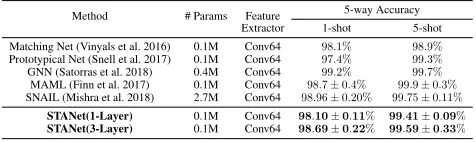
STANet(1-Layer) 0.1M Conv64 98.10±0.11% 99.41±0.09%
STANet(3-Layer) 0.1M Conv64 98.69±0.22% 99.59±0.33%
where the meta-train and meta-test sets have the highest sim-ilarity in semantic features. When the meta-train and test are less similar, the meta-learning task becomes more difficult but the performance gap only decreases mildly.
5.3
Omniglot
Dataset. The Omniglot dataset (Lake et al. 2011) consists of 1623 characters (classes) from multiple alphabet vocabu-laries. We follow the setting in (Vinyals et al. 2016) to split the dataset into 1200 classes for training and the remain-ing 423 for testremain-ing, and augment the dataset by rotation pro-posed by (Santoro et al. 2016).
Experimental Results The Omniglot dataset (Lake et al. 2011) has been widely used for testing few-shot learning methods and most recent methods achieve strong perfor-mances. Here we use it as a sanity check to validate our method. For semantic regularization, we choose the parent level of the base categories, which include 39 classes, as a coarse-level supervision in training the embedding network. The overall comparison results are shown in Table 4. We can see that our STANet achieves competitive performance on the Omniglot dataset in comparison with the state-of-the-art methods. This indicates that our approach performs well on different types of image data.
6
Conclusion
References
Andrychowicz, M.; Denil, M.; Gomez, S.; Hoffman, M. W.; Pfau, D.; Schaul, T.; and de Freitas, N. 2016. Learning to
learn by gradient descent by gradient descent. InNIPS.
Bahdanau, D.; Cho, K.; and Bengio, Y. 2015. Neural Ma-chine Translation by Jointly Learning to Align and Trans-late. InICLR.
Cheng, Y.; Yu, M.; Guo, X.; and Zhou, B. 2017. Few-shot
learning with meta metric learners. InNIPS 2017 Workshop
on Meta-Learning.
Fei-Fei, L.; Fergus, R.; and Perona, P. 2003. A bayesian approach to unsupervised one-shot learning of object
cate-gories. InICCV.
Fei-Fei, L.; Fergus, R.; and Perona, P. 2006. One-shot
learn-ing of object categories. TPAMI.
Finn, C.; Abbeel, P.; and Levine, S. 2017. Model-agnostic
meta-learning for fast adaptation of deep networks. In
ICML.
Gidaris, S., and Komodakis, N. 2018. Dynamic few-shot
visual learning without forgetting. InCVPR.
He, K.; Zhang, X.; Ren, S.; and Sun, J. 2016. Deep residual
learning for image recognition. InCVPR.
Koch, G.; Zemel, R.; and Salakhutdinov, R. 2015. Siamese
neural networks for one-shot image recognition. InICML
Deep Learning Workshop.
Krizhevsky, A., and Hinton, G. 2009. Learning multiple
layers of features from tiny images. Technical report,
Uni-versity of Toronto.
Krizhevsky, A.; Sutskever, I.; and Hinton, G. E. 2012.
Imagenet classification with deep convolutional neural
net-works. InNIPS.
Lake, B.; Salakhutdinov, R.; Gross, J.; and Tenenbaum, J.
2011. One shot learning of simple visual concepts. In
CogSci.
Lake, B. M.; Ullman, T. D.; Tenenbaum, J. B.; and Gersh-man, S. J. 2017. Building machines that learn and think like
people.Behavioral and Brain Sciences.
Lake, B. M.; Salakhutdinov, R.; and Tenenbaum, J. B. 2015. Human-level concept learning through probabilistic
pro-gram induction.Science.
LeCun, Y.; Bengio, Y.; and Hinton, G. 2015. Deep learning. Nature.
Li, Z.; Zhou, F.; Chen, F.; and Li, H. 2017.
Meta-SGD: Learning to Learn Quickly for Few Shot Learning. arXiv:1707.09835.
Mishra, N.; Rohaninejad, M.; Chen, X.; and Abbeel, P.
2018. A simple neural attentive meta-learner. InICLR.
Munkhdalai, T., and Yu, H. 2017. Meta networks. InICML.
Naik, D. K., and Mammone, R. 1992. Meta-neural networks
that learn by learning. InIJCNN.
Qiao, S.; Liu, C.; Shen, W.; and Yuille, A. L. 2018. Few-shot image recognition by predicting parameters from
acti-vations. InCVPR.
Ravi, S., and Larochelle, H. 2017. Optimization as a model
for few-shot learning. InICLR.
Russakovsky, O.; Deng, J.; Su, H.; Krause, J.; Satheesh, S.; Ma, S.; Huang, Z.; Karpathy, A.; Khosla, A.; Bernstein, M.; et al. 2015. Imagenet large scale visual recognition
chal-lenge. ICCV.
Santoro, A.; Bartunov, S.; Botvinick, M.; Wierstra, D.; and Lillicrap, T. 2016. Meta-learning with memory-augmented
neural networks. InICML.
Satorras, V. G., and Estrach, J. B. 2018. Few-shot learning
with graph neural networks. InICLR.
Schmidhuber, J. 1987. Evolutionary principles in
self-referential learning. On learning how to learn: The
meta-meta-... hook. Diploma thesis, TUM.
Shyam, P.; Gupta, S.; and Dukkipati, A. 2017. Attentive
recurrent comparators. InICML.
Snell, J.; Swersky, K.; and Zemel, R. 2017. Prototypical
networks for few-shot learning. InNIPS.
Sukhbaatar, S.; Weston, J.; Fergus, R.; et al. 2015.
End-to-end memory networks. InNIPS.
Sung, F.; Yang, Y.; Zhang, L.; Xiang, T.; Torr, P. H.; and Hospedales, T. M. 2018. Learning to compare: Relation
network for few-shot learning. InCVPR.
Thrun, S., and Pratt, L. 1998. Learning to learn: Introduction
and overview. InLearning to learn.
Triantafillou, E.; Zemel, R.; and Urtasun, R. 2017. Few-shot
learning through an information retrieval lens. InNIPS.
Vaswani, A.; Shazeer, N.; Parmar, N.; Uszkoreit, J.; Jones, L.; Gomez, A. N.; Kaiser, L. u.; and Polosukhin, I. 2017.
Attention is all you need. InNIPS.
Vinyals, O.; Blundell, C.; Lillicrap, T.; Wierstra, D.; et al.
2016. Matching networks for one shot learning. InNIPS.
Xu, K.; Ba, J.; Kiros, R.; Cho, K.; Courville, A.; Salakhudi-nov, R.; Zemel, R.; and Bengio, Y. 2015. Show, attend and tell: Neural image caption generation with visual attention.