Regulation and regulatory effectiveness
in public health
GUEST EDITOR
Stephen J. Corbett
Centre for Population Health, Sydney West Area Health Service Email: [email protected]
10.1071/NB08047
NSW PUBLIC HEALTH
BULLETIN
Vol. 19(11–12) • November–December 2008 State Health Publication PH 080306 ISSN 1034 7674
Regulation
Much of the global success of 19th century sanitary reform in developed economies was built upon the prescriptive, but effective, regulation of: urban water quality and sewage dis-posal; food safety; burials and mortuaries; noxious trades; and housing and building standards.1 Within New South Wales (NSW) these regulations were supported by a trained inspectorate and a system of governance at local govern-ment level, which endured more or less unchanged for 100 years after the first NSW Public Health Act of 1896.
Since the 1970s, regulatory modernisation in all arms of government has been driven by a need to reduce administra-tive red tape without compromising regulatory effecadministra-tive- effective-ness. This modernisation accepted that regulators would be more likely to succeed by being responsive to the context, conduct and culture of those being regulated, and by invok-ing escalatinvok-ing sanctions; that is, soft words before hard words, and carrots before sticks.2
Health departments have been slow to embrace regulatory reform, perhaps because many of these regulatory activities are now marginal and, to a degree, alien to the culture of health-care delivery. It is, however, significant that regula-tory reform has transformed the domains of environment protection, food safety and occupational health and safety, all of which originated in health departments and continue to have primary public health objectives.
This transformation began with the publication of the Robens Report in the United Kingdom in the 1970s.3Robens
argued that occupational health and safety regulation had become a complex mass of technical rules for workers to follow and inspectors to enforce. Not only were the regula-tions not understood by workers, they also undermined responsibility for safety throughout organisations by invit-ing the impression that safety was imposed from outside the workplace.4As a result of regulatory reform, organisations were to be given general duties of care for their employees’ occupational health and safety. Such duties were to be dis-charged by collaborating with the workforce to develop, document, implement and improve auditable safety man-agement systems.
The new style of regulation seeks to use its power of command in a way that is more analogous to good management – it seeks to encourage excellence at the same time as setting a standard, below which performance shall not fall.
Responsive regulation can be viewed as a regulatory pyramid comparable to the principle of a hierarchy of control of occu-pational or environmental hazards:5
• Voluntarism is based on an individual or organisational undertaking to do the right thing without any coercion.
• Self-regulation occurs where an organised group regulates the behaviour of its members (e.g. by establishing an industry-level code of practice). • Economic instruments involve economic sanctions or
incentives, or measures that give more power to consumers.
w w w. p u b l i s h . c s i r o. a u / j o u r n a l s / p h b CONTENTS – See back page
• Meta-regulation involves an external regulatory body (e.g. ensuring that health-care providers implement safety and quality programs and practices).
• Command and control involves enforcement by government (e.g. ensuring compliance with rules for licensing facilities).
Over the last few years, some of these principles of responsive regulation and modern approaches to regula-tory governance have found application not only in the more traditional public health fields such as environ-mental health, but also in areas as diverse as clinical safety and quality and research governance.
This edition of the Bulletin includes articles demonstrating the successful contribution of regulatory governance to public health. Byleveld and others assess the impact over the last 7 years of a responsive, regulatory framework to improve the quality of drinking water in rural NSW; Bloom and Frew outline the gains made in the regulation of clinical research. These contributions share the conclu-sion that the application of frameworks and systems rather than an elaborate and prescriptive list of requirements are vital to effective regulation.
Tutt provides a local perspective of tobacco control in his report of the enforcement of laws related to selling tobacco products to minors. He reminds us that all regulatory effort must be accompanied by the support of field staff in what is sometimes difficult work and by a commitment to the ongoing evaluation of the effectiveness of regulatory programs.
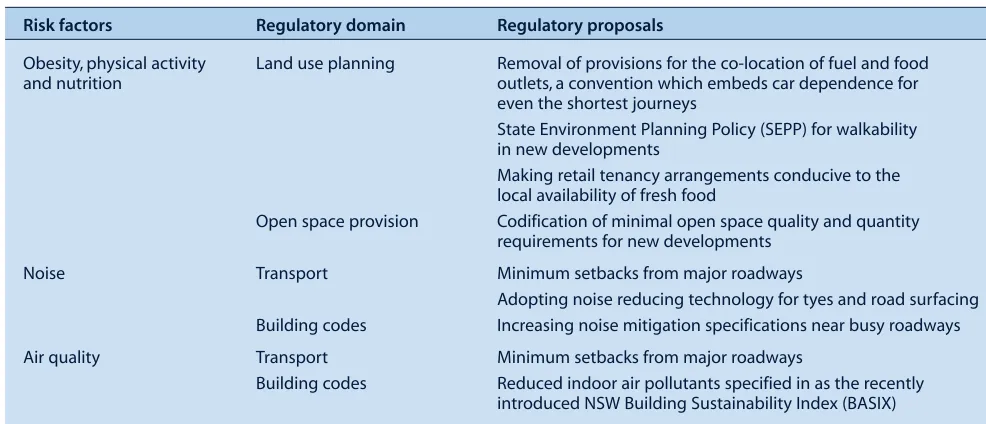
There is a need for constant vigilance and innovation in the development of public health regulatory frameworks. The regulation of the built environment has been a cornerstone of public health practice, but both technological progress and the increasing importance of chronic disease preven-tion are changing the nature of this task. I have discussed this aspect of public health regulation in a separate article.
Using the example of proposed future directions in tobacco regulation, especially the adoption of economic instru-ments to regulate unhealthy products, Penman provides some important and timely insights into how regulatory initiatives in public health should be framed so that they attract the support both of the community and our political representatives.
Regulation has become more common with the growth of private entrepreneurs and the introduction of market mechanisms into the public sector. These new bodies are seeking flexible, participatory and devolved forms of reg-ulation, in addition to traditional enforcement such as inspections.5A review of the NSW Public Health Act 1991 is currently underway and the articles in this issue provide some evidence of the growing awareness of both the utility and possibilities of modernised and effective public health regulation.
References
1. Hamlin C, Sheard S. Revolutions in public health: 1848, and 1998? BMJ 1998; 317: 587–91.
2. Ayres I, Braithwaite J. Responsive regulation: transcending the deregulation debate. New York: Oxford University Press; 1992.
3. Committee on Safety. Health at Work (Robens Committee). Safety and Health at Work: Report of the Committee 1970–72. London: HMSO; 1972.
4. Gruen N. Regulating for innovation. Centre for Policy Development. Sydney: Centre for Policy Development; 2008. Available at: http://cpd.org.au/article/regulating-innovation (Cited 10 November 2008.)
Vol. 19(11–12) 2008 NSW Public Health Bulletin | 195
Regulation for health in the modern era has its foundations in the English Public Health Act of 1848 and the imprint of this legislation can still be found in legislation of most jurisdictions formerly under the British Empire. The miasma theory of disease was then accepted wisdom and legislation was concerned with controlling environmental causes of disease and conferring the powers required to do so. Public Health Acts have retained their focus on health protection, i.e. on controlling the microbial, physical, toxic and xenobiotic causes of disease.
Containing the potential for these hazards to cause disease remains essential, but the regulatory debate focuses around how great a degree of protection, or safety margin, is required and how regulatory efficiency may be improved. Functions integral to early boards of health, such as build-ing regulation, have been spun off to other agencies. In con-sequence, the focus within health departments on the regulatory craft has diminished, displaced by a focus on health services and related programs.
Regulation for chronic disease control:
the pathfinder role of tobacco
Abstract: Regulation for health in the modern era
has its foundations in the English Public Health
Act of 1848. Early legislation was concerned with
controlling environmental causes of disease. However, the focus on regulation today within health departments has diminished, displaced by a focus on services and related programs. The regu-latory debate is now centred on what degree of pro-tection, or safety margin, is required, and how regulatory efficiency may be improved. The example of tobacco control is reviewed to show how regulation can play a large role in chronic disease control, and consideration given to how regulatory tools could be further diversified and regulatory effectiveness improved.
Andrew Penman
The Cancer Council NSW Email: [email protected]
Population health goals in the early 21st century mostly focus on reducing mortality from chronic disease and the compression of associated morbidity.1 These conditions share common proximate risk factors rooted in lifestyle. Health promotion developed largely to change lifestyle behaviours through education and social change – a change mediated though information, services, the built environ-ment and organisational practice. In this paradigm, the role of health protection, or health regulation, has been min-imised, and the title given to the frontline warrior of the first public health act – Inspector of Public Nuisances – seems out of place in these more egalitarian times.
Developments in health regulation
Health promotion has resulted in a more explicit under-standing of the diversity of the health environment and recognition that individual behaviour is profoundly affected by social context. Human behaviour and the environment interact, and environmental regulation can play an important role in chronic disease control. This understanding has required an evolution in the philosophy and practice of health regulation. The story of tobacco control illustrates the role that regulation can play in mod-ifying behaviours and lifestyles.
One development is in our understanding of chronic disease. Traditional health protection excelled at elimina-tion of a hazardous agent at source. In chronic disease, spe-cific regulatory measures are crafted to eliminate not the proximate cause of disease, but any of a number of con-tributory causes. Taken as a whole, these measures may be demonstrably effective in reducing risk, but the contribu-tion of any single measure may be moderate to minor. Advertising bans, tax increases, smoke-free public places, on-pack warnings and point-of-sale restrictions have all contributed to smoking abatement. Although evidence can be adduced to demonstrate short-term impact on behav-iour, it is more difficult to isolate the impact of each measure on smoking prevalence, and especially to predict this in advance of a regulatory decision.2The statement, “Why don’t you just ban the stuff?”, heard in popular dis-course on tobacco illustrates the public expectation that our measures should be more decisively effective.
Another development has been to recruit regulatory instru-ments from outside the health sector, appropriate to the environmental–behavioural goals. In tobacco control, taxing
10.1071/NB08055
powers – state tobacco licensing fees and now federal excise – have been imposed at unprecedented levels to raise the cost of tobacco dramatically, well beyond the level needed to fund the treatment of the health consequences of smoking. Price remains one of the most effective measures for lowering smoking and consumption rates.3
A third change has been to transfer enforceable sanctions from the person who commits a hazardous act to the person who creates the circumstances that contribute. One cannot yet be personally fined just for smoking. This is not without precedent in public health law – owners as well as occupiers are enjoined to comply with controls on dwellings – but the extent to which this has been pursued in tobacco control is extraordinary. The ban on advertising in any form includes a striking assumption of powers over broadcasting, rewriting generally accepted freedoms in communication.
Many factors have contributed to the regulatory achieve-ments in tobacco.
1. Regulation has followed rather than led social norms. All credit here to health advocates and communicators who have transformed social consciousness on tobacco.
2. Advocacy has deliberately undermined the credibility of the tobacco industry and its influence with
government, reducing the political price that government may pay for regulation.
3. Research into tobacco and tobacco control has been critical to developing the evidence base for regulation. The Cancer Council Victoria has led the world in high quality research not only in creating the case for regulatory reform, but as importantly, also in validating the outcomes of regulation.
4. Regulation is very cost-effective. Over the long term, governments have been reluctant to spend money on health promotion strategies in tobacco. One could argue for greater spending on the implementation of regulation but governments prefer measures that are inexpensive to implement.
5. Regulation leverages the effectiveness of
non-regulatory strategies. It is striking how effective Australian tobacco social marketing campaigns have been despite limited expenditure compared to that in the USA. It is likely that the absence of pro-tobacco marketing in Australia lies behind this outcome.
Future tobacco legislation
Governments have treated tobacco in an exceptional way compared to products of lesser risk, like heroin in medical practice or lead in petrol, which have been scheduled or regulated to extinction. Even though it is tempting to revert to this course as the prevalence of smoking falls, it is this exceptionalism that provides some precedent for how other risks might be regulated. There are several ways
in which tobacco regulation might be extended in the future while keeping it a legal product. One important feature is that the regulations reduce commercial incen-tives to frustrate public health goals. All have implications for the broader control of chronic disease.
Licensing
On 22 April 2008, the New South Wales (NSW) govern-ment announced a number of reforms as part of its reform package Protecting Children from Tobacco and foreshad-owed a licensing system for tobacco retailers.4Although retailer reaction has been benign, the final proposal is for a negative licensing system, conferring the power to pro-hibit a business from selling tobacco if, for example, it sells to minors or displays tobacco products. A future direction for health-based licensing is to mould the retail tobacco environment actively by reducing the density of retail outlets, diminishing convenience retailing and mod-ifying the exchange that occurs within an outlet to encour-age quitting – akin to converting drug pushers into habit-management agents.
Statutory liability for tobacco-related harms
The industry mantra that tobacco is a legal product is used to absolve them from product liability. When claims have been pressed in the courts, the results have been mixed and the majority of litigants are deterred by the costs.
The Dust Diseases Act is an example of how the behaviour of business can change when the balance of power is shifted in favour of the damaged party. Tobacco smoke is a dust, and to bring tobacco-related harms within the purview of this Act is scientifically defensible. The risks of commercial loss arising from litigation for product related harm are presently too low to affect the industry’s returns. The imposition of liability though statute on the industry, and the simplification of the judicial path to redress, would increase the success rate of product-related claims for damages. This in turn would introduce the real risk of busi-ness loss and seriously reframe commercial incentives to sell tobacco, legal product or not.
Regulating tobacco emissions
Vol. 19(11–12) 2008 NSW Public Health Bulletin | 197
regulation and license tobacco companies to pollute. This shifts the focus of regulation from the uncertainties of
individual dose exposure and harms to population
expo-sure. It could be accomplished by transforming the current excise regime into a Pareto tax imposed on cigarette emis-sions, weighted according to the harmfulness of specific constituents.7(A Pareto tax – or Pareto efficient tax – is one designed to redistribute economic allocations or outputs so as to optimise welfare. The point at which no further welfare gains can be made from further redistribu-tions is termed the Pareto optimum.) With the imposition of penalties, the same system could be used to cap the aggregate weighted emissions delivered into the lungs of Australians and lower this cap progressively.8 While the idea of positively sanctioning commercial trade in deadly products may appal some, it has the virtue of improving on the current situation where the tobacco industry has an unfettered licence to pollute the lungs of Australians. The effect of this change would be to turn the science and product development endeavours of a powerful industry somewhat more towards meeting rather than frustrating public health goals.
Compulsory acquisition of commercial information
Information asymmetry is an impediment to evidence-based public health practice. The expenditure and efforts of health agencies and public health researchers to under-stand, anticipate and respond to the tobacco epidemic are puny compared to the information and research amassed by the tobacco industry. A requirement that all information on product and the market be made available to public health agencies for tobacco-control purposes could stop this cat and mouse game.
Shifting the incidence of costs in tobacco control
It seems beyond argument that the tobacco industry is the principal vector in the tobacco epidemic. However, there are other players, who wittingly or unwittingly, for profit or not, play a contributory role. For example, there is strong evidence that the glamorous portrayal of smoking in movies promotes youth smoking. At the moment, the community bears the cost of countering this effect. It is open to regulators to impose this cost on the cinema, film and television industries by requiring them to run approved anti-smoking advertisements in association with movies promoting smoking.9
A great barrier to effective regulation in chronic disease lies in the social framing of propositions for state inter-ventions in health. Health is not alone in having a culture removed from the mainstream and seen as self-referential. The acceptance of health protection in the nineteenth and early twentieth centuries rested on a particular view of the public interest – one where the measure concerned reflected an interest in common to all members of society, or at least a preponderant proportion. The perception of an
imminent common threat is a powerful motivator for regulation, providing a groundswell of support even for cost-ineffective measures.
However, with hazards that are seen to involve the personal assumption of risk – be it obesity, sedentary behaviour, smoking or drinking – this view of the public interest is unsound, and opposition frames regulatory controls as a social engineering intrusion into individual rights and free-doms. The libertarian view restricts the domain of public regulation to ensuring the provision of information only and holds the unfettered exercise of private property rights as essential to liberty.
However, as Feintuck explains, at the core of democratic values is the commitment to full participation and equal standing in society.10 To the extent that private matters limit this potential, they become matters of public interest. In a capitalist democracy, although private property rights are central to the notion of liberty, the notion rests on the belief that this maximises the welfare of the community. If the exercise of this private property power results in fun-damentally undemocratic outcomes, limiting the ability of others to enjoy the entitlements of citizenship and partici-pation, then the underlying assumption is rebutted and intervention is justified. This principle is readily accepted in trade practices, anti-trust and utilities regulation. It is a driving principle in the public funding and provision of health services, but is strangely absent as a driving philos-ophy of health regulation. This is even stranger, perhaps, when we reflect that Edwin Chadwick came to the role of enacting the Public Health Act of 1848 from his experi-ence as Poor Law Commissioner. He saw health regulation as a tool to address poverty and its attendant burden. As we remake public health for the challenge of preventing chronic disease, it may be that a new philosophy of health regulation will enable us to undertake a similar journey, adapting the experience of success in tobacco to the control of other risk factors.
References
1. Fries JF. Aging, natural death and the compression of morbidity. N Engl J Med 1980; 303(3): 130–5.
2. Research and Evaluation Committee, ed. Australia’s National Tobacco Campaign, Evaluation Report. Volume 1 (1999). Canberra: Commonwealth Department of Health and Aged Care; 1999. Available from: http://www.quitnow.info.au/ internet/quitnow/publishing.nsf/content/evaluation-reports (Cited 3 November 2008.)
3. Ranson MK, Jha P, Chaloupka FJ, Nguyen SN. Global and regional estimates of the effectiveness and cosy-effectiveness of price increases and other tobacco control policies. Nicotine Tob Res 2002; 4(3): 311–9. doi:10.1080/14622200210141000 4. Protecting Children from Tobacco. A NSW Government
Discussion Paper on the Next Steps to Reduce
Tobacco-Related Harm. North Sydney: NSW Department of Health; 2008. Available at: http://www.health.nsw.gov.au/pubs/
2008/pdf/protecting_children_from_tobacco.pdf (Cited 22 July 2008.)
5. Burns DM, Dybing E, Gray N, Hecht S, Anderson C, Sanner T et al. Mandated lowering of toxicants in cigarette smoke: a description of the World Health Organization TobReg proposal. Tob Control 2008; 17(2): 132–41. doi:10.1136/tc.2007.024158
6. Kozlowski LZ. The proposed tobacco regulation: the triumph of hope over experience? Tob Control 2008; 17(2): 132–41. doi:10.1136/tc.2008.025155
7. Stiglitz J. Pareto Efficient and Optimal Taxation and the New Welfare Economics. From Handbook of Public Economics. Auerbach AA, Feldstein M, editors. Amsterdam: Elsevier Science Publishers B.V.; 1987: pp. 991–1042.
8. Penman AG. Regulating combustible tobacco products when every cigarette is doing you damage. 13th World Conference on Tobacco OR Health, Washington 12–15 July 2006. Available from: http://2006.confex.com/uicc/wctoh/ techprogram/P6321.HTM (Cited 9 September 2008.)
9. Edwards C, Harris W, Cook D, Bedford K, Zuo Y. Out of the Smokescreen: does an anti-smoking advertisement affect young women’s perception of smoking in movies and their intention to smoke? Tob Control 2004; 13(3): 277–82. doi:10.1136/tc.2003.005280
Vol. 19(11–12) 2008 NSW Public Health Bulletin | 199
Research involving human participants is regulated in many ways and at many levels. Regulatory requirements apply through Commonwealth and state legislation, and deal with a range of matters such as the rules governing the conduct of clinical trials for therapeutic goods, radiation safety, use of human tissue samples and privacy of personal health information.1–7However, in addition to this legislative reg-ulation of research, a relatively new concept of research governance has been developed. Research governance is a wider concept than regulation as it is directed to organisa-tional frameworks and quality standards rather than mere mandates and prohibitions. In this article, we aim to: • explain the meaning of research governance and its
importance
• describe recent developments in research governance within NSW Health
• present arguments as to why consistent research governance frameworks across Australia are desirable for the promotion of research.
Regulation of research through research
governance: within and beyond NSW Health
Abstract: Research governance takes a broad
approach to the regulation of human research encompassing: (a) frameworks and systems over ad hoc policy making; (b) quality standards as well as regulatory requirements; and (c) definition of roles and responsibilities of all parties involved in research. The effective and consistent imple-mentation of research governance plays a role in the promotion of quality research. NSW Health has recently issued several policies and proce-dures in relation to research governance. However, for regimes of research governance to achieve optimal effectiveness, they must be consistent with each other in both the public and private sectors and across Australian jurisdictions.
Geoffrey S. Bloom
A,Cand Deborah Frew
BAGeoffrey Bloom & Associates, Sydney BPolicy Impact Program, Sax Institute, Sydney
CCorresponding author. Email: [email protected]
Research governance and its importance
Research governance has been described as an organisa-tional framework through which all research meets appro-priate standards of quality, safety, privacy, risk management, financial management and ethical acceptability and where the roles, responsibilities and accountabilities of all those who play a part in research are specified.8This definition is similar to those used elsewhere in Australian and United Kingdom (UK) guidelines and in the literature.9–11 This definition highlights three important concepts in research governance:
• frameworks and systems over ad hoc policy making • quality standards and practices as well as regulatory
requirements
• the definition of roles and responsibilities for all parties involved in research.
Implicit in these three points is the concept of consistency as an important element to be considered in the implemen-tation of research governance frameworks in Australia.
Frameworks and systems
The concept of frameworks and systems is core to instigating a transparent and accountable approach to research gover-nance. In the past, many research institutions dealt with the governance of research in an ad hoc manner. This is unsur-prising, given that there were few high-level policies that either delineated appropriate research governance standards or required them to be imbedded in the practice of institu-tions or health systems. Although there are existing effective instruments in relation to certain aspects of research gover-nance (e.g. the National Statement on Ethical Conduct in Human Research), there has been a lack of policy, or at least of transparency, in relation to other aspects of governance.9
Standards and practices
The concept of standards and practices is important, because it underpins the quality of research that is produced. Meeting regulatory requirements is clearly a necessary part of good research but, in itself, is not sufficient. Regulations can mandate or prohibit the undertaking of certain actions or require the establishment of certain review mechanisms. However, the achievement of high standards of quality and safety requires flexible instruments against which perform-ance can be assessed and improved. It requires the applica-tion of expert opinion, judgement and peer assessment, rather than just a measurement of compliance or non-compliance.
Roles and responsibilities
The concept of defining the roles and responsibilities of all parties is of crucial importance, as it recognises that all participants – including governments, health systems, institutions, various review bodies and researchers – have a role to play in ensuring high quality, safe and ethical research. In the past, there has been a tendency to conflate research governance and ethical review of research, so that some Human Research Ethics Committees (HRECs) have been required to play the role of both ethical reviewer and institutional gatekeeper. The proper implementation of research governance recognises that health systems, insti-tutions and researchers all have roles in relation to the proper conduct of research and that it improves the ability of each player to fulfil their responsibilities efficiently and effectively if their roles are clearly defined.
Consistency
The question of what is meant by consistency in research governance is one that bears examination. There are many different types of research, governed by various legisla-tion, guidelines, codes of practice and accepted standards. The requirements in relation to governance of clinical trials, for example, will be different to those for population health research. We do not suggest that these different types of research in different settings should be governed in exactly the same manner. What we do advocate is a basic set of underlying requirements that are consistent across institutions and jurisdictions in order that the fol-lowing may occur:
1. there is a level of public accountability in ensuring that all factors relevant to the governance of a research project have been examined by an appropriate authority, regardless of where the research takes place
2. researchers are able to approach different institutions for approval of their research with the same, or a similar set of, information regarding their project, as opposed to producing a new set of information for each institution
3. the various stakeholders in the research endeavour – including institutions, researchers and HRECs – are clear as to the role they play in relation to the governance of research, and that these roles are defined at a system level, not at the individual committee or institutional level.
Research governance developments within NSW Health
Most human research undertaken in Australia is conducted in hospitals, their associated universities and research institutes, many of which are public institutions. As New South Wales (NSW) is Australia’s most populous state with the largest public hospital system, NSW Health poli-cies are likely to apply to a significant proportion of all human research in Australia.11 In the past five years or
more, NSW Health and other state government authorities have developed policies that have given organisational shape and substance to the concept of research gover-nance. It is important for those involved in research within NSW Health to understand the policies that comprise the new research governance framework in this state.
Frameworks and systems
NSW Health has developed standard operating procedures for its HRECs.12The standard operating procedures cover: objectives; functions; scope of responsibility; status of the HREC within the area health service; accountability of the HREC; membership; conduct; post-approval responsibili-ties and activiresponsibili-ties; and complaints and review. The aim of these policies is to save individual HRECs from establish-ing their own operational parameters, thereby allowestablish-ing them to spend more time and resources on their core busi-ness of ethical review. These standard operating proce-dures also aim to enhance consistency of HREC operations across NSW Health.
NSW Health’s recent policy and procedures to provide for single ethical and scientific review of multi-centre research aim to reduce duplication of HREC effort and make more efficient use of scientific and ethical expertise, and also to save time for proponents of research.13,14 The ethical review of research will be conducted by an accredited lead HREC and this single approval will serve as a sufficient ethical approval for the proposed research at any site within NSW Health.
The line between quality improvement and research can sometimes be difficult to draw. In either case, the activity may raise ethical issues beyond those occasioned by direct patient care. The relevant NSW Health guideline, which elaborates upon the national standard, aims to assist in determining whether a quality improvement exercise raises ethical risks to participants requiring review by an HREC.15,16
Standards and practices
The quality of the operations of NSW Health lead HRECs is now determined by accreditation standards.13,14 Each lead HREC is accredited in a specific type of research; for example, clinical trials or epidemiological research. Among other things, the accreditation standards provide for lead HRECs to be registered with the National Health and Medical Research Council (NHMRC), to meet NHMRC minimum membership requirements in terms of number of members and requisite expertise, to have sufficient resources and executive support, and to meet a maximum 60 day turn-around for research applications.
Vol. 19(11–12) 2008 NSW Public Health Bulletin | 201
for review by a body other than the reviewing HREC, where scientific issues are beyond that HREC’s expertise.17 The aim of this policy is to assist HRECs to comply with legal and administrative requirements under the Clinical Trial Exemption (CTX) and the Clinical Trial Notification (CTN) Schemes of the Therapeutic Goods Administration.
Clinical trial agreements are now generally standardised, with all commercially sponsored research conducted within NSW Health being considered in accordance with the Medicines Australia standard form clinical trial agree-ment, developed jointly by Medicines Australia, the Victorian Managed Insurance Authority and NSW Health, and in consultation with other Australian health depart-ments.18A similar agreement will be released to govern trials sponsored by contract research organisations and collaborative trial groups.
Roles and responsibilities
A major change aimed at shifting the governance burden associated with research away from HRECs is the advent of a policy requiring each research site or institution to consider and approve the operational dimensions of having research conducted within its facilities.19A research gov-ernance officer, reporting to the institution rather than the HREC, is responsible for considering whether the use of the institution’s resources (such as facilities, staff and equipment) is appropriate, whether the project adheres to the institution’s site-specific policies (such as sign-offs from appropriate heads of department) and whether the institutionally based researchers involved in the project have the relevant training, expertise and experience. Research within an area health service may only begin once it has scientific and ethical approval by a duly con-stituted HREC and operational approval for each specific site within the area health service and the Chief Executive of the area health service, or delegate, has agreed to the commencement of the research.
Given that entities other than NSW Health are responsible for initiating and sometimes conducting research within NSW Health, it is necessary to define the roles and responsibilities applicable to insurance and indemnity for research. At the time of writing, NSW Health has released a draft policy for area health services to assist them with this crucial aspect of risk management and to standardise requirements throughout NSW Health.20
Expanded horizons for research governance
We have argued that research governance plays a role in promoting higher quality human research; has the poten-tial to streamline the research approval process; and ensures that the main stakeholders in the research endeav-our are vested with appropriate responsibilities. The NSW Health framework described above is but one example of a research governance system that could apply within
Australia. At present, it relates only to the NSW public health system and not to the private sector, the university sector or other Australian jurisdictions. Other Australian states and institutions have also implemented governance frameworks for human research. As yet, it is not possible to tell which of the (aspects of ) various frameworks will prove superior. All other things being equal, it is likely that consistency in research governance across research set-tings will improve the effectiveness of research governance in any one setting. We advocate that this level of consis-tency should be national, for the following reason.
A great deal of research in Australia is undertaken on a national, multicentre basis.21,22That is, it is conducted in multiple sites within different jurisdictions and across the public and private sectors. We have argued that consis-tency (as we have defined it) is important to achieving the aims of research governance. In the context of multicentre research, it is reasonable to expect that this consistency is best found at a national level. By extension, and given that much research in Australia is part of larger research proj-ects spanning several countries, it is also desirable to seek to achieve consistency with the larger centres of research beyond Australia.
Australia has often been described as a good place to do research.21,23,24 Although this is undoubtedly the case, there are several factors that mitigate against Australia’s ability to compete with other countries in maintaining and further developing a strong, vibrant and innovative research culture. Many of these factors are out of our control, such as geographic isolation, shortage of human research sub-jects and growth in study costs in comparison to other Asia-Pacific and emerging European nations.22However, the regulatory and governance environment is amenable to control and can play a significant role in Australian and international decisions as to where to conduct research, particularly in relation to clinical trials.21,22
The NHMRC is currently engaged in a project to stream-line ethical review of multicentre research nationally.25 This project is an example of the approach we advocate: ethical review of multicentre research is one part of research governance and the multicentre nature of this project implies the desirability of consistency in research governance across centres. It remains to be seen which (parts) of the developing regimes of research governance in Australia will prove most effective, including the regime within NSW Health. In our view, the degree to which one regime is consistent with others is, in itself, a significant element is its effectiveness.
Conclusion
is being developed within NSW Health. However, a national approach to research governance is desirable, and its value is likely to be enhanced if the approach is as consistent as possible across jurisdictions, institutions and public and private sectors.
Disclosure: Deborah Frew was Director, Health Research
and Ethics Branch, NSW Department of Health at the time the policies discussed in this article were developed and played a substantial role in their content.
Geoffrey Bloom has provided legal and policy advice to the Health Research and Ethics Branch, on issues of research governance.
References
1. Therapeutic Goods Act 1989 (Cth).
2. Therapeutic Goods Regulation 1990 (Cth).
3. Radiation Control Act 1990 (NSW).
4. Radiation Control Regulation 2003 (NSW).
5. Human Tissue Act 1983 (NSW).
6. Health Records and Information Privacy Act 2002 (NSW).
7. Privacy Act 1988 (Cth).
8. National Health and Medical Research Council, Australian Research Council, Universities Australia. Australian code for the responsible conduct of research. Revision of the joint NHMRC/AVCC statement and guidelines on research practice. Canberra: Australian Government; 2007. Available from: http://www.nhmrc.gov.au/publications/synopses/r39syn.htm (Cited 17 July 2008.)
9. Australian Government (NHMRC, ARC), Australian Vice-Chancellors’ Committee. National statement on ethical conduct in human research. Canberra: Australian Government; 2007. Available from: http://www.nhmrc.gov.au/publications/ synopses/e72syn.htm (Cited 17 July 2008.)
10. UK Department of Health, Social Services and Public Safety. Research governance framework for health and social care, 3rd edn. Belfast: Department of Health, Social Services & Public Safety; 2005. Available from: http://www.centralservices agency.com/files/rdo_whats_new/file/RGF_061106.pdf (Cited 17 October 2008.)
11. Walsh MK, McNeil JJ, Breen KJ. Improving the governance of health research. Med J Aust 2005; 182(9): 468–71.
12. NSW Health. Human research ethics committees: operations manual for NSW Health HRECs, GL2005_059. North Sydney: NSW Health; 2005. Available from: http://www.health. nsw.gov.au/policies/gl/2005/GL2005_059.html (Cited 17 July 2008.)
13. NSW Health. Model for single ethical & scientific review of multi-centre research, PD 2007_072. North Sydney: NSW Health; 2007. Available from: http://www.health.nsw.gov.au/ policies/pd/2007/PD2007_072.html (Cited 17 July 2008.)
14. NSW Health. Human research ethics committees: national ethics application form – application within NSW Health, PD2007_026. North Sydney: NSW Health; 2007. Available from: http://www.health.nsw.gov.au/policies/pd/2007/ PD2007_026.html (Cited 17 July 2008.)
15. NSW Health. Human research ethics committees – quality improvement & ethical review: a practice guide for NSW, GL2007_020. North Sydney: NSW Health; 2007. Available from: http://www.health.nsw.gov.au/policies/gl/2007/ GL2007_020.html (Cited 17 July 2008.)
16. NHMRC. When does quality assurance in health care require independent ethical review – Advice to Institutions, Human Research Ethics Committees and Health Professionals. North Canberra: Commonwealth of Australia; 2003. Available from: http://www.nhmrc.gov.au/health_ethics/human/conduct/ guidelines/_files/e46.pdf (Cited 17 July 2008.)
17. NSW Health. Human research ethics committees: standards for scientific review of clinical trials, PD2007_035. North Sydney: NSW Health; 2007. Available from: http://www.health.nsw. gov.au/policies/pd/2007/PD2007_035.html (Cited 17 July 2008.)
18. NSW Health. Clinical research: standard clinical trial research agreement for NSW public health organisations – NSW Department of Health, PD2007_038. North Sydney: NSW Health; 2008. Available from: http://www.health.nsw.gov.au/ policies/pd/2008/PD2008_039.html (Cited 17 July 2008.)
19. NSW Health. Research – Authorisation of proposals to conduct research on humans [Includes the Site Specific Assessment (SSA) Form & Guidance document for completing the SSA Form], PD2007_043. North Sydney: NSW Health; 2007. Available from: http://www.health.nsw.gov.au/ policies/pd/2007/PD2007_043.html (Cited 17 July 2008.)
20. NSW Health. Clinical trials: risk management, insurance and indemnity, draft policy directive (for consultation). North Sydney: NSW Health; 2005.
21. Woolley K, Woolley M. Clinical trials in Australia-the FACTS. Good Clin Prac J 2003; 10(5): 13–6.
22. The Allen Consulting Group. Drivers of pharmaceutical industry investment; understanding Australia’s competitive position. Available from: http://www.medicinesaustralia.com.au/ pages/images/Drivers%20of%20Pharmaeceutical%20Industry %20Investment%20FINAL20060915.pdf (Cited 17 July 2008.)
23. Mudge SJ. Australia: The number one place for clinical trials? App Clin Trials 2006; 15(9): 44–51.
24. The Economist Intelligence Unit. Benchmarking Study of the Australian and International Pharmaecuticals Industries. Canberra: Australian Government Department of Industry, Tourism and Resources; 2005. Available from:
http://www.innovation.gov.au/General/Innov-PS/Documents/ Pharma_Benchmarking_Final_Sept20051007095438.pdf (Cited 17 July 2008.)
Vol. 19(11–12) 2008 NSW Public Health Bulletin | 203
Safe drinking water is essential for public health. Drinking water can pose serious health risks through microbial and chemical contamination, or inadequate disinfection and treatment.1,2In particular, microbial contamination poses an ongoing threat of sporadic gastrointestinal illness and
Ensuring safe drinking water in regional
NSW: the role of regulation
Abstract: In regional and rural areas of NSW,
drink-ing water is provided by 107 local water utilities serving a total population of some 1.7 million and operating 323 water supply systems. NSW Health exercises public health oversight of these regional water utilities through the NSW Health Drinking
Water Monitoring Program, which provides
guid-ance to water utilities on implementing elements of the Australian Drinking Water Guidelines 2004, including drinking water monitoring.
The Water Unit of the NSW Department of Health and local public health units are active in promoting the Program to local water utilities and there is evidence the Program has helped improve the management of regional and rural water sup-plies. Since the introduction of the current NSW
Health Drinking Water Monitoring Program to
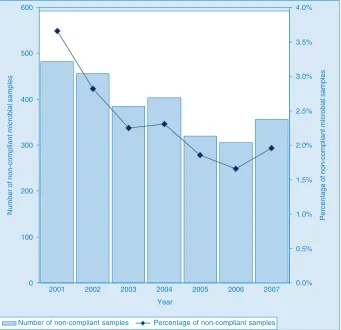
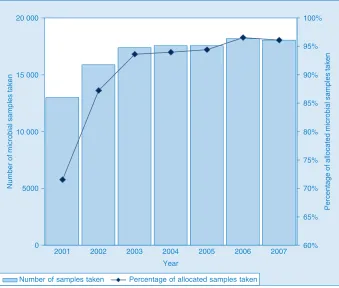
regional NSW in 2001, there has been a significant improvement in both microbial compliance (from more than 3.5% of samples non-compliant in 2001 to fewer than 2% in 2007, p⬍0.001) and adequacy of microbial sampling (from approximately 70% of allocated samples collected in 2001 to more than 95% in 2007, p⬍0.001).
Paul M. Byleveld
A,D, Michelle A. Cretikos
B,C,
Sandy D. Leask
Aand David N. Durrheim
CAWater Unit, NSW Department of Health
BNSW Public Health Officer Training Program, NSW Department
of Health
CHunter New England Population Health, Hunter New England
Area Health Service
DCorresponding author. Email: [email protected]
acute outbreaks of waterborne gastrointestinal disease. Illness related to unsafe drinking water can lead to sub-stantial morbidity and mortality, community anger and detrimental economic impacts.1,2
NSW Health exercises its responsibility as the public health regulator of metropolitan water utilities (Sydney Water Corporation, Sydney Catchment Authority and Hunter Water Corporation) through operating licences and memo-randa of understanding. In regional and rural areas of NSW, drinking water is provided by 107 local water utilities, mostly councils, serving a population of 1.7 million and operating 323 public water supply systems. NSW Health provides public health oversight of these regional water util-ities through the NSW Health Drinking Water Monitoring
Program.3The Drinking Water Monitoring Program pro-vides guidance on drinking water monitoring as well as on implementing several elements of the Australian Drinking
Water Guidelines.4This paper describes the Program and its regulatory context and reviews the impact of the Program on microbial drinking water quality.
The Australian Drinking Water Guidelines
The Australian Drinking Water Guidelines published by the National Health and Medical Research Council serve as the model of best practice in NSW.4These guidelines provide a risk management framework for drinking water supply systems, which includes a multiple barrier ‘catch-ment to tap’ approach, because a single barrier risk man-agement approach is vulnerable to failure.5The Guidelines recommend that systems should be monitored for drinking water quality and operational compliance.4
The Guidelines provide guideline values for microbial, physical, chemical and radiological characteristics that affect health or the quality of drinking water, and recom-mend that drinking water supplies be monitored regularly for Escherichia coli, which is an indicator of faecal contamination.
Although monitoring is an important step in verifying that preventive measures are working effectively, the current monitoring system for NSW regional water supplies has a number of inherent limitations, including:
• sampling cannot detect all contamination events • exposure of the supply population to contaminated
water may occur days before a non-compliant sampling result is available
• the system may fail to identify contamination with certain pathogens (e.g. protozoa or viruses) unless the contamination is accompanied by the indicator organism (E. coli) or elevated turbidity.
Thus the current system of microbial and chemical moni-toring of regional water supplies is unable to provide routine early warning of contamination events. For water utilities to supply drinking water that is safe, as defined in the Guidelines, NSW Health strongly recommends that water utilities implement the Guideline’s Framework for
Management of Drinking Water Quality.
The legislative basis for ensuring drinking water safety
In 1998, Sydney’s drinking water was found to contain
Cryptosporidium and Giardia, which resulted in a series of
alerts to boil water affecting more than three million con-sumers over a two-month period. Following this event, the
Public Health Act 1991 was amended to ensure that NSW
Health had adequate powers in relation to drinking water quality.6,7The amendments gave NSW Health the powers to: • require a water utility to issue advice to the public
regarding the safety of drinking water (e.g. a boil water alert)
• correct misleading information issued by a water utility • enter and inspect water utility premises
• require the testing of drinking water
• require the production of information (e.g. the results of water testing)
• close a water supply or order that it be brought to a condition that no longer poses a risk to public health.
In contrast to the operating licence requirements for met-ropolitan water utilities, there is no requirement for regional water utilities to fully implement the Australian Drinking
Water Guidelines (and its framework).
How does NSW Health exercise its legislative responsibility?
The current NSW Health Drinking Water Monitoring
Program has been operating comprehensively since 2001.
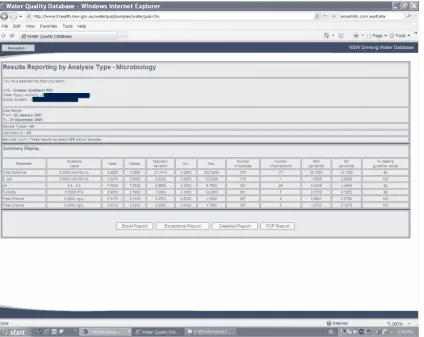
Samples are allocated annually to each public water supply system and tested by NSW Health (or other accred-ited) laboratories free of charge. Characteristics routinely tested include microbial (E. coli, total coliforms and cor-responding field results, including chlorine) and physical/ inorganic chemical (more than 30 characteristics). Charac-teristics tested through project monitoring include bacter-ial pathogens, pesticides and disinfection by-products (more than 150 characteristics). Microbial and physical/ chemical monitoring results are stored in the internet-based NSW Drinking Water Database, which allows secure access to results for local water utilities, NSW Health and other government agencies.8The Database records results for more than 20 000 samples per year from 323 water
supply systems. The Database has a user-friendly web interface that allows water utilities and public health units to search for results, generate reports and download data files (Figure 1). The reports provide basic descriptive sta-tistics for each characteristic, including the number of samples tested and the percentage of samples meeting guideline values.
The NSW Health Drinking Water Monitoring Program meets the recommendations of the World Health Organization by providing public health oversight of drinking water supplies, using predominantly independent testing and consolidating data as an input to the develop-ment of public health policies.9
The Program recommends the minimum numbers of samples that should be taken based on the size and com-plexity of water supply systems and in accordance with the Guidelines. This allocated number of samples must be collected to ensure that water quality remains satisfactory. The Program provides water utilities with protocols for responding to incidents of contamination (both microbial and chemical) or treatment system interruption. The Program also defines the roles of the NSW Department of Health Water Unit, local public health units and the local water utility in responding to such incidents.
Significant factors in the acceptance of the current Program include its development in consultation with, and support by, the peak industry bodies, including Local Government and Shires Associations and the NSW Water Directorate.
Functioning of the NSW Health Drinking Water Monitoring Program
The current Program commenced in late 2000, with data captured from 2001. The Water Unit and local public health units are active in promoting the Program to local water utilities. Multiple methods of communication are used to ensure the widest possible understanding of the Program within water utilities.
Each year, the Water Unit writes to the water utility general managers to advise them of sampling frequency recommendations. Sample testing is provided free of charge by NSW Health laboratories. The Water Unit issues bar-coded labels that uniquely identify each sample col-lected under the Program and remove the need for sample submission forms, previously completed by water utilities. NSW Health also actively promotes the Program through industry conferences, newsletters and regional training workshops for local water utilities. The Department of Water and Energy (DWE) has supported and promoted the Program through their Best-Practice Management of Water
Supply and Sewerage Guidelines and training courses for
Vol. 19(11–12) 2008 NSW Public Health Bulletin | 205
NSW Health and the DWE actively encourage water utili-ties to adopt the Framework as a model for managing their supplies. However, it is unlikely that all regional water utilities will fully implement the Framework unless it becomes a regulatory requirement.
Some water utilities use the Database results to prepare reports for local communities. The Database also allows NSW Health to monitor the adequacy of sampling and reporting by each utility. Reminders are issued to utilities to increase sampling frequency where needed.
NSW Health laboratories report non-compliant results to the water utility and public health unit. This provides public health units with an opportunity to confirm that the response protocols are being followed, including investigation and immediate corrective action by the local water utility.
The impact of the NSW Health Drinking Water Monitoring Program
The current Program has helped improve the management of regional and rural water supplies. Prior to its introduction, 10% of microbial samples were reported to be non-compliant, and 27% of water supply systems failed to submit samples.10
Since the introduction of the current Program, there has been a significant improvement in both microbial compliance (Figure 2) and adequacy of microbial sampling (Figure 3) in regional NSW. The significance of improvement was assessed using the Cochran-Armitage test for trend in com-pliance by year. In 2007, the overall results of microbial sam-pling achieved the Australian Drinking Water Guidelines 2004 criteria, i.e. no more than two samples per 100 samples were non-compliant for E. coli (Figure 2). This improvement appears to be the result of many factors, including improved reporting to the NSW Health Drinking Water Monitoring
Program, monitoring and maintenance of regional drinking
water systems, disinfection and treatment of drinking water supplies, and sampling frequency. It is possible that in some systems there are sampling biases that result in unusually high compliance. Despite the improvements in regional microbial performance, some small water supply systems remained well below the targets for sampling frequency and water quality. In order to better detect systematic problems, repeat testing and follow up occurs with water utilities that have non-compliant samples, especially with those that exceed the 2% target.
The NSW Health Drinking Water Monitoring Program and the Database has been well accepted by local water utilities Ensuring safe drinking water in regional NSW
and government agencies. Since the amendment of the
Public Health Act in 1998, NSW Health has not used
legislative powers to place orders on public water utilities. In contrast, over the same period, orders have been placed on two private water supplies that represented a risk to public health and did not comply with NSW Health advice.
The powers would be used in relation to water utilities should it be necessary. To make such decisions, public health units have access to the Database and disease sur-veillance data. In cases where a water utility does not meet sampling requirements, public health units follow up and remind the water utility of the requirements and the powers that exist under the Public Health Act. Where a persistent risk to public health is identified, the public health unit will advise the water utility to issue an alert to boil water or other warnings to the community. In most cases, water utilities willingly issue alerts to boil water, often before public health unit intervention.
During 2007, there were 12 such alerts issued in regional NSW. Two of these alerts were instituted before test results
became available, and were the result of contaminated raw water or treatment failure. The remainder were issued fol-lowing the detection of E. coli in routine drinking water samples. In such cases, the community may already have been exposed by the time a boil water alert is issued. Complete implementation of the Guideline’s Framework
for Management of Drinking Water Quality by all water
utilities is the only way to ensure safe drinking water for regional communities.
Conclusion
The NSW Health Drinking Water Monitoring Program has contributed to a marked improvement in the monitoring and quality of drinking water in regional NSW. This has been achieved through a combination of factors, includ-ing: a clear regulatory framework; a centralised system of ongoing sampling monitoring; technical support for local utilities and public health units; and collaborative relation-ships between public health units and local water utilities. Despite these improvements, more work is needed to support smaller water supply systems to meet the Australian
Drinking Water Guidelines requirements and ensure safe
drinking water for their communities.
0 100 200 300 400 500 600
2001 2002 2003 2004 2005 2006 2007
Year
Number of non-compliant microbial samples
0.0% 0.5% 1.0% 1.5% 2.0% 2.5% 3.0% 3.5% 4.0%
Percentage of non-compliant microbial samples
Number of non-compliant samples Percentage of non-compliant samples
Vol. 19(11–12) 2008 NSW Public Health Bulletin | 207
The NSW Drinking Water Database has helped identify persistent and sporadic problems in water supplies. It has also provided useful historical data to inform decision making on improvements required for specific supplies. Access to this data has proven useful in advocating for upgrades to water treatment, prioritising expenditure under the Country Towns Water Supply and Sewerage Program, and informing government inquiries.
The most significant challenge for the future is to ensure that all water utilities fully implement the Australian Drinking
Water Guidelines Framework. Communities cannot simply
rely on end-point drinking water quality monitoring to prevent outbreaks. There is strong international consensus that a preventive risk-management approach as set out in the Framework is the most reliable way to protect public health.
Acknowledgment
Thanks to Ling Li for preparing the figures.
References
1. Hrudey SE, Hrudey EJ. Safe drinking water: lessons from recent outbreaks in affluent nations. London, UK: International Water Association Publishing; 2004.
2. Hunter PR, Waite M, Ronchi E, eds. Drinking water and infectious disease: Establishing the links. Boca Raton, Florida: CRC Press/IWA Publishing; 2003.
3. NSW Health. Drinking Water Monitoring Program December 2005. NSW Department of Health; 2008.
4. National Health and Medical Research Council and Natural Resource Management Ministerial Council. Australian Drinking Water Guidelines. Canberra: NHMRC; 2004.
5. Reason J. Managing the risk of organisational accidents. Aldershot, UK: Ashgate; 1997.
6. McClellan P. Sydney Water Inquiry – Final Report Volumes 1 and 2. Sydney: New South Wales Premier’s Department; 1998.
7. NSW Public Health Act 1991 No 10.
8. Persson L, Byleveld P, Fien M, Cowie C. NSW Drinking Water Database. Perth: OzWater Australian Water Association National Convention, April 2003, pp. 60–1.
9. World Health Organization. Guidelines for drinking-water quality [electronic resource]: incorporating first addendum. Vol. 1, Recommendations, 3rd ed. Geneva: WHO; 2006. Available at: http://www.who.int/water_sanitation_health/dwq/gdwq3rev/en/ (Cited 23 October 2008.)
10. Cowie C, Corbett S. Surveillance of rural drinking water quality in NSW. N S W Public Health Bull 1994; 5: 35–9. doi:10.1071/NB94016
Ensuring safe drinking water in regional NSW
0 5000 10 000 15 000 20 000
2001 2002 2003 2004 2005 2006 2007
Year
Number of microbial samples taken
60% 65% 70% 75% 80% 85% 90% 95% 100%
Percentage of allocated microbial samples taken
Number of samples taken Percentage of allocated samples taken
Figure 3. Trend in microbial sampling adequacy in regional NSW by year (2001–2007), using samples tested for either
Bringing law to bear for public health ends is not new. The first Public Health Act was passed in Britain in 1848, with an independent New South Wales (NSW) Act in 1896. Other NSW laws, like the Abattoir Act of 1850 and the
Infectious Diseases Supervision Act of 1881, were
neces-sary to improve health standards.1
Only comparatively recently has law played a significant part in combating tobacco harm with Section 59 of the
Public Health Act 1991 of NSW, making sales to
under-18-year-olds illegal, although it had been officially illegal to sell to under-16-year-olds for nearly a century.2Restrictions on marketing and advertising, and on smoking in enclosed public places have become state law since then.2,3
Divergent opinions about the effectiveness of restrictions on selling tobacco to juveniles have been expressed. One
Enforcing law on tobacco sales to minors:
getting the question and action right
Abstract: There is a substantial history of
health-related law in Australia, but only recently has this included a significant amount of state regulation pertaining to tobacco promotion, sale and public use. The important question is: under what cir-cumstances do regulation and law enforcement work? Rigorous, energetic, long-term local law enforcement on the supply of tobacco to minors demonstrates success in preventing uptake. A model for success combines education, enforcement and publicity; a model used to some effect in alcohol law. Future directions in regulation might include on-the-spot penalties; ensuring the law is simple and has community support; striving for sufficient resources, enthusiasm and skills; and making the tobacco retail industry pay some of the costs of regulating that industry.
Douglas C. Tutt
Health Promotion, Northern Sydney Central Coast Area Health Service
Email: [email protected]
view is that it does not reduce teen smoking while propo-nents counter that ineffective enforcement efforts do not hinder youth-purchasing behaviour, and therefore could not be expected to reduce tobacco consumption.4–7
An example of effective law enforcement
The Gosford-based health promotion unit of Northern Sydney Central Coast Area Health Service has undertaken vigorous activity on cutting retail supply to minors since 1994 when intense education of retailers started. Initially, the enforcement component of this program was under-taken with local police co-operation, but the compliance testing methodology of under-age volunteers attempting purchases has become part of NSW Health practice across the state and public health units now undertake most of the enforcement and prosecution activities.8
Volunteers aged 14–16 years in everyday clothing were rehearsed in asking for a particular product and instructed to be honest if asked by retailers about their age or identi-fication during these controlled purchase operations. Successful prosecutions were the subject of concentrated media activity, including local newspaper front pages and editorials, television current affairs programs’ hidden cameras and an advertised hotline for the public to report law-breaking retailers. Most states were undertaking similar programs by 2000.9
The random testing methodology was confirmed as appro-priate in the NSW Court of Criminal Appeal and the Court of Appeal.10,11
Vol. 19(11–12) 2008 NSW Public Health Bulletin | 209
Enforcing law on tobacco sales to minors
No other special teen smoking intervention was under way during this time in this location. Ordinary school educa-tion or exposure to state or naeduca-tional media campaigns con-tinued as usual. A number of local high schools periodically collected and provided data on smoking rates. The first effect was on the youngest and lightest smokers, but as time went on this effect spread across the 12–17 year age range.12The adolescent smoking rate on the Central Coast in 1993 was similar to that of the rest of the state and nation; however, by 1996 the area had a significantly lower rate than the rest of NSW and, by 1999, only 17.1% of local teens were smoking compared with 25.9% 6 years earlier.12
The methodology has continued in the same manner since 1999. The rates of monthly teen smoking compared with state and national rates are shown in Figure 1.
The results in Figure 1, which were presented in Northern Sydney Central Coast Area Health Service’s 2007 Performance Review, show the continued difference in local rates from state and national rates. In 2002, eight years after starting action on supply to minors, the Central Coast teen smoking rate remained significantly lower (p ⬍0.0001) than that of NSW and Australia, even though the reduction in teen smoking in those larger jurisdictions paralleled that of the Central Coast.
The reason is probably because nicotine is an addictive product. Intervention on supply over time becomes inter-vention in demand, as fewer young people start smoking in the first place. Fewer 13-year-old smokers at one time means fewer addicted 16-year-old tobacco consumers three
years later. As time progresses, fewer continuing teen addicts mean fewer smokers can entice others to join them, so the effect continues to compound.
The area between the Central Coast line in Figure 1 and the Australian line represents the total of ‘prevented smokers’ brought about by doing something different from the rest of the country. Of course, other interventions have occurred throughout the nation, notably on the supply side with taxation changes post 1999, and large scale media campaigns on the demand side. But the difference achieved by adopting energetic law enforcement early on is illus-trated by Figure 1. That difference equates to nearly 20% fewer teen smokers in those 12 years on the Central Coast than if direct-supply-side law enforcement had not been undertaken when it was.
Other examples of modern health law at work
One of the best examples of saving lives with law in recent decades is roadside random breath testing for alcohol. A quarter of a century ago, more than 40% of deaths on NSW roads were attributed to alcohol.14The death rate is now reduced to 23%.15Over 400 lives are saved every year in NSW as a result of the intervention. This outcome has come about by “strengthened legislation and enforcement in conjunction with high profile media and public educa-tion activities”.16
Australia’s problems with alcohol attract media and policy attention. Licensed premises are expected to exercise responsible service of alcohol.17What method works to get these suppliers to practise this responsibility? Unfortunately, it seems education alone is not enough. Just educating bar staff to get them to do the right thing achieves fewer than one in ten acting correctly, but coupling that with enforcement improves that figure nearly eight-fold.18
Determining success
Success in achieving change in tobacco sales to minors, or in road safety and alcohol are underpinned by education, enforcement and publicity. Education is necessary, but it is not sufficient. Enforcement adds to effectiveness. Extensive publicity about enforcement increases the per-ceived risk of being caught, and also engages a concerned community in knowing that action to address a problem is underway. All of this activity has to be carried out with vigour and skill.
The question to be answered is not whether law and enforcement work. Rather the question is “under what cir-cumstances do they work in achieving public health aims?” The examples above show that education, enforcement and publicity are key components in achieving success.
The Canadian Cancer Society, in reviewing the features of supply efforts targeting tobacco and minors, concluded that
Monthly smoking prevalence 1993 to 2005 for adolescents aged 12 to 17 years
0% 5% 10% 15% 20% 25% 30%
1993 1996 1999 2002 2005
Central Coast
NSW
Australia