A b s t r a c t. The aim of the study was to determine the effect of different drying methods on selected physical properties of pomace obtained from purple carrot cv. Deep Purple. Drying was performed using four methods: convective, microwave-convec-tive, infrared-convective and freeze-drying. The freeze-dried ma-terial had the lowest apparent density (422 kg m-3), which was caused by slight shrinkage, and indicated high porosity. Apparent density was almost three times greater in dried materials produced using the other drying methods as compared to the freeze-dried variants. Freeze-dried pomace adsorbed vapour more quickly than the other dried variants, which was caused by its high porosity and relatively low degree of structural damage. Rehydration characte-ristics were significantly affected by the drying method. The highest mass increase and losses of soluble substance were recorded for the freeze-dried samples. Conversely, the traditional convective dry-ing method resulted in the lowest mass increase and soluble sub-stance leaching. A positive linear correlation was found between the loss of soluble dry substance components and the absorbance of liquid obtained during rehydration.
K e y w o r d s: purple carrot, drying, rehydration, hygroscopic properties
INTRODUCTION
Purple carrot roots contain considerable amounts of pro-health compounds. Similarly as in the traditional orange carrot, purple carrot contains carotenoids and phenolic acids as well as acylated anthocyanin pigments – the latter are in contrast to the traditional cultivars (Aghbashloet al., 2009). These pigments are relatively stable to heat and pH change as compared to the non-acylated anthocyanins found in berry fruits, such as currants, bilberries or strawberries.
Many different drying methods are used to remove moisture from food of plant origin. The applied method should provide a dried product of the highest possible quality,ieone characterized by only slight structure change, appropriate composition, high nutritive value and good sensory attributes. To produce such a dried product it is necessary to choose the best drying method and to select the optimal drying conditions (Marabi et al., 2006; Perera, 2005; Ratti, 2001). Deterioration of quality takes place due to high temperature, internal mass flow as well as water loss and shrinkage. Changes also take place due to the influence of the drying process on the physical properties of the dried material, such as apparent density, rehydration and hygro-scopic properties (Stêpieñ, 2008).
Convective drying is the most frequently applied me-thod. The low energy efficiency of this method and the rela-tively poor quality of the dried product (Wang and Chao, 2002) have led researchers to seek other methods that would provide a high-quality product in terms of quality and low pro-duction costs. Combined infrared convective drying is one such method. Infrared drying shortens the drying time by as much as 50% in comparison with convective drying at simi-lar material temperatures (Nowak and Lewicki, 2004). The quality of microwave-convective dried material is superior as compared to that obtainedviaconvective drying. These values are due to the lower stresses occurring in the tissue, which results from the material being heated throughout its entire volume (Chou and Chua, 2001; Zhanget al., 2006).
Purple carrot, possessing an exceptionally high content of anthocyanins (176 mg 100 g-1fresh carrot) and polyphe-nols (827 mg 100 g-1fresh carrot), is potentially a valuable Int. Agrophys., 2013, 27, 143-149
doi: 10.2478/v10247-012-0079-6
Effect of the applied drying method on the physical properties of purple carrot pomace
E. Janiszewska
1*, D. Witrowa-Rajchert
1, M. Kidoñ
2, and J. Czapski
21Department of Food Engineering and Process Management, Warsaw University of Life Sciences, Nowoursynowska 159c, 02-776 Warsaw, Poland
2
Institute of Food Technology of Plant Origin, Poznañ University of Life Sciences, Wojska Polskiego 31, 60-624 Poznañ, Poland Received April 3, 2012; accepted October 22, 2012
© 2013 Institute of Agrophysics, Polish Academy of Sciences
*Corresponding author e-mail: [email protected]
A
A
2008). The pomace left after juice pressing is considered to be treated as production waste and the contained valuable substances, such as dietary fibre and soluble components of cell sap, are not used. Currently, and for economic reasons, more and more producers want to fully utilise raw materials, including pomace. Purple carrot pomace may be used in powdered form as a colouring additive as well as a source of dietary fibre and as an antioxidant component of different dry and liquid products. Its potential applicability also de-pends on its hygroscopic and rehydration properties.
The aim of this study was to determine the effect of the different drying methods on selected physical properties of purple carrot pomace, ie apparent density, as well as on hygroscopic and reconstitution properties.
MATERIAL AND METHOD
Pomace from purple carrot (Daucus carotassp. sativus var. atrorubensAlef.) Deep Purple F1 was obtained after juice pressing. The carrot was grown on horticultural farms. The seeds of purple carrot were delivered by a seed com-pany, Bejo Zaden Poland Ltd. (Poland).
Drying was performed using four methods: convective drying (CD), microwave-convective drying (MCD), infrared-convective drying (IRCD) and freeze-drying (FD).
CD was run in a laboratory dryer at air temperature of 70°C, with air flowing over the material at a superficial velocity of 1.5 m s-1. The pomace was placed separately on sieves at a load of 4.0 kg m-2. The process was run until constant mass was obtained.
MCD was performed in a Promise Tech Inc. laboratory dryer (Wroclaw, Poland) with microwave incident power of 300 W. Samples were placed on a rotating tray with four shelves positioned perpendicular to the air flow. Air velocity was 3.5 m s-1and the temperature was 40°C. The dryer was loaded with 5.5 kg m-2of pomace. Drying was run until a mois-ture content of about 10% w.b. water was attained.
IRCD was performed in a laboratory dryer with nine in-frared electric light bulbs by Philips (Amsterdam, Holland). The temperature of the lamps was 2010 K. The distance bet-ween the emitters and the heated surface was 20 cm at a spe-cific power of 7.875 kW m-2. The flow of ambient air over the heated surface was set at 1.0 m s-1. The dryer was loaded with 4.0 kg m-2of pomace. Drying was run until constant mass was achieved.
FD was run in a Gamma 1-16LSC CHRIST apparatus (Osterode, Germany). A pressure of 63 Pa and plate tem-perature of 30°C were applied. Before drying the raw mate-rial was convective frozen at –20°C in an Electrolux freezer (Warsaw, Poland). The material was distributed on dryer pla-tes at a load of 4.0 kg m-2. The drying process was run until the temperature of 30°C was obtained inside the pomace.
mined by oven drying at 95°C according to the Polish stan-dard PN-A-75101-03:1990: Processed fruit and vegetables.
The volume of dried carrot pomace was measured by the displacement method using toluene (Mazza, 1983). These measurements were used to calculate the apparent density.
In order to investigate the hygroscopic properties, batches of 1±0.0001 g of dried pomace were placed in a de-siccator filled with distilled water at 20°C (aw=1). Kinetics of vapour adsorption was analyzed for 120 h, determining the mass after 1, 3, 4, 5, 48, 72, 96 and 120 h.
In order to investigate the reconstitutive properties, batches of 1 g dried carrot pomace were weighed and flood-ed with 100 cm3of distilled water at a temperature of 20± 0.1°C. Kinetics of rehydration was analyzed for 1 h, determin-ing the total mass and thus the content of dry matter in the rehydrated material after 5, 10, 15, 20, 30, 40 and 60 min. The course of rehydration was analyzed in terms of the re-lative mass increment (the ratio of the mass of rehydrated material to the mass of dried material) and relative dry mat-ter content (the ratio of the mass of dry matmat-ter in the rehydra-ted material to the mass of dry matter in the dried material).
Absorbance was determined in order to assess the amount of coloured compounds in water after each rehydration time. The study was carried out using a Helios Gamma spectro-photometer (Thermo Electron Corporation, England) at a wa-velength ofl= 510 nm. Distilled water was used as a refe-rence. The samples were diluted to achieve a range of ab-sorbance amounting to 0.6-0.7. All measurements were performed in triplicate.
Changes in the hygroscopic properties of the dried car-rots and the relative increment in the weight of the dried raw material as well as changes in absorbance of the solution during rehydration were described by a kinetic equation of the form:
y a b
bc = +
-+ æ è
ç ö
ø ÷
1 1
1 t , (1)
where:a, b, c– coefficients,t– time (h),y– analyzed index. For individual properties the following changes were adopted as indexes:
– for relative increment in water weight during rehydration:
y m
ms s
= H2O . .
, (2)
where:mH2O– increment in weight of water in the sample, ms.s.– weight of dry substance in the sample, with g as the drying substance;
– for the relative weight increment during rehydration:
y m
m = t
0
, (3)
y = absorbance . (4)
In the case of a relative loss of soluble components of dry substance during rehydration of dried purple carrot po-mace, sample changes in the dry substance were described using exponential equations of the form:
ss
ss a b c
t t
0
= + expæèç- öø÷, (5)
where:sst – mass of dry substance after timet(g),ss0– initial mass of dry substance (g).
Goodness of fit for the equation coefficients was provi-ded using GoodFit computer software.
All of the obtained results were subjected to an analysis of variance (ANOVA) using Statgraphics Plus 5.1 (Stat Point Technologies, Inc., Warrenton, VA). Individual group differences were identified using LSD multiple range tests with the probability level set at 0.05.
Coefficients of determination (R2) and root mean square errors (RMSE) were used in this study to determine the goodness of fit (Hassan-Beygiet al., 2009).
RESULTS AND DISCUSSION
The initial apparent density and water content of purple carrot pomace was 972 kg m-3and 16.4±0.3%, respectively. The shortest pomace drying time to constant water content was found for the MCD method, while the longest for IRCD. The drying time until water content of 0.1 kg H2O kg-1d.b. for MCD, CD and IRCD was 65, 94, and 198 min, respectively. Dry matter contents in the dried carrots exceeded 91%. The greatest dry matter content was recorded for the FD carrots, as it was over 96% (Table 1). Statistically significant differences in dry matter contents were found for carrots dried using different methods.
Physicochemical changes in the plant material occur-ring duoccur-ring drying consist in the condensation of dry matter, which is revealed in changes of density and porosity of the plant tissue (Perera, 2005). All drying processes with the application of air flow resulted in an increased apparent density, while freeze-drying caused its reduction in relation to values characterizing the raw material. These densities ranged from 422±33.5 kg m-3in the FD carrots to 1060.2± 42.6 kg m-3 for the CD carrots (Table 1). The presented values of apparent density in the tested dried purple carrot pomace were higher in comparison to the apparent density of dried purple carrot (Witrowa-Rajchertet al., 2009) and dried orange carrot (Baysalet al., 2003), produced using identical methods. No statistically significant differences were observed in the density of dried pomace produced using convection methods. The high density of dried carrot is caused by shrinkage of the samples, which is evidence for their low porosity. This, in turn, in the opinion of many re-searchers determines the hygroscopic and reconstitution pro-perties of dried carrots (Krokida and Philippopoulos, 2005; Prakashet al., 2004; Witrowa-Rajchert and Lewicki, 2006).
Kinetics of vapour adsorption was presented as a plot of relative increases in water mass versus the time of wetting (Fig. 1). Vapour was most rapidly adsorbed by the FD car-rots which after 40 h of rehydration adsorbed 0.30 g H2O g-1 d.m. The CD carrots, within the same time, adsorbed 19.5% less water in comparison to the FD carrots. The course of the curves plotted for vapour adsorption by carrots dried using both the IRCD and MCD methods did not differ. These dried carrots adsorbed 0.21 g H2O g-1d.m. after 40 h. Greater vapour adsorption capacity of dried carrots is equivalent to greater porosity and lesser damage to the material stru-cture. In the case of vapour adsorption by whole slices of purple carrot similar dependencies were obtained to those presented here for purple carrot pomace (Witrowa-Rajchert et al., 2009).
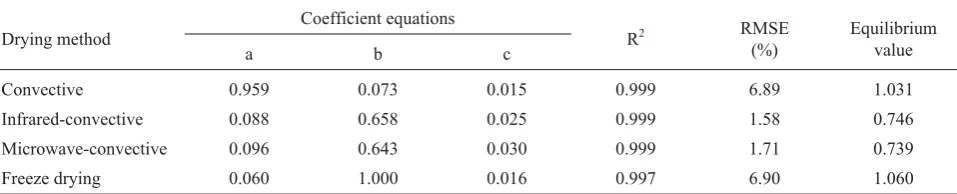
On the basis of kinetic equations the equilibrium values of a relative increment in water mass were calculated (Table 2). The proposed model equations describe well or very well the course of kinetics of vapour adsorption and facilitate the determination of the values for equilibrium water mass increment.
Drying method Dry matter (%)
Apparent density (kg m-3)
Before drying 16.4±0.3a 812±49b
Convective 93.7±0.9c 1060±43c
Infrared-convective 92.3±0.5b 1043±14bc Microwave-convective 91.5±0.6bc 1027±26bc
Freeze drying 96.8±0.2d 422±34a
a, b, c… – means with the same letter are not significantly dif-ferent.
T a b l e 1.Physical properties of dried purple carrot pomace
During the rehydration process, water adsorption and swel-ling of the dried tissue take place, with simultaneous leaching of soluble solid compounds (Markowski and Zieliñska, 2011). The course of the rehydration process is a significant quality attribute of dried food due to the fact that many dried products are consumed or further processed after their previous rehydration (Sumnuet al., 2005). It was shown that the rehydration process depends on the degree of structural damage and cell fragmentation (Prothonet al., 2003).
During rehydration the mass and volume of the dried ma-terial increase. At the same time, the soluble solid compounds are diffuzed to water. Changes in the mass of the material in relation to the initial mass of the dried carrot used in rehy-dration in the course of the process are presented in Fig. 2. The rate and degree of rehydration depend on the drying conditions, which may cause disruption of the internal structure while at the same time affecting product quality (Lewicki and Wiczkowska, 2006; Stêpieñ, 2008; Witrowa-Rajchert and Lewicki, 2006).
The greatest relative mass increment was recorded for FD carrot pomace – after 5 min of rehydration the mass in-creased by 91% in relation to mass after 60 min rehydration. The relative increase in mass for CD, MCD and IRCD carrots did not differ statistically and after 5 min of rehydra-tion each dried carrot variant reached approx. 70% in com-parison to mass after a 60 min process. Purple carrot poma-ce, in comparison to the dried tissues of other fruits and ve-getables from which cell sap had not been removed, was cha-racterized by much greater mass increments. For example, in the course of rehydration of purple carrot slices, Witrowa-Rajchertet al.(2009) obtained an 84% increment in mass for the freeze-dried material after 5 min. Convective dried, infrared-convective dried and microwave-convective dried materials within the same time reached an increment in mass amounting to approx. 35%. This situation could have been attributed to a more developed water adsorption area of the dried pomace in comparison to the water absorption area of whole dried slices.
The curves presenting a relative increase in mass during rehydration of dried pomace (Fig. 2) were described by kinetic Eq. (1), while values of the equation coefficients, va-lues of the root mean square error as well as coefficients of determination are presented in Table 3.
In the course of rehydration of the dried material, losses of soluble solids are observed as a result of their transfer to the surrounding medium. This process occurs most rapidly at the beginning of rehydration and depends on the chemical composition and structure of the material (Krokida and Marinos-Kouris, 2003; Witrowa-Rajchert and Lewicki, 2006). Changes in relative dry matter content during rehydration are presented in Fig. 3. These curves were described by Eq. (2), while their characteristics are given in Table 4.
The lowest losses of dry matter components were found for CD material, followed by the IRCD and MCD variants (Fig. 3). The greatest losses were observed in the case of FD pomace. This was confirmed by the recorded equilibrium values. The decrease in dry matter resulted from losses of so-luble solids, including coloured compounds, ie anthocy-anins. This was confirmed by analyses of changes in water absorbance during rehydration (Fig. 4).
Similarly as in the case of an increase in mass, the greatest loss of dry matter components was observed in the first stages of the rehydration process. During the first 5 min of rehydration, losses of soluble solids from the CD, IRCD, MCD and FD materials amounted to 23, 32, 25 and 33%, re-spectively. The loss of dry matter components after 60 min rehydration was the greatest for the FD material and reached 40%, while it was the lowest for dried pomace obtained by CD (37%). In the rehydration of purple carrot slices after Drying method
Coefficient equations
R2 RMSE
(%)
Equilibrium value
a b c
Convective 0.959 0.073 0.015 0.999 6.89 1.031
Infrared-convective 0.088 0.658 0.025 0.999 1.58 0.746
Microwave-convective 0.096 0.643 0.030 0.999 1.71 0.739
Freeze drying 0.060 1.000 0.016 0.997 6.90 1.060
pomace
60 min of the process, Witrowa-Rajchertet al.(2009) ob-served losses of dry matter in the convective dried, infrared-convective dried and microwave-infrared-convective dried material, which varied from 30 to 37%, while in the case of freeze-drying this was 20%. The recorded results are contrary to the literature data referring to whole carrot slices, particularly for the freeze-dried variant. These differences were probab-ly caused by a highprobab-ly developed mass exchange area con-nected with the greatest porosity of the material. Dry matter components retained to a lesser extent may be due to the considerable penetration of dried tissue by water. In the case
of whole freeze-dried purple carrot slices, the area of mass exchange is not as well developed and water has a longer distance to penetrate into the product structure,iealso to leach the components.
During rehydration of the dried purple carrot pomace losses of soluble solids were observed, includingeg colou-red anthocyanins. Their transfer from the dried material to the surrounding water was assessed on the basis of measurements of solution absorbance during rehydration. Absorbance was converted into 1g dry matterfound in the material in timet= 0 (Fig.4).
Drying method
Coefficient equations
R2 RMSE
(%)
a b c
Convective 1.002 9.726 0.032 0.999 10.08
Infrared-convective 0.992 9.796 0.028 0.992 27.33
Microwave-convective 1.004 9.507 0.038 0.995 20.12
Freeze drying 1.000 10.560 0.141 0.999 11.40
T a b l e 3.Coefficients of Eq. (1) describing kinetics of changes in relative mass increments during rehydration of dried purple carrot pomace
Fig. 3. Losses of soluble dry matter components during rehydration of dried purple carrot pomace. Explanations as in Fig. 1.
Drying method
Coefficient equations
R2 RMSE
(%)
Equilibrium value
a b c
Convective 0.639 0.360 5.361 0.998 0.66 0.639
Infrared-convective 0.626 0.371 5.012 0.993 3.13 0.626
Microwave-convective 0.620 0.380 3.069 0.997 3.18 0.620
Freeze drying 0.591 0.409 3.299 0.997 0.79 0.591
It may be observed here that definitely a greater amount of pigments was leached from the pomace of FD carrot, which was correlated with the greatest losses of dry substance components (Fig. 3). After 1 h of rehydration the absorbance of solutions for CD, IRCD, MCD and FD material amounted to 0.65, 0.7, 0.66 and 0.75, respectively. As a result of mechanical operations (grinding, pressing) and thermal processes (drying) the tissue structure was dis-turbed, which facilitated the transfer of anthocyanins from the dried material to the water.
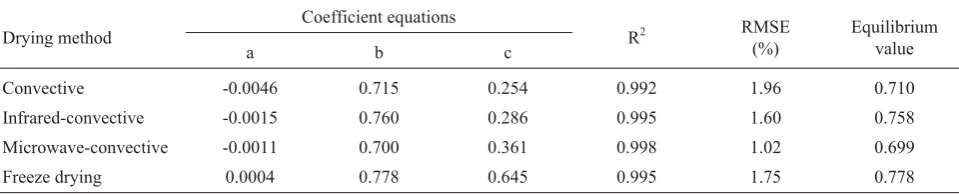
Changes in absorbance in the function of time were described using kinetic Eq. (1), while the values of the equa-tion coefficients are presented in Table 5.
The lowest equilibrium value of solution absorbance,ie such as would be recorded after timet= ¥, was found in pomace dried using the MCD, whereas the highest was recorded for the FD material. This means that the degree of anthocyanin retention in the MCD material was the lowest.
The rate of pigment leaching was the highest at the beginning of rehydration (Fig. 4), similarly as in the case of
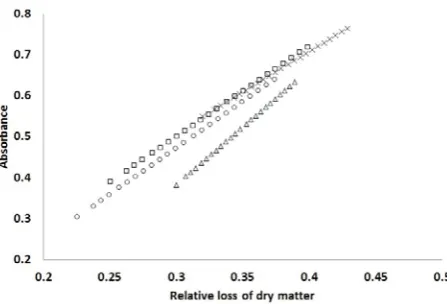
losses of soluble dry matter components (Fig. 3). Figure 5 presents a dependence for the values of absorbance on the relative losses of soluble dry substance components.
An increase in solution absorbance,iethe amounts of coloured compounds (mainly anthocyanins) transferred to the medium, was linearly dependent (Absorbance = a ssD t+b) on the dry matter content transferred to water (Table 6).
The drying process causes changes in the tissue structu-re of the raw material, thus structu-resulting in its partial damage and in changes in the chemical compounds. This influences the acceleration or slowing down of the transfer of soluble com-pounds to water during rehydration. The FD purple carrot po-mace was characterized by the lowest value of the slope of straight line ‘a’ (Table 6), whereas it was the highest for the MCD material. The values of the slopes for the straight lines confirmed earlier considerations which indicated that the MCD material most effectively retained coloured com-ponents in its structure, while this was the poorest for the FD material.
Drying method
Coefficient equations
R2 RMSE
(%)
Equilibrium value
a b c
Convective -0.0046 0.715 0.254 0.992 1.96 0.710
Infrared-convective -0.0015 0.760 0.286 0.995 1.60 0.758
Microwave-convective -0.0011 0.700 0.361 0.998 1.02 0.699
Freeze drying 0.0004 0.778 0.645 0.995 1.75 0.778
T a b l e 5.Coefficients of Eq. (1) describing the kinetics of changes in solution absorbance values during rehydration of purple carrot
CONCLUSIONS
1. The drying time of pomace depended on the drying method applied. In comparison to convective drying, micro-wave drying shortened the drying time by approx. 30%, while infrared drying increased the drying time two-fold.
2. The freeze-dried material was characterized by the lowest density of the material and the fastest rate of vapour adsorption, which indicates its high porosity and slight structural damage.
3. The rate of mass increase and loss of soluble com-ponents of dry matter in the dried material during rehy-dration was the greatest for freeze-drying and the lowest for convective dried material.
4 . In the course of rehydration the rate of leaching for soluble dry matter components was similar to that of antho-cyanin pigments.
REFERENCES
Aghbashlo M., Kianmehr M.H., Khani S., and Ghasemi M., 2009.Mathematical modelling of thin-layer drying of car-rot. Int. Agrophy., 23, 313-317.
Baysal T., Icier F., Ersus S., and Yildiz H., 2003.Effects of microwave and infrared drying on the quality of carrot and garlic. Eur. Food Res. Technol., 218, 68-73.
Chou K. J. and Chua S.K., 2001.New hybrid drying technologies for heat sensitive foodstuffs. Trends Food Sci. Technol., 12, 359-369.
Hassan-Beygi S.R., Aghbashlo M., Kianmehr M.H., and Massah J., 2009.Drying characteristics of walnut (Juglans regiaL.) during convection drying. Int. Agrophys., 23, 129-135.
Kidoñ M., Czapski J., and Witrowa-Rajchert D., 2008.Purple carrot and its products as a source of bioactive compounds (in Polish). Bromat. Chem. Toksykol., 51(3), 771-776.
Krokida M.K. and Marinos-Kouris D., 2003.Rehydration kine-tics of dehydrated products. J. Food Eng., 57, 1-7.
Krokida M.K. and Philippopoulos C., 2005.Rehydration of de-hydrated foods. Drying Technol., 23, 799-830.
Lewicki P.P. and Wiczkowska J., 2006.Rehydration of apple dried by different methods. Int J. Food Properties, 9(2), 217-226.
Marabi A., Thieme U., Jacobson M., and Saguy I.S., 2006.
Influence of drying method and rehydration time on sensory evaluation of rehydrated carrot particulates. J. Food Eng., 72, 211-217.
Markowski M. and Zieliñska M., 2011.Kinetics of water absorp-tion and soluble-solid loss of hot-air-dried carrots during rehydration. Int. J. Food Sci. Technol., 46, 1122-1128.
Mazza G., 1983.Dehydration of carrots. effect of predrying treat-ments on moisture transport and product quality. J. Food Technol., 18, 113-123.
Nowak D. and Lewicki P.P., 2004.Infrared drying of apple slices. Innovative Food Sci. Emerg. Technol., 5(3), 353-360.
Perera C.O., 2005.Selected quality attributes of dried foods. Drying Technol., 23(4), 717-730.
Prakash S., Jha S.A., and Datta N., 2004.Performance evaluation of blanched carrot dried by three different methods. J. Food Eng., 62, 305-313.
Prothon F., Ahrné L., and Sjöholm I., 2003.Mechanisms and prevention of plant tissue collapse during dehydration. Critical review. Crit. Rev. Food Sci., 43(4), 447-479.
Ratti C., 2001.Hot air and freeze-drying of high-value foods. Review. J. Food Eng., 49, 311-319.
Stêpieñ B., 2008.Rehydration of carrot dried using various me-thods. Acta Agrophysica, 156, 239-251.
Sumnu G., Turabi E., and Oztop M., 2005.Drying of carrots in microwave and halogen lamp-microwave combination mo-vens, LWT, 38, 549-553.
Wang J. and Chao Y., 2002.Drying characteristics of irradiated apple slices, J. Food Eng., 52, 83-88.
Witrowa-Rajchert D., Bawo³ A., Czapski J., and Kidoñ M., 2009.
Studies on drying of purple carrot roots. Drying Technol., 27, 1325-1331.
Witrowa-Rajchert D. and Lewicki P.P., 2006.Rehydation pro-pretties of dried plant tissues. Int. J. Food Sci. Technol., 41(9), 1040-1046.
Zhang M., Tang J., Mujumdar A.S., and Wang S., 2006.Trends in microwave-related drying of fruits and vegetables. Trends Food Sci. Technol., 17, 524-534.
Drying method
Coefficient equations
a b c
Convective 2.268 -0.206 0.999
Infrared-convective 2.221 -0.165 0.963 Microwave-convective 2.812 -0.461 0.853
Freeze drying 1.981 -0.085 0.914
T a b l e 6. Coefficients of Eq. (1) describing the dependence of solution absorbance and dry substance losses during rehydration of dried purple carrot