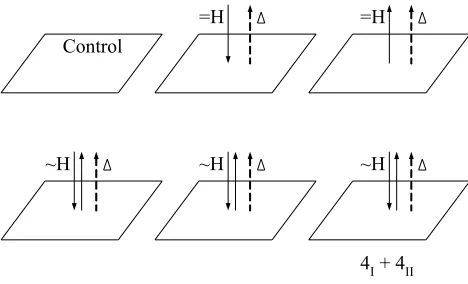
replication). Electromagnetic field was produced by a special reel. In such reels both continuous and alternating electromagnetic fields of different power were produced. The trials consisted of the following treatments: control – without artificial electromagnetic field; 1A - 1800 Am-1 (=H); 1B - 1000 Am-1(=H); 2A - 800 Am-1(~H); 2B - 1500 Am-1(~H); 4I+4II- 200 Am-1(~H) (Fig. 1). Boxes with plants were placed inside the reels. The reels were elevated so that the field affected the zone of tomato apical meristem during plant growth. The power of electromagnetic field was measured by Magnetic Field Monitor HI-3550, a meter designed for measurement of continuous (=H) and alternating (~H) electromagnetic fields. The measurement range of the meter was from 80 Am-1to 24000 Am-1.
The gradient of electromagnetic field H=H(x, y, z)was measured and calculated according toDHX,DHY,DHZ;
¶ ¶ H X X H X =limD = D
D
0 (1)
grad. H = H Xi +
H Yj +
H Zk ¶ ¶ ¶ ¶ ¶ 
r r r
(2)
grad. H = H
X + H Y H Z ¶ ¶ ¶ ¶ ¶ ¶ æ è ç ö ø ÷ æ è ç ö ø
÷ +æèç ö ø ÷
2 2 2
. (3)
Because the gradient H was measured only in the Z axis, ieaccording to the direction of plant growth, so:
grad. H = H Z 
¶ . (4)
The gradient of electromagnetic field was: 1B (DH= 15 A(m cm)-1), 1A (DH= 23 A(m cm)-1), 2A (DH= 13 A(m cm)-1), 2B (DH= 19 A(m cm)-1
) and 4I+4II(DH= 3 A(m cm)-1). In 1999 tomatoes were affected by electromagnetic fields during the whole vegetation period. Seeds were chosen from the first and the second trusses of the tomatoes. These seeds were sown in 2000 (further on these plants are called ‘tomato of the first generation’). Analogically, seeds were also chosen from these plants of the first generation after the effect of electromagnetic fields. In 2001 plants were grown from those seeds (further on these plants are called ‘tomato of the second generation’). In 2000-2001 tomatoes were grown on compost substrate in 58x36x27 cm plastic boxes. Two plants were grown in each box. There were three boxes in each variant. One plant was one replication.
Tomatoes were sown in January-February in all the years of the investigations. Till April, plants were provided with 14 h photoperiod in the greenhouses. Additionally they were irradiated by SON-T Agro lamps. During vegetation, the day/night air temperature was 15-20/22-27°C. Tomatoes were fertilized 3 times per week with 0.3% complex fertilizers ‘Kemira Combi’ (NPK 14:11:25 plus magnesium (1.4%) and microelements). Germinative energy (determined 6 days after sowing at temperatures of 20-30°C) and germinating capacity (determined 10 days after sowing at temperatures of 20-30°C) of tomato seeds, height and green mass of tomato seedlings, the amount of chlorophylls in their leaves in 100% acetone extraction (acc. to Wettstein (Gavrilenko et al., 1975)) and yield were determined. Morphological analyses of tomato seedlings were made according to Kupermanet al.(1982).
RESULTS
The direct impact of electromagnetic fields stimulated the development of plants (Table 1). Seedlings formed more leaves, grew up higher and had more fresh weight. The highest tomato seedlings grew up when affected with electromagnetic field of the power of 1500 Am-1(~H). This tendency was noticed through the whole development period. Tomato affected by this electromagnetic field reach the 8th organogenesis stage faster,iethey were good for transplanting. They had the most developed inflorescence according to apex height and formed the greatest number of leaves, though during the whole growth period their speed of development was undistinguished.
The development of the first generation tomato differed in various growth stages (Table 2). According to measurements of 29 February, tomato plants grown in 1A, 1B and 2A variants were in organogenesis stage II. At that time, these tomato plants had the smallest apex. Tomatoes which were grown from seeds of plants affected by electromagnetic fields of the power of 1000 Am-1 (=H) formed the smallest number of leaves till the 1st truss. The Control
=H H =H H
~H H ~H H ~H H
1B 1A
2A 2B 4I+ 4II
depressing impact of this electromagnetic field also persisted in later organogenesis stages. Seedlings had the shortest first truss and formed the smallest number of leaves.
Plants which grew in the control and the 4I+4II variants
developed faster till the 7th organogenesis stage. Later, only tomato seedlings in the control variant formed more leaves
and plants in variant 4I+4II practically did not differ from
others. In different variants the height of the first generation
tomato depended on the organogenesis stages. In
organogenesis stages 2-3rd the smallest were the plants which grew in variants 1A and 1B, in stages 5-7th – in variants 1B and 2B. The height difference between plants of various variants decreased as the tomatoes grew and developed. At the initial organogenesis stages, the highest
seedlings grew up in variant 4I+4II, but in organogenesis
stages 7-8th they did not differ from other plants. Tomato seedlings of variant 1B produced the smallest amount of green mass in all the organogenesis stages. Till the 8th organogenesis stage, tomato seedlings of the control and
4I+4IIvariants produced more green mass, though the plants
of this last variant differed little from plants of variant 1B before transplanting.
In the second tomato generation it was determined that
plants of variant 4I+4IIdeveloped slowly (Table 3). Before
transplanting, those seedlings had the shortest first truss and formed the smallest number of leaves. Meanwhile, tomato seedlings of variants 1A and 1B developed faster, though plants of the first generation, on the contrary, developed slowly. The height of the second generation tomato differed more only at the initial organogenesis stages. Higher plants were observed in variant 1B at the time of seedling growth, though they grew up the least in the first generation. Contrary to tomatoes of the first generation, in variant 1B seedlings of the second generation produced the highest amount of fresh weight. This tendency remained till the transplanting of seedlings. Tomatoes of variant 1A differed little from others at the initial organogenesis stages, but they
produced the highest amount of fresh weight in
organogenesis stage 8. Tomato seedlings of variant 4I+4II
produced the smallest amount of fresh weight at this stage. The direct impact of electromagnetic fields had a positive effect on chlorophylls synthesis, except for the
electro-magnetic field of the power of 200 Am-1(~H) (Fig. 2A).
Development of apex Fresh weight
Variants
Stage Height (mm) Leaves number
Plant height
(cm) (g)
2.01
Control II 0.10±0.000 6.3±0.58 5.6±0.72 0.2±0.03
1A II 0.10±0.000 7.3±0.58 6.9±0.98 0.3±0.11
1B II 0.10±0.000 7.0±0.00 7.4±0.79 0.3±0.02
2A II 0.10±0.000 7.0±1.00 7.1±0.67 0.3±0.09
2B II 0.11±0.014 7.7±0.58 7.8±0.76 0.4±0.02
4I+4II II 0.11±0.014 7.3±0.58 7.1±0.58 0.3±0.05
02.11
Control IV.Va 0.32±0.076 10.0±0.00 8.0±0.67 0.7±0.04
1A Va.Vb 0.50±0.100 9.3±0.58 12.0±1.03 1.5±0.14
1B IV.Va 0.35±0.500 10.0±0.00 11.8±0.97 1.7±0.28
2A IV.Va 0.33±0.580 10.3±0.58 12.1±0.91 1.7±0.24
2B IV 0.32±0.029 10.0±0.00 12.5±1.00 2.2±0.45
4I+4II Vb 0.28±0.029 10.0±0.00 10.8±0.86 1.3±0.18
02.21
Control Vd 0.87±0.058 10.3±0.58 16.7±1.29 5.3±1.50
1A Vd. VI 1.20±0.300 12.3±0.58 24.7±1.95 8.4±2.68
1B VI.VII 2.27±1.514 12.7±1.53 27.0±3.60 7.5±0.06
2A Vd.VI 1.57±0.603 13.3±0.58 28.4±1.77 8.9±1.95
2B VI 1.73±0.115 13.0±1.00 29.4±2.12 10.8±0.93
4I+4II Vd.VI 1.63±0.551 13.0±1.00 25.4±2.32 13.6±2.55
03.04
Control VII.VIII 7.07±3.602 13.3±1.55 43.6±3.41 26.4±1.69
1A VII 7.27±1.966 14.3±0.58 50.6±3.41 25.0±5.04
1B VII.VIII 9.70±6.366 14.3±1.16 56.1±2.18 39.6±7.70
2A VII.VIII 15.77±12.400 15.0±1.00 54.4±5.83 32.6±2.48
2B VIII 22.17±10.596 16.0±0.00 60.9±3.41 37.8±1.70
4I+4II VII.VIII 10.67±2.887 15.0±1.00 52.1±4.41 33.9±1.43
Development of apex Fresh weight Variants
Stage Height (mm) Leaves number
Plant height
(cm) (g)
Control III 0.20± 0 10.3± 0.58 5.5± 0.46 1.0± 0.04
1A II 0.10± 0 9.0± 1.73 4.1± 0.95 0.6± 0.22
1B II 0.10± 0 8.3± 0.58 3.9± 0.79 0.5± 0.12
2A II 0.10± 0 9.0± 0 4.4± 0.12 0.6± 0.12
2B II,III 0.12± 0.029 8.7± 1.16 5.1± 0.12 0.6± 0.11
4I+4II II,III 0.17± 0.076 9.7± 1.53 5.9± 0.98 0.9± 0.27
Control Vb, Vd 1.57± 0.666 13.7± 0.58 18.7± 1.26 12.3± 0.97
1A Vc, Vd 1.13± 0.252 13.3± 0.58 16.5± 1.32 10.0± 0.86
1B Va, Vb 0.83± 0.351 12.0± 1.00 11.8± 1.89 7.0± 1.54
2A Vc, Vd 1.30± 0.557 12.7± 0.56 13.2± 1.76 8.9± 2.31
2B Vb, Vc 1.03± 0.115 13.0± 0.00 12.0± 0.50 6.6± 0.59
4I+4II Vc, Vd 1.43± 0.577 13.7± 0.58 19.1± 1.15 11.7± 1.85
Control VII,VIII 9.17± 1.258 17.3± 0.58 46.8± 1.61 48.8± 0.82
1A VIII 12.17± 0.764 16.0± 0 40.7± 2.52 45.5± 0.44
1B VII,VIII 7.50± 2.291 15.0± 0 37.5± 4.27 34.6± 5.00
2A VII,VIII 13.83± 5.508 15.7± 0.58 39.8± 0.58 45.1± 2.22
2B VII,VIII 12.33± 6.292 15.7± 0.58 34.8± 0.29 37.7± 4.54
4I+4II VII,VIII 8.00± 3.464 15.7± 1.53 39.7± 0.76 35.4± 1.63
T a b l e 2.Morphological and biometric characteristics of the first generation tomato seedlings after the effect of electromagnetic fields
Development of apex Fresh weight
Variants
Stage Height (mm)
Leaves number Plant height
(cm) (g)
Control III,IV 0.22± 0.021 10.0± 0 5.9± 0.62 0.8± 0.09
1A III,IV 0.20± 0.041 9.3± 0.47 5.0± 0.21 0.6± 0.16
1B III,IV 0.22± 0.024 10.0± 0 6.7± 0.57 1.2± 0.36
2A III 0.17± 0.047 10.0± 0 5.3± 0.29 0.7± 0.03
2B III 0.20± 0 10.0± 0 5.0± 0.25 0.1± 40.7
4I+4II II 0.12± 0.024 9.3± 0.47 5.7± 0.19 0.6± 0.07
Control Vc 1.13± 0.125 12.7± 0.47 11.8± 0.76 4.6± 0.21
1A Va-Vc 0.70± 0.245 12.0± 1.41 11.5± 0.78 4.2± 0.71
1B Vc,VI 1.73± 1.040 13.7± 0.47 13.2± 1.31 6.8± 1.86
2A Vb,Vd 1.00± 0.294 13.3± 0.94 12.7± 1.04 6.1± 1.20
2B Vc,Vd 1.33± 0.189 13.3± 0.47 11.3± 0.56 6.1± 0.45
4I+4II Va,Vd 0.67± 0.249 13.0± 0 11.5± 1.23 5.0± 0.71
Control VII,VIII 12.23± 4.055 17.0± 0 40.0± 3.74 38.2± 2.50
1A VIII 21.33± 4.190 17.7± 0.47 39.7± 1.25 54.9± 2.81
1B VIII 22.27± 1.543 16.7± 0.47 43.3± 1.70 49.2± 4.92
2A VII,VIII 11.00± 6.377 16.3± 0.94 37.2± 2.25 35.0± 6.06
2B VII,VIII 13.53± 7.722 16.3± 0.47 35.7± 0.47 34.1± 9.60
4I+4II VII,VIII 9.33± 3.091 15.7± 0.47 33.0± 5.89 30.3± 3.37
Greater chlorophyll content was determined in leaves of tomato affected by electromagnetic fields of the power of 1000 Am-1(=H) and 1500 Am-1(~H). In the first generation, this index was a little lower in leaves of variants 1B, 2A and 2B (Fig. 2B) and in the second generation – in variants 1A and 1B (Fig. 2C). After the effect of electromagnetic fields, the amount of chlorophylls in tomato leaves did not exceed the control in none of the generations.
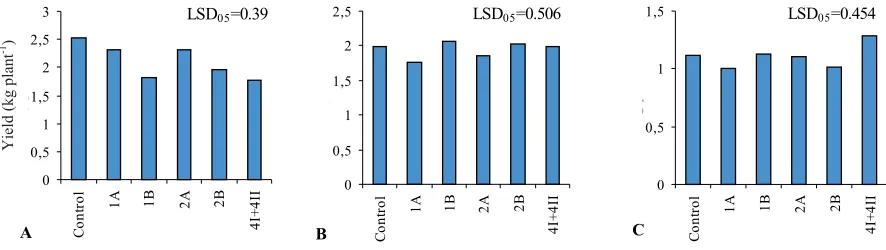
Total yield of tomato affected by electromagnetic fields of the power of 1000 Am-1(=H), 1500Am-1(~H) and 200 Am-1(~H) was significantly lower in comparison with the control (Fig. 3A). No significant differences in total yield in the various variants after the effect of electromagnetic fields were established in any year (Fig. 3B,C).
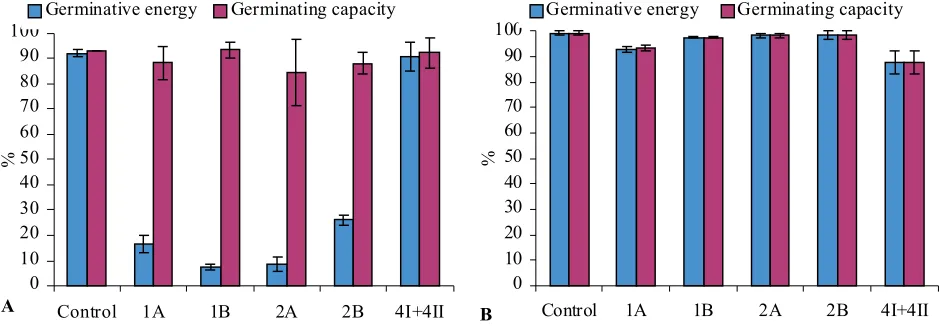
Seeds of tomatoes which grew under the direct effect of electromagnetic fields of the power of 1000 Am-1(=H) and 800 Am-1(~H), had the least germination energy (7.3 and 8.3%, respectively) (Fig. 4A). Seed germination of the latter tomato was the poorest (84.3%) as well. Seed germination of tomatoes which grew under the effect of electromagnetic fields of the power of 1000 Am-1(=H) was similar to that of
the control (93.0%) and was 93.3%. Electromagnetic field of the power of 200 Am-1(=H) had practically no impact on the germination of the first generation tomato seeds after the effect. Electromagnetic fields had no impact on the germinative energy and germinating capacity of the first generation tomato seeds after the effect (Fig. 4B). In variant 4I+4IIthese indices of the first generation tomato seeds after the effect were a little lower.
DISCUSSION
In the first stage of research, tomato apical meristem zones were affected by electromagnetic fields during the whole vegetation period. The investigated electromagnetic fields stimulated the development of plants, but their impact depended on the organogenesis stages. Seedlings developed rapidly and grew up the highest when they were affected by the electromagnetic field of the power of 1500 Am-1(~H) (Table 1). Such plants, also, formed the biggest leaf area (Stašelis et al., 2000a). According to other data, such electromagnetic fields did not have any impact on the
1,0 1,5 2,0 2,5 3,0 3,5 C ont ro l
1A 1B 2A 2B
4I + 4 II mg /g
A
1,0 1,5 2,0 2,5 C ont ro l1A 1B 2A 2B
4I + 4 II mg /g
B
1,0 1,5 2,0 2,5 Co n tr o l1A 1B 2A 2B
4I + 4 II mg /g
C
Fig. 2.Chlorophylls amount of tomato seedlings (A - direct impact of electromagnetic fields, B - the first generation of tomato after the effect of electromagnetic fields, C - the second generation tomato after the effect of electromagnetic fields).
Chlorophylls amount (mg g -1) 0 0,5 1 1,5 2 2,5 3 Co nt ro l
1A 1B 2A 2B
4I +4 II kg /p la nt
LSD05=0.39
A 0 0,5 1 1,5 2 2,5 C ont ro l
1A 1B 2A 2B
4I +4 II kg/ pl an t
LSD05=0.506
B 0 0,5 1 1,5 C ont ro l
1A 1B 2A 2B
4I +4 II kg/ pl an t
LSD05=0.454
C
Fig. 3.Yield of tomato (A - direct impact of electromagnetic fields, B - the first generation of tomato after the effect of electromagnetic fields, C - the second generation tomato after the effect of electromagnetic fields).
Yield
(kg
plant
number of flowers and fruits (Stašeliset al., 2000b). The leaves of tomatoes affected by electromagnetic fields of the power of 1000 Am-1(=H) and 1500 Am-1(~H) accumulated the highest amount of chlorophylls (Fig. 2A). The most intensive photosynthesis occurred under the effect of electromagnetic fields of the power of 1800 Am-1(=H) and 1500 Am-1(~H) (Gavrilenkoet al., 1975). The effect of all the electromagnetic fields decreased the tomato yield. The electromagnetic field of the power of 200 Am-1 (~H) impeded most strongly the formation of chlorophylls (Fig. 3A) and photosynthesis intensity in tomato leaves (Stašelis
et al., 2000b), and decreased the yield.
Electromagnetic field had an impact on subsequent tomato generations after the effect. The greatest negative effect established was that on the germinative energy of seeds chosen from tomatoes which were affected by electromagnetic fields during the whole vegetation (Fig. 4). In scientific literature we found references that electromagnetic field of high power decreased seed germination of pines which grew under their effect for a long time (Selga and Selga, 1996). In the first and second generations, the effect of electromagnetic field on growth and development was mostly observable in the initial organogenesis stages (Tables 2 and 3). Later on the differences between the various variants were inconsiderable. The effect of electromagnetic field of the power of 1000 Am-1(=H) (variant 1B) and 200 Am-1 (~H) (variant 4I+4II) was eminent. The first field, whose direction of vector was contrary to the direction of plant growth, depressed germination energy of seeds most strongly. Tomatoes of the first generation grew and developed slowly in this variant. Opposite results were obtained in the second generation. They grew and developed rapidly, but the synthesis of chlorophylls was a little lower. Contrary to this, the first generation tomatoes from variant 4I+4IIdid not lag behind the control in the initial organogenesis stages. Later,
their rate of growth and development slowed down. In the second generation, the germination energy and seed germination of these tomatoes were the least. They grew and developed slowly, though this field had not depressing impact on the amount of chlorophylls and on yield. Meanwhile, when tomatoes grew under the effect of electromagnetic field of the power of 200 Am-1(~H) during the whole vegetation, lower amount of chlorophylls in leaves (Fig. 2A) and yield (Fig. 3A) were determined as compared with others. Maybe it is possible to assume that electromagnetic fields not only change the cell ultrastructure (Selga and Selga, 1996), but also influence gene expression and that this influence could be expressed not only in the first, but in the second generation after the effect as well.
CONCLUSIONS
1. The direct effect of electromagnetic fields stimulated the development of plants, but their impact depended on the organogenesis stages.
2. Tomato seedlings developed rapidly and grew up the highest when directly affected by the electromagnetic field of the power of 1500 Am-1(~H).
3. The direct impact of electromagnetic fields had a positive effect on chlorophyll synthesis, except for the electro-magnetic field of the power of 200 Am-1 (~H). After the effect of electromagnetic fields, the amount of chlorophylls in tomato leaves did not exceed the control in none of the generations.
4. The direct effect of electromagnetic fields decreased tomato yield. No significant differences in total yield in the various variants after effect of electromagnetic fields were determined in any year.
5. The greatest negative effect of electromagnetic fields was established for the germinative energy of seeds chosen from tomatoes which were affected directly during the whole vegetation period.
0 10 20 30 40 50 60 70 80 90 100
Control 1A 1B 2A 2B 4I+4II
%
Germinative energy Germinating capacity
A
0 10 20 30 40 50 60 70 80 90 100
Control 1A 1B 2A 2B 4I+4II
%
Germinative energy Germinating capacity
B