Threat Landscape and Good Practice
Guide for Software Defined
Networks/5G
DECEMBER 2015
About ENISA
The European Union Agency for Network and Information Security (ENISA) is a centre of network and information security expertise for the EU, its member states, the private sector and Europe’s citizens. ENISA works with these groups to develop advice and recommendations on good practice in information security. It assists EU member states in implementing relevant EU legislation and works to improve the resilience of Europe’s critical information infrastructure and networks. ENISA seeks to enhance existing expertise in EU member states by supporting the development of cross-border communities committed to improving network and information security throughout the EU. More information about ENISA and its work can be found at www.enisa.europa.eu.
Authors
Adrian Belmonte Martin (ENISA), Louis Marinos (ENISA), Evangelos Rekleitis (ENISA), George Spanoudakis (City University London), Nikolaos Petroulakis (City University London)
Editors
European Union Agency for Network and Information Security ENISA responsible officer: Adrián Belmonte Martín
For contacting the authors please use [email protected]
For media enquiries about this paper, please use [email protected].
Acknowledgements
We would like to express our gratitude to the following individuals for providing valuable comments as external reviewers of the report:
Lorenzo Di Gregorio (InnoRoute GmbH), Giuseppe Bianchi (CNIT / Univ. Roma Tor Vergata), Eduardo Jacob (University of the Basque Country)
Legal notice
Notice must be taken that this publication represents the views and interpretations of the authors and editors, unless stated otherwise. This publication should not be construed to be a legal action of ENISA or the ENISA bodies unless adopted pursuant to the Regulation (EU) No 526/2013. This publication does not necessarily represent state-of the-art and ENISA may update it from time to time.
Third-party sources are quoted as appropriate. ENISA is not responsible for the content of the external sources including external websites referenced in this publication.
This publication is intended for information purposes only. It must be accessible free of charge. Neither ENISA nor any person acting on its behalf is responsible for the use that might be made of the
information contained in this publication. Copyright Notice
© European Union Agency for Network and Information Security (ENISA), 2015 Reproduction is authorised provided the source is acknowledged.
Table of Contents
Executive Summary 6 1. Introduction 8 Policy Context 8 Scope 9 Target Audience 9Structure of this document 10
2. Methodology 11 3. SDN/5G Architecture 12 SDN Architecture 12 5G Design Principles 14 4. SDN/5G Assets 16 Methodological conventions 16 Categories of SDN Assets 17 5. SDN Threats 19 Taxonomy of SDN/5G Threats 19 SDN specific Threats 20
Network Virtualisation Threats 23
5G radio access threats 24
Generic network infrastructure threats 24
Lists of SDN/NFV/5G and Generic Network Threats 25
6. Threat Agents 37
7. Good Practices 39
Existing threat mitigation practices 39
7.1.1 Overview of tools/techniques 39
7.1.2 Mitigated SDN threats 42
Threat mitigation practices under development 52
7.2.1 Related 5G-PPP HORIZON 2020 projects 52
7.2.2 Other related EU funded projects 55
8. Recommendations 63
Technical recommendations 63
Organisational recommendations 64
9. Conclusions 66
Annex A: Description of SDN/5G Assets 67
Annex B: Detailed Mind Map for SDN/5G Assets 71
Executive Summary
5G1 represents the next major phase of mobile telecommunication systems and network architectures
beyond the current 4G standards, aiming at extreme broadband and ultra-robust, low latency connectivity, to enable the programmable connectivity for the Internet of Everything2. Despite the significant debate on
the technical specifications and the technological maturity of 5G, which are under discussion in various fora3,
5G is expected to affect positively and significantly several industry sectors ranging from ICT to industry sectors such as car and other manufacturing, health and agriculture in the period up to and beyond 2020. 5G will be driven by the influence of software on network functions, known as Software Defined Networking
(SDN) and Network Function Virtualization (NFV). The key concept that underpins SDN is the logical centralization of network control functions by decoupling the control and packet forwarding functionality of the network. NFV complements this vision through the virtualization of these functionalities based on recent advances in general server and enterprise IT virtualization. Considering the technological maturity of the technologies that 5G can leverage on, SDN is the one that is moving faster from development to production. To realize the business potential of SDN/5G, a number of technical issues related to the design and operation of Software Defined Networks need to be addressed. Amongst them, SDN/5G security is one of the key issues, that needs to be addressed comprehensively in order to avoid missing the business opportunities arising from SDN/5G.
In this report, we review threats and potential compromises related to the security of SDN/5G networks. More specifically, this report contains a review of the emerging threat landscape of 5G networks with particular focus on Software Defined Networking. It also considers security of NFV and radio network access. To provide a comprehensive account of the emerging threat SDN/5G landscape, this report has identified related network assets and the security threats, challenges and risks arising for these assets. Driven by the identified threats and risks, this report has also reviewed and identified existing security mechanisms and good practices for SDN/5G/NFV, and based on these it has analysed gaps and provided technical, policy and organizational recommendations for proactively enhancing the security of SDN/5G.
This report proposes 6 technical recommendations and 3 organizational recommendations:
Technical Recommendations
o Recommendation 1 (for Network providers): Mandate encryption and authentication in NBI, SBI and EWBI.
o Recommendation 2 (for Network providers): Identify and monitor exposed functionalities of SDN controllers.
o Recommendation 3 (for Network and Service providers): Control and monitor running application resources.
o Recommendation 4 (for Network, Service providers and End users): Holistic Support for Security policies.
o Recommendation 5 (for Administrators): Access control and Credentials enforcement o Recommendation 6 (for Developers): Application Isolation and Sandboxing.
1 www.5g-ppp.eu/roadmaps 2 http://ioeassessment.cisco.com/
Organisational Recommendations
o Recommendation 7 (for Service providers): Develop incident response capabilities and information sharing practices among telecom operators.
o Recommendation 8 (for Administrators): Keep systems up to date
o Recommendation 9 (for Network and Service providers): Use adequate security methods
1.
Introduction
Software Defined Networking (SDN) is a new network paradigm moving rapidly from development to production environments. The key concept of the new paradigm is the decoupling of the control and packet forwarding functionality of the network. In classic networks, these two functionalities were the responsibility of the forwarding devices of the network. In SDN, these two functionalities have been separated into two functionality planes: the control plane and the data plane. The separation of these two functionality planes in SDNs has two significant consequences: (a) it reduces the difficulty in the configuration and alteration of the control functions of the network, as this functionality has no longer the responsibility of the forwarding devices of the network that tend to have proprietary implementations (e.g., operating systems), and (b) it enables the implementation of more consistent control policies through fewer and uniformly accessible controllers.
The concept of SDN has been around for many years having its roots in “active programmable networking” in academic research and the research literature4. In contrast to the early incarnations of SDN, the “modern”
SDN realisation paradigm completely separates the Control and Data planes for increased functionality, control and programmability.
The potential benefits of SDN have attracted the interest of the wider IT community with many parties realigning the still “cloudy” concept of SDN, to fit their purposes. A large number of research and scientific reports, which are discussed in this report, have already been published reciting the architecture of SDN and the potentially benefits on simple and complex network Infrastructures. In summary, SDN is seen as a means of providing a more efficient, extremely flexible, cost effective, and potentially fully automated holistic network management and provisioning.
Policy Context
The value of threat analysis and emerging trends in cyber security is prioritized in the Cyber Security Strategy for the EU5. The ENISA Threat Landscape is aligned with this EU strategy and aims to contribute by identifying
emerging trends in cyber-threats and analysing the evolution of cyber-crime (see ENISA’s report on Understanding the Importance of the Internet Infrastructure in Europe6).
Moreover, in the new ENISA regulation7the need of analysing current and emerging risks is highlighted. The
new ENISA regulation stipulates that “the Agency, in cooperation with Member States and, as appropriate,
4 Psounis, Konstantinos. "Active networks: Applications, security, safety, and architectures." Communications
Surveys, IEEE 2.1 (1999): 2-16.
5 http://ec.europa.eu/digital-agenda/en/news/eu-cybersecurity-plan-protect-open-internet-and-online-freedom-and-opportunity-cyber-security
6 ENISA, “Understanding the Importance of the Internet Infrastructure in Europe”,
https://www.enisa.europa.eu/activities/Resilience-and-CIIP/critical-infrastructure-and-services/inter-x/guidelines-for-enhancing-the-resilience-of-ecommunication-networks
with statistical bodies and others, collects relevant information”. More specifically, it is stated that it should “enable effective responses to current and emerging network and information security risks and threats”. Therefore it is evident that the ENISA Threat Landscape makes a significant contribution to the EU Cyber Security Strategy, as it streamlines and consolidates available information on cyber-threats and their evolution.
This study on “Software Defined Networks Threat Landscape and Good Practice Guide” is one of the deliverables (“WPK1.1-D2: Risk Assessment on two emerging technology/application areas” that focuses on SDN/5G) foreseen in the ENISA Work Programme 20158, which aims to provide a contribution in the
assessment of the exposure to cyber threats of the envisioned 5G networks with particular focus on their backbone networking technology represented by Software Defined Networking. As such, it contributes in the definition of the current state of the art as far as cyber security is concerned in this domain and it directly contributes to the cyber security assessment by addressing industry concerns in the area.
Scope
This report contributes to the definition of a threat landscape, which is an overview of current and emerging threats applicable to the SDN/5G technologies and their associated trends. Since 5G is a general term that integrates various networking technologies with different technological maturity, this study focuses on backbone network operation technologies, i.e., Software Defined Networking. Around these core technologies, other integral components of 5G, including radio access and NFV are also discussed. This discussion, however, is scoped by the relation of these other 5G components to SDN.
The goal is to identify threats and needs for enhancing the security of 5G networks with particular focus on SDN, and to provide good practices and recommendations for threats that are considered important.
Target Audience
This report can be useful to carry out detailed threat analyses and risk assessments for telecom operators and service providers according to their particular needs and mandate (e.g., protect specific based on asset impact analysis, respond to specific vulnerabilities with customized mitigation measures etc.). The threat exposure of SDN/5G that is presented in this study may be deepened by telecom operators through their own further threat analysis and risk assessment. Where this is necessary, the aim of this report is to provide a generic, yet comprehensive, set of asset and threat details that can serve as a starting point for further analysis. Deeper analysis may also be informed by the assessed threats, vulnerabilities, and impact statements of this report in as far as they are relevant to the concrete assets deployed by the particular telecom operators.
Moreover, the SDN/5G threat landscape presented in this report may be useful to policy-makers for understanding the current state of threats and respective mitigation practices and measures. The threat
8 “ENISA Work Programme 2015”, https://www.enisa.europa.eu/publications/programmes-reports/amending-work-programme-2015
landscape identified in this report may support policy actions in the areas of 5G networks, SDN, NFV, cyber security, critical infrastructure protection, Internet of Things9 and Industrial Internet.
Furthermore, the SDN/5G security and threat research and technology reports collected and analysed by this study provide a comprehensive collection of information regarding related cyber security threats. To this end, this report targets also individual researchers, who might want to obtain access to these identified sources in order to use them for their own research purposes.
Structure of this document
The remainder of this report is organised as follows:
Chapter 2 gives insight into the methodology adopted for conducting this study.
Chapter 3 presents the architectural framework of SDN and describes the separation of control and forwarding functions, logically centralized network control elements and programmable interfaces at multiple levels.
Chapter 4 presents the SDN/5G asset types identified in our study by giving an overview of them and identifying their dependencies in the form of a mind map.
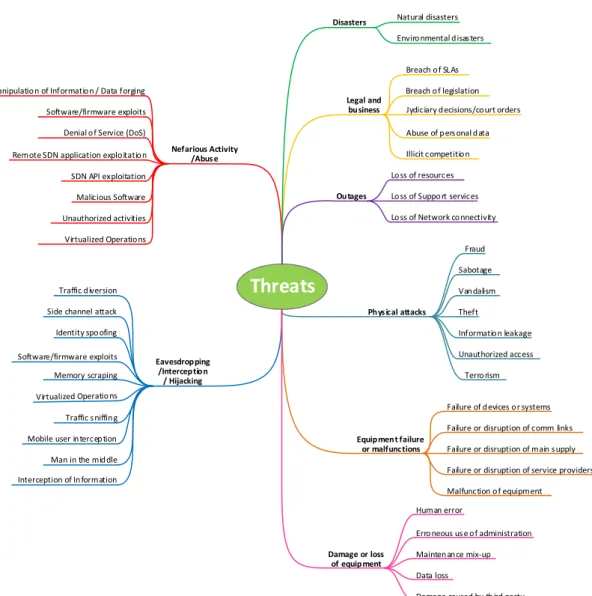
Chapter 5 presents a taxonomy of the threat types that our analysis has shown for the identified assets. Interrelated threats have been grouped to form a taxonomy that is presented as mind map.
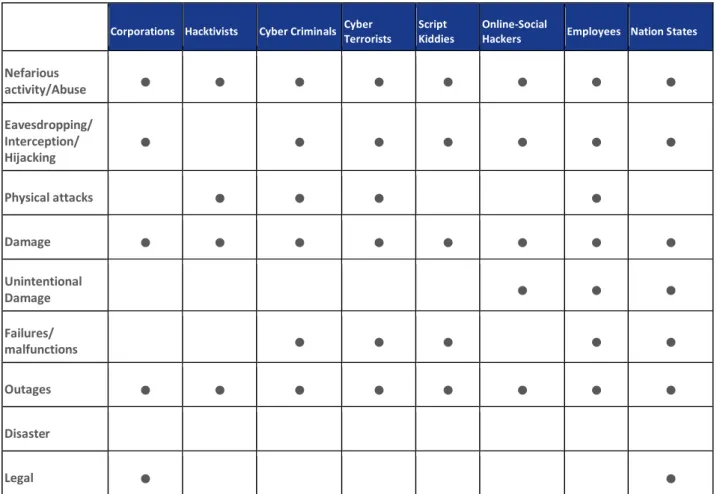
Chapter 6 introduces the threat agents of SDN/5G.
Chapter 7 reviews existing and emerging (i.e., under development) practices for mitigating the identified threats. It also identifies and analyses the gaps identified in addressing current and emerging threats. Chapter 8 provides technical and organisational recommendations arising in the context of our study. Finally, Chapter 9 provides concluding remarks.
The report includes also three annexes, containing more detailed information on SDN/5G assets (Annex A) and their taxonomy (Annex B), and SDN/5G threats (Annex C). The provision of more detailed material as annexes was necessary in order to keep the size of the report within reasonable boundaries, and at the same time give to interested stakeholders access to more comprehensive lists of SDN/5G assets and threats. A general note that is important to make prior to the rest of this report is that all material, which has been referenced by a URL in footnotes was last accessed on the day of publication of this study.
9 Petroulakis, Nikolaos E., et al. "A privacy-level model of user-centric cyber-physical systems." Human Aspects
2.
Methodology
The methodology adopted in this study is in line with the methodology introduced in the ENISA’s Cyber Threat Landscape.10 According to this methodology, someone has first to identify valuable assets and then
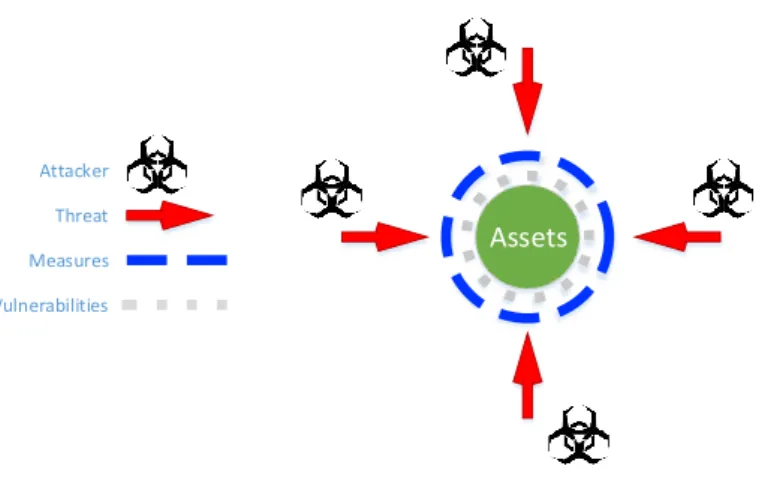
perform a risk assessment, which identifies the necessary protection levels for these assets. Subsequently, security measures that can achieve the required protection levels by mitigating fully or partly the assessed risks are identified. Any risks, which are not addressed by these measures, might be transferred or accepted. The elements of risk are graphically depicted in Figure 1.
Threats have a key role in defining the risk assessment especially when considering the components of risks. ISO 27005, the widely adopted standard in the area defines that risks emerge when: “Threats abuse vulnerabilities of assets to generate harm for the organization”.
Following this methodology, we have identified assets, threats, existing and emerging security measures for SDN/5G. These constitute the core of the SDN Threat Landscape and Good Practice Guide (STL) presented in this report. Based on this core, we have also identified gaps that originate from non-mitigated threats and provided relevant recommendations. An additional key element of our methodology is that identification and analysis has been based on a study of the related literature, without attempting any experimental or other form of validation of the claims made within this literature.
Figure 1 - Elements of risks
Furthermore, this study does not consider the use of any specific SDN equipment or the operational processes and services. Thus, it has not been possible to make a detailed and quantitative assessment of the impact and vulnerabilities of assets. Such activities could only be performed by asset owners and would probably require supporting tools for carrying out more comprehensive risk assessments in complex environments.
10 “ENISA Threat Landscape 2014”,
https://www.enisa.europa.eu/activities/risk-management/evolving-threat-environment/enisa-threat-landscape/enisa-threat-landscape-2014 Assets Vulnerabilities Measures Threat Attacker
3.
SDN/5G Architecture
SDN Architecture
The main principle that underpins an SDN’s architecture can be summarized as the separation of control and forwarding functions, logically centralized network control elements and programmable interfaces at multiple levels.
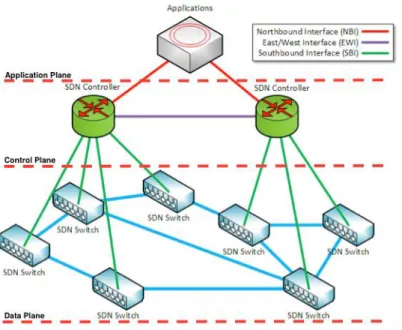
Figure 2 - Typical SDN Architecture Topology
The typical architecture of SDNs according to the Open Networking Foundation11 is shown in Figure 2. As
shown in the figure, this architecture involves three separate functionality planes:
The Data Plane – i.e., the plane responsible for the data forwarding functionality of the network.
The functionality of this plane is realized through a set of physical network devices (network elements).
The Control Plane – i.e., the plane responsible for the control functionality of the network. The
functionality of this plane is realized through a set of controllers and devices that facilitate the creation and destruction of network flows and paths. In an SDN, different controllers have control responsibility over disjoint subsets of forwarding devices. Through these forwarding devices, they
control different parts of the SDN. Typical SDN Controllers include OpenDaylight12, NSX13, Nuage14,
OpenContrail15, ONOS16, Beacon17, Floodlight18, NOX19, ONIX20, POX21 and Maestro22.
The Application Plane – i.e., the plane responsible for generic network management auditing, and
reporting functionalities (e.g., SDN management, monitoring and security). The functionality of this plane is realized through different network management applications (e.g. Network visualization). The SDN architecture defines also the key interfaces between the different components in it. These interfaces are:
The East/West bound API – This interface is implemented by the different controllers of the SDN
and is used to facilitate communications between them. Representative examples of such APIs are ALTO23 and Hyperflow24.
The Southbound API – This interface is implemented by the different forwarding devices in the SDN
to enable the communication between these devices and the controllers of the network. Representative examples of such APIs are OpenFlow25, ForCES26, PCEP27, NetConf28 and IRS29.
12 OpenDaylight: open platform for programmable networks, https://www.opendaylight.org/ 13 NSX: Vmware network virtualization platform, http://www.vmware.com/products/nsx 14 Nuage: Nuage Networks network virtualization platform,
http://www.nuagenetworks.net/products/virtualized-services-platform/
15 OpenContrail: open source network virtualization platform for the cloud, http://www.opencontrail.org/ 16 ONOS: open carrier-grade SDN network operating system designed, http://onosproject.org/
17 Beacon: cross-platform and modular Java-based OpenFlow controller,
https://openflow.stanford.edu/display/Beacon/Home
18 Floodlight: open enterprise-class SDN controller, http://www.projectfloodlight.org/floodlight/ 19 NOX: open c++ based SDN development controller platform, http://www.noxrepo.org/
20 Koponen, Teemu, et al. "Onix: A Distributed Control Platform for Large-scale Production Networks." OSDI.
Vol. 10. 2010., http://static.usenix.org/events/osdi10/tech/full_papers/Koponen.pdf
21 POX: open python based SDN development controller platform, http://www.noxrepo.org/pox/about-pox/ 22 Cai, Zheng. "Using and Programming in Maestro.",
http://maestro-platform.googlecode.com/files/programming.pdf
23 ALTO: Application Layer Traffic Optimization for distributed topologies, https://tools.ietf.org/html/rfc7285 24 Tootoonchian, Amin, and Yashar Ganjali. "HyperFlow: A distributed control plane for OpenFlow."
Proceedings of the 2010 internet network management conference on Research on enterprise networking. USENIX Association, 2010., https://www.usenix.org/legacy/event/inmwren10/tech/full_papers/Tootoonchian.pdf
25 OpenFlow: communications protocol providing access to the data plane, https://en.wikipedia.org/wiki/OpenFlow
26 Yang, Lily, et al. Forwarding and control element separation (ForCES) framework. No. RFC 3746. 2004.,
http://www.rfc-editor.org/info/rfc3746
27 Vasseur, J. P., and J. L. Le Roux. "Path computation element (PCE) communication protocol (PCEP)." (2009)., http://tools.ietf.org/html/rfc5440_1
28 Zhou, Lei, Ligang Dong, and Rong Iin. "Research on ForCES Configuration Management Based on NETCONF."
Information Technology Journal 13.5 (2014): 904-911., http://docsdrive.com/pdfs/ansinet/itj/0000/56356-56356.pdf 29 IRS: interface to the Routing System, routing protocol, https://tools.ietf.org/html/draft-ward-irs-framework-00
The Northbound API – This interface is implemented by the controllers of the SDN and is used to facilitate the communication between controllers and the network management applications. Representative examples of such APIs are FML30, Procera31, Frenetic32, Maple33 and RESTful34.
The final purpose of separating the network’s control and forwarding planes is to provide various benefits; as simplified administration, automated reconfiguration and performance improvements, however it can also introduces some significant challenges in network security. In addition this approach reduces the CAPital EXpenditure (CAPEX), the initial money investment of a company as well as the OPerating EXpenditure (OPEX) that is the ongoing cost of the investment. In the following, we identify the key assets in an SDN that may become the source of security risks for it.
5G Design Principles
The fifth generation of mobile technology known as 5G is positioned to address the demands and business of the future internet. Whether the need is to download multimedia content, provide content for robots and autonomous cars or enable distant healthcare, 5G will be the technology behind the scenes and will be on the forefront of all consumer and business applications. Experts speculate that 5G will be in place by the end of the decade.
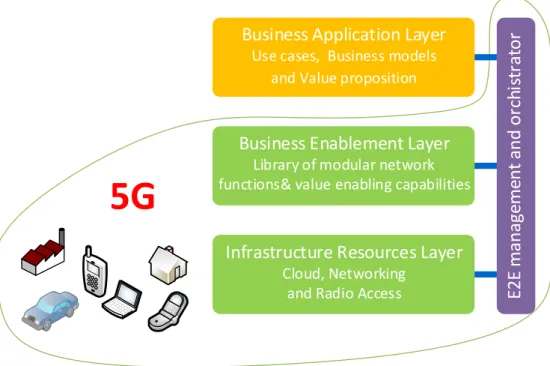
At the time of writing this report, there is no standardized architecture for 5G access. An illustration of the 5G architecture as envisioned by the Next Generation Mobile Networks (NGMN)35 alliance is depicted in
Figure 3.
30 Katta, Naga Praveen, Jennifer Rexford, and David Walker. "Logic programming for software-defined
networks." Workshop on Cross-Model Design and Validation (XLDI). Vol. 412. 2012., http://www.cs.princeton.edu/~jrex/papers/xldi12.pdf
31 Voellmy, Andreas, Hyojoon Kim, and Nick Feamster. "Procera: a language for high-level reactive network
control." Proceedings of the first workshop on Hot topics in software defined networks. ACM, 2012., http://dl.acm.org/citation.cfm?id=2342451
32 Frenetic: high-level domain-specific SDN programming language,
https://en.wikipedia.org/wiki/Frenetic_(programming_language)
33 Voellmy, Andreas, et al. "Maple: Simplifying SDN programming using algorithmic policies." ACM SIGCOMM
Computer Communication Review. Vol. 43. No. 4. ACM, 2013., http://dl.acm.org/citation.cfm?id=2486030 34 Sezer, Sakir, et al. "Are we ready for SDN? Implementation challenges for software-defined networks."
Communications Magazine, IEEE 51.7 (2013): 36-43., http://ieeexplore.ieee.org/xpls/abs_all.jsp?arnumber=6553676 35 Next Generation Mobile Networks NGMN
Figure 3 - 5G architecture
“NGMN envisions an architecture that leverages the structural separation of hardware and software, as well as the programmability offered by SDN and NFV. As such, the 5G architecture is a native SDN/ NFV architecture covering aspects ranging from devices, (mobile/ fixed) infrastructure, network functions, value enabling capabilities and all the management functions to orchestrate the 5G system. The architecture comprises three layers and an E2E management and orchestration entity.”36
The infrastructure resource layer contains any physical device including mobile devices, Internet of Things (IoT) devices etc. (5G devices), as well as fixed networking devices (networking nodes, cloud nodes, access nodes etc.). This layer utilizes the SDN/NFV programmability as well as the configurability of 5G devices in order to meet the 5G design specifications (e.g. bandwidth, capacity latency).
The business enablement layer contains all the necessary functions for the 5G converged network in the form of modular architecture building blocks. These blocks along with configuration parameters can be evoked from a common repository upon request depending on the use case.
The E2E management and orchestration entity has access to manage and orchestrate the above mentioned architectural blocks. In addition, it defines network slices for each use case, interconnects the relevant functions of the network, assigns the proper configuration to meet E2E specifications and maps all these to the network entities of the infrastructure resource layer.
The business application layer contains applications and services of the 5G network operators or other enterprises that use the network. An interface to the E2E management and orchestration entity can be used to map an application to existing network slices, or to create new slices for the applications.
36 “NGMN 5G white paper”, https://www.ngmn.org/5g-white-paper/5g-white-paper.html
Business Application Layer
Use cases, Business models and Value proposition
Business Enablement Layer
Library of modular network functions& value enabling capabilities
Infrastructure Resources Layer
Cloud, Networking
and Radio Access
E2
E
m
anage
m
ent
a
nd
or
ch
is
tr
at
or
5G
4.
SDN/5G Assets
Methodological conventions
As commonly defined, in our study, an asset is anything that has value and therefore requires protection. Due to their value, assets become the targets of threat agents. Threat agents are human or software agents, which may wish to abuse, compromise and/or damage assets. Threat agents may perform attacks, which create threats that pose risks to assets.
In a typical ICT system, assets can be: (a) hardware, software and communication components; (b) communication links between them; (c) data that control the function of the system, are produced and/or consumed by it, or flow within it; (d) the physical and organizational infrastructure within which the ICT system is deployed, and (e) the human agents who interact with the system and may affect its operation (e.g., users, system administrators etc.).
In the overview of SDN assets that we provide in the remainder of this report, we have categorized assets into the above categories. Furthermore, we have grouped assets according to their position within the typical SDN architecture, i.e., into data plane, control plane and application plane assets.
Another important consideration has been the inter-domain multi-operator landscape, which refers to the interconnection of several network operators through specific SLAs. In the current, non-SDN-based network model, a network operator is only capable to request network resources from a neighbouring network operator based on static and agreed SLAs. This is not flexible and requires high negotiation efforts to facilitate end-to-end QoS through multiple operator networks. Moreover, in contemporary multi-operator ecosystems, QoS provisioning, as required by industrial applications is not manageable due to different QoS levels that operators are able to provide37. SDN technology addresses these issues, by providing mechanisms
that enable and allow to access the network infrastructure in different operator domains and provide path-level QoS across different operator domains.
It should be noted that, due to the emerging nature of SDNs, there is no commonly accepted detailed architecture of data and software components below the 3 architectural layers indicated in Figure 2. Hence, to provide a thorough asset analysis, we have identified the different types of functionalities, which have been suggested in the literature for each of the different SDN architecture layers, and mapped them onto logical functional SDN components, which we, subsequently, refer to as assets. Clearly, these “logical” software assets may be realized through different groups of actual software components in different SDN implementations. Nevertheless, we believe that, as a first step towards a security threats analysis, the reference to “logical” software assets is sufficient.
Categories of SDN Assets
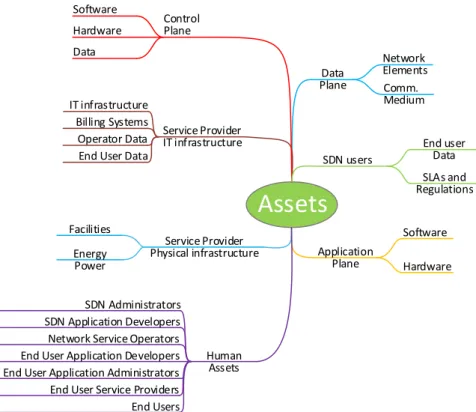
In this part valuable assets of an SDN network infrastructure are presented that are commonly found in the literature in a hierarchical manner. Based on a single first top layer classification these SDN assets are distinguished into:
Data Plane Assets: This asset group includes all assets of the SDN network deployments that include the physical instances of the network such as switching devices (Switches/Routers) and the communication medium (wired or wireless). Data plane assets include both hardware and software (e.g. Firmware, or a more or less full-fledged operating system and software switch) of the so called network elements.
Control plane Assets: This asset group includes any SDN assets related to the control plane of the SDN. Such assets include both the hardware (e.g. controllers and Interfaces) and software used to realize SDN control (e.g. protocols for the controller communication), along with system configuration and control data.
Application plane Assets: This asset group includes software applications that are used to implement any network explicitly, directly. Applications can communicate their network requirements and desired network behaviour to the SDN Controllers via APIs. Application plane assets include also hardware that is used to run these applications (e.g. Servers)
SDN Users: This asset group includes any User that is using equipment attached to the Data plane of an SDN deployment. Service-level agreements and regulations can be considered as SDN user assets as well.
Service provider IT Infrastructure Assets: This asset group includes any component of an IT infrastructure that is used by or belong to any service provider in the SDN from a billing system to stored data of an end user in a cloud.
Network service provider physical infrastructure Assets: This asset group includes physical assets of the network service providers including every construction (e.g. Buildings, data centres etc.), machinery as well as the power supply networks
Human Assets: This asset group includes any human in the SDN ecosystem from system and network administrators to simple end users.
A mind map presenting the above taxonomy is shown in Figure 4. A more detailed taxonomy of assets categorised in deeper taxonomic levels is also provided in Annex A.Annex A:
Figure 4 - SDN assets threat landscape
It should be noted that the SDN network infrastructure and its respective components/assets, assumed by our analysis, may belong either to a single network operator (intra-domain case) or to multiple network operators (inter-domain case).
Data Plane
Assets
Network Elements Comm. Medium Application Plane Hardware Software IT infrastructure Billing Systems Operator Data End User DataService Provider IT infrastructure Facilities Service Provider Physical infrastructure Energy Power SDN Administrators SDN Application Developers Network Service Operators End User Application Developers End User Application Administrators End User Service Providers
Human Assets End Users Hardware Data Software Control Plane End user Data SLAs and Regulations SDN users
5.
SDN Threats
SDN brings significant innovation to networking. Key concepts associated with SDN such as Logically Centralized Intelligence, Programmability and Network Abstraction establish a basis for future communications. While significant improvements may be achieved in network security by centralization and programmability, these two concepts can also attract a new level of threats and attacks.
Security within the SDN paradigm is a challenge, as all layers, sub-layers and components need to communicate according to strict security policies. In this report, we have attempted to increase awareness by identifying key valuable assets of the SDN infrastructure that are needed in order to ensure proper network function and interoperability. As these assets may, however, become the target of attacks, they become naturally the main driver of threat analysis aimed at securing SDNs.
Taxonomy of SDN/5G Threats
The identification of SDN/5G threats has been based on a study of the related literature, which indicates not only SDN threats but also generic taxonomies that could be used for classifying them.
One of these taxonomies has been documented in the ENISA report “ENISA Threat Landscape 2014”38
(ETL14). Although this taxonomy has not been developed for SDN/5G threats, our view is that it is generic enough to be used for classification of such threats. This is because of the similarity of the respective landscapes, i.e., the Internet Infrastructure and the SDN/5G landscape, which renders the taxonomic classification presented in ELT14 broadly applicable to the SDN/5G landscape. Furthermore, the adoption of this taxonomy can make the understanding of the SDN/5G threat landscape easier for the reader.
Based on ETL14, the general categories of threats for the SDN/5G landscape are:
Nefarious activity/abuse (NAA): This threat category is defined as “intended actions that target ICT
systems, infrastructure, and/or networks by means of malicious acts with the aim to either steal, alter, or destroy a specified target”34
Eavesdropping/Interception/ Hijacking (EIH): This threat category is defined as “actions aiming to
listen, interrupt, or seize control of a third party communication without consent”34
Physical attacks (PA): This threat category is defined as “actions which aim to destroy, expose, alter,
disable, steal or gain unauthorised access to physical assets such as infrastructure, hardware, or interconnection”34
Damage (DAM): This threat category is defined as intentional actions aimed at causing “ destruction,
harm, or injury of property or persons and results in a failure or reduction in usefulness”34
Unintentional Damage (UD): This threat category is defined as unintentional actions aimed at
causing “ destruction, harm, or injury of property or persons and results in a failure or reduction in usefulness ”34
38 ENISA Threat Landscape 2013,
Failures or malfunctions (FM): This threat category is defined as “insufficient functioning of an (Internet infrastructure) asset”34. In the case of SDN/5G the assets include those defined in the asset
list.
Outages (OUT): This threat category is defined as “unexpected disruptions of service or decrease in
quality falling below a required level “34
Disaster (DIS): This threat category is defined as “serious disruption of the functioning of a society”34
Legal (LEG): This threat category is defined as “legal actions of third parties (contracting or
otherwise), in order to prohibit actions or compensate for loss based on applicable law” 34
In addition to the above general taxonomy, we also categorise threats depending on whether their source is an SDN element, a 5G element or a generic network element. Based on this criterion, threats can be further categorised into:
SDN specific threats39: These are threats related to the elements of the SDN architecture. These
threats fall under the categories “Nefarious activity/abuse” and “Eavesdropping/Interception/ Hijacking”. SDN specific threats are described in detail in Sect. 5.2.
Network Virtualisation threats: These are threats related to the underlying IT infrastructure used for
virtualising network operations. Network Virtualisation specific threats are described in more detail in Sect. 5.3.
5G/Radio access threats40: These are threats related to the 5G landscape but not specific to the SDN
infrastructure. 5G specific threats include threats related to the wireless medium, the virtualisation of functions and the multi-operator environment. Threats of the wireless medium are mostly related to “Eavesdropping/Interception/Hijacking”; threats on virtualisation are related to “Nefarious activity/abuse” and “Eavesdropping/Interception/ Hijacking”. 5G specific threats are described in more detail in Sect. 5.4.
Generic network infrastructure threats: These are threats that any network infrastructure faces
without reference to the 5G and/or SDN landscape. Generic network infrastructure threats fall under the categories “Physical attacks”, “Damage or loss of equipment”, “Equipment failures or malfunctions”, “Outages”, “Disaster” and “Legal and business”. Generic network infrastructure threats are described in more detail in Sect. 5.5.
SDN specific Threats
In the following, we present types of threats that are specific to SDN. Such threats may relate to different assets in the reference SDN architecture, as shown in Figure 5. For the listed threats, we also identify the layer of the reference SDN architecture that these threats are primarily related to according to the literature if relevant.
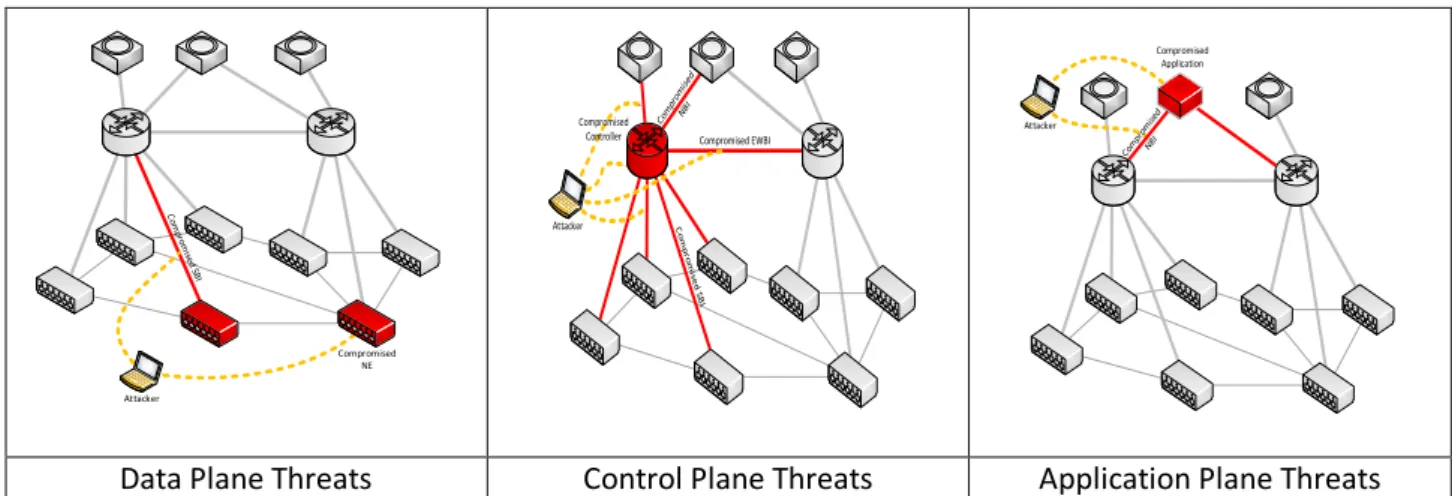
Data forging: This threat involves compromising an SDN element (e.g., controller, router, switch) in order to forge network data and launch other attacks (e.g., DOS). Whilst data forging may, in principle, relate to data
39 SDNSecurity.org, “An Overview of Misuse / Attack Cases”, http://sdnsecurity.org/project_SDN-Security-Vulnerbility-attack-list.html
40 Ericsson White paper, “5G Security”, Uen 284 23-3269 | June 2015, http://www.ericsson.com/res/docs/whitepapers/wp-5g-security.pdf
held by any component of an SDN (e.g., network switches, controllers and/or SDN applications), a threat specific to SDN consists in forging requests from accessible low level SDN controllers to upper level ones, in order to drive their decisions on how to redefine large parts of the network. In the literature it has been identified as a threat related to components in the data plane and the controller plane.
Traffic diversion: This threat involves compromising a network element in order to divert traffic flows and to enable eavesdropping. Traffic diversion is a threat relating to network elements of the data plane. A specific kind of traffic diversion that is available in virtualized networks is network slice trespassing. This occurs when the mandatory isolation between slices is compromised in any active node or when the enforcing access to a slice in the edge equipment is either bypassed or misconfigured. This ends with alien traffic circulating on a given slice.
Data Plane Threats Control Plane Threats Application Plane Threats Figure 5 - Threats of SDN reference architecture
Side channel attack: This threat involves extracting information on existing flow rules that are used by network elements. The threat can be realised by exploiting patterns of network operations (e.g. exploiting the time required for establishing a network connection). Side channel attacks is a threat relating to network elements of the data plane.
Flooding attack: Flooding attacks involve compromising a SDN component in order to make it flood other components, which it interacts with. Flooding occurs through the transmission of data that can exhaust component resources and lead to a reduction or complete shutdown of the service provided by the component. Flooding attacks occur primarily for network components of the data plane. In such cases, the threat involves compromising a network component in order to make it flood its controller with network messages, and overload and eventually exhaust the controller’s resources. Flooding attacks can also occur at the control plane. In such cases, a controller is flooded with messages from other (malicious) controllers that can exhaust its resources causing a reduction or complete shutdown of the controller’s service. Specific to SDN are amplification flooding attacks where a small stream of requests with a faked sender elicits a flooding large stream of response. While protection from such attacks have been devised for many known network protocol, the exposure of several network functions (NFV) by SDN controllers presents a whole new landscape of threats. Compromised EWBI Compromised Controller Attacker Compromised Application Attacker Compromised NE Attacker
Software/firmware exploits: This threat involves exploiting vulnerabilities of the software/firmware in order to cause some malfunction, reduction or disruption of service, eavesdrop data or destroy/compromise data. Software/firmware exploits may occur in all layers of the SDN reference architecture, and depending on the layer that they relate to they have been distinguished into network element software/firmware exploits,
controller software/firmware exploits, and SDN applications software/firmware exploits. Software/firmware exploits of network elements and controllers cause the malfunction or even their termination of operation. In the case of switches, for example, the exploited switches can drop, slow down, clone or deviate network traffic. Exploited switches software/firmware can also create forged traffic in order to exhaust other switches and/or the controllers the switches are connected to.
Denial of Service (DoS): This threat relates to attacks aimed at causing reduction or disruption of the SDN service. DoS threats may occur in all layers of the SDN reference architecture. At the data plane, DoS can be caused by attackers, which flood the bandwidth or resources of network elements. This arrack type in many occasions originate by multiple compromised systems, such as botnets, which are flooding the targeted SDN with traffic. At the control plane, a DoS can be caused by congesting controllers through a large number of forged flow arrivals, causing network performance degradation and interruption. Traditional DoS defences’ approaches focus on protecting the data plane, and are therefore ineffective in the cases of SDN control plane DoS attacks. DoS attacks may also appear at the application plane affecting, for example, network management applications.
Identity spoofing: Identity spoofing is a threat where a threat agent successfully determines the identity of a legitimate entity and then masquerades this entity in order to launch further attacks. Identity spoofing is a threat that can affect any type of software component or human agents. In the case of SDN, identify spoofing has been identified as an attack affecting mainly SDN controllers (SDNcontroller identity spoofing). In this attack, the attacker spoofs the identity of a legitimate controller and interacts with the network elements controlled by the legitimate controller (i.e., elements of the data plane) in order to trigger several other types of attacks (e.g., instantiate network flows, divert traffic etc.).
API exploitation: This threat involves exploiting the API of a software component in order to launch different types of further attacks such as the unauthorised disclosure, compromise of integrity and/or destruction of information, or the unauthorised destruction/degradation of service. In SDN, API exploitation may relate to all the different types of APIs that may be found in an SDN. These include: (a) the Northbound API (Northbound API exploitation) that facilitates the communication between SDN controllers and SDN applications; (b) the Southbound API that facilitates the communication between SDN network elements and SDN controllers (i.e., Southbound API exploitation), and (c) the Eastbound/Westbound API that facilitates the communication between SDN controllers (i.e., Eastbound/Westbound API exploitation).
Memory scraping: This threat arises when an attacker scans the physical memory of a software component in order to extract sensitive information that is it not authorised to have. Whilst in SDN, memory scrapping can affect components of any layer, this type of threat has been primarily identified for SDN application servers41. While the memory scrapping threat is exclusive to SDN, a core dump (e.g. as the result of malicious
software) can be used to exploit private data. Furthermore SDN reconfiguration may require reboots that an attacker could use in order to attack the boot procedure. Once successfully performed, memory scrapping can be used to extract sensitive SDN data (e.g., flow rules at the Northbound API).
41 J. Hizver, Taxonomic Modeling of Security Threats in Software Defined Networking, BlackHat Conference, August 5-6, 2015,
available from: https://www.blackhat.com/docs/us-15/materials/us-15-Hizver-Taxonomic-Modeling-Of-Security-Threats-In-Software-Defined-Networking-wp.pdf
Remote application exploitation: In this threat, an attacker gains access or obtains higher access privileges to an SDN application by exploiting software vulnerabilities of it. This can then be used to execute operations illegitimately.
Traffic sniffing: Traffic sniffing involves tapping data flows within a network. In SDN, traffic sniffing has been identified primarily as an attack upon the communication link between an application at the SDN application plane and a controller at the control plane in order to gain access to important controller configuration data or application-level credentials. Traffic sniffing can be enabled by the use of weak or no encryption in the relevant communication link. It should be noted that traffic sniffing might also be used for legitimate reasons (e.g., for network monitoring and administration) and if used in this manner it should not be regarded as an attack.
Network Virtualisation Threats
Network virtualisation threats42,43,44,45 are threats related to the underlying IT infrastructure used for
virtualising network operations. Such threats can be distinguished into:
Threats related to servers running virtualised network functions (virtualised host abuse): Virtualisation of functions and their operation on virtual machines (e.g., a server that can be used as a network switch) is a common practice in SDN. Therefore traditional security threats for servers running virtualised network operations such as network monitoring, access control, network management etc. should be considered.46
Threats to data centres hosting SDN operations (Data centre threats): Many SDN systems are deployed within data centres. Hence, security threats of data centres should be considered, similarly to the server case. Moreover, data servers are using Data Centre Interconnect (DCI) protocols, which may lack authentication and encryption to secure the packet contents. Thus an attacker could create spoofed traffic in such a way that it traverses the DCI links or to create a DoS attack of the DCI connections.
Threats related to virtualization mechanism: (Network Virtualization bypassing): The use of the network between different tenants need to assure that only legitimated traffic enters or leaves a network slice, but also that any switching element checks and enforces the traffic isolation by installing legitimate flow rules preventing slice trespassing.
42 Drutskoy, Dmitry, Eric Keller, and Jennifer Rexford. "Scalable network virtualization in software-defined
networks." Internet Computing, IEEE 17.2 (2013): 20-27.,
http://ieeexplore.ieee.org/xpls/abs_all.jsp?arnumber=6362137
43 Pearce, Michael, Sherali Zeadally, and Ray Hunt. "Virtualization: Issues, security threats, and solutions." ACM
Computing Surveys (CSUR) 45.2 (2013): 17., http://dl.acm.org/citation.cfm?id=2431216
44 ETSI GS NFV-SEC 001 V1.1.1 (2014-10): Network Functions Virtualisation (NFV);NFV Security;Problem
Statement, http://www.etsi.org/deliver/etsi_gs/NFV-SEC/001_099/001/01.01.01_60/gs_NFV-SEC001v010101p.pdf 45 ETSI GS NFV-SEC 003 V1.1.1 (2014-12): Network Functions Virtualisation (NFV);NFV Security;Security and
Trust Guidance, http://www.etsi.org/deliver/etsi_gs/NFV-SEC/001_099/003/01.01.01_60/gs_NFV-SEC003v010101p.pdf
46 Network Functions Virtualisation (NFV);NFV Security; Problem Statement,
In reference to the taxonomy of threats outlined in Sect. 2, wireless medium threats fall under the general category of “Eavesdropping/Interception/ Hijacking”.
5G radio access threats
In SDNs there can also be threats arising due to the use of 5G technology47,48; in particular the use of
wireless communication in 5G. Such threats, as described in49 can be distinguished into:
User emulation: The wireless medium can be exploited by adversaries that mimic incumbent signals. Nodes launching such attacks can be (i) Greedy mobile nodes that by transmitting fake incumbent signals force all other users to vacate a specific band (spectrum hole) in order to acquire its exclusive use and (ii)
Malicious mobile nodes (adversaries) that mimic incumbent signals in order to cause Denial of Service (DoS) attacks. Malicious nodes can cooperate and transmit fake incumbent signals in more than one band, thus causing extensive DoS attacks making a radio hop from band to band, severely disrupting its
operation.
Spectrum sensing data falsification: The received signal power may enforced to become lower compared to what path loss models have predicted due to transmission features such as signal fading, multi-path propagation, etc., 50. This may lead to harmful interference due to undetected primary signals.
MAC layer attack: This category of attacks includes (i) MAC spoofing, where attackers send spurious messages aiming to disrupt the operation of network(e.g. channel negotiation), (ii) Congestion attacks, where attackers flood Common Control Channel in order to cause an extended DoS attack and (iii) Jamming attacks, where attackers cause DoS attacks at this layer by creating interference.
In reference to the taxonomy of threats outlined in Sect. 2, Network Function Virtualization (NFV)51 threats
can be seen as threats under the “Nefarious Activity/Abuse” and “Eavesdropping/Interception/ Hijacking” categories.
Generic network infrastructure threats
Besides the pure telecommunication infrastructures, in SDN/5G there are interdependencies with other computing infrastructures such as the cloud that may be used for network virtualisation. Such
47 Mantas, Georgios, et al. "Security for 5G Communications." Fundamentals of 5G Mobile Networks (2015):
207-220., http://onlinelibrary.wiley.com/doi/10.1002/9781118867464.ch9/summary
48 Demestichas, Panagiotis, et al. "5G on the horizon: key challenges for the radio-access network."Vehicular Technology Magazine, IEEE8.3 (2013): 47-53., http://ieeexplore.ieee.org/xpls/abs_all.jsp?arnumber=6568922 49 Fragkiadakis, Alexandros G., Elias Z. Tragos, and Ioannis G. Askoxylakis. "A survey on security threats and
detection techniques in cognitive radio networks." Communications Surveys & Tutorials, IEEE 15.1 (2013): 428-445.
50 R. Chen, J. Park, T. Hou, and J. Reed, “Toward secure distributed spectrum sensing in cognitive radio
networks,” IEEE Magazine, vol. 46, pp. 50–55, 2008., http://ieeexplore.ieee.org/xpls/abs_all.jsp?arnumber=4481340 51 ETSI, “Network Functions Virtualisation – Introductory White Paper”, 2012,
interdependencies can introduce additional generic infrastructure threats, which may lead to SDN/5G failures, misconfiguration and errors. ENISA has produced an extensive and comprehensive report for this area52. In the following, we highlight the generic network infrastructure threats that should be considered
in addition to the SDN specific threats and the 5G specific threats.
Physical threats: This type of attack refers to actions (attacks) aimed at destroying, disabling, altering or stealing physical ICTinfrastructure assets. This type of threat applies to any network and computing infrastructure, including SDN/5G infrastructures. Physical threats are very important due to the
virtualisation of networking functions, which may result in deploying such functions in remote servers and data centres. Despite the existence of physical protection mechanisms (e.g., physical surveillance and surveillance cameras, security locks, security guards), physical breaches and insider threat attacks still occur53. Examples of such attacks include fraud, sabotage vandalism, theft, information leakage/sharing,
unauthorised physical access and terrorist attacks.
Damage/loss: This type of threats refers to intentional or unintentional destruction of ICT infrastructure. It may be physical as for example the destruction of a server or take the form of a cyber damage as, for example, mixing-up information in a data centre due to maintenance errors or erroneous system administration.
Failures/malfunctions: This type of threats refers to failures or insufficient functioning of network and infrastructure subsystems. Examples of this threat type include failure or malfunctioning of devices including network elements, controllers and network management applications, disruption of the communication links, and/or failure of service providers.
Outages: This type of threats refers to the interruption or failure in the supply of a service. In the case of SDN/5G networks, it includes interruption of support services such as Internet and electricity, the loss of network connectivity either due to cable errors or the loss of (part of) a wireless network, or loss of human (e.g. strike of employees of a network operator) or physical resources.
Disaster: A disaster is a sudden incident that interrupts the daily activities of the society. It can be
categorised in disasters caused by the intervention of human (environmental) or natural disasters such as floods, earthquakes etc.
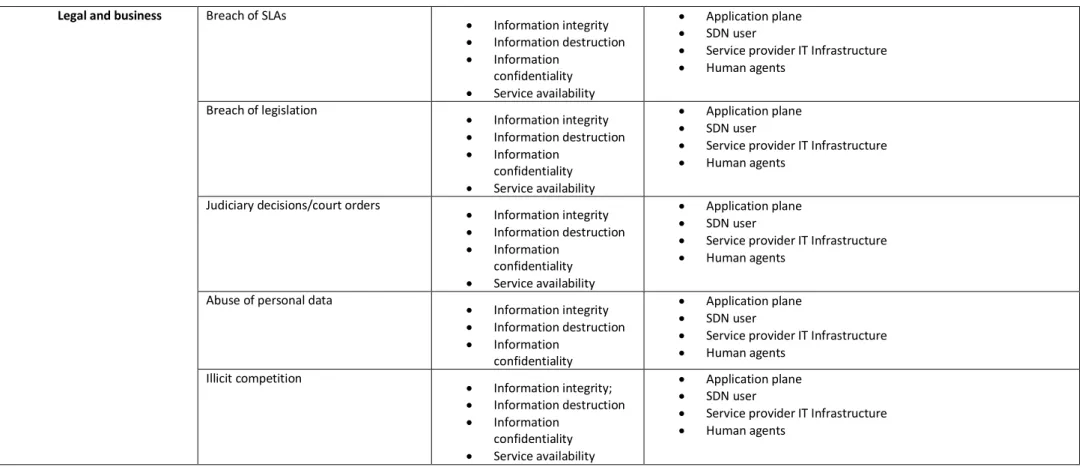
Legal: Since the 5G landscape is of multi-operator nature, where all operators will be interconnected to each other, multi-operator related threats are very important. In this landscape, operators of the SDN infrastructure that will not honestly stick to business agreements (SLAs) should be considered. Moreover, measures for non-repudiation of SLAs between different operators should be considered.
Lists of SDN/NFV/5G and Generic Network Threats
52 Enisa, “Annual Incident Reports”,
https://www.enisa.europa.eu/activities/Resilience-and-CIIP/Incidents-reporting/annual-reports 53 Kelly Jackson Higgins, “Five Ways To (Physically) Hack A Data Center” Available: http://www.darkreading.com/five-waysto-(physically)-hack-a-data-center/d/d-id/1133615
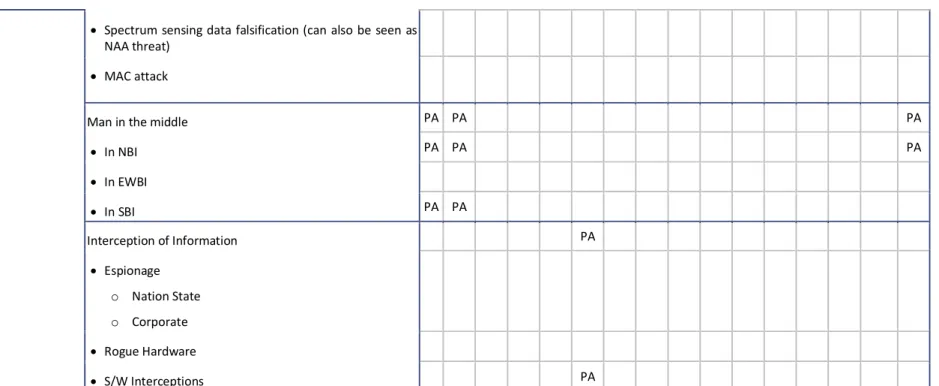
In the following, we present two tables of SDN related threats. These tables list SDN/NFV/5G specific threats (Table 1 - SDN/5G Specific threats and assetsTable 1), and generic network threats (Table 2), respectively. For each threat, the tables provide:
(a) A brief description of the threat (see “Threat” column), the main type of the threat in reference to the taxonomy described in the ENISA report on “Threat Landscape and Good Practice Guide for Internet Infrastructure”54 that has been overviewed in Sect. 2 of this report. In cases where a threat
falls under more than one categories in the ENISA taxonomy, the additional categories are identified in the description of the threat.
(b) The assets that the threat affects (see column “Asset types”). This description refers to the asset listing produced earlier as part of the project.
(c) The potential effect of the threat described in terms of the basic security properties that a threat can compromise, i.e., confidentiality, integrity or availability (see column “Potential Effect”).
54 Enisa, “Threat Landscape and Good Practice Guide for Internet Infrastructure”,
https://www.enisa.europa.eu/activities/risk-management/evolving-threat-environment/enisa-thematic-landscapes/threat-landscape-of-the-internet-infrastructure
Threat types Threats Potential Effect Asset types
Nefarious Activity/Abuse
Manipulation of Information / Data forging
Routing table manipulations
DNS manipulations
Falsifications of configurations
Information integrity
Information destruction
Service availability
Data plane data
Control plane data,
Application plane data
Software/firmware exploits
Controller
o Kernel flaws (can also be seen as FM threats)
o Buffer overflows (can also be seen as FM
threats)
o SQL injection (can also be seen as FM threats)
o XSS (can also be seen as FM threats)
Network element
o Kernel flaws (can also be seen as FM threats)
o Buffer overflows (can also be seen as FM
threats)
Information integrity
Information destruction
Outage
Service availability
Data plane software
Control plane software
Denial of Service (DoS) (can also be seen as OUT threats)
Flooding attack
Amplification attack
Service availability Data plane
Control plane
Application plane
Service Provider IT infrastructure
SDN users
Remote SDN application exploitation
Network visualisation exploitation
Network management
Mobility management
Service provisioning exploitation
Information integrity
Information destruction
Service availability
SDN API exploitation NBI exploitation EWBI exploitation SBI exploitation Information integrity Information destruction Service availability Data plane Control plane Application plane Malicious Software Virus Malware Worms Trojan Botnet Greyware Information integrity Information destruction
Other software asset integrity
Other software asset
destruction Service availability Data plane Control plane Application plane SDN user
Service provider IT Infrastructure
SDN users
Human agents
Unauthorised activities
Unauthorised access
Unauthorised installation of software
Unauthorised use of software
Unauthorised administration of devices and systems
Information integrity
Information destruction
Other software asset integrity
Other software asset
destruction Service availability Data plane Control plane Application plane SDN user
Service provider IT Infrastructure
Network service provider physical
infrastructure
SDN user
Human agents
Virtualisation threats
Virtualised hosts abuse
o Denial or Loss of service (can also be seen as
OUT threats)
o Degradation of service (can also be seen as
OUT threats)
Data Center threats
o Resource contention (can also be seen as FM
and OUT threats)
o Abuse of unencrypted data
Information integrity
Information destruction
Other software asset integrity
Other software asset
destruction Service availability Data plane Control plane, Application plane SDN user
Service provider IT Infrastructure
Network service provider physical
infrastructure Human agents Eavesdropping/Interception/ Hijacking Traffic diversion Information confidentiality Data plane Control plane
Side channel attack Information confidentiality Service availability Data plane Control plane SDN user Identity spoofing SDN o Controller o Network element Network administrators Network operators Information confidentiality Service availability Data plane Control plane Application plane SDN user
Service provider IT Infrastructure
SDN user Human agents Software/firmware exploits Controller Network element Information confidentiality Service availability Data plane Control plane
Memory scraping (can also be seen as NAA threat)
Information confidentiality Service availability Data plane Control plane Application plane Virtualisation threats
Virtualised hosts abuse
o Unauthorised access
o Loss of control of virtualised function
Data Center threats
o DC Traffic spoofing
o Inter VM attack
Network Virtualization bypass
o Unlawful network slice ingress and egress
o Slice trespassing. Information confidentiality Service availability Data plane Control plane Application plane SDN user
Service provider IT Infrastructure
Human agents
Traffic sniffing
Information confidentiality Data plane
Control plane
Application plane
SDN user
Spectrum sensing data falsification (can also be seen as NAA threat)
MAC attack
Service availability
Man in the middle
In NBI
In EWBI
In SBI
Information confidentiality Data plane
Control plane
Application plane
SDN user
Service provider IT Infrastructure
Human agents Interception of Information Espionage o Nation State o Corporate Rogue Hardware S/W Interceptions Information confidentiality Data plane Control plane Application plane SDN user
Service provider IT Infrastructure
Human agents
Threat types Threats Potential effect Asset types
Physical attacks Fraud
Information integrity Information destruction Information confidentiality Data plane Control plane Application plane SDN user
Service provider IT Infrastructure
Network service provider physical infrastructure
Human agents Sabotage Information integrity Information destruction Information confidentiality Service availability Data plane Control plane Application plane SDN user
Service provider IT Infrastructure
Network service provider physical infrastructure
Human agents Vandalism Information integrity Information destruction Information confidentiality Service availability Data plane Control plane Application plane SDN user
Service provider IT Infrastructure
Network service provider physical infrastructure
Human agents
Theft (of devices, storage media and
documents) Information integrity
Information destruction Information confidentiality Service availability Data plane Control plane Application plane SDN user
Service provider IT Infrastructure
Network service provider physical infrastructure
Human agents Information leakage/sharing Information integrity Information destruction Information confidentiality Data plane Control plane Application plane SDN user
Service provider IT Infrastructure
Unauthorised physical access /
Unauthorised entry to premises Information integrity
Information destruction Information confidentiality Data plane Control plane Application plane SDN user
Service provider IT Infrastructure
Network service provider physical infrastructure
Human agents Terrorists attack Information integrity Information destruction Information confidentiality Service availability Data plane Control plane Application plane SDN user
Service provider IT Infrastructure
Network service provider physical infrastructure
Human agents
Damage Information leakage/sharing due to
human error Information integrity
Information destruction Information confidentiality Data plane Control plane Application plane SDN user
Service provider IT Infrastructure
Network service provider physical infrastructure
Human agents
Erroneous use or administration of
devices and systems Information integrity
Information destruction Information confidentiality Service availability Data plane Control plane Application plane SDN user
Service provider IT Infrastructure
Network service provider physical infrastructure
Human agents Maintenance mix-up Information integrity Information destruction Information confidentiality Service availability Data plane Control plane Application plane SDN user
Service provider IT Infrastructure
Network service provider physical infrastructure
Human agents