Please cite this article as: H. Van Hoten, Gunawarman, I. Hari Mulyadi, A. Kurniawan Mainil, P. Bismantolo, Nurbait, Parameters Optimization in Manufacturing Nanopowder Bioceramics of Eggshell with Pulverisette 6 Machine using Taguchi and ANOVA Method, International Journal of Engineering (IJE), IJE TRANSACTIONS A: Basics Vol. 31, No. 1, (January 2018) 45-49
International Journal of Engineering
J o u r n a l H o m e p a g e : w w w . i j e . i rParameters Optimization in Manufacturing Nanopowder Bioceramics of Eggshell
with Pulverisette 6 Machine using Taguchi and ANOVA Method
H. Van Hoten*a, Gunawarmanb, I. Hari Mulyadib, A. Kurniawan Mainila, P. Bismantoloa, Nurbaitic
a Mechanical Engineering Department, Bengkulu University, Indonesia b Mechanical Engineering Department, Andalas University, Indonesia
c Mechanical Engineering Department, Prof. Dr. Hazairin, SH University, Indonesia
P A P E R I N F O
Paper history:
Received 17 March 2017
Received in revised form 12 October 2017 Accepted 12 October 2017
Keywords:
Eggshell Ball Milling Nanopowder Bioceramics Taguchi and ANOVA
A B S T R A C T
Bioceramics is essential, especially for clinical application. Many resources can be explored to obtain bioceramics. Household wastes such as the chicken eggshell is the potential one. From waste eggshell, Hydroxiapatite (HA) can be extracted to produce bioceramics. Most bioceramics materials are formed in the fine grain powder. The size of the grain should be in nanosized. However, it is very difficult to produce such size if only depending to one processing method such as Ball Milling process. But, the windows of possibility are still open. This is due to many previous studies limiting the process parameters at certain magnitude. There are no evidence that the process parameters had been set at their optimum. Therefore, this study investigated the optimum parameters of Ball Milling for the manufacturing of nano-powder of bioceramics from local materials such as Eggshell that had been calcinated at 900o C. A Taguchi method with a L-9 orthogonal array and Analysis of Variances (ANOVA) were utilized. The Ball milling machine was set at 3 levels for each of observed parameters (e.g. Milling rate, Milling time and eggshell powder to weight ratio (PBR). This parameter was employed to produce fine grain of HA powder. The Mean Analysis showed that higher milling rate, longer milling time and lower PBR are responsible to reduce the grain size of the powder. With those combination, 1.33 µm of powder grain size can be achieved. However, there is a contradictive fact revealed from the experimental results, whereas the moderate PBR had an effect in producing fine grain powder. But, this can be neglected since the contribution of PBR is relatively lower. The contribution percentage of PBR was only 6.64% or less significant due to having a P-value ≥ 0.05 (95% of Confidential Factors). Thus, it can be inferred that machine parameters have significant effect in producing nano grain sizes of bioceramics powder.
doi: 10.5829/ije.2018.31.01a.07
1. INTRODUCTION1
Bioceramics have found their suitable applications in medical fields such as orthopedic and dental implants. Therefore, bioceramics need to be in various forms from thin films and powder in nano-sized to porous or dense bodies [1]. For bone implants, it requires a massive porous Hydroxiapatite (HA) and -Tricalcium Phospate (-TCP) and their mixture. Meanwhile, for artificial teeth and hip joints, the thin film of HA is necessary. Most of the application of HA for medical is in the
*Corresponding Author’s Email: [email protected] (M. Osanloo)
forms of powder, especially fine grain of powder and/ nanostructured bioceramics. The fine grain of powder and/ nanostructured bioceramics could enable to control the microstructure of bioceramics. This is due to the fact that nanostructured forms would have distinctive mechanical properties in comparison to their conventional coarse grain powder counterparts [2-4].
Hydroxiapatite (HA) is a substantial ingredient for implant materials. This substance has characteristics highly bio-active and bio-compatible material for medical applications. HA can be acquired either from natural resources or through chemical processing. From nature, HA is available widely in large amount, especially from household disposal such as chicken
eggshells. The chicken eggshells compose with 94% - 97% of CaCO3 [5]. This CaCO3 can be converted into
HA powder by means of many processing methods and/ combination of processing methods. After fine powder of HA is produced, the powder, then can be applied for many purposes. Ghorbani et al. [6] and Afshar et al. [7] used the HA powder as coating substrates.
Mechanical processing is one of method that can enable in producing the fine HA powder. It uses a ball mill to grind the extracted HA to produce a fine powder. This mechanical processing method is known as MM-PM method (mechanical alloying-powder metallurgy). In MM-PM, the impact energy is utilized to re-crash the coarse powder of HA between the balls and the vial wall. However, in single stage processing (i.e. only one stage of calcination and subsequently process using ball mill), very fine grain powder in nano scales is difficult to obtain. Several past studies had proofed that mechanical processing such as ball milling find difficulty to produce fine grain powder in nano scale [8-10]. Most likely, only micro scale grain powder can be achieved. This would be exceptional if the processing method is conducted in several stages and combined with thermal or chemical reaction [9].
But, the possibilities of a mechanical processing such as ball milling to reproduce very fine grain powder does still open. This is due to many studies only focusing on a certain set of ball milling parameters. Relatively limited reports have been published attempting to use an optimum set of ball mill parameters. Therefore, in this study, by using Taguchi and Analysis of Variances (ANOVA), the optimum set of parameters enabling to produce very fine grain powder of HA would be elaborated.
2. METHODOLOGY
2. 1. Samples Preparation Hidroxiapatite used in this study was extracted from the chicken eggshell collected from household wastes around Padang City in West Sumatra Indonesia. Initially, the eggshells were washed with aquades and placed in the sun for 3 days to vaporize the water content. Then, the eggshells were crushed into coarse grain particles by means ofa Blender. The coarse grain powder of eggshell was then calcined at 900oC for 10 hours in a Nabertherm P320 furnace. After calcination, the calcined eggshell powder was milled by means of a Pulverisette 6 Classic Line Fritsch Planetary Mono Mill. This ball milling machine is equipped with 54 grams stainless steel balls. Two balls were employed to re-mill the coarse grain powder. Fine calcined eggshell powder produced by ball mill machine were filtered using shieve with variations in mesh numbers of 35, 60 and 230. Re-milled powder would go through the shave holes to obtain a certain
size of powder grain. The powder was subsequently taken into the petri dish and spread uniformly over to examine the morphology and microstructure of calcined eggshell powder as well as measuring the grain size of the particles under Scanning Electron Microscope (SEM) of Hitachi S3400.
2. 2. Experimental Methods To acquire an
optimum set of parameters in manufacturing
bioceramics from the chicken eggshell by using ball milling, orthogonal array design Taguchi was opted. This method was selected due to its capability in reducing the number of experimental stages [11]. In addition, it is also useful in regards to screening purposes. According to the literatures, there are three ball milling parameters that have been frequently used. Thus, it was conceivable that those parameters are of importance. Those parameters were milling rate (MR), milling time (MT) and ball to powder ratios (PBR). Meanwhile, to determine the optimum combination, each parameter had to set into more than two levels. In this study, three levels were considered to be appropriate. The observed parameters and its level are depicted in Table 1.
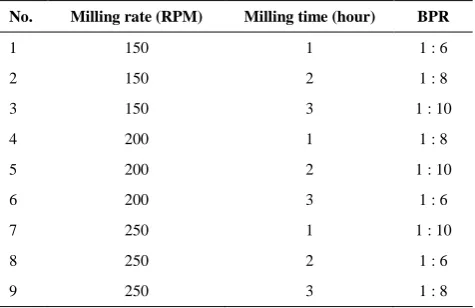
With having three parameters and three levels for each, thus, L-9 orthogonal array design Taguchi was sufficient. These nine sets of combination are given in Table 2. Furthermore, to improve the validity of the results, response from each combination, in this case powder sizes, would be conducted and measured twice.
TABLE 1. Selected factors and levels in this experiment
No. Factors Levels
1 Milling rate (RPM) 150 200 250
2 Milling time (hour) 1 2 3
3 Ball to Powder Ratio 1 : 6 1 : 8 1 : 10
TABLE2. L-9(33) orthogonal array design Taguchi used for this experiment
No. Milling rate (RPM) Milling time (hour) BPR
1 150 1 1 : 6
2 150 2 1 : 8
3 150 3 1 : 10
4 200 1 1 : 8
5 200 2 1 : 10
6 200 3 1 : 6
7 250 1 1 : 10
8 250 2 1 : 6
To measure the experimental responses, in this case the grain size of re-milled powder of calcined eggshell, the calcined coarse powder of the eggshell was segregated into eighteen portions. Each portion was poured into the Ball Mill’s chamber and re-milled. Every re-milling process was conducted by setting machine parameters referring to L-9 orthogonal array design Taguchi (Table 2). Re-milled powder for every set of parameters was filtered by using shieve beginning with the highest shiever number.
Moreover, the results would be analyzed by using Means. Meanwhile, the significance of the results would be tested through Analysis of Variance (ANOVA).
3. RESULTS AND DISCUSSIONS
3. 1. Grain Size of Calcined Eggshell Powder at Optimum Conditions The experimental results for manufacturing intended nanopowder bioceramics from coarse calcined eggshell are exhibited in Table 3. From Table 3, it can be seen that the highest milling rate and milling time as well as a moderate powder to ball milling ratios provide the smallest particle size of the calcined eggshell powder.
However, Analysis of Means as indicated in Figure 1, shows a different set of optimum conditions. From Figure 1, it can be suggested that the highest milling rate and milling time as well as the lowest magnitude of powder to ball ratios could be a precise set in operating Ball Milling machine at optimum conditions used in this study. Indeed, based on prediction analysis for this set, it would produce smaller grain size of calcined eggshell powder compared to the experimental results. The set enabled to reduce the grain size to 1.33 µm.
But, the set of optimum conditions suggested by Analysis of Means can be regarded. This is due to powder to ball ratios exceeding the P-values for 95% of Confidential Factor.
TABLE 3.Experimental design and measured average powder size of the eggshells after the check using SEM
Experiment no.
Milling rate (RPM)
Milling
time (h) BPR
Average powder
size (m)
P1 150 1 1 : 6 3
P2 150 2 1 : 8 4.2
P3 150 3 1 : 10 2.4
P4 200 1 1 : 8 6.7
P5 200 2 1 : 10 6.05
P6 200 3 1 : 6 3.8
P7 250 1 1 : 10 3.5
P8 250 2 1 : 6 3.4
P9 250 3 1 : 8 2.05
250 200 150 5.4 4.8 4.2 3.6 3.0
3 2 1
1:10 1:8 1:6 5.4 4.8 4.2 3.6 3.0
Milling Rates (RPM)
M
e
a
n
o
f
M
e
a
n
s
Milling Time (Hours)
Powder to Ball Ratios
Figure 1. Means analysis to seek the optimum set of parameters
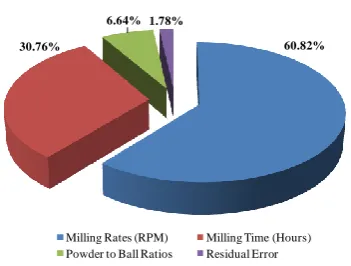
From Analysis of Variances (ANOVA) summarized in Figure 2 and Table 4, milling rate contributes greater than any others observing parameters. Although, milling time is also responsible in reducing the grain size of the powder owing to 30.76 % of the contribution, but statistically its significance is still questionable. This is due to having P-values slightly higher than P=0.05. Nonetheless, it still considers as rather important parameter. That is why milling time are still included in many studies that are utilizing ball milling machine to produce fine grain size of bioceramic powder [8-10].
Figure 2. Percentage contributions of each parameter for operation of ball milling machine.
TABLE 4. Response table for means analysis
Level Milling rate (RPM) Milling time (hour) BPR
L1 3.2 4.4 3.4
L2 5.52 4.55 4.317
L3 2.98 2.75 3.983
Lmax - Lmin 2.53 1.8 0.917
Ranking 1 2 3
60.82% 30.76%
6.64% 1.78%
Furthermore, this result implies that combination of varying milling rate and milling time could improve the performance of the ball milling machine in reducing grain size of the powder. Yet, it is machine dependent characteristics. Therefore, it would suggest to utilize ball milling machine with higher performance.
Although the re-milling process using mechanical processing cannot entirely produce nanosized of powder, but this mechanical system still gains benefit to the processing method. Reducing the grain size of powder as small as possible by using the ball milling machine, it would facilitate other advanced processing method to obtain nanosized of bioceramics powder. This evident from study of Macha [12]. A 75-100 µm of grain size produced using mechanical processing could be reduced significantly to 2.5 µm.
3. 2. Morphology of Grain Structures of Calcine Eggshell Bioceramics Produced by Ball Milling Machine Producing nanosized bioceramics powder using ball milling machine is comparatively more difficult than other processing methods that are based on chemical reactions. Many reports published have only utilized ball milling machine as intermediate process. However, by using the optimum set of parameters, the ball milling machine still can gain grain size closer to nano scale. Unfortunately, coagulation is difficult to get rid of. This can be seen from Figure 3 that shows the morphology of grain structures of eggshell powder. From Figure 3, it can be seen that some particles is still coagulate to form bulk particles. This, therefore, eliminates the possibility of producing a higher percentage distribution of the smallest grain size of the powder. Only lower distribution percentage of smallest grain sizes of powder could be produced.
4. CONCLUSION
Ball milling machine is frequently utilized in producing bioceramics powder.
Figure 3. Morphology of grain structures of calcined eggshell produced by using Ball Milling at optimum conditions
However, there were no clear evidentsavailable that ball milling machine could enable to produce nanosized of bioceramics powder. This was assumed due to no optimum parameters commonly employed. Therefore, this study attempted to produce nanosized biocreamics powder from eggshells collected from household disposal. By setting the operating conditions at optimum level, this study prooved that it was difficult to achieve nanosized bioceramics powder by only depending on a mechanical processing such as ball milling machine. Although at optimum conditions, the smallest particles can be obtained closer to the nano scale, but the distribution of smallest particles was still limited. Nevertheless, the use of mechanical processing can still be required as an intermediate process. This is based on the thought that the smallest grain size achieved would ease the subsequent processing method to produce nanosized of bioceramics powder.
Moreover, reduction in grain size was identified as responsible of milling rate and milling time. However, these parameters are machine dependent characteristics. Thus, using high performance ball milling machine would be imperatively substantial.
5. REFERENCES
1. Tanaka, Y. and Yamashita, K., Fabrication processes for bioceramics, in Bioceramics and their clinical applications. 2008, Elsevier.28-52.
2. Padmanabhan, K. and Hahn, H., "Synthesis and processing of nanocrystalline powder, ed. By dl bourell", TMS, Warrendale, (1996).
3. Romanov, A., Chow, G. and Noskova, N., Nanostructured materials: Science and technology. 1998, Dordrecht Boston London: Kluwer Academic.
4. Niihara, K., "New design concept of structural ceramics", Journal of the Ceramic Society of Japan, Vol. 99, No. 1154, (1991), 974-982.
5. Nurlaela, A., Dewi, S.U., Dahlan, K. and D.S. Soejoko, "The use of hen's and duck's eggshell as calcium source to synthesis bone mineral", Jurnal Pendidikan Fisika Indonesia, Vol. 10, (2014), 81-85.
6. Ghorbani, M., Afshar, A., Ehsani, N., Saeri, M. and Sorreli, C., "Interface characterization of plasma sprayed hydroxyapatite coat on ti-6al-4v", International Journal of Engineering Transactions B, Vol. 15, (2002), 173-182.
7. Afshar ,A., Ghorbani, M., Ehsani, N., Saeri, M. and Sorrell, C., "A study of zeta potential of plasma sprayed hydroxyapatite coating in four simulated physiological solutions", International Journal of Engineering Transactions B: Applications, Vol. 16, (2003), 343-354.
8. Balázsi, C., Wéber ,F., Kövér, Z., Horváth, E. and Németh, C., "Preparation of calcium–phosphate bioceramics from natural resources", Journal of the European Ceramic Society, Vol. 27, No. 2, (2007), 1601-1606.
hydroxyapatite from eggshell", Ceramics International, Vol. 36, No. 2, (2010), 803-806.
10. Hassan, T.A., Rangari, V.K., Rana, R.K. and Jeelani, S., "Sonochemical effect on size reduction of caco 3 nanoparticles derived from waste eggshells", Ultrasonics Sonochemistry, Vol. 20, No. 5, (2013), 1308-1315.
11. Farbod, M., Rafati, Z. and Shoushtari, M.Z., "Optimization of parameters for the synthesis of y2Cu2O5 nanoparticles by taguchi
method and comparison of their magnetic and optical properties with their bulk counterpart", Journal of Magnetism and Magnetic Materials, Vol. 407, (2016), 266-271.
12. Macha, I.J., Ozyegin, L., Oktar, F.N. and Ben-Nissan, B., "Conversion of ostrich eggshells (struthio camelus) to calcium phosphates", Journal of The Australian Ceramic Society, Vol. 51, No. 1, (2015), 125–133.
Parameters Optimization in Manufacturing Nanopowder Bioceramics of
Eggshell with Pulverisette 6 Machine using Taguchi and ANOVA
Method
TECHNICAL NOTE
H. Van Hotena, Gunawarmanb, I. Hari Mulyadib, A. Kurniawan Mainila, P. Bismantoloa, Nurbaitic
a Mechanical Engineering Department, Bengkulu University, Indonesia b Mechanical Engineering Department, Andalas University, Indonesia
c Mechanical Engineering Department, Prof. Dr. Hazairin, SH University, Indonesia
P A P E R I N F O
Paper history:
Received 17 March 2017
Received in revised form 12 October 2017 Accepted 12 October 2017
Keywords:
Eggshell Ball Milling Nanopowder Bioceramics Taguchi and ANOVA
ديكچ ه
تسیز کیمارس یداوم اه هب ،دنتسه یرورض تسیز .ینیلاب یاهدربراک یارب هژیو
کیمارس هب یدایز عبانم زا ناوت یم ار اه
سپ .دروآ تسد دنام
یسکوردیه ناوت یم غرم مخت هتسوپ زا .تسا هوقلاب عبنم کی غرم مخت هتسوپ دننام یگناخ یاه
( تیتاپآ HA تسیز نآ را و هدرک دیلوت ) داوم رثکا .درک جارختسا کیمارس
تسیز کیمارس هناد .دنتسه ردوپ لکش هب ی دیاب اه
بایسآ دنیآرف دننام شزادرپ شور کی زا اهنت رگا ،هتبلا .دنشاب ونان هزادنا هب هلولگ یراک
نینچ هب ندیسر ،دوش هدافتسا یا
هزادنا هرجنپ نکیل .تسا راوشد رایسب یا تاعلاطم رطاخ هب یراوشد نیا تلع .دنتسه زاب زونه یلامتحا یاه
اب ًافرص یلبق
نیرتهب رد دنیآرف یاهرتماراپ هک درادن دوجو یدهاش چیه .تسا صخشم رادقم کی رد دنیارف یاهرتماراپ ندرک دودحم
بایسآ بولطم یاهرتماراپ ،قیقحت نیا رد ،نیاربانب .دنشاب هتشاد رارق تلاح هلولگ یراک
ردوپ ونان دیلوت یارب یا تسیز
-کیمارس خت دننام یلحم داوم زا یامد رد هدش هنیسلک غرم م
900 یتناس زا هنیهب طیارش نتفای یارب .دندش یسررب ،دارگ
دماعتم هیارآ اب یچوگات شور L-9
( سنایراو هیزجت و ANOVA
هاگتسد .دش هدافتسا ) بایسآ
یراک هلولگ یا ره یارب
رد هدش هدهاشم یاهرتماراپ زا کی 3
ینزو تبسن و نامز ،تعرس لاثم ناونع هب( حطس ،)هلولگ هب غرم مخت هتسوپ ردوپ
هناد دیلوت یارب ردوپ هدش درخ یاه
HA نامز ،رتلااب دنیآرف گنهآ هک داد ناشن نیگنایم لیلحت .تفرگ رارق هدافتسا دروم
بایسآ و رتشیب یراک PBR
ردوپ هناد هزادنا هب ناوت یم بیکرت نیا اب .دنراد ریثات ردوپ هناد هزادنا رب رت نییاپ 33
/ 1
هک نیا نآ و ،تسا هدش هدهاشم یبرجت جیاتن زا ضقانتم تیعقاو کی ،لاح نیا اب .تفای تسد رتمورکیم PBR
طسوتم
هناد ردوپ دیلوت رد تبثم ریثات یا ناوت یم ار نیا اما تشاد رتزیر یاه
مهس اریز تفرگ هدیدان هجیتن ن PBR
رت نییاپ ًاتبسن
مهس دصرد .تسا PBR
اهنت 6.64 ٪ دیلوت رد هاگتسد یاهرتماراپ هک تفرگ هجیتن ناوت یم ،بیترت نیا هب .تسا رتمک ای
هناد هزادنا ردوپ تارذ ونان یاه تسیز