I
I
I
N
N
N
T
T
T
E
E
E
R
R
R
N
N
N
A
A
A
T
T
T
I
I
I
O
O
O
N
N
N
A
A
A
L
L
L
J
J
J
O
O
O
U
U
U
R
R
R
N
N
N
A
A
A
L
L
L
O
O
O
F
F
F
R
R
R
E
E
E
S
S
S
E
E
E
A
A
A
R
R
R
C
C
C
H
H
H
I
I
I
N
N
N
C
C
C
O
O
O
M
M
M
M
M
M
E
E
E
R
R
R
C
C
C
E
E
E
,
,
,
I
I
I
T
T
T
A
A
A
N
N
N
D
D
D
M
M
M
A
A
A
N
N
N
A
A
A
G
G
G
E
E
E
M
M
M
E
E
E
N
N
N
T
T
T
C
C
C
CONTENTS
ONTENTS
ONTENTS
ONTENTS
Sr.
No.
TITLE & NAME OF THE AUTHOR (S)
Page No.
1.
IMPACT OF EMPLOYEES’ EDUCATING ON PRODUCTIVITY IN BANKING SECTORHAMID REZA QASEMI
1
2.
ASSESSING THE EFFECTIVENESS OF FRONTLINE MANAGERS IN PUBLIC SECTOR COLLEGES OF PAKISTANANSAR MAHMOOD & DR. WAHEED AKHTER
6
3.
DOES EMPOWERMENT MODERATE OF THE RELATIONSHIP BETWEEN PERCEIVED OVERQUALIFICATION AND JOB ATTITUDES?KENGATHARAN. N
14
4.
LINKING THE ‘BIG FIVE’ PERSONALITY DOMAINS TO ORGANIZATIONAL COMMITMENTJYOTI KUMAR CHANDEL, DR. SUJEET KUMAR SHARMA & DR. S.P. BANSAL
19
5.
A STUDY ON DEVELOPMENT AND PROCESSING IN MYSORE MILK UNION LIMITEDDR. HARISH.M
25
6.
USE OF INTERNET FOR ELECTRONIC GADGETS PURCHASING – IMPACT OF CIRCUMSTANTIAL ELEMENTSASMATARA KHAN & DR. MOHD. ZAFAR SHAIKH
31
7.
QUALITY MANAGEMENT INITIATIVES AND COMPETITIVENESS - CASE STUDIES ON SMALL AND MEDIUM ENTERPRISESDR. S. R. ASHOK, DR. C. S. VENKATESHA & DR. B. T. ACHYUTHA
37
8.
RELATIONSHIP BETWEEN EMPLOYEE ENGAGEMENT AND COMMITMENT: A STUDY AT IVRCLSURESH KANDULAPATI & DR. G. MANCHALA
44
9.
PERCEPTION AND RECEPTIVITY OF BRANDING BY BANKS BY CUSTOMERS OF SMALL SCALE INDUSTRIES IN BANGALORE: AN EMPIRICAL EVIDENCEDR. S. JOHN MANOHAR & N. S. RAVINDRA
48
10.
EXPECTATIONS AND PERCEPTIONS OF STUDENTS IN ENGINEERING EDUCATION - A STUDYDR. KANAGALURU SAI KUMAR
55
11.
CONSUMER BEHAVIORAL PATTERNS OF PASSENGER CARSBALAKRISHNAN MENON & DR. JAGATHY RAJ V. P.
61
12.
REPATRIATION PROGRAM AS A PROCESS FOR RETAINING REPATRIATES - ISSUES SURROUNDING INTERNATIONAL HUMAN RESOURCEB. R. SANTOSH & DR. KRISHNAVENI MUTHIAH
69
13.
ROLE OF TRAINERS IN IMPROVING TRAINING EFFECTIVENESS: A CASE STUDY OF INSURANCE SECTOR IN ARID INDIARICHA DIXIT & DR. HARSH PUROHIT
73
14.
A STUDY ON WORK INTERFERENCE WITH FAMILY (WIF) AND FAMILY INTERFERENCE WITH WORK (FIW) AMONG MARRIED FEMALE MANAGEMENT FACULTIESSMRUTI R PATRE & DR. ANANT DESHMUKH
78
15.
WORK-LIFE BALANCE: A CROSS SECTIONAL STUDY OF BANKING & INSURANCE SECTORPRERNA PATWA
85
16.
THE CHALLENGING JOB DESIGN OF GLOBAL MANAGERPAYAL JOHARI
92
17.
CULTURAL INTELLIGENCE (CQ): LEVERAGING EFFECTIVENESS OF INDIAN BPO SECTORSHIKHA BHARDWAJ
95
18.
GLOBAL FOREX MARKET VIS-A-VIS INDIAN CURRENCY– A STUDYT. CHANDRABAI, SRIVALLI. J & T. BHARATHI
100
19.
RANKING MFIS IN INDIA: USING TOPSISSANTANU DUTTA & PINKY DUTTA
103
20.
SERVICE QUALITY EVALUATION: AN APPLICATION OF THE SERVQUAL MODEL WITH SPECIAL REFERENCE TO TWO WHEELER SERVICE STATIONS IN NANGAL DAMABHAY TIWARI & NITIN CHAUDHARY
108
21.
A STUDY OF PROBLEMS & PROSPECTS OF INTERNET RETAILING IN INDIADR. HEMANT J. KATOLE
114
22.
ORGANISATIONAL OUTCOMES OF EFFECTIVE RELATIONSHIP MARKETING IN INDIAN INSURANCE COMPANIESDR. M. DHANABHAKYAM & K. VIMALADEVI
117
23.
E – GOVERNANCE: AN INITIATIVE TO PUBLIC DEVELOPMENT IN INDIA WITH SPECIAL REFERENCE TO ODISHADEVI PRASAD DASH
121
24.
TO STUDY THE FACTORS AFFECTING JOB SATISFACTION LEVEL IN THE SELECTED BPO COMPANIES IN NCR REGIONSURENDER SARIN & VIJENDER PAL SAINI
125
25.
JOB SATISFACTION AMONG EMPLOYEES IN SMALL SCALE INDUSTRIES, VISAKHAPATNAMDR. M. RAMESH
130
CHIEF PATRON
CHIEF PATRON
CHIEF PATRON
CHIEF PATRON
PROF. K. K. AGGARWAL
Chancellor, Lingaya’s University, Delhi
Founder Vice-Chancellor, Guru Gobind Singh Indraprastha University, Delhi
Ex. Pro Vice-Chancellor, Guru Jambheshwar University, Hisar
PATRO
PATRO
PATRO
PATRON
N
N
N
SH. RAM BHAJAN AGGARWAL
Ex. State Minister for Home & Tourism, Government of Haryana
Vice-President, Dadri Education Society, Charkhi Dadri
President, Chinar Syntex Ltd. (Textile Mills), Bhiwani
CO
CO
CO
CO----ORDINATOR
ORDINATOR
ORDINATOR
ORDINATOR
AMITA
Faculty, E.C.C., Safidon, Jind
ADVISOR
ADVISOR
ADVISOR
ADVISORSSSS
PROF. M. S. SENAM RAJU
Director A. C. D., School of Management Studies, I.G.N.O.U., New Delhi
PROF. M. N. SHARMA
Chairman, M.B.A., Haryana College of Technology & Management, Kaithal
PROF. S. L. MAHANDRU
Principal (Retd.), Maharaja Agrasen College, Jagadhri
EDITOR
EDITOR
EDITOR
EDITOR
PROF. R. K. SHARMA
Dean (Academics), Tecnia Institute of Advanced Studies, Delhi
CO
CO
CO
CO----EDITOR
EDITOR
EDITOR
EDITOR
DR. BHAVET
Faculty, M. M. Institute of Management, Maharishi Markandeshwar University, Mullana, Ambala, Haryana
EDITORIAL ADVISORY BOARD
EDITORIAL ADVISORY BOARD
EDITORIAL ADVISORY BOARD
EDITORIAL ADVISORY BOARD
DR. AMBIKA ZUTSHI
Faculty, School of Management & Marketing, Deakin University, Australia
DR. VIVEK NATRAJAN
Faculty, Lomar University, U.S.A.
DR. RAJESH MODI
Faculty, Yanbu Industrial College, Kingdom of Saudi Arabia
PROF. SANJIV MITTAL
University School of Management Studies, Guru Gobind Singh I. P. University, Delhi
PROF. ANIL K. SAINI
Chairperson (CRC), Guru Gobind Singh I. P. University, Delhi
DR. KULBHUSHAN CHANDEL
Reader, Himachal Pradesh University, Shimla
DR. TEJINDER SHARMA
DR. SAMBHAVNA
Faculty, I.I.T.M., Delhi
DR. MOHENDER KUMAR GUPTA
Associate Professor, P. J. L. N. Government College, Faridabad
DR. SHIVAKUMAR DEENE
Asst. Professor, Government F. G. College Chitguppa, Bidar, Karnataka
MOHITA
Faculty, Yamuna Institute of Engineering & Technology, Village Gadholi, P. O. Gadhola, Yamunanagar
ASSOCIATE EDITORS
ASSOCIATE EDITORS
ASSOCIATE EDITORS
ASSOCIATE EDITORS
PROF. NAWAB ALI KHAN
Department of Commerce, Aligarh Muslim University, Aligarh, U.P.
PROF. ABHAY BANSAL
Head, Department of Information Technology, Amity School of Engineering & Technology, Amity University, Noida
PROF. A. SURYANARAYANA
Department of Business Management, Osmania University, Hyderabad
DR. ASHOK KUMAR
Head, Department of Electronics, D. A. V. College (Lahore), Ambala City
DR. JATINDERKUMAR R. SAINI
Head, Department of Computer Science, S. P. College of Engineering, Visnagar, Mehsana, Gujrat
DR. V. SELVAM
Divisional Leader – Commerce SSL, VIT University, Vellore
DR. PARDEEP AHLAWAT
Reader, Institute of Management Studies & Research, Maharshi Dayanand University, Rohtak
S. TABASSUM SULTANA
Asst. Professor, Department of Business Management, Matrusri Institute of P.G. Studies, Hyderabad
TECHNICAL ADVISOR
TECHNICAL ADVISOR
TECHNICAL ADVISOR
TECHNICAL ADVISOR
AMITA
Faculty, E.C.C., Safidon, Jind
MOHITA
Faculty, Yamuna Institute of Engineering & Technology, Village Gadholi, P. O. Gadhola, Yamunanagar
FINANCIAL ADVISORS
FINANCIAL ADVISORS
FINANCIAL ADVISORS
FINANCIAL ADVISORS
DICKIN GOYAL
Advocate & Tax Adviser, Panchkula
NEENA
Investment Consultant, Chambaghat, Solan, Himachal Pradesh
LEGAL ADVISORS
LEGAL ADVISORS
LEGAL ADVISORS
LEGAL ADVISORS
JITENDER S. CHAHAL
Advocate, Punjab & Haryana High Court, Chandigarh U.T.
CHANDER BHUSHAN SHARMA
Advocate & Consultant, District Courts, Yamunanagar at Jagadhri
SUPERINTENDENT
SUPERINTENDENT
SUPERINTENDENT
SUPERINTENDENT
CALL FOR MANUSCRIPTS
CALL FOR MANUSCRIPTS
CALL FOR MANUSCRIPTS
CALL FOR MANUSCRIPTS
We
invite unpublished novel, original, empirical and high quality research work pertaining to recent developments & practices in
the area of Computer, Business, Finance, Marketing, Human Resource Management, General Management, Banking, Insurance,
Corporate Governance and emerging paradigms in allied subjects like Accounting Education; Accounting Information Systems;
Accounting Theory & Practice; Auditing; Behavioral Accounting; Behavioral Economics; Corporate Finance; Cost Accounting;
Econometrics; Economic Development; Economic History; Financial Institutions & Markets; Financial Services; Fiscal Policy;
Government & Non Profit Accounting; Industrial Organization; International Economics & Trade; International Finance; Macro
Economics; Micro Economics; Monetary Policy; Portfolio & Security Analysis; Public Policy Economics; Real Estate; Regional
Economics; Tax Accounting; Advertising & Promotion Management; Business Education; Business Information Systems (MIS);
Business Law, Public Responsibility & Ethics; Communication; Direct Marketing; E-Commerce; Global Business; Health Care
Administration; Labor Relations & Human Resource Management; Marketing Research; Marketing Theory & Applications;
Non-Profit Organizations; Office Administration/Management; Operations Research/Statistics; Organizational Behavior & Theory;
Organizational Development; Production/Operations; Public Administration; Purchasing/Materials Management; Retailing;
Sales/Selling; Services; Small Business Entrepreneurship; Strategic Management Policy; Technology/Innovation; Tourism,
Hospitality & Leisure; Transportation/Physical Distribution; Algorithms; Artificial Intelligence; Compilers & Translation; Computer
Aided Design (CAD); Computer Aided Manufacturing; Computer Graphics; Computer Organization & Architecture; Database
Structures & Systems; Digital Logic; Discrete Structures; Internet; Management Information Systems; Modeling & Simulation;
Multimedia; Neural Systems/Neural Networks; Numerical Analysis/Scientific Computing; Object Oriented Programming;
Operating Systems; Programming Languages; Robotics; Symbolic & Formal Logic; Web Design. The above mentioned tracks are
only indicative, and not exhaustive.
Anybody can submit the soft copy of his/her manuscript
anytime
in M.S. Word format after preparing the same as per our
submission guidelines duly available on our website under the heading guidelines for submission, at the email addresses,
[email protected]
or
.
GUIDELINES FOR SUBMISSION OF MANUSCRIPT
GUIDELINES FOR SUBMISSION OF MANUSCRIPT
GUIDELINES FOR SUBMISSION OF MANUSCRIPT
GUIDELINES FOR SUBMISSION OF MANUSCRIPT
1. COVERING LETTER FOR SUBMISSION:
DATED: _____________
THE EDITOR
IJRCM
Subject:
SUBMISSION OF MANUSCRIPT IN THE AREA OF .
(e.g. Computer/IT/Finance/Marketing/HRM/General Management/other, please specify)
.
DEAR SIR/MADAM
Please find my submission of manuscript titled ‘___________________________________________’ for possible publication in your journal.
I hereby affirm that the contents of this manuscript are original. Furthermore it has neither been published elsewhere in any language fully or partly, nor is it under review for publication anywhere.
I affirm that all author (s) have seen and agreed to the submitted version of the manuscript and their inclusion of name (s) as co-author (s).
Also, if our/my manuscript is accepted, I/We agree to comply with the formalities as given on the website of journal & you are free to publish our contribution to any of your journals.
NAME OF CORRESPONDING AUTHOR: Designation:
Residential address with Pin Code:
Mobile Number (s):
Landline Number (s):
E-mail Address:
Alternate E-mail Address:
2. INTRODUCTION: Manuscript must be in British English prepared on a standard A4 size paper setting. It must be prepared on a single space and single column with 1” margin set for top, bottom, left and right. It should be typed in 8 point Calibri Font with page numbers at the bottom and centre of the every page.
3. MANUSCRIPT TITLE: The title of the paper should be in a 12 point Calibri Font. It should be bold typed, centered and fully capitalised.
4. AUTHOR NAME(S) & AFFILIATIONS: The author (s) full name, designation, affiliation (s), address, mobile/landline numbers, and email/alternate email address should be in italic & 11-point Calibri Font. It must be centered underneath the title.
5. ABSTRACT: Abstract should be in fully italicized text, not exceeding 250 words. The abstract must be informative and explain the background, aims, methods, results & conclusion in a single para.
6. KEYWORDS: Abstract must be followed by list of keywords, subject to the maximum of five. These should be arranged in alphabetic order separated by commas and full stops at the end.
7. HEADINGS: All the headings should be in a 10 point Calibri Font. These must be bold-faced, aligned left and fully capitalised. Leave a blank line before each heading.
8. SUB-HEADINGS: All the sub-headings should be in a 8 point Calibri Font. These must be bold-faced, aligned left and fully capitalised. 9. MAIN TEXT: The main text should be in a 8 point Calibri Font, single spaced and justified.
10. FIGURES &TABLES: These should be simple, centered, separately numbered & self explained, and titles must be above the tables/figures. Sources of data should be mentioned below the table/figure. It should be ensured that the tables/figures are referred to from the main text.
11. EQUATIONS: These should be consecutively numbered in parentheses, horizontally centered with equation number placed at the right.
12. REFERENCES: The list of all references should be alphabetically arranged. It must be single spaced, and at the end of the manuscript. The author (s)
should mention only the actually utilised references in the preparation of manuscript and they are supposed to follow Harvard Style of Referencing.
The author (s) are supposed to follow the references as per following:
•
All works cited in the text (including sources for tables and figures) should be listed alphabetically.•
Use (ed.) for one editor, and (ed.s) for multiple editors.•
When listing two or more works by one author, use --- (20xx), such as after Kohl (1997), use --- (2001), etc, in chronologically ascending order.•
Indicate (opening and closing) page numbers for articles in journals and for chapters in books.•
The title of books and journals should be in italics. Double quotation marks are used for titles of journal articles, book chapters, dissertations, reports,working papers, unpublished material, etc.
•
For titles in a language other than English, provide an English translation in parentheses.•
The location of endnotes within the text should be indicated by superscript numbers.PLEASE USE THE FOLLOWING FOR STYLE AND PUNCTUATION IN REFERENCES: BOOKS
•
Bowersox, Donald J., Closs, David J., (1996), "Logistical Management." Tata McGraw, Hill, New Delhi.•
Hunker, H.L. and A.J. Wright (1963), "Factors of Industrial Location in Ohio," Ohio State University.CONTRIBUTIONS TO BOOKS
•
Sharma T., Kwatra, G. (2008) Effectiveness of Social Advertising: A Study of Selected Campaigns, Corporate Social Responsibility, Edited by DavidCrowther & Nicholas Capaldi, Ashgate Research Companion to Corporate Social Responsibility, Chapter 15, pp 287-303.
JOURNAL AND OTHER ARTICLES
•
Schemenner, R.W., Huber, J.C. and Cook, R.L. (1987), "Geographic Differences and the Location of New Manufacturing Facilities," Journal of UrbanEconomics, Vol. 21, No. 1, pp. 83-104.
CONFERENCE PAPERS
•
Garg Sambhav (2011): "Business Ethics" Paper presented at the Annual International Conference for the All India Management Association, NewDelhi, India, 19–22 June.
UNPUBLISHED DISSERTATIONS AND THESES
•
Kumar S. (2011): "Customer Value: A Comparative Study of Rural and Urban Customers," Thesis, Kurukshetra University, Kurukshetra.ONLINE RESOURCES
•
Always indicate the date that the source was accessed, as online resources are frequently updated or removed.WEBSITE
USE OF INTERNET FOR ELECTRONIC GADGETS PURCHASING – IMPACT OF CIRCUMSTANTIAL ELEMENTS
ASMATARA KHAN
RESEARCH SCHOLAR & LECTURER
DRAVIDIAN UNIVERSITY
ST ANN’S P G COLLEGE
HYDERABAD
DR. MOHD. ZAFAR SHAIKH
DIRECTOR
AURORA’S SCIENTIFIC, TECH. & RES. ACADEMY
BANDLAGUDA
HYDERABAD - 05
ABSTRACT
Purpose – This paper seeks to understand the triggers which influence the adoption (and the discontinuation) of online electronics shopping. Specifically, the research aims to establish the role of situational factors in the process of adoption. Design/methodology/approach – A two-step research process is employed. First, exploratory qualitative research is carried out, with the purpose of gaining an in-depth understanding of consumers’ online electronics shopping behaviour. This is followed by a large-scale quantitative survey extending the findings of the qualitative research and validating the role of situational factors in instigating the commencement (and discontinuation) of online electronics buying. Cluster analysis is used to segment consumers based on the importance of specific types of situations. Findings – Both qualitative and quantitative results establish the importance of situational factors, such as having health problems or giving gifts to a person in distant location or using the online offers, as triggers for starting to buy electronics online. Many shoppers are found to discontinue online electronics shopping once the initial trigger has disappeared or they have experienced a problem with the service. Practical implications – While situational factors are beyond a marketer’s control, they could be used as a basis for marketing communications content and target advertising, for instance, by using magazines containing details on what gift can be given or what all offers are going on. Originality/value – The importance of situational factors as triggers for the adoption of online electronics shopping suggests an erratic adoption process, driven by circumstances rather than by a cognitive elaboration and decision. The adoption of online shopping seems to be contingent and may be discontinued when the initiating circumstances change.
KEYWORDS
Cluster analysis, Consumer behaviour, Internet shopping.
INTRODUCTION
nternet electronics industries are developing on a fast pace. Yet, while the online gagdets and electronics market is reported to have grown by almost 34 per cent in 2006, online electronics purchases are estimated to still account for a very small portion of the total sales (Keynote, 2007). Mintel (2007) concludes that online shopping for gadgets remains a niche market.
The fast growth rate of the online electronics market presents a challenge for retail outlets and supermarket chains competing for share, in terms of balancing their online and offline investments. A better understanding of the triggers which influence the adoption (and the discontinuation) of online electronics shopping is vital for the strategicmanagement of this sector, both in the developing Andhra Pradesh market and elsewhere.
Shopping for electronics online is arguably a discontinuous innovation (Hansen, 2005), requiring a significant change in behaviour (see Robertson, 1967): online shoppers forfeit the social interaction of offline shopping and the potential to evaluate electronics prior to purchase. For online electronics shopping to develop beyond its current “niche” size, retailers need to understand not only what triggers consumers to change their purchase behaviour, but also the extent to which their online shopping experience reinforce the adoption process.
Previous research pertaining to internet electronics shopping has focused on comparing online and offline purchase behaviour in terms, for instance, of brand loyalty (e.g. Danaher et al., 2004), shopping behaviour (e.g. Andrews and Currim, 2004), the importance of brand names (e.g. Degeratu et al., 2000); and consumers’ perceptions of the advantages and disadvantages of shopping online for electronics (Ramus and Nielsen, 2005).
Another important stream of research has examined the consumer traits of internet shoppers, either in terms of their general shopping orientation (e.g. Brown et al., 2003), their web-usage-related lifestyle (Brengman et al., 2005), or psychographic characteristics (Barnes et al., 2007). Additionally, Rohm and Swaminathan (2004) developed a typology of internet electronics shoppers based upon their motivations for shopping online.
The aim of our research is to identify triggers for the adoption and discontinuation of online electronics shopping. Specifically, the objective of this study is to establish the role of situational factors in the process of adoption of online electronics shopping behaviour. This knowledge will assist online retailers in their customer recruitment and retention efforts.
Our research makes a significant contribution to the literature by extending knowledge of online purchase behaviour beyond the much researched influence of consumer traits, assessing the impact of situational factors and their role as triggers for the adoption of online electronics shopping. Bandura (1977) highlighted the importance of contextual factors, including the social, situational, and temporal circumstances under which events occur in shaping the cognitive appraisal of the causes and consequences of one’s behaviour. Yet, situational factors have often been ignored in research on consumer behaviour and the adoption of innovations, with rare exceptions (e.g. Dabholkar, 1996; Dabholkar and Bagozzi, 2002, in the general context of the adoption of technology based self-service). The framing of much of the existing literature implies that that the adoption of electronics shopping is a once-off process, but our findings suggest that this is a misconception. The importance of situational factors as triggers for the adoption of online electronics shopping suggests an erratic adoption process, driven by circumstances rather than by a cognitive elaboration and decision. The adoption of online shopping seems to be contingent and may be discontinuedwhen the initiating circumstances change.
From a managerial perspective, uncovering the importance of situational factors as triggers for consumers to start (or to stop) online electronics shopping enables e-suppliers to target segments of consumers in relevant predicaments or life-states and will help them to take more appropriate, proactive steps to improve retention rates.
The paper is structured as follows. First we review the literature relevant to the adoption process of online (electronics) shopping and theories relevant to our study, highlighting the gap pertaining to the study of situational factors. In the next section we discuss the sampling frame and data collection procedures for the first, qualitative, stage of the research and present our analysis and findings. This is followed by the method and findings of the second, quantitative, stage. Finally, we discuss the implications of the overall findings for theory and practice.
CONCEPTUAL FRAMEWORK
Our research aims to identify the triggers for the adoption and discontinuation of online electronics shopping relate to the literature on the adoption of innovations in general and of internet shopping in particular. Social cognitive theory informed the specific objective of uncovering the role of situational factors.
THE PROCESS OF ADOPTION
Robertson (1967) classifies innovations as continuous, dynamically continuous and discontinuous. Crucially, discontinuous innovations not only involve the adoption of a new product, but also cause buyers to significantly alter their behaviour patterns. Using Robertson’s typology, shopping online for electronics can be classified as a discontinuous innovation, because there is a significant change in behaviour: selecting electronics items from a list on a web page instead of choosing items on display of an electronics store or supermarket shelf. The changes in behaviour patterns that mark discontinuous innovations suggest that the process of adoption for these innovations may be lengthier, and possibly more problematic, than for continuous or dynamically continuous innovations. Furthermore, consumers’ perceptions of the characteristics of an innovation affect its rate of adoption (Mahajan et al., 1995; quoted in Verhoef and Langerak, 2001). According to Rogers (1983), the five characteristics of relative advantage, compatibility, complexity, divisibility and communicability influence the rate of adoption of an innovation. In the context of the adoption process of online electronics shopping, Verhoef and Langerak (2001) investigated the effects of perceived relative advantage, compatibility and complexity on consumers’ intentions to purchase electronics online. Their research showed that consumer perceptions of the relative advantage and compatibility of electronic electronics shopping positively influenced the intention to adopt online electronics shopping. Perceived convenience emerged as a potentially decisive factor in determining consumers’ perceived relative advantage and compatibility of electronic electronics shopping. Moreover, as expected, consumers’ perceptions of the complexity of electronic electronics shopping had a negative influence on their online electronics intentions.
The focus on intentions is a major limitation of Verhoef and Langerak’s (2001) findings. In contrast, Hansen’s (2005) research investigated both experienced and inexperienced online electronics consumers. Hansen’s findings suggest that US adopters of online electronics shopping attached higher compatibility, higher relative advantage, more positive social norms and lower complexity to internet electronics shopping, not only compared with consumers who had never bought anything on the internet, but crucially, also compared with consumers who had purchased other goods/services on the internet, but not electronics.
Hansen’s findings are significant for several reasons. Firstly, they indicate that online shopping is not adopted per se, but in connection with specific product categories. This is consistent with Brown et al.’s (2003) findings that the product category, rather than the shopping orientation of the individual, was a significant determinant of online shopping.
Therefore, acceptance of and familiarity with internet technology do not appear to be sufficient antecedents of the adoption of online shopping; other factors instigate the behaviour changes involved in online shopping in particular consumption categories.
Example, Davis et al. (1989, p. 987) note that self-efficacy “is one of the major factors theorised to underlie intrinsic motivation”. Putting together Hansen’s (2005) and Davis etal.’s (1989) findings, we infer that consumers who have already purchased electronics online have an enhanced assessment of their own self-efficacy or ability to perform this behaviour. This enhanced assessment affects the higher compatibility and relative advantage, the more positive social norms and the lower complexity that these consumers attribute to internet electronics shopping, compared with other internet shoppers. This inference is consistent with Bandura’s (1977, p. 205) claim that “experiences based on performance accomplishments produce higher, more generalised and stronger efficacy expectations than [...] vicarious experience’.
Furthermore, according to Bandura’s (1977) Social Cognitive Theory, contextual factors, including the social, situational and temporal circumstances under which events occur, have an impact on how self-efficacy is cognitively appraised. The suggestion of a continuous reciprocal interaction between the environment in which an individual operates, his or her own cognitive perceptions (self-efficacy and outcome expectations) and behaviour, suggests that situational factors need to be investigated as prompts for the adoption of online electronics shopping.
SITUATIONAL FACTORS AND THE ADOPTION OF ONLINE SHOPPING
Many studies have sought to identify the individual personality or psychographic traits which correlate with the adoption of new technologies in general and of internet shopping in particular. This has resulted in many typologies of internet shoppers (e.g. Brengman etal., 2005; Brown etal., 2003; Childers etal., 2001; Fenech and O’Cass, 2001; Sénécal et al., 2002). Additionally, Rohm and Swaminathan (2004) developed a typology of online electronics shoppers based upon their motivations for shopping online. Shopping motivation was found to interact with the product category in affecting the online purchase frequency of various categories of internet shoppers (convenience shoppers, variety seekers, balanced buyers).
However, many of these studies have evaluated the influence of personality traits on intentions to purchase online, rather than actual behaviour. Yet, as discussed in the previous section, experiences based on performance accomplishments produce higher, more generalised and stronger efficacy expectations (Bandura, 1977).
Furthermore, situational factors are usually ignored in consumer behaviour research, both in general and in the specific contexts of the adoption of technology and of internet shopping. As noted, there has been an assumption that adoption is a rational and enduring decision.
However, those authors who do acknowledge the role of situational factors suggest that these may be very important in the understanding of the process of adoption. Engell and Blackwell (1982) and Dabholkar and Bagozzi (2002) note that situational factors may prevent a consumer from adopting a new product (or technology), even if he/she possesses the “right” consumer trait. Hence Dabholkar and Bagozzi’s (2002, p. 197) suggestion that “researchers need to understand the consequences of various situational factors (and their interactions) so that managers can plan to avoid negative situational influences, whether in-store or online”.
Two studies have considered the influence of situational factors in the context of home and online shopping. Gillett (1976) found that in-home shopping was often motivated by specific needs or circumstances, such as avoiding an extra trip to pick up a needed item. More recently, Morganosky and Cude (2000) noted that convenience was a particularly relevant motive when there were situational constraints such as ill health or the presence of small children in the household. This suggests that situational factors may be important in shaping and reinforcing online shopping motivations.
METHODOLOGY
The research was in two stages. First, we conducted exploratory qualitative research, (Study 1), with the purpose of gaining an in-depth understanding of what motivates consumers to start shopping online for electronics and the extent to which their online shopping experience encourages them to continue or to stop online electronics shopping. Following the qualitative research, we designed and implemented a large-scale quantitative survey (Study 2), in order to extend the findings of the qualitative research and to validate the role of situational factors in instigating the commencement or discontinuation of online electronics buying. Cluster analysis was used to uncover specific triggers for particular groups of consumers.
STUDY 1: QUALITATIVE RESEARCH
RESEARCH DESIGN OF STUDY 1
• female regular buyers;
• female “mixed” light and regular buyers;
• male “mixed” light and regular buyers; and
• female light and lapsed buyers.
Regular buyers were defined as those who shopped online for electronics once a month or more, with light buyers shopping less than once a month. The inclusion of a male group reflects their relative importance in the market; men account for one third of online electronics shopping (Verdict, 2004). The focus groups were led by an experienced moderator. All groups were tape-recorded; the tapes were transcribed by a professional audio-typist. Data analysis took place in two stages. First, the group moderator analysed the transcripts using paper coding and a thematic approach, producing a report and presentation. In a further, supplementary analysis, the transcripts and tapes were analysed by an analyst who coded the research brief, transcripts and the research report using Qualrus software. The use of computer assisted qualitative data analysis software (CAQDAS) enabled a more comprehensive analysis of our data, providing additional and more detailed findings (for full details of the qualitative analysis, see Robinson et al., 2007).
MAIN FINDINGS OF STUDY 1
Starting and stopping online electronics shopping. Situational factors appeared to be the key triggers for starting online electronics shopping. Many respondents described lifestyle changes that had led them to start online electronics shopping. These included moving house, breaking a limb, getting a job or changing jobs, sending gifts to distant location, leaving work, working late, working at home, internet offers, ease in booking new launched product, difficult store location, and no vehicle:
My sister needs to send gifts to a friend in distant location and she shops online (female light/regular buyer). I am unable to go looking out and comparing products as I am old, so it was then (female regular buyer). I broke my arm (female regular buyer)
For some, moving house to an area where their particular brand did not have a physical presence had triggered shopping in the “virtual” store. Others had been influenced by advertising such as leaflets, coupons, TV ads, banners and air miles.
Significantly, situational factors appeared to be important triggers not only for starting but also for diminishing the frequency of shopping online for electronics or for stopping altogether, particularly when the initiating situation had reverted back to normal. For example:
When the IPhone was launched then it was much easier to book it online then keep on standing in long queues. But now they are readily available and as such I can go to a store and pick it up then and there. (female light/regular buyer).
A friend of mine had a hip replacement ... and she did all her shopping online for a few months so it is very useful in that respect (female light/regular buyer). Another significant finding was that almost all respondents continued to shop in off-line stores for electronics, in tandem with their online purchases. Some enjoyed shopping in electronic stores and found the online browsing experience less satisfactory, as they did not come across interesting new items and could not see & feel the products in the same way as when shopping in the store. Whether electronics were bought more often online rather than offline depended on situational variables.
THE ONLINE ELECTRONICS SHOPPING EXPERIENCE
Overall, internet electronics shopping was regarded as a chore rather than a pleasure, much less interesting or fun than “surfing the web”, gambling, or buying products such as books and holidays.
A number of areas of concern were raised: many respondents felt that their online electronics providers could not be trusted to be reliable because particular brand of products were regularly omitted from the delivery. Substitute items were often considered unsuitable and there was an awareness of differences in service quality between orders supplied fromthe warehouse or from a local store:
I have given up expecting to get what I’ve ordered (female regular buyer).
If you are relying on a delivery coming and they don’t deliver it, you have to go out anyway so that defeats the object of buying online (female light/regular buyer).
Unsatisfactory deliveries and incorrect orders were the main cause of complaint and were given as the main reason for discontinuing online electronics shopping. Some respondents considered a two-hour delivery slot too long and many complained about late deliveries:
I find delivery quite stressful because you are anticipating them coming and I find that quite stressful. The longer I have to wait theworse it gets, I just getmore andmore stressed (female light/regular buyer).
CONCLUSIONS OF STUDY 1
The results of the qualitative study indicate that situational factors are important triggers not only for starting but also for diminishing the frequency of shopping online for electronics or for stopping altogether. Overall the findings suggest that the online mode of shopping for electronics is discretionary: it may be abandoned when a particular trigger disappears or because consumers are unhappy with service, but equally, it may be restarted as changing life events create new triggers. Furthermore, online electronics shoppers continued to shop in traditional electronics stores.
In the second stage of the research, a postal survey was used to quantify and amplify the findings from Study 1.
STUDY 2: SURVEY
RESEARCH DESIGN OF STUDY 2
The findings of Study 1 informed the construction of a questionnaire, which covered a wide range of issues such as the frequency of shopping online for electronics, the reasons for choosing a particular provider and attitudes towards electronics shopping in general and online. This paper focuses on the analysis of questions relating to the adoption process for online electronics shopping.
In total, 20 statements describing situational variables believed to prompt online shopping and 18 reasons for stopping were derived from the qualitative research. Respondents were asked to evaluate each statement against a five-point scale where 1 denoted “not applicable/no influence”, 2 1/4 “weak influence”, 3 1/4 “moderate influence”, 4 1/4 “strong influence” and 5 1/4 “very strong influence”. A five-point scale was considered appropriate: using a seven- or nine-point scale could have made the question appear more difficult to answer and a larger number of categories would assume that the respondents are able to finely discriminate between the levels of influence each of the 20 reasons given had on their behaviour.
After a pilot study with 40 respondents, the final questionnaire was posted to a sample of 5,000 names, randomly extracted from a commercial list of online electronics shoppers [1]. Our decision to adopt a postal survey seems counter-intuitive as our study focuses on internet use. Even if a sampling frame of e-mail addresses were available, there would be reasons to prefer a postal survey. As Bryman and Bell (2007) note, response rates for online surveys tend to be lower than for comparable postal surveys (see also Grandcolas et al., 2003; Lozar Manfreda et al., 2008). An e-mail survey requires access to bulk-mailing facilities and risks introducing additional sampling error through e-mails inviting participation in the survey being blocked by spam filters (Malhotra and Birks, 2007). In our study, 1,327 questionnaires were returned (a response rate of 27 percent); of these, 1,128 were valid (had ever used the internet for electronics shopping). In order to assess our sample, we compared theMOSAIC groups represented in our sample to the national distribution (Table I).
Our sample provides a reasonably good match to the population of Andhra Pradesh in terms of MOSAIC categories, although the two largest categories (Symbols of Success and Happy Families) are slightly overrepresented, whilst those in the Municipal Dependency category are under-represented.
MAIN FINDINGS OF STUDY 2
TRIGGERS FOR STARTING TO SHOP ONLINE
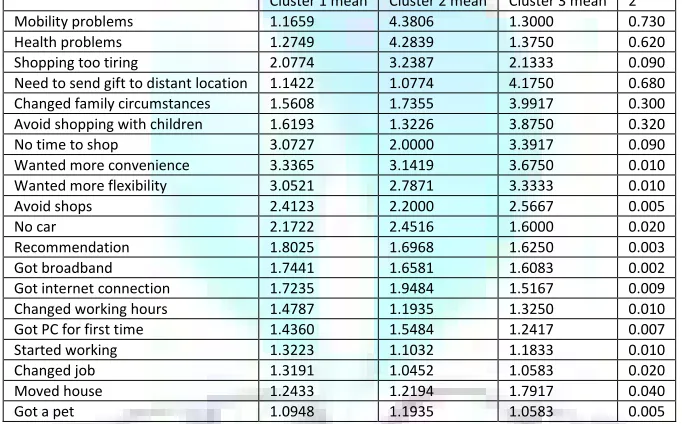
Of the 1,128 responses we received, 908 completed the question related to situational triggers for starting online shopping. The respondents were asked to indicate the level of influence that each particular situational variable (e.g. mobility problems) had on their decision to start buying electronics online (the 20 variables are shown in Table II). We subjected these 908 responses to hierarchical cluster analysis using Ward’s method in SPSS to determine whether there were identifiable groups of electronics shoppers in terms of the decision to begin buying online. The increases in the agglomeration coefficient suggested that there were five clusters; however, these were found to overlap considerably. Results of the three-cluster solution are presented here as these give the clearest picture. To determine whether differences between the clusters were significant, we used an effect size measure, 2, which can be derived from ANOVA results as the ratio of the sum of squares between groups to the total sum of squares. We used this measure in preference to performing one-way ANOVAs as our large sample size rendered the ANOVA test too sensitive (differences in responses too small to be of practical use were found to be statistically significant). The larger the value of 2, the greater the difference between the clusters; as a rule of thumb, 0.01 is a small effect, 0.06 is a medium effect and 0.14 can be considered a large effect (Cohen, 1988). The mean scores for each of our 20 statements for each cluster are given in Table II.
TABLE I: MOSAIC PROFILE OF THE UNCLASSIFIED DATA SET
Mosaic group Frequency Sample Percentage National (percent)
Missing (no ID number) 12 0.90 --
A. Symbols of success 166 12.51 9.62
B. Happy families 179 13.49 10.76
C. Suburban comfort 219 16.50 15.1
D. Ties of community 192 14.47 16.04
E. Urban intelligence 98 7.39 7.19
F. Welfare borderline 48 3.62 6.43
G. Municipal dependency 56 4.22 6.71
H. Blue-collar enterprise 116 8.74 11.01
I. Twilight subsistence 36 2.71 3.88
J. Grey perspectives 114 8.59 7.88
K. Rural isolation 90 6.78 5.39
Total 1327 100 100
TABLE II: SITUATIONAL VARIABLES INFLUENCING DECISION TO START ONLINE ELECTRONICS SHOPPING
Cluster 1 mean Cluster 2 mean Cluster 3 mean 2
Mobility problems 1.1659 4.3806 1.3000 0.730
Health problems 1.2749 4.2839 1.3750 0.620
Shopping too tiring 2.0774 3.2387 2.1333 0.090
Need to send gift to distant location 1.1422 1.0774 4.1750 0.680
Changed family circumstances 1.5608 1.7355 3.9917 0.300
Avoid shopping with children 1.6193 1.3226 3.8750 0.320
No time to shop 3.0727 2.0000 3.3917 0.090
Wanted more convenience 3.3365 3.1419 3.6750 0.010
Wanted more flexibility 3.0521 2.7871 3.3333 0.010
Avoid shops 2.4123 2.2000 2.5667 0.005
No car 2.1722 2.4516 1.6000 0.020
Recommendation 1.8025 1.6968 1.6250 0.003
Got broadband 1.7441 1.6581 1.6083 0.002
Got internet connection 1.7235 1.9484 1.5167 0.009
Changed working hours 1.4787 1.1935 1.3250 0.010
Got PC for first time 1.4360 1.5484 1.2417 0.007
Started working 1.3223 1.1032 1.1833 0.010
Changed job 1.3191 1.0452 1.0583 0.020
Moved house 1.2433 1.2194 1.7917 0.040
Got a pet 1.0948 1.1935 1.0583 0.005
Notes: Cluster 1 (“no reason”), n = 633; cluster 2 (“health”), n = 155; cluster 3 (“kids”), n = 120; total, n = 908
Convenience and Flexibility were fairly important to all three clusters (mean <3). With the exception of Convenience, Flexibility and No time to shop, Cluster 1
recorded low means on every statement. This cluster is the largest of the three we found, with 633 respondents, and would seem to represent a “no real reason” cluster, whose members are unable to explain what motivated them to start. An alternative explanation may lie in the distribution of the responses to each question; some were distinctly bimodal, suggesting that some were very important to a few people, but unimportant to the majority. The second and third clusters are more clear-cut. Health problems (mean = 4.28), Mobility problems (mean = 4.38) and Shopping being too tiring (mean = 3.23) had the strongest influence on the second cluster. The third cluster records high means for Changed family circumstance (mean = 3.99), Had a baby (mean = 4.17) and Avoiding shopping with children (mean = 3.87). Somewhat surprisingly, Recommendation appears to have played little role in the decision to start shopping for electronics online.
TRIGGERS FOR STOPPING TO SHOP ONLINE
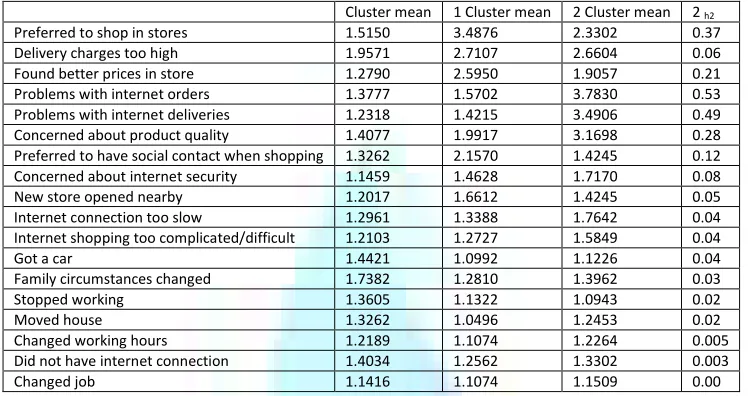
A total of 460 respondents answered a question relating to their reasons that had influenced their decision to discontinue online shopping at some time. The 18 variables that had influenced the decision to stop online electronics shopping were also subjected to hierarchical cluster analysis, and again a three-cluster solution was again preferred on the grounds of ease of interpretation (see Table III).
As before, we found one cluster recording low means on every variable (a similar cluster was found when the number of clusters was increased). Preferred to shop in stores (mean = 3.49), Found better prices in store (mean = 2.59) and Delivery charges too high (mean = 2.71) were important to stopping Cluster 2. Members of this cluster could be more closely identified with hedonic shoppers, rather than utilitarian shoppers (see Childers etal., 2001) in that they would seem to derive some benefit from shopping in stores.
DISCUSSION
Situational factors have usually been ignored in consumer behaviour research, both in general and in the specific contexts of the adoption of technology and of internet shopping, despite strong suggestions from theory (Bandura, 1977) of a continuous reciprocal interaction between the environment in which an individual operates, his or her own cognitive perceptions and consequent behaviour. Our study aimed to start filling this gap in the literature.
TABLE III: VARIABLES INFLUENCING DECISION TO STOP ONLINE ELECTRONICS SHOPPING
Cluster mean 1 Cluster mean 2 Cluster mean 2 h2
Preferred to shop in stores 1.5150 3.4876 2.3302 0.37
Delivery charges too high 1.9571 2.7107 2.6604 0.06
Found better prices in store 1.2790 2.5950 1.9057 0.21
Problems with internet orders 1.3777 1.5702 3.7830 0.53
Problems with internet deliveries 1.2318 1.4215 3.4906 0.49
Concerned about product quality 1.4077 1.9917 3.1698 0.28
Preferred to have social contact when shopping 1.3262 2.1570 1.4245 0.12
Concerned about internet security 1.1459 1.4628 1.7170 0.08
New store opened nearby 1.2017 1.6612 1.4245 0.05
Internet connection too slow 1.2961 1.3388 1.7642 0.04
Internet shopping too complicated/difficult 1.2103 1.2727 1.5849 0.04
Got a car 1.4421 1.0992 1.1226 0.04
Family circumstances changed 1.7382 1.2810 1.3962 0.03
Stopped working 1.3605 1.1322 1.0943 0.02
Moved house 1.3262 1.0496 1.2453 0.02
Changed working hours 1.2189 1.1074 1.2264 0.005
Did not have internet connection 1.4034 1.2562 1.3302 0.003
Changed job 1.1416 1.1074 1.1509 0.00
Notes: Cluster 1 (“disinterested stopper”), n = 233; cluster 2 (“prefer offline”), n = 121; cluster 3 (“internet problems”), n = 106; total, n = 460
The qualitative research carried out in Study 1 uncovered the importance of situational factors and life events in particular (e.g. having a baby, health problems) as the trigger for starting online electronics shopping. Crucially, the results of Study 1 also indicated that the decision to shop online for electronics may be reversed when the initiating situation no longer applies. Furthermore, Study 1 highlighted that online electronics shopping may be discontinued also as a consequence of frustrations and negative experiences with the service. For some, the experience of purchasing electronics online was less enjoyable than purchasing other products on the internet or less satisfactory than shopping in electronics stores.
These results were confirmed in Study 2. The key finding from the cluster analysis is the importance of situational factors in the decision to start buying electronics online for two distinct clusters. Similarly, two clusters (stopping Cluster 2 and Cluster 3) had stopped purchasing electronics online because dissatisfied with certain aspects of the service or with the experience as a whole.
Our research makes a number of significant contributions to the understanding of the adoption process of internet electronics shopping.
Our findings suggest that, at least in some circumstances, the adoption of innovations may not follow the process postulated in the relevant literature (e.g. Rogers, 1983). The results of Study 1 indicate that online electronics shoppers do not undertake a pre-adoption evaluation of the characteristics of the innovation in terms of relative advantage, compatibility and complexity (e.g. Verhoef and Langerak, 2001), before deciding whether to start shopping for electronics online. Rather, the adoption decision is changeable and influenced by the changes in needs prompted by a new situation or circumstance.
The results of Study 2 confirm the importance of situational factors as triggers of adoption for at least two clusters. Similarly, two clusters are influenced by situational and performance triggers in their decision to discontinue online electronics shoppers.
The significance of a specific situation as a trigger for the adoption of internet shopping has important implications. First, being driven by circumstances rather than by a cognitive elaboration and decision process, the adoption of online electronics shopping may be an erratic process. Second, for some consumers at least, the adoption decision triggered by a specific situational factor is easily reversed when the situation changes again and the initial trigger disappears. This finding indicates that even the convenience associated with online electronics shopping is dependent upon the situation or circumstance, in contrast with Verhoef and Langerak’s (2001) suggestion of perceived convenience as a decisive factor in determining consumers’ perceived relative advantage and compatibility of electronic electronics shopping. Furthermore, situational factors related to the reliability of the service provided, both in terms of delivery and the price, quality and range of the goods on offer greatly affect the evaluation of online electronics shopping and the decision of whether or not to revert to shopping in stores.
Our findings that many consumers discontinue the online mode of shopping whenever the initial trigger disappears or when they are dissatisfied either with specific or with general aspects of the experience suggest that the process of diffusion of the online electronics innovation by no means follows the smooth and continuous path suggested by some traditional definitions of adoption and the associated mental and behavioural processes: “Adoption is defined as the process by which an individual becomes committed to continue use of an innovation. Adoption includes not just the act of buying a new product but also includes the mental and behavioral sequence through which consumers progress, potentially leading to acceptance and continued use” (Engell and Blackwell, 1982, p. 382). In contrast, the adoption decision of online electronics shopping seems to be re-evaluated frequently and consequently post-adoption evaluation appears crucial to the decision of whether to continue with or to drop the innovation. This is consistentwithGillett’s (1976) suggestion 30 years ago that in-home shoppers are not a captive market.
Overall our findings suggest that the adoption of the online mode of shopping is complementary to buying in stores, rather than substitutive. Reverting back to the traditional mode of shopping is easy because most consumers never cease completely to shop in traditional stores.
MANAGERIAL IMPLICATIONS
The combined findings of the two studies have important implications for online electronics providers and potentially for other e-retailers.
The results of the first cluster analysis in Study 2 suggest that, besides increased convenience and flexibility, the main motives for starting online electronics shopping lie beyond the retailers’ control and relate more to shoppers’ personal circumstances. However, while situational factors are beyond a marketer’s control, they could be used as a basis for marketing communications content and target advertising, for instance, by using magazines directed at people who want to send gifts to distant locations or people who have difficulty in mobility.
Existing providers should concentrate on service quality issues, particularly in terms of delivery and should consider improvements to web sites to make the online electronics shopping experience easier, more stimulating and rewarding for customers. This is very important, as Study 1 suggests that the decision to shop online is frequently re-evaluated, creating tangible opportunities for conversion by online providers. Online electronics providers should also monitor use frequency to identify drop-outs and actively target them with promotional offers. Finally, incentives to start, or restart, online electronics shopping should be offered, with targeting based on different life events, for example, the birth of a child or a health crisis.
FINAL CONSIDERATIONS
The start/stop pattern of the online electronics shopping adoption process and the complementary rather than the substitutive nature of online electronics shopping have not been noted in any previous research. However, these findings make an important contribution to both theory and practice. Furthermore they are factors that may explain why online electronics market in the world is still very small. Researchers may want to generalise this to other adoption processes, for instance the use of the internet for other purposes, e.g. internet banking, and the use of mobile phones.
REFERENCES
• Andrews, R.L. and Currim, I.S. (2004), “Behavioural differences between consumers attracted to shopping online versus traditional supermarkets:
implications for enterprise design and marketing strategy”, International Journal of Internet Marketing and Advertising, Vol. 1 No. 1, pp. 38-61.
• Bandura, A. (1977), “Self-efficacy: toward a unifying theory of behavioral change”, Psychological Review, Vol. 84 No. 2, pp. 191-215.
• Barnes, Sj., Bauer, H.H., Neumann, M.M. and Huber, F. (2007), “Segmenting cyberspace: a customer typology of the internet”, European Journal of
Marketing, Vol. 41 No. 1/2, pp. 71-93.
• BBC News (2008), “Christmas online sales ‘rise 50%’”, 18 January, available at:
http://newsvote.bbc.co.uk/mpapps/pagetools/print/news.bbc.co.uk/1/hi/business (accessed 18 January 2008).
• Brengman, M., Heuens, M., Weijters, B., Smith, S.M. and Swinyard, W.R. (2005), “Segmenting internet shoppers based on their web-usage related lifestyle:
a cross cultural validation”, Journal of Business Research, Vol. 58 No. 1, pp. 79-88.
• Brown, M., Pope, N. and Voges, K. (2003), “Buying or browsing? An exploration of shopping orientations and online purchase intention”, European Journal
of Marketing, Vol. 37 No. 11/12, pp. 1666-84.
• Bryman, A. and Bell, E. (2007), “Business Research Methods”, Oxford University Press, Oxford.
• Childers, T.L., Carr, C.L., Peck, J. and Carson, S. (2001), “Hedonic and utilitarian motivations for online retail shopping behavior”, Journal of Retailing, Vol. 77
No. 4, pp. 511-35.
• Cohen, J. (1988), “Statistical Power Analysis for the Behavioral Sciences”, Lawrence Erlbaum Associates, Hillsdale, NJ.
• Dabholkar, P.A. (1996), “Consumer evaluations of new technology-based self-service options: an investigation of alternative models of service quality”,
International Journal of Research in Marketing, Vol. 13 No. 1, pp. 29-51.
• Dabholkar, P.A. and Bagozzi, R.P. (2002), “An attitudinal model of technology-based self-service: moderating effects of consumer traits and situational
factors”, Journal of the Academy of Marketing Science, Vol. 30 No. 3, pp. 184-201.
• Danaher, Pj., Wilson, I.W. and Davis, R.A. (2004), “A comparison of online and offline consumer brand loyalty”, Marketing Science, Vol. 22 No. 4, pp.
461-76.
• Davis, F.D., Bagozzi, R.P. and Warshaw, P.R. (1989), “User acceptance of computer technology: a comparison of two theoretical models”, Management
Science, Vol. 35 No. 8, pp. 982-1003.
• Degeratu, A., Rangaswamy, A. and Wu, J. (2000), “Consumer choice behavior in online and traditional supermarkets: the effects of brand name, price and
other search attributes”, International Journal of Research in Marketing, Vol. 17 No. 1, pp. 55-78.
• Engell, J.F. and Blackwell, R.D. (1982), Consumer Behavior, The Dryden Press, Chicago, IL.
• Fenech, T. and O’Cass, A. (2001), “Internet users’ adoption of web retailing: user and product dimensions”, Journal of Product & Brand Management, Vol.
10 No. 6, pp. 361-81.
• Geuens, M., Brengman, M. and S’Jegers, R. (2003), “Gadgets retailing, now and in the future: a consumer perspective”, Journal of Retailing and Consumer
Services, Vol. 10 No. 4, pp. 241-51.
• Gillett, P.L. (1976), “In-home shoppers – an overview”, Journal of Marketing, Vol. 40 No. 4, pp. 81-8.
• Grandcolas, U., Rettie, R. and Marushenko, K. (2003), “Web survey bias: sample or mode effect?”, Journal of Marketing Management, Vol. 19 No. 5/6, pp.
541-62.
• Hansen, T. (2005), “Consumer adoption of online electronics buying: a discriminant analysis”, International Journal of Retail & Distribution Management,
Vol. 33 No. 2, pp. 101-21.
• Key Note (2007), E-Commerce: The Internet Electronics Market, February, Key Note Ltd, Hampton.
• Lozar Manfreda, K., Bosnjak, M., Berzelak, J., Haas, I. and Vehoar, V. (2008), “Web surveys versus other survey modes: a meta-analysis comparing response
rates”, International Journal of Market Research, Vol. 50 No. 1, pp. 79-104.
• Mahajan, V., Muller, R. and Bass, F.M. (1995), “Diffusion of new products: empirical generalizations and managerial uses”, Management Science, Vol. 14
No. 3, pp. 79-89.
• Malhotra, N. and Birks, D. (2007), Marketing Research: An Applied Approach, 3rd European edition, Financial Times Prentice-Hall, Harlow.
• Mintel (2007), Gadgets Retailing–UK, November 2007, Mintel International Group Limited, London.
• Morganosky, M.A. and Cude, Bj. (2000), “Consumer response to online electronics shopping”, International Journal of Retail & Distribution Management,
Vol. 28 No. 1, pp. 17-26.
• Ramus, K. and Nielsen, N.A. (2005), “Online electronics retailing: what do consumers think?”, Internet Research, Vol. 15 No. 3, pp. 335-52.
• Robertson, T.S. (1967), “The process of innovation and the diffusion of innovation”, Journal of Marketing, Vol. 31 No. 1, pp. 14-19.
• Robinson, H., Dall’Olmo Riley, F., Rettie, R. and Rolls-Willson, G. (2007), “The role of situational variables in online electronics shopping in the UK”, The
Marketing Review, Vol. 7 No. 1, pp. 89-106.
• Rogers, E.M. (1983), Diffusion of Innovations, The Free Press, New York, NY.
• Rohm, Aj. and Swaminathan, V. (2004), “A typology of online shoppers based on shopping motivations”, Journal of Business Research, Vol. 57 No. 7, pp.
748-57.
• Sénécal, S., Gharbi, J.-E. and Nantel, J. (2002), “The influence of flow on hedonic and utilitarian shopping values”, Advances in Consumer Research, Vol. 29,
pp. 483-4.
• Verdict (2004), Verdict on e-Retail 2004, Verdict Research Limited, London.
• Verhoef, P.C. and Langerak, F. (2001), “Possible determinants of consumers’ adoption of electronic electronics shopping in The Netherlands”, Journal of
REQUEST FOR FEEDBACK
Dear Readers
At the very outset, International Journal of Research in Commerce, IT and Management (IJRCM)
acknowledges & appreciates your efforts in showing interest in our present issue under your kind perusal.
I would like to request you to supply your critical comments and suggestions about the material published
in this issue as well as on the journal as a whole, on our E-mails i.e.
or
for further improvements in the interest of research.
If you have any queries please feel free to contact us on our E-mail
.
I am sure that your feedback and deliberations would make future issues better – a result of our joint
effort.
Looking forward an appropriate consideration.
With sincere regards
Thanking you profoundly
Academically yours
Sd/-