Working Vacation Queue with Second Optional Service and Unreliable Server
M. Jaina, D. Chauhan*b
a Department of Mathematics, Indian Institute of Technology, Roorkee-247667 b Department of Mathematics, Allenhouse Institute of Technology, Kanpur-208007
A R T I C L E I N F O
Article history: Received 2 January 2010
Accepted in revised form 17 May 2012
Keywords: Working Vacation Second Optional Service Matrix Geometric Technique Server Breakdown Repair
Queue Size
A B S T R A C T
An M/M/1 queueing system with second optional service and unreliable server is studied. We consider that the server works at different rate rather than being idle during the vacation period. The customers arrive to the system according to Poisson process with state dependent rates depending upon the server’s status. All customers demand the first essential service whereas only some of them demand the second optional service. A customer either may leave the system after the first essential service with probability (1-r) or at the completion of the first essential service go for second optional service with probability r (0≤r≤1). The server may breaks down according to Poisson process during the busy and working vacation duration. Both service times in vacation and in service period are exponentially distributed. The matrix geometric technique is used for the analysis of the concerned queueing system. The sensitive analysis is also performed to examine the variation of the system performance characteristics with various input parameters.
doi:10.5829/idosi.ije.2012.25.03c.06
1. INTRODUCTION1
Queueing model with vacations provide performance prediction of many congestion situations encountered in computer, communication, manufacturing, production systems, etc.. Several researchers have contributed significantly in this direction [1]. Lee et al. [2] studied Mx/G/1 queueing system with N-policy and single vacation. GI/M/c queue with two classes of vacation mechanism was considered by Chao et al. [6, 3]; in the first case all servers take vacation simultaneously whereas in second class of vacation, each server takes its own vacation. Bacot et al. [4] generalized a single server bulk input batch service queues with multiple vacations. The classical single server vacation model was generalized by Seri and Finn [5] by considering working vacation. Simple explicit formulae for the mean, variance of the number of customers in the system were provided. Arumuganathan et al. [6] considered Mx/G/1 queueing system with multiple vacations, setup times and closedown times under N-policy. An M/G/1 queue was studied by Wu et al. [7] by considering the multiple vacations and exhaustive
*Corresponding Author Email:[email protected] (D. Chauhan)
service discipline; the server was assumed to work at different service rates rather than completely stopping the service during vacation. A queueing system with c servers and a threshold type vacation has been considered by Tian et al. [8]. Ke [9] studied the operating characteristics of an Mx/G/1 queueing system under a variant vacation policy. Lin and Ke developed a cost model to determine the optimal values of the number of the servers and working vacation rate for M/M/R queue with vacation.
In many real cases, the server may experience breakdowns, so that a more realistic queueing model is that which incorporates the assumption of unreliable server. Cao et al. [10] investigated an M/G/1 queueing model with repairable server. Reliability analysis of M/G/1 queueing system with server breakdowns and vacations has been examined by Li et al. [11]. Wang et al. [12] analyzed the retrial queue with server breakdowns and repairs. Ke [13] studied the N-policy M/G/1 queue with server vacations, startup and breakdowns. Almasi et al. [14] examined a single server retrial queue with finite number of homogeneous sources of calls and a single removable server. Stability conditions are provided by Sherman et al. [15] for an M/M/1 retrial queue with infinite capacity orbit. Mx/G/1
TECHNICAL
NOTE
Intrnational Journal of Engineering
system under vacation policies with startup/closedown times has been examined by Ke [16]. Wang et al. [17] considered a single unreliable server in an Mx/M/1 queueing system with multiple vacations. M/G/1 queueing system with a single removable and unreliable server has been considered by Wang et al. [18], by assuming that the server needs a startup time before providing the service. Yang and Alfa [19] studied a multi server queueing system with identical unreliable server with phase type distributed service time.
Most studies on queueing models have considered the main service. However, in many real service systems some customers require the main as well as subsidiary services provided by the server. A pioneer work on such queueing situation was done by Madan [20], who first introduced the concept of second optional service while studying the time dependent as well as steady behavior of an M/G/1 queueing system with no waiting capacity, using supplementary variable technique. An M/G/1 queueing system with second optional service has also studied by Madan [20]. Medhi [21] proposed an M/G/1 queueing model with second optional channel and developed the explicit expressions for the mean queue length and mean waiting time. Supplementary variable technique was used to develop the time dependent probability generating function in terms of their Laplace transform for M/G/1 queue by Al- Jararha and Madan [22]. Mx/G/1 queueing system with two phases of heterogeneous service under N-policy was examined by Choudhury and Paul [23]. Wang [24] considered an M/G/1 queueing system with second optional service and server breakdowns based on supplementary variable technique. Mx/G/1 queueing system was studied with additional second phase of optional service and unreliable server by Choudhury et al. [25].
Many authors have paid attention on matrix geometric approach which is used to solve the more
complex queueing problems having phase
arrivals/services [26]. A matrix geometric approximation for tandem queues has been examined by Gomez [27] with blocking and repeated attempts. Matrix geometric solution of the nested QBD chains was given by Choi et al. [28]. The queue length distribution was computed by Gray et al. [29] using matrix geometric method for a queueing model with multiple types of server breakdowns. Ke and Wang [30] used matrix geometric theory in studying the machine repair problem with R servers who take vacation of random length. A single server working vacation queueing model with multiple types of server breakdown via matrix geometric approach was described by M. Jain and A. Jain [31].
In this paper, we develop a working vacation queueing model with second optional service and unreliable server. The server may breaks down during
the vacation as well as while working. The paper is organized as follows. In section 2, we outline the underlying assumptions and notations to develop mathematical model under study. The governing steady state equations are constructed by taking appropriate transition rates. In section 3, matrix geometric solution of the system is given. In section 4, various performance characteristics of the system are formulated explicitly in terms of steady sate probabilities. In section 5, we perform comparative study of the system characteristics for various input parameters. In the last section, conclusions and future scopes of the work are provided.
2. MATHEMATICAL MODEL
We consider a single server vacation model with second optional service and unreliable server. The following assumptions are made to describe the model;
v A single server queue begins with a working vacation, when the system is empty. During the vacation the customers arrive in Poisson fashion to the system with rate λV.
v The customers are served at mean rate of µV during the working vacation and the server is prone to breakdown with mean rate αV. When the server breaks down during vacation, it is sent for repair with rate βV.
v When the server is not on working vacations, the customers arrive to the system according to Poisson process with rate λB.
v Two types of services are provided to the customers. The first essential service is needed to all arriving customers with mean rate µ1. As soon as the first service of a customer is completed, then with probability r, he may opt for the second service or else with probability (1-r), he may opt to leave the system. The second service times are assumed to be exponentially distributed with mean service rate µ2.
v Assume that the life time of the server is exponentially distributed with mean 1/α1 in first essential service. In second optional service, the server may fails according to exponential distribution with rate α2.
v After breakdown, the server immediately sent for repair. The repair time distributions while server fails during essential and optional service phases are exponentially distributed with mean rate β1 andβ2, respectively.
v The server immediately starts to serve the customers after it is fixed.
For mathematical formulation purpose, we define the following steady state probabilities:
P(1,n,V) Probability that there are n customers in the system when the server is in broken down state during working vacation
P(1,n,B) Probability that there are n customers in the system when the server is rendering first essential service
P(2,n,B) Probability that there are n customers in the system when the server is rendering second optional service
P(3,n,B) Probability that there are n customers in the system and the server is in broken down state while rendering first essential service
P(4,n,B) Probability that there are n customers in the system and the server is in broken down state while rendering second optional service The steady state equations governing the model are constructed as follows:
) , 1 , 2 ( ) , 1 , 1 ( ) 1 ( ) , 1 , 0 ( ) , 0 , 0 ( ) ( 2
1P B P B
r V P V P V B V m m m l l + -+ = + (1) 0 ), , 1 , 1 ( ) , 1 , 0 ( ) , 1 , 0 ( ) , , 0 ( ) ( > + -+ + = + + n V P V n P V n P V n P V V V V V V b l m m a l (2) ) , 1 , 0 ( ) , 1 , 1 ( )
(lV +bV P V =aVP V (3)
1 ), , 1 , 1 ( ) , , 0 ( ) , , 1 ( )
(lV+bV P nV =aVP nV +lVP n- V n> (4)
) , 2 , 1 ( ) 1 ( ) , 2 , 2 ( ) , 1 , 3 ( ) , 0 , 0 ( ) , 1 , 1 ( ) ) 1 ( ( 1 2 1 1 1 1 B P r B P B P V P B P r r B B m m b l m m l a -+ + + = + -+ + (5) 1 ), , 1 , 1 ( ) 1 ( ) , 1 , 2 ( ) , , 3 ( ) , 1 , 1 ( ) , , 1 ( ) ) 1 ( ( 1 2 1 1 1 1 > + -+ + + + -= + -+ + n B n P r B n P B n P B n P B n P r r B B m m b l m m l a (6) ) , 1 , 4 ( ) , 1 , 1 ( ) , 1 , 2 ( )
(lB+a2+m2 P B =rm1P B +b2P B (7)
1 ), , 1 , 2 ( ) , , 4 ( ) , , 1 ( ) , , 2 ( ) ( 2 1 2 2 > -+ + = + + n B n P B n P B n P r B n P B B l b m m a l (8) ) , 1 , 1 ( ) , 1 , 3 ( )
(lB +b1 P B =a1P B (9)
1 ), , 1 , 3 ( ) , , 1 ( ) , , 3 ( )
(lB+b1P nB =a1P nB +lBP n- B n> (10) ) , 1 , 2 ( ) , 1 , 4 ( )
(lB +b2 P B =a2P B (11)
1 ), , 1 , 4 ( ) , , 2 ( ) , , 4 ( )
(lB+b2 P nB =a2P n B +lBP n- B n> (12)
3. MATRIX GEOMETRIC SOLUTION
The theory of matrix geometric approach was developed [26] to solve the stationary state probabilities for the vector state Markov Process with repetitive structure. Consider the generator matrix Q as shown below:
ú ú ú ú ú ú ú ú ú ú ú ú û ù ê ê ê ê ê ê ê ê ê ê ê ê ë é -= 0 1 2 0 1 2 0 1 2 0 1 10 01 00 A A A A A A A A A A A B B B Q
The matrix can be decomposed in to sub matrices B00, B01, B10, A0, A1, A2 as follows:
( )
[ ];
00 V B
B = - l +l
[ 0 0 0 0]
01 B
B = ln l
ú ú ú ú ú ú ú ú û ù ê ê ê ê ê ê ê ê ë é -= 0 0 ) 1 ( 0 2 1
10 m m
m r B V ú ú ú ú ú ú ú ú û ù ê ê ê ê ê ê ê ê ë é = B B B B V V A l l l l l l 0 0 0 0 0 0 0 0 0 0 0 0 0 0 0 0 0 0 0 0 0 0 0 0 0 0 0 0 0 0 0 ú ú ú ú ú ú ú ú û ù ê ê ê ê ê ê ê ê ë é + -+ -+ + -+ + -+ -+ + -= ) ( 0 0 0 0 0 ) ( 0 0 0 0 ) ( 0 0 0 0 ) ( 0 0 0 0 0 0 ) ( 0 0 0 0 ) ( 2 2 1 1 2 2 2 1 1 1 1 1 b l b b l b a m a l a m m a l b l b a m a l B B B B V V V V V V V r A ú ú ú ú ú ú ú ú û ù ê ê ê ê ê ê ê ê ë é -= 0 0 0 0 0 0 0 0 0 0 0 0 0 0 0 0 0 0 0 0 ) 1 ( 0 0 0 0 0 0 0 0 0 0 0 0 0 2 1 2 m m m r A V
Let X be the vector of the steady state probabilities with Q as coefficient matrix, such that XQ=0, and the normalizing condition is Xe=1, where e is the column vector of appropriate dimension with all elements equal to 1. Let us partition X as X=
[
X0,X1,X2,...]
where:] [ 0,0,
0 X V
X = 1 ], , , , , ,
[ 0,, 1,, 1,, 2,, 3,, 4,, ³
= X X X X X X i
Xi iV iV iB iB iD iD
We examine the existence of a solution of the form, R
X
Xi = i-1 or Xi=X1Ri-1,i³1 (13) Since, Xi depends only on the state transition between level (i-1) and level i, the balance equations are given by:
0 10 1 00
0B +X B =
X (14) 0 2 2 1 1 01
0B +X A+X A =
1 , 0 2 1 1 0
1 + + + = >
-A X A X A i
Xi i i (16)
In Equation (13), R is a square matrix and is the unique minimal non negative solution to the non linear matrix equation
0
2 2 1
0+RA +R A =
A (17)
The matrix R can be computed by successive substitution in the recurrence relation R(0)=0
0 , ) ( )
1
(n+ =-A0A1-1-R2 n A2A1-1 n³
R (18)
Finally, we are interested to calculate the vector
X=[X0, X1, X2,……] for this purpose. The balance equations for the boundary states given by Equations (14) and (15) can be written in matrix form as:
0 ) ( 1 2 0 A +RA =
X (19)
1 ) ( 1
0 I-R -e=
X (20)
where, e is the column matrix of suitable dimension having all elements 1; this gives a unique solution for
X=[X0, X1, X2,……].
4. PERFORMANCE MEASURES
The validity of the model and the system performance characteristics can be analyzed by computing the system performance characteristics, in terms of the steady state probabilities explicitly. Some of the system performance indices are as follows:
v Probability that the server is on working vacation is obtained as:
( )
å
¥ ==
0 ) , , 0 (
i
v P iV
W
P (21)
v Probability that the server is in broken down state while fails during working vacation is:
( )
å
¥ ==
1 ) , , 1 (
i
v P iV
D
P (22)
v Probability that the server is busy with first essential service is:
( )
å¥=
= 1
1 (1, , )
i
B i P B
P (23)
v Probability that the server is busy with second optional service is:
( )
å¥= =
1
2 (2, , )
i
B i P B
P (24)
v Probability that the server is in broken down state while failed during first essential service is:
( ) å¥ =
=
1
1 (3,, )
i
D i P D
P (25)
v Probability that the server is in broken down state while failed during second optional service is:
( ) å¥
=
= 1 2 (4,, )
i
D i P D
P (26)
v Average number of customers in the system is:
[ ]
[ (1,, ) (2, , ) (3, , ) (4,, )] )
, , 1 ( ) , , 0 ( ]
[
1 0
D i P D i P B i P B i P i
V i P V i P i N E
i i
+ +
+
+ +
=
å
å
¥
= ¥
= (27)
v Throughput is given by:
å
å
¥= ¥
=
+ +
+ =
1
2 1
0
)] , , 2 ( ) , , 1 ( [ )] , , 1 ( ) , , 0 ( [ ) (
i i
V P iV P iV P iB P iB
P
T m m m (28)
5. SENSITIVITY ANALYSIS
In order to determine the performance of the working vacation queueing system with second optional service and unreliable server, we perform a computational experiment by a program developed in MATLAB using matrix geometric technique discussed in section 3. The Tables 1-5 and Figures 1-6 depict the variation of the system performance characteristics with respect to the various input parameters. We assume the following basic input data for different tables:
TABLE 1: λB=0.3, m1=6, m2=4, mV=2, a1=0.05, a2=0.03, aV=0.02, b1=3.5, b2=2.5, bV=1.5, r=0.2 TABLE 2: λV=0.1, m1=6, m2=4, mV=2,
a1=0.05, a2=0.03, αV=0.02, b1=3.5, b2=2.5, bV=1.5, r=0.2 TABLE 3: λV=0.1, λB=0.3, a1=0.05, a2=0.03,
αV=0.02, b1=3.5, b2=2.5, bV=1.5, r=0.2
TABLE 4: λV=0.1, λB=0.3, m1=6, m2=4, mV=2, b1=3.5, b2=2.5, bV=1.5
TABLE 5: λV=0.1, λB=0.3, a1=0.05, a2=0.03, αV=0.02, r=0.2, m1=6, m2=4
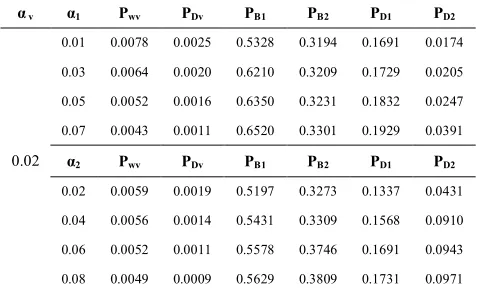
repair state, follow increasing trend for increased server breakdown rates α1, α2 whereas PWV and PDV have very dormant decrement with the increase in failure rates. Table 5 presents the comparison between probabilities of server status for different repair rates β1 and β2 by keeping βV as constant. We observe that the vacation state probabilities of the server increase with the increase in the value of repair rate while the probabilities of the server being busy and under repair show decreasing pattern.
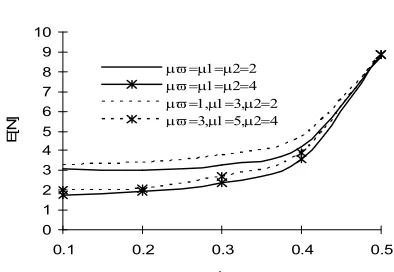
In Figures 1-6, we plot the variation of the queue length with respect to different parameters such as failure rate, repair rate, service rate, etc.. Figures 1-6 depict that the average queue length E[N] follow an increasing trend for higher values of arrival rate λ.
In Figures 1 and 2, E[N] depicts a clearly increasing pattern with the increase in server breakdown rate. This trend indicates that the system performance tremendously affected by the server breakdown and will lead to increased congestion. From Figures 3 and 4, it is noticed that initially there is a gradual decrement in the
TABLE 1. Long run probabilities of the server status by
varying λv
λv Pwv PDv PB1 PB2 PD1 PD2
0.1 0.4071 0.3029 0.1040 0.1685 0.1147 0.0785
0.2 0.4009 0.3015 0.1301 0.1725 0.1194 0.0975
0.3 0.3498 0.2222 0.1506 0.2256 0.1393 0.1084
0.4 0.3050 0.2107 0.1810 0.2520 0.1577 0.1137
0.5 0.3005 0.2072 0.1978 0.2612 0.1654 0.1262
0.6 0.2777 0.2047 0.2437 0.2734 0.1676 0.1373
0.7 0.2119 0.1453 0.2556 0.3661 0.1666 0.1404
0.8 0.1439 0.1317 0.3271 0.5934 0.1635 0.1469
0.9 0.0994 0.0932 0.3619 0.5812 0.1585 0.1557
TABLE 2. Long run probabilities of the server status by
varying λB
λB Pwv PDv PB1 PB2 PD1 PD2
0.1 0.5975 0.4833 0.0016 0.0519 0.0172 0.0233
0.2 0.4820 0.4847 0.0034 0.0819 0.0212 0.0476
0.3 0.4660 0.4799 0.0055 0.1191 0.0264 0.0743
0.4 0.3493 0.4749 0.0080 0.1641 0.0322 0.1054
0.5 0.3322 0.3697 0.0111 0.2179 0.0381 0.1434
0.6 0.3147 0.3645 0.0150 0.2819 0.0437 0.1917
0.7 0.2968 0.2591 0.0202 0.3582 0.0486 0.2546
0.8 0.1780 0.1536 0.0269 0.4500 0.0524 0.3385
0.9 0.1600 0.0480 0.0358 0.5630 0.0551 0.3520
average queue length but later on a sharp decrement can be seen in E[N] on increasing the repair rate of the server. Therefore, by keeping higher repair rate, the performance of the system can be improved. Figures 4-6 depict how service rates affect the average queue length.
TABLE 3. Long run probabilities of the server status by
varying µ1 and µ2
µv µ1 Pwv PDv PB1 PB2 PD1 PD2
3
2 0.0054 0.0017 0.3369 0.3169 0.2718 0.1720
4 0.2329 0.1104 0.2912 0.2778 0.1841 0.0882
6 0.2607 0.2199 0.1678 0.2542 0.1477 0.0795
8 0.2890 0.2634 0.1082 0.2091 0.1191 0.0651
µ2 Pwv PDv PB1 PB2 PD1 PD2
1 0.0082 0.0024 0.3301 0.3028 0.2601 0.1102
3 0.2408 0.1212 0.2721 0.2493 0.1792 0.0828
5 0.2841 0.2652 0.1390 0.2391 0.1408 0.0729
7 0.2988 0.2981 0.0998 0.1830 0.1118 0.0539
TABLE 4. Long run probabilities of the server status by
varying α1 and α2
α v α1 Pwv PDv PB1 PB2 PD1 PD2
0.02
0.01 0.0078 0.0025 0.5328 0.3194 0.1691 0.0174
0.03 0.0064 0.0020 0.6210 0.3209 0.1729 0.0205
0.05 0.0052 0.0016 0.6350 0.3231 0.1832 0.0247
0.07 0.0043 0.0011 0.6520 0.3301 0.1929 0.0391
α2 Pwv PDv PB1 PB2 PD1 PD2
0.02 0.0059 0.0019 0.5197 0.3273 0.1337 0.0431
0.04 0.0056 0.0014 0.5431 0.3309 0.1568 0.0910
0.06 0.0052 0.0011 0.5578 0.3746 0.1691 0.0943
0.08 0.0049 0.0009 0.5629 0.3809 0.1731 0.0971
TABLE 5. Long run probabilities of the server status by
varying β1 and β2
βv β1 Pwv PDv PB1 PB2 PD1 PD2
2.5
3 0.0951 0.0216 0.5374 0.3294 0.1148 0.1481
5 0.0953 0.0217 0.4438 0.3019 0.1031 0.1423
7 0.0954 0.0217 0.3368 0.3000 0.1009 0.1409
9 0.0959 0.0319 0.2291 0.2902 0.0962 0.1399
β2 Pwv PDv PB1 PB2 PD1 PD2
2 0.0944 0.0314 0.5242 0.3616 0.1443 0.1988
4 0.0958 0.0316 0.5297 0.3220 0.1201 0.1701
6 0.0961 0.0319 0.4038 0.3201 0.1179 0.1516
0 1 2 3 4 5 6 7 8 9
0.1 0.2 0.3 0.4 0.5
l
E
[N]
a1=a2=0.3 a1=a2=0.9 a1=0.2,a2=0.4 a1=0.95,a2=0.85
Figure 1. Average queue length vs l
0 2 4 6 8 10
0.1 0.2 0.3 0.4 0.5
l
E
[N]
av =a1=a2=0.2 av =a1=a2=0.7 av =0.15,a1=0.2,a2=0.25 av =0.5,a1=0.9,a2=0.7
Figure 2. Average queue length vs l
5 7 9 11 13 15 17 19 21 23
0.1 0.2 0.3 0.4 0.5
l
E
[N]
b1=b2=2 b1=b2=5 b1=2.5,b2=1.5 b1=3.5,b2=6.5
Figure 3. Average queue length vs l
5 7 9 11 13 15 17 19 21 23
0.1 0.2 0.3 0.4 0.5
l
E
[N]
bv =b1=b2=2 bv =b1=b2=4 bv =1,b1=3,b2=2 bv =3,b1=5,b2=4
Figure 4. Average queue length vs l
0 1 2 3 4 5 6 7 8
0.1 0.2 0.3 0.4 0.5
l
E
[N]
m1=m2=3 m1=m2=5 m1=3,m2=7 m1=4,m2=2
Figure 5. Average queue length vs l
0 1 2 3 4 5 6 7 8 9 10
0.1 0.2 0.3 0.4 0.5
l
E
[N]
mv=m1=m2=2 mv=m1=m2=4 mv=1,m1=3,m2=2 mv=3,m1=5,m2=4
Figure 6. Average queue length vs l
6. CONCLUDING REMARKS
In many stochastic systems, there may occur a situation in which the first service is essential to all arrivals whereas second service is needed by only some of them. Similarly breakdown is a remarkable and unavoidable phenomenon in the service facility of a queueing system, because system performance deteriorates seriously by the server breakdown and limitations of the repair capacity. In this paper, we have studied the effect of second optional service and unreliable server on the performance measures for working vacation queueing model. The queue with working vacation may be applicable in modeling of many practical situations related to computers, communications, and productions systems, etc., wherein the server works at different service rates rather than completely stopping the service during a vacation.
7. REFERENCE
1. Takagi, H., “Queueing Analysis Vacation and Priority Systems”,
Vol. 1, North Holland, Amsterdam, (1991).
2. Lee, S.S., Lee, H.W., Yoon, S.H. and Chae, K.C., “Batch arrival
queue with N-policy and single vacation”, Computers &
Operations Research, Vol. 22, (1995), 173-189.
3. Chao, X. and Zhao, Y.Q., “Analysis of multiserver queue with station and server vacation”, European Journal of Operational Research,Vol. 110, (1998), 392-406.
4. Bacot, J.B. and Dshalalow, J.H., “A bulk input queueing system
with batch gated service and multiple vacation policy”, Mathematical and Computer Modelling, Vol. 34, (2001), 873-886.
5. Seri, L.D. and Finn, S.G., “M/M/1 queues with working
vacations (M/M/1/WV)”, Performance Evaluation, Vol. 50,
(2002), 41-52.
6. Arumuganathan R. and Jeyakumar S., “Steady state analysis of
bulk queue with multiple vacations, setup times with N-Policy
and closedown times”, Applied Mathematical Modelling, Vol.
29, (2005), 972-986.
7. Wu, and Takagi, “M/G/1 queue with multiple working
vacations”, Performance Evaluation, Vol. 63, (2006), 654-681.
8. Tian, N. and Zhang, Z.G., “A two-threshold vacation policy in
multiserver queueing system”, European Journal of Operational
Research, Vol. 168, (2006), 153-163.
9. Ke, J.C., “Operating characteristics analysis of Mx/G/1 system
with variant vacation policy and balking”, Applied Mathematical
Modelling, Vol. 31, (2007), 1321-1337.
10. Cao, J. and Cheng, K., “Analysis of M/G/1 queueing system
with repairable service station”, ActaMathematicae Applicatae, Vol. 5, (1982), 113-127.
11. Li, W., Shi, D. and Chao, X., “Reliability analysis of M/G/1 queueing system with server breakdowns and vacations”, Journal of Applied Probability, Vol. 34, (1997), 546-555.
12. Wang, J., Cao, J. and Li, Q., “Reliability analysis of the retrial queue with server breakdown and repairs”, Queueing Systems, Vol. 38, (2001), 363-380.
13. Wang, K.H., Chan, M.C. and Chuan, J., “Maximum entropy
analysis of Mx/M/1 queueing system with multiple vacations and server breakdowns”, Computers & Industrial Engineering, Vol. 52, (2007), 192-202.
14. Almasi, B., Roszik, J. and Sztrik, J., “Homogeneous finite
source retrial queues with server subject to breakdowns and
repair”, Mathematical and Computer Modelling, Vol. 42,
(2005), 673-682.
15. Sherman, N.P. and Kharoufeh, J.P., “An M/M/1 retrail queue
with unreliable server”, Operations Research Letters, Vol. 34, (2006), 697-705.
16. Ke, J.C., “Batch arrival queue under vacation policy with server
breakdown and startup/closedown time”, Applied Mathematical
Modelling, Vol. 31, (2007), 1282-1292.
17. Ke, J.C., “The optimal control of an M/G/1 queueing system
with server vacations, startup and breakdowns”, Computers & Industrial Engineering, Vol. 44, (2003), 567-579.
18. Wang, K.H., Wang, T.Y. and Pearn, W.L., “Optimal control of the N-policy M/G/1 queueing system with server breakdowns and general startup times”, Applied Mathematical Modelling, Vol. 31, (2007), 2199-2212.
19. Yang, X. and Alfa, A.S., “A class of multi server queueing
system with server failure”, Computers & Industrial
Engineering, Vol 56 (1), (2009), 33-43.
20. Madan, K.C., “An M/G/1 queueing system with second optional
service”, Queueing System, Vol. 34, (2000), 37-16.
21. Medhi, J., “A single server Poisson input queue with a second optional channel”, Queueing Systems, Vol. 42, (2002), 239-242.
22. Al-Jararha, J. and Madan, K.C., “An M/G/1 queue with second
optional service with general service time distribution”, Information Management Science, Vol. 14, (2003), 17-56.
23. Choudhury, G. and Paul, M., “A batch arrival queue with an
additional service channel under N-policy”, Applied
Mathematical Modelling, Vol. 156, (2004), 115-130.
24. Wang, J., “An M/G/1 queue with second optional service and
server breakdowns”, Computers and Mathematics with
Applications, Vol. 47, (2004), 1713-1723.
25. Choudhury, G., Ke, J.C. and Tadj, L., “The N-policy for an unreliable server with delaying repair and two phase of service”, Journal of Computational and Applied Mathematics, Vol. 231, No. 1, (2009), 349- 364.
26. Neuts, M.F., “Matrix Geometric Solution for Stochastic Models”
Johns Hopkins University Press, Baltimore, MD, (1981).
27. Gomez, C.A., “A matrix geometric approximation for tendem
queues with blocking and repeated attempts”, Operations
Research Letters, Vol. 30, (2002), 95-128.
28. Choi, S.H., Kim, B. and Soharaby, K., “On matrix geomertric solution of nested QBD chains”, Queueing Systems, Vol. 43, (2003), 95-128.
29. Gray, W.J., Patrick, P. and Scott, M., “ A queueing model with
multiple types of server breakdowns”, Quality Technology and Quantitative Management, Vol. 1, (2004), 245-255.
30. Ke J. C. and Wang K. H., “Vacation policies for machine repair
problem with two types of spare”, Applied Mathematical
Modelling, Vol. 31, (2007), 880-884.
31. Jain, M. and Jain, A., “Working vacation queueing model
multiple types of server breakdown”, Applied Mathematical
TECHNICAL
NOTE
Working Vacation Queue with Second Optional Service and Unreliable
Server
M. Jaina, D. Chauhanb
a Department of Mathematics, Indian Institute of Technology, Roorkee-247667 b Department of Mathematics, Allenhouse Institute of Technology, Kanpur-208007
A R T I C L E I N F O
Article history: Received 2 January 2010
Accepted in revised form 17 May 2012
Keywords: Working Vacation Second Optional Service Matrix Geometric Technique Server Breakdown Repair
Queue Size
هﺪﯿﮑﭼ
هدر ﻢﺘﺴﯿﺳ ﮏﯾ يﺪﻨﺑ
M/M/1
رﻮﻣ ﺮﺒﺘﻌﻣﺎﻧ روﺮﺳ و يرﺎﯿﺘﺧا ﯽﻧﺎﺒﯿﺘﺸﭘ ﺲﯾوﺮﺳ هاﺮﻤﻫ ﻪﺑ
ﺖﺳا ﻪﺘﻓﺮﮔ راﺮﻗ ﻪﻌﻟﺎﻄﻣ د
. ﻪﺟﻮﺘﻣ ﺎﻣ
ﯽﺑ يﺎﺟ ﻪﺑ روﺮﺳ ﻪﮐ ﻢﯾﺪﺷ
ﺖﻋﺮﺳ ﺎﺑ ،تﻼﯿﻄﻌﺗ نﺎﻣز رد ندﻮﺑ رﺎﮐ
ﯽﻣ رﺎﮐ ﯽﺗوﺎﻔﺘﻣ يﺎﻫ
ﺪﻨﮐ . ﺪﻨﯾاﺮﻓ ﻖﺒﻃ ناﺮﺑرﺎﮐ
ﻦﺴﯾﻮﭘ
(Poisson)
ﺖﻋﺮﺳ ﻪﺑ ﻪﺟﻮﺗ ﺎﺑ و )
ﺖﻧﺮﺘﻨﯾا ( روﺮﺳ ﺖﯿﻌﺿو و ﻪﺑ
ﺪﻧراد ﯽﺳﺮﺘﺳد ﻢﺘﺴﯿﺳ .
ﺲﯾوﺮﺳ رﺎﺘﺳاﻮﺧ ناﺮﺑرﺎﮐ ﻪﻤﻫ
ﺪﻨﺘﺴﻫ ﻪﯿﻟوا مزﻻ ﯽﻟﺎﺣ رد
نا زا ﯽﻀﻌﺑ ﻂﻘﻓ ﻪﮐ
ﺎﻫ هدﺎﻔﺘﺳا يرﺎﯿﺘﺧا ﯽﻧﺎﺒﯿﺘﺸﭘ ﺲﯾوﺮﺳ زا ﯽﻣ
ﺪﻨﻨﮐ . زا ﺪﻌﺑ ﺮﺑرﺎﮐ ﮏﯾ ﺖﺳا ﻦﮑﻤﻣ
) زا هدﺎﻔﺘﺳا ( لﺎﻤﺘﺣا ﺎﺑ ﻪﯿﻟوا مزﻻ ﺲﯾوﺮﺳ
1-r)
( ﻦﯾا ﺎﯾ ﺪﻨﮐ كﺮﺗ ار ﻢﺘﺴﯿﺳ لﺎﻤﺘﺣا ﺎﺑ ﻪﮐ
r (0<r<1)
ﻞﯿﻤﮑﺗ رد ) رﺎﮐ ( ﺲﯾوﺮﺳ
ﻪﯿﻟوا مزﻻ ، ﺎﻔﺘﺳا يرﺎﯿﺘﺧا نﺎﺒﯿﺘﺸﭘ ﺲﯾوﺮﺳ زا هد
ﮐ ﺪﻨ . هرود ﯽﻃ ،ﻦﺴﯾﻮﭘ ﺪﻨﯾاﺮﻓ ﻖﺒﻃ ﺖﺳا ﻦﮑﻤﻣ تﻼﯿﻄﻌﺗ و مﺎﺣدزاﺮﭘ يرﺎﮐ يﺎﻫ
ﺪﺘﻓﺎﯿﺑ رﺎﮐ زا روﺮﺳ
)
دراد دﻮﺟو روﺮﺳ ﯽﺑاﺮﺧ لﺎﻤﺘﺣا
.(
ﻪﺑ ﺲﯾوﺮﺳ نﺎﻣز تﺪﻣ ﻢﻫ و تﻼﯿﻄﻌﺗ رد ﺲﯾوﺮﺳ تﺎﻌﻓد
ترﻮﺻ
) ﻊﺑاﻮﺗ ( ﺖﺳا هﺪﺷ ﻊﯾزﻮﺗ ﯽﯾﺎﻤﻧ .
ﺲﯾﺮﺗﺎﻣ شور زا هدر ﻢﺘﺴﯿﺳ ﯽﮕﺘﺴﺑاو ﺰﯿﻟﺎﻧا ياﺮﺑ ﮏﯾﺮﺘﻣﻮﺋژ
ﻨﺑ ﺖﺳا هﺪﺷ هدﺎﻔﺘﺳا يﺪ .
ﻦﯿﻨﭽﻤﻫ
ﺖﺳا هﺪﺷ مﺎﺠﻧا توﺎﻔﺘﻣ يدورو يﺎﻫﺮﺘﻣارﺎﭘ ﺎﺑ ﻢﺘﺴﯿﺳ ﯽﯾاﺮﺟا تﺎﯿﺻﻮﺼﺧ تاﺮﯿﯿﻐﺗ ﯽﺳرﺮﺑ ياﺮﺑ ﯽﻘﯿﻗد ﺰﯿﻟﺎﻧا .