Research and Trends in the Field of
Technology-Enhanced Learning from 2006
to 2011: A Content Analysis of Quick
Response Code (QR-code) and Its
Application in Selected Studies
Goh Bak Hau [1], Saedah Siraj [2], Norlidah Alias [3], Rose Amnah Abd. Rauf [4], Abd. Razak Zakaria [5] Ghazali Darusalam [6]
[1] Faculty of Education University of Malaya
50603 Kuala Lumpur, Malaysia [email protected]
[2] Faculty of Education University of Malaya
50603 Kuala Lumpur, Malaysia [email protected]
[3] Faculty of Education University of Malaya
50603 Kuala Lumpur, Malaysia [email protected]
[4] Faculty of Education University of Malaya
50603 Kuala Lumpur, Malaysia [email protected]
[5] Faculty of Education University of Malaya
50603 Kuala Lumpur, Malaysia [email protected]
[6] Faculty of Education University of Malaya
50603 Kuala Lumpur, Malaysia [email protected]
ABSTRACT
This study provides a content analysis of selected articles in the field of QR code and its application in educational context that were published in journals and proceedings of international conferences and workshops from 2006 to 2011. These articles were cross analysed by published years, journal, and research topics. Further analysis was carried out according to research settings, participants, research design types, research methods and findings. It was found from analysis that QR code technology cover a wide range of applications such as augmented reality game, science education, student assignment submission, library catalogue system, communication tools in large classroom environment, system for learning language, collaborative mapping and knowledge management environment, multimedia access tools, assessment tools and so forth. Although the technology covers a wide range of applications, the reported effectiveness of QR technology was not conclusive as most of the data were self-reported such as from questionnaire survey. Most of the studies involved short term research which would not be sufficient to address the complexity of technology integration in educational settings. Hence, it is suggested that future studies should consider offering more reliable and richer findings through longitudinal study and providing inter-observer and intra-observer agreement reliability.
Keywords: QR-codes, Quick response code, 2-D barcode, Education
INTRODUCTION
QR Code (abbreviated from Quick Response Code) is a multifaceted two dimensional graphical description of data. Its capability has gone beyond the traditional linear barcode (which is mainly used to automate supermarket checkout systems and as automatic identification and data capturing tag) due to its large storage capacity and fast readability. A long piece of multilingual scaffolding text, URL of a linguistic mastering website, a direct link to Moodle or Schoology, an automated SMS message to a formative assessment application, a direct access to students’ science electronic portfolio, or even an augmented reality object can be amalgamated into the small 2D matrix barcode. Affiliated with a sufficiently equipped mobile phone or any handheld devices, QR code is able to power a speedy and ready connection between learners, instructors and digital content available.
Although QR code has existed for almost two decades, there was still a lack of research on of its usage in educational setting. However, the interest to integrate this technology in education is rising due to the rapid advancement in mobile and wireless technology, and low technical barrier to encode and decode. These provisions enable educators to explore its potential creatively. In this paper, the authors explored the usage of QR code in educational context. The investigative journey was guided by the following questions:
1.How was QR code being used in educational settings?
2.What types of research methods have been applied using QR codes?
3.What data collection methods were employed in the research?
4.What research topics have been investigated on QR code in education settings? And what were their findings?
BACKGROUND
QR CODES
QR Code was invented by Denso Wave Incorporation (a Toyota subsidiary) in 1994. It is one of the most popular types of two-dimensional barcodes (Furht, 2011). which was designed to allow its contents to be decoded at high speed (Denso-Wave, 2011). The code consists of black modules (or coloured) arranged in a square pattern on a white background (or coloured). The information encoded can be text, URL, SMS, email, vCard, video, spread sheet, among many others. Initially QR code was confined to industrial uses; it has gained more attention in the commercial world and even in education lately due to the dissemination of smartphones. The recent diffusion of this technology over a broad range of applications is attributed to its features as follows.
(a) The patent right owned by Denso Wave is not exercised;
(b) QR Code specification is disclosed to the public by the company;
(c) QR Code is capable of handling several hundred times more information than conventional linear barcode;
(d) QR Code can be read even if distorted;
(e) QR Code has high (up to 30%) correction capability against dirt and damage;
(f) QR Code enables a linking functionality which is possible for a QR code to be represented by up to 16 QR codes at maximum;
(g) Information can be easily encrypted in a QR code to provide confidentiality;
(h) QR Code can handle various languages.
QR CODES IN EDUCATION
The study of QR code in education can be considered as a subset of mobile learning (m-learning). Resent research in m-learning seems to indicate that digital contents, concurrently associated with authentic learning environment, tends to enhance learners’ interest (Liu, Li, & Carlsson, 2010), motivation (Liaw, Hatala, & Huang, 2010), and achievement Hwang, Kuo, Yin, & Chuang, 2010). Despite its potential, m-learning is self-confined by usability factors of the mobile handheld devices in use such as limited screen size, text input and editing functionality. Limited screen size has been a stimulating condition for learners to perform even the most basic internet navigation tasks (Jones, Buchanan, & Thimbleby, 2003), and educational related tasks (Luchini, Quintana, & Soloway, 2004). Inter alia, the situation is aggravated by limited input and editing functionalities of these devices (Metcalf & Rogers, 2010). Clayton (2010) stated in the abstract, the limited input functionalities of mobile devices means accessing stored information, digital content and support services is often an unfriendly user experience ultimately affecting the uptake of mobile-technologies in educational institutions. In view of these reasons, OR code is considered as promising technology to offer speedy and ready access to multimedia learning resources, information, and services (Elena, 2009). The use of QR codes in education still in its infancy, some typical examples, among many others, is provided as follow.
(a) Review of embedded information directly (Shaof, Pollak, & Schneider, 2004);
(b) Access website resources from QR codes printed on posters, flyers, and handbook (Chaisatien, & Akahori, 2007);
(c) A QR code associated with library catalogue (Bath, 2010);
(d) Assignment submission sheets with printed QR code (Bath, 2010);
(e) Spontaneously generated of a QR code to the bottom of Moodle print-outs (Bath, 2010).
SIGNIFICANCE OF THIS REVIEW
This paper is expected to be able to facilitate researchers and practitioners in identifying the current research topics, research methodologies, data collection methods and usage of QR code in education settings. Moreover, it suggests potential directions for future research as well as some guidelines of the nature of future research.
METHOD
SOURCES OF DATA
The searches for empirically based articles were carried out in two stages. In the first stage, the authors examined articles found in electronic databases using keywords including QR code, 2D barcode, and education. The electronic databases used were Academic Search Premier, ERIC, ProQuest, Web of Science, PsycARTICLES and Google Scholar. In the subsequent stage, further searches on journal articles, as well as articles presented in conferences which were cited in the articles found in the first stage were conducted.
As of 10 April 2012, the serach yielded a total of 36 articles. Out of 36 articles found, 17 were identified for the current review. The rest of the articles were excluded because they were found to be non-empirical (opinion papers, conceptual articles, literature review) or unrelated to the subject of the use of QR code in education. Nonetheless, they were used as ‘background’ references whenever appropriate.
DATA ANALYSIS
The basic unit of analysis for the current review was the individual empirical articles identified from the sources of data. Creswell’s guideline was adopted where summary of major research topics, weaknesses in current research, direction for future study related to the subject were expected to be drawn from the current review (Creswell, 1994).
To answer the first research question, “How was QR code being used in educational settings?”, Wing Sum, Cheung, and Hew (2009) outline was used to initiate the analysis and coding. Initially, the guideline consisted of 5 categories namely multimedia access (MA), Connectivity (Con), capture (Cap), representation (Rep), analytical (Ana), two more categories were added by Cheung and Hew (2009), which were assessment and task management.
To address the subsequent research questions, “What types of research methods, have been applied by using QR code?”; “What data collection methods were used in the research?”, “What research topics have been conducted and what were their major findings?”, the guidelines by Shih, Feng, and Tsai (2008) and Cheung and Hew (2009) were used to guide the analysis and coding. For types of research methods, three major types were put forward: descriptive research, experimental research, and developmental research; in terms of data collection, five types of data collection methods were laid down: test or quiz, questionnaire or survey, interview, observation, and content analysis; with regard to research topics, seven topics were addressed: usage profile, viability as an assessment tool, learning outcomes, motivation, instructional approach, cognitive psychology characteristics, and learning environment.
RESULTS AND FINDINGS
USES OF QR CODE IN EDUCATIONAL SETTINGS
Multimedia access tools
This refer to the use of QR code as a ready and speedy link to multimedia resources including text, audio file, video clips, web page, databases (Churchill & Churchill, 2008). For instance, users of Pediaphon in Bischoff (2007) were distributed 2D barcodes embedded with URL to a specific audio file generated from the well-known Wikipedia.
Connectivity tools
This account for the use of QR code as a convenient way to connect and exchange ideas, ask questions, get in touch with potential clients, engage in discussions (Shih, Feng, & Tsai (2008). In this study, 3G mobile phone was used to scan a QR code and users were redirected to a URL which fetched an asynchronous communication page on the web.
Capture tools
Capture capability enables users to take photos, videos, and audio clips (Churchill & Churchill, 2008). By using QR code, the captured media can be shared directly with the intended audience conveniently. In players of SciMyst were required to capture the tag attached to a specific object found as an evidence of solving an enigma (Sedano, Laine, Vinni, & Sutinen, 2007).
Representational tools
This affordance refers to the ability to create representations of knowledge and ideas such as concept map by using mobile handheld devices. The current review revealed that there was a lack of study in this area. However, typical example was given in Dieterle and Dede (2006).
Analytical tools
This applies to the use of some application in a mobile handheld device to manipulate data or variables (Churchill & Churchill, 2008). The current review found no study in this area. Nevertheless, an example could be found in Hennessy (1999).
Assessment Tools
This can be taken as the usage of handhelds to answer examination questions, tests, quizzes and assessment questions (Cheung & Hew, 2009). By using QR code, users can be resolved to the web page that contains the targeted test items directly. In Susono and Shimomura (2006), QR code was used to answer classroom assessment questions.
Task management tools
This connects with the employment of QR code to trigger the personal information managers which store and organise a user’s address book, contact information, calendar, task list and so forth. In the current paper, none of the articles identified geared into this direction. A typical example for this usage can be found in Yamamoto and Akahori (2006).
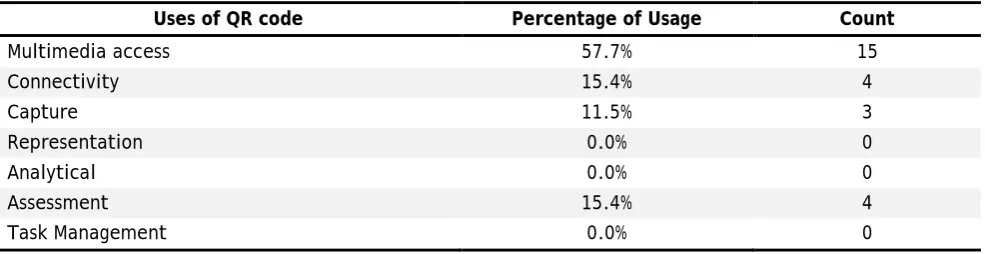
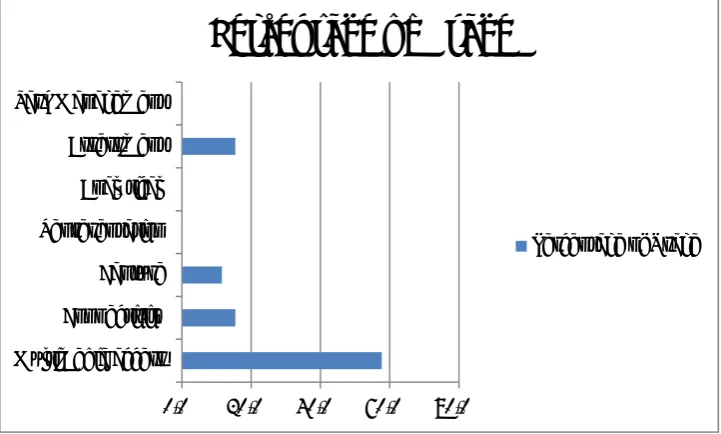
Analysis revealed that the two most frequent uses of QR code in educational settings were as multimedia access tools (57.7%) and as communication tools (17.9%) and three areas were not explored in the setting of this review (QR code as enabler of representation tools, analytical tools, and task management tools) (See Tab. 1 and Fig. 1).
Table 1. Uses of QR code
Uses of QR code Percentage of Usage Count
Multimedia access 57.7% 15
Connectivity 15.4% 4
Capture 11.5% 3
Representation 0.0% 0
Analytical 0.0% 0
Assessment 15.4% 4
Task Management 0.0% 0
Figure 1. Uses of QR code
TYPES OF RESEARCH METHODS
In addressing the second research question, three methods were put forward, experimental, descriptive and developmental research.
Experimental Research
This type of research involved treatment group, control group, testing hypotheses or theory and the employment of random sampling (Ozcelik & Acarturk, 2011). We identified three experimental studies in the current review.
Descriptive Research
Descriptive research describe state of affairs using surveys, ethnography, and so forth (Fraenkel & Wallen, 2006). This type of research is typically naturalistic and depicts conditions as they exist in a particular setting (Ross & Morrison, 1997). The authors found a total of 10 studies dealing with this method.
Developmental research
This type of research usually looked into the analysis, design, development, implementation and evaluation process of an educational intervention based on certain theoretical framework (Richey & Nelson, 1996). The development of technology-enhanced learning system is one of the examples of this research method. Developmental research usually involves an iterative cyclical processes of design, enactment, analysis, evaluation and redesign (Collins, 1992). In the current review, five developmental research studies were found. However, almost all studies reviewed in this paper incorporated certain elements of developmental research but only the studies which reported the complete process as mentioned above were tagged as developmental research. For instance, in Susono and Shimomura (2006), the authors reported on a project using mobile phones and QR code for formative class assessment, however it was categorized as descriptive research instead of developmental research as the report focused on describing students’ perceptions and experience rather than the developmental process. One typical example of this research can be seen in Chen and Choi (2010). The researchers designed and developed a history learning module which was integrated with a location aware online platform called Visible Past.
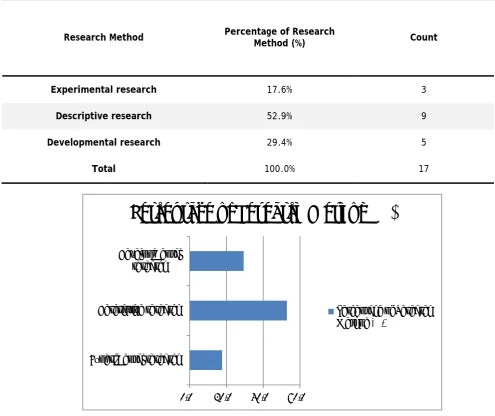
Tab. 2 and Fig. 2 displayed the summary of research methods used in QR code related researches. The finding indicated that descriptive research was the dominant type of research method (52.9%), followed by developmental research (29.4%) and experimental research (17.6%). The finding was consistent with the prediction by Kunpfer and McLellan (1996) about the increasing number of descriptive research studies in educational settings. This was probably because the adaptation of QR code in education was still in its infancy and thus researchers were still in the stage to understand more about the phenomenon.
0,0% 20,0% 40,0% 60,0% 80,0% Multimedia access
Connectivity Capture Representation Analytical Assessment Task Management
Percentage of Usage
Percentage of Usage
Table 2. Research Methods
Research Method Percentage of Research Method (%) Count
Experimental research 17.6% 3
Descriptive research 52.9% 9
Developmental research 29.4% 5
Total 100.0% 17
Figure 2. Research Methods
DATA COLLECTION METHODS
The categories of data collection used in the current review of past empirical studies including test or quiz, questionnaire or survey, interview, observation and content analysis.
Test of Quiz
Typical examples of this collection method are the administration of pre-test and post-test for experimental research. Pre-test is an instrument to test participants’ prior knowledge before the intervention. In other words, participants in both treatment and control group must be compared on a fair ground. Post-test is usually used to evaluate participant’s performance after the removal of the intervention. In Ozcelik and Acarturk (2011) pre and post-tests were administered to students to evaluate their performance under two approaches of multimedia learning.
Questionnaire or Survey
Judd, Smith and Kidder (1991) defined survey as “…simply be interested in documenting the distribution of some variables of interest in some population.” Likert-scaled items used to collect data about the distribution of students’ perceived usefulness pertaining an intervention could be a good example. In Tsung, Tan, and Chu (2007) questionnaire survey approach was used to evaluate the distribution of perceived easiness, usefulness and attitude of students towards a learning system called HELLO.
0,0% 20,0% 40,0% 60,0% Experimental research
Descriptive research Developmental
research
Percentage of Research Method (%)
Percentage of Research Method (%)
Interview
Interview means conversation with information (Pratt, 1980). Interview is conducted mainly to collect data which is not possible to obtain without face-to-face interaction between researcher and the subjects of the research (Guba & Lincoln, 1981). In the current review, two studies were found using this method. Ching-yin Law and Simon (2010) used a questionnaire to collect data pertaining to perceived usefulness and interest of participants in Math Trail.
Observation
Observation is normally used to collect ‘non-verbal’ data in order to understand more about the state of affairs and provide critical thought about the behavior of the informant Mohamad Nor bin Mohamad Taib. (2001). Observation is done in order for a researcher to hear, see, observe and feel in particular situation in order to gather data. From the literature, four realistic studies were using this method in data collection. In Ching-yin Law and Simon (2010), this method was used to understand participants’ behavior in the course of the planned activity.
Content Analysis
This method is employed by researchers to investigate the behavior of participants by gathered written contents through comparison and categorization (Fraenkel & Wallen, 2006). We found a total of seven studies dealing with this method of data collection. For example, in Bischoff (2007), time log was used to understand online users’ behavior in respect to the usage of Pediaphone.
Result (see Fig. 3 and Tab. 3) showed that questionnaire or survey (37.9%) and content analysis (24.1) were the two most common data collection methods. The least common method was interview (6.9%).
Table 3. Data Collection Methods
Data Collection Method Percentage of Research Topic (%) Count
Test / quiz 38.5% 15
Questionnaire / Survey 28.2% 11
Interview 5.1% 2
Observation 10.3% 4
Content Analysis 17.9% 7
Total 100.0% 39
Figure 3. Data Collection Methods
RESEARCH TOPICS
Six research topics were used to categorize the topics research area covered in the previous studies: utility profile, viability as an assessment tool, learning outcomes, motivation, instructional approaches and cognitive psychology characteristics.
Usage Profile
This topic investigate issues such as types of mobile devices owned, subscribed service provider, installation of QR code reader, and mobile phone with an integrated camera. Eight studies were found dealt with this topic. For instance, percentage of participants that access internet via mobile phone was investigated in Hend S. Al-Khalifa (2008).
Viability as an Assessment Tool
This refers to the research which examined the usability of mobile handheld devices with associated QR code application for various types of assessment. In the current review, Susono and Shimomura (2006), Ching-yin Law and Simon (2010), Sedano, Laine, Vinni, and Sutinen ( 2007) and Hend S. Al-Khalifa (2008) dealt with this topic. The types of assessment varied from MCQ auto-corrected question to semi-paper-based self-evaluated assessment.
Learning Outcomes
This research topic examined the interaction between the use of QR code and students’ learning performance. We found four studies dealt with this topic. In Ozcelik and Acarturk (2011), learning outcomes (retention, transferable skill and matching) were evaluated in relation to two different learning approaches.
Motivation
This research topic dealt with students’ or teachers’ beliefs, attitudes, interest and so forth. We found two studies under this topic. In Sedano et al. (2007), interest and motivation of SciMyst participants were investigated by using a questionnaire.
Instructional Approaches
This type of research refers to various types of learning approaches such as multimedia learning, cooperative learning, game-based learning, and etc. A total of 11 studies related to this topic were found. For example, outdoor learning and contextual learning approaches were investigated in Tsung, Tan, and Chu (2007).
0,0% 10,0% 20,0% 30,0% 40,0% 50,0% Test / quiz
Questionnaire / Survey Interview Observation Content Analysis
Percentage of Data Collection Methods (%)
Percentage of Data Collection Methods (%)
Cognitive Psychology Characteristics
This topic looks into cognitive related variables such as cognitive load, cognitive style, knowledge representation of learners (Shih, Feng, & Tsai, 2008). In the current review, two studies were found related to this topic. For instance, in Ozcelik and Acarturk (2011), students’ cognitive load in different instructional approaches was examined.
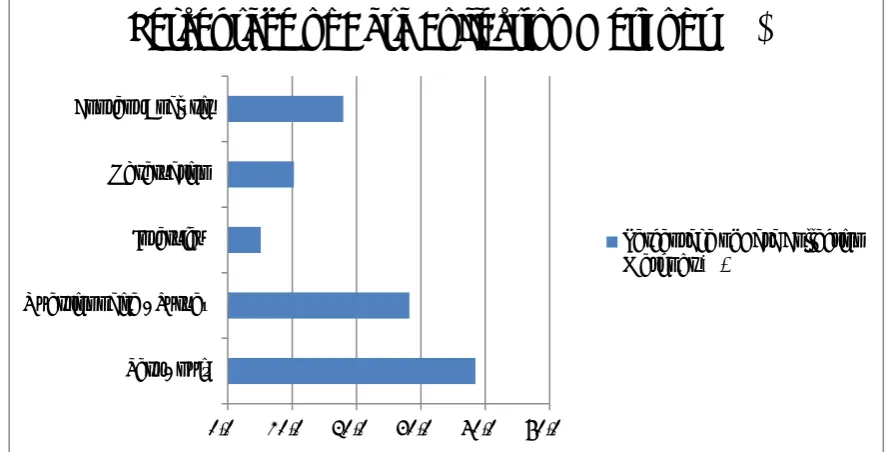
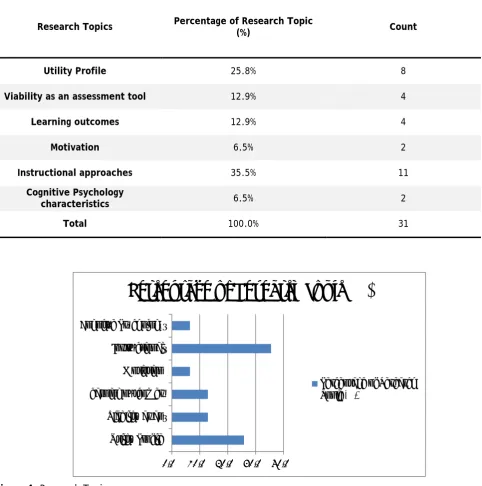
Finding showed that instructional approaches and usage profile were the two most common research topics. Lack of research was found in motivation and cognitive psychology characteristics (see Fig. 4 and Tab. 4).
Table 4. Research Topics
Research Topics Percentage of Research Topic (%) Count
Utility Profile 25.8% 8
Viability as an assessment tool 12.9% 4
Learning outcomes 12.9% 4
Motivation 6.5% 2
Instructional approaches 35.5% 11
Cognitive Psychology
characteristics 6.5% 2
Total 100.0% 31
Figure 4. Research Topics
0,0% 10,0% 20,0% 30,0% 40,0% Utility Profile
Viability as an… Learning outcomes
Motivtion Instructional… Cognitve Psychology…
Percentage of Research Topic (%)
Percentage of Research Topic (%)
DISCUSSION AND CONCLUSION
MAJOR RESULTS
In this section, the authors summarise and discuss the major findings, and limitations of previous empirical studies. Later on, some recommendations for future studies related to the use of QR code in education are provided. The major results are:
1. QR code was mainly used as a speedy and ready access to multimedia contents such as web site, databases, audio and video files, question and answer texts and so forth. The frequent use of QR codes in this aspect is expected as the code was initially developed to provide quick access to embedded information. Even though the uses of mobile handheld devices are widely accepted in education now, its weaknesses such as limited display area and ineffective input method have restricted its development. The association of QR code and handhelds offers a potential solution due to its capability to embed information such as URL to a targeted website which otherwise could be very redundant for a potential user to key in the lengthy URL.
2. Descriptive research was the most common type of research method used within the setting of this review. Most probably this is due to the association of QR code with handheld device in education is still in its infancy; many of the researches were still in the stage to explore the usability and feasibility in order for researchers to understand more about the happening, dynamism and complexity of this technology. This is evidenced by almost all descriptive research reviewed were majority part of a developmental project carried out by the researchers to investigate the affordability of this technology.
3. The most frequent data collection method was questionnaire or survey. Most probably, this is because questionnaire or survey method enables the researchers to collect data from a relatively large pool of participants easily and quickly. Moreover, the data collected also were easier to process.
4. Most of the research topics covered in the previous studies involved the adequacy of QR code as an enabler in various types of instructional approaches. Instructional approaches covered included experiential learning, collaborative learning, discovery learning, science-technology-society approach and so forth.
LIMITATIONS OF PREVIOUS EMPIRICAL STUDIES
Our review found several limitations concerning previous empirical research on the use of QR code in education. First, most of the previous research (44.8 %) based their findings on respondents’ self-report data such as questionnaires and interviews. By using questionnaires, respondents may answer superficially especially in a prolonged survey. The mistakes of asking too many questions and irrelevant questions should be minimized. Moreover, it is not possible for a participant to elaborate on points in the questionnaire as questionnaire is usually structuralised with limited options. In addition, questionnaire survey takes place after an event, and participants may ignore critical issues.
Second, most of the research were limited in their duration, varying from a few hours to a semester. Short term research is not sufficient to investigate the dynamism and complexity of technology integration in the educational setting. One of the limitations of short term studies is bias of the result due to novel effect.
Third, research topics covered in the previous empirical studies were limited. Research in certain important areas in teaching and learning such as cognitive psychology characteristics, learning environment, motivation and information processing were still in deficiency.
RECOMMENDATIONS FOR FUTURE STUDIES
In the light of all above, the authors suggest that future studies should provide richer and more reliable data so that results and findings can be fittingly interpreted by the readers. Second, future study should pay more attention to longitudinal research in order to understand more about the long term effects of QR code integration in education. Third, research topics such as mental model, cognitive style, interactive learning environment, learning community, behavioural change should be attempted.
Appendix A. Summary of reviewed studies
T it le So ur ce A u th o r(s )/ Ye a r Sa mpl es R es ea rch O b ject iv es Me th o d F indi ng M obi le S R S : A C la ss room C om m uni ca ti o n an d A ss es sm en t S er v ice Inno va ti ons in I nf or m at ion T ec hnol o gy, 2008 II T 20 08. Int er na ti o na l C onf er enc e. P p. 342 -34 6. He n d S . Al -K h alif a/ 2 0 0 8 150 u nde rgr ad ua te s tude nt s 1. t o de sig n an d ev al u ate a m
o b il e l ear n in g sys te m w it h Q R c ode t o e nha nc e co m m u n icat io n an d as ses sm en t i n l ar g e scal e cl as sr o o m . d es cr ip tiv e 1. the i m pl em ent ed s ys te m s ee m s to be pot ent ia l i n e nha nc ing c om m uni ca ti on a nd as ses sm en t i n l ar g e s cal e cl as sr o o m . T he P edi aphon - S p eech I n ter face t o t h e fr ee W ik ip ed ia E n cy cl o p aed ia for M obi le P hone s, P D A 's a nd M P # -P lay er s D at ab as e an d E x p er im en tal S y st em s A ppl ic at ion, 20 07. D E X A 2007. Int er na ti ona l W or ks hop. P p. 5 75 -57 9 A ndr ea s B is chof f/ 200 7 On -lin e u se rs 1. t o e va lua te t he p o ss ib ility o f Q R c o d e to b e u sed as i m m ed iat e acces s t o a w eb -b as ed l ear n in g r es o u rce. d es cr ip tiv e 1 . le ss th an 5 % o f r eq u es t u tiliz e th e m obi le pho ne w it h Q R c ode i nt er fa ce t o g ai n acces s t o t h e w eb -ba se d l ea rni ng res o u rce. A P il ot S
tudy on 3G
M obi le P hone a n d T w o D im ens ion B ar code i n C la ss room C om m uni ca ti on a n d S up por t S ys te m A dva nc e L ea rni ng T ec h no logi es , 2007 . IC A L T 2007, S eve nt h I E E E I nt er na ti o na l C onf er enc e. P p. 11 1 -1 13 P ra ch C ha is at ie n a nd K anj i A ka hor i/ 2 007 50 un de rg ra dua te a nd gr adua te s tude nt s 1. T o c on duc t a pi lot s tudy us ing a m obi le le ar ni ng s ys te m w it h Q R c ode t o e nha nc e co m m u n icat io n an d i n fo rm at io n acces s in a b ig c la
ss. des
De si gni ng O n lin e C o lla b o ra tiv e L o ca tio n -Awa re P la tf or m f or H is tor y L ea rni ng Jour na l o f E d uc at iona l T ec hnol ogy de ve lopm ent an d E xc ha nge . 3 1( 1) , 23 -26 X ia o ju n C he n a n d J ea H . C ho i/ 2010 H igh s chool hi st or y s tude nt s 1. T o s tudy t he pos si bi li ty of p ri nt ed Q R code o n t ext boo k a n d ha nd -o u t as a m ea n t o acces s w eb -b as ed l ear n in g r es o u rces . de ve lopm ent al 1 . Q R co d e can b e u sed as a s p eed y an d read y acces s t o w eb -ba se d l ea rni ng res o u rces . R ed u ci n g T h e S p at ial D is ta n ce b et w een P ri nt ed a nd O nl ine I nf or m at io n s our ce s by m ea ns of M obi le T ec h nol o gy E n ha nc es L ea rni ng: U si ng 2D B ar code s C om put er s & E duc at ion. 57 ( 2011 ) 207 7 -
2085. Erol
O zc el ik a nd C engi z A ca rt ur k/ 20 11 44 un de rg ra dua te s tude nt s 1. T o i nve st iga te w he the r the r educ ed sp at ial d is tan ce b et w een p ri n ted m at er ial s and o nl ine i n for m at ion s o ur ce s e nha nc e le ar ni ng o ut com es . E x p er im en tal 1. P ar ti ci pa nt s i n t he E x pe ri m ent al gr o up (p ap er -pl us -m o bi le phone ) ha d hi ghe r re te n tio n te st sco res t h an t h e p ar ti ci p an ts in t he c o nt rol gr ou p ( pa pe r-pl us -com put er ). 2. M obi le ha ndhe
ld d
R ea li zi ng t he U bi qui tous S T S C ol la bor at ive L ea rni ng E nvi ronm ent : U si ng H and he ld de ve lopm ent w ith 2 D -B ar co d e an d E -L ea rn in g P la tfo rm S ens or N et w or ks , U bi qui tous a nd T rus tw or thy C om p ut ing, 2006. I E E E Int er na ti ona l C on fe re nc e. P p. 130 -137 Ru ey -M ing C ha o, T a-S he ng L an, Ji a-Na n C ha ng a nd J o y I o ng -Z ong C he ng/ 20 06 P ri m ar y gr ade 5 s tude nt s 1. T o c ons tr uc t a u bi qui tou s c ol la bor at ive le ar ni ng e nvi ro nm ent by us ing m obi le ha ndhe ld de ve lopm ent w it h 2 D ba rc ode . d es cr ip tiv e 1. m obi le ha nd he ld de ve lopm ent w it h Q R co d e s eem s t o b e u sef u l i n pr om ot in g u bi qui tous c ol la bor at ive l ea rni ng.
探討結合
QR
-c
ode
與無線
網
路
建置國小
校園生
態教學
互動
式數位學
習系統
之研究
D is se rt at ion. (ht tp: // 140. 12 7. 8 2. 166/ ha ndl e/ 98 765 432 1/ 228 6)
` 42 pr
T he I m pl em ent at ion of U -L ear n in g M an ag em en t S y st em w it h Q R C ode I nt egr at ion a nd I ts A ppl ic at
ion on N
at ur e S ci en ce D is se rta tio n . (h ttp ://n d ltd .n cl. ed u .tw /c g i-bi n/ gs 32/ gs w eb. cgi ?o= dnc lc d r& s= id= % 22098T M T C 54 800 34% 22. & se ar ch m ode = ba si c) Ch ih -H ung C he n/ 104 g ra de s ix p ri m ar y s tude nt s 1. T o de ve lopm ent a s ui ta bl e U -L ear n in g M an ag em en t S ys te m w it h Q R C ode I nt egr at ion a nd t o e va lua te th e sy st em . 2. T o in v es tig ate t h e i n fl u en ce o f U -L ea rni ng on st ude nt s’ sci en ce p ro ces s s k il ls a n d l ear n in g ach iev em en ts . 3 . T o in v es tig ate th e p u p ils ’ attitu d e tow ar d t he s ys te m a n d ubi qui to us l ea rni ng. d es cr ip tiv e 1. T he ubi qui tous l ea rni ng s ys te m i s c apa bl e of i m pr ovi n g st ude nt s' s ci enc e pr oc es s s ki ll s s igni fi ca nt ly. 2. S tude nt s c ons ide r t ha t us in g Q R C ode f or t he ubi qui tou s le ar ni ng i s ve ry i nt er es ti ng a n d c o ul d l ea rn m or e aut he nt ic al ly, c o ul d o bs er ve m or e e ff ec ti ve ly, a nd c oul d lear n m o re . S can & L ear n ! U se o f Q u ick R es p ons e C ode s an d S m ar tph one s i n a B iol og y F ie ld S tudy T he A m er ic an B iol ogy T ea ch er , V ol . 73, N o. 8, pa ge s 4 85 – 492 Ju n -K i L ee, I l-S u n L ee , Y o ng -J u K w on/ 201 1 N ot m ent ione d 1. T o de ve lop a t ea chi n g m et hod a nd pr oc es s tha t i nc or p or at es qui ck r es po ns e ( Q R ) c ode s and s m ar tpho ne s i nt o f ie ld t ri ps f or bi ol o gy cl asse s. d es cr ip tiv e 1. L ea rni n g vi a Q R -c ode -d ec od ing on s m ar tph one s m ay m o re ef fect iv el y m o tiv ate in te re st in le ar n in g about na tur al f auna t ha n t ra di ti ona l f ie ld stu d ie s th at u se p rin te d fi el d gui de . O ut door E d uc at ion S upp or t S ys te m w ith L oc at ion A w ar ene ss U si ng R F ID a nd S ym bol og y T ags Jour na l of E duc at iona l M ul ti m edi a a nd H ype rm edi a, 16( 4) P p. 411 -4 28 N or it aka O sa w a/ 2007 24 un de rg ra dua te s tude nt s 1. T o i nve st iga te w he the r t he 2D s ym bol o gy tag s y st em i
s a m
o re p ref er ab le m o d e o f o ut doo r e duc at ion s up por t s ys te m w it h lo cat io n aw ar en es s as co m p ar ed t o R F ID t ag sy st em
. Ex
REFERENCES
Bath (2010). Library Catalogue University of Bath. Retrieved from http://www.bath.ac.uk/library/
Bischoff, J. (2007). The Pediaphon-Speech interface to the free Wikipedia Encyclopaedia for Mobile Phones, PDA’s and MP3-Players. Database and Expert Systems Application, 2007. DEXA 2007. International Workshop. pp. 575-579.
Chaisatien, K., & Akahori, K., 2007. A pilot study on 3G mobile phone and two dimension barcode in classroom communication and support system. In Proceeding of the Seventh IEEE International Conference on Advanced Learning Technologies (ICALT 2007) pp. 111-113.
Chen, X. J., & Choi, J. H.(2010). Designing online collaborative location-aware platform for History learning. Journal of Educational Technology Development and Exchange, 31(1), 23-26.
Cheung, Wing Sum, & Hew, Khe Foon,. (2009). A review of research methodologies used in studies on mobile handheld devices in K-12 and higher education settings. Australasian Journal of Educational Technology 25(2), 153-183. Retrieved from (Link)
Ching-yin Law C. Y., & Simon, S. (2010). QR Codes in education. Journal of Educational Technology Development and Exchange, 3(1), 85-100.
Churchill, D., & Churchill, N. (2008). Education affordances of PDAs: A study of a teacher’s exploration of this technology. Computers & Education 50, 1439 – 1450.
Clayton, J. (2010) Introducing QR codes in educational institutions: A pictorial overview. In: British Educational Research Association (BERA) Annual Conference 2010, 1-4 September, 2010, Coventry, England.
Collins, A. (1992). Toward a design science of education. In E. Scanlon & T. O’Shea (Eds.), New directions in educational technology. New York, NY: Springer-Verlag.
Creswell, J. (1994). Research design qualitative and quantitative approaches. Thousand Oaks, CA: Sage.
Denso-Wave, (2011). "QR Code — About 2D Code".
Dieterle, E., & Dede, C. (2006). Straightforward and deep effects of wireless handheld devices for teaching and learning in university settings. Paper presented at the 2006 American Educational Research Association Conference, San Francisco, CA.
Elena. (2009) Educational QR codes.
Fraenkel, J. R., & Wallen, N. E. (2006). How to design and evaluate research in education (6th ed.). New York, NY: McGraw-Hill.
Furht, B., (2011). Handbook of Augmented Reality. Springer. p. 341. Retrieved from (Link).
Guba, E. G., & Lincoln, Y. S. (1981). Effective evaluation. San Francisco, CA: Jossey-Bass.
Hend S. Al-Khalifa, H. S. (2008). Mobile SRS: A Classroom Communication and Assessment Service. In Proceedings of the Innovations in Information Technology, 2008 IIT 2008. International Conference (pp. 342-346).
Hennessy, S. (1999). The potential of portable technologies for supporting graphing investigations. British Journal of Educational Technology, 30, 57–60. doi: 10.1111/1467-8535.00090
Hwang, G. J., Kuo, F. R., Yin, P. Y., & Chuang, K. H. (2010). A heuristic algorithm for planning personalized learning paths for context-aware ubiquitous learning. Computers & Education, 54(2), 404– 415.
Jones, M., Buchanan, G., & Thimbleby, H. (2003). Improving web search on small screen devices. Interacting with Computers, 15(4), 479–495.
Judd, C. M., Smith, E. R., & Kidder, Louise H. (1991). Research methods in Social Relations. International Edition (6th ed.). London: Harcourt Brace Jovanavich.
Kunpfer, N., & McLellan, H. (1996). Descriptive research methodologies. In D. H. Jonassen (Ed.), Handbook of research for educational communications and technology (2nd ed.) (pp. 1196–1212). Mahwah, NJ: Erlbaum.
Liaw, S.-S., Hatala, M., & Huang, H.-M. (2010). Investigating acceptance toward mobile learning to assist individual knowledge management: based on activity theory approach. Computers & Education, 54(2), 446–454.
Liu, Y., Li, H., & Carlsson, C. (2010). Factors driving the adoption of m-learning: an empirical study. Computers & Education, 55(3), 1211–1219.
Luchini, K., Quintana, C., & Soloway, E. (2004). Design guidelines for learner- cantered handheld tools. CHI, 6(1), 135–141.
Metcalf, D., & Rogers, D. (2010). Contextual learning and memory retention: the use of near field communications, QR codes, QBIC, and the spacing effect in location based learning. In T. T. Goh (Ed.),
Multiplatform e-learning systems and technologies: Mobile devices for ubiquitous ICT-based education (pp.309–320). Hershey, NY: Information Science Reference.
Mohamad Nor bin Mohamad Taib. (2001). Model guru sebagai penyelidik: Asas-asas menjalankan kajian di sekolah. Kuala Lumpur: Bahagian Perancangan dan Penyelidikan Dasar Pendidikan.
Ozcelik, E., & Acarturk, C. (2011). Reducing the spatial distance between printed and online information sources by means of mobile technology enhances learning: Using 2D barcodes, Computers & Education, 57, 2077-2085. doi 10.1016/j.compedu.2011.05.019.
Pratt, D. (1980). Curriculum design and development. International Edition, USA: Harcourt Brace Jovonavich.
Sedano, C. I., Laine, T. H., Vinni, M., & Sutinen, E. (2007). Where is the answer? The importance of curiosity in pervasive mobile games. In Future Play' 07. Proceedings of the 2007 Conference on Future Play (pp. 46- 53).
Shih, M. L., Feng J, & Tsai, C. C. (2008). Research and trends in the field of e-learning from 2001 to 2005: A content analysis of cognitive studies in selected journals. Computer & Science, 51, 955-967.
Susono, H., & Shimomura, T. (2006). Using Mobile Phones and QR Codes for Formative Class Assessment.
Richey, R., & Nelson, W. (1996). Development research. In D. H. Jonassen (Ed.), Handbook of research for educational communications and technology (2nd ed.) (pp. 1213– 1245). Mahwah, NJ: Erlbaum.
Ross, S. M., & Morrison, G. R. (1997). Getting started in instructional technology research (3rd ed.). Bloomington, IN: Association for Educational Communications and Technology.
Shaof, M., Pollak, H., & Schneider, J. (2004). Math Trail. The Consortium for Mathematics and Its Applications.
Tsung, Y. L., Tan, T. H., & Chu, Y. L. (2007). 2D Barcode and Augmented Reality Supported English Learning System. Computer and Information Science, 2007. ICIS 2007. 6th IEEE ACIS International Conference. (pp. 5-10)
Yamamoto, M., & Akahori, K. (2006). The practice and evaluation of the application of mobile phone in the university class. In C. Crawford et al. (Eds.), Proceedings of the Society for Information Technology and Teacher Education International Conference 2006 (pp. 2440- 2450). Chesapeake, VA: AACE.