INTRODUCTION
The Adams methods constitute an impor tant class of multistep method for the numer ical solutions of ordinar y differential equations. In contrast to one-step methods, multistep methods increase efficiency by using the infor mation from several previous solution approximations.
These methods were introduced by J.Couch Adams (1883) for solving problems of capillary action due to Francis Bashforth. Bashforth published his numerical theory and Adams’ numerical method (Goldstine, 1977). They are based on the following idea:
Suppose that the solution y(t) is in fact a polynomial and the function f (t, y) has no explicit dependence on y, then it follows that
A Class of Adams-like Implicit Collocation Methods of
Higher Orders for the solutions of Initial Value Problems
J.O. FATOKUN¹*, TSAKU NUHU
1and I.K.O AJIBOLA²
¹Department of Mathematical Sciences.Nasarawa State University.P.M.B.1022, Keffi (Nigeria). ²Department of Mathematics and Statistics, Polytechnic of Namibia, Windhoek (Namibia).
(Received: May 10, 2011; Accepted: July 12, 2011)
ABSTRACT
The focus of this research work is the derivation of a class of Adams-like collocation multistep methods of orders not exceeding p=9. Numerical quadrature rule is used to derive steps k= 3,...,8 of the Adams methods. Convergence of each formula derived is established in this paper. As a numerical experiment, the step six pair of the Adams method so derived was used as predictor-corrector pair to solve a non-stiff initial value problem. The absolute errors show an accuracy of o(h7).
Key words: Adams methods, Numerical quadrature, Stability, Order of accuracy, predictor-corrector methods.
We seek the values of the coefficients βj so that the corresponding formula has the maximum possible degree of precision. (Note here that the corresponding numerical integration rule would use points from outside the range of integration). A ready example in literature is the popular two-step order two explicit method given as
Theorem due Dahlquist A linear multistep
0 method is said to be convergent if it is consistent and zero stable.
A linear multistep method is consistent if it satisfies the conditions bellow
i.
ii.
A linear multistep method is said to be zero stable if the roots of the characteristic polynomial
l(r) = if | r | ≤1 and each root is distinct.
Order of accuracy of Linear Multistep methods Equation (2) is said to have order of accuracy p if p is the largest positive integer such that for any sufficiently smooth curve in the rectangular domain D of the first order initial value problem (Equation 1). There exist constants k and h0 such that for |Tn| ≤ khp for 0<h<, for any k+1
points (on the solution
cur ve. We can thus deduce that the method (equation 2) is of order of accuracy p if and only if
in this case is the error constant.
Highest Attainable Order of Stable Multistep Methods
It is a natural task to investigate the stability of the multistep methods with highest possible order. Counting the order conditions shows that for order p the parameters of a linear multistep method have to satisfy p+1 linear equations. As 2k+1 free parameters are involved, (without loss of generality one can assume αk=1), this suggests that 2k is the highest attainable order. According to Dahlquist (1956), “The order p of a stable linear k –step method satisfies the following conditions:
Predictor –Corrector Methods
The idea behind this is that an Adams-Bash forth formulae is used to estimate the value of y(xk+1) and this is then used in place of yk+1 on the right-hand side of an Adams- Moulton formula in order to obtain an improved estimate for yk+1. The Adams Bashforth method is thus used to predict the value yk+1 and the Adams Moulton formula is the corrector which may be applied iteratively until convergence.
Methodology
For the k- step implicit Adams method, we
seek that is
We require
thus we
have the following equations to solve:
We seek the values of the coefficients βj so that the corresponding formula has the maximum possible degree of precision.
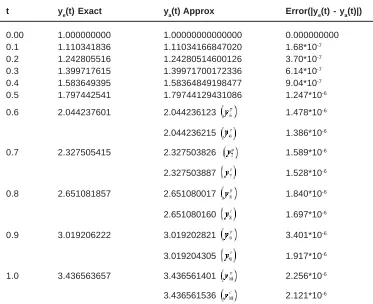
Table 2: Absolute errors
t ye(t) Exact ya(t) Approx Error(|ye(t) - ya(t)|)
0.00 1.000000000 1.00000000000000 0.000000000
0.1 1.110341836 1.11034166847020 1.68*10-7
0.2 1.242805516 1.24280514600126 3.70*10-7
0.3 1.399717615 1.39971700172336 6.14*10-7
0.4 1.583649395 1.58364849198477 9.04*10-7
0.5 1.797442541 1.79744129431086 1.247*10-6
0.6 2.044237601 2.044236123 1.478*10-6
2.044236215 1.386*10-6
0.7 2.327505415 2.327503826 1.589*10-6
2.327503887 1.528*10-6
0.8 2.651081857 2.651080017 1.840*10-6
2.651080160 1.697*10-6
0.9 3.019206222 3.019202821 3.401*10-6
3.019204305 1.917*10-6
1.0 3.436563657 3.436561401 2.256*10-6
3.436561536 2.121*10-6
Table 1: Order, error constants and convergence of implicit Adams methods k-step Order Error constants Convergence property
1 2 Convergent
2 3 Convergent
3 4 Convergent
4 5 Convergent
5 6 Convergent
6 7 Convergent
7 8 Convergent
For the three – step Adams Moulton method,
We seek
we require
we have the following equations
Solving the martrix equation for
and
This yields the formula
Following the same procedure we derive the following higher orders:
Stability Accuracy and Convergence Analysis of the Methods
Using the definitions in Section 1, above, the computed order of accuracy, and the convergence analysis of the methods are presented in the table below:
It is clear that the methods are of orders k+1 whenever k is the step, and all the methods are convergent.
Numerical Experiment and Results
To implement any of the methods, just like any implicit multistep method we need a predictor and in this case we develop explicit methods of the same steps for implementation as in Lambert (1991). In this paper we implement the step six implicit method which is of order seven and we use a step six order six explicit method as the predictor.
Example 1
We consider the ivp.
y(t)=2et - t - 1
as predictor for the step six order seven methods
The table below shows the absolute errors which is of at least order O(h6)
CONCLUSION
The proposed methods have been shown to be accurate and efficient. They provide option for continuous output. Further improved accuracy can be achieved by block hybrid methods for numerical derivatives combined with self-starting block hybrid methods for the direct integration of.
1. Butcher, John C, Numerical Methods for Ordinary Differential Equations, John Wiley, ISBN 978-0-387-90277-7 (2003).
2. Butcher, John C, Numerical Methods for Ordinary Differential Equations, John Wiley & Sons Ltd, Chichester, England (2008). 3. J.Fatokun, P.Onumanyi and U.W. Sirisena.,
A Multistep Collocation based on Exponential Basis for Stiff Initial Value Problems. Nigerian Journal of Mathematics and Applications 12: 207-223 (1999).
4. Fatokun, P. Onumanyi and U.W. Sirisena, Solution of First Order Finite Difference Method with Arbitrary Basis, Journal of Mathematical Society of Nigeria, 24: 30-40 (2005).
5. J.O.Fatokun., A Fifth Order Collocation Method for Solving First Order Initial Value Problems. Jour. Inst. Maths. & Computer Sciences (Comp. Sc. Ser.) 17(1): 73-79 (2006).
6. Fox, L. in Gladwell, I. and Sayers, D.K. (eds.), Computational Techniques for Ordinary Differential Equations. Academic Press (1980).
7. Gear C.W., Numerical initial value problems in Ordinary Differential Equations, Prentice Hall (1971).
8. Goldstine, Her man H., A Histor y of Numerical Analysis from the 16th through the
19th century, New York: Springer-Verlag, ISBN 978-0-471-96758-3 (1977).
9. Iserles, Arieh, A first course in the Numerical Analysis of Differntial Equations, Cambridge University Press, ISBN 978-0-521-55655-2 (1996).
10. Lambert J.D. Computational methods in Ordinary Differntial Equations, John Wiley. 11. P. Onumanyi, Progress in the Numerical
Treatment of Stiffness at the 15th Inaugural Lecture Series, held on 30th September, 2004. University of Jos, Jos, Nigeria (2004). 12. P. Onumanyi, D.O. Awoyemi, Jator, S.N. and U.W. Sirisena, New Linear Multistep Methods with Continuous Coefficients for First Order IVPs. Journal of Mathematical Society of Nigeria, 13: 37-51 (1994).
13. P. Onumanyi, U.W. Sirisena, J.P. Chollom, Y.A. Yahaya and Yusuph Skwame, New Multivalue Multistep Implicit RKMs based on AML Collocation Points for Stiff Ordinary Differential Equations, A paper delivered at the One-day Seminar on Recent Numerical Methods for Solving Differential equations, organised and Proceedings printed at the National Mathematical Centre, Kwali - Abuja, Nigeria, pp 25–58 (2005).
14. Turner, Peter, Guide to Numerical Analysis, Macmillian Education LTD, ISBN 0-333-44947-9 (1989).