Second Order Cone Programming Formulations for Feature Selection
Chiranjib Bhattacharyya [email protected]
Department of Computer Science and Automation Indian Institute of Science
Bangalore, 560 012, India
Editor: John Shawe-Taylor
Abstract
This paper addresses the issue of feature selection for linear classifiers given the moments of the class conditional densities. The problem is posed as finding a minimal set of features such that the resulting classifier has a low misclassification error. Using a bound on the misclassification error involving the mean and covariance of class conditional densities and minimizing an L1norm
as an approximate criterion for feature selection, a second order programming formulation is de-rived. To handle errors in estimation of mean and covariances, a tractable robust formulation is also discussed. In a slightly different setting the Fisher discriminant is derived. Feature selection for Fisher discriminant is also discussed. Experimental results on synthetic data sets and on real life microarray data show that the proposed formulations are competitive with the state of the art linear programming formulation.
1. Introduction
The choice of useful features for discriminating between two classes is an important problem and has many applications. This paper addresses the issue of constructing linear classifiers using a small number of features when data is summarized by its moments.
A linear two-class classifier is a function defined as
f(x) =sgn(w>x−b). (1)
The classifier outputs 1 if the observation x∈Rn falls in the halfspace{x|w>x>b}, otherwise it outputs−1. During training, the parameters,{w,b}, of the discriminating hyperplane w>x=b are computed from a specified data set D={(xi,yi)|xi∈Rn,yi={1,−1},i=1, . . . ,m}.
Finding useful features for linear classifiers is equivalent to searching for a w, such that most elements of w are zero. This can be understood as when the ith component of w is zero, then by (1) the ith component of the observation vector x is irrelevant in deciding the class of x. Using the L0 norm of w, defined as
kwk0=|S| S={i|wi6=0},
the problem of feature selection can be posed as a combinatorial optimization problem:
minimize
w,b kwk0,
subject to yi w>xi−b
≥1, ∀1≤i≤m. (2)
heuris-tic tractable approximation to the proposed objective is to minimize the L1norm of w. For a discus-sion of this issue see Chen et al. (1999), and for other approximations to L0norm see Weston et al. (2003). In the sequel, we will enforce the feature selection criterion by minimizing the L1norm.
Let X1 and X2denote n dimensional random vectors belonging to class 1 and class 2 respec-tively. Without loss of generality assume that class 1 is identified with the label y=1, while class 2 is identified with label y=−1. Let the mean and covariance of X1 be µ1∈Rn andΣ1∈Rn×n respectively. Similarly for X2the mean and covariance be µ2∈RnandΣ2∈Rn×nrespectively. Note thatΣ1 andΣ2 are positive semidefinite symmetric matrices. In this paper we wish to address the problem of feature selection for linear classifiers given µ1,µ2,Σ1andΣ2.
Lanckriet et al. (2002a,b) addressed the problem of classification given µ1, µ2, Σ1 andΣ2 in a minimax setting. In their approach, a Chebychev inequality is used to bound the error of misclas-sification. We wish to use the same inequality along with the L1 norm minimization criterion for feature selection. This leads to a Second Order Cone Programming problem (SOCP). SOCPs are a special class of nonlinear convex optimization problems, which can be efficiently solved by interior point codes (Lobo et al., 1998). We also investigate a tractable robust formulation, which takes into account errors in estimating the moments.
The paper is organized as follows. In Section 2 the linear programming approach is discussed. The main contributions are in Section 3 and Section 4. The Chebychev bound and the feature selection criterion leads to a SOCP. The Fisher discriminant is also rederived using the Chebychev bound. We also discuss feature selection for the Fisher discriminant. A robust formulation is dis-cussed in Section 4. Experimental results for these formulations are shown in Section 5. The concluding section summarizes the main contributions and future directions.
2. Linear Programming Formulation for Feature Selection
The problem of finding a{w,b}, so that the hyperplane w>x=b discriminates well between two classes and also selects a small number of features, can be posed by the following optimization problem.
minimize
w,b kwk1,
subject to yi w>xi−b
≥1, ∀1≤i≤m. (3)
At optimality it is hoped that most of the elements of the weight vector w are zero. The above formulation can be posed as a Linear Programming (LP) problem by introducing two vectors in the following way.
w=u−v; kwk1= (u+v)>e; u≥0, v≥0. (4) This makes the nonlinear objective linear (see Fletcher, 1989) and the optimization problem can be posed as the following LP.
minimize
u,v,b (u+v)
>e,
subject to yi (u−v)>xi−b
≥1 ∀1≤i≤m, u≥0,v≥0.
(5)
3. Feature Selection Using Moments
Let the data for each class be specified by the first two moments, the mean and covariance. The problem of feature selection, given the moments, is approached in a worst case setting by using a multivariate generalization of Chebychev-Cantelli inequality. The inequality is used to derive a SOCP, which yields a classifier using a very small number of features.
The following multivariate generalization of Chebychev-Cantelli inequality will be used in the sequel to derive a lower bound on the probability of a random vector taking values in a given half space.
Theorem 1 Let X be a n dimensional random vector. The mean and covariance of X be µ∈Rnand
Σ∈Rn×n. Let
H
(w,b) ={z|w>z<b,w,z∈Rn,b∈R}be a given half space, with w6=0. ThenP(X∈
H
)≥ s 2s2+w>Σw (6) where s= (b−w>µ)+,(x)+=max(x,0).
For proof see Appendix A.
The theorem says that the probability of the event that an observation drawn from X takes values in the halfspace
H
, can be bounded using µ andΣ. Let X1∼(µ1,Σ1)denote a class of distributions that have mean µ1, and covarianceΣ1, but are otherwise arbitrary; likewise for class 2, X2∼(µ2,Σ2). The discriminating hyperplane tries to place class 1 in the half spaceH
1(w,b) ={x|wTx>b}and class 2 in the other half spaceH
2(w,b) ={x|wTx<b}. To ensure this, one has to find{w,b}such that P(X1∈H
1)and P(X2∈H
2)are both high. Lanckriet et al. (2002a,b) considers this problem and solves it in a minimax setting.In this paper we consider the problem of feature selection. As remarked before, feature selection can be enforced by minimizing the L1norm of w. To this end, consider the following problem
min
w,b kwk1,
s.t Prob(X1∈
H
1)≥η, Prob(X2∈H
2)≥η,X1∼(µ1,Σ1), X2∼(µ2,Σ2). (7) In most cases the objective yields a sparse w. The two constraints state that the probability of belonging to the proper half space should be atleast more than a user defined parameter η. The parameterηtakes values in(0,1). Higher the value ofη, more stringent is the requirement that all points belong to the correct half space.
The problem (7) has two constraints, one for each class, which states that the probability of a random vector taking values in a given half space is lower-bounded byη. These constraints can be posed as nonlinear constraints by applying theorem 1 (see Lanckriet et al., 2002b). The constraint for class 1 can be handled by setting
Prob(X1∈
H
1)≥ (wTµ
1−b)2+
(wTµ1−b)2
++wTΣw≥
which yield two constraints
w>µ1−b≥ r η
1−η p
wTΣ1w; w>µ1−b≥0.
Similarly applying theorem 1 to the other constraint, two more constraints are obtained. Note that the constraints are positively homogenous, that is, if w,b satisfies the constraints then a cw,cb also satisfies the constraints where c is any positive number. To deal with this extra degree of freedom one can require that the classifier should separate µ1and µ2even ifη=0. One way to impose this requirement is via the constraint
wTµ1−b≥1, b−wTµ2≥1.
As both the matricesΣ1andΣ2are positive semi-definite, there exist matrices C1and C2such that
Σ1=C1C>1, Σ2=C2C>2.
The problem (7) can now be stated as a deterministic optimization problem
min
w,b kwk1,
s.t w>µ1−b≥ q η
1−ηkC>1wk2, b−w>µ2≥
q η
1−ηkC>2wk2, wTµ1−b≥1, b−wTµ2≥1.
The nonlinear objective can be tackled, as in (4), by introducing two vectors u and v, which leads to the formulation
min
u,v,b (u+v)
>e,
s.t (u−v)>µ1−b≥q η
1−ηkC>1(u−v)k2, b−(u−v)>µ2≥q η
1−ηkC>2(u−v)k2, (u−v)>µ1−b≥1,
b−(u−v)>µ2≥1,
u≥0,v≥0. (8)
This problem is convex, and is an instance of SOCP. The nonlinear constraints are called Second Order Cone(SOC) constraints. A SOC constraint on the variable x∈Rnis of the form
c>x+d≥ kAx+bk2,
where b∈Rm,c∈Rn,A∈Rm×nare given. Minimizing a linear objective over SOC constraints is
convex nonlinear optimization SOCPs have gained much attention in recent times. For a discussion of efficient algorithms and applications of SOCP see Lobo et al. (1998).
On the training data set, the error rate of the classifier is upper bounded by 1−η. This upper bound also holds for the generalization error (Lanckriet et al., 2002b) if the test data comes from a distribution having the same mean and covariance as the training data. Asηis increased, the data is forced to lie on the correct side of the hyperplane with more probability. This should result in a smaller training error. Again with increasingη, sparseness would decrease, as more stress is given to accuracy. Thus the parameterηtrades off accuracy with sparseness.
3.1 Feature Selection for Fisher Discriminants
In this section we derive the Fisher discriminant using the Chebychev bound and discuss a formula-tion for feature selecformula-tion. For a linearly separable dataset, one can find{w,b}so that all observations belonging to class 1(class 2) obey w>x1≥b (w>x2≤b), which implies w>X1≥b(w>X2≤b). If X=X1−X2 defines the difference between the class conditional random vectors, then X lies in the halfspace
H
(w) ={z|w>z≥0}. One can derive the Fisher discriminant by considering the following formulationmax
w,η η
s.t Prob(X∈
H
)≥η, X∼(µ,Σ). (9)As X1and X2are independent the mean of X is µ=µ1−µ2and covarianceΣ=Σ1+Σ2. Using the Chebychev bound (6) the constraint can be lower bounded by
Prob(X∈
H
)≥ (w>µ) 2(w>µ)2+w>Σw; w>µ≥0, and hence it follows that (9) is equivalent to solving
max
w
{w>(µ1−µ2)}2 w>(Σ1+Σ2)w
, (10)
which is same as the Fisher discriminant. The above formulation shows that Fisher discriminant can be understood as computing a discriminant hyperplane whose generalization error is less than 1−η∗, where
η∗= d(w∗)
1+d(w∗); d(w∗) =maxw
{w>(µ1−µ2)}2 w>(Σ1+Σ2)w
.
The bound holds provided the data distribution has the neccessary first and second moments. One can incorporate feature selection by minimizing the L1norm of w for a fixed value ofηas follows
min
w,b kwk1
s.t Prob(X∈
H
)≥η, X∼(µ1−µ2,Σ1+Σ2)and arguing as in (8) the following SOCP
min
w,b kwk1,
s.t w>(µ1−µ2)≥ q
1−η
η
p
w>(Σ1+Σ2)w,
w>(µ1−µ2)≥1, (12)
is obtained. The parameterηensures that the resulting classifier has a misclassification error less than 1−η, while feature selection is ensured by the objective.
3.2 Estimation of Mean and Covariance for Each Class
Let T1 = [x11, . . . ,x1m1] be the data matrix for one class, say with label y=1. Similarly T2= [x21, . . . ,x2m2]be the data matrix for the other class having the label y=−1. Both the matrices have the same number of rows, n, the number of features. The columns correspond to data points; m1data points for the first class and m2data points for the other class. For microarray data sets the number of features, n, is in thousands, while the number of examples, m1or m2, is less than hundred.
In the present formulation, empirical estimates of the mean and covariance are used
µ1=x1= 1
m1T1e, µ2=x2= 1 m2T2e;
Σ1=Σ1=C1CT1, C1=
1
√m
1
(T1−µ1e>);
Σ2=Σ2=C2CT2, C2=
1
√m2(T2−µ2e>).
Note that the covariances are huge matrices (of size n×n). Instead of storing such huge matrices one can store the much smaller matrices C1and C2of size n×m1and n×m2respectively. The resulting classifier is heavily dependent on the estimates of the mean and covariance. In the next section, we will discuss classifiers which are robust to errors in the estimation of mean and covariance.
4. A Robust Formulation
In practical cases it might happen that the error rate of the classifiers is well above 1−η. As pointed out by Lanckriet et al. (2002b), this problem often occurs when the training data set has very few data-points compared to the number of features, for example, microarray data sets. In such cases the estimates of mean and covariance are not very accurate. It will be useful, especially for microarray data sets, to explore formulations which can yield classifiers robust to such estimation errors. In the following, we discuss one such formulation.
formulation (7),
min
w,b kwk1,
s.t Prob(X1∈
H
1)≥η, Prob(X2∈H
2)≥η, X1∼(µ1,Σ1)X2∼(µ2,Σ2),(µ1,Σ1)∈U1, (µ2,Σ2)∈U2. (13)
It ensures that the misclassification rate of the classifier is always less than 1−η, for any arbitrary distribution whose means and covariances take values in some specified sets.
The tractability of this formulation depends on the definition of the sets U1and U2.We assume that the sets describing the values of means and covariances are independent of one another, more precisely Um1,Um2,Uv1 and Uv2 describe the uncertainty in the values of µ1,µ2,Σ1 andΣ2 respec-tively. As before, applying the Chebychev bound and with a reformulation of (8) the following robust version
minw,b,t1,t2 kwk1
s.t. w>µ1−b≥t1∀µ1∈Um1,
b−w>µ2≥t2∀µ2∈Um2,
p
w>Σ1w≤q1−η
η t1∀Σ1∈Uv1,
p
w>Σ2w≤q1−η
η t2∀Σ2∈Uv2,
t1≥1, t2≥1 (14)
is obtained. The reformulation is obtained by modifying the SOC constraint corresponding to class 1 by introducing a new variable t1as follows,
w>µ1−b≥t1≥ r η
1−ηkC>1wk2, t1≥1.
Likewise another variable is introduced to deal with the other SOC constraint belonging to class 2. To restrict the uncertainty to a low dimension space the following assumption is made.
Assumption 1 The random vector X1 takes values in the linear span of columns of T1, while the random vector X2takes values in the linear span of columns of T2. More precisely the n dimensional random vectors X1 and X2 are linearly related to a m1 dimensional random vector Z1 and a m2 dimensional random vectorZ2respectively as follows
X1=T1Z1, X2=T2Z2. (15)
For microarray data sets m1 and m2 are much smaller than n. Thus, the assumption restricts the random variables X1 and X2 to much smaller dimension spaces. Let µz1, Σz1 be the mean and
covariance of the random variable Z1, and µz2, Σz2 be the mean and covariance of the random
variable Z2. It follows that
Clearly then the sample estimates z1and z2are related to x1and x2by
xi=Tizi Σi=TiΣziTi>, Σzi=
1 mi
(I−ee>)∀i∈ {1,2}. (16)
Assuming an ellipsoidal uncertainty on the estimate of µ1and in light of (16), we define
Um1={µ1|µ1=T1µz1, (µz1−z1)>T1>T1(µz1−z1)≤δ2}.
For the uncertainty set Um1and a given w the constraint
w>µ1−b≥t1∀µ1∈Um1,
is equivalent to
min
µ1∈Um1
w>µ1−b≥t1. (17)
Noting that minimizing a linear function over an ellipsoid is a convex optimization problem having the following closed form solution (see Appendix B),
min
µ1∈Um1
w>µ1= 1 m1
w>T1e−δkT1wk, (18)
the constraint (17) can be restated as
1 m1w
>T
1e−b≥t1+δkT1wk. (19)
Similarly for µ2the uncertainty set is defined as
Um2={µ2|µ2=T2µz2, (µz2−z2)>T2>T2(µz2−z2)≤δ2},
and analogous to (19) the following constraint
b− 1 m2
w>T2e≥t2+δkT2wk, (20) is obtained. Following Lanckriet et al. (2002b), the sets characterizing the covariance matrices are defined using Frobenius norm
Uvi={Σi|Σi=TiΣziTi> kΣzi−ΣzikF ≤ρ} i={1,2}.
Imposing robustness to estimation errors in the covariance matrixΣiis equivalent to the constraint
maxΣi∈Uvi p
w>Σiw≤
s 1−η
η ti, i={1,2}. (21)
Using the result (see Appendix B)
maxΣi∈Uvi p
w>Σiw=
q
η 0 0.2 0.4 0.6 0.8 0.9 0.95 0.99 fs 10 10 10 10 10 10 9, 10 7,8,9,10
Table 1: The set of selected features, fs, for various values ofηon synthetic data set. See text for more details.
the formulation (14) turns out to be
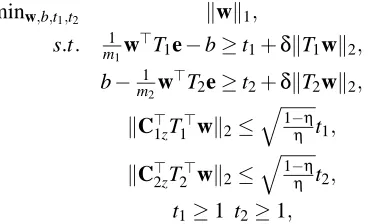
minw,b,t1,t2 kwk1, s.t. m1
1w
>T1e−b≥t1+δkT1wk2, b−m1
2w
>T2e≥t2+δkT2wk2,
kC>1zT1>wk2≤ q
1−η
η t1,
kC>2zT2>wk2≤ q
1−η
η t2,
t1≥1 t2≥1, (22) an SOCP. The matrix C1zis obtained by using the cholesky decomposition of the regularized matrix
Σz1+ρI, similarly for C2z.
As a consequence of Assumption 1, one needs to factorize matrices of size m1×m1, and m2× m2 instead of a much larger n×n matrix for the Frobenius norm uncertainty model. Thus, the assumption has computational benefits but it is quite restrictive. However, in absence of any prior knowledge, this maybe a good alternative to explore. In the next section, we experiment on the formulations (8) and (22) on both synthetic and real world microarray data sets.
5. Experiments
The feature selection abilities of the proposed formulations were tested on both synthetic and real world data sets. As a benchmark, the performance of the LP formulation on the same data sets are also reported.
Consider a synthetic data set generated as follows. The class label,y, of each observation was randomly chosen to be 1 or−1 with probability 0.5. The first ten features of the observation, x, are drawn as y
N
(−i,1), whereN
(µ,σ2) is a gaussian centered around µ and varianceσ2. Nine hundred ninety other features were drawn asN
(0,1). Fifty such observations were generated. The feature selection problem is to detect the first ten features, since they are the most discriminatory from the given pool of 1000 features, when the sample size is fifty.The features were selected by the following procedure (see ?). From the data set fifty partitions was generated by holding out one example as test data and others as training data. For each partiton, formulation (8) was solved on the training set for a fixed value ofηusing the open source package SEDUMI (Sturm, 1999) to obtain a set of features and the resulting classifier was used to predict the label of test data. The union of fifty sets of features is reported in Table 1 for various values of
power. As the value of ηis increased the formulation reports more discriminatory features. For
η=0.95, the formulation reported {7,8,9,10}, a set of four features. This shows that inspite of sample size being low compared to the number of features this formulation is able to discover the most discriminatory features. The corresponding list of features selected by the LP(5) is fs=
{2,3,4,5,6,7,8,9,10}. Both the formulations pick up the most discriminatory features but the LP formulation picks up more features. The experiment was repeated for 100 randomly generated data sets, and gave similar results. This demonstrates that the formulation (8) picks up discriminatory features and is comparable to the LP formulation.
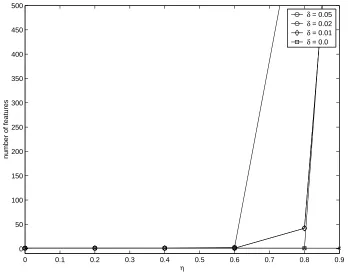
We also experimented with the robust formulation (14) for different values ofδ, andρ.In Figure 1 number of features are plotted for various values of δ. Asδ increases, the number of features selected by the formulation (22) increases, the value ofρwas zero for the reported experiment. The robust formulation tries to maintain the classification accuracy even when the estimates of mean and covariance are not correct. To ensure this, more features are needed to maintain the accuracy. Similar results were also obtained by varyingρ.
0 0.1 0.2 0.3 0.4 0.5 0.6 0.7 0.8 0.9
0 50 100 150 200 250 300 350 400 450 500
η
number of features
δ = 0.05
δ = 0.02
δ = 0.01
δ = 0.0
Figure 1: Plots of number of selected features versusηfor various values ofδ.
The formulation (8) was tested on six data sets (B, C, D, E, F, G) defined by Bhattacharyya et al. (2003). These binary classification problems are related to Small Round Blue Cell Tumors (SR-BCT). Each data set have various number of data points but have the same number of features, n=2308.
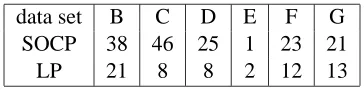
data set B C D E F G SOCP 38 46 25 1 23 21
LP 21 8 8 2 12 13
Table 2: Number of selected features for which the LOO error was minimum. The row titled SOCP tabulates the minimum number of features reported by (8) for which the LOO error was zero. The row titled LP tabulates the number of features selected by the LP formulation. Total number of features is n=2308
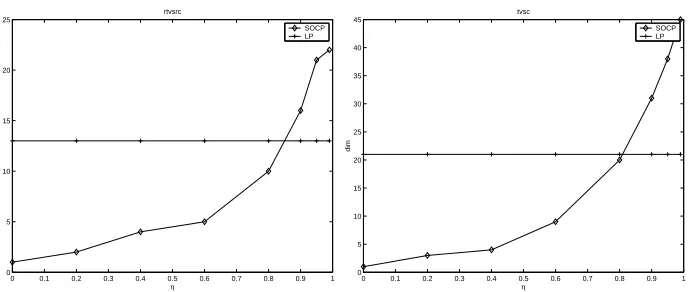
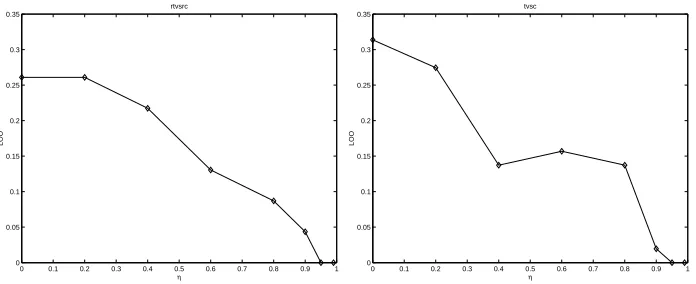
was solved for all possible partitions. For each partition the resulting classifier was tested on the held out data point. Average number of errors over all the partitions was reported as the LOO (leave one out) error. The results were compared against the linear programming formulation(5). Table 2 compares the number of features required to attain a zero LOO error by formulations (8) and (5). In both cases very small number of features, less than 2% of the total number of 2308 features, were selected. However the LP formulations almost always found a smaller set of features. Figures 2, 3, 4 show plots for the number of features selected by (8) for various values ofη. Asη increases, the number of features increase. For comparison, the number of features selected by the LP formulation is also plotted on the same graph. Figures 5, 6, 7 show plots for the LOO error the SOCP formulation. Asηincreases the LOO error decreases. This conforms to the view that asη increases, the classifier is forced to be accurate which leads to increase in the number of features.
0 0.1 0.2 0.3 0.4 0.5 0.6 0.7 0.8 0.9 1
0 5 10 15 20 25
η
dim
ecvsrc
SOCP LP
0 0.1 0.2 0.3 0.4 0.5 0.6 0.7 0.8 0.9 1
0 5 10 15 20 25
η
dim
etvsec
SOCP LP
Figure 2: Plots of number of selected features versusηfor data sets E, F.
6. Conclusions and Future Directions
0 0.1 0.2 0.3 0.4 0.5 0.6 0.7 0.8 0.9 1 0 5 10 15 20 25 η dim etvsrt SOCP LP
0 0.1 0.2 0.3 0.4 0.5 0.6 0.7 0.8 0.9 1
0 5 10 15 20 25 30 35 40 45 50 η dim evsr SOCP LP
Figure 3: Plots of number of selected features versusηfor data sets D, C.
0 0.1 0.2 0.3 0.4 0.5 0.6 0.7 0.8 0.9 1
0 5 10 15 20 25 η dim rtvsrc SOCP LP
0 0.1 0.2 0.3 0.4 0.5 0.6 0.7 0.8 0.9 1
0 5 10 15 20 25 30 35 40 45 η dim tvsc SOCP LP
Figure 4: Plots of number of selected features versusηfor data sets G, B.
On a toy data set, the formulation discovered the discriminatory features. The formulation has a parameterη, which can trade off accuracy with number of features. For small values ofη, low number of discriminatory features are reported, while asηis increased the formulation reports more number of features. As borne out by experiments on the microarray data sets, the accuracy of the classifier increases asηis increased.
The approach in this paper can also be extended to design nonlinear classifiers using very few support vectors. Let the discriminating surface be{x|∑iαiK(xi,x) =b}which divides the
n-dimensional Euclidean space into two disjoint subsets{x|∑iαiK(x,xi)<b}and{x|∑iαiK(x,xi)>
b}, where the kernel K, is a function K :Rn×Rn→Robeying the Mercer conditions (Mercer, 1909).
One can restate the nonlinear discriminating surface by a hyperplane in m dimensions,
H
={x|α>k(x)−b=0}0 0.1 0.2 0.3 0.4 0.5 0.6 0.7 0.8 0.9 1 0 0.01 0.02 0.03 0.04 0.05 0.06 0.07 0.08 0.09 0.1 η LOO ecvsrc
0 0.1 0.2 0.3 0.4 0.5 0.6 0.7 0.8 0.9 1
0 0.05 0.1 0.15 0.2 0.25 0.3 0.35 η LOO etvsec
Figure 5: Plots of LOO error versusηfor data sets E, F.
0 0.1 0.2 0.3 0.4 0.5 0.6 0.7 0.8 0.9 1
0 0.05 0.1 0.15 0.2 0.25 η LOO etvsrt
0 0.1 0.2 0.3 0.4 0.5 0.6 0.7 0.8 0.9 1
0 0.02 0.04 0.06 0.08 0.1 0.12 0.14 0.16 0.18 0.2 η LOO evsr
Figure 6: Plots of LOO error versusηfor data sets D, C.
surface utilizing very small number of these vectors, or in other words, the goal is to minimize the cardinality of the set S, which can be approximated by the L1norm ofα.
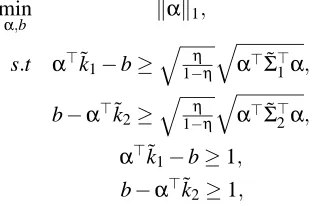
Let k1=k(X1)be a random vector corresponding to class 1 while k2=k(X2)be another random vector belonging to class 2. Let the means of k1and k2be ˜k1and ˜k2respectively and the covariance be ˜Σ1and ˜Σ2respectively. The problem can be approached as in (7) and on applying the Chebychev bound (6) the following formulation
min
α,b kαk1,
s.t α>˜k1−b≥q1−ηη q
α>Σ˜>
1α, b−α>˜k2≥
q η 1−η
q
α>Σ˜>
2α,
α>˜k1−b≥1,
b−α>˜k2≥1, (23)
0 0.1 0.2 0.3 0.4 0.5 0.6 0.7 0.8 0.9 1 0
0.05 0.1 0.15 0.2 0.25 0.3 0.35
η
LOO
rtvsrc
0 0.1 0.2 0.3 0.4 0.5 0.6 0.7 0.8 0.9 1
0 0.05 0.1 0.15 0.2 0.25 0.3 0.35
η
LOO
tvsc
Figure 7: Plots of LOO error versusηfor data sets G, B.
Acknowledgments
The author thanks the referees and the editor for their constructive comments. Their suggestions improved the paper significantly.
Appendix A. The Chebychev-Cantelli inequality
In this appendix we prove a multivariate generalization of the one sided Chebychev inequality. This inequality will be used to derive a lower bound on the probability of a multivariate random variable taking values in a given half space. Marshall and Olkin (1960)(also see Popescu and Bertsimas, 2001) proved a more general case.
We first state and prove the Chebychev inequality for a univariate random variable, (Lugosi, 2003). It would be useful to recall the Cauchy-Schwartz inequality. Let X and Y be random variables with finite variances,E(X−E(X))2<∞andE(Y−E(Y))2<∞, then
|E[(X−E(X))(Y−E(Y))]| ≤ q
E(X−E(X))2E(Y−E(Y))2. Chebychev-Cantelli inequality Let s≥0, Then
P(X−E(X)<s)≥ s 2
s2+E(X−E(X))2. Proof Let Y =X−E(X). Note thatE(Y) =0. For any s,
s=E(s−Y)≤E((s−Y)I{Y<s}(Y)).
For any s≥0, using the Cauchy-Schwartz inequality
s2≤ E(s−Y)2E(I2
{Y<s}(Y)),
= E(s−Y)2P(Y
<s),
On rearranging terms one obtains
P(Y<s)≥ s 2 E(Y2) +s2 and the result follows.
The above inequality can be used to derive a lower bound on the probability of a random vector taking values in a given half space.
Theorem 1 Let X be a n dimensional random vector. The mean and covariance of X be µ∈Rn andΣ∈Rn×n. Let
H
(w,b) ={z|w>z<b,w,z∈Rn,b∈R}be a given half space, with w6=0. ThenP(X∈
H
)≥ s 2 s2+w>Σw, where s= (b−w>µ)+,(x)+=max(x,0).Proof There are two cases: b≤w>µ and b>w>µ.
For the case b≤wTµ, s=0, and plugging its value in the Chebychev-Cantelli inequality, yields P(X∈
H
)≥0, which is trivially true. For the other case b>wTµ, by definition s=b−wTµ. Define Y =w>x, so thatE(Y) =wTµ E(Y−E(Y))2=w>Σw. We haveP(X∈
H
) =P(Y <b) =P(Y−E(Y)<s).Application of Chebyshev-Cantelli inequality to the above relationship gives our desired result. This completes the proof.
Note that the proof does not requireΣto be invertible. For a more general proof pertaining to convex sets and tightness of the bound see (Marshall and Olkin, 1960, Popescu and Bertsimas, 2001).
Appendix B. Uncertainty in Covariance Matrices
Consider the following problem
maxΣpw>Σw,
Σ=TΣzT>,
kΣz−ΣzkF≤ρ. (25)
Eliminating the equality constraint the objective can be stated as
p
w>Σw= q
w>TΣzT>w.
Introduce a new variable∆Σ∈S+n, so thatΣz=Σz+∆Σ,and the optimization problem (25) can be
stated as
max∆Σ
q
w>T(Σz+∆Σ)T>w,
s.t. k∆ΣkF ≤ρ.
(26)
B.1 Notation
The vector[1,1, . . . ,1]> will denoted by e, and[0, . . . ,0]by 0, the dimension will be clear from the context. If w= [w1, . . . ,wn]>, we write w≥0 to mean wi≥0,∀i∈ {1, . . . ,n}. The euclidean norm
of a vector x= [x1, . . . ,xn]>, will be denoted by kxk2= q
∑n
i=1x2i, while the 1-norm of x will be
denoted bykxk1=∑ni=1|xi|. The indicator function defined on the set A, denoted by IA(x), is
IA(x) =
1 x∈A
0 otherwise.
The cardinality of set A is given by |A|. The Frobenius norm of a m×n matrix A, is denoted by
kAkF =
q
∑m
i=1∑nj=1a2i j. References
E. Amaldi and V. Kann. On the approximability of minimizing nonzero variables or unsatisfied relations in linear systems. Theoretical Computer Science, 290:237–260, 1998.
C. Bhattacharyya, L. Grate, A. Rizki, D. Radisky, F. Molina, M. I. Jordan, M. Bissell, and Saira I. Mian. Simultaneous classification and relevant feature identification in high-dimensional spaces: application to molecular profiling data. Signal Processing, 83:729–743, 2003.
S. Chen, D. Donoho, and M. Saunders. Atomic decomposition by basis pursuit. Siam Journal of Scientific Computing, 20(1):33–61, 1999.
R. Fletcher. Practical Methods of Optimization. John Wiley and Sons, New York, 1989.
G. R. G. Lanckriet, L. El Ghaoui, C. Bhattacharyya, and M. I. Jordan. Minimax probability machine. In Advances in Neural Information Processing Systems. MIT Press, 2002a.
G. R. G. Lanckriet, L. El Ghaoui, C. Bhattacharyya, and M. I. Jordan. A robust minimax approach to classification. Journal of Machine Learning Research, pages 555 – 582, December 2002b.
M. S. Lobo, L. Vandenberghe, S. Boyd, and H. Lebret. Applications of second-order cone program-ming. Linear Algebra and its Applications, 284(1–3):193–228, 1998.
G. Lugosi. Concentration-of-measure inequalities, 2003. URL
http://www.econ.upf.es/˜lugosi/pre.html/anu.ps. Lecture notes presented at the Machine learning Summer School 2003, ANU, Canberra.
A. W. Marshall and I. Olkin. Multivariate Chebychev inequalities. Annals of Mathematical Statis-tics, 31(4):1001–1014, 1960.
J. Mercer. Functions of positive and negative type and their connection with the theory of integral equations. Philosophical Transactions of the Royal Society, London, A 209:415–446, 1909.
I. Popescu and D. Bertsimas. Optimal inequalities in probability theory. Technical Report TM 62, INSEAD, 2001.
J. F. Sturm. Using SeDuMi 1.02, a MATLAB toolbox for optimization over symmetric cones. Optimization Methods and Software, 11/12(1-4):625–653, 1999.