Distances between Data Sets Based on Summary Statistics
Nikolaj Tatti [email protected]
HIIT Basic Research Unit
Laboratory of Computer and Information Science Helsinki University of Technology, Finland
Editor: Dale Schuurmans
Abstract
The concepts of similarity and distance are crucial in data mining. We consider the problem of defining the distance between two data sets by comparing summary statistics computed from the data sets. The initial definition of our distance is based on geometrical notions of certain sets of distributions. We show that this distance can be computed in cubic time and that it has several intuitive properties. We also show that this distance is the unique Mahalanobis distance satisfying certain assumptions. We also demonstrate that if we are dealing with binary data sets, then the distance can be represented naturally by certain parity functions, and that it can be evaluated in linear time. Our empirical tests with real world data show that the distance works well.
Keywords: data mining theory, complex data, binary data, itemsets
1. Introduction
In this paper we will consider the following problem: Given two data sets D1and D2of dimension K, define a distance between D1and D2. To be more precise, we consider the problem of defining the
distance between two multisets of transactions, each set sampled from its own unknown distribution. We will define a dissimilarity measure between D1and D2and we will refer to this measure as CM distance.
Generally speaking, the notion of dissimilarity between two objects is one of the most funda-mental concepts in data mining. If one is able to retrieve a distance matrix from a set of objects, then one is able to analyse data by using for example, clustering or visualisation techniques. Many real world data collections may be naturally divided into several data sets. For example, if a data collection consists of movies from different eras, then we may divide the movies into subcollec-tions based on their release years. A distance between these data (sub)sets would provide means to analyse them as single objects. Such an approach may ease the task of understanding complex data collections.
The CM distance will be based on summary statistics, features. Let us give a simple example: Assume that we have data sets D1={A,B,A,A}and D2={A,B,C,B}and assume that the only
feature we are interested in is the proportion of A in the data sets. Then we can suggest the distance between D1 and D2 to be |3/4−1/4|=1/2. The CM distance is based on this idea; however,
there is a subtle difficulty: If we calculate several features, then should we take into account the correlation of these features? We will do exactly that in defining the CM distance.
The rest of this paper is organised as follows. In Section 2 we give the definition of the CM distance by using some geometrical interpretations. We also study the properties of the distance and provide an alternative characterisation. In Section 3 we study the CM distance and binary data sets. In Section 4 we discuss how the CM distance can be used with event sequences and in Section 5 we comment about the feature selection. Section 6 is devoted for related work. The empirical tests are represented in Section 7 and we conclude our work with the discussion in Section 8.
2. The Constrained Minimum Distance
In the following subsection we will define our distance using geometrical intuition and show that the distance can be evaluated efficiently. In the second subsection we will discuss various properties of the distance, and in the last subsection we will provide an alternative justification to the distance. The aim of this justification is to provide more theoretical evidence for our distance.
2.1 The Definition
We begin by giving some basic definitions. By a data set D we mean a finite collection of samples lying in some finite spaceΩ. The setΩis called sample space, and from now on we will denote this space by the letterΩ. The number of elements inΩis denoted by|Ω|. The number of samples in the data set D is denoted by|D|.
As we said in the introduction, our goal is not to define a distance directly on data sets but rather through some statistics evaluated from the data sets. In order to do so, we define a feature function
S :Ω→RN to map a point in the sample space to a real vector. Throughout this section S will indicate some given feature function and N will indicate the dimension of the range space of S. We will also denote the ithcomponent of S by Si. Note that if we have several feature functions, then we
can join them into one big feature function. A frequencyθ∈RN of S taken with respect to a data set D is the average of values of S taken over the data set, that is,θ=|D1|∑ω∈DS(ω). We denote this
frequency by S(D).
Although we do not make any assumptions concerning the size ofΩ, some of our choices are motivated by thinking that |Ω|can be very large—so large that even the simplest operation, say, enumerating all the elements inΩ, is not tractable. On the other hand, we assume that N is such that an algorithm executable in, say, O(N3)time is feasible. In other words, we seek a distance whose
evaluation time does not depend of the size ofΩbut rather of N.
LetPbe the set of all distributions defined onΩ. Given a feature function S and a frequencyθ (calculated from some data set) we say that a distribution p∈Psatisfies the frequencyθif Ep[S] =θ.
We also define a constrained set of distributions
to be the set of the distributions satisfying θ. The idea behind this is as follows: From a given data set we calculate some statistics, and then we examine the distributions that can produce such frequencies.
We interpret the sets Pand
C
+(S,θ)as geometrical objects. This is done by enumerating thepoints inΩ, that is, we think thatΩ={1,2, , . . . ,|Ω|}. We can now represent each distribution p∈P
by a vector u∈R|Ω|by setting ui=p(i). Clearly,Pcan be represented by the vectors inR|Ω|having
only non-negative elements and summing to one. In fact,Pis a simplex inR|Ω|. Similarly, we can give an alternative definition for
C
+(S,θ)by sayingC
+(S,θ) =(
u∈R|Ω||
∑
i∈Ω
S(i)ui=θ,
∑
i∈Ωui=1,u≥0
)
. (1)
Let us now study the set
C
+(S,θ). In order to do so, we define a constrained spaceC
(S,θ) =(
u∈R|Ω||
∑
i∈Ω
S(i)ui=θ,
∑
i∈Ωui=1
)
,
that is, we drop the last condition from Eq. 1. The set
C
+(S,θ) is included inC
(S,θ); the setC
+(S,θ) consists of the non-negative vectors fromC
(S,θ). Note that the constraints definingC
(S,θ)are vector products. This implies thatC
(S,θ)is an affine space, and that, given two different frequenciesθ1andθ2, the spacesC
(S,θ1)andC
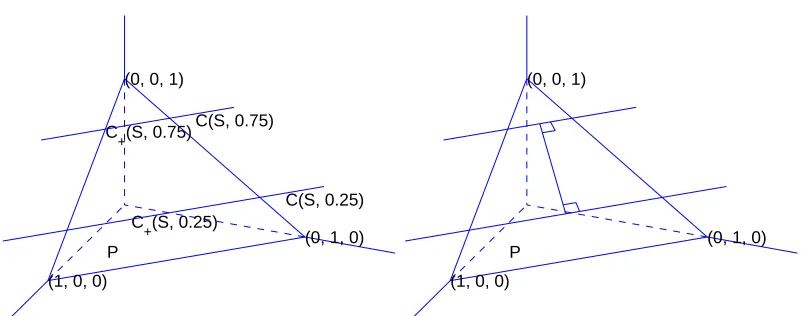
(S,θ2)are parallel.Example 1 Let us illustrate the discussion above with a simple example. Assume thatΩ={A,B,C}. We can then imagine the distributions as vectors in R3. The set Pis the triangle having(1,0,0), (0,1,0), and(0,0,1)as corner points (see Figure 1). Define a feature function S to be
S(ω) =
1 ω=C
0 ω6=C.
The frequency S(D) is the proportion of C in a data set D. Let D1 = (C,C,C,A) and D2 = (C,A,B,A). Then S(D1) =0.75 and S(D2) =0.25. The spaces
C
(S,0.25) andC
(S,0.75) are parallel lines (see Figure 1). The distribution setsC
+(S,0.25)andC
+(S,0.75)are the segments of the linesC
(S,0.25)andC
(S,0.75), respectively.The idea of interpreting distributions as geometrical objects is not new. For example, a well-known boolean query problem is solved by applying linear programming to the constrained sets of distri-butions (Hailperin, 1965; Calders, 2003).
Let us revise some elementary Euclidean geometry: Assume that we are given two parallel affine spaces
A
1andA
2. There is a natural way of measuring the distance between these two spaces. Thisis done by taking the length of the shortest segment going from a point in
A
1 to a point inA
2(forexample see the illustration in Figure 1). We know that the segment has the shortest length if and only if it is orthogonal with the affine spaces. We also know that if we select a point a1∈
A
1havingthe shortest norm, and if we similarly select a2∈
A
2, then the segment going from a1to a2has theshortest length.
(0, 1, 0) C(S, 0.25) C(S, 0.75)
C
+(S, 0.25)
(0, 0, 1)
P C
+(S, 0.75)
(1, 0, 0)
(0, 1, 0) (0, 0, 1)
P (1, 0, 0)
Figure 1: A geometrical interpretation of the distribution sets for |Ω|=3. In the left figure, the setP, that is, the set of all distributions, is a triangle. The constrained spaces
C
(S,0.25)and
C
(S,0.75)are parallel lines and the distribution setsC
+(S,0.25)andC
+(S,0.75)aresegments of the constrained spaces. In the right figure we added a segment perpendic-ular to the constraint spaces. This segment has the shortest length among the segments connecting the constrained spaces.
feature function S. Let us shorten the notation
C
(S,S(Di))byC
(S,Di). We pick a vector from eachconstrained space having the shortest norm
ui= argmin u∈C(S,Di)
kuk2, i=1,2.
We define the distance between D1and D2to be dCM(D1,D2|S) =
p
|Ω|ku1−u2k2. (2)
The reasons for having the factorp|Ω|will be given later. We will refer to this distance as
Con-strained Minimum (CM) distance. We should emphasise that u1or u2may have negative elements.
Thus the CM distance is not a distance between two distributions; it is rather a distance based on the frequencies of a given feature function and is motivated by the geometrical interpretation of the distribution sets.
The main reason why we define the CM distance using the constrained spaces
C
(S,Di) andnot the distribution sets
C
+(S,Di)is that we can evaluate the CM distance efficiently. We discussedearlier thatΩmay be very large so it is crucial that the evaluation time of a distance does not depend on|Ω|. The following theorem says that the CM distance can be represented using the frequencies and a covariance matrix
Cov[S] = 1
|Ω|ω
∑
∈ΩS(ω)S(ω)T
− 1
|Ω|ω
∑
∈ΩS(ω) !1
|Ω|ω
∑
∈ΩS(ω) !T.
Theorem 1 Assume that Cov[S]is invertible. For the CM distance between two data sets D1and D2we have
The proofs for the theorems are given in Appendix.
The preceding theorem shows that we can evaluate the distance using the covariance matrix and frequencies. If we assume that evaluating a single component of the feature function S is a unit operation, then the frequencies can be calculated in O(N|D1|+N|D2|)time. The evaluation time of the covariance matrix is O(|Ω|N2)but we assume that S is such that we know a closed form for the covariance matrix (such cases will be discussed in Section 3), that is, we assume that we can evaluate the covariance matrix in O(N2)time. Inverting the matrix takes O(N3)time and evaluating
the distance itself is O(N2)operation. Note that calculating frequencies and inverting the covariance
matrix needs to be done only once: for example, assume that we have k data sets, then calculating the distances between every data set pair can be done in O N∑ki|Di|+N3+k2N2
time.
Example 2 Let us evaluate the distance between the data sets given in Example 1 using both the definition of the CM distance and Theorem 1. We see that the shortest vector in
C
(S,0.25) is u1= 38,38,14
. Similarly, the shortest vector in
C
(S,0.75)is u2= 18,18,34
. Thus the CM distance is equal to
dCM(D1,D2|S) =
√
3ku1−u2k2=√3
22 82+
22 82+
22 42
1/2
=√3 8.
The covariance of S is equal to Cov[S] = 13−1313=29. Thus Theorem 1 gives us
dCM(D1,D2|S) =
"
Cov−1[S]
3 4−
1 4
2#1/2
=
" 9 2
2 4
2#1/2
=√3
8.
From Theorem 1 we see a reason to have the factorp|Ω|in Eq. 2: Assume that we have two data sets D1and D2and a feature function S. We define a new sample spaceΩ0={(ω,b)|ω∈Ω,b=0,1}
and transform the original data sets into new ones by setting D0i={(ω,0)|ω∈Di}. We also expand
S intoΩ0by setting S0(ω,1) =S0(ω,0) =S(ω). Note that S(Di) =S0(D0i)and that Cov[S] =Cov[S0]
so Theorem 1 says that the CM distance has not changed during this transformation. This is very reasonable since we did not actually change anything essential: We simply added a bogus variable into the sample space, and we ignored this variable during the feature extraction. The size of the new sample space is|Ω0|=2|Ω|. This means that the differenceku1−u2k2in Eq. 2 is smaller by
the factor√2. The factorp|Ω|is needed to negate this effect.
2.2 Properties
We will now list some important properties of dCM(D1,D2|S). Theorem 2 dCM(D1,D2|S)is a pseudo metric.
The following theorem says that adding external data set to the original data sets makes the distance smaller which is very reasonable property.
Theorem 3 Assume three data sets D1, D2, and D3over the same set of items. Assume further that D1and D2have the same number of data points and letε= |D1||D+3||D3|. Then
Theorem 4 Let A be a M×N matrix and b a vector of length M. Define T(ω) =AS(ω) +b. It follows that dCM(D1,D2|T)≤dCM(D1,D2|S)for any D1and D2.
Corollary 5 Adding extra feature functions cannot decrease the distance.
Corollary 6 Let A be an invertible N×N matrix and b a vector of length N. Define T(ω) = AS(ω) +b. It follows that dCM(D1,D2|T) =dCM(D1,D2|S)for any D1and D2.
Corollary 6 has an interesting interpretation. Note that T(D) =AS(D) +b and that S(D) = A−1(T(D)−b). This means that if we know the frequencies S(D), then we can infer the frequencies
T(D) without a new data scan. Similarly, we can infer S(D) from T(D). We can interpret this relation by thinking that S(D)and T(D) are merely different representations of the same feature information. Corollary 6 says that the CM distance is equal for any such representation.
2.3 Alternative Characterisation of the CM Distance
We derived our distance using geometrical interpretation of the distribution sets. In this section we will provide an alternative way for deriving the CM distance. Namely, we will show that if some distance is of Mahalanobis type and satisfies some mild assumptions, then this distance is proportional to the CM distance. The purpose of this theorem is to provide more theoretical evidence to our distance.
We say that a distance d is of Mahalanobis type if
d(D1,D2|S)2= (θ1−θ2)TC(S)−1(θ1−θ2),
whereθ1=S(D1)andθ2=S(D2)and C(S)maps a feature function S to a symmetric N×N matrix.
Note that if C(S) =Cov[S], then the distance d is the CM distance. We setMto be the collection of all distances of Mahalanobis type. Can we justify the decision that we examine only the distances included inM? One reason is that a distance belonging toMis guaranteed to be a metric. The most important reason, however, is the fact that we can evaluate the distance belonging toMefficiently (assuming, of course, that we can evaluate C(S)).
Let d∈Mand assume that it satisfies two additional assumptions:
1. If A is an M×N matrix and b is a vector of length M and if we set T(ω) =AS(ω) +b, then C(T) =AC(S)AT.
2. Fix two pointsω1 andω2. Letσ:Ω→Ωbe a function swappingω1 andω2 and mapping
everything else to itself. Define U(ω) =S(σ(ω)). Then d(σ(D1),σ(D2)|U) =d(D1,D2|S).
The first assumption can be partially justified if we consider that A is an invertible square matrix. In this case the assumption is identical to d(·,· |AS+b) =d(·,· |S). This is to say that the distance is independent of the representation of the frequency information. This is similar to Corollary 6 given in Section 2.2. We can construct a distance that would satisfy Assumption 1 in the invertible case but fail in a general case. We consider such distances pathological and exclude them by making a broader assumption. To justify Assumption 2 note that the frequencies have not changed, that is,
U(σ(D)) =S(D). Only the representation of single data points have changed. Our argument is that the distance should be based on the frequencies and not on the values of the data points.
3. The CM distance and Binary Data Sets
In this section we will concentrate on the distances between binary data sets. We will consider the CM distance based on itemset frequencies, a very popular statistics in the literature concerning binary data mining. In the first subsection we will show that a more natural way of representing the CM distance is to use parity frequencies. We also show that we can evaluate the distance in linear time. In the second subsection we will provide more theoretical evidence why the CM distance is a good distance between binary data sets.
3.1 The CM Distance and Itemsets
We begin this section by giving some definitions. We set the sample spaceΩto be
Ω={ω|ω= (ω1, . . . ,ωK),ωi=0,1},
that is,Ωis the set of all binary vectors of length K. Note that |Ω|=2K. It is custom that each dimension inΩis identified with some symbol. We do this by assigning the symbol ai to the ith
dimension. These symbols are called attributes or items. Thus when we speak of the attribute aiwe
refer to the ith dimension. We denote the set of all items byA={a1, . . . ,aK}. A non-empty subset
ofAis called itemset.
A boolean formula S :Ω→ {0,1} is a feature function mapping a binary vector to a binary value. We are interested in two particular boolean formulae: Assume that we are given an itemset
B={ai1, . . . ,aiL}. We define a conjunction function SBto be
SB(ω) =ωi1∧ωi2∧ ··· ∧ωiK,
that is, SB results 1 if and only if all the variables corresponding the itemset B are on. Given a
data set D the frequency SB(D)is called the frequency of the itemset B. Conjunction functions are
popular and there are a lot of studies in the literature concerning finding itemsets that have large frequency (see e.g., Agrawal et al., 1993; Hand et al., 2001). We also define a parity function TBto
be
TB(ω) =ωi1⊕ωi2⊕ ··· ⊕ωiK,
where⊕is the binary operator XOR. The function TB results 1 if and only if the number of active
variables included in B are odd.
A collection
F
of itemsets is said to be antimonotonic or downwardly closed if each non-empty subset of an itemset included inF
is also included inF
. Given a collection of itemsetsF
={B1, . . . ,BN}we extend our definition of the conjunction function by setting SF = [SB1, . . . ,SBN]
T.
We also define TF = [TB1, . . . ,TBN]
T
.
Assume that we are given an antimonotonic family
F
of itemsets. We can show that there is an invertible matrix A such that TF =ASF. In other words, we can get the parity function TF from the conjunction function TF by an invertible linear transformation. Corollary 6 now implies thatdCM(D1,D2|SF) =dCM(D1,D2|TF), (3)
for any D1 and D2. The following lemma shows that the covariance matrix Cov[TF]of the parity
Lemma 8 Let TF be a parity function for a family of itemsets
F
, then Cov[TF] =0.5I, that is, thecovariance matrix is a diagonal matrix having 0.5 at the diagonal.
Theorem 1, Lemma 8, and Eq. 3 imply that
dCM(D1,D2|SF) =
√
2kθ1−θ2k2, (4)
whereθ1=TF(D1) andθ2=TF(D2). This identity says that the CM distance can be calculated
in O(N)time (assuming that we know the frequenciesθ1 andθ2). This is better than O(N3)time
implied by Theorem 1.
Example 3 Let
I
=aj |j=1. . .K be a family of itemsets having only one item. Note that
T{a
j}=S{aj}. Eq. 4 implies that
dCM(D1,D2|SI) =
√
2kθ1−θ2k2,
where θ1 and θ2 consists of the marginal frequencies of each aj calculated from D1 and D2,
re-spectively. In this case the CM distance is simply the L2distance between the marginal frequencies of the individual attributes. The frequenciesθ1andθ2resemble term frequencies (TF) used in text mining (see e.g., Baldi et al., 2003).
Example 4 We consider now a case with a larger set of features. Our motivation for this is that using only the feature functions SI is sometimes inadequate. For example, consider data sets with two items having the same individual frequencies but different correlations. In this case the data sets may look very different but according to our distance they are equal.
Let
C
=I
∪ajak|j,k=1. . .K,j<k be a family of itemsets such that each set contains
at most two items. The corresponding frequencies contain the individual means and the pair-wise correlation for all items. Let Sajak be the conjunction function for the itemset ajak. Let
γjk=Sajak(D1)−Sajak(D2) be the difference between the correlation frequencies. Also, letγj= Saj(D1)−Saj(D2). Since
Tajak=Saj+Sak−2Sajak
it follows from Eq. 4 that
dCM(D1,D2|SC)2=2
∑
j<k
γj+γk−2γjk
2
+2
K
∑
j=1
γ2
j. (5)
3.2 Characterisation of the CM Distance for Itemsets
The identity given in Eq. 4 is somewhat surprising and seems less intuitive. A question arises: why this distance is more natural than some other, say, a simple L2 distance between the itemset
frequencies. Certainly, parity functions are less intuitive than conjunction functions. One answer is that the parity frequencies are decorrelated version of the traditional itemset frequencies.
However, we can clarify this situation from another point of view: Let
A
be the set of all itemsets. Assume that we are given two data sets D1and D2 and define empirical distributions p1and p2by setting
pi(ω) =
number of samples in Diequal toω
|Di|
The constrained spaces of SA are singular points containing only pi, that is,
C
(SA,Di) ={pi}. Thisimplies that
dCM(D1,D2|SA) =
√ 2Kkp
1−p2k2. (6)
In other words, the CM distance is proportional to the L2 distance between the empirical
distribu-tions. This identity seems very reasonable. At least, it is more natural than, say, taking L2distance
between the traditional itemset frequencies.
The identity in Eq. 6 holds only when we use the features SA. However, we can prove that a distance of the Mahalanobis type satisfying the identity in Eq. 6 and some additional conditions is equal to the CM distance. Let us explain this in more detail. We assume that we have a distance d having the form
d(D1,D2|SF)2= (θ1−θ2)TC(SF)−1(θ1−θ2),
whereθ1=SF (D1)andθ2=SF(D2)and C(SF)maps a conjunction function SF to a symmetric N×N matrix. The distance d should satisfy the following mild assumptions.
1. Assume two antimonotonic families of itemsets
F
andH
such thatF
⊂H
. It follows thatd(·,· |SF)≤d(·,· |SH).
2. Adding extra dimensions (but not changing the features) does not change the distance.
The following theorem says that the assumptions and the identity in Eq. 6 are sufficient to prove that d is actually the CM distance.
Theorem 9 Assume that a Mahalanobis distance d satisfies Assumptions 1 and 2. Assume also that there is a constant c1such that
d(D1,D2|SA) =c1kp1−p2k2.
Then it follows that for any antimonotonic family
F
we haved(D1,D2|SF) =c2dCM(D1,D2|SF),
for some constant c2.
4. The CM distance and Event Sequences
In the previous section we discussed about the CM distance between the binary data sets. We will use similar approach to define the CM distance between sequences.
In order to apply the CM distance we will now describe how we can transform a sequence s to a binary data set. Assume that we are given a window length k. We transform a window of length k into a binary vector of length|Σ|by setting 1 if the corresponding symbol occurs in the window, and 0 otherwise. Let D be the collection of these binary vectors. We have now transformed the sequence
s to the binary data set D. Note that parallel episodes of s are represented by itemsets of D.
This transformation enables us to use the CM distance. Assume that we are given two sequences
s1 and s2, a collection of parallel episodes
F
, and a window length k. First, we transform thesequences into data sets D1and D2. We set the CM distance between the sequences s1and s2to be dCM(D1,D2|SF).
5. Feature Selection
We will now discuss briefly about feature selection—a subject that we have taken for granted so far. The CM distance depends on a feature function S. How can we choose a good set of features?
Assume for simplicity that we are dealing with binary data sets. Eq. 6 tells us that if we use all itemsets, then the CM distance is L2distance between empirical distributions. However, to get
a reliable empirical distribution we need an exponential number of data points. Hence we can use only some subset of itemsets as features. The first approach is to make an expert choice without seeing data. For example, we could decide that the feature function is SI, the means of the individual attributes, or SC, the means of individual attributes and the pairwise correlation.
The other approach is to infer a feature function from the data sets. At first glimpse this seems an application of feature selection. However, traditional feature selection fails: Let SI be the fea-ture function representing the means of the individual attributes and let SA be the feature function containing all itemsets. Let ωbe a binary vector. Note that if we know SI(ω), then we can de-duce SA(ω). This means that SI is a Markov blanket (Pearl, 1988) for SA. Hence we cannot use the Markov blanket approach to select features. The essential part is that the traditional feature selection algorithms deal with the individual points. We try to select features for whole data sets.
Note that feature selection algorithms for singular points are based on training data, that is, we have data points divided into clusters. In other words, when we are making traditional feature selection we know which points are close and which are not. In order to make the same ideas work for data sets we need to have similar information, that is, we need to know which data sets are close to each other, and which are not. Such an information is rarely provided and hence we are forced to seek some other approach.
We suggest a simple approach for selecting itemsets by assuming that frequently occurring itemsets are interesting. Assume that we are given a collection of data sets Di and a thresholdσ.
Let
I
be the itemsets of order one. We defineF
such that B∈F
if and only if B∈I
or that B is a σ-frequent itemset for some Di.6. Related Work
Distance Time
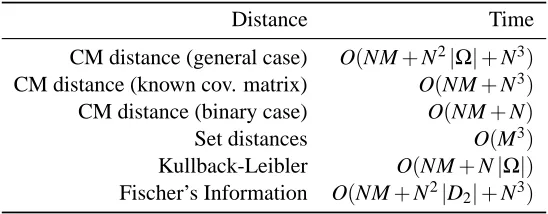
CM distance (general case) O(NM+N2|Ω|+N3)
CM distance (known cov. matrix) O(NM+N3)
CM distance (binary case) O(NM+N)
Set distances O(M3)
Kullback-Leibler O(NM+N|Ω|)
Fischer’s Information O(NM+N2|D2|+N3)
Table 1: Comparison of the execution times of various distances. The number M=|D1|+|D2|is the
number of data points in total. The O(NM)term refers to the time needed to evaluate the frequencies S(D1)and S(D2). Kullback-Leibler distance is solved using Iterative Scaling
algorithm in which one round has N steps and one step is executed in O(|Ω|)time.
6.1 Set Distances
One approach to define a data set distance is to use some natural distance between single data points and apply some known set distance. Eiter and Mannila (1997) show that some data set distances defined in this way can be evaluated in cubic time. However, this is too slow for us since we may have a vast amount of data points. The other downsides are that these distances may not take into account the statistical nature of data which may lead into problems.
6.2 Edit Distances
We discuss in Section 4 of using the CM distance for event sequences. Traditionally, edit tances are used for comparing event sequences. The most famous edit distance is Levenshtein dis-tance (Levenshtein, 1966). However, edit disdis-tances do not take into account the statistical nature of data. For example, assume that we have two sequences generated such that the events are sampled from the uniform distribution independently of the previous event (a zero-order Markov chain). In this case the CM distance is close to 0 whereas the edit distance may be large. Roughly put, the CM distance measures the dissimilarity between the statistical characteristics whereas the edit distances operate at the symbol level.
6.3 Minimum Discrimination Approach
There are many distances for distributions (see Baseville, 1989, for a nice review). From these distances the CM distance resembles the statistical tests involved with Minimum Discrimination Theorem (see Kullback, 1968; Csiszár, 1975). In this framework we are given a feature function
S and two data sets D1 and D2. From the set of distributions
C
+(S,Di) we select a distributionmaximising the entropy and denote it by pMEi . The distance itself is the Kullback-Leibler divergence between pME1 and pME2 . It has been empirically shown that pMEi represents well the distribution from which Diis generated (see Mannila et al., 1999). The downsides are that this distance is not a
metric (it is not even symmetric), and that the evaluation time of the distance is infeasible: Solving
information, that is,
D pME1 kpME2 ≈ 1
2(θ1−θ2)
TCov−1
S|pME2
(θ1−θ2),
whereθi=S(Di)and Cov
S|pME2 is the covariance matrix of S taken with respect to pME2 (see Kullback, 1968). This resembles greatly the equation in Theorem 1. However, in this case the covariance matrix depends on data sets and thus generally this approximation is not a metric. In ad-dition, we do not know pME2 and hence we cannot evaluate the covariance matrix. We can, however, estimate the covariance matrix from D2, that is,
CovS|pME2 ≈ 1 |D2|ω
∑
∈D2
S(ω)S(ω)T− 1
|D2|2
"
∑
ω∈D2S(ω)
# "
∑
ω∈D2S(ω)T
#
.
The execution time of this operation is O(N2|D 2|). 7. Empirical Tests
In this section we describe our experiments with the CM distance. We begin by examining the effect of different feature functions. We continue studying the distance by applying clustering algorithms, and finally we represent some interpretations to the results.
In many experiments we use a base distance dU defined as the L2distance between the itemset
frequencies, that is,
dU(D1,D2|S) =
√
2kθ1−θ2k2, (7)
whereθi are the itemset frequenciesθi=S(Di). This type of distance was used in Hollmén et al.
(2003). Note that dU(D1,D2|ind) =dCM(D1,D2|ind), where ind is the feature set containing only
individual means.
7.1 Real World Data Sets
We examined the CM distance with several real world data sets and several feature sets. We had 7 data sets: Bible, a collection of 73 books from the Bible,1 Addresses, a collection of 55
inaugu-ral addresses given by the presidents of the U.S.,2 Beatles, a set of lyrics from 13 studio albums
made by the Beatles, 20Newsgroups, a collection of 20 newsgroups,3 TopGenres, plot summaries
for top rated movies of 8 different genres, and TopDecades, plot summaries for top rated movies from 8 different decades.4 20Newsgroups contained (in that order) 3 religion groups, 3 of
poli-tics, 5 of computers, 4 of science, 4 recreational, and misc.forsale. TopGenres consisted (in that order) of Action, Adventure, SciFi, Drama, Crime, Horror, Comedy, and Romance. The decades for
TopDecades were 1930–2000. Our final data set, Abstract, was composed of abstracts describing
NSF awards from 1990–1999.5
1. The books were taken fromhttp://www.gutenberg.org/etext/8300on July 20, 2005.
2. The addresses were taken fromhttp://www.bartleby.com/124/on August 17, 2005.
3. The data set was taken fromhttp://www.ai.mit.edu/~jrennie/20Newsgroups/, a site hosted by Jason Rennie,
on June 8, 2001.
4. The movie data sets were taken fromhttp://www.imdb.com/Top/on January 1, 2006.
5. The data set was taken fromhttp://kdd.ics.uci.edu/databases/nsfabs/nsfawards.data.htmlon January
Bible and Addresses were converted into binary data sets by taking subwindows of length 6
(see the discussion in Section 4). We reduced the number of attributes to 1000 by using the mutual information gain. Beatles was preprocessed differently: We transformed each song to its binary bag-of-words representation and selected 100 most informative words. In 20Newsgroups a trans-action was a binary bag-of-words representation of a single article. Similarly, In TopGenres and in TopDecades a transaction corresponded to a single plot summary. We reduced the number of attributes in these three data sets to 200 by using the mutual information gain. In Abstract a data set represented one year and a transaction was a bag-of-words representation of a single abstract. We reduced the dimension of Abstract to 1000.
7.2 The Effect of Different Feature Functions
We begin our experiments by studying how the CM distance (and the base distance) changes as we change features.
We used 3 different sets of features: ind, the independent means, cov, the independent means along with the pairwise correlation, and freq, a family of frequent itemsets obtained by using APRI-ORI(Agrawal et al., 1996). We adjusted the threshold so that freq contained 10K itemsets, where K is the number of attributes.
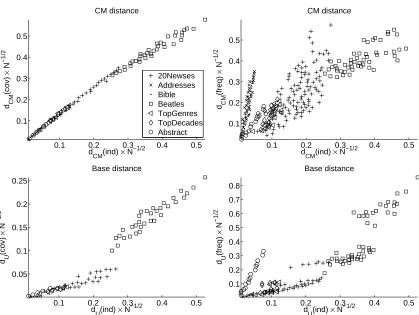
We plotted the CM distances and the base distances as functions of dCM(ind). The results are
shown in Figure 2. Since the number of constraints varies, we normalised the distances by dividing them with√N, where N is the number of constraints. In addition, we computed the correlation of
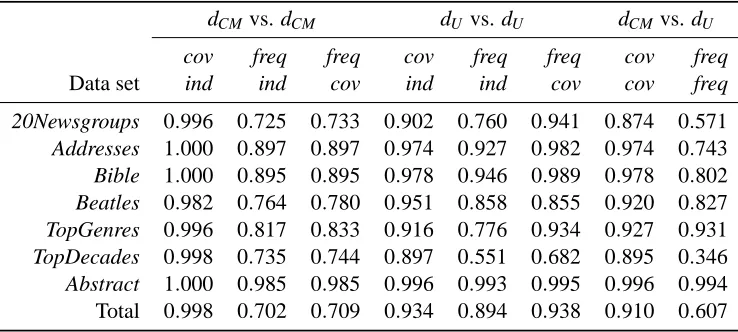
each pair of distances. These correlations are shown in Table 2.
dCMvs. dCM dU vs. dU dCMvs. dU
cov freq freq cov freq freq cov freq
Data set ind ind cov ind ind cov cov freq
20Newsgroups 0.996 0.725 0.733 0.902 0.760 0.941 0.874 0.571
Addresses 1.000 0.897 0.897 0.974 0.927 0.982 0.974 0.743
Bible 1.000 0.895 0.895 0.978 0.946 0.989 0.978 0.802
Beatles 0.982 0.764 0.780 0.951 0.858 0.855 0.920 0.827
TopGenres 0.996 0.817 0.833 0.916 0.776 0.934 0.927 0.931
TopDecades 0.998 0.735 0.744 0.897 0.551 0.682 0.895 0.346
Abstract 1.000 0.985 0.985 0.996 0.993 0.995 0.996 0.994 Total 0.998 0.702 0.709 0.934 0.894 0.938 0.910 0.607
Table 2: Correlations for various pairs of distances. A column represents a pair of distances and a row represents a single data set. For example, the correlation between dCM(ind) and
dCM(cov)in 20Newsgroups is 0.996. The last row is the correlation obtained by using the
distances from all data sets simultaneously. Scatterplots for the columns 1–2 and 4–5 are given in Fig. 2.
Our first observation from the results is that dCM(cov)resembles dCM(ind)whereas dCM(f req)
0.1 0.2 0.3 0.4 0.5 0.1 0.2 0.3 0.4 0.5 CM distance d
CM(ind) × N −1/2 d CM (cov) × N −1/2 20Newses Addresses Bible Beatles TopGenres TopDecades Abstract
0.1 0.2 0.3 0.4 0.5 0.1 0.2 0.3 0.4 0.5 CM distance d
CM(ind) × N −1/2 dCM (freq) × N −1/2
0.1 0.2 0.3 0.4 0.5 0.05 0.1 0.15 0.2 0.25 Base distance d
U(ind) × N −1/2 d U (cov) × N −1/2
0.1 0.2 0.3 0.4 0.5 0.1 0.2 0.3 0.4 0.5 0.6 0.7 0.8 Base distance d
U(ind) × N −1/2 dU (freq) × N −1/2
Figure 2: CM and base distances as functions of dCM(ind). A point represents a distance between
two data sets. The upper two figures contain the CM distances while the lower two contain the base distance. The distances were normalised by dividing√N, where N is the number
of constraints. The corresponding correlations are given in Table 2. Note that x-axis in the left (right) two figures are equivalent.
The correlations between dCM(cov) and dCM(ind) are stronger than the correlations between
dU(cov)and dU(ind). This can be explained by examining Eq. 5 in Example 4. If the dimension
is K, then the itemsets of size 1, according to Eq. 5, involve 12K(K−1) +K times in computing dCM(cov), whereas in computing dU(cov)they involve only K times. Hence, the itemsets of size 2
have smaller impact in dCM(cov)than in dU(cov).
On the other hand, the correlations between dCM(f req)and dCM(ind)are weaker than the
cor-relations between dU(f req)and dU(ind), implying that the itemsets of higher order have stronger
impact on the CM distance.
7.3 Clustering Experiments
We used 3 different clustering algorithms: a hierarchical clustering with complete linkage, a standard K-median, and a spectral algorithm by Ng et al. (2002). Since each algorithm takes a number of clusters as an input parameter, we varied the number of clusters between 3 and 5. We applied clustering algorithms to the distances dCM(cov), dCM(f req), dU(cov), and dU(f req), and
compare the clusterings obtained from dCM(cov)against the clusterings obtained from dU(cov), and
similarly compare the clusterings obtained from dCM(f req)against the clusterings obtained from
dU(f req).
We measured the performance using 3 different clustering indices: a ratio r of the mean of the intra-cluster distances and the mean of the inter-cluster distances, Davies-Bouldin (DB) in-dex (Davies and Bouldin, 1979), and Calinski-Harabasz (CH) inin-dex (Calinski and Harabasz, 1974). The obtained results were studied in the following way: Given a data set and a performance index, we calculated the number of algorithms in which dCM(cov) outperformed dU(cov). The
distances dCM(f req)and dU(f req)were handled similarly. The results are given in Table 3. We also
calculated the number of data sets in which dCM(cov)outperformed dU(cov), given an algorithm
and an index. These results are given in Table 4.
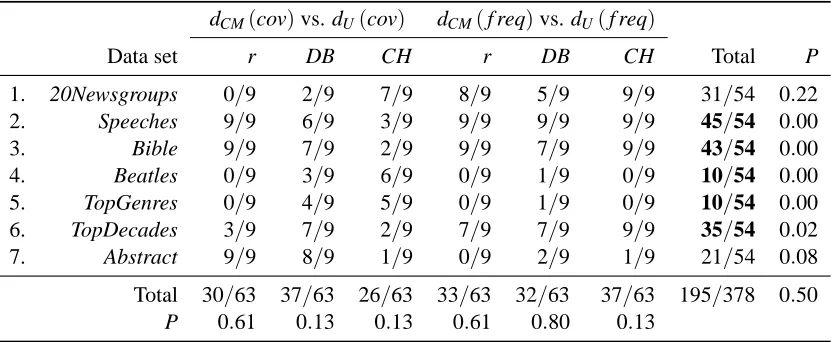
dCM(cov)vs. dU(cov) dCM(f req)vs. dU(f req)
Data set r DB CH r DB CH Total P
1. 20Newsgroups 0/9 2/9 7/9 8/9 5/9 9/9 31/54 0.22 2. Speeches 9/9 6/9 3/9 9/9 9/9 9/9 45/54 0.00 3. Bible 9/9 7/9 2/9 9/9 7/9 9/9 43/54 0.00 4. Beatles 0/9 3/9 6/9 0/9 1/9 0/9 10/54 0.00 5. TopGenres 0/9 4/9 5/9 0/9 1/9 0/9 10/54 0.00 6. TopDecades 3/9 7/9 2/9 7/9 7/9 9/9 35/54 0.02 7. Abstract 9/9 8/9 1/9 0/9 2/9 1/9 21/54 0.08
Total 30/63 37/63 26/63 33/63 32/63 37/63 195/378 0.50
P 0.61 0.13 0.13 0.61 0.80 0.13
Table 3: Summary of the performance results of the CM distance versus the base distance. A single entry contains the number of clustering algorithm configurations (see Column 1 in Table 4) in which the CM distance was better than the base distance. The P-value is the standard Fisher’s sign test.
We see from Table 3 that the performance of CM distance against the base distance depends on the data set. For example, the CM distance has tighter clusterings in Speeches, Bible, and TopDecade whereas the base distance outperforms the CM distance in Beatles and TopGenre.
Table 4 suggests that the overall performance of the CM distance is as good as the base distance. The CM distance obtains a better index 195 times out of 378. The statistical test suggests that this is a tie. The same observation is true if we compare the distances algorithmic-wise or index-wise.
7.4 Distance Matrices
dCM(cov)vs. dU(cov) dCM(f req)vs. dU(f req)
Algorithm r DB CH r DB CH Total P
1. K-MED(3) 4/7 2/7 5/7 4/7 4/7 4/7 23/42 0.44 2. K-MED(4) 4/7 4/7 3/7 4/7 4/7 4/7 23/42 0.44 3. K-MED(5) 4/7 4/7 3/7 4/7 4/7 4/7 23/42 0.44
4. LINK(3) 3/7 4/7 3/7 2/7 3/7 4/7 19/42 0.44
5. LINK(4) 3/7 4/7 3/7 4/7 3/7 4/7 21/42 0.88
6. LINK(5) 3/7 3/7 4/7 4/7 2/7 4/7 20/42 0.64
7. SPECT(3) 3/7 6/7 1/7 3/7 4/7 4/7 21/42 0.88
8. SPECT(4) 3/7 4/7 3/7 4/7 4/7 4/7 22/42 0.64
9. SPECT(5) 3/7 6/7 1/7 4/7 4/7 5/7 23/42 0.44
Total 30/63 37/63 26/63 33/63 32/63 37/63 195/378 0.50
P 0.61 0.13 0.13 0.61 0.80 0.13
Table 4: Summary of the performance results of the CM distance versus the base distance. A single entry contains the number of data sets (see Column 1 in Table 3) in which the CM distance was better than the base distance. The P-value is the standard Fisher’s sign test.
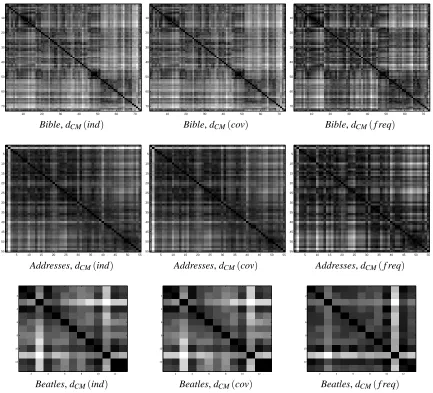
We calculated the distance matrices using the feature sets ind, cov, and freq. The matrices are given in Figures 4 and 3. In addition, we computed performance indices, a ratio of the mean of the intra-cluster distances and the mean of the inter-cluster distances, for various clusterings and compare these indices to the ones obtained from the base distances. The results are given in Table 5.
cov freq
Data Clustering ind dCM dU dCM dU
Bible Old Test.|New Test. 0.79 0.79 0.82 0.73 0.81 Old Test.|Gospels|Epistles 0.79 0.79 0.81 0.73 0.81
Addresses 1–32|33–55 0.79 0.80 0.85 0.70 0.84 1–11|12–22|23–33|34–44|45–55 0.83 0.83 0.87 0.75 0.87
Beatles 1,2,4–6|7–10,12–13|3|11 0.83 0.86 0.83 0.88 0.61 1,2,4,12,13|5–10|3|11 0.84 0.85 0.84 0.89 0.63
20Newsgroups Rel.,Pol.|Rest 0.76 0.77 0.67 0.56 0.62 Rel.,Pol.|Comp., misc|Rest 0.78 0.78 0.79 0.53 0.79
TopGenres Act.,Adv., SciFi|Rest 0.74 0.73 0.64 0.50 0.32
TopDecades 1930–1960|1970–2000 0.84 0.83 0.88 0.75 0.88 1930–1950|1960–2000 0.88 0.88 0.98 0.57 1.06
2 4 6 8 10 12 14 16 18 20 2 4 6 8 10 12 14 16 18 20
20Newsgroups, dCM(ind)
2 4 6 8 10 12 14 16 18 20
2 4 6 8 10 12 14 16 18 20
20Newsgroups, dCM(cov)
2 4 6 8 10 12 14 16 18 20
2 4 6 8 10 12 14 16 18 20
20Newsgroups, dCM(f req)
1 2 3 4 5 6 7 8
1 2 3 4 5 6 7 8
TopGenres, dCM(ind)
1 2 3 4 5 6 7 8
1 2 3 4 5 6 7 8
TopGenres, dCM(cov)
1 2 3 4 5 6 7 8
1 2 3 4 5 6 7 8
TopGenres, dCM(f req)
1 2 3 4 5 6 7 8
1 2 3 4 5 6 7 8
TopDecades, dCM(ind)
1 2 3 4 5 6 7 8
1 2 3 4 5 6 7 8
TopDecades, dCM(cov)
1 2 3 4 5 6 7 8
1 2 3 4 5 6 7 8
TopDecades, dCM(f req)
1 2 3 4 5 6 7 8 9 10
1 2 3 4 5 6 7 8 9 10
Abstract, dCM(ind)
1 2 3 4 5 6 7 8 9 10
1 2 3 4 5 6 7 8 9 10
Abstract, dCM(cov)
1 2 3 4 5 6 7 8 9 10
1 2 3 4 5 6 7 8 9 10
Abstract, dCM(f req)
Figure 3: Distance matrices for 20Newsgroups, TopGenres, TopDecades, and Abstract. In the first column the feature set ind contains the independent means, in the second feature set cov the pairwise correlation is added, and in the third column the feature set freq consists of 10K most frequent itemsets, where K is the number of attributes. Darker colours indicate smaller distances.
We should stress that standard edit distances would not work in these data setups. For example, the sequences have different lengths and hence Levenshtein distance cannot work.
10 20 30 40 50 60 70 10 20 30 40 50 60 70
Bible, dCM(ind)
10 20 30 40 50 60 70
10 20 30 40 50 60 70
Bible, dCM(cov)
10 20 30 40 50 60 70
10 20 30 40 50 60 70
Bible, dCM(f req)
5 10 15 20 25 30 35 40 45 50 55
5 10 15 20 25 30 35 40 45 50 55
Addresses, dCM(ind)
5 10 15 20 25 30 35 40 45 50 55
5 10 15 20 25 30 35 40 45 50 55
Addresses, dCM(cov)
5 10 15 20 25 30 35 40 45 50 55
5 10 15 20 25 30 35 40 45 50 55
Addresses, dCM(f req)
2 4 6 8 10 12
2 4 6 8 10 12
Beatles, dCM(ind)
2 4 6 8 10 12
2 4 6 8 10 12
Beatles, dCM(cov)
2 4 6 8 10 12
2 4 6 8 10 12
Beatles, dCM(f req)
Figure 4: Distance matrices for Bible, Addresses, and Beatles. In the first column the feature set ind contains the independent means, in the second feature set cov the pairwise correlation is added, and in the third column the feature set freq consists of 10K most frequent itemsets, where K is the number of attributes. Darker colours indicate smaller distances.
46th book. The New Testament starts from the 47th book. An alternative clustering is obtained by separating the Epistles, starting from the 52th book, from the Gospels. In Addresses we some temporal dependence. Early speeches are different than the modern speeches. In Beatles we see that the early albums are linked together and the last two albums are also linked together. The third album, Help!, is peculiar. It is not linked to the early albums but rather to the later work. One explanation may be that, unlike the other early albums, this album does not contain any cover songs. In 20Newsgroups the groups of politics and of religions are close to each other and so are the computer-related groups. The group misc.forsale is close to the computer-related groups. In
TopDecades and in Abstract we see temporal behaviour. In Table 5 the CM distance outperforms
the base distance, except for Beatles and TopGenres.
8. Conclusions and Discussion
Our task was to find a versatile distance that has nice statistical properties and that can be evaluated efficiently. The CM distance fulfils our goals. In theoretical sections we proved that this distance takes properly into account the correlation between features, and that it is the only (Mahalanobis) distance that does so. Even though our theoretical justifications are complex, the CM distance itself is rather simple. In its simplest form, it is the L2 distance between the means of the individual
attributes. On the other hand, the CM distance has a surprising form when the features are itemsets.
In general, the computation time of the CM distance depends of the size of sample space that can be exponentially large. Still, there are many types of feature functions for which the distance can be solved. For instance, if the features are itemsets, then the distance can be solved in polynomial time. In addition, if the itemsets form an antimonotonic family, then the distance can be solved in linear time.
In empirical tests the CM distance implied that the used data sets have structure, as expected. The performance of the CM distance compared to the base distance depended heavily on the data set. We also showed that the feature sets ind and cov produced almost equivalent distances, whereas using frequent itemsets produced very different distances.
Sophisticated feature selection methods were not compared in this paper. Instead, we either decided explicitly the set of features or deduced them using APRIORI. We argued that we cannot use the traditional approaches for selecting features of data sets, unless we are provided some additional information.
Acknowledgments
The author would like to thank Heikki Mannila and Kai Puolamäki for their extremely helpful comments.
Appendix A.
In this section we will prove the theorems given in this paper.
A.1 Proof of Theorem 1
To simplify the notation denote S0(x) =1,θ∗1= [1,θ11, . . . ,θ1N]T andθ∗2= [1,θ21, . . . ,θ2N]T. The
norm function restricted to the affine space has one minimum and it can be found using Lagrange multipliers. Thus we can express the vectors uiin Eq. 2
where j∈Ωandλiis the column vector of length N+1 consisting of the corresponding Lagrange
multipliers. The distance is equal to
dCM(D1,D2|S)2=|Ω|ku1−u2k22, =|Ω|
∑
j∈Ω
(u1 j−u2 j) (u1 j−u2 j),
=|Ω|
∑
j∈Ω
(u1 j−u2 j) λ1TS(j)−λT2S(j)
,
=|Ω|(λ1−λ2)T
∑
j∈Ω
(u1 j−u2 j)S(j),
=|Ω|(λ1−λ2)T(θ∗1−θ∗2).
Since ui∈
C
(S,θi), the multipliersλi can be solved from the equationθ∗
i =
∑
j∈Ω
S(j)ui j=
∑
j∈Ω
S(j)λTi S(j) =
∑
j∈Ω
S(j)S(j)T
! λi,
that is,θ∗i =Aλi, where A is an(N+1)×(N+1)matrix Axy=∑jSx(j)Sy(j). It is straightforward
to prove that the existence of Cov−1[S]implies that A is also invertible. Let B be an N×N matrix
formed from A−1by removing the first row and the first column. We have |Ω|ku1−u2k22=|Ω|(θ∗1−θ∗2)TA−1(θ∗1−θ∗2),
=|Ω|(θ1−θ2)TB(θ1−θ2).
The last equality is true sinceθ∗10=θ∗ 20.
We need to prove that|Ω|B=Cov−1[S]. Let[c; B]be the matrix obtained from A−1by removing the first row. Letγ=E[S]taken with respect to the uniform distribution. Since the first column of
A is equal to|Ω|[1,γ], it follows that c=−Bγ. From the identity
cxA(0,y)+
N
∑
z=1
B(x,z)A(z,y)=δxy
we have
N
∑
z=1
B(x,z) A(z,y)−A(0,y)γz
=
N
∑
z=1
|Ω|B(x,z)
|Ω|−1A(z,y)−γyγz
=δxy.
Since|Ω|−1A(z,y)−γzγyis equal to the(z,y)entry of Cov[S], the theorem follows.
A.2 Proofs of Theorems given in Section 2.2
Proof [Theorem 2] The covariance matrix Cov[S]in Theorem 1 depends only on S and is positive definite. Therefore, the CM distance is a Mahalanobis distance.
Proof [Theorem 3] Let θi=S(Di) for i=1,2,3. The frequencies for D1∪D3 and D2∪D3 are (1−ε)θ1+εθ3and(1−ε)θ2+εθ3, respectively. The theorem follows from Theorem 1.
Lemma 10 Let A :RN→RMand define a function T(ω) =A(S(ω)). Letφ=T(D)andθ=S(D)
be the frequencies for some data set D. Assume further that there is no two data sets D1and D2such that S(D1) =S(D2)and T(D1)6=T(D2). Then dCM(D1,D2|T)≤dCM(D1,D2|S). The equality holds if for a fixedφthe frequencyθis unique.
Before proving this lemma, let us explain why the uniqueness requirement is needed: Assume that the sample spaceΩconsists of two-dimensional binary vectors, that is,
Ω={(0,0),(1,0),(0,1),(1,1)}.
We set the features to be S(ω) = [ω1,ω2]T. Define a function T(x) = [ω1,ω2,ω1ω2]T = [S1(ω),S2(ω),S1(ω)S2(ω)]T. Note that uniqueness assumption is now violated. Without this
as-sumption the lemma would imply that dCM(D1,D2|T)≤dCM(D1,D2|S)which is in general false.
Proof Letθ1=S(D1) andφ1=T(D1). Pick u∈
C
(S,θ1). The frequency of S taken with therespect to u isθ1and because of the assumption the corresponding frequency of T isφ1. It follows
that
C
(S,θi)⊆C
(T,φi). The theorem follows from the fact that the CM distance is the shortestdistance between the affine spaces
C
(S,θ1)andC
(S,θ2).A.3 Proof of Theorem 7
It suffices to prove that the matrix C(S)is proportional to the covariance matrix Cov[S]. The notation δ(ω1|ω2)used in the proof represents a feature functionδ:Ω→ {0,1}which returns 1 ifω1=ω2
and 0 otherwise.
Before proving the theorem we should point one technical detail. In general, C(S) may be singular, especially in Assumption 1. In our proof we will show that C(S)∝Cov[S]and this does not require C(S)to be invertible. However, if one wants to evaluate the distance d, then one must assume that C(S)is invertible.
Fix indices i and j such that i6= j. Let T(ω) = [Si(ω),Sj(ω)]T. If follows from Assumption 1
that
C(T) =
Cii(S) Ci j(S)
Cji(S) Cj j(S)
.
This implies that Ci j(S)depends only on Siand Sj. In other words, we can say Ci j(S) =Ci j(Si,Sj).
Let ρ : {1, . . . ,N} → {1, . . . ,N} be some permutation function and define U(x) =
Sρ(1)(x), . . . ,Sρ(N)(x)
T
. Assumption 1 implies that
Cρ(i)ρ(j)(S) =Ci j(U) =Ci j(Ui,Uj) =Ci j(Sρ(i),Sρ(j)).
This is possible only if all non-diagonal entries of C have the same form or, in other words, Ci j(S) =
Ci j(Si,Sj) =C(Si,Sj). Similarly, the diagonal entry Sii depends only on Si and all the diagonal
entries have the same form Cii(S) =C(Si). To see the connection between C(Si) and C(Si,Sj) let
V(ω) = [Si(ω),Si(ω)]T and let W(ω) = [2Si(ω)]T. We can represent W(ω) =V1(ω) +V2(ω). Now
Assumption 1 implies
which shows that C(Si) =C(Si,Si). Fix Sj and note that Assumption 1 implies that C(Si,Sj) is a
linear function of Si. Thus C has a form
C(Si,Sj) =
∑
ω∈Ω
Si(ω)h(Sj,ω)
for some specific map h. Letα∈Ω. Then C(δ(ω|α),Sj) =h(Sj,α)is a linear function of Sj. Thus
C has a form
C(Si,Sj) =
∑
ω1,ω2∈Ω
Si(ω1)Sj(ω2)g(ω1,ω2)
for some specific g.
Letα, β, andγbe distinct points inΩ. An application of Assumption 2 shows that g(α,β) = C(δ(ω|α),δ(ω|β)) = C(δ(ω|α),δ(ω|γ)) = g(α,γ). Thus g has a form g(ω1,ω2) = aδ(ω1|ω2) +b for some constants a and b.
To complete the proof note that Assumption 1 implies that C(S+b) =C(S) which in turns implies that∑xg(ω1,ω2) =0 for all y. Thus b=−a|Ω|−1. This leads us to
C(Si,Sj) =
∑
ω1,ω2∈Ω
Si(ω1)Sj(ω2)
aδ(ω1|ω2)−a|Ω|−1
,
=a
∑
ω∈Ω
Si(ω)Sj(ω)−a
∑
ω∈Ω Si(ω)
!
∑
ω∈Ω|Ω|−1Sj(ω)
!
,
∝E[SiSj]−E[Si]E[Sj],
where the means are taken with respect to the uniform distribution. This identity proves the theorem.
A.4 Proof for Lemma 8
Let us prove that Cov[TF] =0.5I. Let A be an itemset. There are odd number of ones in A in exactly half of the transactions. Hence, E
T2
A
=E[TA] =0.5. Let B6=A be an itemset. We wish to have
TB(ω) =TA(ω) =1. This means thatωmust have odd number of ones in A and in B. Assume that
the number of ones in A∩B is even. This means that A−B and B−A have odd number of ones.
There is only a quarter of all the transactions that fulfil this condition. If A∩B is odd, then we must
an even number of ones in A−B and B−A. Again, there is only a quarter of all the transactions for
which this holds. This implies that E[TATB] =0.25=E[TA]E[TB]. This proves that Cov[TF] =0.5I.
A.5 Proof of Theorem 9
Before proving this theorem let us rephrase it. First, note even though d(·,· | ·)is defined only on the conjunction functions SF, we can operate with the parity function TF. As we stated before there is an invertible matrix A such that TF =ASF. We can write the distance as
d(D1,D2|SF)2= (Aθ1−Aθ2)T A−1
T
C(SF)−1A−1(Aθ1−Aθ2).
Thus we define C(TF) =AC(SF)AT. Note that the following lemma implies that the condition
stated in Theorem 9 is equivalent to C(TA) =cI, for some constant c. Theorem 9 is equivalent to
stating that C(TF) =cI.
Lemma 11 Let
A
be the family of all itemsets. There existsε>0 such that for each real vectorγof length 2K−1 that satisfieskγk2<εthere exist distributions p and q such thatγ=Ep[TA]−Eq[TA].Proof To ease the notation, add T0(x) =1 to TAand denote the end result by T∗. We can consider T∗
as a 2K×2K matrix, say A. Let p be a distribution and let u be the vector of length 2Krepresenting the distribution. Note that we have Au=Ep[T∗]. We can show that A is invertible. Let U some
2K−1 dimensional open ball of distributions. Since A is invertible, the set V∗={Ax|x∈U}is a 2K−1 dimensional open ellipsoid. Define also V by removing the first coordinate from the vectors
of V∗. Note that the first coordinate of elements of V∗ is equal to 1. This implies that V is also a 2K−1 dimensional open ellipsoid. Hence we can pick an open ball N(θ,ε)⊂V . The lemma
follows.
We are now ready to prove Theorem 9:
Abbreviate the matrix C(TF)by C. We will first prove that the diagonal entries of C are equal to c. Let
A
be the family of all itemsets. Select G∈F
and defineR
={H∈F
|H⊆G}. As we stated above, C(TA) =cI and Assumption 2 imply that C(TR) =cI. Assumption 1 implies thatd ·,· |SR2
≤d(·,· |SF)2≤d(·,· |SA)2. (8) Selectεcorresponding to Lemma 11 and letγA = [0, . . . ,ε/2, . . . ,0]T, that is,γA is a vector whose entries are all 0 except the entry corresponding to G. Lemma 11 guarantees that there exist distri-butions p and q such that d(p,q|SA)2=ckγAk22. LetγF =Ep[TF]−Eq[TF]andγR =Ep
TR−
Eq
TR
. Note thatγR andγF has the same form asγA. It follows from Eq. 8 that
cε2/4≤CG,Gε2/4≤cε2/4,
where CG,Gis the diagonal entry of C corresponding to G. It follows that CG,G=c.
To complete the proof we need to show that CG,H=0 for G,H∈
F
,G6=H. Assume that CX,Y6=0 and let s be the sign of CG,H. Apply Lemma 11 again and select γA =
[0, . . . ,ε/4,0, . . . ,0,sε/4, . . . ,0]T, that is, γA has ε/4 and sε/4 in the entries corresponding to G
and H, respectively, and 0 elsewhere. The right side of Eq. 8 implies that
2cε2/16+2|C
G,H|ε2/16≤2cε2/16
which is a contradiction and it follows that CG,H=0. This completes the theorem.
References
Rakesh Agrawal, Tomasz Imielinski, and Arun N. Swami. Mining association rules between sets of items in large databases. In Peter Buneman and Sushil Jajodia, editors, Proceedings of the 1993
ACM SIGMOD International Conference on Management of Data, pages 207–216, Washington,
D.C., 26–28 1993.
Rakesh Agrawal, Heikki Mannila, Ramakrishnan Srikant, Hannu Toivonen, and Aino I. Verkamo. Fast discovery of association rules. In Usama M. Fayyad, Gregory Piatetsky-Shapiro, Padhraic Smyth, and Ramasamy Uthurusamy, editors, Advances in Knowledge Discovery and Data
Pierre Baldi, Paolo Frasconi, and Padhraic Smyth. Modeling the Internet and the Web. John Wiley & Sons, 2003.
Michéle Baseville. Distance measures for signal processing and pattern recognition. Signal
Pro-cessing, 18(4):349–369, 1989.
Toon Calders. Axiomatization and Deduction Rules for the Frequency of Itemsets. PhD thesis, University of Antwerp, Belgium, 2003.
Tadeusz Calinski and Jerzy Harabasz. A dendrite method for cluster analysis. Communications in
Statistics, 3:1–27, 1974.
Gregory Cooper. The computational complexity of probabilistic inference using Bayesian belief networks. Artificial Intelligence, 42(2–3):393–405, Mar. 1990.
Imre Csiszár. I-divergence geometry of probability distributions and minimization problems. The
Annals of Probability, 3(1):146–158, Feb. 1975.
David L. Davies and Donald W. Bouldin. A cluster separation measure. IEEE Transactions of
Pattern Analysis and Machine Intelligence, 1(2):224–227, April 1979.
Thomas Eiter and Heikki Mannila. Distance measures for point sets and their computation. Acta
Informatica, 34(2):109–133, 1997.
Theodore Hailperin. Best possible inequalities for the probability of a logical function of events.
The American Mathematical Monthly, 72(4):343–359, Apr. 1965.
David Hand, Heikki Mannila, and Padhraic Smyth. Principles of Data Mining. The MIT Press, 2001.
Jaakko Hollmén, Jouni K Seppänen, and Heikki Mannila. Mixture models and frequent sets: Com-bining global and local methods for 0-1 data. In Proceedings of the SIAM Conference on Data
Mining (2003), 2003.
Solomon Kullback. Information Theory and Statistics. Dover Publications, Inc., 1968.
Vladimir I. Levenshtein. Binary codes capable of correcting deletions, insertions and reversals.
Soviet Physics Doklady., 10(8):707–710, February 1966.
Heikki Mannila, Dmitry Pavlov, and Padhraic Smyth. Prediction with local patterns using cross-entropy. In Knowledge Discovery and Data Mining, pages 357–361, 1999.
Andrew Y. Ng, Michael I. Jordan, and Yair Weiss. On spectral clustering: Analysis and an algo-rithm. In Advances in Neural Information Processing Systems 14, 2002.