Comparative Sequence Analysis of Different Strains of
African Swine Fever Virus Outer Proteins Encoding
Genes from Nigeria, 2009 – 2014
Pam D. Luka1,2,*, Joseph Erume2, Frank N. Mwiine2, David Shamaki3, Bitrus Yakubu1
1
Biotechnology Division, National Veterinary Research Institute, Vom, Nigeria
2
College of Veterinary Medicine, Animal Resources and Biosecurity, Makerere University, Kampala, Uganda
3
Directorate of Research, National Veterinary Research Institute, Vom, Nigeria
Abstract
African swine fever (ASF) is an economically important disease of domestic pigs causing a huge amount of losses. Understanding the extent and dynamics of genetic diversity of genes coating outer proteins is required for a rational vaccine design and interpretation of efficacy of vaccine or therapy for the control of ASF. This study was designed to investigate the nucleotide structure of genes: E183L, KP177R and O61R encoding outer proteins p54, p22 and p12, respectively, of African swine fever virus isolates from Nigeria for genetic variability. The samples were collected over three years and analyzed for relatedness using MEGA5 and Hopp and Woods procedure for predicting protein antigenic determinants. The result of our comparative study revealed variability in p12 sequences of the isolates collected from different locations within the country. The p54 and p22 genes were observed to be more conserved among the isolates. Hydropathy analysis of all the genes failed to reveal any structural variability within the proteins of interest. Our study revealed mutations (insertions/deletions) within the 3’ terminus of the p12 gene thus we conclude that p12 is under selection pressure and therefore, its utility needs to be further assessed widely for genetic diversity, antigenicity and pathogenicity of the virus.Keywords
African swine fever virus, p54 gene, p22 gene, p12 gene, Comparative sequence analysis, Hydropathy profile, Nigeria1. Introduction
African swine fever (ASF) is an economically significant disease of pigs caused by a large DNA virus and a sole member of the family Asfarviridae and genus Asfivirus 1 [1]. African swine fever virus (ASFV) within an infected host, replicates in the cytoplasm with variable levels of virulence that ranges from highly lethal to subclinical infections. The virus within an infected host elicits a peculiar immune response in which no neutralizing antibodies produced are effective and apparently healthy animals become carriers [2]. Both domestic and wild pigs are susceptible to the virus with the soft tick (Ornithodoros genus) being the primary reservoir. Wild African suids such as warthogs and bush pigs have been reported to be infected but hitherto remained clinically asymptomatic.
The ASF virion is ~200 nm in diameter and contains more than 50 proteins and consists of several concentric
* Corresponding author:
[email protected] (Pam D. Luka) Published online at http://journal.sapub.org/ijvmb
Copyright © 2016 Scientific & Academic Publishing. All Rights Reserved
layers enclosing an electron-dense nucleoid, containing a double stranded DNA genome of 170-190 kilobase pairs (kbp). The viral core is enwrapped by an inner lipid envelope beneath the icosahedral capsid [3]. The extracellular particles also possess an additional envelope which is derived from the plasma membrane. However, on analysis of cell extracts at various life cycle phases of the virus revealed more than 100 viral proteins [4].
ASF has been reported in most sub-Saharan Africa where the virus is maintained within a sylvatic cycle that involves soft tick (Ornithodoros genus) infecting wild pigs with asymptomatic effects. The virus then replicates in the tick before being transmitted to wild swine through blood meal and the cycle maintained indefinitely. Interestingly, these has facilitated the persistence and emergence of new variants in east, central and southern Africa. However, a domestic cycle with or without the involvement of ticks also occur and common in West Africa [5].
Eventually the disease became endemic in the island of Sardinia [7]. Recently, the disease was re-introduced into the borders of Europe with Ukraine, Georgia, Poland, Ukraine, the Caucasus and the Russian federation being affected and posing varying risk of introduction to other European ASF free countries [8-10].
Several factors such as genome length variation between different ASFV isolates, host susceptibility, presence of tick vectors, and the probable interaction amongst host, suids and vectors has been associated with virulence and pathogenicity of viral isolates [11, 12]. Structurally, the ASFV p54 protein is a viral structural protein of 25-27 kDa, which is externally located. It’s a putative transmembrane domain localized at the endoplasmic reticulum (ER)-derived envelope precursors. The protein is encoded by the E183L gene open reading frame (ORF) [13] and critical for the recruitment and transformation of the ER membranes into the precursors of the viral envelope for the virus viability and early viral infection and adsorption to susceptible host cells [14]. Other published reports have also shown that p12, p22, and p30 are equally essential viral proteins that are also involved in early events of replication [15].
The p22 protein is encoded by the gene - ORF KP177R, has an apparent molecular weight 22 kDa and located externally in the viral particle and carries a hydrophobic domain that is characterized by a signal peptide. Whereas the ASFV virus protein p12 (ORF O61R) mediates in the adsorption of ASFV to susceptible cells via the structural virus proteins located within the outer envelope of the virion. The protein appears and accumulates late after the earlier phases of infection have occurred without undergoing posttranslational modification to become functional [13, 16, 17]. Previous studies reported high level of conservation of the 5’ flanking region of the p12 gene and high variability of the downstream 3’ end [18]. However, Vlasova et al., [19] in a comparative study of the three genes revealed that the p12 gene seems to be under selection pressure.
Since there is no available vaccine against ASF, stringent bio-security and rapid diagnostic response are options for the control and eradication of the disease in sub-Saharan Africa and Nigeria. Nevertheless, several vaccine studies have been conducted but with minimal or no success of obtaining long-term neutralizing antibodies. This lack of ASFV vaccines might be due to unique molecular and biological properties of the virus and the interactions of its proteins which are responsible for virus–cell interactions [20, 21].
The virus within infected host elicits certain immune responses from its structural proteins to which neutralizing antibodies are produced against them [15, 20]. Extensive studies into the genetic structure, genes, and immune mechanisms of the virus which affect viral replication, virus–host interactions, and virulence will help in understanding the viral biological characteristics and mechanism of disease for comprehensive and effective
control strategies for the agent to be achieved [6, 22]. During infection, the host cell comes in contact with both external and proteins structures of the virus. This interaction stimulates the production of immune structures for effective control. As a result, the aim of this study was to investigate the nucleotide structure of genes encoding outer proteins p54, p22 andp12 of African swine fever virus isolates from Nigeria and compare with others obtained globally for possible variation.
2. Materials and Methods
2.1. Study Area and Samples
Nigeria is a federated country comprising 36 states and the Federal Capital Territory and bordered by four countries namely Benin, Niger, Chad, Cameroon and the Atlantic Ocean. Pig production is concentrated in the south western, central and eastern parts of the country but restricted in the north due to cultural and religious bias. In this study, 31 ASF confirmed positive samples collected by field veterinarians and submitted to the Central Diagnostics Laboratory (CDL) of the National Veterinary Research Institute (NVRI), Vom Nigeria from 2009 – 2014 were used for this study. The samples were collected from domestic pigs from 6 states (Anambra, Benue, Cross River, Delta, Lagos and Plateau states).
2.2. DNA Amplification of ASFV p12, p22 and p54 genes
DNA from field samples were extracted from liver, spleen, and mediasternal lymph nodes using QIAamp DNA mini kit (Qiagen, Hilden, Germany) according to the manufacturer’s specification. Lyophilized freeze-dried E70 from the European Union reference laboratory for ASF (CISA-INIA, Madrid Spain) was used as control for this study. The expected genes were amplified with primers according to protocols earlier described by Nielan et al., [20] and Angulo et al., [18]. The PCR products were resolved on 2% agarose gel.
2.3. DNA Sequencing and Sequence Analysis
Amplicons obtained were purified using the Wizard® SV Gel and PCR Clean-Up System (Promega, Madison USA) according to manufacturers’ specifications and shipped to Inqaba biotec®, South Africa for sequencing. The three gene segments (p54, p22 and p12) were sequenced using the ABI Big Dye V3.1 kit cycle sequencing on the ABI PRISM® 3100 Genetic Analyzer (Applied Biosystems).
for comparison as reference sequences of genes p54 (protein ID CBW46791.1), p22 (protein ID CBW46645.1), p12 (protein ID CBW46764.1).
2.4. Hydropathy Profiles Analysis
The initial step in search of antigenic determinants [24] in pathogenic organism is by analysing the protein(s) that antibody binds. Therefore, deduced amino acids were analysed for antigenic determinants. Hydrophobic amino acids on protein folding and function were also analysed based on Hoop and Wood [25] method on
www.web.expasy.org/protscale/
3. Result
3.1. Sequence Analysis
The expected 603, 534 and 138 bp fragments for the corresponding p54, p22 and p12 genes respectively were amplified from the 31 ASF positive tissue samples collected. All the positive samples amplified a single and discrete corresponding amplicon. The nucleotide sequences of the ASFV isolates were deposited into GenBank (accession nos. p54: KT150945-150973 KT961344-961363; p22: KU641719-641749 and p12: KU641698-641718).
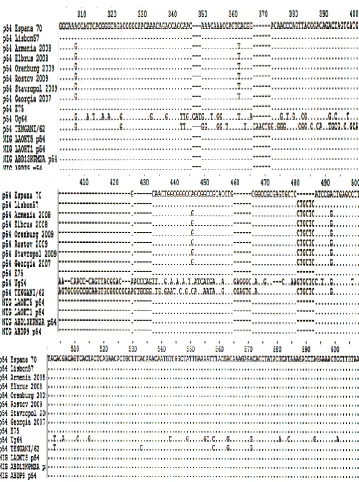
Figure 1. Multiple sequence alignment of p54 gene sequences of ASFV isolates where: (points) denotes identical nucleotide, - (dash) indicates deletions of nucleotide
Sequence analysis revealed that all the nucleotide sequences of the gene encoding p54 from Nigeria were identical to each other and to Espana70 and E75 sequences (Figure 1, only four sequences are shown). Between positions 180-190, all the Russian isolates have 6 nt deletions while Nigeria and European have 3nt. The Ug64 isolate do not have a deletion at that position. Also at positions 458, 6nt deletions were also observed for both Nigerian, European and Russian isolates with the exception of Tengani62 and Ug64 isolates.
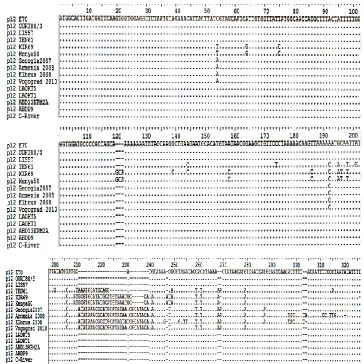
Similarly, nucleotide sequence structure of the p22 gene was also identical for all the Nigeria isolates obtained from this study (only LAOKT5, LAOKT1, ABD13KPM2A, ABDP9 and C-River are shown) and the European. The
Georgia 2007 and the Russian ASFV isolates (Stavropol 2008, Armenia 2008), thirteen nucleotide substitutions were recognized which were not found in the referenced E75 strain genome (Figure 2). The p22 nucleotide sequence are generally conserved except for the few point mutations from the Georgia 2007 and Russian strain that corresponded to silent mutations and gave rise to conservative amino acid changes (data not shown).
European gene sequences with the exception of some African isolates (TEN61, KIR69 and Kenya 50) which has less than the 28nt in number. Comparatively, a few mutations were observed between nucleotide positions 170-265 for all the sequences compared with each other. Identical nucleotide sequences were observed between the
Figure 2. Multiple sequence alignment of p22 gene sequences of ASFV isolates where: (points) denotes identical nucleotide, - (dash) indicates deletions of nucleotide
Figure 3. Multiple sequence alignment of p12 gene sequences of ASFV isolates where:. (points) denotes identical nucleotide, - (dash) indicates deletions
3.2. Hydropathy and Amino Acid Analysis
All the genes analyzed (p54, p22 and p12) showed single nucleotide substitutions. The substitution within p12 is within the 3’end (N-terminal) which has a net positive charge but not present in Nigerian and European sequences. However, analysis of these changes on the functional role of encoded proteins carried out revealed similar outcome as reported by Vlasova et al., [19].
Deduced amino acid sequence analysis and hydrophilicity profile of p54 revealed a 32aa stretch of hydrophobic residues and a 130aa long hydrophilic c-terminal. The N-terminal of all p54 sequences are conserved however, using reference sequence (Georgia 2007/1) a number of mutations were observed i.e. threonine to proline in African and European (E70, E75) strains but non on the eastern European strains. Only the Ugandan strain (Ug64) showed 3 mutations of tyrosine to Cysteine, Isoleucine to valine, and valine to isoleucine within the hydrophobic residues. Mutations to alanine was more prevalent with a highly variable c-terminal (Figure 4).
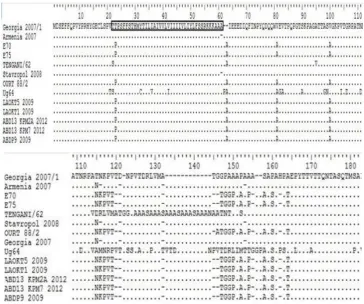
Similarly, the p22 amino acid profile reveals a highly hydrophobic stretch that consisted of 26 amino acid residues and a long hydrophilic C-terminus formed by 140 a.a. residues (Figure 5). Generally, the p22 a.a. were conserved compared to the other two genes. Three
mutational changes (leucine to valine, serine to threonine) were observed on all the African and European strains (Figure).
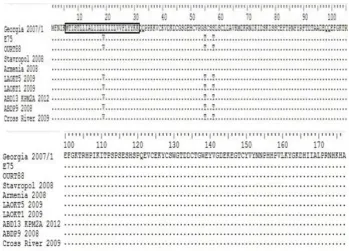
The deduced amino acid sequences of the p12 showed a stretch of 22 hydrophobic residues and a hydrophilic C-terminus formed by 13 a.a. residues (Figure 6). Fewer mutations were observed with non from the Nigerian, European and eastern European strains. Mutations were observed from East and Southern Africa strains. The mutations found were glycine to serine (SPE51), isoleucine to valine (KIR69, UGA591), glutamic acid to aspartic acid (TEN61, KIR69, SPE51), alanine to proline (KIR61) and asparagine to threonine (KIR61) (Figure 6).
3.3. Phylogenetic Analysis of ASFV Isolates
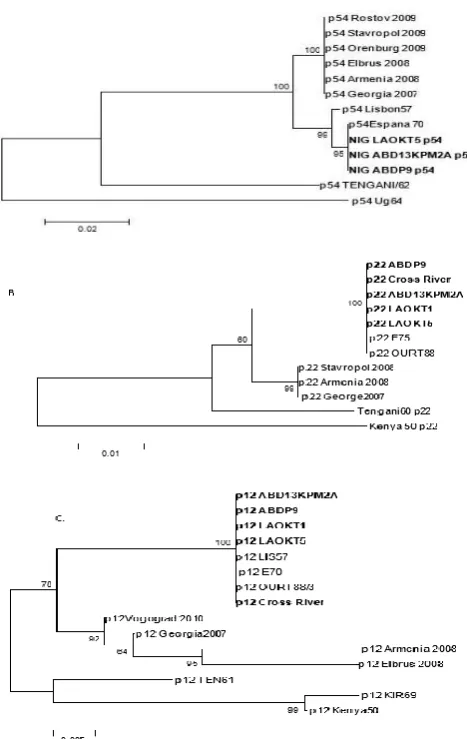
The results of phylogenetic analysis of the three (p54, p22, p12) genes obtained from 31 ASFVs from Nigeria are presented. A total of 26 sequences (p54) obtained from this study were compared with sequences from the GenBank database to infer phylogenetic relationship using neighbor-joining. The Nigerian p54 cluster with other European isolates, the other clusters are from the Armenia and Russian Federation and the southern Africa isolates (Tengani and Ug64) (Figure 7).
Figure 5. Deduced amino acid sequence of p22 gene nucleotide sequence in different ASF virus isolates. The complete amino acid sequence of strain Georgia 2007/1 (protein_id CBW46645.1) is shown for comparison; the boxed region corresponds to the hydrophobic segment. Only silent point or conservative mutations at the amino acids that change with respect to the sequence of Georgia 2007/1 are indicated
Figure 6. Deduced amino acid sequence of p12 gene nucleotide sequence in different ASF virus isolates. The complete amino acid sequence of strain Georgia 2007/1 (protein_id CBW46764.1) is shown for comparison; the boxed region corresponds to the hydrophobic segment. Only silent point or conservative mutations at the amino acids that change with respect to the sequence of Georgia 2007/1 are indicated
4. Discussion
ASF is a major economic and transboundary disease of pigs that causes significant mortality. Morbidity and mortality have continued to vary due to varying virulence of the virus within an infected area. Several authors had described high levels of variabilities across discrete regions which have been useful in differentiating closely related strains of the virus. However, none of the structural heterogeneity is up to 40% [18, 26].
Within the framework of Hoop and Woods [25] procedure, hydropathy profile has been reported to predict and or corresponds to adjacent antigenic determinants in relation to the functional properties of the protein structure. The ASFV deduced amino acids proteins sequences from our study were generally conserved and similar to previous results obtained by other workers [18, 19, 27] but with
minor variations (silent or conversed mutations) which translate into a changes such as Isoleucine to valine, glycine to serine glutamic acid to aspartic acid as observed in p12. This gene encoding an outer protein have been reported to be under selection pressure by their involvement in attachment and penetration into the host cell. Our finding is in agreement with Angulo et al [18] who suggested that conservation of the p12 polypeptide sequence was associated with selective pressure against mutations that alters the basic properties of the polypeptide due to its essential role in infection. Additionally, the p12 protein putative transmembrane domain that anchor the polypeptide chain externally and a cysteine-rich domain in the
Figure 7. Phylogenetic relationship of E183L (p54) genes (A), KP177R (p22) gene (B) and O61R (p12) gene (C) sequences of some representatives
The p22 (KP177R) proteins are localised on viral envelope as a single copy gene in BA71V and Georgia 2007/1 [33]. Our findings agree with Chapman et al [34] who reported that the p22 protein in Benin 97/1 and OURT 88/3 are 100% conserved. Besides, some genomes have been reported to encode 2 copies of the p22-related ORF which are quite divergent and expression of these proteins has been suggested to contribute to antigenic variation of the virus [33].
ASFV p54 is one of the most variable glycoprotein. Our study observed high level of variability across the amino acid sequence with the C-terminal showing the most variability. This is in agreement with the findings of Mima et al [35] who demonstrated mostly variability on the C-terminal region which is localized on the inner side of the cell membrane. However, high level of differences in the nucleotide sequences of p54gene (E183L) for various ASFV isolates used in this study may be the result of random mutations during virus evolution.
Genotically, several gene segments such as p72, p54, and central variable region (CVR) have being used to
characterize ASF virus. Several genotypes have been resolved globally with a majority of the genotypes circulating in East and Southern African due to the presence of wild pigs and tick vector [28]. Sequence analysis also suggests that the circulating viruses in Nigeria are homogenous and therefore reaffirms genotype I as the only circulating genotype in Nigeria [29, 30].
A phylogenetic analysis showed that all the Nigerian sequences cluster together separately from European, Russian/Eastern Europe and East/Southern Africa. Our findings suggest that the sequences are homogenous at the regional level and heterogeneous globally. This is in agreement with Vlasova et al [19] who reported a similar clustering of isolates from the Russian Federation and Armenia differently from sequences from Europe and Africa.
The p12 phylogenetic analysis also followed a similar pattern with those reported by Vlasova et al., [19] where the Nigerian, Russian, European, and Southern African strains cluster differently from each other. All the p12 sequences were conserved at the 5’ terminus whereas high level of variability at the 3’ terminus was observed. This is in agreement with findings of Angulo et al., [18]. The role of these variations in adaptation or virulence is yet to be determined. Nevertheless, based on Michaud et al., [31] and Rowlands et al., [32], the Russian cluster belong to genotype II, Nigeria and Europe genotype I, Ten61 genotype V, KIR69 and Kenya1950 genotype X.
5. Conclusions
There is scanty information in the GenBank for p12 sequences but for a wider comparison however, sequence analysis of the Nigerian and European strains observed deletions at the 3’flanking terminus of p12 and insertions for the Russian and Southern African strain. Our findings revealed that the p12 gene is more prone to mutation thus we conclude that p12 might be prone to selection pressure and its utility needs to be further assessed widely for genetic diversity. Although there is minimal diversity among p54 and p22 genes, it would be ideal to have a good representation of the diversity of circulating ASFV structural protein genes worldwide when thinking of vaccine design and efficacy. Considering that selective pressure plays an important role in structuring the diversity of antigens however, a single strain or gene may not represent global circulating strains if there is synergy between two or more genes.
ACKNOWLEDGEMENTS
National Veterinary Research Institute, Vom, Plateau State, Nigeria, and the IAEA Research Contract No: 18347/R0.
REFERENCES
[1] Dixon. L.K., Costa. J.V., Escribano. J.M., Rock. D.L., Vinuela. E., Wilkinson. P.J., 2000, Family Asfarviridae, Virus taxonomy: classification and nomenclature of viruses, Seventh report of the International Committee on Taxonomy of Viruses, Ed: M.H.V. van Regenmortel, C.M. Fanquet, D.H.L. Bishop, E.B. Carstens, M.K. Estes, S.M. Lemon, J. Maniloff, M.A. Mayo, D.L. McGeohh, C.R. Pringle, R.B. Wickner (eds), Academic press: San Diego, 2000:159–165. [2] Dimmock N.J., 1993, Neutralization of animal viruses. Curr.
Top Microbiol Immunol., 183:1-149.
[3] Carrascosa. J.L., Carazo. J.M., Carrascosa. A.L., Garcia. N., Santisteban. A., Vinuela. E., 1984, General morphology and capsid fine structure of African swine fever virus particles, Virol., 132:160-172.
[4] Zilda. G., Carvalho. A.P., De Matos. A., and Rodrigues-Pousada. C., 1988, Association of African swine fever virus with the cytoskeleton. Virus Res., 1:175–192. [5] Penrith. M.L., Thomson. G.R., and Bastos. A.D.S., 2004,
African swine fever. In: Coetzer, J.A.W., Tustin, R.C. (Eds), Infectious Diseases of Livestock with special Reference to Southern Africa. 2nd ed. Oxford University Press, Cape Town., 1087-1119.
[6] Costard. S., Wieland. B., de Glanville. W., Jori. F., Rowlands. R., Vosloo. W., Roger. F., Pfeiffer. D.U., and Dixon. L.K., 2009, African swine fever: how can global spread be prevented? Philos Trans R Soc Lond B Biol Sci., 364: 2683–2696.
[7] Martinez-Lopez. B., Perez. A.M., Feliziani. F., Rolesu. S., Mur. L., and Sanchez-Vizcaino. J.M., 2015, Evaluation of the risk factors contributing to the African swine fever occurrence in Sardinia, Italy. Front. Microbiol., 6:314. DOI:10.3389/fmicb.2015.00314.
[8] Gogin. A., Gerasimov. V., Malagolovkin. A., and Kolbasov. D., 2013, African Swine Fever in the North Caucasus region and the Russian Federation in years 2007-2012. Virus Res., 173:198-203.
[9] De la Torre. A., Bosch. J., Iglesias. I., Munoz. M.J., Mur. L., Martinez-Lopez. B., and Martinez. M., and Sanchez-Vizcaino. J.M., 2015, Assessing the Risk of African Swine Fever Introduction into the European Union by Wild Boar. Transbound Emerg Dis., 62:272-279.
[10] OIE, World Animal Health Information Database (WAHID) Interface. (2015) Available at: http://www.oie.int/wahis_2/ public/wahid.php/Wahidhome/Home. Accessed 19th November 2015.
[11] Tulman. E.R., and Rock. D.L., 2001, Novel virulence and host range genes of African swine fever virus. Curr Opin Microbial., 4:456–461.
[12] Portugal. R., Coelho. J., Höper. D., Little. N.S., Smithson. C., Upton. C., Martins. C., Leitão. A., and Keil. G.M., 2015, Related strains of African swine fever virus with different
virulence: genome comparison and analysis. J Gen Virol, 96:408–419.
[13] Carrascosa. A.L., Sastre. I., and Vinuela. E., 1991, African Swine Fever Virus Attachment Protein. J Virol., 65: 2283–2289.
[14] Rodriguez. J.M., Garcia-Escudero. R., Salas. M.L., and Andres. G., 2004, African swine fever virus structural protein p54 is essential for the recruitment of envelope precursors to assembly sites. J Virol., 78:4299-1313
[15] Gomez-Puertas. P., Rodrigueez. F., Oviedo. J.M., Ramiro-Ibanez. F., Ruiz-Gonzalvo. F., Alonso. C., and Escribano. J.M., 1996, Neutralizing Antibodies to Different Proteins of African Swine Fever Virus Inhibit both Virus Attachment and Internalization. J Virol., 70:5689–5694 [16] Alcami. A., Angulo. A., Lopez-Otin. C., Munoz. M., Freije.
J.M., Carrascosa. A. L., and Vinuela. E., 1992, Amino acid sequence and structural properties of protein p12, an African swine fever virus attachment protein. J Virol., 66:3860-3868. [17] Almazan. F., Rodriguez. J.M., Angulo. A., Vinuela. E., and Rodriguez. J.F., 1993, Transcriptional mapping of a late gene coding for the p12 attachment protein of African swine fever virus. J Virol., 67: 553-556.
[18] Angulo. A., Vinuela. E., and Alcami. A., 1992, Comparison of the sequence of the gene encoding African swine fever virus attachment protein p12 from field virus isolates and viruses passaged in tissue culture. J Virol., 3869-3872. [19] Vlasova. N.N., Kazakova. A.S., Varentsova. A.A., Akopian.
T.A., and Kostryukova. E.S., 2012, Comparative sequence analysis of the genes encoding outer proteins of African Swine fever virus isolates from different regions of Russian Federation and Armenia. Intl J Virol Mol Biol., 1:1-11. [20] Neilan. J.G., Zsak. L., Lu. Z., Burrage. T.G., Kutish. G.F., and
Rock. D.L., 2004, Neutralizing antibodies to African swine fever virus proteins p30, p54, and p72 are not sufficient for antibody-mediated protection. Virol., 319:337–342.
[21] Escribano. J.M., Galindo. I., and Alonso. C., 2013, Antibody-mediated neutralization of African swine fever virus: Myths and facts. Virus Res., 173:101–109
[22] FAO. African Swine Fever (ASF) Recent developments and timely updates - Worrisome dynamics: Steady spread towards unaffected areas could have disastrous impact. In Focus on No. 6. [electronic bulletin]. Rome, FAO. 2012. Available at http://www.fao.org/docrep/016/ap372e/ ap372e.pdf). [23] Tamura. K., Stecher. G., Peterson. D., Filipski. A., and Kumar.
S., 2013, MEGA6: Molecular Evolutionary Genetics Analysis Version 6.0. Mol. Biol. Evol., 30: 2725–2729. doi:10.1093/molbev/mst197.
[24] Fraga. S., 1982, Theoretical prediction of protein antigenic determinants from amino acid sequences. Can. J Chem., 60:2606-2610.
[25] Hopp. T. P., and Woods. K.R., 1981, Prediction of protein antigenic determinants from amino acid sequences. Proc Natl Acad Sci U S A. 78:3824-3828.
Rodriguez. J. F., and Escribano. J.M., 1996, The structural protein p54 is essential for African swine fever virus viability. Virus Res., 40:161–167.
[28] Bastos. A.D.S., Penrith. M.L., Cruciere. C., Edrich. J.L., Hutchings. G., Roger. F., Couacy-Hymann. E., and Thomson. G.R., 2003, Genotyping field strains of African swine fever virus by partial p72 gene characterization. Arch Virol, 148: 693–706.
[29] Owolodun. A.O., Bastos. A.D.S., Antiabong. J.F., Ogedengbe. M.E., Ekong. P. S., and Yakubu. B., 2010, Molecular characterization of African swine fever virus variants and reaffirms CVR epidemiological utility. Virus Genes., 41: 361-368.
[30] Luka. P.D., Achenbach. J.E., Mwiine. F.N., Lamien. C.E., Shamaki. D., Unger. H., and Erume. J., 2016, Genetic Characterization of Circulating African Swine Fever Viruses in Nigeria (2007–2015). Transbound Emerg Dis.,
doi:10.1111/tbed.12553.
[31] Michaud. V., Randriamparany. T., and Albina. E., 2013, Comprehensive phylogenetic reconstructions of African swine fever virus: proposal for a new classification and molecular dating of the virus. PLoS One., 8: e69662.
[32] Rowlands. R.J., Michaud. V., Heath. L., Hutchings. G., Oura. C., Vosloo. W., Dwarka. R., Onashvili. T., Albina. E., and Dixon. L.K., 2008, African swine fever virus isolate, Georgia, 2007. Emerg Infect Dis., 14:1870–1874.
[33] Chapman. D.A.G., Tcherepanov. V.,Upton. C., and Dixon. L.K., 2008, Comparison of the genome sequences of nonpathogenic and pathogenic African swine fever virus isolates. J Gen Virol., 89: 397–408.
[34] Chapman. D.A.G., Darby. A.C., Da Silva. M., Upton C., Radford. A.D., and Dixon. L.K., 2011, Genomic Analysis of Highly Virulent Isolate of African Swine Fever Virus. Emerg Infect Dis. DOI: 10.3201/eid1704.101283.