Ownership Identity and Mitigation of Diversification Discount:
Evidence from Malaysia
Kian-Tek Leea Sunway University
Chee-Wooi Hooyb Universiti Sains Malaysia
Abstract: This paper examines the mitigation effect of the ultimate ownership identity on the diversification discount under the emerging market’s institutional setting. Using a sample of non-financial listed firms in Malaysia from 2002 to 2013, the study reveals that government ultimate ownership is able to mitigate the diversification discount better than family ultimate ownership by 5 to 43 percent, whereas family ultimate ownership is better than foreign ultimate ownership in mitigating the diversification discount by 30 to 118 percent. Our study also finds that a high degree of ownership concentration gives rise to the diversification discount.
Keywords: Diversification, firm value, GMM, ownership identity JEL classification: G30, G32, G34
1. Introduction
The conundrum of diversification effect on firm performance is finally steadfast after more than two decades of scholarly research, that is, the general consensus has been reached to support the argument of “diversification discount”. Why do emerging-market firms still diversify their businesses rampantly? The plausible answer offered to this question is often explained through the unique institutional setting of the emerging countries. Under the supposition that the emerging-market firms operate in the less-developed and inefficient capital markets, thus these firms would have a greater motivation to diversify into other types of businesses in order to build their internal capital markets substituting for the weaker external financial markets. To some extent, diversification is just a natural response from firms submitted to the reality of
“institutional voids” in the emerging markets (Khanna & Palepu, 2000).
On the contrary, under the inefficient setting of formal market-supporting institu-tions such as lack of protection for the minority shareholders’ right, emerging-market firms may be prone to more corporate governance problems where diversification activities are being exploited for personal interests of managers or controlling shareholders. Unlike firms in the developed markets, a majority of emerging-market
a Business School, Sunway University, No. 5, Jalan Universiti, 47500 Bandar Sunway, Malaysia. Email:
[email protected] (Corresponding author)
b School of Management, Universiti Sains Malaysia, 11800 Penang, Malaysia. Email: [email protected]
firms have high concentrated ownership as opposed to the widely-held type of owner-ship found in their Western counterparts. As such, when ultimate owners have voting rights (or also known as control rights) greater than their cash-flow rights, they are more motivated to expropriate minority shareholders’ interests since the opportunity for expropriation becomes easier to attain. Particularly, the controlling shareholders with highly concentrated ownership may choose to engage in diversification strategies for their own private gains at the expense of the minority shareholders. If this happens, the precedent argument based on the internal capital market creation out of diversification strategy (Gertner, Scharfstein, & Stein, 1994; Stein, 1997; Stulz, 1990; Williamson, 1985) would have no merits in the emerging economies.
Given that high concentrated ownership is the norm in many emerging markets, the identity of controlling owners naturally is of paramount importance noting that different ownership identities may yield different impact on firm’s corporate gover-nance, strategies and performance (Douma, George, & Kabir, 2006). As such, different identity of controlling owners may not necessarily perceive the value of diversification or any other business propositions in the same way. Thus, this warrants the current investigation on how ownership identity influences the value of diversification. In the setting of emerging markets, the dominant ultimate ownership identity in publicly listed firms can be typically characterised as family, government and foreign multinational firms. These ultimate owners normally hold enough shares to be the largest share-holders but do not necessarily hold the majority shares in order to exert their control on the firms.
Emerging economies such as Malaysia poses a unique setting for examining the relationship between ownership identity, diversification and firm value. First, the high number of diversified firms in Malaysia can serve as a good platform for exploring this research issue. Second, Malaysia’s institutional setting of a small open economy can provide an interesting perspective in the exploration of this research issue. Third, the phenomenon of ownership structure of Malaysian firms with high level of ownership concentration, excessive control possessed by ultimate shareholders through pyramid structure or crossholdings, and active shareholding participation from the government and also multinational firms besides family, shall provide us the insights into this research topic.
The remainder of this paper is as follows. Section 2 reviews the relevant literature and develops the hypotheses. Section 3 describes data source, variable measurements and model specifications. Section 4 presents descriptive statistics and discusses the main results. The last section concludes the paper.
2. Literature Review and Hypotheses Development 2.1 Ownership Identity and Diversification Value
The value impact of ownership identity on corporate diversification in an emerging market environment is an interesting subject of analysis. In the institutional setting of emerging markets where concentrated ownership is the norm, the identity of owners is naturally of significant importance since controlling shareholders with different identities are instrumental in exerting their influence on firm’s corporate decisions and performance (Douma et al., 2006; Kim & Mathur, 2008). Drawing on these insights, different identity of the ultimate owners of a firm may have different level of incentives and motivation to engage in the diversification strategies and thus impact on the firm value.
Studies show family ownership is predominantly representing a majority of the publicly listed firms in most emerging economies, and most of these family-controlled firms are also conglomerates via pyramiding and crossholdings (Claessens, Djankov, & Lang, 2000). Some prior studies posit that family-controlled conglomerate affiliation firms have a higher tendency of “tunnelling benefits” that enable them to control a pyramidal group of firms (Gursoy & Aydogan, 2002; Morck, Wolfenzon, & Yeung, 2005). According to Lien and Li (2013), family-controlled firms may have an adverse impact on the diversification performance if the diversification is driven by the controlling family’s motive to safeguard its controlling rights for its generations to come in the future. This also means that a family may favour business diversification to reduce the conflicts among family members given that each family member may be assigned to manage different business segments. This contention is further supported in a recent study by Ng, Ong, Teh and Soh (2015) that when families have absolute control over their firms, their ability to expropriate intensifies which may lead to a potential decline in the firm performance. Nevertheless, the counterargument is that families are perceived to be more attentive and committed to their firm’s performance in order to ensure their businesses can sustain for their next generations (Lubatkin, Ling, & Schulze, 2007). As such, family-controlled firms’ diversification may be more of value driven rather than for self-interest expropriations.
performance among Malaysian firms. However, from the resource-based perspective, it has been argued that government ultimate ownership can effectively remedy market deficiencies. Furthermore, government-controlled firms receive preferential treatment in terms of external capital financing (Chen & Yu, 2011), market power and networks (Tan, 2002), and reduction in investment risk (Shailer & Wang, 2015). All these benefits may help to smooth the process of firm’s diversification efforts and in turn increase the firm value.
As with foreign ownership, Dunning and Rugman (1985) argues that foreign ownership of locally set up firms has the advantage of localisation to serve its local market better as compared with exports from their home countries. Setting up a firm locally with majority shareholdings allows them to internalise their operations from different business units into one single corporation and in turn reduces transaction costs and enhances firm performance. From the ownership and control perspective, the rationales of foreign ownership are in line with transaction economics arguments (Williamson, 1985), which stress the benefits of economies of scale and scope. In addition, from the investor perspective, a foreign-owned firm has an advantage in the valuation for having more modern technologies, higher financial capability and better corporate governance, and more efficient managerial expertise and skills (Sulong & Mat, 2008). However, most of these foreign-owned firms are very focused in what they do best, and they normally fill in the gap of market imperfections in terms of capital, labour and technological markets in the emerging countries. Thus, these foreign-controlled firms may not be in a good position to diversify their businesses in a foreign country.
H1a: Compared to family ownership, government ownership performs better in mitigating the diversification discount.
H1b: Compared to family ownership, foreign ownership performs worse in mitigat -ing the diversification discount.
2.2 Does the Degree of Ownership Concentration Matter?
Many prior studies have contended that ownership structure affects corporate strate-gies such as corporate diversification (e.g., Berger & Ofek, 1995; Denis, Denis, & Sarin, 1997). Literally, the effects of concentrated ownership are rendered in two opposing ways: alignment of interest effect and entrenchment effect (Claessens, Djankov, Fan, & Lang, 2002; Fan & Wong, 2002). According to the alignment of interest effect, a higher level of concentrated ownership in the hands of the largest shareholders will motivate the largest shareholders to manage the firms properly in order to raise their own personal wealth. Thus, it is believed that raising a controlling shareholder’s ownership can improve the alignment of interests between the controlling shareholders and minority shareholders (Claessens et al., 2002). Concentrated ownership can effectively reduce the problem of asymmetric information for shareholders. Controlling shareholders have the incentive and voting power to demand for more information about the operations of firms. Furthermore, the controlling shareholders have less incentive to extract private benefits knowing that doing so would reduce the per-formance of the firm, in turn reducing their own personal wealth. As a result, the alignment of interest effect would cause a positive relationship between ownership level or concentration of the largest shareholder and firm performance.
On the contrary, the entrenchment effect claims that the higher the ownership concentration in the hand of largest shareholders, the more entrenched these largest shareholders would become. This is explained as the shareholders with significant control power are able to make decisions that benefit only themselves even if it is at the expense of the other shareholders. Thus, the entrenchment effect suggests a negative relationship between ownership level or concentration of the largest shareholders and firm performance. It is also highlighted in the literature that this effect is particularly pronounced in markets with pyramidal and crossholding ownership structure, in which the controlling shareholders disproportionately raise their control beyond their actual ownership rights.
concentrated, the controlling shareholders would become more entrenched. From the above discussion, the following hypothesis is proposed:
H2: The degree of ownership concentration negatively influences the value of diversification.
3. Data and Methods 3.1 Data Collection Procedures
Our sample comprises all non-financial firms listed on the Main Board of Bursa Malaysia stock exchange market from 2002 to 2013. The sample has excluded the finance sector firms for the reason that this sector is subjected to a different set of rules and regulations which make them incomparable to other sectors. This is also intended to be consistent in the sample data collection procedure with past established studies (Berger & Ofek, 1995; Lins & Servaes, 1999; Fauver, Houston, & Navanjo, 2003, 2004) in which firms in the financial services industry may have irregular sales reporting. The two main sources of data are: (i) Datastream for collecting companies’ financial data used to calculate firm value measure and also the values of control variables, (ii) company annual report to manually extract data on ownership concentration (measured by the percentage of ultimate ownership) and identity of ultimate owner (family, government or foreigner).
3.2 Measurement of Firm Value
Tobin’s q has become the most widespread measurement of firm performance/value used in this research area after the study of Lang and Stulz (1994). Subsequently, many other researchers used Tobin’s q to measure firm value in relation to the value impact of diversification (e.g. Khanna & Palepu, 2000; Lin & Su, 2008; Lins & Servaes, 2002; Servaes, 1996; Villalonga, 2004a&b). This study employs the approach following the study of Chung and Pruitt (1994) that is referred to as a simple approach based on the assumption that the market value and the book value of a firm’s liabilities are equal. This version reduces Tobin’s q as follows:
(1)
The variable EMV represents the market value of the equity calculated by a firm’s share price multiplied with the total number of common stock outstanding. EBV represents the book value of the equity of the firm recorded in each year’s financial statement.
3.3 Measurement of Diversification
In this study, diversification is defined as a form of corporate growth strategy by which a firm expands from its core business into other lines of businesses (or equivalently as segments or industries). In this study, we use three proxies of industrial diversification
following previous studies from the finance literature. The following measures of diversification are used in this study:
(i) Dummy variable (DIVFDUMMY) – firms are classified either as “diversified” or
“focused” based on the number of segments disclosed. Using this discrete measure, a diversified firm is a firm with more than one industrial or segment where the sales of the primary or core segment are no more than 90 percent of the total sales. This measure is used in the studies of Lins and Servaes (2002) and Fauver et al. (2003, 2004).
(ii) Number of segments based on two-digit SIC-codes (DIVFSEGMENT). A continuous
variable measuring the degree of diversification. This measure is used in the studies of Denis et al. (1997) and Zuaini and Napier (2006).
(iii) Herfindahl Index of diversification modified by Berry (1971) (DIVFHERFINDAHL).
This measure is used in the studies of Schoar (2002), Villalonga (2004a&b) and Jara-Bertin, Lopez-Iturriaga and Espinosa (2015), and is calculated as follows for each company i:
(2)
Based on Berry’s modified Herfindahl Index of diversification measure, the values range from 0 to 1, and the higher this variable value, the higher the level of diversification of the firm.
3.4 Control Variables
In order to be consistent with some prior studies that used Tobin’s q as a measure for firm value (e.g., Stowe & Xing, 2006; Lin & Su, 2008), our study controls for factors that could affect Tobin’s q (firm value) and whose magnitudes are not entirely determined by whether or not the firm is diversified. These industry-adjusted control variables include firm growth opportunities (GROW) measured by the percentage change in total assets; size (SIZE) measured by log of total asset; intangible asset (IA) measured by the ratio of intangible assets to total assets; dividend payout (DPR) measured by dividend dummy that is equal to 1 if firm declares a cash dividend otherwise equal to zero; financial leverage (FL) measured by the ratio of debt to common share equity.
3.5 The Model Specifications
To estimate the specification model empirically, the sample firms are pooled together to form the following model specifications:
Tobin’s qit= b0 + b1GROWit+ b2Sizeit+ b3IAit+ b4DPRit+ b5FLit+ b6DIVFit+
b7FURUOit+ b8GOVUOit+ b9(DIVFit* FURUOit) + b10(DIVFit*
GOVUOit)eit (3)
The variable FORUO represents a dummy variable that equals 1 when the largest shareholder is a foreigner, and 0 otherwise. The variable GOVUO represents a dummy
Herfindahl Index of Diversification Sales per segment Tot
= −1 Σ
aal sales
variable that equals 1 when the largest shareholder is government-linked, and 0 otherwise.
The study also tests the influential role of ownership concentration on the diversifi -cation and firm value relationship by using the following regression specifi-cation:
Tobin’s qit= b0 + b1GROWit+ b2Sizeit+ b3IAit+ b4DPRit+ b5FLit+ b6DIVFit+
b7UOit+ b8(DIVFit* UOit) + eit (4)
The variable UO represents total percentage of shares owned by ultimate owner. The ultimate owner is measured by the firm’s outstanding shares held by the substantial shareholders with at least 10 percent share ownership including direct and indirect interest or commonly known as ultimate ownership in a firm.
4. Analysis and Discussion of Findings 4.1 Summary of Descriptive Statistics
Panel A of Table 1 shows that diversified firms have lower Tobin’s q value than focused firms, which is consistent with many prior studies in developed countries (e.g., Berger & Ofek, 1995; Lang & Stulz, 1994; Lins & Servaes, 2002). The diversification dummy (DIVFDUMMY) shows that about 71 percent of firms are diversified. The mean
(median) number of segments (DIVFSEGMENT) is 2.675 (2.000), and Herfindahl Index of
diversification (DIVFHERFINDAHL) is 0.245 (0.186). As for a comparison, Zuaini and Napier
(2006) reported Herfindahl Index of 0.71 (also means 0.29 based on Berry’s Herfindahl Index) and an average number of 2.36 segments from their sample of 355 Malaysian firms in 2001, whereas Che Ahmad, Ishak and Abd Manaf (2003) reported an average number of 2.30 segments from their sample of 219 Malaysian firms in 1995. This suggests that the firm diversification scenario has changed very little based on the proxies of “number of segments” and “Herfindahl Index” before and after the 1997 Asian Financial Crisis.
to distribute the excess income to their shareholders instead of using it to pursue diversification.
In Panel B, the statistics show that ultimate owners in non-diversified firms have slightly higher percentage of shares as compared to ultimate owners in diversified firms, but the difference is not statistically significant. Panel C compares the dif-ferences of firm characteristics and diversification measures among the three types of ownership identity. It shows on average, government-controlled firms are more diversified than both family-controlled and foreign-controlled firms in all three proxies for diversification. For all the control variables, the data show that family-controlled companies have the highest growth opportunity, whereby government-controlled firms, on average, are the largest in size and have the highest financial leverage, intangible assets and ownership concentration. Meanwhile, foreign-controlled firms have the largest dividend pay out ratio.
4.2 The Influence of Ownership Identity
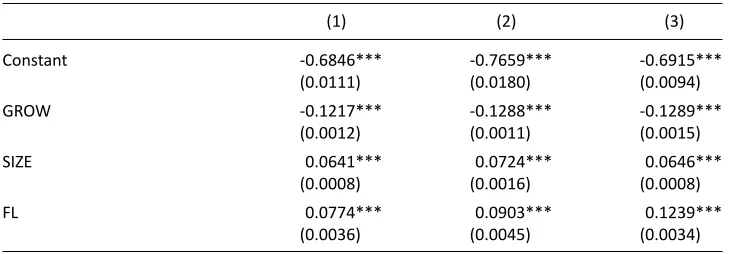
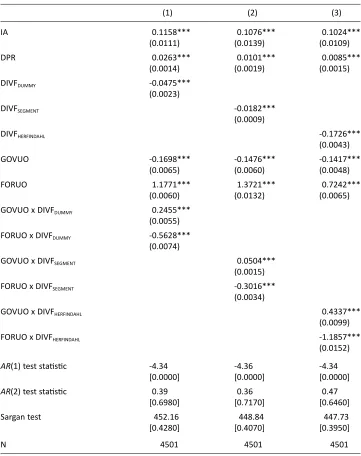
Table 2 reports the regression model results that show the effect of different identity of ultimate owner (family, government and foreigner) on the relationship between diversification and firm value. It is observed that the interaction coefficients of three diversification measures and government-ultimate-owner (GOVUO) are positive. The results imply that the discount is lower if a firm is diversified with a government ultimate ownership than that with a family ultimate ownership by 5.04 to 43.37 percent. The findings support H1a. On the other hand, the interaction coefficients of the three diversification measures and foreign-ultimate-owner (FORUO) are all showing negative values which is in support of H1b.
This result indicates that foreign-ultimate-owner performs worse than family-ultimate-owner in influencing the diversification and firm value relationship. The result implies that if a firm is diversified with foreign ultimate ownership, the discount increases from 30.16 to 118.57 percent than that with a family ultimate ownership. It is worth noting that different magnitude of diversification discounts is because of different measurements of diversification used in our study.
Table 2: The influence of ownership identity on the value of diversification using two-step system GMM
(1) (2) (3)
Constant -0.6846*** -0.7659*** -0.6915***
(0.0111) (0.0180) (0.0094)
GROW -0.1217*** -0.1288*** -0.1289***
(0.0012) (0.0011) (0.0015)
SIZE 0.0641*** 0.0724*** 0.0646***
(0.0008) (0.0016) (0.0008)
FL 0.0774*** 0.0903*** 0.1239***
Table 2: (Continued)
(1) (2) (3)
IA 0.1158*** 0.1076*** 0.1024***
(0.0111) (0.0139) (0.0109)
DPR 0.0263*** 0.0101*** 0.0085***
(0.0014) (0.0019) (0.0015)
DIVFDUMMY -0.0475***
(0.0023)
DIVFSEGMENT -0.0182***
(0.0009)
DIVFHERFINDAHL -0.1726***
(0.0043)
GOVUO -0.1698*** -0.1476*** -0.1417***
(0.0065) (0.0060) (0.0048)
FORUO 1.1771*** 1.3721*** 0.7242***
(0.0060) (0.0132) (0.0065)
GOVUO x DIVFDUMMY 0.2455***
(0.0055)
FORUO x DIVFDUMMY -0.5628***
(0.0074)
GOVUO x DIVFSEGMENT 0.0504***
(0.0015)
FORUO x DIVFSEGMENT -0.3016***
(0.0034)
GOVUO x DIVFHERFINDAHL 0.4337***
(0.0099)
FORUO x DIVFHERFINDAHL -1.1857***
(0.0152)
AR(1) test statistic -4.34 -4.36 -4.34
[0.0000] [0.0000] [0.0000]
AR(2) test statistic 0.39 0.36 0.47
[0.6980] [0.7170] [0.6460]
Sargan test 452.16 448.84 447.73
[0.4280] [0.4070] [0.3950]
N 4501 4501 4501
Note: This table rewrites the regression model as a dynamic panel by including lagged value of Tobin’s q as
a regressor, and estimated with two-step system GMM. Year dummies are included in the regressions
but not reported for brevity. Figures in parentheses are standard errors, while p-values are reported
4.3 The Influence of Degree of Ownership Concentration
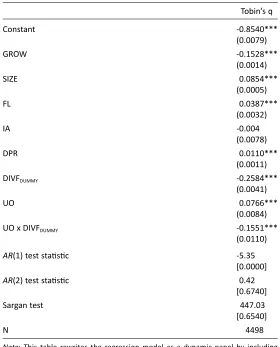
Table 3 presents the test results on how the degree of ownership concentration influences the relationship between diversification and firm value. Since there are a number of difficulties and problems in interpreting interaction term between two continuous variables (Aiken & West, 1991; Jaccard, Turrisi, & Wan, 1990), our study generates only interaction term using diversification dummy (DIVFDUMMY). The results of
Table 3. The influence of ownership concentration on the diversification-firm value relationship using two-step system GMM
Tobin’s q
Constant -0.8540***
(0.0079)
GROW -0.1528***
(0.0014)
SIZE 0.0854***
(0.0005)
FL 0.0387***
(0.0032) IA -0.004 (0.0078)
DPR 0.0110***
(0.0011)
DIVFDUMMY -0.2584***
(0.0041)
UO 0.0766***
(0.0084)
UO x DIVFDUMMY -0.1551***
(0.0110)
AR(1) test statistic -5.35
[0.0000]
AR(2) test statistic 0.42
[0.6740]
Sargan test 447.03
[0.6540] N 4498
Note: This table rewrites the regression model as a dynamic panel by including
lagged value of Tobin’s q as a regressor, and estimated with two-step system GMM. Year dummies are included in the regressions but not reported
for brevity. Figures in parentheses are standard errors, while p-values are
the interaction term between control right percentage and diversification dummy (UO x
DIVFDUMMY) shown in Table 3 is a negative value of -0.1551, significant at 1 percent level.
This result implies that the higher the degree of ownership concentration, the higher the discount of diversification value.
This result is consistent with the study of Lins and Servaes (2002) who reported that the discounted value of diversification in emerging markets is mostly found within 10 to 30 percent ownership concentration level implying that when control becomes more concentrated, the controlling shareholders would become more entrenched. This result is also supported by the notion that emerging economies normally have weaker and less efficient mechanisms for protection of the minority shareholders’ interests as opposed to developed economies, thus controlling shareholders have more opportunities to expropriate the interests of minority shareholders. Furthermore, this result is in support of the studies by Claessens et al. (2000), La Porta et al. (1999) and Ng et al. (2015), in which they all contended that the agency problem in Asian countries can be intensified by the high concentration of ownership in the hands of family members or politically connected diversified conglomerates. When majority shareholders can effectively exert control on a firm, their policies tend to support the expropriation of minority shareholders. The types of expropriation of minority shareholders include outright expropriation, i.e., controlling shareholders enrich them-selves by not paying out dividends to shareholders or transferring profits to other firms under their control, or deliberately pursuing non-profitable projects. Overall, this finding is in support of agency-based view that ownership concentration influences significantly and negatively on the diversification and firm value relationship based on H2.
5. Conclusion
Overall, the findings of this study reveal that government ultimate ownership is able to mitigate the diversification discount better than family ultimate ownership by 5 to 43 percent. This finding has reaffirmed that government owned firms practically have the advantage on the easy access to financial and tangible resources which will facilitate their business diversification activities very well. On the other hand, family ultimate ownership is better than foreign ultimate ownership in mitigating the diversification discount by 30 to 118 percent. This finding indicates that foreign-owned firms are better off to stay focused in one industry based on their respective expertise areas rather than to diversify their business segments. Nevertheless, our study finds that the higher the degree of ultimate ownership concentration, the higher the diversification discount.
References
Aiken, L.S., & West, S.G. (1991). Multiple regression: Testing and interpreting interactions. Newbury Park, CA: Sage.
Berger, P., & Ofek, E. (1995). Diversification’s effect on firm value. Journal of Financial Economics,
37(1), 39-65. https://doi.org/10.1016/0304-405X(94)00798-6
Berry C.H. (1971). Corporate growth and diversification. Journal of Law and Economics, 14(2), 371-383. https://doi.org/10.1086/466714
Che Ahmad, A., Ishak, Z., & Abd Manaf, N.A. (2003). Corporate governance, ownership structure and corporate diversification: Evidence from the Malaysian listed companies. Asian Academy of Management Journal, 8(2), 67-89.
Chen, C.J., & Yu, C.M.J. (2011). Managerial ownership, diversification, and firm performance: Evidence from an emerging market. International Business Review, 21(3), 518-534. https:// doi.org/10.1016/j.ibusrev.2011.06.002
Chung, K.H., & Pruitt, S.W. (1994). A simple approximation of Tobin’s q. Financial Management,
23(3), 70-74. http://dx.doi.org/10.2307/3665623
Claessens, S., Djankov, S., Fan, J.P.H., & Lang, L.H.P. (2002). Disentangling the incentive and entrenchment effects of large shareholdings. Journal of Finance, 57(6), 2741-2771. http:// dx.doi.org/10.1111/1540-6261.00511
Claessens, S., Djankov, S., & Lang, L.H.P. (2000). The separation of ownership and control in East Asian corporations. Journal of Financial Economics, 58(1-2), 81-112. https://doi.org/10.1016/ S0304-405X(00)00067-2
Click, R.W., & Harrison, P. (2000). Does multi-nationality matter? Evidence of value destruction in US multinational corporations (FEDS Working Paper No. 2000-21). Washington DC: Federal Reserve Board.
Denis, D.J., Denis, D.K., & Sarin, A. (1997). Agency problems, equity ownership, and corporate diversification. Journal of Finance, 52(1), 135-160. https://doi.org/10.2307/2329559
Douma, S., George, R., & Kabir, R. (2006). Foreign and domestic ownership, business groups, and firm performance: Evidence from a large emerging market. Strategic Management Journal,
27(7), 637-657. https://doi:10.1002/smj.535
Dunning, J.H., & Rugman, A.M. (1985). The influence of Hymer’s dissertation on the theory of foreign direct investment. American Economic Review, 75(2), 228-232.
Fan, J.P.H., & Wong, T.J. (2002). Corporate ownership structure and the informativeness of accounting earnings in East Asia. Journal of Accounting and Economics, 33(3), 401-425. https://doi.org/10.1016/S0165-4101(02)00047-2
Fauver, L., Houston, J.F., & Naranjo, A. (2003). Capital market development, integration, legal systems, and the value of corporate diversification: A cross-country analysis. Journal of Financial and Quantitative Analysis, 38(1), 135-158. https://doi.org/10.2307/4126767 Fauver, L., Houston, J.F., & Naranjo, A. (2004). Cross country evidence on the value of corporate
industrial and international diversification. Journal of Corporate Finance, 10(5), 729-752. https://doi.org/10.1016/S0929-1199(03)00027-0
Gertner, R.H., Scharfstein, D.S., & Stein, J.C. (1994). Internal versus external capital markets. Quarterly Journal of Economics, 109(November), 1211-1230. https://doi.org/10.2307/ 2118361
Gomez, E.T., & Jomo, K.S. (1999). Malaysia’s political economy: Politics, patronage and profits. Cambride, UK: Cambridge University Press.
Jaccard, J., Turrisi, R., & Wan, C.K. (1990). Interaction effects in multiple regression. Newbury Park, CA: Sage.
Jara-Bertin, M., Lopez-Iturriaga, F.J., & Espinosa, C. (2015). Diversification and control in emerging markets: The case of Chilean firms. Business Research Quarterly, 18(4), 259-274. https://doi. org/10.1016/j.brq.2015.01.002
Jensen, M.C. (1986). Agency costs of free cash flow, corporate finance, and takeovers. American Economic Review, 76(2), 323-329.
Khanna, T., & Palepu, K. (2000). Is group affiliation profitable in emerging markets? An analysis of diversified Indian business groups. Journal of Finance, 55(2), 867-891. https:// doi. org/10.1111/0022-1082.00229
Kim, Y.S., & Mathur, I. (2008). The impact of geographic diversification on firm performance. International Review of Financial Analysis, 17(4), 747-766. https://doi.org/10.1016 /j.irfa. 2007.09.007
Lang. L., & Stulz, R. (1994). Tobin’s q, corporate diversification and firm performance. Journal of Political Economy, 102, 1248– 1280. https://doi.org/10.1086/261970
La Porta, R., de Silanes, F.L., & Shleifer, A. (1999). Corporate ownership around the world. Journal of Finance, 54(2), 471-517. https://doi.org/10.1111/0022-1082.00115
Lau, Y.W., & Tong, C.Q. (2008). Are Malaysian Government-Linked Companies (GLCs) creating value? International Applied Economics and Management Letters, 1(1), 9-12.
Lewellen, W. (1971). A pure financial rationale for the conglomerate merger. Journal of Finance, 26(2), 521-537. https://doi.org/10.1111/j.1540-6261.1971.tb00912.x
Lien, Y.C., & Li, S. (2013). Does diversification add firm value in emerging economies? Effect of corporate governance. Journal of Business Research, 66(12), 2425-2430. https://doi. org/10.1016/j.jbusres.2013.05.030
Lin, C., & Su, D. (2008). Industrial diversification, partial privatization and firm valuation: Evidence from publicly listed firms in China. Journal of Corporate Finance, 14(4), 405-417. https://doi. org/10.1016/j.jcorpfin.2008.05.001
Lins, K., & Servaes, H. (1999). International evidence on the value of corporate diversification. Journal of Finance, 54(6), 2215-2239. https://doi.org/10.1111/0022-1082.00186
Lins, K., & Servaes, H. (2002). Is corporate diversification beneficial in emerging markets? Financial Management, 31(2), 5-31.
Lubatkin, M.H., Ling, Y., & Schulze, W.S. (2007). An organizational justice-based view of self-control and agency costs in family firms. Journal of Management Studies, 44(6), 955-971. https://doi.org/10.1111/j.1467-6486.2006.00673.x
Morck, R., Wolfenzon, D., & Yeung, B. (2005). Corporate governance, economic entrenchment, and growth. Journal of Economic Literature, 43(3), 657-720. https://doi.org/10.1257/ 002205105774431252
Ng, S.H., Ong, T.S., Teh, B.H., & Soh, W.N. (2015). How is firm performance related to family ownership in Malaysia and does board independence moderate the relationship? Corporate Board: Role, Duties, and Composition, 11(2), 21-35. http://doi.org/10.22495/cbv11i2art2 Schoar, A. (2002). Effects of corporate diversification on productivity. Journal of Finance, 57(6),
2379-2403. https://doi.org/10.1111/1540-6261.00500
Servaes, H. (1996). The value of diversification during the conglomerate merger wave. Journal of Finance, 51(4), 1201-1225. https://doi.org/10.1111/j.1540-6261.1996.tb04067.x
Shailer, G., & Wang, K. (2015). Government ownership and the cost of debt for Chinese listed corporations. Emerging Markets Review, 22(March), 1-17. https://doi.org/10.1016/j. ememar.2014.11.002
Stowe, J., & Xing, X. (2006). Can growth opportunities explain the diversification discount? Journal of Corporate Finance, 12(4), 783-796. https://doi.org/10.1016/j.jcorpfin.2005.05.001 Stulz, R.M. (1990). Managerial discretion and optimal financing policies. Journal of Financial
Economics, 26(1), 3-27. https://doi.org/10.1016/0304-405X(90)90011-N
Sulong, Z., & Mat N.F. (2008). Dividends, ownership structure and board governance on firm value: Empirical evidence from Malaysian listed firms. Malaysian Accounting Review, 7(2), 55-94.
Tan, J. (2002). Impact of ownership type on environment-strategy linkage and performance: Evidence from a transitional economy. Journal of Management Studies, 39(3), 333-354. https://doi.org/10.1111/1467-6486.00295
Ting, I.W.K., & Lean, H.H. (2015). Does government ownership matter? Comparative study between GLCs and NGLCs in Malaysia. Singapore Economic Review, 60(2), 1-22. https://doi. org/10.1142/S0217590815500198
Villalonga, B. (2004a). Diversification discount or premium? New evidence from the business information tracking series. Journal of Finance, 59(2), 479-506. https://doi.org/10.1111/ j.1540-6261.2004.00640.x
Villalonga, B. (2004b). Does diversification cause the diversification discount? Financial Manage-ment, 33(2), 5-27.
Williamson, O.E. (1985). The economic institutions of capitalism. New York, NY: The Free Press. Wiwattanakantang, Y. (2001). Controlling shareholders and corporate value: Evidence from
Thailand. Pacific-Basin Finance Journal, 9(4), 323-362. https://doi.org/10.1016/S0927-538X(01)00022-1
Wurgler, J. (2000). Financial markets and the allocation of capital. Journal of Financial Economics, 58(1-2), 187-214. https://doi.org/10.1016/S0304-405X(00)00070-2