ISSN 2373-2156 (Print) 2373-2164 (Online) Copyright © The Author(s). 2015. All Rights Reserved. Published by American Research Institute for Policy Development DOI: 10.15640/jpesm.v2n1a5 URL: http://dx.doi.org/10.15640/jpesm.v2n1a5
All for One and One for All: A Collaborative Approach to Professional Development
Mary E. La Vine1 & Pamela Bechtel2
Abstract
The purpose of this study was to evaluate the attainment of benchmarks established using the physical education content standards in a K-12 curricular revision process, as well as, determining the impact of professional development on teachers who participated in this process. Participants included 5 physical education teachers, 3 principals, and the district curriculum coordinator of a school district where the curricular revision process occurred. An interpretive qualitative approach was used to determine the impact of participation in a curriculum review process and participation in professional development opportunities offered to the teacher participants as part if the process. Data were collected from in-depth interviews with participants. The constant comparative method was used to determine the emerging themes of the study. The four themes that emerged from this study were collaboration, ownership, curricular change, and teacher change. These themes were found to be essential for the curricular revision process to be effective.
Introduction
Educational reform continues to receive attention as countries position themselves within the global economy. The reform issues and efforts are continuous and seemingly endless. In the United States alone, nearly two decades after the wave of educational reform policies of the 1980’s, schools and teacher preparation institutions continue to face the challenge of improving education for all children. The latest effort has been the No Child Left Behind bill (NCLB, 2001) signed into law by President Bush in January of 2002, in an effort to affect the education of the nation’s children and youth.
1PhD, Youngstown State University, Youngstown, OH 44555.
Eight years later and educational reform is still mounting a campaign to improve the education of the nation’s children. One of NCLB’s many goals is to improve the quality of the teaching force. Teachers of specific subjects such as, English, reading or language arts, mathematics, science, foreign languages, civics and government, economics, arts, history, and geography were to be ‘highly qualified’ by the end of the 2005-06 school year (NCLB, 2001).
Although there were several methods mentioned in the NCLB legislation, one most important to this study is professional development. Teachers’ professional development opportunities should be enhanced for the following: gaining easier access to workshops, on-going course work, seminars, conferences and providing more resources and revenue for technology. Professional development opportunities remain important for all teachers regardless of their main subject area as learning is life-long and changing. The NCLB policy does not mention teacher licensure in the areas of music and physical education. The omission of these subjects within this legislation serves to decentralize them from the school’s mission and promotes their further marginalization.
Theoretical Framework and Underpinnings for Professional Development
Continuous Professional Development
Teachers of all subject areas should be given equal opportunities for professional development that is on-going. Armour and Yelling (2004a) suggest there is “an abundance of literature on professional development, teacher learning and teacher change but surprisingly little knowledge about what makes continuous professional development (CPD) effective” (p 72). They also found that schools in the United Kingdom need to offer professional learning opportunities that have meaning and relevance to physical educators. Sparkes (2002) describes high quality professional development as: (1) focused on deepening teachers’ content knowledge and pedagogical skills; 2) involved opportunities for practice, research, and reflection; 3) is embedded in educator’s work; 4) sustained over time; and 5) founded on a sense of collegiality and collaboration among teachers and between teachers and principals in solving important problems related to teaching and learning (p.1-4).
This construct allows for a new approach to learning across a teacher’s professional career and provides support for continued professional development opportunities that enrich the teacher, student learning, and the community.
Armour and Yelling’s (2004a) findings indicate professional development for physical education specialists usually involves sport specific update courses, is rarely physical education specific, and is haphazard in nature without any progression. Most of these types of CPD opportunities offer off-site, one-shot short training days (Armour and Yelling, 2002a). This type of professional development is indicative of the institutional marginalization of physical education despite the centrality of its contribution to a healthy active society. Fejgin and Hanegby (1999) found supporting evidence that physical educators face difficulties in accessing the type and amount of professional development they would consider ideal and essential. The need for CPD for all physical education teachers is critical, physical education content continues to grow, as does new pedagogical practices and rising concerns for student wellness. An example of an area that needs to be addressed by CPD is dealing with the problem of obesity in P-12 students.
Support for Professional Development
In order to answer these calls to action and provide reform, there needs to be a more supportive environment for educators. Many teachers cite lack of support and working conditions as major factors in their decision to exit the profession (Darling-Hammond, 2001) or give up trying to create change. Supportive schools are often described as workplaces that allow teachers to focus on teaching and continue their learning as opposed to places where teachers battle administration on disciplinary policies and plead for opportunities to attend continuing education and/or professional workshops/conferences (Ingersoll, 1999). O’Sullivan & Deglau (2006) state that when it comes to professional development activities assumptions are too often made that all teachers receive opportunities to improve practice and professional growth.
In the core curricular areas of math, science, and language arts, there is abundant attention and funding to investigate ways to improve working conditions and curricular programs. However, in physical education the legitimacy of the subject area ranks extremely low with school administrators (O’Sullivan 1989), therefore exacerbating the issues surrounding the professional development of physical education specialists, their retention, and in turn student learning. The post-WWII emphasis on core academic subjects had led to the arts in public schools being marginalized to a “nice, but not necessary,” status (Tozar & Horsley, 2006). Educational reform has called for CPD, which drives teacher change.
Process of Teacher Change
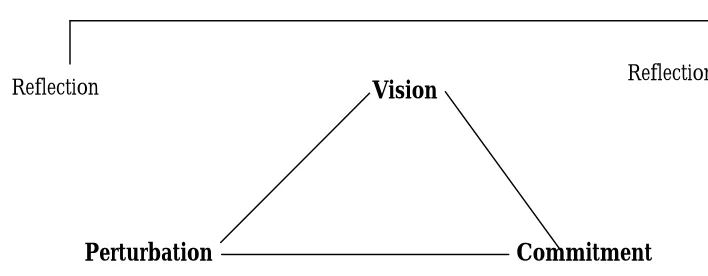
As introduced in physical education literature by Bechtel & O’Sullivan (2007) Shaw, Davis and McCarty (1991) developed a framework in an attempt to explain the process of teacher change. This model emerged as part of a research project that was designed to improve mathematics and science teaching. This cognitive framework illustrated how teachers personalize recommendations for change. Through research it had been determined that teachers did not respond well to change when it was mandated to them. Instead, teachers responded better when they had a desire to change (Shaw et al, 1991). The cognitive framework is described in Figure 1.
A second component of this model is the presence of a perturbation. Teacher change is due to having a perturbation take place (Shaw et al., 1991). Some may call this mental dissonance. These perturbations come from many sources including colleagues, students, books, professional development programs or any item that causes a teacher frustration, discomfort and reflection. Teachers have to experience a perturbation in order to desire to make change. The third component is a commitment in one's decision to make change as a result of the perturbation. This is often felt by teachers as the need to make change (Shaw et al., 1991). Having this commitment allowed teachers to self-reflect and then begin to take risks in implementing new strategies in their teaching.
The final component of this model is vision. Teachers must know what they think teaching and learning in their content area should look like in their classrooms. New images need to be formed to replace the traditional images teachers have of their classrooms. The image of a quiet classroom with students working independently may need to be replaced with an image of students working together in small groups. The researchers found that teachers had to be helped to form these new visions.
A necessary component of the model is reflection. Teachers in the change process begin to examine their own practices and question these practices. This reflection occurs at various stages of the process and is key to the teacher change process. Teachers might have to be helped to reflect effectively, but will begin to use reflection as the change process progresses.
This model does not suggest that change is a one-time experience, but that this is the process teachers go through as they attempt to implement continuous change in their classrooms. Each teacher experiences new perturbations, new commitments and new visions as they are introduced to new practices that might prompt them to change. This model merely provides an explanation of how the teacher change process occurs. Educational reform has mandated improvements in education and drives professional development, which drives teacher change, but a barrier to success may be legitimacy and marginalization of physical education.
Legitimacy and Marginalization
Physical educators in particular must deal with the struggle for legitimacy. Physical education is often ignored or grossly devalued by both non-physical education teaching colleagues and administrators (O’Sullivan, Tannehill, Knop, Pope, & Henninger, 1999). The physical education specialist often found that administrators and colleagues assigned low academic worth to physical education, held a lack of respect for their instructional capabilities (O’Sullivan, 1989) and often perceived that physical education was considerably easier than other academic areas (Hebert &Worthy, 2001).
Isolation and marginalization are well-documented factors that confront and frustrate both beginning and experienced physical educators (Doolitle & Schwager, 1989; Templin, Sparkes, & Schempp, 1991). Physical education specialists are teaching professionals who have completed rigorous licensure programs. Yet face marginalization by teachers in other disciplines who view them as lesser teachers. Physical educators have reported being treated as second-class citizens by their own teaching colleagues (Curtner-Smith, 2001).
The Study
The purpose of the study was to evaluate attainment of the benchmarks established using the NASPE content standards, in a comprehensive K-12 physical education curricular revision process. The major research questions for this study were:
1. Has administrative support provided the teachers with access to professional development opportunities that led to change in their practice and programs? What are the level and types of support that school principals and district administrators provide to the teachers for professional development?
2. Does determining the level of administrative support have impact on the curricular
change process of a subject that is often “marginalized”?
3. Have the teachers found that increased professional development opportunities have led to positive curricular and practical changes?
4. What are the opportunities and obstacles that were overcome in adopting a new curriculum?
5. What are suggestions for creating or sustaining meaningful professional growth for
teachers?
Five physical education teachers, three principals and the district curriculum director were contacted and elected to participate in the study. The participants were from one suburban K-12 school district in northwestern Ohio, who had just completed and participated in the curriculum revision process.
Methodology
The researcher explores a few general topics to help uncover the participant’s perspective, but otherwise respects how the participant frames and structures the response. The interviews were audio recorded and transcribed verbatim with dialog attributed to each speaker. The constant comparative method was used to determine major themes, patterns, and categories. These themes were then used as the framework for discussion.
Participants
The selection of participants was representative of purposive sampling. The primary researchers contacted each physical education teacher, principal and district administrator to explain the study, gauge interest, and arrange a meeting. Primary data collection occurred during the spring 2012. The study was to identify strengths, gains, barriers and opportunities of the curriculum revision and opening of professional development opportunities for the teachers. The teachers, principals, and district administrator participated in structured interviews to identify and describe their involvement in the revision process, and identify to what extent the revised curriculum has improved the quality of the physical education program and teacher professional development.
Data Collection
Data Analysis
The rigor and quality of an interpretive qualitative research project can be examined by the representation of four criteria: credibility, transferability, dependability and confirmability (Lincoln & Guba, 1985). To establish credibility (internal validity), which is to determine whether the findings match what is really occurring, this proposed study used the five recommended strategies of triangulation, member checking, peer debriefing, and disclosure of researcher bias for qualitative research (Merriam, 1998).
Trustworthiness and credibility (Patton, 1990) were established through peer debriefing, member checks, and triangulation of data sources (Rubin & Rubin, 1995). Methodological triangulation (interviews, field observations, and document analysis) allowed the data sources to be crosschecked. This helped ensure that the findings were accurate and strengthened perspectives drawn from the field observations. Member checks were carried out twice by first, replaying the tapes for the teachers to modify and clarify any aspect of the interview and secondly each teacher reading the transcript to verify interpretations. Each participant read the final narrative to verify interpretation. There were no changes suggested from the participants. Peer debriefing was also used (Lincoln & Guba, 1985; Patton, 1990) to establish credibility of the data analysis process. Both researchers read the transcripts, documents, and field notes independently and interpretations were subsequently compared (Bogdan & Biklen, 1998). Lastly, data were scrutinized for negative case examples that represented disconfirming evidence (Patton, 1990).
This study attempted a measure of self-reporting through interviews. A conceptual limitation may be attributed to the interviews, which were used as significant tools for evaluation and information, but may not be completely accurate due to participants’ concerns about self-disclosure and confidentiality. Additionally, the data and information was filtered through the authors’ own personal perspectives as well as the conceptual framework which guides this study.
Findings/Discussion
The teachers found ownership in creating change and on-going professional development. They were committed to remaining current and apprised of new pedagogies for increasing student learning and activity. Four themes emerged from the study; collaboration, ownership, curricular change, and teacher change.
Collaboration
Collaboration played a role in the growth of each individual as well as unifying the group. The professional development workshops had a great impact on the participants, as they were active together as one in their professional development. After the explanation of the course of study revision process and what their active roles in this process would be, the collaboration between participants readily occurred.
“I think my job is to focus on introductory skills, so when they move to Tom at the 3-5 building and he adds a little more then they go to Sally at the middle school then by the time they get to Byron and Ned hopefully they have an idea of what they should be doing…” (Les interview)
“I know what Les is doing, he knows what I am doing. Sally knows what I’m doing and then Ned and Byron know what we are doing so it is nice that we aren’t repeating things over and over again…” (Follow up interview)
The need for collegial support from teachers in the same content area has been critical for professional development to be effective (Doutis & Ward, 1999). The workplace conditions in the current study were sufficient to stimulate change to occur and all participants accepted the changes. This was key for professional development to become effective with teachers; there needed to be a unified front (Doutis & Ward, 1999).
“I found them to be a great team…they were cooperative in carving the times out of their schedules as they are people involved in afterschool sports and everything else, but they found time for any of the meetings.” (Samantha interview)
Ownership
According to Bechtel and O’Sullivan (2007), teachers need to have a vision for how change might look and how they can carry out proposed changes if professional development was to become effective. This would be considered where ownership begins in the process of change (the start of their ownership of change). In this study all of the teachers took the responsibility to develop outcomes appropriate for the grade bands each teacher dealt with in teaching based upon the NASPE standards (NASPE, 2004). The ownership that each teacher gained had impact on change and was demonstrated by designing the outcomes that were directly related to their own facilities, equipment, and previous experiences in mind. As Byron, a high school teacher said, “I think it is because I have ownership of the curriculum, so I take more involvement in the curriculum and then I take that and project that on to them and then it becomes theirs.” (Follow-up interview)
“I feel that uh, the two gentlemen I have do our high school curriculum uh, were kind of ahead of, ahead of the game so to speak in that … taking part in the development of their content area, so they knew the changes were coming…” (Ron interview)
This process helped the participants become willing to implement the assessments as each was designed with their own students’ needs in mind. Rather than having the outcomes imposed upon them. This process also led each teacher to know the outcomes in place at the previous grade levels and also realize the skills the students should possess when they reached the next grade level. The participants gained a clearer picture of the skills and activities taught throughout the grade levels. The participants felt united in their revision process, and developed a more sequential curriculum across the grade levels.
Curricular Change
The study strengthened the connection that curriculum change is necessary to improve student learning. Helping their students understand “why and how” so they can remain active beyond physical education. Studies have shown that educational programs should become student-centered and outcome based, which provides increased opportunities for learning (Griffin & Butler, 2005; Tinning, 1999; Toppings, 2005).
One focus was on understanding and finding creative ways to increase physical activity during and after class times. These teachers identified the need to increase physical fitness activities to help their student become invested in becoming more physically active. The realized through the curricular revision process that they needed to address obesity and sedentary lifestyles for their students benefit. They learned and implemented more physical fitness activities into daily lessons. Physical Best activities (NASPE, 2005) were introduced to these teachers during a workshop and several implemented them on a regular basis with their classes. Several teachers began to utilize handheld computers to record scores on Fitness Gram testing components. New equipment was purchased by the school district in order to teach new activities or integrate new technology in the form of pedometers and heart rate monitors with the students. The teachers integrated new activities appropriate for their grade levels after revising the course of study.
“Probably the biggest thing was like trying to get more assessments going on there…I try to get as much fitness as I can from the beginning of the nine weeks until the end to hopefully we can see some improvements... but I think we definitely um, emphasize physical fitness um, as a district as a whole…Dance would another, um got lacrosse equipment last year so we have been gradually trying to um, play lacrosse… (Sally interview)
“I have been moving away you know like softball, and you know, I don’t know I can’t say basketball it sports like that just seem to have a lot of kids standing and a lot of kids doing nothing, I personally was moving away from those things I mean this was kind of reinforced that to move towards a different movement…” (Tom interview)
I think it again it just revitalized you because I had been a 12-13 year veteran teacher and it was refreshing to know there is something new and everyone in the department is on board with it.” (Follow-up interview)
The increased sense of accountability was attributed to the assessments developed for the outcomes of the standards. The teachers were not only holding their students more accountable, they were also holding themselves accountable in terms of the type of content and activities each covered at their own grade level. There were new activities and assignments for the junior high and high school students to complete that integrated new concepts and content from the revised course of study. This sense of accountability is reflected in statements made by Sally’s and Ned’s statements regarding the impact of curricular change.
“I think personally as a teacher, the curriculum changes have made me more accountable to my district and myself, you know I want to put a program out there that the students enjoy, but that also reflects our curriculum and our philosophies and our goals for the district.” (Sally Follow up interview)
“Uh, we set it up, the curriculum is set-up in a way for us still address the team sports that the kids have become familiar and we have gone toward more lifetime activities sports versus you know the sport…we’ve gone more toward the personal fitness so the kids get both aspects…” (Ned interview)
Teacher Change
The district also provided additional resources to purchase equipment and materials needed to implement the revised course of study.
“ I have also seen how the curriculum has evolved since we started it and each year it changes. What we are doing now is different that what we did last year, so we have been tweaking it each year adding more components…which has been kind of nice.” (Ned interview)
“I think I do a better job myself of drawing on information hopefully they did learn when you worked on things previously in the school year. And then I try to redo it in different games…I think when we did the tinikling …hat’s an area that I think I need some work more on …” (Les interview)
These teachers took ownership of the course of study revision process and this helped them successfully make changes not only in the curriculum, but also in their own teaching.
Implications
The release days were exactly the same as the other content areas and even in-service days.” An expert in each specific content area was hired by the district to help facilitate the course of study revision process with content area teachers. There must be positive workplace conditions present between not only the teachers on the team, but also the district administrators in order for the professional development presented to take hold and become effective with the teachers.
The support from the district towards the team members involved in the course of study revisions was critical. Bechtel and O’Sullivan, (2007) reported support from the school district as being a key enhancer for teacher change. The support the physical education team received from their district was key to the course of study being implemented effectively and the professional development presented being effective. According to Samantha, the Director of Student Services had been very supportive of the revisions made to the physical education course of study when she stated, “And particularly with physical education because we were looking at major software purchase, and training for our teachers.” (Follow-up interview)
The district support was critical to the physical education team feeling valued and important. This support encouraged them to develop a meaningful course of study that would be utilized and not shelved as in the past. Support from the district must be present and observable in order for professional development to occur, be deemed effective, and be sustained.
Armour and Yelling (2004b) previously addressed the need for on-going professional development for physical education teachers. The teachers involved in the current study expressed this need also. As Sally remarked, “we were just lumped with everyone else.” Samantha even remarked, “I often think it was how do we fit them [physical education] into this.” Due to professional development sessions being offered specifically for the physical education teachers during the curriculum revision process their needs finally emerged and were viewed as being important. Samantha realized the physical education teachers’ needs when she stated,
The teachers themselves expressed a need for on-going professional development. Byron indicated that he wanted university faculty to come and present new ideas that were being presented to their teacher education students. As he said, “I don’t want to be old school, I don’t want to be known as old school, so I want to make sure we are staying up to speed.” Three of the teachers continue to attend the state conference each year to gain new ideas. As Sally stated, “when I go the state conference I’m looking for sessions that I can go in and learn something that I can take back.” The request for professional development opportunities had come from the teachers themselves, as they are more attuned to the needs in their content area. The state professional organization offers workshops that can be scheduled at local sites to help provide this continuing professional development for physical educators. The idea of “All for one and one for all” seemed to most accurately describe this professional development opportunity. In order for professional development to be successful there must be this “All for one and one for all attitude.”
Educational reform is not some new concept, but one that was initially designed to improve education and provide teachers with continuous professional development. Although professional development comes in many forms, legitimacy and marginality still impact teachers across America. This study demonstrated that through professional development aimed specifically at physical education; these teachers were eager and engaged in the change process. The support from the administration demonstrated the positive impact on professional development for these teachers. These teachers became better equipped to help combat obesity through the integration of fitness into daily lessons, curricular design, and changing pedagogy. They also cohesively gained support from administrators and parents, “All for one and one for all”.
References
Armour, K .M. & Yelling, M. (2004a). Professional development and professional learning: Bridging the gap for experienced physical education teachers, European Physical Education Review, 10(1), 71-93.
Armour, K.M. and Yelling, M. (2004b). Continuing professional development for experienced physical education teachers: Towards effective provisions, Sport, Education and Society, 9(1), 95-114.
Cochran-Smith, M. and Lytle, S. (2001). Beyond certainty: Taking an inquiry stance on practice, In: A. Lieberman & L. Miller (eds), Teachers caught in the action: Professional Development that Matters, New York, Teachers College Press.
Curtner-Smith, M.D. (2001). The occupational socialization of a first-year physical education teacher with a teaching orientation, Sport, Education and Society, 6(1), pp. 81-105. Creswell, J. W. (1994). Research design: Qualitative and quantitative approaches. Thousand
Oaks, CA: Sage Publications.
Darling-Hammond, L. (2001). The challenge of staffing our schools. Educational Leadership, 58(8), 12-17.
Deglau, D., & O’Sullivan, M. (2006). Chapter 3: The effects of a long-term professional development program on the beliefs and practices of experienced teachers [Monograhph]. Journal Teaching in Physical Education, 25, 379-396.
Doolittle, S. & Schwager, S. (1989). Socialization and Inservice Education. In T.Templin & P. Schrempp (Eds.) Socialization into physical education: Learning to teach (pp. 105-122). Indianapolis: Benchmark Press.
Doutis, P., & Ward, P. (1999). Chapter 4: teachers’ and administrators’ perceptions of the saber-tooth project reform and of their changing workplace conditions [Monograph]. Journal of Teaching in Physical Education, 18, 417-427.
Ennis, C. (2003).Using curriculum to enhance student learning. In S.J. Silverman & C.D. Ennis (Eds.), Student learning in physical education: Applying research to enhance instruction (2nd ed., pp.109-127). Champaign, IL: Human Kinetics.
Erickson, F. (1986). Qualitative methods in research on teaching. In M. C. Wittrock (Ed), Handbook of research on teaching (pp.119-161). NY: Macmillan.
Fejgin, N. and Haneby, N. (1999). School based in-service training of physical education Teachers, European Journal of Physical Education, 4(1), 4-16.
Fraenkel, J.R. & Wallen, N.E. (2003). How to design and evaluate research in education. Boston, MA : McGraw Hill.
Griffin, L., & Butler, J. (2005). Teaching Games for Understanding: Theory, Research, and Practice. Champaign, IL: Human Kinetics.
Hargreaves, A. (2005). Educational change takes ages: Life career and generational factors in teachers’ emotional responses to educational change. Teaching and Teacher Education, 21(8), 967-983.
Hebert, E., & Worthy, T. (2001). Does the first year of teaching have to be a bad one? Teaching and Teacher Education, 17, 897-911.
Holland, D., Skinner, D., Lachicotte, W., & Cain, C. (1998). Identity and agency in cultural worlds. Cambridge, MA: Harvard University Press.
Ingersoll, A. M. (1999). The problem of underqualified teachers in American secondary schools. Educational Researcher, 28( 2), 26-37.
Kahn, R., & Cannell, C., (1957). Dynamics of the Interviewing. John Wiley: New York. Kirk, D., & MacDonald, D. (1998). Situated learning in physical education. Journal of
teaching in Physical Education, 17,376-387.
Lave, J., & Wenger, E. (1991). Situated learning: Legitimate peripheral participation. Cambridge, UK: Cambridge University Press.
Lincoln, Y.S., & Guba, E. G. (1985). Naturalistic inquiry. Beverly Hills: Sage Publishing. Merriam, S. B. (1998). Qualitative research and case study applications in education. San
National Association for Sport and Physical Education. (2004). Moving into the future: National standards for physical education. (2nd ed.). Reston, VA: Author.
No Child Left Behind Act of 2001, Pub. L. No. 107-110, 115 Stat. 1425 (2002). Retrieved December 13, 2002, from http://www.ed.gov/ legislation/ESEA02/.
O’Sullivan, M. (1989). Failing gym is like failing lunch or recess: Two beginning teachers’ struggle for legitimacy. Journal of Teaching in Physical Education, 8, 227-242. O’Sullivan, M., & Deglau, D. (2006). Chapter 7: Principles of professional development
[Monograph]. Journal of Teaching in Physical Education, 25, 441-449.
O’Sullivan, M., Tannehill, D., Knop, N., Pope, C., & Henniger, M. (1999). A school-university collaborative: Journey toward relevance and meaning in as urban high school physical education program, Quest, 51, 225-243.
Rubin, H., & Rubin, I. (1995). Qualitative Interviewing: The art of hearing data. Thousand Oaks, CA: Sage Publishing.
Shaw, K.L., Davis, N.T., &McCarty, B.J. (1991). A cognitive framework for teacher change. In R.G.Underhill (Ed.) Proceedings of the Thirteenth Annual Meeting for the Psychology of Mathematics Education Conference, vol. 2. (pp. 161-167). Blacksburg, VA: Virginia Tech, ERIC Document Reproduction Service No. 352274.
Sparks, D. (2002). Designing Powerful Professional Development for Teachers and Principles. National Staff Development Council. (Available online at
www.nsdc.org/sparksbook.html).
Templin, T., Sparkes, A., & Schempp, P. (1991). The professional life cycle of a retired physical education teacher: A tale of bitter disengagement, Physical Education Review, 14, 143-156.
Tinning, R. (2002). Teacher education pedagogy: Dominant discourses and the process of problem solving. Journal of Teaching in Physical Education, 11, 1-20.
Toppings, K.J. (2005). Trends in peer learning. Educational Psychology, 25, 631-645.
Tozar, S., & Horsley, H. (2006). Chapter 9: Professional development of teachers in physical education – where are we now?[Monograph]. Journal of Teaching in Physical Education, 25, 450-457.
Wilson, S., & Berne, J. (1999). Teacher learning and the acquisition of professional knowledge: An examination of research on contemporary professional development. Review of Research in Education, 24, 173-209.
Cultural Environment
Vision
Perturbation Commitment
Figure 1: Framework for Teacher Change (Shaw, Davis, & McCarty, 1991)