IJPAR |Vol.8 | Issue 4 | Oct - Dec - 2019 Journal Home page: www.ijpar.com
Research article Open Access
Study of method validation on ramipril with reverse phase HPLC method
Radhika Ramidi
1,*, Lakkarasu Bhanu Chander
2 1Anurag Group of Institutions, Venkatapur, Ghatkesar, Hyderabad, India.
2
St.Peter’s Institute of Pharmaceutical Sciences, Vidyanagar, Hanmakonda, Warangal, India.
*Corresponding Author:Radhika Ramidi Email: [email protected]
ABSTRACT
A new simple and precise reverse phase high performance liquid chromatographic method has been developed and subsequently validated for the estimation of Ramipril in bulk and its pharmaceutical dosage form. The chromatographic separation was performed by using mobile phase consisting of 0.01M KH2PO4: Acetonitrile in the ratio of 30:70 % v/v and the pH 2.8 adjusted with 0.2% orthophosphoric acid. The column used was Kromasil C18 (150×4.6 mm, 5µ) with flow rate of 1 ml/min using PDA detection at 210nm. The described method was found to be linear over the range of 5- 30µg/ml and correlation coefficient was found to be 0.999. The assay of Ramipril was found to be 100.80 %. The results of the study showed that the proposed RP-HPLC method is simple, rapid, precise, reliable, accurate and economical which is useful for the routine determination of Ramipril in bulk and its pharmaceutical dosage form.
Keywords:
Ramipril, Method validation, RP-HPLC.INTRODUCTION
Ramipril [1] is a long acting angiotensin converting enzyme (ACE) inhibitor, which exhibits similar pharmacodynamic properties to captopril and enalapril. Like enalapril it is a prodrug, which is hydrolysed after absorption to form the active metabolite ramiprilat which has a long elimination half-life, permitting once daily administration. In hypertensive patients daily doses in the range 2.5 to 20 mg are usually effective in reducing high blood pressure and maintaining satisfactory control during long term treatment [2]. Ramipril is well tolerated in general practice, with 5% or fewer
Chemically it is (2S, 3aS, 6aS)- 1[(S)-N-[(S)-1-carboxy-3-phenylpropyl] alanyl] octa hydro cyclopenta [b] pyrrole-2-carboxylic acid-1-ethyl ester [6]. Ramipril owes its activity to ramiprilat to which it is converted after oral administration. Ramipril and ramiprilat compete with angiotensin I and block the conversion of angiotensin I to angiotensin II. Angiotensin II contracts the muscles of most arteries in the body, including the heart, thereby narrowing the arteries and elevating the blood pressure. The drug effectively reduces both supine and standing blood pressure without significant alteration in the pulse rate.
Various UV Spectroscopy [7-11],
Spectrofluorometric [12], GC [13], HPLC and LCMS [14-20] assay methods are reported in the literature for the estimation of Ramipril. The reported RP-HPLC method was not economical in terms of mobile phase composition, flow rates and less efficient. Hence there is a need to develop an RPHPLC method for the estimation of Ramipril in the tablet formulations. The aim of the present analytical research is to develop simple, precise, accurate, rapid and economical RP-HPLC method for the assay of Ramipril in tablet formulation.
EXPERIMENTAL
Instrumentation
Chromatography was performed with Alliance waters 2695 HPLC provided with high speed auto sampler, column oven, degasser and & 2996 PDA detector to provide a compact and convenient for LC with class Empower-2 software.
Reagents and chemicals
The reference sample of Ramipril was provided as gift samples from Spectrum pharma research solutions, Hyderabad. HPLC grade Acetonitrile, HPLC grade Methanol and all other chemicals were obtained from Merck chemical division, Mumbai. HPLC grade water obtained from Milli-Q water purification system was used throughout the study. Commercial tablets (Cardiopril 5mg) were purchased from the local pharmacy.
Chromatographic condition
The mobile phase consisted of phosphate buffer and acetonitrile was taken in ratio of 30:70 at a flow rate of 1.0 mL/min. Kromasil, C18 column
stationary phase. 210 nm was selected as the detection wavelength for PDA detector.
Preparation of standard stock solution
Accurately Weighed and transferred 5 mg of Ramipril working Standard into a 50 ml clean dry volumetric flask, add 70ml of diluent, sonicated for 30 minutes and make up to the final volume with diluents.
Preparation of Working Standard Solutions
Aliquot of 0.5, 1, 1.5, 2, 2.5 & 3 mL were pipette out from stock solution into 10 mL volumetric flask and volume was made up to 10 mL with diluent. This gives the solutions of 5, 10, 15, 20, 25 and 30µg/mL for Ramipril .
Preparation of phosphate Buffer
Accurately weighed and transferred 1.36gm of Potassium dihydrogen Orthophosphate in a 1000ml of Volumetric flask add about 900ml of milli-Q water added add 1ml of triethylamine and degassed to sonicate and finally make up the volume with water, then pH adjusted to 2.8 with dil. Ortho phosphoric acid solution.
Sample preparation
20 tablets were weighed and calculate the average weight of each tablet then the weight equivalent to two tablets was transferred into a 100 mL volumetric flask, 70mL of diluent added and sonicated for 30 min, further the volume made up with diluent and filtered. From the filtered solution 2ml was pipeted out into a 10 ml volumetric flask and made upto 10ml with diluent.
Method validation
Parameters such as systems suitability, Linearity, accuracy, specificity, LOD & LOQ and robustness were performed according to the ICH guidelines.
RESULTS AND DISCUSSIO
N
Method development
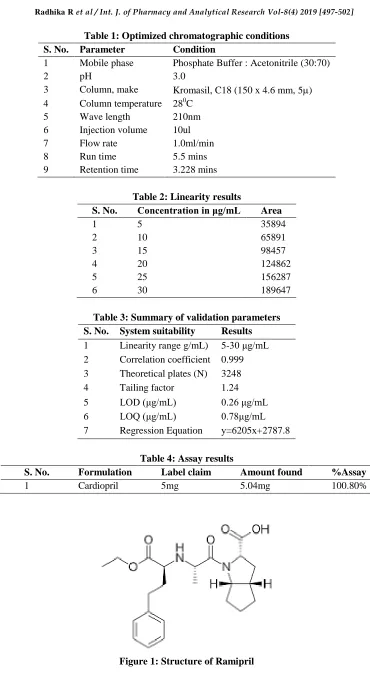
drug. To improve the tailing factor, the pH of mobile phase becomes important factor. Thereafter, phosphate buffer: acetonitrile were taken in isocratic ratio: 30: 70 and with flow rate of 1.0 mL/min was employed. Kromasil C18 column (4.6 x150mm, 5μ particle size) was selected as the stationary phase to reduce the tailing of the peak. 210 nm was selected as the detection wavelength for PDA detector. The retention time was found to about 3.228 min and the results were shown in Table 1 and Figure 2.
Method Validation
System suitability
A system suitability test was performed to evaluate the chromatographic parameters (number of theoretical plates, tailing of the peak) before the validation runs. The results of system suitability parameters were given in Table 3. The analytical method validation was carried out as per ICH method validation guidelines.
Linearity
The linearity range was found in the range of 5-30μg/mL. The response for the drug was linear and the regression equation was found to be y=6205x+2787.8 and correlation coefficient was found to be 0.999 and the results are given in Table 2 and Figure 3.
Precision
Precision is the degree of repeatability of an analytical method under normal operational conditions. Precision of the method was performed as intra-day precision and inter-day precision.
Intra-day precision
To study the intra-day precision, six replicate standard solutions of Ramipril were injected. The percent relative standard deviation (%RSD) was calculated and it was found to be 0.68 which are well within the acceptable criteria of not more than 2.0.
Inter-day precision
To study the inter-day precision, six replicate standard solutions of Ramipril were injected. The percent relative standard deviation (%RSD) was
calculated and it was found to be 0.48 which are well within the acceptable criteria of not more than 2.0.
Specificity
The effect of wide range of excipients and other additives usually present in the formulation of Ramipril in the determinations under optimum conditions were investigated. Chromatographic parameters maintained are specific for Ramipril.
Limit of detecti
on and limit of quantification
A calibration curve was prepared using concentrations in the linearity range (expected detection limit range). The standard deviation of Y-intercepts of regression line was determined. The LOD and LOQ of Ramipril were 0.26 and 0.78 µg/mL, respectively (Table 3).
Accuracy
The accuracy of the method was determined by standard addition method. A known amount of standard drug was added to the fixed amount of pre-analyzed standard solution. The standard addition method was performed at 50%, 100% and 150% level of standard ppm. The solutions were analyzed in triplicate at each level as per the proposed method. The percent recovery and %RSD was found to be 0.98. Satisfactory recoveries ranging from 98% to 102% were obtained by the proposed method. This indicates that the proposed method was accurate.
Robustness
Robustness of the method was determined by making slight changes in the chromatographic conditions. It was observed that there were no marked changes in the chromatograms, which demonstrated that the RP-HPLC method developed is robust.
Tablet Analysis
TheContent of Ramipril in the tablets was found by the proposed method. RSD values for Ramipril are found to be 0.84 and results were shown in table.4.
Table 1: Optimized chromatographic conditions S. No. Parameter Condition
1 Mobile phase Phosphate Buffer : Acetonitrile (30:70)
2 pH 3.0
3 Column, make Kromasil, C18 (150 x 4.6 mm, 5) 4 Column temperature 280C
5 Wave length 210nm
6 Injection volume 10ul
7 Flow rate 1.0ml/min
8 Run time 5.5 mins
9 Retention time 3.228 mins
Table 2: Linearity results
S. No. Concentration in μg/mL Area
1 5 35894
2 10 65891
3 15 98457
4 20 124862
5 25 156287
6 30 189647
Table 3: Summary of validation parameters S. No. System suitability Results 1 Linearity range g/mL) 5-30 μg/mL 2 Correlation coefficient 0.999 3 Theoretical plates (N) 3248
4 Tailing factor 1.24
5 LOD (μg/mL) 0.26 μg/mL
6 LOQ (μg/mL) 0.78μg/mL
7 Regression Equation y=6205x+2787.8
Table 4: Assay results
S. No. Formulation Label claim Amount found %Assay
1 Cardiopril 5mg 5.04mg 100.80%
Figure 2. Chromatogram of Ramipril Standard
Figures: 3. Linearity curve of Ramipril
CONCLUSION
A new precise accurate and simple HPLC method was developed and validated for the estimation of Ramipril in tablet dosage form. This
method is fast, accurate, precise and sensitive hence it can be employed for routine quality control of Ramipril tablets in QC laboratories and industries.
REFERENCES
[1]. Mills TP.Ramipril: a review of the new ACE inhibitor. J Ark Med Soc. 88(9), 1992 , 437-40.
[2]. Bünning P.Kinetic properties of the angiotensin converting enzyme inhibitor ramiprilat. J Cardiovasc Pharmacol. 10(7), 1987, S31-5.
[4]. Frampton JE, Peters DH.Ramipril. An updated review of its therapeutic use in essential hypertension and heart failure. Drugs. 49(3), 1995, 440-66.
[5]. Warner TG, Perry MC. Ramipril: a review of its use in the prevention of cardiovascular outcomes. Drugs 62, 2002, 1381-1405.
[6]. British Pharmacopoeia, vol. II. London, Royal Pharmaceutical Society, 2000, 1331-1333.
[7]. Sankar AS, Vetrichelvan T, Venkappaya D. Simultaneous estimation of ramipril, acetylsalicylic acid and atorvastatin calcium by chemometrics assisted UV-spectrophotometric method in capsules.Acta Pharm. 1,61(3), 2011 , 283-96. doi: 10.2478/v10007-011-0027-1.
[8]. Bhushan R, Gupta D, Singh SK. Liquid chromatographic separation and UV determination of certain antihypertensive agents. Biomed Chromatogr. 20(2), 2006 , 217-24.
[9]. Joseph L, George M, Rao B VR.Simultaneous estimation of atorvastatin and ramipril by RP-HPLC and spectroscopy.Pak J Pharm Sci. 21(3), 2008 , 282-4.
[10].Abdine HH, El-Yazbi FA, Shaalan RA, Blaih SM. Direct differential solubility and compensatoryderivative spectrophotometric methods for resolving and subsequently determining binary mixtures of some anti hypertensive drugs. S. T. P. Pharm Sci., 9, 1999, 587-591.
[11].Salem H. Derivative spectrophotometric determination of two component mixtures. Chin. Pharm. J.,51, 1999, 123-142.
[12].Erk N. Ratio-spectra-zero-crossing derivative spectrophotometric determination of certain drugs in two component mixtures. Anal.Lett., 32, 1991, 1371-1388.
[13].Andrews GP, Jones DS, Senta-Loys Z, Almajaan A, Li S, Chevallier O, Elliot C, Healy AM, Kelleher JF, Madi AM, Gilvary GC, Tian Y. The development of an inline Raman spectroscopic analysis method as a quality control tool for hot melt extruded ramipril fixed-dose combination products. Int J Pharm. 20, 2019 , 566, 476-487.
[14].Patel B, Jangid AG, Suhagia BN, Desai N.Challenges in Simultaneous Determination of Hydrochlorothiazide and Ramipril in Human Plasma: Application to a Bioequivalence Study. J Chromatogr Sci. 1, 56(10), 2018 , 867-878.
[15].Dubey R, Ghosh M. Simultaneous Determination and Pharmacokinetic Study of Losartan, Losartan Carboxylic Acid, Ramipril, Ramiprilat, and Hydrochlorothiazide in Rat Plasma by a Liquid Chromatography/Tandem Mass Spectrometry Method. Sci Pharm. 30, 83(1), 2014¸ 107-24.
[16].Serrano-Rodríguez JM, Gómez-Díez M, Esgueva M, Castejón-Riber C, Mena-Bravo A, Priego-Capote F, Serrano Caballero JM, Muñoz A. Pharmacokinetics and pharmacodynamics of ramipril and ramiprilat after intravenous and oral doses of ramipril in healthy horses. Vet J. 208, 2016 , 38-43.
[17].Patel JR, Pethani TM, Vachhani AN, Sheth NR, Dudhrejiya AV. Development and validation of bioanalytical method for simultaneous estimation of ramipril and hydrochlorothiazide in human plasma using liquid chromatography-tandem mass spectrometry. J Chromatogr B Analyt Technol Biomed Life Sci. 1, 2014 , 970, 53-9.
[18].Lawson G, Cocks E, Tanna S. Bisoprolol, ramipril and simvastatin determination in dried blood spot samples using LC-HRMS for assessing medication adherence. J Pharm Biomed Anal. 81-82, 2013, 99-107
[19].Sereda KM, Hardman TC, Dilloway MR, Lant AF. Development of a method for the detection of angiotensin-converting enzyme [peptidyldeipeptidase A] inhibitors using electron-capture gas chromatography detection.Anal. Proc. 30, 1993, 371–372.