Multiple Parameter Based Resource Allocation
Algorithm in Cloud Computing through
Auctioneer
Reeta Reena Kaushal
M. Tech Student Assistant Professor
Department of Computer Science & Engineering Department of Electronic and Communication Engineering International Institute of telecom Technology Pojewal International Institute of telecom Technology Pojewal
Abstract
Cloud computing is a model that is dynamically, delivered the software applications and hardware infrastructure as the services on the internet to the Cloud users. Clouds provide the services such as virtual servers, storage, application development, design, and testing and these services can access by multiple users at anytime and anywhere. Some time multiple clients send their requests simultaneously for the same resource therefore, it also faces some problems like scarcity of resources, security, fault tolerance and resource allocation. The optimal resource allocation and resource management is must to avoid these kinds of problems. Numbers of authors have proposed their techniques for resource allocation, from these some are market based resource allocation technique. The proposed algorithm is on the basis of Auction based techniques. Here, number of users can send their request for the different resources with multiple parameters. Seller and buyer has different point of view, customer wants to buy the resource with less price and seller wants to sell their resources with profit so, some techniques are based on the user point of view and some are based on the seller point of view, but the proposed technique beneficial for both because here providers and users send their bids and requirements to the auctioneer. This method dynamically calculates the price, gave the discount to the users on basis of time, and penalise to defaulter provider. It also reduces the SLA violation, VM migration, and Execution time.
Keywords: Cloud Computing, Challenges, Resource Allocation, Auction, Model
_______________________________________________________________________________________________________
I.
I
NTRODUCTIONCloud computing is combination of earlier technologies like grid, distributed computing, utility computing, and Virtualization. It is a model that is dynamically delivered software application and hardware infrastructure as services on the internet. Consumers can pay for these services but they pay according to use mean to say the payment is paid by using pay-as-you-use model. This feature made it most cost effective. It is mostly used in business, due to its cost effectiveness and distributed features. It is cheaper to use, to maintain, and to upgrade. Number of autonomous users from number of different places can communicate, share their information and operations, hardware and software infrastructure, and storage also due to its distributed nature. Service Level Agreement (SLA) and Quality of Services (QoS) are main component of cloud computing. SLA is used by consumer for negotiation between user and service provider and QoS is helpful to making cloud services acceptable to end users. It also contains deadline, budget, file size, penalty rate ratio and requested length. Deadline is the maximum time in which users wait for results. Budget is the total amount of user’s that he wants to pay for the resources. Penalty Rate Ratio is a ratio of compensation for users if the deadline is missing by SaaS provider. Input File Size is the size of input file that is provided by consumer. Request Length is the Millions of Instructions (MI) necessary to complete the request [1]. The National Institute of Standards and Technology (NIST) defines cloud computing as “ cloud computing a model for permitting convenient, on-demand network access to a shared pool of defendable computing resources (e.g. network, servers, storage, applications and services) that can be rapidly provisioned and released with minimal management effort or service provider interaction. [2]
Challenges or Obstacles In Cloud Computing
Cloud Computing introduces many issues for system and application developers, engineers, system administrators, and service provider which needs to be addressed to made this model more secure, cost effective and efficient so that it will fulfil all users’ requirements. In this section discussed some challenges [4] [2] [5] [3][6] [7]:
Security, Privacy and trust
Data security is a major issue in Cloud Computing. Service provider, provide the security to users’ data. Since service providers do not have authorization for access to the physical security system of data centers. Users depend upon infrastructure provider to get full security of data. In a virtual private cloud environment, customers don’t know exactly those are fully implemented security because the service provider can only state the security setting remotely.
Legal and Regulatory
management of data. For example, some countries could not allow used specific cryptography techniques. So, some specific classes of users, like banks, would not put their sensitive data into the Cloud, to save their customers and their business from any harm or any lose.
Energy Management
If data centers consume huge amount of power, then they will become expensive to operate. More power consumption addresses these issues. Energy efficient resource allocation and algorithms need to be developed to solve these kinds of problems. The performance of data centers depends on the usages of its hardware devices according to need of users by the VM management software. As more CPUs are used, automatically temperature of the hardware increases, so requires cooling of the data center. Performance of the data center and energy consumption is directly related to each other. Consequently when energy consumption increased, the cost of operation of the data center also increased. So make balances in performance and energy consumption necessary for provider.
Service Level Agreement
Service Level Agreements describe the functional and non-functional characteristics of Cloud services, are approved by both the consumer and the provider. Pricing model, usage model, resource metering, billing, and monitoring, are the common parameters that define a SLA and level of security is also established within a SLA. When a service vendor of Cloud Computing is unable to provide the terms that are assured in the SLA, a violation occurs. For example, an IaaS Cloud service vendor may guarantee to provide a minimum response time from a VM, minimum storage space, reliability of data etc. However, if a user do not obtain the desired response time, runs out of virtual disk space or is met with frequent errors, then SLA violated. In case of violations, the SLA also defines a penalty model to compensate the user.
Virtual Machine Migration
Virtual Machine migration provides main benefits in cloud computing through load balance. It also provides strong and high response in data centers. Virtual machine migration was extended from process migration. It is a process of moving a running virtual machine or application on different physical machines without disconnecting the client or its application. Memory, storage, and network connectivity of the virtual machine are also transferred from the original virtual machine to the destination. At migration time security is must issue. During this procedure, protection of sensitive information like passwords and encryption keys are most important. A secure channel is at times not enough for protection of data or information from attackers. Live VM Migration, means process bound any other network, at this time users’ data is not secure because network may under attacks such as ARP spoofing, DNS poisoning, and route hijacking. If a hijacker place himself between the source and the destination host, he can then conduct passive (sniffing) or active (man-in-the-middle) attacks. The fact that the live migration procedure is usually run inside a LAN, a network attack to be successful, especially in situations where third-parties run their VMs inside the same network subnet, which is the case in cloud computing.
Resource Allocation
Resource allocation means provide the resources to all Cloud users on their demand. One another feature of Clouds has availability of computing resources that can be supplied to users on their demands. Cloud rely resources to Users with elasticity by resource allocation system in a flexible way. Due to this flexibility users feels like Cloud has infinite resources because this flexibility helps to multiplexing the statistical of computing resources. Multiplexed resources avoid both over provisioning and under provisioning of IT infrastructure. Moreover there is heterogeneity of resources is necessary. The important feature of resource allocation is the assurance of resources and satisfied the requirements of all Cloud users. According to [8] resource allocation must restrict the degradation of performance up to certain range. Allocation techniques should be aware of status of every resource in distributed environment. And using this information efficiently applies algorithms so as to allocate computing resources in distributed environment. Users in Cloud can arrive and leave anytime without prior knowledge about their requirements. So developing efficient resource provisioning and allocation technique is one of the most challenging issues to meet heterogeneous requirements of Cloud users.
Auction based Models
In Auction based model there is an Auctioneer who conducts the auction. Buyer and seller send their bids to auctioneer, he find the winner and assign the service provider to users according to their requirement [11]. Following are the basic terminologies in auction:
Bidder: A bidder is the one who wants to buy the services in auctions..
Seller: A seller who wants to sell commodities. The commodities can be bandwidth, licenses of spectrum, and time slots etc. Auctioneer: An intermediate agent called an auctioneer who hosts and directs auction processes.
Commodity: A commodity is a object traded between a buyer and a seller. Each product or commodity has a value at which the buyer/seller wants to buy/sell.
II.
P
ROPOSED WORKmarket based algorithms are designed for seller side auction or some for buyer side auction but in proposed algorithm both buyers and sellers send their bids to auctioneer. Between user and provider, Auctioneer works like a trading agent who would decide the scheme for resource allocations. In ‘Combinatorial Auction’ providers and users send their bids and ask respectively to the auctioneer for a bundle of resources than a single resource. If single commodity is not received from a requested set of commodity the buyer is not satisfied because buyer needs, complete set of commodities. Auctioneer sends messages to both providers and users about starting the auction and set a timer for receiving requests and bids for the resources from buyers and sellers respectively. After this, buyer or users send their requests to auctioneer with price that they willing to pay. The buyer list is sorted in descending order by the auctioneer according to bid density. Similarly, Auctioneer received the offers from the sellers or providers and arranged it in ascending order according to bid density. Then starts the matching, if all the requested resources attributes are matched with offered attributes of resources by the first provider then match them otherwise access the next provider. This process will continue until all requests are not fulfilled. If winner sellers are unable to satisfy the users then they get penalty. In proposed algorithm users will get discounts if they will buy the resources more than three days and it also helpful to provide the optimal resource allocation in Clouds.
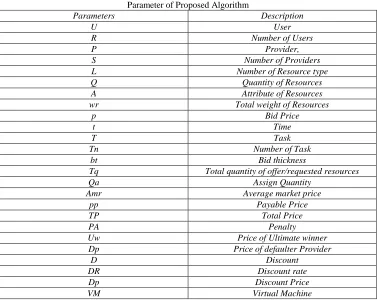
Parameters of Proposed Algorithm
Let Users (U) and number of users i={1,2,3,4...r}
Cloud Provider (P) and the number of Providers j ={1,2,3.4.5...s} Total number of resources L and L={1,2,3,4...l}
Task (T) and total number of task T={T1, ...,Tn}
Users Ui can request for different kind of resources with their different attributes. {Ai1 ... AiL} this vector divide the requested resources with their attributes.
Similarly Providers Pj can offered different kind of resources with their different attribute. {Aj1...AjL} this vector categorise the different offered resources with their attributes.
The quantity of resources that is requested by users {Qi1...QiL}. The offered quantity of resources by Providers {Qj1...QjL}.
Table – 1
Parameter of Proposed Algorithm
Parameters Description
U User
R Number of Users
P Provider,
S Number of Providers
L Number of Resource type
Q Quantity of Resources
A Attribute of Resources
wr Total weight of Resources
p Bid Price
t Time
T Task
Tn Number of Task
bt Bid thickness
Tq Total quantity of offer/requested resources
Qa Assign Quantity
Amr Average market price
pp Payable Price
TP Total Price
PA Penalty
Uw Price of Ultimate winner
Dp Price of defaulter Provider
D Discount
DR Discount rate
Dp Discount Price
VM Virtual Machine
Proposed Algorithm with their Phases:
Phase1
1. Number of Cloud Providers registered them to Auctioneer and advertises about their services and resources.
2. Multiple users send their request to Auctioneer for resources.
Phase2
1. Resource Providers Pj, {1, 2, 3 ...s} check the availability of resources if resources are available then each provider generate a set of
resources with their attributes.
2. Providers send their resources set to Auctioneer and create price value for each set of resources.
3. Providers send their bids to an Auctioneer.
4. Multiple Users also create required resources sets with their attributes and create price value for each set according to their budget.
5. Users send their Bids and required time for resources to an Auctioneer.
Phase3
1. Auctioneer sent the messages about close the bidding process to Providers and Users.
Phase4
a) Winner Determination
Auctioneer received the bids with attributes and quantity for the offered resources by different Providers and he calculates the winner Provider. He also received the bids for the resources (with their attributes, quantity and required time for resources) from multiple Users and then Auctioneer calculates the winner from Users. He creates two lists one for users and other for cloud providers. After this he sorts the user list according Eq. (1) and Eq. (3) and sort the Providers list according to Eq. (4) and Eq. (5). The sort operation is depends upon offered and requested resources (with their bid, attribute and quantity) by providers and users. Auctioneer sorts the Users list in descending order and Provider list in ascending order. For sorting process in this algorithm used the bid thickness bt and total weight of resources wr. Total weight of resources depends upon their number of attributes of resources and quantity of resources. Calculate the winners as following:
... Eq. (1)
In equation (1) wri used for total number of resources requested by users, is attribute of resources that are requested by the user i for resource L, is quantity of resources L that required by user i. Equation (2) calculate the bid price p of user i at time t and is requested time for resource L by user i.:
... Eq. (2)
Eq. (4.3) evaluates the bid thickness bti that is depends upon bid price p for resources L by user i and total weight of requested resources by users i.
bti = ... Eq. (3)
Similarly, in equation (4.4) find the total weight of resources offered by Provider j like user i in equation (4.1).
... Eq. (4)
Compute the bid thickness in Eq. (5) like equation (3). btj = ... Eq. (5)
Phase5
a) Allocation of Resources
After prepared the sorted lists for users and providers, Auctioneer starts the matching between both lists. Firstly he will match the first User from Users list to first Cloud Provider from provider list with their requested and offered resources, attributes of resources and quantity of resources. If attributes of the requested type of resources from the first User matched with the attributes of offered type of resources by the first Provider then assigned otherwise check the next Provider. Before assigning the Cloud Provider to User, check the requested capacity and quantity of the resources should be less than or equal to the capacity and quantity of the Provider resources. This process will run until the first user not satisfied. When first user fully satisfied then next user starts matching with providers same steps will run until the all users are not satisfied. Then, Auctioneer will send the result to Provider and user by message.
Phase6
a) Calculate the Price
Price calculation must be cleared to attract the multiple users and providers. In this algorithm used the average price of user and provider to calculate the payable cost by users, as used in [8].
In Eq. (6) and Eq. (7) evaluate the Total Quantity of requested resources and offered resources respectably to find out the average of requested resources and offered resources.
... Eq. (6)
... Eq. (7)
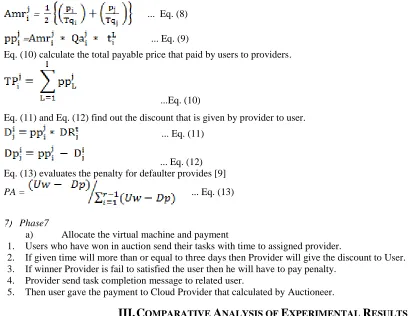
... Eq. (8)
... Eq. (9)
Eq. (10) calculate the total payable price that paid by users to providers.
...Eq. (10)
Eq. (11) and Eq. (12) find out the discount that is given by provider to user.
... Eq. (11)
... Eq. (12) Eq. (13) evaluates the penalty for defaulter provides [9]
PA = ... Eq. (13)
Phase7
a) Allocate the virtual machine and payment
1. Users who have won in auction send their tasks with time to assigned provider.
2. If given time will more than or equal to three days then Provider will give the discount to User. 3. If winner Provider is fail to satisfied the user then he will have to pay penalty.
4. Provider send task completion message to related user.
5. Then user gave the payment to Cloud Provider that calculated by Auctioneer.
III.
C
OMPARATIVEA
NALYSIS OFE
XPERIMENTALR
ESULTS The proposed algorithm has been compared using VM Migration, SLA Violations and Execution Time.VM Migrations
Figure 1 shows that proposed algorithm has minimum VM migrations as compared to Random overlap algorithm. The Random Choice (RC) policy selects a VM to be migrated according to a uniformly distributed discrete random variable, whose values index a set of VMs allocated to a host [10]. At 0.1 threshold valued, an existing approach has 517 VM migrations and proposed approach has 429 VM migrations. For all the threshold values, our proposed algorithm shows best results
Fig. 1: VM Migration
SLA Violations
In proposed algorithm number of SLA (Service level Agreement) Violations decreased as compared to Random Choice Policy that exposed in figure 2. At threshold value 0.4, number of violations in existing system are 0.000837 where in proposed system these values are 0.000749, that are fewer than existing algorithm.
SLAV= SLATAH * PDM
Fig. 2: SLA Violations
Execution Time
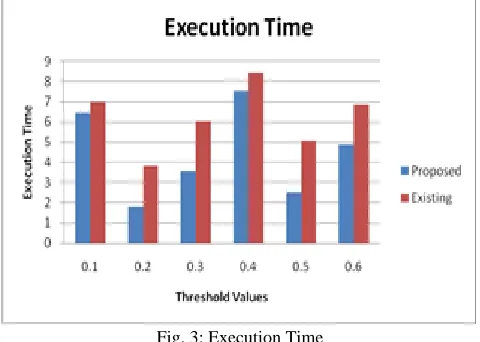
Execution Time is the time to execute tasks within specific time. It is also defined as the difference between ending time and starting. Figure 3 shows the execution time of proposed algorithm and existing algorithm where each threshold value of proposed system is less than existing.
Fig. 3: Execution Time
System. At threshold value 0.2 the execution time of proposed algorithm is 1.797561mille seconds and existing system has 3.825784 mille seconds. Similarly each threshold value shows proposed algorithm has less execution time than existing system.
IV.
C
ONCLUSION ANDF
UTUREW
ORKMultiple parameter based Resource allocation is one of the most challenging issues in Cloud Computing. Many of the researchers have proposed various algorithms and techniques to provide the resources to users from Cloud and this thesis also proposed a technique by which number of users and number of providers can send their requests and offers to the auctioneer for resources with their multiple parameters. So, the resources that are allocated to Cloud users based on the parameters such as cost, time, quantity and type of resource. The proposed technique calculates the price of the resources online and users can get the discount on the basis of requested time for the resources. If they order resources more than three days then user can get the discount and here is also a penalty check the for defaulter providers. The selected Providers should be penalised if they failed to provide required resources to users. It is economically beneficial model because users can get the multiple resources at a time. It also reduced the VM migrations, SLA Violations and Execution Time.
Future Directions:
1) In the current thesis, results are compared with Random overlap, but in future, the results can be compared with existing Auction based models.
2) It can be implemented to schedule multiple tasks at the same time during resource allocation. 3) Automatic discount policy would implement according to number of requested resources.
R
EFERENCES[1] N,Ani Brown Mary. and K,Jayapriya., “An Extensive Survey on QoS in Cloud computing”, N.Ani Brown Mary et al, / (IJCSIT) International Journal of
Computer Science and Information Technologies, Vol. 5 (1) , 2014, pp.1-5.
[2] Faith Shimba.,”Cloud Computing: Strategies for Cloud Computing Adoption”, Dublin Institute of Technology, ARROW@DIT; 2010-09-01; pp8-53.
[3] Rajkumar Buyya., James Broberg. and Andrzej Goscinski., ”Cloud Computing Principles and Paradigms”, Published by John Wiley & Sons, Inc., Hoboken,
New Jersey Published simultaneously in Canada, pp13-16.
[4] Bhaskar Prasad Rimal., Eunmi choi. and Ian Lumb., “A Taxonomy and Survey of Cloud Computing System.” 2009 Fifth International Joint Conference on
INC, IMS and IDC.
[5] Qi Zhang., Lu Cheng. and Raouf Boutaba., “ Cloud computing: state-of-the-art and research challenges”, J Internet Serv Appl (2010), Received 8 January
2010, Accepted 25 February 2010 , Published online 20 April 2010 , The Brazilian Computer Society 2010, pp.7–18.
[6] Rajkumar Buyya., Suraj Pandey. and Christian Vecchiola., “14 Market-Oriented Cloud Computing and the Cloudbus Toolkit”, Cloud Computing and
Distributed Systems (CLOUDS) Laboratory, Department of Computing and Information Systems, The University of Melbourne, Australia Manjrasoft Pty Ltd, Melbourne, Australia.
[7] V, Krishna Reddy., B. Thirumala Rao., Dr. L,S,S, Reddy. and P, Sai Kiran., "Research Issues in Cloud Computing” Global Journal of Computer Science and
Technology, Volume 11, Issue 11, Version1.0 July2011, Type: Double Blind Peer Reviewed International Research Journal, Publisher: Global Journals Inc. (USA) Online ISSN: 0975-4172 & Print ISSN: 0975-4350.
[8] L. Li., Y.-A. Liu., K.-M. Liu., X.-L. Ma. and M. Yang., “Pricing in combinatorial double auction-based grid allocation model”, J. China Univer. Posts Telecommun. 16 (2009) 59–65.
[9] Richa Goyal. and Dr. Anju Bala.,” An Efficient Auction Based Resource Allocation Algorithm in Cloud Computing” COMPUTER SCIENCE AND
ENGINEERING DEPARTMENT, THAPAR UNIVERSITY PATIALA – 147004 July 2015.
[10] Anton Beloglazov. and Rajkumar Buyya.,” Optimal Online Deterministic Algorithms and Adaptive Heuristics for Energy and Performance Efficient Dynamic
Consolidation of Virtual Machines in Cloud Data Centers” CONCURRENCY AND COMPUTATION: PRACTICE AND EXPERIENCE, Concurrency Computat.: Pract. Exper.2012;24:1397–1420, Published online in Wiley InterScience (www.interscience.wiley.com). DOI: 10.1002/cpe.1867.
[11] Yang Zhang, Chonho Lee, Dusit Niyato, and Ping Wang, “Auction Approaches for Resource Allocation in Wireless Systems: A