Volume 6
Issue 2 Spring 2018 Article 5
April 2018
A Mixed-Methods Study Examining Developmental Milestones
A Mixed-Methods Study Examining Developmental Milestones
and Parental Experiences in Ghana
and Parental Experiences in Ghana
Kate G. Barlow
American International College - USA, [email protected]
Stacey Reynolds
Virginia Commonwealth University - USA, [email protected]
Follow this and additional works at: https://scholarworks.wmich.edu/ojot
Part of the Occupational Therapy Commons
Recommended Citation Recommended Citation
Barlow, K. G., & Reynolds, S. (2018). A Mixed-Methods Study Examining Developmental Milestones and Parental Experiences in Ghana. The Open Journal of Occupational Therapy, 6(2). https://doi.org/ 10.15453/2168-6408.1407
This document has been accepted for inclusion in The Open Journal of Occupational Therapy by the editors. Free, open access is provided by ScholarWorks at WMU. For more information, please contact
Abstract Abstract Background:
Background: Ghana currently lacks a systematic method for identifying children with developmental delays, and there do not appear to be any culturally sensitive assessment tools available. The objectives of this mixed-methods research study were to explore normal developmental milestones and parental practices in the Ghanaian population. The study also aimed to identify and describe culturally specific factors that should be accounted for on assessments used in the Ghanaian culture.
Methods:
Methods: Twenty-eight Ghanaian parents were interviewed and asked to participate in a developmental milestone picture-identification task. Quantitative and qualitative data analyses were performed.
Results:
Results: The interviews revealed several cultural factors that may need to be accounted for on a
standardized assessment for Ghanaian children. Some gross motor and self-care skills (e.g., crawling and toilet training) were reported to develop earlier in Ghanaian children compared to children in the United States.
Discussion:
Discussion: Developmental assessments normed on a U.S. sample may be inappropriate to use in the Ghanaian culture. Renorming of existing developmental assessments for the Ghanaian population is recommended.
Comments
The authors have no conflicts of interest to disclose.
Keywords Keywords
child development, Ghana, international, rehabilitation, occupational therapy
Cover Page Footnote Cover Page Footnote
The authors would like to thank Ellen Serwaa Adomako and Joseph Appah for serving as consultants on this project, as well as Eugenia Kahu, Bless Darlington, Eric Annan, and Felicia Annan for help with subject recruitment. We would also like to acknowledge Caitlin McDaniel for her assistance with manuscript preparation, as well as Nava Hymowitz, Samantha Costanzo, and Meghan Odom Reynolds, who served as research assistants on various aspects of the project. The authors would like to acknowledge Carol Ivey for her support while in Ghana and Diane Simons for her consultation regarding qualitative methodology. Lastly, we would like to thank the Ghanaian moms and dads who shared their time to participate in the study.
Credentials Display Kate Barlow, DOT, MS, OTR/L
Stacey Reynolds, PhD, OTR/L, FAOTA
Copyright transfer agreements are not obtained by The Open Journal of Occupational Therapy (OJOT). Reprint permission for this Applied Research should be obtained from the
corresponding author(s). Click here to view our open access statement regarding user rights and distribution of this Applied Research.
The American Occupational Therapy Association (2003) states in the Centennial Vision that occupational therapy will become “a powerful, widely recognized, science-driven, and evidence-based profession with a globally connected and diverse workforce meeting society’s occupational needs” (American Occupational Therapy Association, 2003, p. 1). In order for current and future occupational therapists to meet this goal of global connectivity, steps must be taken to create partnerships with
persons with disabilities and with rehabilitation professionals in other countries. There is an opportunity for occupational therapists in developed countries, such as the United States, to support developing countries, such as Ghana, that wish to improve the availability of preventative and rehabilitative services for individuals with disabilities. The goals of this project were to provide knowledge and resources to occupational therapists in Ghana for identification of children at risk for developmental delay and who may benefit from rehabilitation services.
Disability Culture in Ghana
The Republic of Ghana is a sovereign and constitutionally democratic country in West Africa considered to be a regional power. The population of Ghana is over 25 million, with 15% of the
population estimated as having a disability (World Health Organization, 2011). Unfortunately, the term disability has not been well defined in Ghana. The Commonwealth Human Rights Initiative (CHRI) based in Accra, Ghana, defines disability as: “A person with a physical, mental or sensory impairment including a visual, hearing or speech functional disability, which gives rise to physical, cultural or social barriers that substantially limits one or more of the major life activities of that individual” (p. 18). As noted by Sarpong (2012), however, because the term disability has not been defined by the Ghanaian lawmakers, the ability to formulate sustainable policies to help the disabled population has been severely limited. The available literature suggests that most Ghanaian citizens think that disability is only
physical (e.g., someone in a wheelchair or with crutches) or sensory (e.g., individuals who are deaf or blind) in nature (Reynolds, 2010; Sarpong, 2012). Mental health disorders, learning disabilities, neuro-developmental disorders, and some chronic health conditions (e.g., asthma, epilepsy) are generally not well understood by the Ghanaian population (Reynolds, 2010; Sarpong, 2012).
The understanding of disability in Ghana and the treatment of the disabled has been influenced for centuries by traditional beliefs; these include beliefs that spirits or witchcraft are the causes of disability and the view that disorders like Down’s syndrome are contagious (Bayat, 2015; Reynolds, 2010). Therefore, those with disabilities in Ghana have historically been seen as a taboo and are oftentimes killed or abandoned at birth or isolated from the rest of society. Because of the poor
understanding of disability in Ghana and the prevailing traditional beliefs, individuals with disabilities in Ghana constitute some of its poorest citizens who often lack access to public health and medical,
educational, and social services.
Disability Law and Practices in Ghana
disabilities, and provide training for health professionals in the field of rehabilitation (Ghana Federation of the Disabled, 2006). Although the law was passed in 2006, there is still not a policy in place to address the process of screening children to identify a disability and place them in a special education program; therefore, there are still many challenges for children with disabilities in Ghana (Mensah & Badu-Shayar, 2016). The purpose of this project was to begin the process of developing a culturally sensitive screening tool that could be used by rehabilitation professionals in Ghana to identify children with a disability and to identify children who are at risk for developmental delay.
Current Services for Children in Ghana
Emerging disability awareness in Ghana has led to the expansion of rehabilitation programs and an increased number of rehabilitation professionals in the country; however, the total number of
practicing rehabilitation professionals is still limited. Professor Ellen Adomako from the Occupational Therapy Program at the University of Ghana estimates that there are currently three practicing
occupational therapists, four speech and language pathologists, and approximately 200 physiotherapists in Ghana (E. S. Adomako, personal communication, June 6, 2016). There are, however, new
rehabilitation programs in the areas of occupational and speech therapy at the University of Ghana, as well as existing programs in physiotherapy. The occupational therapy program at the University of Ghana in Accra graduated its first class of therapists to the workforce in 2017. Current rehabilitation professionals and students will be essential in actualizing the mission set out by PDA-06, including identification and provision of rehabilitation services to children with disabilities.
While routine developmental screening of children is not commonly practiced in Ghana (Bello, Quartey, & Appiah, 2013), developmental screening by health or rehabilitation professionals would allow at-risk children to be identified early and directed into appropriate rehabilitation programs as they become available. Currently there is not a standardized tool being used in Ghana to screen children for developmental delays. Some practicing physiotherapists use the “Evaluation of a Child’s Level of Physical Development” from Disabled Village Children (Werner, 2009), which provides a picture of certain developmental milestones and a gross estimate of when those skills should appear (E.S. Adomako, personal communication, June 6, 2016). While this chart is helpful for depicting a gross estimate of skills for typically developing children, it does not have any established reliability or validity for use as a diagnostic tool, nor is it specific to the Ghanaian population.
One other tool, the “Ages and Stages Questionnaire,” was used by Bello, Quartey, and Appiah (2013) for research purposes to screen rural Ghanaian children. However, the “Ages and Stages Questionnaire” is a screening tool based on the developmental milestones of children from the United States. Use of screening tools that are not designed for the target population can be problematic since child development should be considered in the context affected by the family system, community, culture, laws, resources, and environment (Wijedasa, 2012). For Ghanaian therapists to identify and measure progress accurately in children with disabilities, they need assessment tools that accurately reflect the norms, expectations, and priorities of the Ghanaian culture.
Developmental Screening Across Cultures
personal-social (self-care), fine motor, gross motor, and language, providing a brief but well-rounded view of a child’s overall development (Frankenburg et al., 2009). While the DDST-II was established and normed on a sample of children from Denver, CO, in the United States, it has already been
culturally modified in several countries. For example, Wijedasa (2012) examined the developmental norms for Sri Lankan children and compared Sri Lankan norms with the norms of the DDST-II. Results of this study indicated that the DDST-II norms for Sri Lankan children differed from those of the United States, indicating that “original developmental screening test norms may not be applicable to all child populations in the world” (p. 895). The DDST-II has also been adapted in Turkey (Ozturk, Sari, Bektas, & Elcigil, 2011), Brazil (Fan, Portuguez, & Nunes, 2013), Thailand (Jeharsae, Sangthong, Wichaidit, & Chongsuvivatwong, 2013), Taiwan (Chiu, Liao, Chang, Chen, & Chen, 2011), Singapore (Lim et al., 1996), and Malawi (Gladstone et al., 2008; Gladstone et al., 2010).
In considering tools that may be applicable to the Ghanaian population, the DDST-II is worth consideration since it has successfully been adapted for Malawi, another sub-Saharan African county. However, in adapting the DDST-II into the Malawi Developmental Assessment Tool (MDAT),
Gladstone et al. (2008, 2010) indicated that some test items originally designed to fit Western culture did not make sense in the sub-Saharan African setting and had to be replaced with culturally appropriate ones. Specifically, they found that the gross motor, fine motor, and language items were more culturally acceptable (similar to U.S. expectations), whereas personal-social items were more culturally specific and difficult to adapt (Gladstone et al., 2008). These findings are in line with other cross-cultural studies that found differences in developmental norms and expectations for specific populations compared to Western populations (Findlay, Kohen, & Miller, 2014; Wijedasa, 2012), and specifying a need for establishing culturally specific norms and standards.
With these considerations in mind, the current study incorporated interview questions and developmental items directly from the DDST-II. This was seen as a preliminary step in adapting the DDST-II for the Ghanaian population. It was also important that this preliminary work identify cultural and social factors influencing child development in Ghana and the developmental milestones most salient to this population.
The specific aims of this research study were: (a) to identify and document the ages when children in Ghana were reported to achieve developmental milestones, (b) to identify and describe culturally specific factors that should be accounted for on assessments used in the Ghanaian culture, (c) to identify and describe which developmental milestones are the most valued in Ghanaian culture, and (d) to identify and summarize what actions the parents in Ghana take when they feel their child is not meeting the expected developmental milestones. These aims were intended as a first step in developing or modifying a developmental screening tool that was sensitive to the needs of the Ghanaian culture and their child development practices.
Method Procedures and Sample
In the spring of 2014, occupational therapy students from the United States participated in a course titled “Child Development and Disability Culture in West Africa,” which culminated in a 2-week study abroad trip to Ghana. While in Ghana in May of 2014, the faculty and students conducted a mixed-methods research study to explore parental views and expectations of developmental milestones. Internal Review Board approval was obtained prior to travel. Data was collected through a
participant responses were audio recorded using hand-held voice recorders (Olympus Corporation, Tokyo), and all of the participants gave verbal consent. Using a phenomenological approach, interviews were conducted by an occupational therapist in the postprofessional doctoral program and by two
occupational therapy students (hereafter referred to as the research assistants) in the entry-level Master’s program.
Ghanaian parents were recruited through convenience sampling to participate in the study through one private school administrator in Accra (urban and suburban) and through one orphanage administrator in the Volta region (primarily rural). These administrators were briefed on the study purpose and the inclusion/exclusion criteria for participation (described below); they then contacted eligible families by visiting them at their homes, in their village common area, or calling them on their cell phones. Those who expressed interest in participating in the study then identified a time that the research team could meet with them and a preferred location for the meeting. The formal consent process took place between the research team and the participants during this meeting.
The inclusion criteria for the study required that the participant (a) be willing to participate, (b) be able to speak and understand English moderately well, (c) have been born and currently living in Ghana, and (d) have at least one typically developing child in the household. Potential subjects were excluded if they were under 18 years of age. An effort was made to identify an equal number of families from low, middle, and high income households (based on Ghanaian standards, GDP median family income $2000-$3000/year).
Twenty-four mothers and four fathers completed the study; 18 parents were from the Accra region (urban and suburban) and 10 were from the Volta region (primarily rural). Three parents
identified as being in the first class (annual income above the national average), 10 identified as being in the second or middle class (annual income commensurate with the national average), and 11 identified as being in the third class (annual income much below the national average). All of the participants were given a gift bag filled with scented lotion and hand gel (valued at ~ $10.00) for their participation.
Semi-Structured Interview and Picture-Identification Task
This mixed-methods study consisted of two parts: a semi-structured interview and a picture-identification task. Both activities were conducted at a time and place convenient for the subjects and lasted approximately 45 min. The interview was comprised of 35 open-ended questions targeting parental views and child rearing practices in Ghana. Some examples of interview questions include: (a) tell me about how babies in Ghana eat; (b) what is important for a baby in Ghana to do during its first year of life; (c) tell me about how children in Ghana spend their time when they are not in school; and (d) how can you tell that a child is growing up healthy and doing well? If a subject’s response to a question was brief or vague, the research team asked follow-up questions. For example, for the question “Tell me about how children in Ghana are trained to use the toilet,” follow-up probes may include, “Who is responsible for or involved in training the child?” or “When does toilet training typically occur?”
After the interviews, the subjects completed the picture-identification task. During this task, the subjects were asked at what age their children reached 20 specific developmental milestones
shown to the participant followed by the question, “When did your child first start to drink from a cup?” The visual aids (which were pictures of children taken from Google images) were created to assist with any potential cultural or language barriers.
Data Management and Analysis
Within 8 hours of each interview, audio recordings were transferred onto a password protected laptop and copied onto a secure USB flash drive for backup. After transferring the data, the audio recordings were deleted from the hand-held audio recorders.
Once back in the United States, the researchers transcribed all interviews into text format. Objective data from the structured picture-identification task was loaded into SPSS software (Version 21) and descriptive statistics were generated to identify mean ages for task performance. Text files of the semi-structured interviews were then imported into a qualitative data analysis software program,
NVivo10.
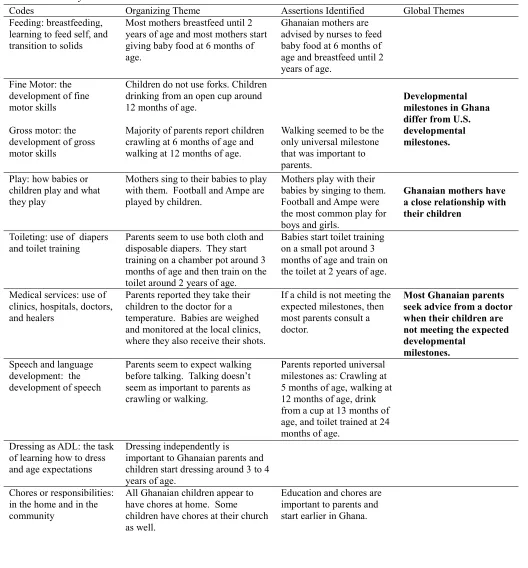
Qualitative data coding. Prior to coding, the interviews were read twice by each author. The codes were jointly identified through the third and fourth review of the interviews. The codes selected were reflective of common attitudes and experiences shared by the informants. Further data analysis after coding the first interview resulted in the modification of selected codes. Once the 25 codes were selected and finalized, the first author and the PI coded the same interview to check for coding reliability and were in 96% agreement. From the information separated into each of the 25 codes, an organizing theme was reported from each code. From the organizing themes, nine assertions were identified. From analysis of the assertions, the five global themes were reported. This extensive analysis of the data is reported in Table 1. The themes were recorded in the research journal and prepared for stakeholder review.
Validation of themes. Stakeholder checks were completed to enhance data trustworthiness; the research assistants were asked to participate in a validation and verification process. The themes, supporting quotations, and a copy of their interview transcript were provided to the research assistants. The research assistants were asked to indicate whether the themes resonated with their perceptions of their informants’ beliefs, attitudes, or experiences. The research assistants were in agreement about the five themes.
Due to the logistics of verifying data with the actual families interviewed, the findings were reviewed with Ghanaian-Americans living in the United States. Ghanaian-American mothers who participated in the data verification process had each spent at least 10 years in Ghana, identified as having strong family ties with Ghana, and had at least one typically developing child in their immediate family. Four Ghanaian mothers agreed with and verified all five themes discussed.
The final verification process was to review the findings with cultural experts who had a background in rehabilitation; two experts were identified and agreed to participate. The first was a Ghanaian mother who is a rehabilitation professional living in Ghana. The second cultural expert was a Ghanaian male who is studying rehabilitation in the United States. Both cultural experts agreed to all five themes with additional commentary to clarify points; their feedback has been incorporated below.
Results Qualitative Findings
differ from those in the United States. Two areas in which these differences were most apparent were in the areas of toileting and feeding.
Table 1
Thematic Analysis Framework
Codes Organizing Theme Assertions Identified Global Themes Feeding: breastfeeding,
learning to feed self, and transition to solids
Most mothers breastfeed until 2 years of age and most mothers start giving baby food at 6 months of age.
Ghanaian mothers are advised by nurses to feed baby food at 6 months of age and breastfeed until 2 years of age.
Fine Motor: the development of fine motor skills
Gross motor: the development of gross motor skills
Children do not use forks. Children drinking from an open cup around 12 months of age.
Majority of parents report children crawling at 6 months of age and walking at 12 months of age.
Walking seemed to be the only universal milestone that was important to parents.
Developmental milestones in Ghana differ from U.S. developmental milestones.
Play: how babies or children play and what they play
Mothers sing to their babies to play with them. Football and Ampe are played by children.
Mothers play with their babies by singing to them. Football and Ampe were the most common play for boys and girls.
Ghanaian mothers have a close relationship with their children
Toileting: use of diapers and toilet training
Parents seem to use both cloth and disposable diapers. They start training on a chamber pot around 3 months of age and then train on the toilet around 2 years of age.
Babies start toilet training on a small pot around 3 months of age and train on the toilet at 2 years of age.
Medical services: use of clinics, hospitals, doctors, and healers
Parents reported they take their children to the doctor for a temperature. Babies are weighed and monitored at the local clinics, where they also receive their shots.
If a child is not meeting the expected milestones, then most parents consult a doctor.
Most Ghanaian parents seek advice from a doctor when their children are not meeting the expected developmental
milestones.
Speech and language development: the development of speech
Parents seem to expect walking before talking. Talking doesn’t seem as important to parents as crawling or walking.
Parents reported universal milestones as: Crawling at 5 months of age, walking at 12 months of age, drink from a cup at 13 months of age, and toilet trained at 24 months of age.
Dressing as ADL: the task of learning how to dress and age expectations
Dressing independently is
important to Ghanaian parents and children start dressing around 3 to 4 years of age.
Chores or responsibilities: in the home and in the community
All Ghanaian children appear to have chores at home. Some children have chores at their church as well.
Codes Organizing Theme Assertions Identified Global Themes Schooling academics: the
age children begin, how far the school is, homework, lunch at school, and the importance of school
Most parents reported their children started school at 2 years of age and their children have homework. Education appears very important to Ghanaian parents.
Religious or spiritual beliefs: habits, routines, responsibilities
All respondents indicated they worship weekly. Most church services also appear to be longer than in the US. Many children had roles and responsibilities in the church.
Religion is very important and 100% of the
respondents attend a religious service at least once a week.
Participation in religious activities is important for Ghanaians.
Gender role differences: different expectations for girls and boys
Most parents stated that chores were different for girls and boys; girl chores included dishes, sweeping, and cooking; boy chores are sweeping, farming, going to the river, and running errands. Girls play Ampe and boys play football.
Chores for children are gender specific and
everyone has chores. Children are given chores, responsibility for money, and start school earlier than children in the US.
Money: how children learn about money, when they are given money
Children learn about money at a young age from their parents sending them with a little bit of money to school.
The Ghanaian parents in this study placed great value on children being able to use a potty or chamber pot independently by 2 years of age and began the potty training process as young as 3 months of age; this is much earlier than is expected in most Western cultures. In contrast, breastfeeding went on much longer in Ghana than in countries like the United States. Many Ghanaian mothers reported
breastfeeding exclusively until 6 months of age and then continuing to supplement with breastmilk until 2 years of age. Recent research supports this finding, with 66% of Ghanaian mothers exclusively breastfeeding until 6 months of age (Diji et al., 2017). In the United States, only 16% of women exclusively breastfeed until 6 months of age (Dunn, Kalich, Henning, & Fredrizzi, 2015).
When discussing the developmental milestones with parents, it was evident that walking was the milestone that was the most valued among the Ghanaian parents interviewed. The parents were quick to remember the age at which their children began walking. It also appeared as if walking “on time” was a sign of typical development and good health.
The interviews also revealed several cultural factors that may need to be accounted for on a standardized assessment for Ghanaian children. Many of the parents reported that their children played with household items (e.g., pots and pans) and/or played outdoor games, such as football (American soccer) or Ampe (hand-clapping song and dance game) with other children. Only a few of the parents mentioned play with toys. The prevalence of toys appears to be dependent on the financial status of the family and reserved for the middle- to upper-class households. Therefore, assessments which rely on the manipulation of toys, such as blocks or dolls, may not represent the playtime occupation of the Ghanaian population.
Two other global themes emerged from the qualitative analysis that can be considered in
are the most likely person to implement suggestions made by rehabilitation professionals. Another theme that emerged from the qualitative analysis was that most of the Ghanaian parents appear to seek medical advice from a doctor when their children are not meeting the expected developmental
milestones. This typically involves going to their local clinic or hospital to seek medical advice. Therefore, nurses or other clinic personnel may be responsible for conducting the screening for children with disabilities. The clinic personnel will need education on how to refer children for rehabilitation services, such as occupational therapy, as well as education on how to refer children for special education services.
Important areas of occupation. The remaining themes emerging from the interviews highlighted several areas of occupation in which it is important for Ghanaian children to participate. These include attending religious services (e.g., church, Sunday school), going to school and doing their homework, and completing chores at home. While these occupations are primarily performed by older children, they are important to consider when screening for a disability. The inability to participate in typical occupations can have a negative impact on the entire family system. Understanding age appropriate role performance in Ghana is also needed for goal planning and intervention strategies.
Quantification of Developmental Milestones
Out of the 20 developmental milestones assessed on the picture-identification task, eight were not reported on due to a lack of responses given by the Ghanaian parents. Three of the eight items (eats baby food, undresses self, and understands simple words) appeared to be phrased in a way that was too ambiguous for the subjects to understand and/or the accompanying picture created confusion about the task. Five of the eight items (playing peek-a-boo, reaching for a toy, putting toys in the mouth, walking backwards, and hopping on one foot), however, seemed culturally irrelevant and/or were not engaged in by the subjects’ typically developing children. These items are important to consider since they did not resonate with the Ghanaian families and are currently included items on the DDST-II. These may be examples of items that would not be appropriate to include on a tool normed specifically for this population.
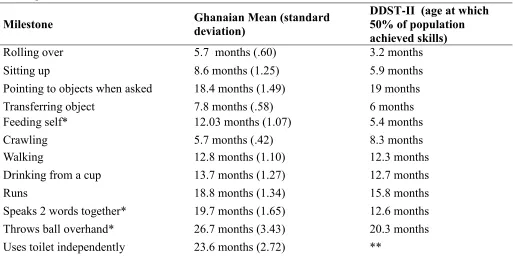
The average age in which the Ghanaian sample identified the emergence of the remaining 12 developmental milestones is presented in Table 2. In comparison to the U.S. norms outlined by the DDST-II, the Ghanaian parents reported similar milestones to U.S. standards (within a 3-month congruence) for eight of the milestones. For three of the items, children from the United States were thought to achieve a skill before Ghanaian children. These items were feeding self, speaks two words together, and throws ball overhand.
Table 2
Developmental Milestones
Milestone Ghanaian Mean (standard deviation)
DDST-II (age at which 50% of population achieved skills)
Rolling over 5.7 months (.60) 3.2 months
Sitting up 8.6 months (1.25) 5.9 months
Pointing to objects when asked 18.4 months (1.49) 19 months
Transferring object 7.8 months (.58) 6 months
Feeding self* 12.03 months (1.07) 5.4 months
Crawling 5.7 months (.42) 8.3 months
Walking 12.8 months (1.10) 12.3 months
Drinking from a cup 13.7 months (1.27) 12.7 months
Runs 18.8 months (1.34) 15.8 months
Speaks 2 words together* 19.7 months (1.65) 12.6 months
Throws ball overhand* 26.7 months (3.43) 20.3 months
Uses toilet independently 23.6 months (2.72) **
Note: DDST-II norms published by Denver Developmental Materials, Inc. (2014) and Frankenburg et al., 2009.
*Developmental milestone with more than 3-month difference. ** Item not on DDST-II.
Recommendations for Tool Modification
Based on the findings from the interviews and the picture-identification task, modifications to existing tools are necessary in order to have a developmental screening tool valid for use with the Ghanaian population. Recommendations specifically for the DDST-II based on the findings from this research are presented in Table 3.
Table 3
DDST-II Recommended Modifications
Item Modification
Domain: Personal-Social
Work for toy Work for desired item. Item can be a toy, food, cup, or spoon.
Feed self Many Ghanaian mothers do not provide opportunities for babies to feed themselves. Remove item or alter expectation of achievement.
Play Pat-a-cake This item is not culturally relevant. Mothers play by singing with their babies.
Imitate household activities Both genders sweep in Ghana. Change to imitate sweeping.
Use spoon/fork Children in Ghana do not use a fork and children in the rural parts do not always use a spoon. There also is not a push for children to feed
Feed doll Many children do not have dolls and this question should be omitted or replaced by having the child feed another person.
Play board/card game This question should be revised to play football or Ampe.
Prepare cereal This question should be omitted or revised to a household chore that both genders participate in, such as sweep independently.
Note. Items taken from DDST-II, published by Denver Developmental Materials, Inc. (2014) and Frankenburg et al., 2009.
Discussion
This study explored the Ghanaian expectations for developmental milestones, parental practices, and the modifications needed to the DDST-II for use in Ghana. Although there were many similarities in the achievement of milestones, there were also some significant differences that should be explored in greater depth in future studies. These differences may be, in part, explained by differences in cultural expectations and values. For example, the Ghanaian parents (mothers in particular) may place more value on skills, such as independent toileting, due to shorter durations between pregnancies. As one respondent from the Volta region noted, there is a sense of urgency to get the first (or youngest) child out of diapers (“napkins”) before the next child is born. Another example may lie in the development of skills related to feeding. The Ghanaian parents reported that their children do not develop finger feeding skills until close to 1 year of age; this is in comparison to the U.S. norm of approximately 6 months of age from the DDST-II. This discrepancy very well may be due to longer periods of breast feeding reported by many of the Ghanaian parents; if this is the case, then the cause may be cultural differences and a lack of opportunity, rather than a lack of skill in Ghanaian children. In the United States, it is common to place a 6-month old in a high chair and allow the child to pick up small bites of food off of the tray, thus developing the ability to self-feed, whereas the Ghanaian parents did not report allowing children to self-feed until 12 months of age. Further, the skill of throwing a ball overhand may be less important in a culture where the primary sport played by children (and adults) is football (American soccer) and where sports like baseball are rarely televised. These are a few instances of when cultural differences might drive the acquisition of developmental milestones. These cultural differences will be important to consider as clinicians and researchers move toward the development of pediatric
assessment tools tailored for the Ghanaian population.
Ghanaian families, like U.S. families, often turn first to a medical doctor if they suspect something is wrong with their child; particularly if a child is not walking at the expected time. In the United States, the doctor would then refer the child to a rehabilitation professional, such as an
occupational therapist or physiotherapist. During the qualitative interview process, there was no
mention of any therapy services in Ghana, which is indicative of the lack of services available. Without knowledge of or access to therapy personnel, Ghanaian families must rely on medical personnel rather than rehabilitative professionals. This suggests that the doctors and staff at medical clinics and hospitals are likely to become the gatekeepers to emerging rehabilitation services and may also be the
professionals conducting developmental screenings when rehabilitation professionals are not available. It will be important moving forward to acknowledge that there is no single standard for
in that window would be those most appropriately referred for rehabilitative services, such as occupational therapy.
Limitations
This mixed-methods study has a relatively small sample size of only 28 families. The Ghanaians interviewed may also not have given full or in-depth replies to the questions because of feeling
uncomfortable about being interviewed by a Caucasian foreigner or because of some language barriers in the rural region. The study was also dependent on the parents remembering when their children reached their developmental milestones, as opposed to researchers directly observing these skills, which may have led to imprecise or erroneous responses.
Conclusion
Occupational therapists are now a part of the growing rehabilitation workforce in Ghana. These occupational therapists need a way to identify children with disabilities in order to provide services. This paper aimed to explore the developmental milestones and parental practices of the Ghanaian population and specifically explore the alignment of Ghanaian expectations with those in the United States. Because of the cultural differences found, it is recommended that these differences be accounted for on a screening tool that is standardized specifically to the Ghanaian population.
References
American Occupational Therapy Association. (2003).
AOTA’s Centennial Vision. Retrieved from
http://www.aota.org/-/media/Corporate/Files/AboutAOTA/Centennial/ Background/Vision1.pdf
Bayat, M. (2015). The stories of ‘snake children’: Killing and abuse of children with developmental disabilities in West Africa. The Journal of Intellectual Disability Research, 59(1), 1-10.
https://doi.org/10.1111/jir.12118
Bello, A., Quartey, J., & Appiah, L. (2013). Screening for developmental delay among children attending a rural community welfare clinic in Ghana. BMC Pediatrics, 13(119), 1-7.
https://doi.org/10.1186/1471-2431-13-119
Blum, N., Taubman, B., & Nemeth, N. (2004). Why is toilet training occurring at older ages? A study of factors associated with later training. Journal of Pediatrics, 145(1), 107-111.
https://doi.org/10.1016/j.jpeds.2004.02.022
Chiu, W-C., Liao, H-F., Chang, P-J., Chen, P-C., & Chen, Y. C. (2011). Duration of breast feeding and risk of developmental delay in Taiwanese children: A nationwide birth cohort study. Paediatric Perinatal Epidemiology, 25(6), 519-527.
https://doi.org/10.1111/j.1365-3016.2011.01236.x
Commonwealth Human Rights Initiative (CHRI). (2007).
A simplified version of disability rights in Ghana. Retrieved from
http://www.humanrightsinitiative.org/publication s/ghana/disability_rights_in_ghana.pdf
Denver Developmental Materials, Inc. (2014). Standardization and norms. The Denver
Developmental Screening Test. Retrieved from
http://denverii.com/
Diji, A. K., Bam, V., Asante, E., Lomotey, A. Y., Yeboah, S., & Owusu, H. A. (2017). Challenges and predictors of exclusive breastfeeding among mothers attending the child welfare clinic at a regional hospital in Ghana: A descriptive cross-sectional study. International Breastfeeding Journal, 12(13), 1-7.
https://doi.org/10.1186/s13006-017-0104-2
Dunn, R. L., Kalich, K. A., Henning, M. J., & Fedrizzi, R. (2015). Engaging field-based professionals in a qualitative assessment of barriers and positive contributors to breastfeeding using the social ecological model. Maternal and Child Health Journal, 19, 6-16.
https://doi.org/10.1007/s10995-014-1488-x
Fan, R., Portuguez, M., & Nunes, M. (2013). Cognition, behavior and social competence of pre-term low birth weight children at school age. Clinics,
68(7), 915-921.
https://dx.doi.org/10.6061/clinics/2013(07)05
Findlay, L., Kohen, D., & Miller, A. (2014).
Developmental milestones among Aboriginal children in Canada. Paediatrics & Child Health,
19(5), 241-246.
https://doi.org/10.1093/pch/19.5.241
Frankenburg, W. K., Dodds, J., Archer, P., Bresnick, B., Maschka, P., Edelman, N., & Shapiro, H. (2009).
Denver II Training Manual.: Denver, CO: Denver Developmental Materials, INC. Ghana Federation of the Disabled. (2006). Persons with
Disability Act, 2006, Act 715. Retrieved from
Gladstone, M. J., Lancaster, G. A., Jones, A. P., Maleta, K., Ashorn, P., & Smyth, R. L. (2008). Can western developmental screening tools be modified for use in a rural Malawian setting?
Archives of Disease in Childhood, 93(1), 23-29.
https://doi.org/10.1136/adc.2006.095471
Gladstone, M., Lancaster, G. A., Umar, E., Nyirenda, M., Kayira, E., van den Broek, N. R., & Smyth, R. L. (2010). The Malawi Developmental Assessment Tool (MDAT): The creation, validation, and reliability of a tool to assess child development in rural African settings. PLOS Medicine, 7(5).
https://doi.org/10.1371/journal.pmed.1000273
Jeharsae, R., Sangthong, R., Wichaidit, W., & Chongsuvivatwong, V. (2013). Growth and development of children aged 1-5 years in low-intensity armed conflict areas in Southern Thailand: A community-based survey. Conflict and Health, 7(8). https://doi.org/10.1186/1752-1505-7-8
Lim, H. C., Ho, L. Y., Goh, L. H., Ling, S. L., Heng, R., & Po, G. L. (1996). The field testing of Denver Developmental Screening Test Singapore: A Singapore version of the Denver II
Developmental Screening Test. Annals of the Academy of Medicine, Singapore, 25(2), 200-209. Retrieved from
http://www.annals.edu.sg/index.html
Mensah, F., & Badu-Shayar, J. (2016). Identification of special education needs for early childhood inclusive education in Ghana. Journal of Education and Practice, 7(11), 1-8. Retrieved from
http://www.iiste.org/Journals/index.php/JEP
Ozturk, C., Sari, H. Y., Bektas, M., & Elcigil, A. (2011). Health screening: A survey of children’s growth and development in Turkey. Paediatric Nursing,
23(1), 24-28.
https://doi.org/10.7748/paed2011.02.23.1.24.c83 14
Reynolds, S. (2010). Disability culture in West Africa: Qualitative research indicating barriers and progress in the greater Accra region of Ghana.
Occupational Therapy International, 17(4), 198-207. https://doi.org/10.1002/oti.303
Sarpong, K. (2012). Who is disabled in Ghana? Part 2. Retrieved from
http://www.ghanaweb.com/GhanaHomePage/Ne wsArchive/Who-is-Disabled-In-Ghana-Part-2-240180
Tuakli-Wosornu, Y. A., & Haig, A. J. (2014).
Implementing the world report on disability in West Africa: Challenges and opportunities for Ghana. American Journal of Physical Medicine & Rehabilitation, 93(1), S50-S57.
https://doi.org/10.1097/PHM.000000000000002 3
Werner, D. (2009). Disabled village children: A guide for community health workers, rehabilitation
workers, and families. Palo Alto, CA: Hesperian Foundation.
Wijedasa, D. (2012). Developmental screening in context: Adaptation and standardization of the Denver Developmental Screening Test-II (DDST-II) for Sri Lankan children. Child: Care, Health and Development, 38(6), 889-899.
https://doi.org/10.1111/j.1365-2214.2011.01332.x
World Health Organization. (2011). World report on disability. Retrieved from
http://whqlibdoc.who.int/hq/2011/WHO_NMH_ VIP_11.01_eng.pdf?ua=1
World Health Organization Multicentre Growth Reference Study Group. (2006). WHO Motor Development Study: Windows of achievement for six gross motor development milestones. Acta
Paediatrica,(Suppl450), 86-95. Retrieved from