ISSN 2324-805X E-ISSN 2324-8068 Published by Redfame Publishing URL: http://jets.redfame.com
Experiences of Teachers of Deaf and Hard- of- Hearing Students’ in a
Special Needs School: An Exploratory Study
Kayi Ntinda1, S’lungile K. Thwala2, Bonginkhosi Tfusi3 1
Department of Education Foundations and Management, University of Eswatini, Kwaluseni, Eswatini/Swaziland
Correspondence: Kayi Ntinda, Department of Education Foundations and Management, University of Eswatini, Private Bag 4 Kwaluseni Campus, M201 Eswatini/Swaziland.
Received: March 5, 2019 Accepted: May 7, 2019 Online Published: May 20, 2019
doi:10.11114/jets.v7i7.4274 URL: https://doi.org/10.11114/jets.v7i7.4274
Abstract
This study reports on the experiences of teachers of the deaf and hard-of- hearing students in a special needs high school for the deaf in Eswatini. The study adopted a qualitative approach and was exploratory in nature. Participants comprised of eighteen (n =18) purposively sampled teachers of deaf and hard-of-hearing students. They participated in individual in-depth and focus group discussion interviews on the teaching and communication aspects with deaf and hard- of- hearing students. Data were also collected through documents review. Credibility and trustworthiness of data were established through member checks. Data were thematically analysed for important meanings.Teachers reported to experience gaps in professional competencies to teach the mainstream curriculum for which they needed further education. Variation in sign language impacting learner engagement hindered teachers’ communication with the deaf and hard-of-hearing students and their parents. Teachers reported to have in service professional training needs which included collaboration, consultation, assessment instruments and language skills. The findings have important implications for policy and practice in educating the deaf and hard- of- hearing students and for interpreting previous research. There is urgent need for the country to consider having a standardized sign language which could enhance positive teaching and learning outcomes as well as social integration for the future lives of these students. Understanding experiences of these teachers from the lived cultural milieu are important for the design and implementation of programmes for supporting the deaf and hard- of hearing learners, their teachers and parents.
Keywords: deaf students, special education, hard-of-hearing, hearing impairment, Eswatini/Swaziland, inclusive education
1. Introduction
Teachers of the deaf and hard-of-hearing students teach in the mainstream schools for which they are evidently trained. Increasing numbers of students who are deaf and hard-of-hearing are receiving their education in general educational settings with special support from teachers trained in deaf education. There is research evidence to suggest that the academic success and experiences of deaf and hard-of-hearing students are as a result of a number of complex factors such as the characteristics of students and their family environments as well as the experiences inside and outside school (Marschark, Shaver, Nagle, & Newman, 2015). Specifically these factors constitute characteristics of students such as language fluencies and mode of communication; features of their family situations like socioeconomic status and parent level of education; and experiences both inside and outside school for example, the school location. Additionally, the roles of teachers of deaf and hard-of-hearing students are changing rapidly as are the classroom settings and demographics of the students in schools (Knoors & Marschark, 2014; Shaver, Marschark, Newman, & Marder, 2013) demanding for more skilled teachers in deaf or special education to meet the needs of the students.
require support in one or more of four broad areas of need such as: communication and interaction, cognition and learning, behavioural, emotional and social development, and sensory or physical aspect of development (Agomoh & Kanu, 2011; Hauser, Lukomski, & Hillman, 2008; Marschark, Morrison, Lukomski, Borgna, & Convertino, 2013). Teachers have a very critical role to play in assisting these students in excelling in their educational endeavours. Deafness affects children’s learning in development of receptive communication skills if teachers are not literate in deaf language. If the deaf and hard-of-hearing students attend ordinary schools, their peers lack in deaf language, limiting communication access with them. However, these language differences are circumvented substantially in specific school settings. The context for this study is considered next.
2. Material Studied
2.1 The Context for this Study
The prevalence of people with hearing disabilities is about 18 389 [11 percent] in the kingdom of Eswatini new name for [Swaziland] (Mavundla, 2015). Furthermore, the percentage of children with disabilities for the age groups 10-14 and 15 -19 were 10424 and 9323 respectively (Eide & Jele, 2011). Disability is higher in rural settings compared to urban areas in Eswatini (Mavundla, 2015). The kingdom’s education system is evolving to embrace inclusion of learners with disabilities in the mainstream schools of the education system through inclusive education. The term inclusive education is defined as a system of education that addresses diverse needs of learners (Naicker, 1999). The kingdom of Eswatini is a signatory to international and national policies on universal education rights that safeguard high quality basic educational for all. For example, the importance of inclusive education is clearly articulated in the Salamanca statement (UNESCO, 2008; United Nations, 1994), as a strategy that contributes towards the ultimate goal of promoting an inclusive society. This society enables all children and adults whatever their ability, gender, age, ethnicity, impairment or HIV/AIDS status to fully participate and contribute to the society. Moreover, in the Eswatini context, education for all is a commitment to provide equal opportunities for all children and the youth as outlined in the country’s constitution of 2005. The constitution of Swaziland was very significant in the introduction of inclusion education. Since then, several policies have been developed by the government, which are aimed at providing equal education opportunities to all children in the country. The policies include the Swaziland National Children’s Policy (2009), Poverty Reduction Strategy and Action Plan (2006), the Education for All Policy (2010) and the Draft Inclusive Education Policy (2005; 2008). The implementation of the Education for All Policy (2010) spearheaded the introduction of inclusive education in mainstream schools. Therefore, all teachers in the country’s schools are expected to be competent to teach learners with a wide range of educational needs including deaf and hard-of- hearing. There is an effort by the government of kingdom of Eswatini to promote education as a basic human right through ensuring that males and females receive equal treatment and benefits at all levels (MoET, 2011; MoET, 2012). However, the assimilation of students with disabilities into the mainstream schools of the education system has not been fully realised despite the effort to explicitly define and explain inclusive education in the policy frameworks by the government of the kingdom of Eswatini (Draft Inclusive Education Policy, 2005; 2008). For instance, most students who are deaf and hard- of- hearing attend special needs schools in the country.
The special needs high school for the deaf in Eswatini is located in a rural setting in one of kingdom’s region. All students in the school are either deaf or hard- of- hearing with differing degrees. One characteristic of children who are deaf is that they use sign language for the deaf (Anastasiou & Keller, 2011). A study conducted by Mpila (2013) in the special needs high school for the deaf in Swaziland on challenges and opportunities in teaching learners with special needs, revealed that learners used sign language as their first language in the school. Mpila (2013) study adopted a quantitative approach using descriptive statistics mainly frequencies and percentages. Furthermore, the same study findings indicated that teachers lacked training in special needs education and appropriate innovations in teaching and learning resources to apply with these students. Yet still the Mpila (2013) study did no provide detailed information on practices adopted by teachers in teaching learners with special needs such as the deaf and hard-of- hearing students in the special needs high school of the deaf. Thus, the need to conduct a qualitative study to explore the experiences of teachers of deaf or hard- of- hearing students in-depth and detail. Studies on experiences of teachers of deaf and hard-of-hearing students teaching in the mainstream curriculum are in need in the kingdom of Eswatini.
2.2 Problem Statement
national examinations for the past 5 years (Examinations Council of Swaziland, 2015). Yet, to date the poor examination results at the special needs high school still remains a cause of concern for teachers, parents and researchers in the kingdom. The reasons behind the poor performance in the national examinations by these students in the high school for deaf are unknown. Hence, this study sought to explore the experiences of teachers of the deaf and hard-of- hearing students in a special needs school for the deaf in Eswatini which addresses the aspects that have not been tackled by previous studies.
2.3 Research Objectives
The study sought to explore experiences of teachers of deaf or hard-of-hearing students in a special needs high school in Eswatini. The following main research question guided the study:
(1) What are the experiences of teachers of deaf or hard-of-hearing students teaching to the mainstream school curriculum?
The specific objectives which guided the study were to:
I. identify the strategies teachers used in teaching the deaf and head-of-hearing students in the special needs high school.
II. determine communication skills that existed between teachers and the deaf and hard-of- hearing students in the special school
III. explore how teachers’ collaboration with the parents of the deaf and hard-of-hearing students assisted in supporting the students in the special needs school.
3. Methodology
The methods and procedures that were utilized in this study are described in this section. The research design is presented next.
3.1 Research Design
A qualitative exploratory research design allowed for the exploration of experiences of teachers of the deaf and hard-of-hearing students from their own perspectives. Exploratory studies are used when the topic or phenomenon to be studied is new and when data is problematic to collect as suggested by Creswell (2014). This study adopted an exploratory qualitative research design to probe the experiences of teachers of deaf-and-hard of hearing students through their own perceptions or words in teaching.
3.2 Participants and Setting
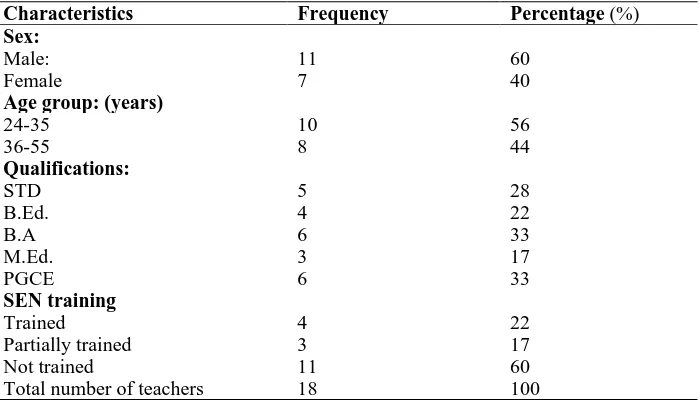
Participants were a convenience sample of eighteen (n=18) high school teachers from the special needs high school for the deaf in the Lubombo rural region of Swaziland (7 females; age range 24-55 years). Participants’ experiences of teaching the mainstream curriculum in the special needs high school for deaf were between 1-9 years. All teacher participants had a minimum of Diploma qualification in Education (see Table 1 for further details about participants’ demographic characteristics).
Table 1. Demographic characteristics of participants
Characteristics Frequency Percentage (%)
Sex:
Male: 11 60
Female 7 40
Age group: (years)
24-35 10 56
36-55 8 44
Qualifications:
STD 5 28
B.Ed. 4 22
B.A 6 33
M.Ed. 3 17
PGCE 6 33
SEN training
Trained Partially trained Not trained
4 3 11
22 17 60
Total number of teachers 18 100
Post Graduate Certificate in Education; STD = Secondary Teachers’ Diploma and SEN = Special Education Needs Training.
Source: Ntinda, K.., Thwala, S.K., & Tfusi, B. (in press). Generated from field data (2017).
3.3 Data Collection and Procedure
The study utilized individual in-depth and focus group discussion interviews to collect data on the teaching and communication aspects with the deaf and hard- of- hearing students. Documents such as the teaching -learning syllabus and reference materials used by special needs education teachers were also reviewed on policies on teaching the deaf and hard-of-hearing students. The use of multiple data collection tools allowed for in-depth exploration of the phenomenon under study. Eleven (11) teacher participants took part in individual in-depth interviews while seven (7) participated in a focus group discussion interview. The individual in-depth interview semi-structured questions required the participants to explain their experiences in teaching the deaf and hard-of- hearing learners using the mainstream curriculum. Due to the nature of the phenomenon explored individual in-depth interviews were used as they enabled for eliciting of explanations on the teaching experiences by the teachers of deaf and hard- of- hearing students. They also allowed for more probing to get explanations and also guaranteed high response rate. The main probe for the focus group discussion interview asked participants for their views on the teaching and communication aspects of the deaf and hard-of-hearing students using the mainstream curriculum in the special needs high school for the deaf. The focus group discussion interview permitted for the collection of extensive and high quality data since there was consented effort from all group participants to discuss their experiences. This reflected the consensus of the group. Both the individual in-depth and focus group discussion interview guides were piloted for contextual relevance and question accessibility on a panel of two (2) deaf education experts and two (2) teachers of deaf and hard- of- hearing students. The same panel for the pilot study forward translated both the individual in-depth and focus group discussion interview guides into Siswati for use by participants preferring to use the local language.
Both the individual in-depth and focus group discussion interviews were conducted in English and SiSwati which are the official languages of instruction in Eswatini. The interviews were tape recorded and audio recordings transcribed and translated into English using a procedure by African Scholarship Development Enterprize [ASDE], (2009). Each individual in-depth interview lasted for about 35 minutes while the focus group discussion interview took approximately 45 minutes. Documents such as the teaching and learning syllabus, scheme books and the teachers’ profile forms were reviewed in order to complement information gathered through individual in-depth and focus group discussion interviews. For instance, teachers’ profile forms provided evidence regarding how many of the interviewed participants had been trained and those who were not trained in inclusive education. Credibility and trustworthiness of the data were established through ―member checks‖. Member checks entail going back to participants to clarify the accuracy of responses to questions as suggested by Guba and Lincoln (2005). The member checks allowed for clearing any inconsistencies in meaning from the language translation to be resolved.
3.4 Ethical Considerations
Permission to conduct the study in the special needs high school for the deaf was granted by the MoET in Eswatini. The school principal also granted permission to conduct the study on the school premises. Informed consent was sought from the teacher participants who individually consented to the study. The participants were informed of their right to withdraw from the study at any point without penalty. Data were de-identified and no individual names were used to identify the participants to ensure anonymity.
3.5 Data Analysis
The analysis of data adopted a thematic procedure recommended by Braun and Clark (2006) through following the six phases of thematic analysis. Firstly, the data analysis began through immersion in collected data for familiarization purposes with the depth and breadth of the content. Secondly, verbal data were transcribed. Thirdly, initial list of ideas was generated and the initial codes were produced from the data. Fourthly, search for themes was established and the different codes were sorted into potential themes. The generated themes were reviewed and refined for meaning. Fifthly the themes that were to be presented for analysis were defined and further refined and data within themes were analysed. Finally, after the thematic map of data had been created the final analysis and the research report was written.
4. Results and Discussion
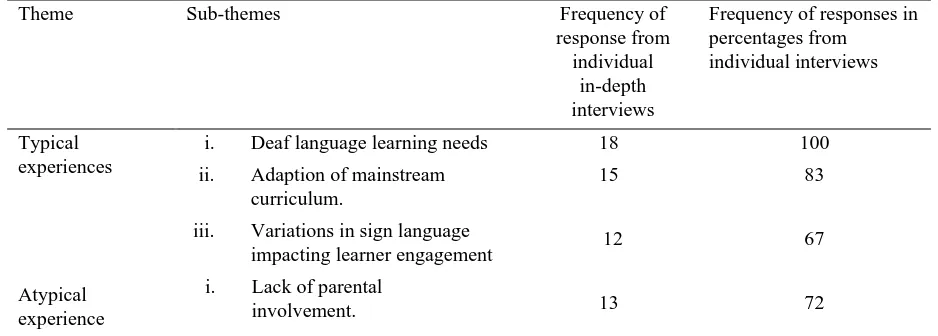
referred to the unusual aspects such as collaboration with stakeholders (e.g., parents and other deaf and hard-of- hearing education specialists) with whom the teachers of the deaf and hard-of-hearing students did not partner with in teaching the mainstream curriculum. Table 2 presents themes and sub-themes which emerged from the study.
Table 2.Themes and sub-themes which emerged from data analysis
Theme Sub-themes Frequency of
response from individual
in-depth interviews
Frequency of responses in percentages from
individual interviews
Typical experiences
Atypical experience
i. Deaf language learning needs
ii. Adaption of mainstream
curriculum.
iii. Variations in sign language impacting learner engagement
i. Lack of parental involvement.
18
15
12
13
100
83
67
72
Source: Ntinda, K.., Thwala, S.K., & Tfusi, B. (in press). Generated from reviewed literature field data (2017).
4.1 Sub-theme 1. Deaf Language Learning Needs
A significant number of individual in-depth participants, 9 out of 11 (82%) reported lack of professional competencies to teach the mainstream curriculum for which their tertiary training institutions did not adequately prepare them to handle deaf and hard-of- hearing learners. Below are illustrative statements from participants:
“We come here without having been extensively trained in deaf education. Then one is tempted to only believe that these learners are deaf only. The reality on the ground is that some of our learners have multiple disabilities”(Participant # 10, male, 26 year old, 3 years teaching experience).
“Right now, every teacher from college or university is simply posted to this school with the hope that he/she will learn everything here on handling students with special needs” (Participant # 4, female, 40 year old, 5 years teaching experience).
“I am one of the teachers who was given brief introductions on deaf education needs courses at the university (Participant # 1, female, 34 year old, 5 years teaching experience).
Teachers of the deaf and hard- of- hearing learners in the Eswatini special needs high school for the deaf did not have adequate deaf language training. This finding was somewhat expected especially that inclusive education (including deaf education) in Eswatini has not properly been integrated in teacher preparation programmes (Khumalo, 2014; Mpila, 2013, Nkhambule, 2011). The goal of teacher preparation programmes is to provide pre-service teachers with the professional knowledge, skills and disposition needed to assist all students to achieve their greatest potential (Darling-Hammond, 2006; Luckner & Ayantoye, 2013; Ratcliff & Hunt, 2009).
4.2 Sub-theme 2. Adaption of Mainstream Curriculum
The study finding showed that 10 out of 11 (91%) individual in-depth participants reported adoption of the mainstream curriculum to address learning needs of the deaf and hard-of –hearing students. The following are example statements from the participants regarding adaption of mainstream curriculum:
“They need a specialized curriculum. But here they are given a curriculum that is used in the mainstream (Participant # 11, male, 42 year old, 9 years teaching experience).
“The mainstream curriculum needs translation to sign language”(Participant # 3, female, 26 year old, 3 years teaching experience).
―The curriculum that is used here does not favour the learners as it is meant for those learners without disabilities in the mainstream. They simply need to have their own specialized curriculum‖ (Participant # 17 male, 35 years old, 6 years teaching experience).
Document review of the teaching-learning syllabus and scheme books further indicated that the curriculum utilized by the participant teachers was not tailored to the deaf and hard-of-hearing students learning needs. This finding complements responses from the individual in-depth and focus group discussion interviews about adoption of the mainstream curriculum to teach the deaf and hard-of- hearing students. Teachers working with the deaf and hard-of-hearing students need to adapt the mainstream curriculum for deaf language communication. The finding suggests that the deaf and hard-of- hearing learners were taught a non-specialized language curriculum. The finding seems to be contradictory to the argument of Berry and Gravelle, (2013) that a majority of teachers of the deaf learners were satisfied with the instructional aspects of their position but dissatisfied with non-instructional role responsibilities in the United States of America (USA). In the USA setting teachers maybe using deaf language adapted curriculum which is not the case in Eswatini. Additionally, the study finding showed that a greater number of focus group participants, 6 out of 7 (86 %) reported consensus that adaption of the mainstream curriculum proved difficult in communication to learner needs. Below are verbatim quotations from participants:
“Aspects of the curriculum needs to be customized to deaf children such that sign language can be used” (Participant # 13, female, 35 year old, 6 year teaching experience).
“Here we are teaching deaf learners who need us to use sign language all the time yet all the books are written in texts and there is no sign language in these books”
(Participant # 9, female, 25 years old, 3 years teaching experience).
4.3 Sub-theme 3. Variations in Sign Language Impacting Learner Engagement
Participants reported that the variations in sign language hindered teacher-student and student-student communication. More than half of the individual in-depth participants, 7 out of 11 (64%) reported that sign language used in the school setting was not universal from one location to the other. Participants reported variations regarding the sign language that was used in the special needs high school for the deaf and that which was used in the primary school for the deaf. These differences in sign language stalled teacher-student as well as student-student communication significantly. Below are some example statements from participants:
“Learners who come from the primary school for the deaf have a deaf language different from that which is used in the special needs high school” (Participant # 6, male, 43 year old, 7 years teaching experience). “The sign language that is used in the primary school for the deaf is also different from the one we are using here. It therefore, becomes a huge set-back when you receive a child who has a totally different sign language. We spend a lot of time teaching them our sign language here, yet the academic programme is too short. It is time-consuming and it affects the teaching and learning process…” (Participant # 8, male, 36 year old, 7 years teaching experience).
“Here we are teaching deaf learners who need us to use sign language every time yet all the books are written in words and there is no sign in those books. The sign language does not cater for all the words in the books, so our learners are disadvantaged in that way. Sometimes it is not easy for us to understand each other because of the sign language” (Participant # 9, female, 25 year old, 2 years teaching experience).
―Sign language present problems to teaching from the inconsistency of the sign language to the books” (Participant #10, male, 26 year old, 3 years teaching experience).
take part in classroom activities, which may also affect their learning and academic success (Long, Stinson, & Braeges, 1991). This might explain the poor examination results among the deaf and hard-of- hearing students in the special needs high school, in Eswatini. This finding seems to be consistent with the findings of studies by (Dakwa & Musengi, 2015; Mpofu & Chimhenga, 2013) which indicate that children with hearing impairment experience communication and language problems at school as they have to learn a different language at home in addition to the non-standard sign language at school. A non-standard sign language could lead to confusion, communication and language problems. Communication breakdown affected the teaching and learning process immensely. The finding also seems to be supported by Forlin, Kawai and Higuchi, (2015) who assert that the teachers were not adequately trained to become inclusive practitioners to equip students with relevant sign language. Additionally, variations in sign language resulted in communication breakdown between teacher-student and student-student which in turn negatively affected the teaching and learning process. There is evidence to suggest that teachers who were inadequately trained in special needs education specifically deaf language use failed to equip learners with relevant sign language (Forlin, Kawai, & Higuchi, 2015; Nougaret, Scruggs, & Mastropieri, 2005). There is also need for the kingdom to consider having a standardized sign language which is critical in communication, teaching and learning between the teachers and the deaf and hard-of-hearing students. Having a standardized sign language may ultimately have positive learning outcomes and social integration for the future lives of these students. Future studies may focus on the description of specific practices of teaching and learning that may work effectively with the deaf and hard-of-hearing learners in special needs schools. The descriptions of these practices could suggest to the educators better ways of supporting the deaf and hard- of -hearing students in special needs school contexts.
4.4 Sub-theme 4. Lack of Parental Involvement
Finding of the study revealed that all focus group discussion participants, 7 out of 7 (100 %) reported a consensus need for higher level of parental involvement. Similarly all individual in-depth participants, 8 out of 8(100%) reported a need for higher level of parental involvement in the academic and personal/ social aspects of development of their children. Below are verbatim quotations from the participants:
“We take the responsibility of being a parent to them. Some of them are not well received where they come from, and they become hopeless in life” (Participant # 16, female, 29 year old, 2 years teaching experience).
“We are the fathers, sisters, mothers, and brothers. Some of them are not well accepted where they come from. So, you find that some even expect you to assist them even financially. Parents get rid of them at home by sending them to school….” (Participant #2, male, 48 year old, 9 years teaching experience).
“…. Some of the parents never care about the academic progress of their children. In fact they do not want these children because there is a widespread belief that if one gives birth to a child with a disability, then that person is cursed. The parents fail even to come around and seek help on how they can be of greater assistance to their children ‖ Participant # 4, female, 40 year old, 5 years teaching experience).
Teachers of the deaf and hard-of- hearing students reported a need for higher levels of parental involvement which seems to mirror results of a study by Okeke and Mazibuko, (2014), where parents were not adequately prepared for their roles with their children who had special educational needs and were less supportive to the children’s educational needs. This might be due to the cultural belief surrounding having a child with a disability in Swaziland which traditionally had negative consequences of social seclusion for the family with the child (Ntinda & Nkwanyana 2017; Thwala, 2004; Thwala, Ntinda, & Hlanze, 2015). Parental involvement in their deaf and hard-of-hearing children’s school-based education programmes can certainly contribute to positive academic outcomes. Specifically parental communication skills are more important for promoting constructive language and academic achievement of the children (Calderon, 2000). Apparently, in the Eswatini context parents of children with disabilities including deafness and hard- of hearing are less prepared to assist their children at home and in school as they lack education on the kind of support to be given (Thwala, Ntinda, & Hlanze, 2015). Future studies should investigate motivations of parents in supporting their children with deafness and hard-of hearing to determine the influence of culture and personal investment in their children’s future.
1. Limitation
The study was exploratory thus the findings as reported are at best tentative. Future studies should sample larger numbers of teachers of deaf or hard-of- hearing students to determine the degree to which findings from this study could be replicated.
2. Implications
detrimental effects on the academic outcomes and future lives of the deaf and hard-of- hearing students. Hence, the urgent need for standardisation of sign language for the kingdom. This could assist in enhancing the quality of communication between the teacher –student and student-student thus ultimately improving the quality of education and future lives of the deaf and hard-of-hearing students. Not having a standardised sign language in the kingdom also has negative academic outcomes for the students and teachers with regards to teaching and learning and how they socialize with their peers and parents both in school and at home.
Lack of professional competencies to adapt and teach the mainstream curriculum to the deaf and hard- of- hearing students has significant implications for the educational success and experience of these students. This is due to the fact that the teachers of deaf and hard-of-hearing students have no innovative methods to use for teaching of these students. There is therefore, a need for curriculum developers to ensure that all tertiary institutions in the kingdom from where teachers are trained include deaf education as part of the teacher training curriculum to allow for adequate preparation of teachers to handle the deaf and hard-of- hearing learners in special needs school contexts.
In the Eswatini cultural context, deafness and hard - of- hearing maybe perceived as negative conditions, and as such teachers of the deaf and hard-of hearing students may need to be proactive in creating awareness on deafness and hard-of hearing conditions and how to live with them among students and parents. Teachers through the parent teacher association meetings may need to be pragmatic and directive guidance provided on solutions for livelihood as parents of children with deafness and hard-of- hearing.
Additionally, the family as a focus for support of these students should comprise all members who live under the same roof. Family counselling support might involve strategies to minimise perceived burden of care for the deaf and hard-of- hearing children. For instance, family communication routines and strategies may have to change to accommodate the needs of the deaf and hard-of-hearing children. Proactively learning of communication strategies may prevent unintended family and teacher parent relationship conflicts (Ntinda & Nkwanyana 2017; Thwala, Ntinda, & Hlanze, 2015).
Findings from this study highlight on the important role that teachers have on the communication, teaching, learning and general well-being of the deaf and hard- of -hearing students. Given the critical role that the teachers of these students play in the communication and perceived quality of school life of these students, deaf education and counselling intervention strategies should seek to strengthen the teachers as primary resource for these students in the Eswatini setting.
5. Conclusion
In conclusion, the findings of the current study suggest that teachers of the deaf or hard- of- hearing students reported to be experiencing gaps in professional competencies to teach the mainstream curriculum for which they need further education. They reported adoption of the mainstream curriculum as a hindrance problematic in the teaching of the deaf and hard-of-hearing students. Variations in sign language impacting learner engagement caused communication breakdown between teacher and student which adversely hindered the teaching and learning process. Lack of parental involvement was stated as an aspect that mired supportive system of the students. There is a dire need for the Ministry of Education and Training in Eswatini to consider developing a standardized sign language as this may have positive learning outcomes and social integration for the future lives of the students. The Ministry of Education and Training could also consider provision of in-service training for teachers in special education needs to capacitate them to effectively work with students with disabilities in both primary and secondary school contexts. It may be beneficial to empower parents with practical skills of handling the deaf or hard-of hearing children through the parent teacher associations meetings which may be very crucial in supporting the teaching and communication of these students.
Acknowledgements
Kayi Ntinda provided the draft document and overall guidance writing.
S’lungile. K. Thwala assisted in literature review and proofing of the manuscript. Bonginkhosi Tfusi conducted some interviews with participants.
Competing interests
References
Adebayo, A. S., & Ngwenya, K. (2015). Challenges in the implementation of inclusive education at Elulakeni Cluster primary schools in Shiselweni district of Swaziland. European Scientific Journal, ESJ, 11(13), 246-261.
Africa Scholarship Development Enterprise [ASDE], (2009). Development of a framework for implementation of tests
in Ministry of Education and Skills Development, Botswana:ASDE.
Agomoh, O. E., & Kanu, S. A. (2011). Introduction to psychology of special needs children: Understanding special needs education. Port Harcourt: Kanissi Books
Anastasiou, D., & Keller, C. (2011). International differences in provision for exceptional learners. In J. M Kauffman,
Handbook of special education, (pp.773-787). New York: Routledge.
Berry, A. B., & Gravelle, M. (2013). The benefits and challenges of special education positions in rural settings: Listening to the teachers. The Rural Educator, 34(2), 76-88.
Braun, V., & Clarke, V. (2006). Using thematic analysis in psychology. Qualitative Research in psychology, 3(2), 77-101. https://doi.org/10.1191/1478088706qp063oa
Calderon, R. (2000). Parental involvement in deaf children's education programs as a Predictor of child's language, early reading, and social-emotional development. Journal of deaf studies and deaf education, 5(2), 140-155. https://doi.org/10.1093/deafed/5.2.140
Creswell, J. W. (2014). Research designs: Qualitative, quantitative and mixed methods approaches. (4th ed.). Los Angeles: Sage Publications.
Dakwa, F. E., & Musengi, M. (2015). A look at language problems experienced by children with hearing impairments—the learner's experience. South African Journal of African Languages, 35(2), 177-180.
https://doi.org/10.1080/02572117.2015.1113001
Darling-Hammond, L. (2006). Constructing 21st-century teacher education. Journal of Teacher Education, 57(3), 300-314. https://doi.org/10.1177/0022487105285962
Davis, J. M., Elfenbein, J., Schum, R., & Bentler, R. A. (1986). Effects of mild and moderate hearing impairments on language, educational, and psychosocial behavior of children. Journal of Speech and Hearing Disorders, 51(1), 53-62. https://doi.org/10.1044/jshd.5101.53
Eide, A. H., & Jele, B. (2011). Living conditions among people with disabilities in Swaziland: A national, representative study. SINTEF report no. A, 20047. Oslo: SINTEF
Examinations Council of Swaziland. (2015). Junior certificate examination results. Mbabane: Examinations Council of Swaziland.
Forlin, C., Kawai, N., & Higuchi, S. (2015). Educational reform in Japan towards inclusion: are we training teachers for success?. International Journal of Inclusive Education, 19(3), 314-331.
https://doi.org/10.1080/13603116.2014.930519
Foster, S., & Cue, K. (2009). Roles and responsibilities of itinerant specialist teachers of deaf and hard of hearing students. American Annals of the Deaf, 153(5), 435-449. https://doi.org/10.1353/aad.0.0068
Guba, E. G., & Lincoln, Y. S. (2005). Paradigmatic controversies, contradictions and emerging confluences. In N. K. Denzin & Y. S. Lincoln (Eds.), The Sage Handbook of Qualitative Research (3rd ed., pp.1-32). Thousand Oaks, CA: Sage.
Hauser, P. C., Lukomski, J., & Hillman, T. (2008). Development of deaf and hard-of-hearing students’ executive function.
Deaf cognition: Foundations and Outcomes, 286-308. https://doi.org/10.1093/acprof:oso/9780195368673.003.0011
Hill-Briggs, F., Dial, J. G., Morere, D. A., & Joyce, A. ( 2007). Neuropsychological assessment of persons with physical disability, visual impairment or blindness, and hearing impairment or deafness. Archives of clinical neuropsychology, 22(3), 389-404. https://doi.org/10.1016/j.acn.2007.01.013
Hyde, M., & Power, D. (2004). Inclusion of deaf students: An examination of definitions of inclusion in relation to findings of a recent Australian study of deaf students in regular classes. Deafness & Education International, 6(2), 82-99. https://doi.org/10.1179/146431504790560564
Khumalo, S. N. (2014). Practices and challenges in teaching secondary school English to the hearing impaired in
Swaziland. Unpublished Master’s thesis, University of Swaziland, Kwaluseni campus, Swaziland
Oxford University Press. https://doi.org/10.1093/acprof:oso/9780199792023.001.0001
Long, G., Stinson, M. S., & Braeges, J. (1991). Students' perceptions of communication ease and engagement: How they relate to academic success. American Annals of the Deaf, 136(5), 414-421.
https://doi.org/10.1353/aad.2012.0455
Luckner, J. L., & Ayantoye, C. (2013). Itinerant teachers of students who are deaf or hard of hearing: Practices and preparation. Journal of Deaf Studies and Deaf Education, 18(3), 409-423. https://doi.org/10.1093/deafed/ent015
Luckner, J. L., & Howell, J. (2002). Suggestions for preparing itinerant teachers: A qualitative analysis. American Annals of the Deaf, 147(3), 54-61. https://doi.org/10.1353/aad.2012.0210
Marschark, M., & Spencer, P. E. (2006). Spoken language development of deaf and hard-of-hearing children: Historical and theoretical perspectives. Advances in the spoken language development of deaf and hard-of-hearing children, 3-21. https://doi.org/10.1093/acprof:oso/9780195179873.003.0001
Marschark, M., Morrison, C., Lukomski, J., Borgna, G., & Convertino, C. (2013). Are deaf students visual? Learning and Individual Differences, 25, 156-162. https://doi.org/10.1016/j.lindif.2013.02.006
Marschark, M., Shaver, D. M., Nagle, K. M., & Newman, L. A. (2015). Predicting the academic achievement of deaf and hard-of-hearing students from individual, household, communication, and educational factors. Exceptional Children, 81(3), 350-369. https://doi.org/10.1177/0014402914563700
Mavundla, S. D. (2015). Country report: Swaziland. African Disability Rights. Yearbook 3, 245-264. https://doi.org/10.17159/2413-7138/2015/v3n1a11
Ministry of Education and Training [MoET] in Swaziland. (2012). Special education needs (SEN) unit. Available at www.gov.sz. Accessed 10:06: 2017.
Ministry of Education and Training. (2005) Draft inclusive education policy of Swaziland. Mbabane. Swaziland Government.
Ministry of Education and Training. (2008). Inclusive education draft policy. Mbabane. Government of Swaziland
Ministry of Education and Training. (2011). Swaziland Education and Training Sector Policy. Mbabane. Government of Swaziland.
Mpila, M. J. (2013). Challenges and opportunities in teaching learners with special needs in Swaziland: A case of
special schools. Unpublished Master’s thesis, University of Swaziland, Kwaluseni campus, Swaziland.
Mpofu, J., & Chimhenga, S. (2013). Challenges faced by hearing impaired pupils inlearning: A case study of King George VI memorial school. Journal of Research and Methods inEducation,2(1), 69-74.
https://doi.org/10.9790/7388-0216974
Naicker, S. (1999). Inclusive education in South Africa. In Engelbrecht, L., Green, S., Naicker & L. Engelbrecht. (Eds.), Inclusive education in Action in South Africa (P.12-24) Van Schaik JL: Pretoria.
Nkhambule, H. L. ( 2011). Attitudes of Primary school teachers towards inclusive education in Swaziland. Unpublished Masters thesis, Kwaluseni: UNISWA.
Nougaret, A. A., Scruggs, T. E., & Mastropieri, M. A. (2005). Does teacher education produce better special education teachers?. Exceptional Children, 71(3), 217-229. https://doi.org/10.1177/001440290507100301
Ntinda, K., & Nkwanyana, S. (2017). Resources for resilient caregiving by parents of children with schizophrenia in Swaziland: A multiple case study. Journal of Psychology in Africa,27(1), 88-92.
https://doi.org/10.1080/14330237.2016.1268298
Okeke, C. I. O., & Mazibuko, G. F. (2014). The experiences of parents of school children with special education needs: An empirical study. Mediterranean Journal of Social Sciences, 5(15), 227-240.
https://doi.org/10.5901/mjss.2014.v5n15p227
Ratcliff, N., & Hunt, G. (2009). Building Teacher-Family Partnerships: The role of teacher preparation programs. Education, 129(3). 495-505.
Rodina, K., (2005). Communicative activity among children with disabilities: A neo-Vygotskyan approach to a qualitative study at centre for inclusion in St.Petersburg. Unpublished manuscript. University of Oslo.
Swart, E., & Pettipher, R. (2013). A framework for understanding inclusion. Pretoria: Van Schaik.
Swaziland Government, Deputy Prime Minister’s Office. (2009). Swaziland National Children’s’ Policy: Bantfwana bangumliba loya embili. Mbabane. Government of Swaziland.
Swaziland Government. (2005). Constitution of Swaziland. Mbabane Webster Printers.
Swaziland Government. (2010). National Plan of Action (NPA) For Children 2011-2015. Mbabane. Government of Swaziland.
Thwala, S. K. (2004). Understanding inclusion in Swaziland: An agenda for change (Unpublished Master’s thesis). University of Exeter, Exeter.
Thwala, S. K. (2018). Teachers’ Strategies of Including Learners with Autism Spectrum Disorders in Mainstream Classrooms in Swaziland. International Journal of Humanities Social Sciences and Education (IJHSSE), 5(12), 78-85. https://doi.org/10.20431/2349-0381.0512009
Thwala, S. K., Ntinda, K., & Hlandze, B. (2015). Lived experiences of parents of children with disabilities. Journal of Education and Training, 3(4), 206-215. https://doi.org/10.11114/jets.v3i4.902
UNESCO- International Bureau of Education (2008). Inclusive education and inclusive curriculum: Moving the EFA agenda forward.
United Nations (1994). The Salamanca Statement and Framework, for action on special needs education. Salamanca:UNESCO.
Werts, M. G., Carpenter, E. S., & Fewell, C. (2014). Barriers and benefits to response to intervention: Perceptions of special education teachers. Rural Special Education Quarterly, 33(2), 3-11.
https://doi.org/10.1177/875687051403300202
World Health Organization [ WHO]. (1980). International classification of impairments, disabilities, and handicaps: a manual of classification relating to the consequences of disease, published in accordance with resolution WHA29. 35 of the Twenty-ninth World Health Assembly, May 1976.
Zwane, S. L., & Malale, M. M. (2018). Investigating barriers teachers face in the implementation of inclusive education in high schools in Gege branch, Swaziland. African Journal of Disability, 7, 1-12.
https://doi.org/10.4102/ajod.v7i0.391
Copyrights
Copyright for this article is retained by the author(s), with first publication rights granted to the journal.