DATA STRUCTURES
AND ALGORITHMS
◻
Graph Traversal
Graph Traversal
◻
Application example
Given a graph representation and a vertex
s
in the graph
Find all paths from
s
to other vertices
◻
Two common graph traversal algorithms
■
Breadth-First Search (BFS)
■
Find the shortest paths in an unweight graph
■
Depth-First Search (DFS)
■
Topological sort
■
Find strongly connected components
BFS and Shortest Path Problem
◻
Given any source vertex s, BFS visits the other vertices at
increasing distances away from s. In doing so, BFS discovers
paths from s to other vertices
◻
What do we mean by “distance”? The number of edges on a
path from s.
2
4
3
5 1
7
6 9
8 0
Consider s=vertex 1
Nodes at distance 1? 2, 3, 7, 9
1
1 1
1 2
2 2
2
s
Example
Nodes at distance 2? 8, 6, 5, 4
BSF algorithm
Example
2
4
3
5 1
7
6 9
8 0
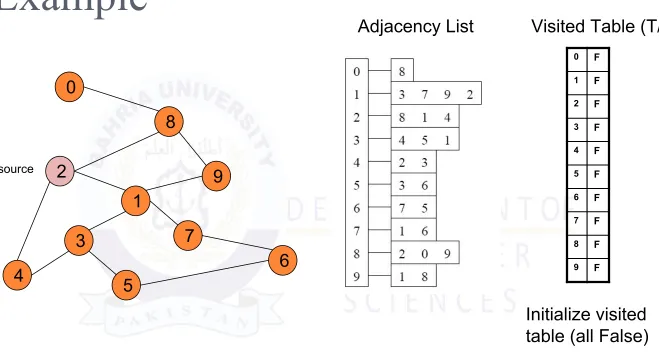
Adjacency List
source
0 1 2 3 4 5 6 7 8 9
Visited Table (T/F)
F
F
F
F
F
F
F
F
F
F
Q = { }
Initialize visited table (all False)
[image:6.720.33.692.66.421.2]Example
2
4
3
5 1
7
6 9
8 0
Adjacency List
source
0 1 2 3 4 5 6 7 8 9
Visited Table (T/F)
F
F
T
F
F
F
F
F
F
F
Q = { 2 }
Flag that 2 has been visited.
Example
2
4
3
5 1
7
6 9
8 0
Adjacency List
source
0 1 2 3 4 5 6 7 8 9
Visited Table (T/F)
F
T T
F
T
F
F
F
T
F
Q = {2} → { 8, 1, 4 }
Mark neighbors as visited.
Dequeue 2.
Place all unvisited neighbors of 2 on the queue
Example
2
4
3
5 1
7
6 9
8 0
Adjacency List
source
0 1 2 3 4 5 6 7 8 9
Visited Table (T/F)
T T T
F
T
F
F
F
T T
Q = { 8, 1, 4 } → { 1, 4, 0, 9 }
Mark new visited Neighbors.
Dequeue 8.
-- Place all unvisited neighbors of 8 on the queue.
-- Notice that 2 is not placed on the queue again, it has been visited!
Example
2
4
3
5 1
7
6 9
8 0
Adjacency List
source
0 1 2 3 4 5 6 7 8 9
Visited Table (T/F)
T T T T T
F
F
T T T
Q = { 1, 4, 0, 9 } → { 4, 0, 9, 3, 7 }
Mark new visited Neighbors.
Dequeue 1.
-- Place all unvisited neighbors of 1 on the queue. -- Only nodes 3 and 7 haven’t been visited yet.
Example
2
4
3
5 1
7
6 9
8 0
Adjacency List
source
0 1 2 3 4 5 6 7 8 9
Visited Table (T/F)
T T T T T
F
F
T T T
Q = { 4, 0, 9, 3, 7 } → { 0, 9, 3, 7 }
Dequeue 4.
-- 4 has no unvisited neighbors!
Example
2
4
3
5 1
7
6 9
8 0
Adjacency List
source
0 1 2 3 4 5 6 7 8 9
Visited Table (T/F)
T T T T T
F
F
T T T
Q = { 0, 9, 3, 7 } → { 9, 3, 7 }
Dequeue 0.
-- 0 has no unvisited neighbors!
Example
2
4
3
5 1
7
6 9
8 0
Adjacency List
source
0 1 2 3 4 5 6 7 8 9
Visited Table (T/F)
T T T T T
F
F
T T T
Q = { 9, 3, 7 } → { 3, 7 }
Dequeue 9.
-- 9 has no unvisited neighbors!
Example
2
4
3
5 1
7
6 9
8 0
Adjacency List
source
0 1 2 3 4 5 6 7 8 9
Visited Table (T/F)
T T T T T T
F
T T T
Q = { 3, 7 } → { 7, 5 }
Dequeue 3.
-- place neighbor 5 on the queue.
Neighbors
Example
2
4
3
5 1
7
6 9
8 0
Adjacency List
source
0 1 2 3 4 5 6 7 8 9
Visited Table (T/F)
T T T T T T T T T T
Q = { 7, 5 } → { 5, 6 }
Dequeue 7.
-- place neighbor 6 on the queue.
Neighbors
Example
2
4
3
5 1
7
6 9
8 0
Adjacency List
source
0 1 2 3 4 5 6 7 8 9
Visited Table (T/F)
T T T T T T T T T T
Q = { 5, 6} → { 6 }
Dequeue 5.
-- no unvisited neighbors of 5.
Example
2
4
3
5 1
7
6 9
8 0
Adjacency List
source
0 1 2 3 4 5 6 7 8 9
Visited Table (T/F)
T T T T T T T T T T
Q = { 6 } → { }
Dequeue 6.
-- no unvisited neighbors of 6.
Example
2
4
3
5 1
7
6 9
8 0
Adjacency List
source
0 1 2 3 4 5 6 7 8 9
Visited Table (T/F)
T T T T T T T T T T
Q = { } STOP!!! Q is empty!!!
What did we discover?
Look at “visited” tables.
Time Complexity of BFS
(Using adjacency list)
◻
Assume adjacency list
n = number of vertices m = number of edges
Each vertex will enter Q at most once.
Each iteration takes time proportional to deg(v) + 1 (the number 1 is to include the case where deg(v) = 0).
Running time
◻
Given a graph with m edges, what is the total degree?
◻
The total running time of the while loop is:
this is summing over all the iterations in the while loop!
O( Σ
vertex v(deg(v)
+
1) )
=
O(n+m)
Time Complexity of BFS
(Using adjacency matrix)
◻
Assume adjacency list
n = number of vertices m = number of edges
Finding the adjacent vertices of v requires checking all elements in the row. This takes linear time O(n).
Summing over all the n iterations, the total running time is O(n2).
O(n
2
)
So, with adjacency matrix, BFS is O(n2) independent of number of edges m. With adjacent lists, BFS is O(n+m); if
Shortest Path Recording
◻
BFS we saw only tells us whether a path exists from source s,
to other vertices v.
It doesn’t tell us the path!
We need to modify the algorithm to record the path.
◻
How can we do that?
Note: we do not know which vertices lie on this path until we reach v!
Efficient solution:
■ Use an additional array pred[0..n-1]
BFS + Path Finding
initialize all pred[v] to -1
Example
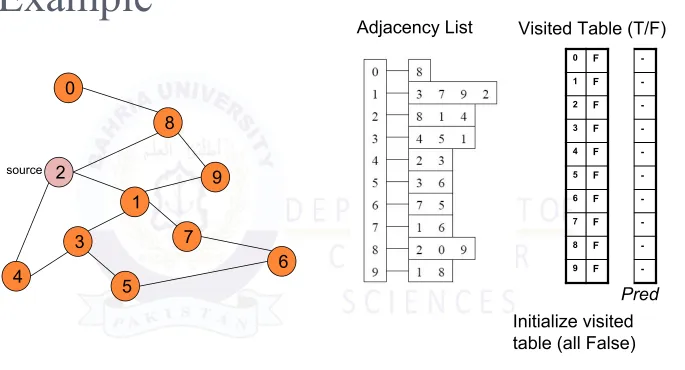
2 4 3 5 1 7 6 9 8 0 Adjacency List source 0 1 2 3 4 5 6 7 8 9Visited Table (T/F)
F F F F F F F F F F
Q = { }
Initialize visited table (all False)
Initialize Pred to -1
Initialize Q to be empty
[image:24.720.34.719.65.435.2]Example
2 4 3 5 1 7 6 9 8 0 Adjacency List source 0 1 2 3 4 5 6 7 8 9Visited Table (T/F)
F F T F F F F F F F
Q = { 2 }
Flag that 2 has been visited.
Place source 2 on the queue.
Example
2 4 3 5 1 7 6 9 8 0 Adjacency List source 0 1 2 3 4 5 6 7 8 9Visited Table (T/F)
F T T F T F F F T F
Q = {2} → { 8, 1, 4 }
Mark neighbors as visited.
Record in Pred that we came from 2.
Dequeue 2.
Place all unvisited neighbors of 2 on the queue
Example
2 4 3 5 1 7 6 9 8 0 Adjacency List source 0 1 2 3 4 5 6 7 8 9Visited Table (T/F)
T T T F T F F F T T
Q = { 8, 1, 4 } → { 1, 4, 0, 9 }
Mark new visited Neighbors.
Record in Pred that we came from 8.
Dequeue 8.
-- Place all unvisited neighbors of 8 on the queue.
-- Notice that 2 is not placed on the queue again, it has been visited!
Example
2 4 3 5 1 7 6 9 8 0 Adjacency List source 0 1 2 3 4 5 6 7 8 9Visited Table (T/F)
T T T T T F F T T T
Q = { 1, 4, 0, 9 } → { 4, 0, 9, 3, 7 }
Mark new visited Neighbors.
Record in Pred that we came from 1.
Dequeue 1.
-- Place all unvisited neighbors of 1 on the queue. -- Only nodes 3 and 7 haven’t been visited yet.
Example
2 4 3 5 1 7 6 9 8 0 Adjacency List source 0 1 2 3 4 5 6 7 8 9Visited Table (T/F)
T T T T T F F T T T
Q = { 4, 0, 9, 3, 7 } → { 0, 9, 3, 7 }
Dequeue 4.
-- 4 has no unvisited neighbors!
Example
2
4
3
5 1
7
6 9
8 0
Adjacency List
source
0 1 2 3 4 5 6 7 8 9
Visited Table (T/F)
T
T
T
T
T
F
F
T
T
T
Q = { 0, 9, 3, 7 } → { 9, 3, 7 }
Dequeue 0.
-- 0 has no unvisited neighbors!
Neighbors 8
2
-1
2
-1
2
8
Example
2 4 3 5 1 7 6 9 8 0 Adjacency List source 0 1 2 3 4 5 6 7 8 9Visited Table (T/F)
T T T T T F F T T T
Q = { 9, 3, 7 } → { 3, 7 }
Dequeue 9.
-- 9 has no unvisited neighbors!
Example
2 4 3 5 1 7 6 9 8 0 Adjacency List source 0 1 2 3 4 5 6 7 8 9Visited Table (T/F)
T T T T T T F T T T
Q = { 3, 7 } → { 7, 5 }
Dequeue 3.
-- place neighbor 5 on the queue.
Neighbors
Mark new visited Vertex 5.
Example
2 4 3 5 1 7 6 9 8 0 Adjacency List source 0 1 2 3 4 5 6 7 8 9Visited Table (T/F)
T T T T T T T T T T
Q = { 7, 5 } → { 5, 6 }
Dequeue 7.
-- place neighbor 6 on the queue.
Neighbors
Mark new visited Vertex 6.
Example
2 4 3 5 1 7 6 9 8 0 Adjacency List source 0 1 2 3 4 5 6 7 8 9Visited Table (T/F)
T T T T T T T T T T
Q = { 5, 6} → { 6 }
Dequeue 5.
-- no unvisited neighbors of 5.
Example
2 4 3 5 1 7 6 9 8 0 Adjacency List source 0 1 2 3 4 5 6 7 8 9Visited Table (T/F)
T T T T T T T T T T
Q = { 6 } → { }
Dequeue 6.
-- no unvisited neighbors of 6.
Example
2
4
3
5 1
7
6 9
8 0
Adjacency List
source
0 1 2 3 4 5 6 7 8 9
Visited Table (T/F)
T
T
T
T
T
T
T
T
T
T
Q = { } STOP!!! Q is empty!!!
Pred now can be traced backward to report the path!
8
2
-1
2
3
7
1
2
8
Path reporting
8
2
-1
2
3
7
1
2
8
0 1 2 3 4 5 6 7 8 9
nodes visited from
Try some examples, report path from s to v: Path(0) ->
Path(6) -> Path(1) ->
BFS tree
◻
The paths found by BFS is often drawn as a rooted tree (called BFS tree),
with the starting vertex as the root of the tree.
BFS tree for vertex s=2.
How do we record the shortest
distances?
d(v) = ∞;
Application of BFS
◻
One application concerns how to find
connected components in a graph
◻
If a graph has more than one connected
components, BFS builds a BFS-forest (not just
BFS-tree)!
Conclusion
In this Lecture we discussed…
What are the Depth First & Breadth First Searching?