Available Online at www.ijpret.com 852
INTERNATIONAL JOURNAL OF PURE AND
APPLIED RESEARCH IN ENGINEERING AND
TECHNOLOGY
A PATH FOR HORIZING YOUR INNOVATIVE WORK
PCA BASED ADVANCE FACE AND NON-FACE RECOGNITION SYSTEM
N. S. WADHE1, R. A. JUWARE2
1. Computer Engineering, Assistant Professor, Information Technology, PRMIT&R, Badnera, Maharashtra, India. 2. Assistant Professor, Electronics & Telecommunication Engineering, PRMIT&R, Badnera, Maharashtra, India.,
Accepted Date: 15/03/2016; Published Date: 01/05/2016
\
Abstract: A face authentication system based on principal component analysis and neural networks is developed in this thesis. The system involves three phases; preprocessing, principal component analysis, and recognition. In preprocessing stage, regularization enlightenment, and head positioning is done. Principal component analysis is applied to find the aspects of face which is essential for identification. Eigenvectors and eigenfaces are calculated from the initial face image fixed. New faces are proposed into the space extended by eigenfaces and represented by weighted sum of the eigenfaces. These weights are used for the faces identification. Neural network is used to create the face database and recognize and authenticate the face by expending these weights. In this paper, a separate system is built for each person. The input face is projected onto the eigenface first and then the new descriptor is achieved. The new descriptor is used as input to each person’s network, trained earlier. The one with supreme output is selected and described as the host if it passes predefined recognition threshold. The algorithms that have been established and tested on ORL, Yale and Feret Face Databases.
Keywords: Face recognition, Principal component analysis, Neural network, Eigenvector, Eigenface, face database.
Corresponding Author: N. S. WADHE Access Online On:
www.ijpret.com
How to Cite This Article:
Available Online at www.ijpret.com 853 INTRODUCTION
Face is one of the most important visual objects in our life which playing a major role in conveying identity and emotion and includes rich information. Face recognition is a huge research area in computer vision, pattern recognition and plays a vital role in the applications of image analysis and understanding. Face recognition commonly includes feature extraction, feature reduction and recognition or classification. Feature extraction is to find the most representative description of the faces, making them can be most easily distinguished from others.
Face reduction is to not only decompose and compress the original features but also not destroy the most important information. Recognition or classification is to choose the available measure method such as Euclidean distance, which is used to classify the feature of images present in the database and test image. Because the face image is often with a high dimension, it is difficult to use the original data directly, so it is critical to choose the effectively distinguished features for extraction and reduction. In all kinds of the algorithms of face recognition, Principle Component Analysis (PCA) [1-6] is effective feature extraction method based on face as a global feature. It reduces the dimension of image effectively and holds the primary information at the same time.
In this paper face and non-face recognition system is described and it is followed by the Principle Component Analysis (PCA) algorithm.
2. FACE RECOGNITION SYSTEM
Typical structures of face recognition system consist of three major steps, acquisition of face data, extracting face feature and recognition of face. Fig. 1 shows typical structure of face recognition system in which subject under consideration given to the system for the recognition purpose this is consider to be acquisition of face image. Later on feature is extracted from the image and finally it is given for the recognition purpose. These steps are elaborated as follow.
2.1 Acquisition of Face Data
Available Online at www.ijpret.com 854 2.2 Extracting Face Feature
Feature extraction process can be defined as the process of extracting relevant information from a face image. In feature extraction, a mathematical representation of original image called a biometric template or biometric reference is generated, which is stored in the database and will form the basis (vector) of any recognition task. Later these extracted features used in recognition. A greyscale pixel is considered as initial feature.
2.3 Recognition of Face
Once the features are extracted and selected, the next step is to classify the image. Appearance-based face recognition algorithms use a wide variety of classification methods Such as PCA, LDA. In classification the similarity between faces from the same individual and different individuals after all the face images in database are represented with relevant features. Sometimes feature extraction & recognition process done simultaneously.
Object under Consideration Fig. -1 Face Recognition System 3. PCA ALGORITHM
Principal component analysis (PCA) is one of the most popular methods for reducing the number of variables in face recognition. In PCA, faces are represented as a linear combination of weighted eigenvectors called as Eigen faces [2][3][4]; These eigenvectors are obtained from covariance matrix of a training image set called as basis function. The number of Eigen faces that obtained would be equal to the number of images in the training set. Eigen faces takes advantage of the similarity between the pixels among images in a dataset by means of their covariance matrix. These eigenvectors defined a new face space where the images are represented. To fix the required notation, let us introduce the following symbols.
Let training image set I consist of N images each having size a×b pixels. Using conventional row appending method converts each of the images into a×b dimensional column vector.
I = {i1, i2………iN } (1)
Covariance matrix c of training image set are calculated by using equation (2)
Import Face Data
Feature Extracting of face
Available Online at www.ijpret.com 855
C = 𝑁1 ∑𝑁 (𝑖𝑛 − 𝑖 ̅
𝑛−1 )T (in - 𝑖̅) (2)
Where, i is the mean vector of all images in the training set. Eigenvalue and eigenvectors of covariance matrix is calculated using equation (3)
CV = l V (3)
Where, λ denotes the eigenvalues of c, and v stands for the corresponding eigenvectors. Note that the rank of the covariance matrix is N, hence at most N number of eigenvectors can be computed.
U = (in - 𝑖̅) x V (4)
Where n = 1, 2... N. The Eigenvectors found, U have a face like appearance, they are called Eigen faces. Sometimes, they are also called as Ghost Images because of their weird appearance after the face space has been constructed, the feature vectors are formed as a linear combination of the eigenvectors of the covariance matrix. Project an image in into the
face space with the help of following equation.
Pn = UT x (in - 𝑖̅) (5)
Where Pn, n = 1, 2,..., N are the vector of weights associated with the eigenvectors in c. One can experiment with the number of eigenvectors to compute the weights, generally only a few amount provide sufficient information for adequately representing the images in the face space. For recognition of unknown face or test image, normalize it by subtracting from mean vector of all images in the training set. Then using equation (4) project the normalized test image as shown in the following equation
T = UT ‘ D (6)
Where D is normalize the test image. After the feature vector (weight vector) for the test image have been found out, next step is to classify it. For the classification task we could simply use Euclidean distance classifier.
e = min ‖ T- Pn ‖ (7)
n= 1,2,...,N. If the distance is small, we say the images are similar and we can decide which the most similar image in the database.
4. DISCUSSION
Available Online at www.ijpret.com 856 Input Image Recognized Image
computed as the ratio of the faces recognized correctly from the test set over the total number of faces in the test set.
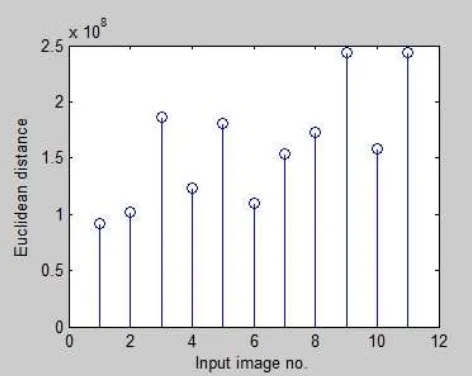
In the first experiment, an individual image provided as a test image or input image to the system, the system recognized correct image from database as shown in Fig.1.For this experiment images from Face94 database are used. The test image is identified as the person with the smallest value among all the Euclidean values of images present in the database. Fig.2 shows the Euclidean distance measure between test image and individual images present in the database. From figure it is clearly observed that at second position has very less Euclidean distance so that the image to be recognized present at second position in the database. Euclidean distance provide similarity measure of feature between test and images present in the database.
Fig.-2: The Recognition of Individual Images having expression variation
Available Online at www.ijpret.com 857 Fig.-4: The Recognition of Individual Images having Pose variation
An input image having pose variation was provided in the second experiment, system correctly recognized image form the database as shown inFig.3. Fig.4 shows Euclidean distance measure between test image and images present in the database. In this figure image present in the database at position one having less Euclidean distance as compared to the other images so that the system recognized image present at position one in the database. Less Euclidean distance shows that maximum feature of input image and image to be recognized is matched. Less Euclidean distance indicates the maximum feature of input image and recognized image is matched.
Fig. -5: Euclidean Distance vs Input Image no. for the Indian Face database. Input image number indicates the location of the image in the database
Input Image Recognized Image
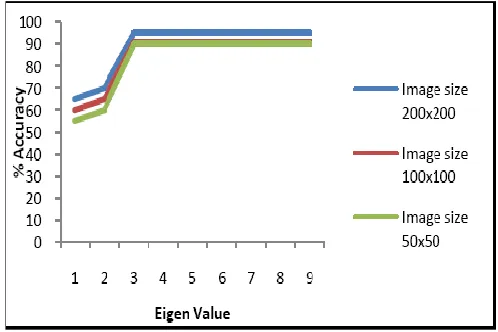
Available Online at www.ijpret.com 858 Third experiment is performed by increasing the amount of salt and pepper noise in the test images to determine a tolerance level of face recognition system. Fig. 5 provides some noisy images for a subject from the Face94 database. In these images noise density is gradually increasing. In Fig. 6 results for the noisy images are shown which indicates that accuracy of the system gradually decreases as the noise density in the image increases. The accuracy of the system saturates after certain increase in Eigen value.
Fig. -6: Images of the Same Individual with Different Salt and Pepper Noise Level
Available Online at www.ijpret.com 859 Fig. – 7: Recognition accuracy for different image size. Test image having small size doesn’t
affect the performance of the system 5. CONCLUSIONS
In PCA based face recognition, increase in the number of Eigen value will increase the recognition rate. However, the recognition rate saturates after a certain amount of increase in the Eigen value. Increasing the number of images and variety of sample images in the covariance matrix increases the recognition rate however noisy image decrease the recognition accuracy. In general, the image size is not important for a PCA based face recognition system. Expression and pose have minimal effect to the recognition rate while illumination has great impact on the recognition accuracy. As such, continuous works have been carried out in order to achieve satisfactory results of face recognition system. All these discussion provide useful performance evaluation criteria for optimal design and testing of human face recognition system.
REFERENCES
1. W.Zhao, R.Chellappa, P.J..Phillips and A. Rosennfeld, “Face Reconition: A literature Survey.
ACM Comput. Surv., 35(4): 399-458, 2003.
2. M.A.Turk and A.P. Pentaland, “Face Recognition Using Eigenfaces”, IEEE conf. on Computer Vision and Pattern Recognition, pp. 586-591, 1991.
3. [B.Poon , M. Ashraful Amin , Hong Yan “Performance evaluation and comparison of PCA
Based human face recognition methods for distorted images” International Journal of Machine
Learning and Cybernetics, , Vol 2, No. 4,pp. 245–259, July 2011. Springer-Verlag 2011.
4. G. J. Alvarado , W. Pedrycz ,M. Reformat ,Keun-Chang Kwak “Deterioration of visual
information in face classification using Eigenfaces and Fisher faces” Machine Vision and
Available Online at www.ijpret.com 860 5. G. Jarillo, W. Pedrycz , M. Reformat “Aggregation of classifiers based on image
transformations in biometric face recognition” Machine Vision and Applications (2008) Vol .
19,pp. 125–140, Springer-Verlag 2007.
6. Ling-Zhi Liao, Si-Wei Luo, and Mei Tian “”Whitened faces” Recognition With PCA and ICA” IEEE Signal Processing Letters, Vol. 14, No. 12, pp1008-1011, Dec. 2007.
7. Kwan-Ho Lin, Kin-Man Lam, and Wan-Chi Siu “A New Approach using ModiGied Hausdorff
Distances with EigenFace for Human Face Recognition” Seventh international Conference on
Control, Automation, Robotics And Vision (ICARCV’O2), Singapore, Dec 2002.
8. Shermina. J “Illumination Invariant Face Recognition Using Discrete Cosine Transform and
Principal Component Analysis” International conference on Emerging Trendes in Electrical and
Computer Technology (ICETECT)-2011.
A. Eleyan and H. Demirel “Face Recognition using Multi resolution PCA” IEEE International Symposium on Signal Processing and Information Technology-2007.
9. W. Zuo, David Zhang, Jian Yang, and Kuanquan Wang “BDPCA Plus LDA: A Novel Fast Feature
Extraction Technique for Face Recognition” IEEE Trans. On Systems, Man, and Cybernetics—Part
B: Cybernetics, vol. 36, no. 4, pp. 946-953Aug. 2006
10. L. Wiskott, Jean-Marc Fellous “Face Recognition by Elastic Bunch Graph Matching” In Intelligent Biometric Techniques in Fingerprint and Face Recognition, eds. L.C. Jain et al., publ. CRC Press, ISBN 0-8493-2055-0, Chapter 11, pp. 355-396, (1999).