Atmospheric refraction: a history
Waldemar H. Lehn and Siebren van der Werf
We trace the history of atmospheric refraction from the ancient Greeks up to the time of Kepler. The concept that the atmosphere could refract light entered Western science in the second century B.C. Ptolemy, 300 years later, produced the first clearly defined atmospheric model, containing air of uniform density up to a sharp upper transition to the ether, at which the refraction occurred. Alhazen and Witelo transmitted his knowledge to medieval Europe. The first accurate measurements were made by Tycho Brahe in the 16th century. Finally, Kepler, who was aware of unusually strong refractions, used the Ptolemaic model to explain the first documented and recognized mirage (the Novaya Zemlya effect). © 2005 Optical Society of America
OCIS codes: 000.2850, 010.4030.
1. Introduction
Atmospheric refraction, which is responsible for both astronomical refraction and mirages, is a subject that is widely dispersed through the literature, with very few works dedicated entirely to its exposition. The same must be said for the history of refraction. Ele-ments of the history are scattered throughout numer-ous references, many of which are obscure and not readily available. It is our objective to summarize in one place the development of the concept of atmo-spheric refraction from Greek antiquity to the time of Kepler, and its use to explain the first widely known mirage.
In the Western world, the history of optics begins with the classical Greek philosophers. Their interest was motivated by the study of vision. The earliest thinkers considered the science of optics to be subdi-vided into two parts.1The first and most important
was calledoptics proper,because it dealt with their original interest, the physiology of the eye and the nature of seeing. The second division wascatoptrics,
which dealt with all cases in which the visual ray was broken, namely, reflection from mirrors and refrac-tion in transparent media. With the passage of time,
the term catoptrics became reserved for reflection only, and the termdioptricswas adopted to describe the study of refraction.2The latter name was still in
use in Kepler’s time.
2. Early Greek Theories
Aristotle (384–322 BC) was one of the first philoso-phers to write about vision. He considered that a transparent medium such as air or water was essen-tial to transmit information to the eye, and that vi-sion in a vacuum would be impossible. How do we, then, see the stars? In his studies of dynamics, Aris-totle had already argued for the existence of a fifth element, different from the four terrestrial ones, to explain the circular motion of the heavens. This ele-ment, the ether, would fill all space beyond the nat-ural levels of the elements air and fire, and carry the stars in their paths.3This medium, extending all the
way to the stars, would now make them visible to observers on the Earth. The existence of the ether was thus supported bytwoarguments, his theory of dynamics and his theory of vision. We should note, in passing, that the idea of the ether was not original with Aristotle, since Anaxagoras had introduced it a century earlier,4but Aristotle demonstrated the
ne-cessity of its existence. This concept proved to be remarkably durable, lasting over two thousand years.
A work attributed to Aristotle (although there is some doubt as to how much of it is actually his) contains the first known comment that, albeit un-knowingly, describes a mirage. The volume Meteoro-logica includes discussions of rainbows, halos, and mock Suns, as well as the effects observed when look-W. Lehn ([email protected]) is with the Department of
Electrical and Computer Engineering, University of Manitoba, Winnipeg R3T-5V6, Canada. S. van der Werf is with Kernfysisch Versneller Instituut, Zernikelaan 25, 9747 AA Groningen, The Netherlands.
Received 16 December 2004; revised manuscript received 25 February 2005; accepted 9 March 2005.
ing at distant objects near the horizon. Here one can read the following5:
So promontories in the sea ‘loom’ when there is a south-east wind, and everything seems bigger, and in a mist, too, things seem bigger: so, too, the sun and the stars seem bigger when rising and setting than on the meridian.
In this passage, he lumped two independent effects into one. The looming of the promontories would be a superior mirage, brought on by the southeast wind that would sweep hot desert air over the cooler water of the Mediterranean, creating a temperature inver-sion. The rest of the line refers to the well-known moon illusion, a perceptual problem that has nothing to do with refraction. Aristotle was clearly familiar with the appearance of mirages that magnify distant objects, and very logically combined this idea with the other known effect that magnified things on the ho-rizon, the Moon illusion. Thus if indeed he wrote these lines, the history of mirages begins with Aris-totle.
The first to write a mathematical treatise on optics was Euclid6,7 (fl. 300 B.C.), but his discussion was
concerned only with the geometry of vision in air, specifically, the laws of perspective, and did not con-sider refraction.8 The first person in the Western
world to write about refraction was Archimedes, who lived in the third century B.C.9Most of his writings
have not survived, but a fragment has been preserved that discusses a standard problem in refraction: the change in appearance of an object when submerged in water.10 Based on Archimedes’ diagram, one
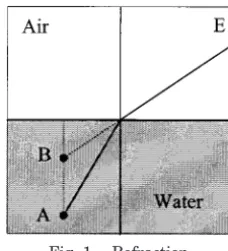
con-cludes that he clearly understood three of the four classical principles of refraction. The first of these states that the incident ray, the refracted ray, and the normal to the surface at the point of incidence all lie in a single plane. The second states that the apparent position of a submerged point lies upon the straight-line extension of the visual ray as it enters the eye. In other words, the eye atEdoes not perceive the bend-ing of the ray at the air–water interface, and there-fore perceives the object Aat the raised positionB;
see Fig. 1. This is one of the earliest known state-ments of the rule that our eyes always assume that incoming light rays are perfectly straight.11The third
principle states that the angle of incidence (within the rarer medium) is always greater than the angle of
refraction (within the denser medium). This rule was never refined into a mathematical form in classical times. In Lejeune’s opinion,12Archimedes very likely
knew the fourth principle as well. This states that the location of the point imageBlies on the perpendicular dropped from the object point A onto the surface that separates the two media. These four principles are the very ones that Ptolemy formulated in the second century A.D. However, if Archimedes wrote anything about refraction in air, or if he conceived of any kind of atmospheric structure, this information has been lost.
We can thus conclude that refraction in transpar-ent media such as glass and water was well appreci-ated in the third century B.C. When was the refraction of air itself first discovered? The oldest text we have today is a description by Pliny the Elder, who lived in the first century A.D. In his vast encyclope-dia,13he included an observation, made two centuries
earlier, in which the refraction of air could be clearly recognized simply by looking with the naked eye. He described a lunar eclipse during which the Sun and the Moon were both seen above the horizon at the same time:
. . . he also discovered for what exact reason, al-though the shadow causing the eclipse must from sun-rise onward be below the earth, it happened once in the past that the moon was eclipsed in the west while both luminaries were visible above the earth.
The person to whom Pliny referred is Hipparchus (second century B.C.), the father of Greek quantita-tive astronomy.14,15Unfortunately, Pliny did not
un-derstand the explanation, and consequently omitted it from the encyclopedia. Nearly all of the writings of Hipparchus have been lost, and what we know of his works comes mainly from Ptolemy’sAlmagest,which will be discussed below in more detail. Unfortunately, theAlmagestleaves out both eclipse and explanation. It would have been fascinating to read Hipparchus’ explanation of the eclipse; judging from later works16
whose ideas can be traced back to Hipparchus, we may conclude that he was the first philosopher to recognize the existence of atmospheric refraction, and the first to visualize a theoretical, if vague, model of the atmosphere.
3. Cleomedes
Another classical scholar from this era, who wrote about refraction, was Cleomedes.17 His two volume
introductory textbook, Circular Theory of the Heav-ens, preserved classical astronomical knowledge through medieval to Renaissance times. Kepler still referred to it frequently in 1604. Cleomedes was, for the most part, a compiler rather than a fundamental contributor to advances in optics. The value of his work is to a large extent due to the quality of his sources.
Cleomedes wrote, in Chap. 6 of his Book II, about “a class of eclipses seemingly paradoxical.”18 He had
parchus. Though he does not name Hipparchus, such events are sufficiently rare that it is very likely the same one. If we accept that Cleomedes lived in the first century A.D., then his mention of this eclipse would be contemporary with that of Pliny. Since it was well known that the Moon must lie in the Earth’s shadow for a lunar eclipse, it should be impossible to see both Sun and Moon at the same time. One would have to abandon this model unless an explanation could be found. Cleomedes, who was well aware of refraction in water and glass, now argued that the same thing must be happening in the air. He appears to have been uncomfortable with refraction in normal air, so he imagined, in the distance where the Sun was setting, a “thoroughly wet condition of the air” that would refract the visual ray downward, so that the Sun would be seen even though it was just below the horizon (in fact, normal atmospheric refraction has exactly this magnitude, independent of the “wet-ness” of the air). Distant, thoroughly wet air in the opposite direction would have made the lunar image visible. Then the eclipse would be explained without having to create a new model for the process. The atmospheric structure that Cleomedes had in mind here is only scantily described. He did, however, dis-cuss an atmospheric model in Book I19: a spherical
shell about the Earth, containing the air, above which was a greater spherical shell, stretching to the bounds of the spherical universe, which consisted of ether (a concept already 500 years old). Combining these ideas, one may deduce a model as shown in Fig. 2. The observer is situated within a zone of pure air, while in the distance, near the visual horizon, the atmosphere in both directions is filled with wet air. In Cleomedes’ terms, visual rays would proceed from the observer’s eye atO,refract atAwhere they entered the wet air, just as rays would upon passing from air to water, and proceed onward to the Moon at M,
which is below the horizon. The observer would see the Moon at the positionM⬘, just above the horizon. A second refraction at B, where the rays entered the ether, is not mentioned, and it is doubtful whether he considered it at all. The same processes, refraction at
Cand possiblyD,would occur in the direction of the Sun, S, also below the horizon, so that it would be seen elevated to S⬘. Thus, even though his own mental image of the process was imprecise, the ex-planation that refraction was responsible for the ob-servation is correct.
Another phenomenon for whose explanation Cleomedes called upon refraction was the Moon illu-sion20 (Book II, Chap. 1). This illusion, first
men-tioned by Aristotle, is important to our discussion because it was instrumental in stimulating early thoughts about refraction of the air.21The illusion is
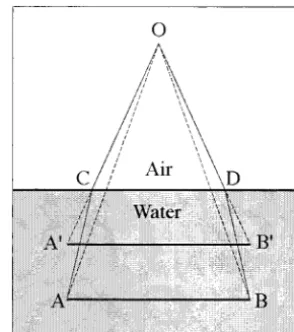
familiar to nearly everyone. It is an effect of human perception whereby the Moon appears to be much larger when it is near the horizon. Aristotle men-tioned it in the passage previously quoted, and both Cleomedes and Ptolemy attempted to explain it. Cle-omedes applied two principles together: refraction of the air, and the size– distance invariance principle. He discussed the refractive effects first. Along with other natural philosophers of the time, he was well aware that objects submerged in water appear mag-nified. This effect is illustrated in Fig. 3. Consider an objectABseen by an observer atO.In the absence of water, the object subtends the angle AOB at O. If water is now added up to the levelCD,light rays will follow the broken pathsOCAandODBto reach the ends of the object; these now appear to be atA=and
B⬘. The image of the object subtends a larger angle
CODat the observer, and it appears to be elevated to the positionA⬘B⬘; thus the object appears magnified. Cleomedes reasoned by analogy that a similar ef-fect would occur in the atmosphere. As with the eclipse just discussed, he postulated a dense moist region of air at some distance, interposed between the observer and the Moon. This dense region should then introduce magnification as water would have done. His analogy is clear enough; not clear, however, is how he visualized the structure of the atmosphere. It must have been something like the model proposed for the eclipse (see Fig. 2). The observer would be within ordinary air, but at a distance the air would become moist and dense, in his opinion capable of refracting light. Whether this dense air extended to a great distance is not stated, but may be assumed. The imaginary surface separating the dry and moist air would have to be a vertical plane, smooth like the surface of a body of water, in order to produce clear images after refraction. The visual ray from the eye would enter the dense air and be refracted toward the normal. The ray would eventually exit from the dense air upward into the ether, within which it would Fig. 2. Cleomedes’ model for the paradoxical eclipse.
proceed in a straight line to the Moon. This analogy of Cleomedes is incompletely thought out; in this case, the effect of the refraction as he visualized it would have been completely negligible. He was simply say-ing that water magnifies, therefore moist air should too. It is interesting that he invoked the same atmo-sphere to do two different jobs: for the eclipse, a ver-tical displacement of the image; for the Moon illusion, magnification. A normal atmosphere does the former, but not the latter.
Next he applied the size– distance invariance prin-ciple known today as Emmert’s Law. This may well be Cleomedes’ chief claim to originality, because he appears to have been the first to enunciate it.22 It
states that, if we perceive a given object to be farther away, then we perceive it as being larger. When the Moon is near the horizon, two effects can aid this perception: first, the Moon is clearly beyond all visible terrestrial objects on the horizon, no matter how far away they are; further, because the Moon is now seen through a great length of atmosphere, it may have the murky, dim appearance that we associate with great distance. The latter effect was already recog-nized by Aristotle: “in a mist, too, things seem big-ger”; but he had no explanation of why this should be so. Both of these factors are absent when the Moon is high; there, the Moon appears closer and hence smaller. This explanation is the one still accepted today.
Even here, however, there is some controversy about the contribution of Cleomedes. As mentioned previously, he based much of his book on reliable sources. One of these was Posidonius of Rhodes23(ca.
135 B.C. to ca. 51 B.C.). The first chapter of Cle-omedes’ Book II, which includes all of the discussions on the Moon illusion, appears to have been lifted bodily from Posidonius.24 Then, in contradiction to
Ross’s claim, even this “original” contribution of Cle-omedes actually came from someone else.
4. Ptolemy
Ptolemaios, known as Ptolemy in the English-speaking world (see Fig. 4), was a brilliant scientist
who worked in Alexandria in the second century A.D.25He produced great advances in the sciences of
optics, astronomy, and geography. In the best tradi-tions of Greek science, he insisted that his theoretical models be corroborated by actual observations. He therefore introduced extensive and accurate mea-surements into the science of Earth and sky. To a large extent, he used the methods, as well as some of the data, of Hipparchus. His major astronomical work, Syntaxis Mathematica, which became known as theAlmagest,26was so comprehensive and
influ-ential that it effectively caused the loss of much pre-vious work; manuscripts written by Ptolemy’s predecessors were no longer deemed worth copying. TheAlmagestreached medieval Europe in two forms: in the original Greek, and in Arabic translation. The Latin Epitome of the Almagest,27 written by
Regio-montanus and printed in 1496, became the standard textbook of astronomy for the next 100 years. Gin-gerich28states that there was no significant further
advance in European astronomy until Copernicus 共1473–1543兲.
Oddly, given that theAlmagestconcerns itself with accurate measurements of stellar positions, the book contains no atmospheric model and never accounts for the errors from astronomical refraction. Ptolemy remedied this later in his life when he wrote the
Optics,a treatise that showed a highly refined knowl-edge of the subject. This most important work re-mained influential for a thousand years. Because it circulated widely in the Arab world, much of it has survived in a Latin translation of a lost Arabic trans-lation from the lost Greek original. By the time Emir Eugene of Sicily produced the Latin translation in the 12th century, Book I and the last part of Book V were already missing.
In Book V of theOptics,Ptolemy studied refraction. He began with a study of the three basic transparent media (air, water, and glass), the first ever in which the angles of incidence and refraction were mea-sured. His results were quite accurate by modern standards; they easily permit us to calculate the re-fractive indices of the materials that he used. Exam-ination of his tabulated data leaves little doubt that he worked very hard trying to find a mathematical relation between the angles, for the data have been manipulated into a structure of constant second dif-ferences.29 This structure implies that the angle of
refraction is a quadratic function of the angle of in-cidence. But he was not able to identify the correct relation, namely, that the sines of the angles were proportional to one another (Snell’s Law).30
rather is expected to circle the pole at a constant distance, he compared its distance from the pole for two positions, one between the pole and the horizon (northward of the pole), and one diametrically op-posed (southward of the pole). In the northward po-sition, in which the star is nearer the horizon, it appears to be closer to the pole than it does in its upper position. In other words, some effect is raising the apparent position of the star when it has a lower elevation. Finally, the amount of the apparent shift in elevation depended on the elevation itself. Stars at lower elevations were shifted more than stars at higher elevations, and a star at the zenith was not shifted at all.
Next, he constructed a model to explain the obser-vations; unlike Cleomedes, and unlike his own work in theAlmagest,he was very clear on his atmospheric structure. Ptolemy’s experience with refraction in transparent media led him to the conclusion that refraction was occurring in the air that surrounds us. He conceived of the atmosphere as a sphere of uni-form density, concentric with the Earth; the fact that the density of the atmosphere is not constant, but changes with elevation, was unknown. Outside the atmosphere was the ether, which Ptolemy took to have a density (and hence refracting power) far less than air. The situation was clearly a direct analogy with the refraction of light through a water surface. In this case, it had to be the refraction of light in the air. Air should resemble water in many aspects, though its density was much less.
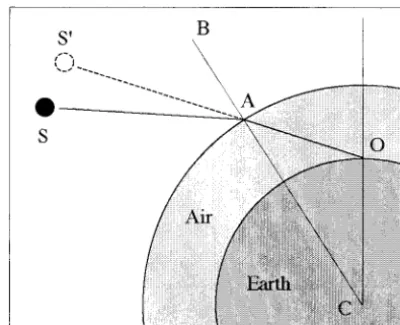
In Fig. 5, a ray from a starS,obliquely entering the air at A, would be refracted downward toward the normal BAC(the angle of refraction CAOwould be smaller than the angle of incidenceBAS) as it entered the denser medium. The lower the star, the greater would be the ray’s deviation, because, as Ptolemy knew from experiment, its larger angle of incidence would produce more change in the ray’s direction. The observer would perceive the star along the straight backprojection of the ray, in a location S⬘
higher than its true one. Only the light from a star directly overhead would not be affected. Here we
re-ceive the first clear model that details the structure of the atmosphere, and recognizes that air alone, with-out vapors, refracts light. Because this model pro-vided a qualitatively correct description of the observed phenomena, it was accepted by Ptolemy and his successors for the next 1500 years.
Unfortunately, Ptolemy reported no actual mea-surements of this refraction. Given that the refrac-tion on the horizon is typically⬃35 arcminutes, his instruments should have been able to provide at least a good estimate of some numerical values.31It should
be noted that Ptolemy was not interested in lateral refraction (measured parallel to the horizon), which is logical, since it could not be observed with the naked eye.
Ptolemy also addressed the Moon illusion. At dif-ferent times, he offered two distinct explanations.32
The earlier one is given in his Almagest (Book I, Chap. 3). Although Ptolemy never mentions Cle-omedes at all, the passage really has the appearance of an abbreviated summary of that given by Cle-omedes, based on refraction alone. Ptolemy men-tioned only the moist atmosphere intervening between the observer and the heavens, and drew the same analogy to the apparent magnification of objects immersed in water. He did, however, add one remark not occurring in Cleomedes: that magnification of a submerged object increased with depth of immersion. He provided no description of an atmospheric model, and although he understood refraction better than Cleomedes, his refractive reasoning here is weak. Comparing the above explanations by Cleomedes and Ptolemy, a modern reader would experience little hesitation in concluding that Ptolemy copied Cle-omedes.
Ptolemy’s second and later theory is found in Book III, Sec. 59, of his Optics. Here, he discussed the psychology of vision.33He thought of looking upward
as unnatural and unusual, whereas looking at the horizon was natural. He must have measured the angles subtended by the Moon when overhead and on the horizon and found them to be the same, for he specifically described the apparent change in size for such objects. He claimed that the eye would have a reduced sensation of distance under the unusual con-ditions. He made no mention at all of any refractive effects. Ross and Ross make the case that Ptolemy did not understand the Moon illusion. They interpret the word “distance” as meaning the distance between two points on the object, rather than the distance of the object from the observer, but either way, we must disagree with them and conclude that Ptolemy was well on the way to a correct explanation. Ptolemy did not specifically mention the idea of size– distance in-variance at this place, but he apparently understood it (Optics II, Secs. 53–63). This passage in Ptolemy can in no way be construed as a copy of Cleomedes.
two millennia later, as one of the most remarkable scientific works of Antiquity.34
5. Arabic Contribution
The next advances in optics were made in the Islamic world. Much of the classical knowledge would have been lost had not the Arab scholars collected, trans-lated, and expanded upon it. An essential but largely unknown contribution to the study of refraction was made by Ibn Sahl, in a treatise on optics that he wrote in Baghdad ca. 984 A.D.35Although refraction in
sin-gle spherical surfaces had already been analyzed by Ptolemy, Ibn Sahl was the first mathematician to study lenses. He was also the first to correctly formu-late the law of refraction that we know today as Snell’s law, although he did not express it in the familiar ratio of sines.36 It is a pity that his exact
mathematical law of refraction was not taken up by subsequent Arabic scholars. Rather, his law returned to obscurity, where it remained up to the times of Descartes and Snell.
6. Alhazen
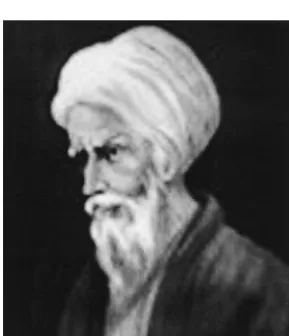
Contemporary with Ibn Sahl was a man considered by many to be the greatest of the Arab scientists (Fig. 6). He is known in the West as Alhazen, but in the East as Ibn al-Haytham.37Details about his life
re-main rather tentative, but the general consensus is this. He was born in Basra ca. 965 A.D., and studied there and in Baghdad. His intellectual abilities hav-ing become widely known, he was called to Cairo around 1000 A.D. There he did his most important work in optics, shortly before his death ca. 1039.
He would have been about 19 years old when Ibn Sahl wrote his treatise. Rashed38considers it likely
that the two scientists knew of each other; however, Ibn Sahl’s law was never incorporated into Alhazen’s work. With 37 years, as well as the great geograph-ical distance between Baghdad and Cairo, interven-ing between the optical studies of Ibn Sahl and Alhazen, it is perhaps not surprising that the law was mislaid.
According to his own count, Alhazen wrote 120 scientific works, in addition to producing Arabic
cop-ies of Ptolemy’sAlmagest.Late in life, he completed a great synthetic work,Kitab al-Manazir (Book of Op-tics),which contained, in addition to his own highly original contributions, nearly everything that was known about optics to that time. A Latin translation reached Europe around 1200 A.D. asDe aspectibus,39
a book that became the dominant influence in optics research, right through the 16th century. In 1572, Friedrich Risner edited and printed the Latin version of Alhazen’s manuscript in Basel, under the title Op-ticae Thesaurus.40 This large, widely read volume
also contains Ibn Mu’adh’sDe crepusculis,formerly attributed to Alhazen, and Witelo’sPerspectiva, orig-inally written ca. 1270.
De aspectibuscovered the three classical divisions of optics in seven books. Book VII, which contained 55 sections organized into seven chapters, was dedicated to a detailed study of refraction. Alhazen was very familiar with Ptolemy’sOptics;the structure and con-tent of Alhazen’s Book VII follow Ptolemy’s Book V41
rather closely. In many cases, Alhazen was more ex-haustive and comprehensive, trying to cover all pos-sible cases and leaving no ambiguities, but numerous sections permit point by point comparison. Thus, like Ptolemy, he designed an instrument for measuring angles of refraction, slightly modified and im-proved.42,43Unlike Ptolemy, however, he recorded not
a single measurement made with this instrument, even while discussing the same topics of refraction between air, water, and glass.
Alhazen thoroughly described refraction through single spherical surfaces, both concave and convex. Whether he abstracted his theory from Ptolemy’s Op-ticsis not certain, but the last surviving pages of Book V are suggestive. Here, Ptolemy was just beginning to study refraction in curved surfaces; the rest of the book is lost. One expects that his analysis would have continued in the methodical organized fashion with which he handled reflection in curved surfaces. If Alhazen had access to such postulated pages, then his additions to refraction in spherical surfaces may have been rather modest.44
With regard to astronomical refraction,45Alhazen
followed Ptolemy46almost exactly. He considered the
angular distances between stars and the pole as they rose and set over the course of a night, and observed that, for any given star, this distance did not remain constant as expected, but rather decreased as the star’s elevation sank toward the horizon. In other words, stars near the horizon were perceived as higher than they really were, whereas stars near the zenith were not affected. Although he claimed to have made measurements, none were reported; his discus-sion was entirely qualitative. He explained the effect by accepting the Ptolemaic model of the atmosphere, in which the air has constant density up to some fixed height, above which is the ether.
stars appeared to be higher than they really were, but Alhazen was interested in magnification only. He started from the premise that the observer was within the denser medium (air rather than vacuum), the exact inverse of the situation where magnifica-tion was seen when objects under water are observed from within the air. The result was that the celestial object would be seen with a magnification less than unity, that is, reduced in size. The same reasoning led him to the conclusion that the apparent distances between stars would be reduced, both in the vertical as well as in the horizontal directions.47Both of these
conclusions are correct, but the effect is too small to be observed with 11th century instruments. For ex-ample, if we take the nominal diameter of the Moon to be 30 minutes of arc, then the atmosphere com-presses its height to 25 minutes when the Moon is just touching the horizon. By the time the Moon reaches an elevation of 8 degrees, the compression is less than half a minute, not discernible to the naked eye. The horizontal compression of the lunar disk is even less, only a few parts in 10,000, which is defi-nitely not visible. Hence these conclusions, while cor-rect, are clearly the result of a thought experiment. It is surprising, however, that Alhazen insisted that celestial objects are seen as circular, with equal hor-izontal and vertical diameters, when the distortion of the setting Moon is easy to see. Perhaps this too was a thought experiment, for it is largely true in a Ptole-maic atmosphere.
Finally, Alhazen delivered an excellent discussion of the Moon illusion.48,49His predecessor Cleomedes
had already stated the size– distance invariance prin-ciple, and Ptolemy’s explanation in his Optics was also headed in this direction. But far superior is Al-hazen’s exhaustive analysis of the effect, which in-deed runs counter to the theoretical reduction in size that he discussed in his preceding paragraphs. He was clearly aware of size– distance invariance when he stated that, in deciding how to perceive an object, the eye carefully weighs two pieces of information: the angle subtended by the object at the eye, and the distance of the object from the eye. For a given sub-tended angle, the more distant object is perceived as larger. He next produced a model, very close to the one that is used today,50of how we perceive the
heav-ens. He observed that the human eye was incapable of seeing the convexity of the Earth and the concavity of the atmosphere’s upper surface, because the radii of curvature were far too large. Therefore the eye perceived Earth and sky as flat parallel planes. Then, objects directly overhead would appear to be much closer than objects at low elevations, and an object at zero elevation (a horizontal line of sight) would ap-pear to be at infinity. Now he knew that the Moon subtended a fixed angle at the eye, independent of the lunar elevation. Therefore the increased perceived distance as the Moon approached the horizon would lead the eye to perceive it as larger. This theory still stands today.
Alhazen briefly mentioned that refraction might play a minor role in the Moon illusion, and he tried to
sharpen up Cleomedes’ picture of the distant vapors. He thought of the distant atmosphere, through which we see stars near the horizon, as filled with vapors that were denser than air. The light from a star would travel through the ether, enter the vapor, and then depart from the vapor into ordinary air in which the observer was situated. The surface from which the ray exits from the vapor would be a plane, in order that the ray would produce a clear image. The anal-ogy would be a water surface that would have to be smooth and planar rather than turbulent, in order to permit vision through it (see the Cleomedes model of Fig. 2). Although he did not attach great importance to the vapors, he kept the concept alive, which led to a more detailed discussion by his successor Witelo.
Thus Alhazen’s contribution to the science of re-fraction was more preservative than creative. He kept the knowledge alive, consolidated it with addi-tions, and passed it on into medieval Europe.
7. Depth of the Atmosphere
In passing, it is worth mentioning theLiber de crep-usculis,by Ibn Mu’adh. This brief 11th century work, long attributed to Alhazen,51 is dedicated to an
at-tempt to calculate the depth of the Ptolemaic atmo-sphere. One of the reasons that Ptolemy gave for not trying to calculate atmospheric refraction was his lack of any knowledge of the depth of the air. Ibn Mu’adh recognized that the twilight following a sun-set must be caused by illuminated matter high in the sky. This matter must be vapors carried in the high-est levels of the atmosphere (the air itself being in-visible because it is entirely transparent). Even if the Sun has long set, the evening skies in the direction of the Sun are lighter that those in opposite direction. The difference ceases to be perceptible only when the Sun has sunk nearly 20 degrees below the horizon. Ibn Mu’adh took the value of 19 degrees below the horizon as the lowest solar elevation for which twi-light is still visible, i.e., the lowest elevation for which the Sun’s rays meet the last upper vestiges of vapor-laden air.
Following his reasoning, let the observer be atA,
catching the last glimpse of twilight on the horizon (Fig. 7). Then his line of sight AB must be drawn tangent to the Earth, and at the pointB,there should be matter that still is illuminated by the Sun. When
the Sun is 19 degrees below the horizon, then the angleAOCmust also be 19 degrees, and consequently the angleAOBwill be 9.5 degrees. It is then easy to establish that, in modern terms,Bshould be 88.6 km above the Earth’s surface. Ibn Mu’adh expressed his result in terms of Italian miles, of which 24,000 make up the circumference of the Earth.52 His value of
51.79 Italian miles translates to 86.3 km, which agrees very well with the modern calculation. While Ibn Mu’adh never discussed atmospheric refraction, his figure became an important point of reference to 16th century scientists who were trying to quantify the phenomenon.53 On the other hand, as we see
below, 86 km is an order of magnitude higher than the value assumed by Kepler.
8. Witelo
Witelo is one of the very important figures in medi-eval optics.54,55 He was born in Silesia in the early
1230s. His father was a Thuringian (likely an immi-grant from Germany), and his mother was Polish. He became interested in optics while studying in Padua. A few years after moving to the Papal Court in Vit-erbo in 1268, Witelo wrote his major work, Perspec-tiva.While he used classical sources such as Ptolemy and Euclid, his principal source, which because of his efforts became widely available in Europe, was Alha-zen’sDe aspectibus.Witelo’s manuscript was first put into print in 1535. Another edition followed in 1551, before Risner compiled and fully cross referenced the optics of Alhazen and Witelo in 1572.
Witelo set himself the objective of countering, in his opinion, the verbosity of the Arabs and the involved arguments of the Greeks.56Ironically, his renderings
of Alhazen’s discussions are much longer than the originals, even though he added little new material. Regarding refraction, every section of Alhazen’s study, Book VII, appears somewhere in Witelo mostly in his Book X. But Witelo reorganized the sections into a more logical sequence,57and he did add 25 new
sections on the origin of the rainbow.
Witelo appears not to have taken any measure-ments of refraction, neither of terrestrial materials nor of the air. With the exception of changing one number, he completely accepted and reproduced Ptolemy’s refraction tables for air, water, and glass.58,59 He thus made Ptolemy’s accurate data
much more widely available in Europe. But his math-ematical abilities were limited. There is no sign that he searched for a mathematical law of refraction. Further, he augmented these tables with a second, incorrect, set of his own making, in which he tabu-lated refraction for the reversed rays i.e., where light passes from the denser medium to the rarer. This is one of the few cases where Witelo misunderstood Al-hazen, for the latter was completely clear on the re-versibility of light rays.
Witelo’s model of the atmosphere was entirely Ptolemaic: a spherical layer of uniform density con-centric with the Earth. His discussion of refraction was essentially the same. But in his discussion of the Moon illusion, in which he attached great importance
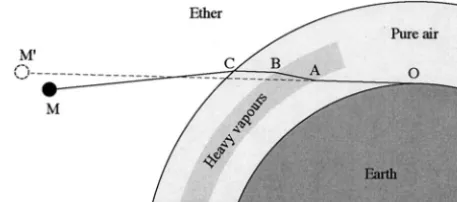
to refraction in distant heavy vapors, he sharpened the model significantly. Alhazen’s fuzzy description was now replaced by the specific structure shown in Fig. 8. Within the atmosphere, Witelo visualized a concentric layer that, while clear overhead, contained heavy vapors in the distance approaching the hori-zon. Three refractions of the light from the Moon (at
M) would then take place: the first atCbetween ether and air, the second at B between air and vapor, and the third atAas the rays leave the vapor on its lower surface and pass to the observer at O.Calculations, however, were not made; at this point, like Cle-omedes and Alhazen, he invoked the analogy of mag-nification in water (the displacement of the Moon’s image toM⬘was not relevant to his argument). If we judge from the degree to which Witelo expanded the vapor discussion, Witelo seemed to think the vapors were the dominant cause of the Moon illusion (while Alhazen attached only minor importance to them). Witelo unavoidably included Alhazen’s size– distance invariance also, but with less emphasis. He seems to have been sidetracked from concentrating on the cor-rect solution by his “improved” vapor model.
Were it not for Kepler, Witelo’s name may have faded away completely. Yet the books of Alhazen and Witelo dominated European optical science for four hundred years.60 They influenced important 15th
century figures such as Regiomontanus and Leo-nardo, and became part of the university curricula. By the 16th century, the elementary textbook of op-tics was Pecham’s Perspectiva communis,61and the
advanced textbooks were thePerspectivaeof Alhazen and Witelo.62 Thus there is a direct line of descent
from the Greek optical tradition, which culminated in Ptolemy, through Alhazen, to Witelo. His work now represented the sum total of optical knowledge in the 13th century.
Only in the mid 17th century did his influence begin to decline. Snell, Descartes, and Galileo were still reading Witelo, but critically. Kepler acknowl-edged his importance in 1604 when he titled his book
Ad Vitellionem Paralipomena (Additions to Witelo),
but this book, together with his Dioptrica of 1611, finally rendered Witelo obsolescent.
9. Tycho Brahe
Tycho Brahe (see Fig. 9) was a Danish nobleman, born in Skåne, Sweden, in 1546. A partial solar eclipse, which he witnessed as a young student,
dled his interest in astronomy. Tycho’s attitude dif-fered from that of all who came before him by his passion for accuracy and completeness. His instru-mentation, which he himself designed and had build, was many times more precise than anything the world had ever seen. Supported by King Frederik II of Denmark, he built an observatory on the island of Hven, where for 20 years he conducted measure-ments of unprecedented accuracy.
In 1599, Emperor Rudolph II invited him to Prague to become the Imperial Astronomer. It was there that Brahe’s and Kepler’s paths came together, when Ke-pler was hired as Tycho’s assistant. Their collabora-tion was not to last long, but the combinacollabora-tion of Brahe’s experimental genius and Kepler’s gift for imaginative interpretation has been decisive in the development of astronomy. Brahe died in 1601, and Kepler became his scientific heir.
Tycho Brahe was the first to measure atmospheric refraction properly. His model was still the Ptolemaic one, where refraction occurred at the sharp boundary between air and ether. His technique was to use the Sun, whose position was accurately predictable, to determine the refraction. He recorded the differences between his measured and predicted positions for a complete set of solar altitudes to build his tables.63He
published his findings in 1596 in hisEpistolae Astro-nomicaeprinted by himself.
The results are shown in Fig. 10. The refractions of the Sun and the fixed stars have been kept separate, because, as the Sun was much closer to the Earth than the stars, Tycho expected parallax to affect their apparent positions. He did not know the distance to the Sun, so he uncritically included Ptolemy’s value of 3 arcminutes (the Sun’s actual parallax at the ho-rizon is only 8⬙.8). If the incorrect 3=is deducted from the solar data points, they agree substantially with his data for the fixed stars. For comparison, the solid curve represents modern refraction data,64which, up
to an altitude of 15°, agree very well with the fixed
star data. Clearly Tycho’s measurements, the first ever made of atmospheric refraction, were of excel-lent quality.
10. Kepler
Everyone knows the name of Kepler (see Fig. 11). His laws of planetary motion laid the foundation for New-ton’s law of universal gravitation, and thus firmly established the Copernican system of the heliocentric universe. We will give only a brief summary of his relevant work. Kepler was born in Weil der Stadt, Germany, in 1571, and he died in Regensburg in 1630. He studied theology at the University of Tübin-gen, but also became interested in mathematics and astronomy under the guidance of Michael Mästlin, who taught both the Ptolemaic and the Copernican systems. In 1594, Kepler reluctantly left his theology to become a teacher of mathematics in Graz, Austria, and there he began his own investigations in astron-omy. By virtue of his bookMysterium Cosmographi-cum,published in 1597, he became known to Tycho Fig. 9. Tycho Brahe.
Fig. 10. Tycho’s measured refraction in air.
Brahe, who in 1600 invited Kepler to become his assistant at the imperial court of Rudolf II in Prague. This position was particularly attractive to Kepler because it would give him access to Tycho’s observa-tions, the best the world had ever seen. When Tycho died in 1601, Kepler was appointed Imperial Mathe-matician, a post he held for the next 12 years.65,66
His optical works are less widely known, even though they too are of revolutionary importance. He was fully acquainted with the classical and medieval traditions in optics, in particular, with the work of Witelo. In 1604, he published his response to Witelo:
Ad Vitellionem Paralipomena,67,68 often known
sim-ply as Kepler’sOptics.In the full title of this book, he implied that he would deal only with the optical part of astronomy, but he also included his discoveries on the means of vision, i.e., the human eye. He was the first to recognize that the eye focuses an inverted image of the scene on the retina. He left the issue of why we see the world “right side up” when its image is upside down to the physicians; this was no longer an optics problem.
Kepler, having access to all of Tycho’s data, was well aware of atmospheric refraction. He also knew about a few exceptional cases. One was an observa-tion of Venus69in which the planet hung on the
ho-rizon for 15 minutes, and refused to set until its real position was 2 degrees below the horizon. Another was a recent observation, made by his former teacher Mästlin in Tübingen,70 of the paradoxical eclipse,
which had not been seen since the time of Hippar-chus. In this case the refraction in each direction exceeded 1 degree.
In hisOptics,Kepler accepted Tycho’s table of as-tronomical refraction, as well as his erroneous value of 3⬘for the solar parallax.71He was the first to even
mention the elliptical setting Sun,72and he criticized
Alhazen and Witelo for claiming that all celestial objects were perceived as circular. He was able to explain it correctly by recognizing that refraction raises the lower limb of the Sun more than the upper, resulting in a vertical compression of the image.
Kepler’s model of atmospheric structure was the Ptolemaic one. He reasoned on the basis of refrac-tions that the altitude of the air could be no more than about half a German mile.73 As there are 15
German miles to one degree of latitude, the height would have been⬃3.7 km. Properties of the air were considered uniform up to this level; above it, the air was abruptly replaced by the ether. The uniformity assumption was quite logical at the time, because the instrumentation (thermometer and barometer) needed to measure any variations had not yet been invented.
Kepler was the first to recognize a mirage and the first to attempt to explain it. In 1598, Gerrit de Veer published a book that described three voyages led by the Dutch navigator Willem Barents into the high Arctic, in search of a North East Passage to China.74,75On the third voyage, begun in 1596, the
mariners became icebound at the Siberian island of Novaya Zemlya, at a latitude of 76°15⬘ N. On 24
January 1597, they recorded their first glimpse of the Sun at the end of the polar night. Barents, knowing their latitude and the solar declination, declared this to be impossible, as it was 15 days early, but three days later, he saw it too, “in its full roundness.” Never had so much atmospheric refraction been observed, for the Sun’s center at this time was 5°26⬘below the horizon. This exceeded by far the well known value, as measured by Tycho, of approximately half a de-gree. The Dutch observation, which immediately be-came famous throughout the scientific community,76
has been given the name the “Novaya Zemlya phe-nomenon.” It is the very first report of a scientifically documented and recognized mirage.
The news of these observations caused great con-troversy. One major issue was the new calendar. In 1582, the Gregorian calendar had been proclaimed, to correct the errors that were slowly accumulating in the old Julian calendar. The conversion introduced a correction of 10 days. While de Veer claimed to have used the New Style for every date, it was argued that he was actually using the Julian calendar. On that basis, their first observation of the Sun would have been only 5 days early, the result of a much smaller and more easily believed refraction. The other issue was the problem of daily timekeeping during the months of perpetual darkness. Here it was argued that the mariners may have easily missed counting a number of days: they may have overslept, or forgotten to turn over the sand glass immediately when it emp-tied. All of these objections have been shown to be groundless.77,78 Kepler accepted the observations at
face value, arguing that if Barents were unable ac-curately to measure his days and his latitude, then the whole art of navigation developed over centuries would have been lost.
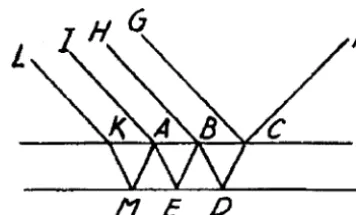
In hisOptics,Kepler suggested several approaches to explain the observations. His preferred explana-tion is as follows. He made an analogy, which he claimed to have drawn from Cleomedes, between the atmosphere and a glass mirror. He had observed that a mirror reflects from its front face as well as from its rear silvered face, and every ray is partially reflected as well as being transmitted. Figure 12 shows the diagram he presented in his book. If we look at it as representing a mirror, then the incoming ray fromF
will meet the front surface of the mirror at C, par-tially reflect along CG, and partially refract along
CD. The latter ray meets the silvered surface at D
and is reflected alongDB.AtBon the front surface, the process is repeated: part of the light leaves the glass alongBH,and part reflects alongBE.There is a loss of light at each reflection, but if F is a very strong source, it may take several such cycles to fully deplete the visibility of the last outgoing ray. Kepler postulated that the atmosphere would do the same thing. Instead of the front surfaceKCof the glass, he considered the top of the atmosphere where it makes a sharp transition to the ether. Rays from a low Sun, striking this interface from below, would be reflected back downward. This reflected image could be seen by an observer, even though the Sun were several degrees below the horizon. Given his value of half a German mile for the thickness of the atmosphere, a single such reflection should suffice to create the No-vaya Zemlya observations. Kepler also suggested in passing that this model, with several reflections from the interface, could explain the twilight without hav-ing to assume, as Ibn Mu’adh did, that the atmo-sphere had to be 12 German miles deep.
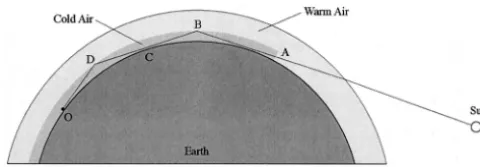
Kepler came strikingly close to the true explana-tion. The Novaya Zemlya effect is caused by optical ducting, in which light rays are trapped within a temperature inversion.79 Figure 13 is a schematic
drawing that illustrates the effect. The inversion ex-ists where the cold air lies beneath the warm air. At the upper boundary of the cold air, there is a sudden increase in temperature, and therefore a sudden drop in density. A ray from the low Sun that enters the inversion at A cannot penetrate upward into the warm air atB;the sudden change in density reflects80
the ray back into the inversion. At C, the ray just skims the Earth and returns to an upward trajectory toward D. There it is reflected again when it tries to pass into the warm air. Under a widespread inver-sion, the ray might undergo several cycles like this before it reaches the observer atO.In this way, light from the Sun may reach the observer even though the Sun is as much as 5° below the horizon. In recent times, a powerful example of the effect has been seen in Antarctica.81
Kepler’s model had exactly this form, except that in his case the abrupt drop in density was caused by the transition from air to ether, a transition whose re-flective power was insufficient to return the rays as he supposed. If Kepler had included the curvature of the Earth in his model, he could have imagined sev-eral cycles of reflection before the image of the Sun reached an observer. Then his explanation of the
No-vaya Zemlya effect would have had the same form as the one we use today.
The Moon illusion, of such great interest to the Greeks and to medieval authors, is finally laid to rest by Kepler. He considered it of no importance in quantitative astronomy. He completely rejected the idea of distant vapors, because “why is it they are always there and never here?”82 He realized that,
with the exception of the well understood vertical compression on the horizon, the actual measured diameter of the Moon remained the same, whether it was low on the horizon or high in the sky. In other words, the Moon illusion had nothing to do with optics, but only with the perceptual problem of es-timating distance. Therefore, as he did with the inverted image on the retina, he left the problem to the physicians.
11. Conclusion
Realization that the atmosphere could refract light came in the second century B.C. It was stimulated by two observations, the extremely rare paradoxical eclipse and the very commonly seen Moon illusion. Ironically, the latter is not a refraction event at all. The initial models for atmospheric structure were very vague, until Ptolemy laid out a detailed model in the second century A.D., a model that Kepler still used. Considering that ancient instruments could distinguish some fraction of a degree,83,84 it is
re-markable that no one ever tried to quantify refraction on the horizon until the 16th century, when Tycho Brahe, with instruments that divided the degree into 60 minutes,85finally produced a practical refraction
table. Kepler put the table to good use in explaining the elliptical setting Sun. He was one of the first to focus on anomalous refractions, and was the first to attempt an explanation. Still to come were Snell’s Law of refraction as well as the measurement of tem-perature and pressure in the atmosphere. But Ke-pler’s work was the turning point, providing the foundation upon which subsequent scientists could build their detailed structures.
References and Notes
1. A. Lejeune,Recherches sur la Catoptrique Grecque(Académie Royale de Belgique, Brussels, 1957), p. 3.
2. A. M. Smith,Ptolemy’s Theory of Visual Perception: an English Translation of the Optics (American Philosophical Society, Philadelphia, 1996), p. 19. This second century work was or-ganized according to the three divisions.
3. M. R. Cohen and I. E. Drabkin,A Source Book in Greek Science
(Harvard University, Cambridge, Mass., 1958), p. 200. 4. Ref. 3, p. 93.
5. Aristotle,Works: Translated into English,12 vols., W. D. Ross, ed. (Clarendon, Oxford, 1908 –1952), vol. III (Meteorologica), pp. 373b12–373b13.
6. P. Ver Eecke, Euclide: L’Optique et la Catoptrique (Albert Blanchard, Paris, 1959). It is considered doubtful if the Ca-toptricawere actually written by Euclid; the lowest layer in this work stems from Euclid’s time, but subsequent editing added several more recent layers.
7. H. E. Burton, “The optics of Euclid,” J. Opt. Soc. Am. 35,
8. The one short statement on refraction in Euclid’sCatoptricais considered to be a later addition; see Ref. 6, p. 99.
9. T. L. Heath,A History of Greek Mathematics,2 vols. (Claren-don, Oxford, 1921).
10. Archimedes appears to be the originator of the coin in the cup experiment: a coin is placed in the bottom of a cup, out of sight to an observer who is looking into the cup at an angle. When the cup is filled with water, refraction makes the coin visible. See Ref. 9, Vol. 1, p. 444. This is the statement referred to in Note 8.
11. This assumption also appears in Euclid’sCatoptrica,probably within the lowest layer, which predates Archimedes. 12. Ref. 1, p. 179.
13. Pliny,Natural History,10 vols., translated by H. Rackham, Loeb Classical Library (Heinemann, London, 1938), vol. I, p. 207.
14. O. Neugebauer,A History of Ancient Mathematical Astronomy, 2 Vols. (Springer-Verlag, Berlin, 1975), pp. 274 –298. 15. G. J. Toomer, “Hipparchus,” Dictionary of Scientific
Biogra-phy,C. Coulston Gillispie, ed. (Scribner’s, New York, 1990), Suppl. I, pp. 207–224.
16. Cleomedes,On the Circular Motion of the Heavenly Bodies,in Ref. 3, p. 284. Cleomedes took this part of his work from Posidonius.
17. There is some controversy about when Cleomedes lived: The consensus is first century A.D. although others say second or even fourth century. The later dates appear unlikely, because he never refers to the well known second century work of Ptolemy.
18. Ref. 3, p. 284. 19. Ref. 9, vol. II, p. 236.
20. H. E. Ross, “Cleomedes (ca. 1stcentury A.D.) on the celestial
illusion, atmospheric enlargement, and size– distance invari-ance,” Perception29,863– 871 (2000).
21. Hipparchus probably, and Posidonius certainly, tried to ex-plain the Moon illusion.
22. Ref. 20, p. 864.
23. “Posidonius,”Dictionary of Scientific Biography,Ref. 15. The writings of Posidonius have not survived; we know of his work primarily through Cleomedes himself.
24. Ref. 9, vol. II, pp. 235–238. That Posidonius studied the Moon illusion is independently confirmed by Strabo (see Ref. 20, p. 864).
25. D. C. Lindberg,Theories of Vision from al-Kindi to Kepler
(University of Chicago, Chicago, Ill., 1976).
26. Ptolemy’sAlmagest,translated and annotated by G. J. Toomer (Springer-Verlag, New York, 1984).
27. R. Wolf,Geschichte der Astronomie(R. Oldenbourg, München, 1877), p. 88.
28. O. Gingerich,The Eye of Heaven: Ptolemy, Copernicus, Kepler
(American Institute of Physics, Molville, New York, 1993), p. 25. 29. Ref. 2, p. 45. Ptolemy’s refraction measurements appear in
many places, e.g., in Ref. 42, cited below.
30. Interestingly, if we expand Snell’s Law in a Taylor series and truncate it after the quadratic term, we get a remarkably good agreement with the quadratic function implicit in Ptolemy’s data. This occurs, however, only if the expansion is done about the midpoint of the data; Wilk expands about the origin and gets a poor fit. See S. R. Wilk, “Claudius´ Ptolemy’s law of refraction,” Op. Photon. News1510, 14 –17 (2004).
31. Ref. 2, p. 242.
32. H. E. Ross and G. M. Ross, “Did Ptolemy understand the moon illusion?,” Perception5,377–385 (1976).
33. Ref. 32, p. 379. 34. Ref. 2, p. 49.
35. R. Rashed, “A pioneer in anaclastics: Ibn Sahl on burning mirrors and lenses.” Isis81,464 – 491 (1990).
36. Ibn Sahl applied his insight to the analysis of lenses; in
par-ticular, he solved the problem of the anaclastic lens: a parab-oloid lens that will bring parallel incident rays to a perfect focus.
37. His full name was Abu Ali Hasan ibn Hasan ibn al-Haytham. While he is known to most as Alhazen, scholars now believe that this should be written as Alhacen.
38. Ref. 35, p. 491. 39. Ref. 25, p. 209.
40. F. Risner, ed.,Opticae thesaurus. Alhazeni Arabis libri septem, nuncprimum editi. Eiusdem liber De Crepusculis et nubium ascensionibus. Item Vitellonis Thuringopoloni libri X,reprint of the 1572 edition; introduction by D. C. Lindberg (Johnson Reprint Corp., New York, 1972).
41. Ref. 2, p. 56.
42. E. Grant, ed.,A Source Book in Medieval Science(Harvard University, Cambridge, Mass., 1974), p. 420.
43. Ref. 40, Alhazen, Book VII, Chap. 2.
44. With respect to lenses, Alhazen’s contribution was small. Ris-ner’s edition (Ref. 40) contains no discussion of lenses (in spite of an erroneously inserted diagram showing a burning sphere). Alhazen wrote a separate work entitled On the Burning Sphere,which considered only spherical lenses. See E. Wiede-mann, “U¨ ber die Brechung des Lichtes in Kugeln nachIbn al HaitamundKamâl al Dîn al Fârisî,” Sitzungsber. Phys.-med. Sozietät Erlangen42,15–58 (1910). He certainly did not de-velop a rigorous geometric theory of lenses, as Rashed (Ref. 35) has claimed. Grant (Ref. 42) states that the burning sphere was as close as any medieval scholar came to a study of lenses. 45. Ref. 40, Alhazen, Book VII, Chaps. 15 and 16.
46. Ref. 2, Ptolemy Book V, Sects. 23–30.
47. The vertical case follows from Ptolemy, but he never stated it explicitly for separation between stars. Alhazen, on the other hand, never concerned himself with the shift in apparent ele-vation of stars.
48. Ref. 40, Alhazen, Book VII, Chap. 55.
49. A. I. Sabra, “Psychology vs mathematics: Ptolemy and Alhazen on the moon illusion,” inMathematics and its Applications to Science and Natural Philosophy in the Middle AgesE. Grant and J. E. Murdoch, eds. (Cambridge University, Cambridge, 1987).
50. J. M. Pernter and F. Exner,Meteorologische Optik,2nd ed. (Braumüller, Vienna, 1922), Part 1.
51. A. I. Sabra, “The authorship of Liber de crepusculis, an eleventh-century work on atmospheric refraction,” Isis 58,
77– 85 (1967). He calls it a work of atmospheric refraction, which it is not.
52. Ref. 40,Liber de crepusculis,p. 288. This edition also gives the height of the atmosphere as 52000 paces (p. 287). The Roman pace was 5 ft. (1.7 m), but its length varied over the centuries. 53. A. M. Smith, “Ptolemy, Alhacen, and Ibn Mu’adh and the problem of atmospheric refraction,” Centaurus45, 100 –115 (2003).
54. Ref. 40, Introduction by D. Lindberg, pp. vii–xiii.
55. J. Burchardt,Witelo: filosofo della natura del XIII sec.: una biografia(Polskiei Akademii Nauk, Wroclaw, 1984).
56. Ref. 40, Introduction by D. Lindberg, p. xiii. 57. Ref. 40, Introduction by D. Lindberg, p. xx. 58. Ref. 42, pp. 424 – 426.
59. Ref. 40, Witelo, Book X, Chap. 8.
60. Ref. 40, Introduction by D. Lindberg, p. xxi.
61. D. C. Lindberg,John Pecham and the Science of Optics: Per-spectiva Communis(University of Wisconsin, Madison, 1970). Pecham’s book presented Alhazen’s conclusions in a reduced and more readable form, while preserving their central ideas. 62. Ref. 40, Introduction by D. Lindberg, p. xxiii.
64. The Air Almanac 1987 (United States Naval Observatory, Washington, D.C., 1986).
65. Ref. 25, pp. 185–186.
66. M. Caspar, Kepler,translated by C. D. Hellman (Abelard-Schuman, New York, 1959).
67. W. H. Donahue (transl.), Optics: Paralipomena to Witelo & Optical Part of Astronomy,by Johannes Kepler (Green Lion Press, Santa Fe, N.M., 2000).
68. J. Kepler,Ad Vitellionem Paralipomena, quibus Astronomiae Pars Optica Traditur(Apud Claudium Marnium & Haeredes Ioannis Aubrii, Frankfurt, 1604).
69. Ref. 67, p. 149.
70. Mästlin saw the eclipse on 7 July 1590 (Old Style).
71. In a later work, Kepler stated that the solar parallax could not be more than 1’.
72. Ref. 67, p. 144. 73. Ref. 67, p. 141.
74. G. de Veer,Waerachtige Beschryvinge van drie seylagiën ter werelt noyt soo vreemt ghehoort (Claes Claesz, Amsterdam, 1598). A Latin version also appeared in 1598.
75. G. de Veer (English translation),The true and perfect de-scription of three voyages, so strange and woonderfull that the like has neuer been heard of before(T. Pauier, London, 1609).
76. To quote Kepler, “The story is familiar to everybody, of the journey of the Netherlanders . . .”; Ref. 67, p. 151.
77. S. Y. van der Werf, G. P. Können, W. H. Lehn, and F. Steenhuisen, “Waerachtighe Beschryvinghe van het Nova-Zembla-Effect,” Ned. Tijdschr. Natuurkd.66,120 –126 (2000). 78. S. Y. van der Werf, G. P. Können, W. H. Lehn, F. Steenhuisen, and W. P. S. Davidson, “Gerrit de Veer’s true and perfect description of the Novaya Zemlya effect, 24 –27 January 1597,” App. Opt.42,379 –389 (2003).
79. W. H. Lehn, “The Novaya Zemlya effect: an arctic mirage,” J. Opt. Soc. Am.69,776 –781 (1979).
80. The effect is actually refraction confined to a very narrow zone; on a larger scale, it looks just like reflection.
81. G. H. Liljequist, “Refractive phenomena in the polar atmo-sphere,” Scientific Results, Norwegian-British-Swedish Ant-arctic Expedition 1949 –1952, Vol. 2, Part 2 (Oslo University, Oslo, 1964). His observation took place on 1 July 1951, when the Sun was 4.3° below the horizon.
82. Ref. 67, p. 96
83. Ref. 14, Book VII. His star tables are given to a resolution of one sixth of a degree.
84. S. van der Werf, “Het astrolabium,” Cornelis Douwes 160,
20 –21 (2004).