Issues
ISSN: 2146-4138
available at http: www.econjournals.com
International Journal of Economics and Financial Issues, 2015, 5(4), 1029-1037.
A Comprehensive Definition of the Concept of Innovation in
Russian and International Science
Viktoriya Valeryevna Manuylenko
1,2*, Andrey Aleksandrovich Mishchenko
2, Olga Borisovna Bigday
3,
Yekaterina Leonidovna Putrenok
4, Anna Valeryevna Savtsova
51Department of Banking and Finance, The Institute of Management and Economics, North-Caucasus Federal University, Stavropol,
Russia, 2Department of Economics and Finance, The Institute of Management and Economics, Stavropol University, Russia,
3Department of Management, The Institute of Management and Economics, Stavropol University, Russia, 4Department of Economics
and Finance, Stavropol University, Russia, The Institute of Management and Economics, 5Department of Banking and Finance, The
Institute of Management and Economics, North-Caucasus Federal University, Stavropol, Russia. *Email: [email protected]
ABSTRACT
Theoretical and methodological studies of innovation content and essence show that methodological assessment approaches fail to represent an explicit conceptual and categorical framework for the category under consideration, which carries ambiguous connotations both in Russian and foreign theory of innovation. This paper explores the essential theoretical conceptual properties of innovation, which is considered a system enabling to argue that a system-wide definition of the innovation concept is the most preferable in terms of comprehensiveness. From a theoretical perspective, we have provided insight into the innovative process by stages within the innovation system, and presented a set of innovation functions, including intensive development and reputation functions; we have traced the logical interrelation between such concepts as “idea,” “novelty,” “invention,” “innovation,” “innovative product,” “innovative service,” “innovative product line.” It is assumed that a methodological innovation assessment should be based on a comprehensive synergy-oriented approach. The methodological principles for the innovation system construction have been formed.
Keywords: Innovations, Innovative Process, Innovation Functions JEL Classifications: B4, D2, L1
1. INTRODUCTION
Although the problems of innovations as a sourceof competitive business advantages in a changeable environment need a long
time to emerge, there is no consistent definition of innovation both in Russian and foreign theory and practice. Innovation is defined as a change (Valenta, 1985; Voldachekand Vodachkova, 1989), a process in different modifications (Gvishiani, 1986; 2007; Twiss, 1998; Myers and Marquis, 1969; Santo, 1990; 2004; Bezdudnyi et al., 1998; Gokhberg, 2011; Ilyenkova, 2007; Yagudin et al., 2009); a result Souder et al. (1990), Vertakova and Simonenko, (2008), an innovative product (Kotler, 2008; Utkin et al., 1996); an innovative service (Pinningo; Valdaytsev), and others. Most academic economists equate such concepts as “novelty,” “invention,”
“innovative product,” “innovative service,” “invention,” “discovery,” etc. Thus, currently, innovation is a complicated phenomenon,
having a versatile essence, which should be examined from a system perspective. A theoretical uncertainty of innovation essence ultimately impairs its objective assessment, as it is commonly believed that the
respective methodological measurement methods should reflect the conceptual framework. Therefore, the definition of economic content
of innovations is an essential element of methodological basis for their assessment. In this respect, it is appropriate to construct the innovation concept in the modern development context that proves the relevance of research.
The purpose of research is to justify the key trends in the formation of modern methodological tools for innovation assessment based on the respective innovation conceptual framework. Research
objectives include analyzing the economic concept content of
assessment from a standpoint of formation and development of the innovation assessment methodology. The theoretical and methodological framework of research is the works of domestic and foreign academic economists, the Oslo Manual on the essence and content of innovations and similar concepts
(innovative process, innovative product, innovative service, etc.).
The methodological framework of research consists of logical,
scientific approaches to study the innovation concept essence
and content. Using such methods as analysis, synthesis, detailed
elaboration, generalization, clustering, formalization, abstract-logical method, the innovation concept essence was identified in
theoretical and methodological terms.
A working hypothesis of research relies on a conceptual thesis that the modern innovation assessment methodology shall be based on an appropriate conceptual framework, consistent with business development conditions. It suggests the following: Clarifying
the innovation essence and content definition; predetermining the
development of innovation assessment methods.
The theoretical relevance of research is in the logical interrelation between such concepts as “idea,” “novelty,” “invention,” “innovation,” “innovative product line” revealed by the authors; in the presented set of functions of innovation, including the intensive development and reputation functions; in the updated and presented innovation properties, such as novelty, innovativeness, industrial applicability, marketing, economic and/or other effects;
in the introduced comprehensive definition of innovation, covering
all aspects of innovative process, where an idea is turned into reality, which constantly interacts with the internal and external
business environment, the specifics of innovative process itself,
favoring the successful service or product launch on the market; in the presented stage wise innovative process content; and in the
justified comprehensive innovation assessment approach from the
methodological perspectives.
2. LITERATURE REVIEW
2.1. The Historical Aspect of the Innovation Concept Origination and Establishment
Peter Ferdinand Drucker, American economist, argued that the introduction of innovations is a science subject to development
(Drucker, 2012). Making a retrospective journey into the history, it should be noted that, according to Kondratyev, innovations are one of
the important reasons of the large cycles of market conditions (large
cycles, “long waves”) and their duration, and exploring the dynamics
of inventions in the context of large cycle phases, he distinguished
them from inventions and discoveries (Kondratyev, 2002). As a
result, it became necessary to study innovations in the dynamic
(static) aspects (the ultimate result of research and production cycle).
Joseph Alois Sсhumpeter, Austrian economist, the pioneer of innovations and Kondratyev’s successor, regards the renewal of innovation capital in Kondratyev’s wave theory as an opportunity
to overcome crisis and decline in industrial production. Study of the key tenets of the innovative process theory, presentation of a invention as a change in technology and management, new
combinations of resource use are reflected in “The Economic
Cycles” (1939). In this regard, an entrepreneur, a businessman is considered a significant link between the invention and innovation in the innovative process (Kondratyev, 2002; Shumpeter, 2007). As a result of the investigations carried by Kondratyev and
Schumpeter, the cyclic regularities of technological progress were revealed; the idea of interaction between technological and
institutional changes was justified.
In a market economy, the concept of innovation has an independent
nature, but it is also used to characterize similar terms, such as “innovative process,” “innovative activities,” etc. A significant
contribution to the innovation theory is the development of technological wave concepts by domestic economists.
2.2. Interrelation of Innovation to Similar Concepts (Idea, Novelty, Invention, Innovative Product, Innovative Service, Innovative Product Line)
Innovation is an act of introducing something new, a new idea, more effective device or process (Lat. - update, improvement,
Eng. – (synonym) invention). It turns out that the terms “innovation” and “invention” are equated, being defined as a
developing complex process of innovation creation, distribution,
use, focused on efficiency growth and development of innovative activities. The innovation and invention are also equated by the following academic economists: Anshin (2005), Beshelev and Gurvich (1990), Lapin (2008), Medynskiy (2008), Mensch (1979); novelty and invention - Balabanov (2001); innovation and novelty by Gvishiani (2007), Karpenko (2013), Mukhamedyarov (2010), Ogoleva (2004), Sokolov (1997), Rumyantseva (2007), believes that innovation is a novelty that has gained a new quality since
acceptance for the distribution.
There is also a fundamentally opposite opinion, according to which the invention is a progressive novelty, used in dynamics and being
new for the organizational system, which accepts and applies it. As
a rule, novelties create the novelty market, and innovations create the competitive innovation market, and the investments create the
capital market, forming together the field of innovative activities.
According to Korobeynikov et al. (2000) and Trifilova (2005) a novelty is a new idea, realized in the process of developing a
new product, method, new technology, etc.; innovation is a new
(retrofittable, upgradable) product or technology, created using
novelty and being marketable, or introduced into production,
management and other activities (Korobeynikov et al., 2000). In
other words, the technological novelty is a source of technological
innovation that gains such a quality since the initiation of
distribution as a new product.
Tsvetkov (2011) also distinguishes the economic categories of “novelty” and “invention” and defines the innovation through a
process based on the practical implementation of novelty, resulting in the meaningful basis of invention as a process. Innovation is an
object, introduced into production upon the completed scientific
research or discovery made, differing from the previous analogue
The Center for Economic and Social Studies of the Republic of
Tatarstan defines the novelty as a new phenomenon, discovery,
idea, method, etc. designed as a result of research, developments
or experimental works on the efficiency improvement in specific
areas, and the innovation as the implementation of novelty, including a complex process of creation, distribution and use of novelty as a new practical tool to meet the human needs that change with the development of social and cultural systems and subjects.
Thus, this is the result of investing in new equipment, technology, management system, labor organization and others. Anshin states
that novelty is a potential innovation, a new solution prior to its
commercialization, i.e., practical use of novelty, accompanied by
its market penetration.
Vertakova and Simonenko (2008) suggest that innovations are
based on novelties, inventions, i.e., novations. The practical
application of invention and discovery in any field of human activity leads to creation of a new product (technology) and
eventually it determines the transformation of idea, underlying the invention, to the innovation, which in its turn stimulates
the emergence of new ideas. Consequently, there arises an
innovation spiral, presented as “scientific and technological progress - idea - invention - technological progress - idea
- invention” (Vertakova and Simonenko, 2008).
Bezdudnyi et al. (1998) determine the semantic differences
between the concepts of novelty, invention, and innovation (Lapin,
2008). Fatkhutdinov believes that novelty is a completed result of
applied and fundamental studies, developments and experimental works in a certain area to improve its effectiveness: Discoveries, inventions, patents, trademarks, innovation proposals, know-how,
scientific principles and others. The invention is a novelty that is used since its market launch, gaining a new quality, and eventually turning into innovation (Fatkhudinov, 2011). Thus, the innovation
is a broader concept than the invention.
Novikov holds a similar position that novelty and novation are the actually completed result of research, developments and experimental works to improve the effectiveness in a certain area (discoveries, inventions, patents, know-how, documents for a
new (retrofittable, upgradable) product, technology (production process) and other recommendations, methods, instructions, standards, results of market research, innovative proposals). The
novelty in the form of new knowledge, approaches, methods
gains a new quality, turning into innovation (invention) since the
period of its introduction and initiation of distribution, and the
innovation is a final result of novelty implementation to achieve the economic, social, environmental, scientific and technical or other
effect, accepted by the society. However, such representations of innovation implementation, in our opinion, are incomplete, as the interrelation chain lacks such concepts as “idea,” “innovative service,” “innovative product,” “innovative product line.”
At the same time, certain academic economists equate the terms “invention” and “discovery.” Kantorovich assumes that innovations are scientific discoveries (inventions) with the practical use that
correspond to the social, economic, political demands and bring
results in certain activities (Kantarovich, 1986); the potential risk
related to innovation implementation is not considered in the
definition. Santo and Twiss use the term “invention” to characterize innovations (Santo, 2004; Twiss, 1998).
At the same time, we should bear in mind that the concepts of “invention” and “discovery” are closely related to the innovation concept, but differ from it:
• The discovery is made by a lone inventor, and the innovation
is produced by groups and takes the shape of an innovation project;
• The discovery occurs by chance, and the innovation is a result of scientific inquiry;
• The target of innovation, as opposed to the discovery, is the tangible benefit.
The authoring team under the direction of Ilyenkova believes that research and technology developments, inventions are the subtotal of research and production cycle, taking into account
the practical application and turning into scientific and technical innovations, i.e., the final cycle result as a special commodity that is a scientific and technical product. Scientific and technological
developments and inventions, i.e., application of new knowledge for their practical use, research and technical innovations are the
materialization of new ideas, knowledge, discoveries, inventions
and technological developments in production for their commercial
sales to meet the individual customer needs (Ilyenkova, 2007).
In Anshin’s opinion, the invention is a new technical solution that
develops into the innovation only after its commercialization.
Vertakova and Simonenko claim that the invention is the
highest level of innovation (Vertakova and Simonenko, 2008),
distinguishing the following key features of innovations: Relevance and rationality of changes in the previous state,
specified by a person; acquiring practical application of change used in the given area for the first time; products, technologies,
social, economic, environmental and management processes as the subject of changes; means of objective achievement and company development, enhancing its performance growth.
Drucker distinguishes the following sources of innovative
ideas: (1) An unexpected event (unexpected success, failure, an external event); (2) incongruence (a discrepancy between the reality and its perception), (3) the inventions for the process needs (imperfection and failures to be eliminated); (4) instant
changes in the composition of economic activity type or market;
(5) demographic changes; (6) changes in understanding, location and important adjustments; (7) new knowledge (scientific, unscientific) (Drucker, 2012). So, the distinguishing features of
innovations are novelty, innovativeness, industrial applicability, marketing, obtaining economic and/or other effects.
In the context of market economy, the methodology for describing innovations is based on the international standards (the Frascati Manual that does not consider innovations in the field of
The Oslo Manual notes that innovation interpretation is complicated by the fact that a substantial part of products and processes forming them are complex systems. A minimal sign of innovation is novelty
or significant improvement of a product, process, marketing or organization method in the practice of business entity that suggests
rating to innovative products, processes and methods, created by
organizations for the first time and/or products, processes and methods, taken from other organizations, and the common feature is their introduction. A new (retrofittable, upgradable) product is
introduced in use after its market launch, and new production
processes, marketing or organizational methods are introduced after their real application in the organization’s activity. National
lawmakers distinguish two types of innovative goods, works and services from the perspective of novelty, these are: Newly implemented ones, including the substantially new ones or
significantly modified ones, and those subjected to improvement.
Comparison of national and international legislation shows that
the current Russian laws bring the definition of innovation into
proximity with the international standards, considering it as a result of activities, a process of change, product, service, commodity, and new method.
2.2.1. Functions of innovations
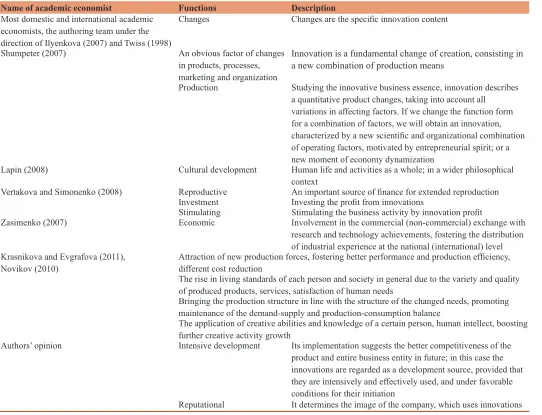
The essence of innovation as an economic category consists in its functions, showing its purpose within the state economy system and business activities (Table 1), although some academic economists denote them without specific identification.
Notably, in 1911 Schumpeter defined five common changes,
predetermining innovations, such as: Application of a new
technique, new process procedures or new market collateral for production (purchase − sale); launching products with new
properties; using new raw materials; changes in production
organization and its material and technical support; creation of
new sales markets. A considerable shortcoming of Schumpeter’s
definition is that innovation is limited to only one economic
activity, excluding the possibility to introduce new sorts of
raw materials, to change the qualitative and quantitative staff composition, and the necessity to achieve the efficiency is omitted.
The definitions (given in the national and international laws, by Buymov and Vaisman (2010); Vinokurov (2005); Ovodenko (2003); Utkin et al., (1996);Gokhberg, (2011); Souder, et al., (1990);note that innovation is implemented as a new service, product, and, therefore, the concepts of “innovative service” and
“product” are equated (Twiss, 1989; Utkin et al., 1996; Souder et al., 1990).
Along with this, the Oslo Manual suggests an expression “product innovations in service sector,” which covers the essential improvements of service rendering means (by effectiveness,
quickness), supplement of the available services with new
functions or properties, or introduction of brand-new services. In addition, the concept of “innovative product” contains changes in design and packaging used to increase the product appeal or
present it on a new market or market segment (Oslo Manual, 2010).
In compliance with the current Russian laws, the innovative goods,
works and services are collectively referred to as the new ones or
those subjected to various process modifications during the last
3 years, which is incorrect, in our opinion.
Borlakova (2014) believes that competitive advantages of an
innovative product at the innovation stage are conditioned by its
temporary novelty and unique nature.
Kleinknecht and Coombs make a clear distinction between
process innovations and product innovations, distinguishing: Unambiguous product innovations for ultimate consumption; new investment goods – production of consumer goods and services; new technological devices and new technological materials – production of investment and consumer goods; scientific instruments for laboratory tests and use for laboratory purposes; and unambiguous process innovations of production facilitation
(Coombs and Kleinknecht, 1983).
In our opinion, it is required to differentiate clearly the concepts
of “innovative service” and “innovative product.” An innovative product is a result of innovative activities carried out by the companies, expressed either in a tangible, informational form, or as work performed and services rendered, and intended to meet the consumer needs. Its basic distinguishing features include
a physical form of the fundamentally new (improved) finished
product, integrity, marketability, product conformity to the key development priorities of the country, region. An innovative service is a type of innovative activities, which does not result
in a new tangible innovative product, but changes the quality of the existing product to satisfy the specific consumer needs for the
purpose of its sale. Therefore, a service, being intangible, may often act as an elementary constituent of some innovative product, further turning into a product.
The reasonable product “saturation” with related services
facilitates the commercialization of respective innovations as far
as a product does not need any additional efforts, but works with a click of a button or a single turn of key. It is important to bear in
mind that creation of new products requires substantial investments due to research and development (R and D), and introduction of
process innovations.
The effective commercialization due to the larger innovation
potential and stable market position in a certain professional
sphere (available client base) allows developing and introducing
the related products in line with the new market expectations, opportunities, potential (including a virtual component,
i.e., services as well). Developing the related innovative products in the subsequent innovation cycles, i.e., brand-new products as they are associated with a virtual (service) base, represented
by independently developing services with regard to a growing number of developed products, we may see the cyclic innovation
reproducibility. So, initially and subsequently created and
developed innovative products represent an innovative product
line, reflecting the development level, consistency and stability of
an innovative (potential) by-product is defined as an increased
innovation potential, which raises the possibility to generate new ideas, methods of their transformation into novelties, inventions and advanced innovations up to a totally new level.
3. RESULTS
3.1. We have Established the Logic Interrelation of the Concepts
We have established the logic interrelation of the concepts of “idea,” “novelty,” “invention,” “innovation,” “innovative product,” “innovative service” and “innovative service line” (Figure 1).
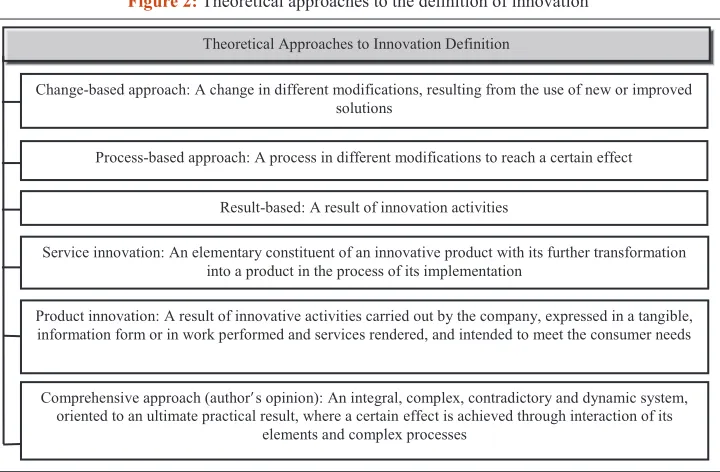
Summarizing the above, we should distinguish the following theoretical approaches to innovation definition depending on the
research object and subject (Figure 2).
3.2. We have formed a Comprehensive Definition of Innovation Concept
We have formed a comprehensive definition of innovation concept, describing it as a system, which includes all aspects
of innovative process, where an idea is first turned into reality,
constantly interacting with an internal or external environment of
the business entity, the specifics of the innovative process itself,
thus contributing to successful product/service launch. Its main
purpose is to ensure the effectiveness (economic, scientific and technical, industrial, social, environmental or other beneficial effect). Thus, we acknowledge that innovation evolves in time with
an explicit staging. Therefore, innovation is an integral, complex, contradictory and dynamic system, being ultimate practical result-oriented, where a certain effect is achieved through interaction of its elements and complex processes. In the context of theoretical
construction of the innovation definition, the interpretation above
lays a methodological basis for creation of innovation assessment system for each stage of implementation; it ensures the appropriate
concept flexibility and scientific rigor, relying on the multi-purpose
nature description.
3.3. We have Revealed the Content of Innovative Process as a Complex Process
We have revealed the content of innovative process as a
complex process, which forms and implements a new quality
Table 1: Functions of innovation as an economic category
Name of academic economist Functions Description
Most domestic and international academic economists, the authoring team under the direction of Ilyenkova (2007) and Twiss (1998)
Changes Changes are the specific innovation content
Shumpeter (2007) An obvious factor of changes
in products, processes, marketing and organization
Innovation is a fundamental change of creation, consisting in a new combination of production means
Production Studying the innovative business essence, innovation describes a quantitative product changes, taking into account all variations in affecting factors. If we change the function form for a combination of factors, we will obtain an innovation, characterized by a new scientific and organizational combination of operating factors, motivated by entrepreneurial spirit; or a new moment of economy dynamization
Lapin (2008) Cultural development Human life and activities as a whole; in a wider philosophical context
Vertakova and Simonenko (2008) Reproductive An important source of finance for extended reproduction Investment Investing the profit from innovations
Stimulating Stimulating the business activity by innovation profit
Zasimenko (2007) Economic Involvement in the commercial (non-commercial) exchange with
research and technology achievements, fostering the distribution of industrial experience at the national (international) level Krasnikova and Evgrafova (2011),
Novikov (2010) Attraction of new production forces, fostering better performance and production efficiency, different cost reduction The rise in living standards of each person and society in general due to the variety and quality of produced products, services, satisfaction of human needs
Bringing the production structure in line with the structure of the changed needs, promoting maintenance of the demand-supply and production-consumption balance
The application of creative abilities and knowledge of a certain person, human intellect, boosting further creative activity growth
Authors’ opinion Intensive development Its implementation suggests the better competitiveness of the product and entire business entity in future; in this case the innovations are regarded as a development source, provided that they are intensively and effectively used, and under favorable conditions for their initiation
of innovation system, represented as the subsequent stages of
innovation development and introduction, interrelation between
the components thereof, aimed at enhancing its efficiency.
Figure 3 shows the pattern of innovative process as a transformation
of idea, which is relevant (according to the marketing study) and feasible (according to the innovation potential assessment),
into an innovative service or product, admitted to the market
(commercialization and diffusion), underlying further innovations (innovative product line).
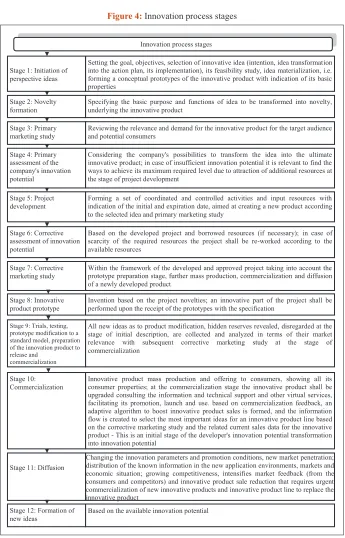
For innovative process staging, having a cyclic nature, but forming an integral, complex entity – (Figure 4).
Therefore, the results are as follows: We have developed and extended the theoretical interpretations of economic essence of
innovations, assuming the following: (1) Presentation of a set of
innovation functions, including intensive development and reputation
functions; (2) establishment of a logical interrelation between the
concepts of “idea,” “novelty,” “invention,” “innovative product,”
“innovative service,” and “innovative product line;” (3) introduction of a comprehensive definition of innovations; (4) insight into the
stagewise innovative process within the innovation system.
Ultimately, the innovation essence is specifically expressed in
a system, hence, for the purpose of innovation assessment, it is necessary to proceed from the following fundamental provision: Innovation is a system, constantly interacting with the internal
and external environment (Manuylenko, 2012), which is
created by the subjects of innovative activities. To ensure the
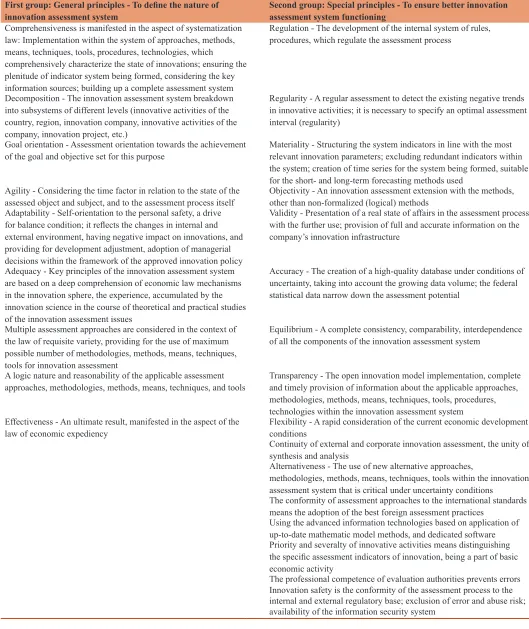
assessment efficiency, the innovation assessment methodology (scoring system) requires specifying the principles, i.e., initial
rules to build the assessment process correctly, in our opinion (Table 2).
4. CONCLUSION
This research may be further developed to form the methodological innovation assessment tools, which should be based on the comprehensive approach. The innovation assessment system
should be built though a sequence of interrelated elements, where
each element with a certain purpose is a link in chain of other elements. Building up the assessment system begins with the goal
setting, and is followed by identification of the indicators which
will ensure its achievement. The ultimate goal of the innovation assessment system is to raise the economic business effectiveness. The objectives of innovation assessment should be represented as the indicators being the reference points for innovation assessment
and innovative process optimization. The primary goal may be
divided into subgoals, attributable to certain assessment elements,
or products, markets, performance, quality or opportunities for study and modification to create and introduce new products,
process, methods of product promotion and launch and/or changes
in organizational practice or structure. The data on goals may be
a source of secondary information on the properties of different innovations. So the key innovation assessment criteria within the innovation assessment system are the innovative activities: Innovation culture, business, potential, environment, product, project, risks, etc.
Figure 1: The logical interrelation pattern for the concepts of
“idea,” “novelty,” “invention,” “innovation,” “innovative product,” “innovative service” and “innovative product line”
Figure 3: Summarized pattern of innovative process
Table 2: Methodological principles of innovation assessment (author’s opinion)
First group: General principles ‑ To define the nature of
innovation assessment system Second group: Special principles - To ensure better innovation assessment system functioning Comprehensiveness is manifested in the aspect of systematization
law: Implementation within the system of approaches, methods, means, techniques, tools, procedures, technologies, which comprehensively characterize the state of innovations; ensuring the plenitude of indicator system being formed, considering the key information sources; building up a complete assessment system
Regulation - The development of the internal system of rules, procedures, which regulate the assessment process
Decomposition - The innovation assessment system breakdown into subsystems of different levels (innovative activities of the country, region, innovation company, innovative activities of the company, innovation project, etc.)
Regularity - A regular assessment to detect the existing negative trends in innovative activities; it is necessary to specify an optimal assessment interval (regularity)
Goal orientation - Assessment orientation towards the achievement
of the goal and objective set for this purpose Materiality - Structuring the system indicators in line with the most relevant innovation parameters; excluding redundant indicators within the system; creation of time series for the system being formed, suitable for the short- and long-term forecasting methods used
Agility - Considering the time factor in relation to the state of the
assessed object and subject, and to the assessment process itself Objectivity - An innovation assessment extension with the methods, other than non-formalized (logical) methods Adaptability - Self-orientation to the personal safety, a drive
for balance condition; it reflects the changes in internal and external environment, having negative impact on innovations, and providing for development adjustment, adoption of managerial decisions within the framework of the approved innovation policy
Validity - Presentation of a real state of affairs in the assessment process with the further use; provision of full and accurate information on the company’s innovation infrastructure
Adequacy - Key principles of the innovation assessment system are based on a deep comprehension of economic law mechanisms in the innovation sphere, the experience, accumulated by the innovation science in the course of theoretical and practical studies of the innovation assessment issues
Accuracy - The creation of a high-quality database under conditions of uncertainty, taking into account the growing data volume; the federal statistical data narrow down the assessment potential
Multiple assessment approaches are considered in the context of the law of requisite variety, providing for the use of maximum possible number of methodologies, methods, means, techniques, tools for innovation assessment
Equilibrium - A complete consistency, comparability, interdependence of all the components of the innovation assessment system
A logic nature and reasonability of the applicable assessment
approaches, methodologies, methods, means, techniques, and tools Transparency - The open innovation model implementation, complete and timely provision of information about the applicable approaches, methodologies, methods, means, techniques, tools, procedures, technologies within the innovation assessment system
Effectiveness - An ultimate result, manifested in the aspect of the
law of economic expediency Flexibility - A rapid consideration of the current economic development conditions Continuity of external and corporate innovation assessment, the unity of synthesis and analysis
Alternativeness - The use of new alternative approaches,
methodologies, methods, means, techniques, tools within the innovation assessment system that is critical under uncertainty conditions
The conformity of assessment approaches to the international standards means the adoption of the best foreign assessment practices
Using the advanced information technologies based on application of up-to-date mathematic model methods, and dedicated software Priority and severalty of innovative activities means distinguishing the specific assessment indicators of innovation, being a part of basic economic activity
The professional competence of evaluation authorities prevents errors Innovation safety is the conformity of the assessment process to the internal and external regulatory base; exclusion of error and abuse risk; availability of the information security system
To conclude, the introduction of a comprehensive description of the innovation concept contributes to the development of methodological tools, based on a comprehensive innovation assessment approach, thus having a positive effect on the ultimate
REFERENCES
Anshin, V.M. (2005), A Company’s Innovational Strategy: Textbook. Moscow: Plekhanov Russian University of Economics.
Balabanov, I.T. (2001), Innovation Management: Textbook for High Schools. St. Peresburg: Piter.
Beshelev, S.D., Gurvich, F.G. (1990), Innovations and We. Moscow: Nauka.
Bezdudnyy, F.F., Smirnova, G.A., Nechaeva, O.D. (1998), Essence of the concept of innovation and its classification. Innovatsii, 2-3, 3-13. Borlakova, T.A. (2014), Innovative process at the micro-level. VI
International Students’ Electronic Scientific Conference “Students’ Scientific Forum”, Feb.15-Mar.31, 2014. Available from: http://www. scienceforum.ru/2014.
Buymov, A.S., Vaisman E.D. (2010), Applying self-management theory to assess and manage integrated risks of innovative project. Bulletin of USYU-UPI. Series Economics and Management, 3, 39-51. Coombs, R., Kleinknecht, A. (1983), New evidence on the shift toward
process innovation during the long wave upswing. In: Freeman, C., editor. Design, Innovation and Long Cycles in Economic Development. London: Design Research Publications. p7-24. Drucker, P.F. (2012), Management Challenges for the 21st Century.
Moscow: Mann, Ivanov i Ferber.
Gokhberg, L.M. (2011), Russian Innovation Index. Moscow: GU VSHE. Gvishiani, D.M. (1986), Dialectical-Materialist Foundation of Systems
Research. Moscow: Nauka.
Gvishiani, D.M. (2007), Selected Works on Philosophy, Sociology and System Analysis. Moscow: Kanon+ROOI “Reabilitatsiya” Publishing House
Ilyenkova, S.D. (2007), Innovation Management. Moscow: Yuniti-Dana. Kantarovich, L.V. (1986), A System Analysis and Certain Problems of
Technological Progress. Dialectics and System Analysis. Moscow: Nauka.
Karpenko, M.O. (2013), Modern approaches to the concept and classification of innoations. Bulletin of Bryansk State University, 3, 129-131.
Kondratyev, N.D. (2002), Large Cycles of Market Conditions and Forecasting Theory. Moscow: Ekonomika.
Korobeynikov, O.P., Trifilova, A.A., Korshunov, I.A. (2000), The role of innovations in the process of strategy formation of industrial enterprises. Management in Russia and Abroad, 3, 29-43.
Kotler, PH. (2008), Marketing Essentials. Moscow: Williams.
Krasnikova, E.O., Evgrafova, I.Y. (2011), Innovation Management. Crib Note. Moscow: Nauchnaya Kniga.
Lapin, V.N. (2008), Innovatics Theory and Practice. Moscow: Universitetskaya Kniga, Logos.
Manuylenko, V.V. (2012), Introduction of the regional investment potential assessment method. Finansy i Kredit, 17(497), 42-49. Medynskyy, V.G. (2008), Innovation Management. Moscow: Infra-M. Mensch, G. (1979), Stalemate in Technology: Innovations Overcome the
Depression. Cambridge, MA: Harvard University Press.
Mukhamedyarov, A.M., Divaeva, E.A. (2010), Innovation Management. Moscow: Infra-M.
Myers, S., Marquis, D.G. (1969), Successful Industrial Innovations: A Study of Factors Underlying Innovation in Selected Firms. Washington: National Science Foundation: NSF 69-17.
Novikov, V.S. (2010), Innovations in Tourism: Manual for Students of Higher Educational Establishments. 3rd ed. (Revised and Corrected). Moscow: “Akademia” Publishing Center.
Ogoleva, L.N., editor. (2004), Innovation Management: Textbook. Moscow: Infra-M.
Oslo Manual. (2010), Guidelines for Collecting and Interpreting Innovation Data. Moscow: Joint OECD and EUROSTAT Publication. Ovodenko, A.A. (2003), Effectiveness Analysis of Investments and
Innovations: Textbook. St. Petersburg: SPbSUAP Press.
Rumyantseva, Z.P. (2007), General corporate governance. Theory and Practice. Moscow: Infra-M.
Santo, B. (1990), Innovation as a means of economic development. Moscow: Progress.
Santo, B. (2004), The power of innovative self-development. Innovatsii, 2, 5-15.
Shumpeter, J.A. (2007), The Theory of Economic Development. Capitalism, Socialism and Democracy. Moscow: Eksmo.
Sokolov, D.V., Titov, A.B., Shabanova, M.M. (1997), Prerequisites of Analysis and Formation of Innovative Politics. St. Petersburg: SPbSUEF Press.
Souder, W.E., Nashar, A.S., Padmanabhan, V. (1990), A guide to the best technology-transfer practices. Journal of Technology Transfer, 15, 5-16.
Trifilova, А.А. (2005), Assessment of the Enterprise’s Innovative Development Efficiency. Moscow: Finansy i Statistika.
Tsvetkov, A.N. (2011), Modern Management: Synthesizing Ideas. Monograph. St. Petersburg: Suee.
Twiss, B.C. (1998), Managing Technological Innovation. Moscow: Ekonomika.
Utkin, E.A., Morozova, N.I., Morozova, G.I. (1996), Innovation Management. Moscow: Akalis.
Valenta, F. (1985), Management of Innovations. Moscow: Progress. Vertakova, Y.V., Simonenko, E.S. (2008), Innovation Management:
Theory and Practice. Moscow: Eksmo.
Vinokurov, V.I. (2005), Basic terms and definitions in the field of innovations. Innovations, 4, 6-22.
Vodachek, L., Vodachkova, O. (1989), Strategy of Innovation Management in the Enterprise: Abridged translation from Slovakian. Moscow: Ekonomika.
Yagudin, S.Y., Ilienkoa, S.D., Gokhberg, L.M., Kuznetsov, V.I. (2009), Innovation Management: Textbook, Study Guide, Practicum, Academic Curriculum. Moscow: MESI.