Volume 2, Issue 7, 2015, pp. 123-137 Available online at www.jallr.ir ISSN: 2376-760X
* Correspondence: Nazanin Naderi Kalali, Email: [email protected] © 2015 Journal of Applied Linguistics and Language Research
The Effect of Genre-Based Teaching on Iranian EFL Learners’
L2 Reading Comprehension
Nazanin Naderi Kalali *
M.A. in TEFL, Islamic Azad University, Bandar Abbas Branch, Bandar Abbas, Iran
Kian Pishkar
Faculty member of Islamic Azad University, Jieroft Branch and PhD Candidate of ELT, University of Isfahan, Iran
Abstract
This study was an attempt to determine whether a genre-based instruction improves the L2 reading comprehension of Iranian EFL learners. To this end, thirty homogenous Iranian BA Students studying English at Islamic Azad University, Bandar Abbas Branch were selected as the participants of the study using a version of TOEFL test. The selected participants were 15 females and 15 males who were randomly divided into two groups (an experimental group and a control group). Nevertheless, the experimental group and the control group took a reading-comprehension pretest followed by sixteen hours instruction, the experimental group using a genre-based pedagogy and the control group through the traditional methodology conventional in teaching reading comprehension. The two groups took the same test that they had taken as the pre-test, albeit this time as the posttest. In analyzing the data, the researchers utilized t-test for comparing the two groups. The results of the study showed that there was a statistically significant difference between the L2 reading comprehension of the participants who went under a genre-based instruction and who did not. Furthermore, the study investigated the role of gender which led to non-significant differences between the performances of the two genders.
Keywords: genre analysis, reading comprehension, gender
INTRODUCTION
Literacy skill which is composed of the ability to read and write has attracted the attention of many researchers. Literacy skill has been considered by many researchers and refers to the ability of extracting and encoding information in the written texts. Effectively, literacy skill includes two macro skills of reading and writing. There is no doubt regarding the fundamentality of reading and writing ability in furthering studies and especially for the university students.
of which is genre. The following illustrates the definition and meaning of reading skill which is the focus of the present study.
Reading skill as one of the sub-skills of literacy, according to Urquhart and Weir (1998), refers to “the process of receiving and interpreting information encoded in language form via the medium of print” (cited in Grabe, 2009, p.14). Likewise, Koda (2005) argues that “Comprehension occurs when the reader extracts and integrates various information from the text and combines it with what is already known” (cited in Grabe, 2009, p.14). Snow and Sweet (2003), in a similar vein, views reading skill as “the process of simultaneously extracting and constructing meaning” (p.1).
Considering the fact that genre is one of the issues which influence the process of reading comprehension; it seems crucial to clarify the notion of genre. The concept of genre refers to "a class of communicative events, the members of which share some set of communicative purposes. These purposes are recognized by the expert members of the parent discourse community, and thereby constitute the rationale for the genre" (Swales, 1990. P. 58). Genre, in effect, demonstrates "the regularities of staged, goal oriented social processes" (Martin, 1993) in which "the type fictional of social and rhetorical action" (Miller, 1984) are recognized.
Swales (1990) as one of the main figures in the domain of genre analysis views genre as “a class of communicative events" (p. 58), “in which language plays both a significant and an indispensable role" (45). The notion of communicative event refers to the discourse and the context in which the discourse is happening, i.e. cultural and situational context (Swales, 1990). The aforementioned issues underscore the fact that one of the indispensable elements of genre analysis is the notion of communicative event.
Christie (1987) states that “production of any text is realized through the context of situation and the context of culture. Context of situation refers to register and context of culture influences all aspects of genre”.
Considering the aforementioned matters the researcher endeavored to design an innovative methodology resorting to the tenets of genre analysis in order to improve the reading comprehension of Iranian EFL learners. Notwithstanding, the study tried to answer the two following questions:
Are there any differences between the reading comprehension of Iranian EFL learners who go under a genre-based instruction and who do not?
Are there any differences between the performances of males and females?
REVIEW OF THE LITERATURE
Genre Analysis and Literacy Skills
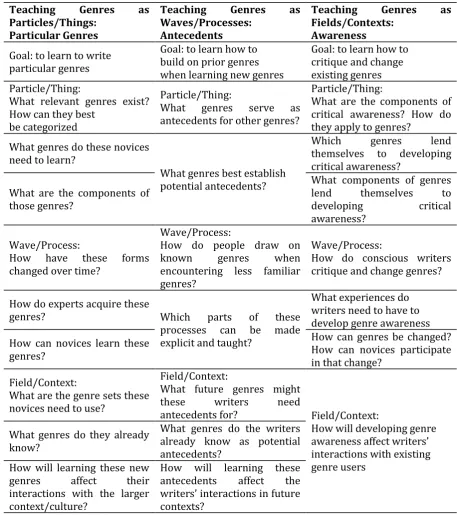
enthusiasm that reaches beyond recognition that writing can serve more modest roles in learning through articulating understanding and rehearsing material to fix it in memory” (p. 280). They particularly sketch out “three pedagogies and how each treats genre as a particle/thing, wave/process, and field/context” (Bazerman, Bonini, & Figueiredo, 2009, p. 344) as table 1 shows:
Table 1: Three Pedagogies in Teaching Genres (Bazerman, Bonini, &Figueiredo, 2009, pp. 345-6)
Teaching Genres as Particles/Things:
Particular Genres
Teaching Genres as Waves/Processes:
Antecedents
Teaching Genres as Fields/Contexts:
Awareness
Goal: to learn to write particular genres
Goal: to learn how to build on prior genres when learning new genres
Goal: to learn how to critique and change existing genres Particle/Thing:
What relevant genres exist? How can they best
be categorized
Particle/Thing:
What genres serve as
antecedents for other genres?
Particle/Thing:
What are the components of critical awareness? How do they apply to genres?
What genres do these novices need to learn?
What genres best establish potential antecedents?
Which genres lend
themselves to developing critical awareness?
What are the components of those genres?
What components of genres
lend themselves to
developing critical
awareness?
Wave/Process:
How have these forms changed over time?
Wave/Process:
How do people draw on
known genres when
encountering less familiar genres?
Wave/Process:
How do conscious writers critique and change genres?
How do experts acquire these
genres? Which parts of these
processes can be made explicit and taught?
What experiences do writers need to have to develop genre awareness How can novices learn these
genres?
How can genres be changed? How can novices participate in that change?
Field/Context:
What are the genre sets these novices need to use?
Field/Context:
What future genres might
these writers need
antecedents for? Field/Context:
How will developing genre awareness affect writers’ interactions with existing genre users
What genres do they already know?
What genres do the writers already know as potential antecedents?
How will learning these new
genres affect their
interactions with the larger context/culture?
How will learning these
antecedents affect the
writers’ interactions in future contexts?
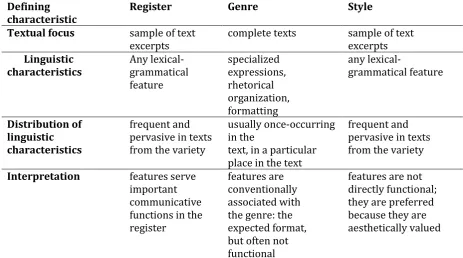
Table 2: Defining characteristics of registers, genres, and styles (Biber&Conrad, 2009, p. 16)
Defining
characteristic Register Genre Style
Textual focus sample of text excerpts
complete texts sample of text
excerpts
Linguistic
characteristics Any lexical-grammatical feature specialized expressions, rhetorical organization, formatting any lexical-grammatical feature Distribution of linguistic characteristics frequent and pervasive in texts from the variety
usually once-occurring in the
text, in a particular place in the text
frequent and pervasive in texts from the variety
Interpretation features serve important communicative functions in the register
features are conventionally associated with the genre: the expected format, but often not functional
features are not directly functional; they are preferred because they are aesthetically valued
Table 2 illustrates the similarities and differences among the three notions. In fact, register, genre and style, according to Biber and Conrad (2009) demonstrate “three different perspectives on text varieties” (p. 2).
The register perspective, in effect, deal with analyzing linguistic features shared in a text variety in terms of “situation of use of the variety” (Biber & Conrad, 2009, p. 2). It is worth mentioning that register considers “linguistic features like pronouns and verbs (to be) functional, and, as a result, particular features are commonly used in association with the communicative purposes and situational context of texts” (Biber & Conrad, 2009, p. 2).
Genre perspective, in a similar vein with register, deals with “description of the purposes and situational context of a text variety” (Biber & Conrad, 2009, p. 2), however through analyzing “the conventional structures used to construct a complete text within the variety” (Biber & Conrad, 2009, p. 2).
Finally, style which is similar to register perspective in terms of linguistic focus, analyzes “the use of core linguistic features that are distributed throughout text samples from a variety” (Biber & Conrad, 2009, p. 2). In fact, style characteristics do not reflect functional perspective but “aesthetic preferences, associated with particular authors or historical periods” (Biber & Conrad, 2009, p. 2).
disciplines, but with homogeneous groups it may be much more efficient to focus on the specific features of the actual genres that students actually have to read or write” (Dudley-Evans, 2000, p. 10).
Hyland and Diani (2009) are two researchers who argue that marketization—a concept which was introduced by Fairclough (1995)—“has given rise to hybrid genres displaying features typically associated with advertising discourse” (p. 200). In collaborating their argument they resort to Bhatia’s (2004) argument and discuss that “academic discourse, genre mixing and embedding has become quite common in the last decades, and that promotional strategies are increasingly employed in genres traditionally considered non-promotional in their communicative intention but informative or merely persuasive” (Hyland & Diani, 2009, p. 200).
Bruce (2008) classifies the works done in the field of genre analysis which has mainly influenced social genre into two approaches of the systemic functional school of linguistics and English for Specific Purposes (ESP). Genre-related works which were specially influenced by systemic functional school of linguistics, as cited in Bruce (2008), are Eggins (1994), Hasan (1985/1989), Martin (1986, 1992, 1997, 2000), and Ventola (1985). On the other hand, the works influenced by ESP, according to Bruce (2008) are Dudley-Evans (1986, 1989, 1994), Swales (1981, 1990, 1998, 2004), Bhatia (1993, 1998, 2004), and Johns (1997, 2001).
Bruce (2008) points out that “the construct of genre identified by linguists working in the context of the systemic functional approach began to be applied to the teaching of writing in schools from the 1980s in Australia” (p. 13). Systemic functional approach to genre analysis, according to Bruce (2008), considers the texts in terms of schematic structure and linguistic features. Schematic structure, according to Bruce (2008), refers to “the staged, step-by step organization of the genre” and the linguistic or lexical-grammatical features to “syntax, lexis, types of cohesion and reference” (Bruce, 2008, p. 13).
Reading Skill: Theoretical Background
Grabe (2009) considers reading skill as “the process of receiving and interpreting information encoded in language form via the medium of print” (p.14). Grabe (2009) argues that reading comprehension is dependent on the extraction and integration of the background knowledge of the readers and the information embedded in the text. Hence, reading comprehension is a complicated process which demands considering a vast variety of issues like background knowledge, linguistic knowledge, world knowledge, and even reading strategies. Snow and Sweet (2003) explicate that reading comprehension is vacillating between extracting and constructing meaning.
Many researchers, during the last decades tried to plan diverse theoretical models for clarifying the reading process which are involved in reading comprehension (Goodman, 1967). In designing diverse reading models, a vast variety of disciplines like Cognitive psychology, psycholinguistics, or linguistics were influential.
Hence, diverse models may be classified into two meta-models of bottom-up and top-down. Bottom-up models refer to the linear process of extracting meaning through letters, their combination as words, sentences (Suna & Zhang, 2004). The bottom-up model of processing reading comprehension was rooted in Gough’s (1972) works (cited in Treiman, 2001). Hence, bottom-up models to reading comprehension is started with the printed text, its letters, words, phrases, sentences, etc. hence, bottom-up models, according to Treiman (2001), follow a liner process through which letters are associated with strings of phonemic information.
Treiman (2001) argues that “bottom-up processes are those that take in stimuli from the outside world -- letters and words, for reading -- and deal with that information with little recourse to higher-level knowledge” (p. 2). He clarifies that “theories that stress bottom-up processing focus on how readers extract information from the printed page, claiming that readers deal with letters and words in a relatively complete and systematic fashion (p. 3). Hence, in bottom-up models, the main thrust of the language learners in the process of reading comprehension is to focus on letters to construct sounds, sounds to construct words, and words to construct sentences which finally result into comprehension and meaning extraction.
Top-down models, according to Treiman (2001), individual’s prior knowledge and expectations play a crucial role. Effectively, Top-down models to reading comprehension emphasize that “readers form hypotheses about which words they will encounter and take in only just enough visual information to test their hypotheses” (Treiman, 2001, p. 3).
Hence, top-down models to reading comprehension demands that the language learners participate in the guessing game and recognizing the main ideas, the main purpose of the text whereas ignoring individual words, verb conjugations, or isolated grammar points (Grabe, 2009). Hence, the top-down approach to reading comprehension underpins the role schemata in reading comprehension.
Genre Studies on Reading Skill
In this part some cases of implementing genre analysis in teaching reading comprehension are numerated.
between students’ knowledge of genres and their reading comprehension. Rozimela (2014) argues that “background knowledge about the content of the texts and field-related vocabulary” (p. 460) are crucial in the process of reading comprehension.
Sadeghi, Hassani and Hemmati (2013) investigated the effects of genre-based instruction on ESP learners’ reading comprehension. To this end, 116 junior and senior B.S students at Islamic Azad University of Kurdistan, majoring in biology were the participants of the study who were randomly assigned into 2 groups of control and experimental. The experimental group received instruction based on the principles of genre analysis and the control group were instructed through the traditional method of teaching ESP, prevailing in Iranian universities. The both groups took 30-items proficiency test of English and 30-items standard tests of English reading comprehension. The results of the reading comprehension test were analyzed by SPSS software through t-test statistic which resulted into the supremacy of the experimental group comparing the performance of the control group.
Minaabad and Khoshkholgh (2012) studied the influence of genre-based instruction on English for specific purpose leaners’ reading comprehension as well as the interaction between their reading comprehension achievement and their general English proficiency. To this end, 150 BA students attending English for specific purpose classes in the field of computer engineering were selected as the subjects of the study using a version of the Michigan test. The subjects were divided into two groups of high and low and each groups were divided into two groups of experimental and control. All groups went through a six-session instructional course followed by a post-test. A factorial design procedure was performed which indicated that a two-way ANOVA was appropriate for the analysis of the results. It is worth mentioning that the researcher utilized ANOVA since the number of groups be compared were more than two (there were two experimental groups and two control groups). The results of the study showed that genre-based instruction has a significant effect on English for specific purpose learners’ reading comprehension. This study also showed that there was an interaction between English for specific purpose learners’ reading comprehension achievement and their general English proficiency.
Toledo (2005), in his study on genre analysis and reading comprehension, underpins that “the notion of genre or rhetoric schemata” (p. 1059) needs to be included in the process of reading comprehension. His study showed that “the comprehension of textual macrostructure does not necessarily imply comprehension along essential dimensions such as the text’s communicative or pragmatic function” (Toledo, 2005, p. 1059).
Alidib (2004) investigated the effects of text genre on French language reading comprehension at two levels of college French instruction. The college students enrolled in the second quarter of elementary French (French 102.01) and the second quarter of intermediate French (French 104.01) of the college French program at The Ohio State University comprised the subjects of the study. The selected subjects “read the same two passages from twentieth century French literature and wrote an L1 free-recall protocol upon relinquishing each passage” (Alidib, 2004, p. ii). The results were analyzed using ANOVA statistic in terms of three variables of Text genre (Play, Novel), Level of language instruction (French 102, French 104), and Teacher assigned rating of student academic performance (Excellent, Good, Poor). Hence, significant effect for text genre and level of class performance non-significant main effect for the level of instruction were revealed.
METHODOLOGY
Participants
Thirty Iranian EFL students who were studying English as a foreign language were the participants of the study. In fact they were 15 females and 15 males with the range age between 20 and 24.
Instruments
A proficiency test (version 2015 of TOEFL test), as well as a reading comprehension test (as the pretest and posttest) were the instrumentations of this study. The proficiency test has composed of twenty multiple choice items (8 items which testing language form and meaning and 12 items on reading comprehension), and the reading comprehension test has composed of twenty multiple choice items. The time allotted was 30 minutes for each test.
The reading comprehension test was extracted and adopted from http://www.education.vic.gov.au/ which is the department of education and training for Australia which has been providing support, services and education resources for teaching and assessment of English language.
Last but not the least, five reading comprehension passages were taught. The reading comprehension passages were selected from http://www.readworks.org/ which is a non-profit educational site and provides teachers the research-proven tools and support they need as well as lessons, and authentic, leveled non-fiction and literary passages.
Procedures
The following sheds light on the steps in teaching reading to the experimental group: 1. Introducing the topic (activating the background knowledge of the learners and
their schemata)
2. Writing the ambiguous and difficult vocabularies and structures on the board and make them clear for the learners.
3. The learners were asked to skim through the text in order to get a general understanding of the text.
4. The expository genre was explicated for the learners in terms of description, sequence, comparison, cause and effect, problem and solution which the text might include in order that the learners were consciously raised to consider in the process of their reading comprehension.
5. Some questions were exposed to the learners which they had to scan the text in order to answer.
6. Finally, the learners checked their answer and asked their ambiguities from the teacher.
It should be mentioned that the teaching procedure to the control group (the non-genre based approach to reading) was similar to the genre-based approach to reading except the step 4. It is worth mentioning that this study just dealt with the expository genres in teaching literacy skills. The following sheds light on the instructed materials in the course:
Table 3: Instructed Materials
Instructed Reading Passage
Leader of the United Nations Classical Music
Space Junk Stop Bullying
RESULTS
Thirty EFL learners - 15 learners in the experimental group and 15 ones in the control group - took the pre-reading test. Table 4 illustrates the descriptive statistics of each group in detail:
Table 4: Pre-reading Test: Experimental vs. Control
groups N Mean Std. Deviation Std. Error Mean
Pre-reading test =exp. =ctrl 15 15 13.4667 13.2000 2.77403 2.51282 .71625 .64881
According to table 4, the experimental group had the mean score of 13.46 and the standard deviation of 2.77; while, the mean score and standard deviation of the control group were 13.20 and 2.51, respectively. In order to prove that the observed differences between the mean score and standard deviation of the two groups were non-significant t-test statistic was run as table 5 shows its result.
Table 5: T-test & Pre-reading Test: Experimental vs. Control
Levene's Test for Equality of
Variances
t-test for Equality of Means
F Sig. t df
Sig. (2-tailed
Mean
Difference Difference Std. Error
95% Confidence Interval of the
Difference
Lower Upper
.305 .585 .276 28 .785 .26667 .96642 -1.712 2.24629
.276 27.731 .785 .26667 .96642 -1.713 2.24716
Likewise, t-test was utilized since there were only two groups to be compared. Considering the results of t-test presented in table 5, it became indicative that the observed differences between the mean score and standard deviation of the experimental and control groups who went under reading instruction are non-significant since the value is 0.785 which is quite above the cut-score of 0.05. (The p-value is a function of the results of the samples which is used in testing a hypothesis. Before the test a threshold value is selected which is called the significance level of the test, traditionally 5%).
Moreover, the two genders who went under reading instruction were compared in their performances on the reading pre-test. Table 6 shows the descriptive statistics of the two genders on pre-reading test.
Table 6: Pre-reading Test: Females vs. Males
gender N Mean Std. Deviation Std. Error Mean
Pre-reading =female =male 15 15 13.2667 13.4000 2.76371 2.52982 .71359 .65320
were 0.71 and 0.65, respectively. In a similar vein, t-test statistic was utilized for comparing the performance of the two genders on pre-reading test which delivered table 7.
Table 7: T-test & Pre-reading Test: Females vs. Males
Levene's Test for Equality of
Variances
t-test for Equality of Means
F Sig. t df Sig. (2-tailed) Difference Mean Difference Std. Error
95% Confidence Interval of the
Difference
Lower Upper
.001 .970 .138 - 28 .891 -.13333 .96741 -2.11497 1.84831
-.138
27.7
84 .891 -.13333 .96741 -2.11567 1.84900
Table 7 indicated that there is non-significant difference between the performances of the two genders since the p-value is 0.891 which is quite above the cut score of 0.05. After a sixteen-hour instruction, the two groups took the same reading test they had taken before instruction as the post-reading test. The descriptive statistics of the performances of the two groups reading-based experimental and control are brought in table 8.
Table 8: Post-reading Test: Experimental vs. Control
group N Mean Std. Deviation Std. Error Mean
Post-reading =exp. 15 17.2000 1.37321 .35456
=ctrl 15 15.6667 1.34519 .34733
As the table shows, the mean score of the experimental group was 17.20 and the mean score of the control group was 15.66. Moreover, the standard deviation of the experimental group was 1.37 and the standard deviation of the control group was 1.34. T-test statistic which is appropriate for comparing two groups were utilized which resulted into following table (Table 9).
Table 9: T-test & post-reading Test: Experimental vs. Control
Levene's Test for Equality of
Variances t-test for Equality of Means
F Sig. t df Sig. (2-tailed) Difference Mean Difference Std. Error
95% Confidence Interval of the
Difference
Lower Upper
.062 .804 3.089 28 .004 1.53333 .49634 .51664 2.55003
3.089 27.988 .004 1.53333 .49634 .51662 2.55005
reading ability of the participants has changed before and after instruction as table 10 shows:
Table 10: T-test & reading Test: pre-reading vs. post-reading
Paired Differences
t df Sig. (2-tailed)
Mean Deviation Std. Std. Error Mean
95% Confidence Interval of the Difference
Lower Upper
13.38333 2.37281 .30633 12.77037 13.99630 43.689 59 .000
The table shows that there are significant differences between the mean scores of the reading test before and after instruction. This issue is indicative that the reading instruction was beneficial for the both groups in terms of their reading comprehension ability. In the next step, the genders were compared in terms of their performances on the posttest. The descriptive statistics of the performances of the both genders were represented in table 11.
Table 11: Post-reading Test: Females vs. Males
gender N Mean Std. Deviation Std. Error Mean
Post-reading =female 15 16.7333 1.53375 .39601
=male 15 16.1333 1.55226 .40079
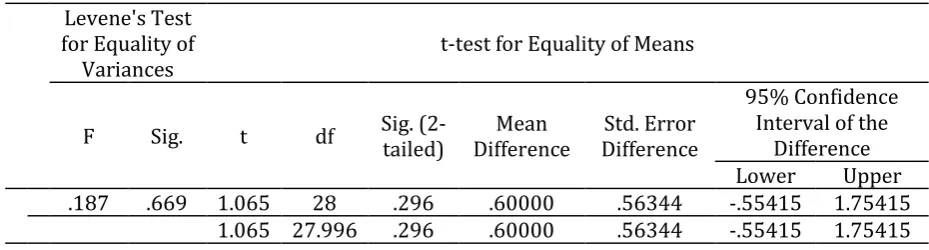
According to table 11, the mean score of the females was 16.73 and their standard deviation was about 1.53. The males showed the mean score of 16.13 and the standard deviation of 1.55. In a similar vein, t-test was run to determine whether gender played a role in the process of reading comprehension which showed statistically non-significant role as table 12 shows:
Table 12: T-test & post-reading Test: females vs. males
Levene's Test for Equality of
Variances
t-test for Equality of Means
F Sig. t df Sig. (2-tailed) Difference Mean Difference Std. Error
95% Confidence Interval of the
Difference
Lower Upper
.187 .669 1.065 28 .296 .60000 .56344 -.55415 1.75415
1.065 27.996 .296 .60000 .56344 -.55415 1.75415
DISCUSSION AND CONCLUSION
to implement genre analysis in order to explicate the linguistic features as well as the way through which a particular genre is molded. Put it in a simpler way, the participants who went under an adopted genre-based teaching model got familiarized with different markers indicative of cause and effect, thought and feelings, fact and opinion which they were instructed to distinguish and this issue improved their reading skill.
Notwithstanding, teaching reading skill demands combining the principles of genre analysis with the traditional teaching reading comprehension and especially with an interactive framework in order to clarify the concept of genre and its role on the process of reading comprehension.
Effectively, the learners in the experimental group outperformed comparing their counterparts due to their familiarity and consideration of the discourse community, topic, setting, and function of the texts they were exposed to.
The fundamental role of genre analysis on the process of reading comprehension, is also discussed by many researchers, for example, Toledo (2005) emphasizes that the concept of genre or rhetoric schemata needs to be implemented in teaching reading comprehension. Toledo (2005) argues that “the comprehension of textual macrostructure does not necessarily imply comprehension along essential dimensions such as the text’s communicative or pragmatic function” (Toledo, 2005, p. 1059). Due to this issue, genre analysis which is mainly illustrating the pragmatic dimension of texts need to be highly considered.
It is worth stating that the background knowledge which is highlighting the notion of schemata through the content domain which is in association with genre influences the rate and extent of reading comprehension. This issue is interpreted by Govier (2013) as inductive arguments which demand exploration from known issues—i.e. familiar and experienced linguistic markers related to a genre into new situation in order to figure out what she/he is exposing to (Govier, 2013). Hence, providing explicit insights about language including the features related to the notion of genre seems to be beneficial for reading comprehension of Iranian EFL learners. Empowering advantage refers to the access which a genre based writing instruction provides “to the patterns and possibilities of variation in valued texts” (Hyland, 2004, p. 11).
The second question of the study tried to investigate the role of gender on the reading comprehension of the participants. To this end, the researcher designed the question as whether there are any differences between the performances of males and females in the two groups who go under reading instruction which the results of the study indicated to non-significant differences.
Hence, genre analysis, according to Bawarshi and Reiff (2010), is “located between textually oriented and socio-cultural methods, enables a pluralistic methodology, integrating multiple methods and data sources in the study of genre” (p. 109).
specific content to be embodied in this genre. In the course of the composing this ‘dimly felt sense’ of the genre is both given form and reshaped as a) this ‘sense,’ b) the composing processes, and c) the unfolding text interrelate and modify one another. Then, on the basis of external feedback (the grade assigned), the learners either confirm or modify their map of the genre” (cited in Bawarshi & Reiff, 2010, p. 111).
Bawarshi & Reiff (2010) refer to the felt sense as the “academic discourse that is modified based on inferences writers made from writing assignments, feedback on assignments, class discussions, lectures, and readings” (p. 111). Bawarshi and Reiff (2010, P. 111) add that “learners learned the genres, then, through active performance, and intuitively acquired new genres, making explicit methods unnecessary”.
Bawarshi and Reiff (2010, P. 111) emphasize that “through studies of classroom genres and learners’ generic productions, we can explore the complex interaction of psychological, social, and institutional factors within the classroom setting and can draw on learners’ prior genre knowledge to inform strategies for teaching learners to enter new realms of discourse”.
Bawarshi and Reiff (2010) point out that genre analysis is recommended to be implemented in teaching language since “learners may be more likely to transfer genre knowledge from one situation to another if they have an understanding of the flexible, dynamic nature of genres” (p. 124).
REFERENCES
Alidib, Z. A. (2004). The Effects of Text Genre on Foreign Language Reading
Comprehension of College Elementary and Intermediate Readers of French.
Unpublished Ph. D. Thesis. Ohio State University, Ohio, US.
Bawarshi, A. S., & Reiff, M. J. (2010). Genre: An introduction to history, theory, research, and pedagogy. West Lafayette, IN: Parlor Press. Bazerman, C., Bonini, A., & Figueiredo, D. (2009). Genre in a changing world. New York:
WAC Clearinghouse.
Biber, D., & Conrad, S. (2009). Register, genre, and style. Cambridge University Press. Bruce, I. (2008). Academic writing and genre: A systematic analysis. London: Continuu Christie, F. (1987). Genre as choice. In I. Reid (Ed.), the place of genre in learning: Current
debates. Geelong: Centre for Studies in Literacy Education, Deakin University. Dudley-Evans, T. (2000). Genre analysis: a key to a theory of ESP?. Ibérica: Revista de la
Asociación Europea de Lenguas para Fines Específicos, (2), 3-11.
Goodman, K. (1967). Reading: A psycholinguistic guessing game. Journal of the Reading Specialist, 6, 126-135.
Govier, T. (2013). A practical study of argument. NY: Cengage Learning.
Grabe, W. (2009). Reading in a second language: Moving from theory to practice. New York: Cambridge University Press.
Martin, J. R., (1993): A Contextual Theory of Language. In The Powers of Literacy: A Genre approach to teaching writing, 116-136.
Miller, C. R. (1984). Genre as Social Action. Quarterly Journal of Speech. 70(2), 151-167. Minaabad, M. S. and Khoshkholgh, F. F. (2012).Investigating the Effect of Genre-Based
Pedagogy on English for Specific Purpose Learners’ Reading Comprehension.
World Applied Sciences Journal,18 (2), 251-260
Rozimela, Y. (2014). The Students' Genre Awareness and their reading comprehension of different text types. International Journal of Asian Social Science, 4(4), 460-469. Sadeghi, B. Hassani, M. T. Hemmati, M. R. (2013). The Effects of Genre-based Instruction
on ESP Learners’ Reading Comprehension. Theory and Practice in Language Studies, 3 (6), 1009-1020.
Shishehsaz, A. R. (2006). The Effect of Explicit Genre Teaching on EST students' Reading comprehension. Unpublished MA. Thesis. Islamic Azad University ,Science and Technology, Tehran, Iran.
Snow, C. E., & Sweet, A. P. (2003). Reading for comprehension. In A. P. Sweet &. C. E. Snow (Eds), Rethinking reading comprehension (pp. 1-11). New York: Guilford Press.
Suna, R., & Zhang, X. (2004). Top-down versus bottom-up learning in cognitive skill acquisition. Cognitive Systems Research, 5(1), 63-89.
Swales, J. M. (1990).Genre analysis. Cambridge: Cambridge University Press.
Toledo, P. F. (2005). Genre analysis and reading of English as a foreign language: Genre schemata beyond text typologies. Journal of Pragmatics, 37, 1059–1079.