VOLUME 37, ARTICLE 19, PAGES 599
,
634
PUBLISHED 1 SEPTEMBER 2017
http://www.demographic-research.org/Volumes/Vol37/19/ DOI: 10.4054/DemRes.2017.37.19
Research Article
Childbearing patterns among immigrant women
and their daughters in Spain:
Over-adaptation or structural constraints?
Amparo González-Ferrer
Teresa Castro-Martín
Elisabeth Katharina Kraus
Tatiana Eremenko
This publication is part of the Special Collection on “Childbearing among the Descendants of Immigrants in Europe,” organized by Guest Editors Hill Kulu and Tina Hannemann.
©2017 González-Ferrer, Castro-Martín, Kraus & Eremenko.
This open-access work is published under the terms of the Creative Commons Attribution 3.0 Germany (CC BY 3.0 DE), which permits use, reproduction & distribution in any medium for non-commercial purposes, provided the original author(s) and source are given credit.
1 Introduction 600
2 The Spanish context 601
2.1 Fertility in Spain 601
2.2 Immigration and fertility in Spain 602
3 Theoretical framework and research questions 604
4 Data, methods, and sample description 608
4.1 Data and methods 608
4.2 Sample description 611
5 Results 614
5.1 Descriptive results 614
5.2 Multivariate results 618
5.2.1 Transition to first birth 618
5.2.2 Transition to second birth 620
5.2.3 Transition to third birth 622
6 Conclusions and discussion 624
7 Acknowledgements 627
References 628
Childbearing patterns among immigrant women and their
daughters in Spain: Over-adaptation or structural constraints?
Amparo González-Ferrer1
Teresa Castro-Martín2
Elisabeth Katharina Kraus3
Tatiana Eremenko4
Abstract
BACKGROUND
Spain, a country with one of the lowest fertility levels in the world, has recently received intense immigration flows that may contribute to fertility recovery.
OBJECTIVE
The objective of this study is to examine whether the childbearing behaviour of immigrant women and their descendants shows a pattern of convergence with that of Spanish women born in or after 1950.
METHODS
After merging data from the Fertility and Values Survey (2006) and the National Immigrants Survey (2007), we analyse the transition to first, second, and third birth using event history models, to identify variations in timing and incidence of birth transitions between native Spanish women and immigrant groups.
RESULTS
First-generation migrant women have an earlier transition to motherhood than Spaniards. By contrast, their overall rates of transition to second birth – with the exception of women born in the Maghreb – are lower than those of Spaniards, while their rates of transition to third birth are again higher. When the analysis is restricted to immigrant women who arrived childless in Spain, all of them delay the transition to first birth even later than Spaniards, with the exception of those born in other EU countries. Among descendants of immigrants, a trend to convergence with natives
1 Spanish National Research Council, Madrid, Spain. E-Mail:[email protected].
2 Spanish National Research Council, Madrid, Spain.
3 University Pompeu Fabra, Barcelona, Spain.
emerges among women of Latin American origin, while those from the Maghreb remain more likely to experience a transition to a second and third birth.
CONTRIBUTION
Previous literature has found that migration disrupts immigrants’ fertility only temporarily; however, in the case of Spain, most migrant women who moved before starting family formation do not seem to fully compensate for migration-related disruption of fertility at a later stage. Our findings challenge the widespread belief that immigrants’ childbearing alone will allow Spain to leave behind the current lowest-low and latest-late fertility scenario.
1. Introduction
For much of the 20th century, Spain had one of the highest fertility levels in Europe and was a laggard country regarding fertility decline, but in the early 1990s it became a forerunner in lowest-low fertility, exhibiting period fertility rates below 1.3 (Kohler, Billari, and Ortega 2002). Like many other European countries, during the first decade of the 21st century Spain experienced both a large immigration boom and an upturn in fertility (Goldstein, Sobotka, and Jasilioniene 2009). Although this recent fertility upturn was brief and transitory and came to a halt with the economic recession and subsequent austerity policies, the acknowledged role played by immigration in fostering fertility recovery has directed increasing attention, both in academic and political circles, to the linkages between migration and fertility. In this context, policymakers pondered the possibility that immigrants, with their youthful age pyramid and higher fertility levels in countries of origin, could help lessen the consequences of Spain’s subfertile and aging population.
We also conduct a separate analysis of women who migrated childless, in an attempt to disentangle selection, socialization, and adaptation processes. Finally, we compare first-and 1.5-generation migrants in order to assess the extent to which they converge with native Spanish women’s childbearing patterns.5
The paper is organized as follows. We first present a background section, describing the Spanish fertility and immigration context. We then discuss some theoretical considerations regarding immigrant fertility and present our research questions. Section 4 describes the data and methods used, and we present our results in section 5. Thereafter follows a discussion of the main findings of our study.
2. The Spanish context
2.1 Fertility in Spain
For much of the 20th century, Spain had one of the highest fertility levels in Europe. However, from the mid-1970s Spain experienced an extraordinarily steep fertility drop. From nearly 3 children per woman in the early 1970s, the total fertility rate (TFR) dropped below replacement in 1981, then below the lowest-low threshold of 1.3 in 1993, finally reaching an historical low of 1.15 in 1998. At the turn of the century there was a moderate recovery in fertility levels as a result of decelerating birth postponement and increased immigration, with the TFR reaching 1.44 in 2008. This moderate fertility rebound came to an end with the onset of the economic crisis, the sharp rise in unemployment – which peaked at 26.9% in early 2013 – and the drastic reduction of migration inflows. Since 2012 Spain has been recording net emigration for the first time since the 1970s. Meanwhile, since 2011 the total fertility rate has remained at around 1.3 children per woman, indicating a return to a lowest-low fertility scenario, even though the mean desired number of children remains stable at around two (Sobotka and Beaujouan 2014).
The long-term decline in fertility is closely linked to a progressive postponement of childbearing. Increasingly, both women and men want to be established in the labour market before becoming parents. In the period 1980–2015 the mean age at first birth increased from 25 to 31.3 for women and from 30.1 to 34.1 for men. Spain currently has one of the latest ages at first birth in the world (OECD 2016). However, in contrast to other European countries, lowest-low period fertility levels in Spain have not
5 The 1.5 generation refers to individuals who were born abroad and who migrated (with one or both parents)
typically been associated with high levels of definitive childlessness. For instance, the level of definitive childlessness among Spanish women born in 1965 (13%) is well below that observed for comparable cohorts in other European countries (Miettinen et al. 2015). Rather than forgone motherhood, it is the low rates of progression to second births that has traditionally explained Spain’s very low fertility levels (Castro-Martín and Martín-García 2013). Nevertheless, for the youngest cohorts, definitive childlessness has increased substantially: One out of four women born in 1970 has recently completed her reproductive years without bearing children.
After more than three decades of fertility levels below 1.5 children per woman, there is a certain resignation that (very) low fertility is here to stay, particularly if the failure to address youth unemployment, job precariousness, and work-family balance persists (Esping-Andersen 2013). In this context, future immigration flows – partly contingent on economic evolution – and migrants’ fertility are likely to play a crucial role in shaping Spain’s demographic future.
2.2 Immigration and fertility in Spain
After being a country of emigration throughout most of the 20th century, between 2000 and the onset of the recent economic crisis in 2008, Spain became one of the main receiving countries in Europe. With a net annual inflow of more than 600,000 foreigners, the share of the foreign-born population increased steeply from 2.3% in 2000 to 13.5% in 2009, although afterwards it declined slightly, to 12.7% in 2015, due to return migration linked to the severe unemployment crisis.6 The composition of the foreign-born population has changed significantly in the past two decades. While formerly migration inflows were largely from Western Europe and high-fertility countries (mostly Morocco), since the mid-1990s there have been large migration inflows from medium-fertility countries in Latin America and, more recently, from low-fertility countries in Eastern Europe.
In parallel with the immigration surge in the first decade of the 20th century, the annual number of births in Spain rose dramatically, after decades of uninterrupted decline: from 365,193 in 1998 to 519,779 in 2008. The crude birth rate of foreign women in this period was roughly twice that of Spaniards, although this was mainly due
6 Unlike population registers in other countries, the Spanish municipal register – known asPadrón – provides
to the younger age profile of the immigrants. There was also a significant rise in total fertility, from 1.15 children per woman in 1998 to 1.46 in 2008, which allowed Spain to surpass the lowest-low fertility threshold. Immigrants’ children born in Spain, known as the second generation, comprise a growing fraction of the Spanish child population. In 2015, approximately one out of four newborns in Spain (22%) had at least one foreign-born parent. This share has increased rapidly, from 4.5% in 1996.
However, several studies have shown that the aggregate impact of migrants on overall fertility levels, though not trivial, is rather modest (Roig and Castro-Martín 2007). This pattern of immigrants’ high contribution to the total number of births but small impact on the period total fertility is observed in most European countries (Sobotka 2008). Castro-Martín and Rosero-Bixby (2011) estimate that immigrants’ contribution to Spain’s TFR in 2004–2006 was just 6.6%, or 0.08 children. This surprisingly small contribution results from the relatively low immigrant share in the childbearing population and a sustained decline in foreign women’s fertility rates over time.
Period total fertility rates of foreign women residing in Spain fell from 2.05 children in 2002 to 1.66 in 2015, which is above the fertility level of native women (1.28) yet nonetheless quite low.7 Despite the common perception among Spaniards that immigrants have high fertility, this is seldom the case. Migrants’ self-selection in terms of education, material resources, and social mobility aspirations, the predominance of work-related migration, and the scarcity of family-work conciliation policies in the host society likely explain the relatively low fertility of the migrant population. Moreover, the downward trend in immigrant fertility can be partly attributed to the ongoing change in the composition of the foreign population – a high proportion of recent immigrants come from low-fertility countries in Eastern Europe – and to the pervasive fertility decline in immigrant-sending countries over recent decades. Additionally, as observed in other countries (Andersson 2004), the longer immigrants stay, the more their fertility converges with that of the native population (Roig and Castro-Martín 2007).
Although the actual contribution of immigrants’ fertility to overall fertility in Spain has been relatively modest, it is important to note that immigrant women’s younger childbearing calendar – in 2015 their mean age at first birth was 27.6 compared to 31.2 among Spanish women – has contributed significantly to slowing down the persistent rise in the mean age at motherhood, and hence decelerated the aggregate process of fertility postponement.
7 These figures are provided by the Spanish Statistical Institute, which estimates fertility rates for the whole
Since the onset of the economic crisis there has been a notable decline in immigration flows and in the union formation and fertility of both Spaniards and immigrants (Castro-Martín et al. 2015). Emigration has substantially increased, while immigrants who arrived during the boom are gradually aging, which suggests a parallel decrease in their fertility rates. In addition, it is not clear whether immigrants’ descendants will maintain their parents’ patterns of family-building. Despite the intensity of recent immigration flows and the relatively rapid process of family reunification in Spain (González-Ferrer 2011), most descendants of immigrants have not reached marriageable age, so it is difficult to anticipate their childbearing behaviour. In the 2011 Population Census there are approximately 2 million descendants of immigrants, of which only 800,000 correspond to the second generation, while the rest came to Spain during their childhood. Only 700,000 of all the descendants were older than 15 in 2011, with just 144,678 from the second generation and 545,000 from the 1.5 generation (González-Ferrer et al. 2015). Thus, any analysis of the fertility patterns of immigrants’ descendants will inform us only about the behaviour of the older members who represent less than half of the total, and for this reason the results obtained should be approached with caution.
3. Theoretical framework and research questions
The main focus of research on migrant fertility has been assessing the influence of past and current social environments and disentangling the role of socioeconomic and cultural factors in shaping migrants’ childbearing patterns (Kulu and González-Ferrer 2014). Various major hypotheses have been proposed in the literature to depict the relationship between migration and fertility: socialization, adaptation, selection, disruption, and interrelation of events (Andersson 2004; Kulu 2005; Lindstrom and Giorguli Saucedo 2007; Milewski 2007; Roig and Castro-Martin 2007). Numerous studies attest that the relative importance of these explanatory hypotheses varies substantially across immigrant groups, as well as across socioeconomic, institutional, and policy settings (Kulu and González-Ferrer 2014).
The underlying assumption of the socialization hypothesis is that an individual's childbearing behaviour is largely shaped by the cultural values and norms internalized during childhood (Milewski 2007). According to this hypothesis, first-generation migrants preserve the dominant fertility patterns of their country of origin, and only migrants who arrive at a very young age and members of the second generation converge with the patterns of the majority population.
social, and cultural environment at destination. According to this view, the longer a migrant resides in the host society, the more her or his fertility patterns resemble those of the native population. This convergence does not necessarily imply a process of acculturation but can result from adjustment strategies intended to cope with the social, economic, and labour-market circumstances in the new country. Moving to a country with better job prospects for women and higher living costs increases the costs of children and childrearing for migrants from less-developed areas (Frank and Heuveline 2005).
The selection hypothesis posits that migrants are a selected group in terms of educational attainment, marital status, socioeconomic resources, and social mobility aspirations for themselves and their children (Feliciano 2005; Adserà et al. 2012). Because of these characteristics, the childbearing patterns of migrants are expected to be closer to those of natives in the host society than to those of nonmigrants remaining in the country of origin.
The disruption and interrelation of events hypotheses focus on the short-term impact of migration on family formation events. According to the disruption hypothesis, in the time immediately before and after migration, immigrants have low fertility levels as a result of the separation of spouses or due to economic stress. The interrelation of events hypothesis argues that high fertility shortly after migration is closely linked to family reunification or couple formation (Toulemon 2004).
Previous studies on migrant fertility in Spain have shown that these hypotheses are complementary rather than mutually exclusive (Roig and Castro-Martín 2007). The fertility of Latin American migrant women residing in Spain is considerably lower than that prevailing in the countries of origin. The observed differential could be partly attributed to selective migration, since the proportion of women with secondary or higher education is considerably larger among Ecuadorian, Colombian, and Peruvian women residing in Spain than among women in their home countries (Castro-Martín and Rosero-Bixby 2011; Kraus and Castro-Martín 2017). Among the largest migrant groups, only women coming from Morocco maintain a substantially higher fertility level than Spaniards, which is closely related to their distinct migration and partnership patterns. A significant proportion of first generation Moroccan women came to Spain as marriage migrants, that is, after marrying a Moroccan migrant who has been living in Spain for a relatively long time.8 This type of marriage-at-a-distance has been found to be associated with more traditional family behaviours in other groups (Turkish immigrants) and countries (Germany, Denmark, Netherlands), as shown by Lievens (1999) and González-Ferrer (2007, 2011), among others.
8 In 2007, 27% of Moroccan women who migrated to Spain as adults (16 or older) were marriage migrants
However, the extent to which these fertility patterns of first-generation immigrant women will persist among their daughters in Spain is still unknown. For instance, women who came to Spain as children will not face the concurrent partnership formation, migration, and fertility that many Moroccan first-generation women experienced. Similarly, disruption arguments and selectivity issues are less relevant for migrants’ descendants because they did not make the decision to migrate themselves, though the indirect influence of parental selective migration may still influence their behaviour.
Given the very young ages of descendants of recent immigrants in Spain, their childbearing patterns have not yet been analysed. The second generation is born and raised in the host country, but within an immigrant family, which plays an important role in the intergenerational transmission of cultural values (Milewski 2011). Members of the 1.5 generation occupy a “socio-cultural middle ground” (Holland and de Valk 2013) between their countries of origin and destination, and we can presume that their family formation norms and behaviour are shaped by both societal contexts. Previous studies in different contexts, such as Germany (Milewski 2007, 2010), Sweden (Scott and Stanfors 2011), the Netherlands (Garssen and Nicholaas 2008), and the United Kingdom (Dubuc 2012), have documented a convergence tendency in the fertility behaviour of immigrant children toward that of natives. However, the pace of convergence may differ according to origin, age at arrival, language fluency, and country of destination, among other factors. Descendants of Turkish migrants, for instance, have been found to converge at a slower rate than other groups. Some authors have explained this pattern by emphasizing the strength of family values in Turkish culture (Milewski 2010). Important variation in the fertility patterns of descendants of Turkish migrants according to the different destination countries has also been found, suggesting the influence of average fertility levels at destination (Milewski 2011), labour market conditions (Scott and Stanfors 2011), and different patterns of selection in their parents’ migration (Adserà et al. 2012).
Accordingly, we expect a more rapid convergence to host-society fertility levels among the descendants of the former than the descendants of the latter.
Fluency in the language of the destination country has long been recognized as a key factor in immigrants’ outcomes and their level of adaptation (Chiswick and Miller 2001). With regard to fertility, a nonofficial mother tongue may impact the ability of the child migrant to access local cultural cues through school and peers when forming her childbearing preferences. In the Spanish case, descendants of Moroccan origin are less likely to be fluent in the language of the host country upon arrival than their Latin American counterparts, who are virtually all native Spanish speakers.
In addition to selection patterns and differential social distances across groups of origin, in a study on immigrants who arrived in Canada before adulthood, Adserà and Ferrer (2013) found that the fertility rate of individuals migrating up to age 6 was either somewhat lower or indistinguishable from that of natives in their host country. This was not the case for those who migrated in their late teens (who maintained differential fertility rates from that of the host country). A similar association between migrants’ age at arrival and fertility has been documented in England and France (Adserà et al. 2012). Overall, when researchers allow estimates of fertility to vary by age at immigration, they find patterns broadly consistent with the adaptation hypothesis. With few exceptions, women who migrated at the youngest ages have fertility rates that are most similar to native-born women (Adserà and Ferrer 2014).
Drawing on previous research and different theoretical perspectives relevant to the relationships between migration and fertility, we address three central questions concerning the childbearing behaviour of migrant women and the 1.5 generation in Spain: How do first-, second-, and third-birth transition patterns of migrant women of various origin groups, the 1.5 generation, and Spanish natives differ? Are the observed differences in parity transitions between migrants and Spaniards explained by differences in the socioeconomic profile of the groups? To what extent do socialization in the countries of origin, the types of selection patterns in (parental) migration, and adaptation to the economic, social, and cultural environment at destination explain the degree of convergence of migrants’ childbearing patterns with those of Spaniards?
generation, we expect to find signs of adaptation to the host-country fertility patterns, albeit uneven across groups of origin.
Migrants have distinct demographic, socioeconomic, and cultural backgrounds from the Spanish-born population, which can impact childbearing decisions. Accordingly, the composition of migrant groups could be responsible for observed fertility differentials. With regard to the sociodemographic characteristics of migrant women, we expect more-educated and younger migrants to have fertility patterns that are closer to those of natives than to those of less-educated migrants and women from older cohorts. Migrants and their descendants from Europe and most Latin American countries are known to have higher educational levels than their Moroccan counterparts (Aparicio 2007; Aparicio and Portes 2014). For that reason, we expect differentials in birth transitions between natives and Moroccan migrants to be largely attributable to their disparate educational composition.
Family values and family size preferences are, to a large degree, transmitted from the parental generation. Hence, we expect that migrants who have one Spanish-born parent will have fertility patterns that resemble those of their native peers, given the selection already involved in mixed marriages formed by immigrants and native partners.
4. Data, methods, and sample description
4.1 Data and methods
women. We obtained a total sample size of 11,677 women aged 15 and older, of which 5,393 are natives and 6,284 immigrants.
Instead of looking at fertility rates, as some previous studies have done, in this article we analyse the transition to first, second, and third births. This approach makes it possible to better understand differences not only in the total number of children but also in the fertility timing patterns of women of different origin (Kulu et al. 2017). This is particularly relevant when we are analysing the fertility behaviour of young cohorts that still have not completed their reproductive cycles.
Moreover, for the first time we analyse the fertility patterns of descendants of immigrants in Spain compared to their native counterparts. The ENI-2007 allows us to examine transitions to the first, second, and third birth of the 1.5 generation of European, Maghrebian, and Latin American origin, and compare them with their mothers’ generation, apart from their Spanish native counterparts. Respondents are categorized as the 1.5 generation if they migrated before age 16. As evident in Table 1, the sample sizes for the 1.5-generation groups are relatively small. Therefore, all the results concerning this group must be taken with caution, not only because of limited sample sizes but also because our data will over-represent 1.5-generation women who had their children at younger ages, which implies that the results obtained for them might change as the rest of the 1.5-generation women become of childbearing age.
Table 1: Person-years. Number of women and number of events by migrant status and parity
First child Second child Third child
Person-years N Events Person-years N Events Person-years N Events
Total 141,278 11,677 7,375 52,024 7,375 4,579 44,370 4,579 1,437
Native 64,283 5,393 3,167 22,158 3,167 2,136 24,395 2,153 563
Immigrants: 1G 69,643 5,635 3,991 28,442 3,991 2,324 18,885 2,307 841
Immigrants: 1.5G 7,352 649 217 1,424 217 119 1,090 119 33
First child Second child Third child
Person-years N Events Person-years N Events Person-years N Events
1G with at least 1 child before migration
22,241 2,636 2,636 21,177 2,636 1,770 15,195 1,756 714
1G with no child before migration
47,402 2,999 1,355 7,265 1,355 554 3,690 551 127
1.5G with no child before migration
7,352 649 217 1,424 217 119 1,090 119 33
In a first descriptive step we use Kaplan–Meier survival curves to depict the successive birth transitions of various origin groups of migrants and their descendants compared to native women. In the multivariate analyses we run discrete-time event history models with a logit link function. For the transition to first birth the process time is the woman’s age, for the transition to second birth the process time is duration (in years) since first birth, and for the transition to third birth the process time is duration since second birth. The data is organized in person-year format, with each person potentially contributing one entry per year. Cases are censored in the year a woman gives birth or at time of interview when a respondent has not yet had a first, second, or third birth.
Apart from geographical region of origin and migrant generation (first or 1.5 generation), we control for a number of factors that have been shown to be relevant to the incidence and timing of birth transitions. We define four cohorts: born in 1950– 1959, 1960–1969, 1970–1979, and 1980–1989. Assuming that the women’s education was completed in early adulthood, we create three categories for education: primary or less, some or completed secondary education, and some or completed tertiary education. In order to take into account the intergenerational transmission of family size norms, we control for the number of siblings in the family of origin. We also take into account whether one parent was born in Spain, in order to control for the potential effect of being the child of a mixed couple, which might distort the socialization effects often associated with the woman’s country of birth. In the analysis of the transition to second birth we control for age at first birth. Likewise, we control for age at second birth in the analysis of the transition to third birth. In models not shown here but available upon request, we also include information on whether the woman had ever worked before having the first child; the results remained largely unchanged.9
A large majority of prior studies that evaluate the processes of convergence or adaptation of migrants’ fertility to the dominant childbearing patterns in the host society focus on post-migration fertility. However, a large proportion of immigrant women have children before moving to Spain,10 since early childbearing is commonplace in non-European societies of origin, and immigration flows to Spain are relatively recent, so the first generation comprises a large part of the total adult female immigrant
9 Only the FFVS includes exact information on the year when a woman worked for the first time in her life.
By contrast, ENI-2007 only provides information on whether women were working in the country of origin right before migrating to Spain and, if not, on whether they had ever worked before that, but not on the exact date of the first job. As a result the variable ‘ever worked before first birth’ included too many missing values for those in the immigrant sample that had their first child before migrating, and we decided to exclude it from the final models.
10 Approximately 47% of immigrant women born in 1950 or later and who migrated at age 16 or older had at
population in the country. Therefore, a fertility analysis restricted only to births after arrival in the destination country would offer only a partial and biased picture of the reproductive behaviour of the immigrant population (Devolder and Bueno 2011) and of their potential contribution to population growth in the destination country. In this study we construct separate models for all immigrants, considering all birth transitions regardless of whether they took place during the pre-migration or post-migration period, and also for those immigrants who were childless at the time of migration. In the first model we intend to evaluate (dis)similarities in the entire reproductive biographies of immigrant and native women. In the second model we intend to assess the influence of the Spanish socioeconomic context on the timing and incidence of migrants’ birth transitions and to indirectly test the selective nature of international female migration to Spain. Besides reflecting distinct self-selection mechanisms, women with children and without children at the time of migration are likely to differ by age at migration, union status, motive for migration, and readiness to work, and therefore we expect them to follow different parity transition patterns.
4.2 Sample description
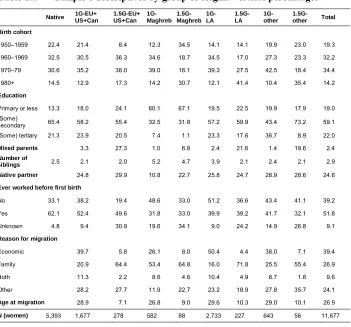
had more than 5 siblings on average, followed by Latin-Americans with almost 4, and native, European, and other immigrant women with between 2 and 2.5.
Table 2a: Sample’s descriptives by group of origin. Vertical percentages
Native 1G-EU+ US+Can
1.5G-EU+ US+Can
1G-Maghreb
1.5G-Maghreb
1G-LA
1.5G-LA
1G-other
1.5G-other Total
Birth cohort
1950–1959 22.4 21.4 8.4 12.3 34.5 14.1 14.1 19.9 23.0 19.3
1960–1969 32.5 30.5 36.3 34.6 18.7 34.5 17.0 27.3 23.3 32.2
1970–79 30.6 35.2 38.0 39.0 16.1 39.3 27.5 42.5 18.4 34.4
1980+ 14.5 12.9 17.3 14.2 30.7 12.1 41.4 10.4 35.4 14.2
Education
Primary or less 13.3 18.0 24.1 60.1 67.1 19.5 22.5 19.9 17.9 19.0
(Some)
secondary 65.4 58.2 55.4 32.5 31.8 57.2 59.9 43.4 73.2 59.1
(Some) tertiary 21.3 23.9 20.5 7.4 1.1 23.3 17.6 36.7 8.9 22.0
Mixed parents 3.3 27.3 1.0 6.8 2.4 21.6 1.4 19.6 2.4
Number of
siblings 2.5 2.1 2.0 5.2 4.7 3.9 2.1 2.4 2.1 2.9
Native partner 24.8 29.9 10.8 22.7 25.8 24.7 28.9 28.6 24.6
Ever worked before first birth
No 33.1 38.2 19.4 48.6 33.0 51.2 36.6 43.4 41.1 39.2
Yes 62.1 52.4 49.6 31.8 33.0 39.9 39.2 41.7 32.1 51.8
Unknown 4.8 9.4 30.9 19.6 34.1 9.0 24.2 14.9 26.8 9.1
Reason for migration
Economic 39.7 5.8 26.1 8.0 50.4 4.4 38.0 7.1 39.4
Family 20.9 64.4 53.4 64.8 16.0 71.8 25.5 55.4 26.9
Both 11.3 2.2 8.6 4.6 10.4 4.9 8.7 1.8 9.6
Other 28.2 27.7 11.9 22.7 23.2 18.9 27.8 35.7 24.1
Age at migration 28.9 7.1 26.8 9.0 29.6 10.3 29.0 10.1 26.9
N (women) 5,393 1,677 278 582 88 2,733 227 643 56 11,677
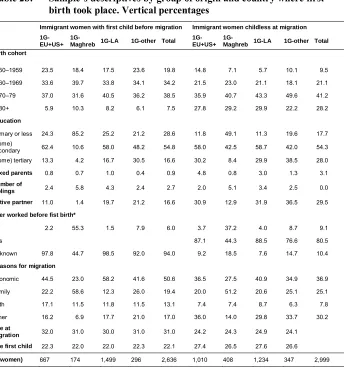
Table 2b: Sample’s descriptives by group of origin and country where first birth took place. Vertical percentages
Immigrant women with first child before migration Immigrant women childless at migration
1G-EU+US+
1G-Maghreb 1G-LA 1G-other Total 1G-EU+US+
1G-Maghreb 1G-LA 1G-other Total Birth cohort
1950–1959 23.5 18.4 17.5 23.6 19.8 14.8 7.1 5.7 10.1 9.5
1960–1969 33.6 39.7 33.8 34.1 34.2 21.5 23.0 21.1 18.1 21.1
1970–79 37.0 31.6 40.5 36.2 38.5 35.9 40.7 43.3 49.6 41.2
1980+ 5.9 10.3 8.2 6.1 7.5 27.8 29.2 29.9 22.2 28.2
Education
Primary or less 24.3 85.2 25.2 21.2 28.6 11.8 49.1 11.3 19.6 17.7
(Some)
secondary 62.4 10.6 58.0 48.2 54.8 58.0 42.5 58.7 42.0 54.3
(Some) tertiary 13.3 4.2 16.7 30.5 16.6 30.2 8.4 29.9 38.5 28.0
Mixed parents 0.8 0.7 1.0 0.4 0.9 4.8 0.8 3.0 1.3 3.1
Number of
siblings 2.4 5.8 4.3 2.4 2.7 2.0 5.1 3.4 2.5 0.0
Native partner 11.0 1.4 19.7 21.2 16.6 30.9 12.9 31.9 36.5 29.5
Ever worked before fist birth*
No 2.2 55.3 1.5 7.9 6.0 3.7 37.2 4.0 8.7 9.1
Yes 87.1 44.3 88.5 76.6 80.5
Unknown 97.8 44.7 98.5 92.0 94.0 9.2 18.5 7.6 14.7 10.4
Reasons for migration
Economic 44.5 23.0 58.2 41.6 50.6 36.5 27.5 40.9 34.9 36.9
Family 22.2 58.6 12.3 26.0 19.4 20.0 51.2 20.6 25.1 25.1
Both 17.1 11.5 11.8 11.5 13.1 7.4 7.4 8.7 6.3 7.8
Other 16.2 6.9 17.7 21.0 17.0 36.0 14.0 29.8 33.7 30.2
Age at
migration 32.0 31.0 30.0 31.0 31.0 24.2 24.3 24.9 24.1
Age first child 22.3 22.0 22.0 22.3 22.1 27.4 26.5 27.6 26.6
N (women) 667 174 1,499 296 2,636 1,010 408 1,234 347 2,999
Note: * See footnote 5
Source: Fertility, Family and Values Survey (FFVS-2006). National Immigrant Survey (ENI-2007).
profiles. The same pattern appears at a lower level among Latin-American women (25% versus 12% with only primary) and European women (24% versus 12% with only primary). Economic and academic reasons for migration were also more common among migrant women who were childless at migration, and therefore these migrant women were also much more likely to have worked before having their first child. In any case, it is important to note that many of the aforementioned differences may simply be reflecting the younger profile of immigrants who migrated to Spain before having any children (24-years-old versus 31); the younger profile also helps to explain the much higher percentage of mixed partnerships among the childless migrants. For instance, 13% of Moroccan women who migrated childless have a Spanish partner, while this is only the case for 1% of Moroccan women who migrated after becoming mothers.
Among the 1.5 generation there are considerably fewer differences across origins in migration motivation and incidence of mixed partnership. In fact, the proportion of mixed marriages among the 1.5 generation is as high as 23% among women from the Maghreb, and 25% among those of Latin-American origin. Nonetheless, descendants of North African immigrants still come from substantially larger families and have much lower levels of education attainment than both natives and their immigrant counterparts.
5. Results
5.1 Descriptive results
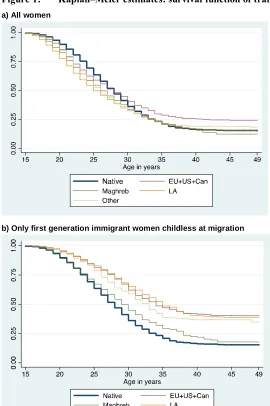
countries of origin (Ecuador, Colombia, Bolivia, and Peru).11 Likewise, the median age at first birth for Moroccan women residing in Spain was 26.7 in 2007,12 whereas it was 23.9 in their country of origin.13 Nonetheless, differences between first-generation migrant women and native women in the transition to motherhood mainly concern timing rather than level.
Figure 1b restricts the analysis to first generation immigrant women who arrived childless in Spain. We can observe that first-generation migrant women who did not start the process of family formation in their country of origin have a later transition to first birth than Spanish women. This is the case for all origin groups, including women from the Maghreb, and remains consistent with the much more selective profile of Moroccan immigrant women who arrive in Spain childless, as was previously described (they are considerably more highly educated and more frequently motivated to migrate due to economic reasons than those who had already began the process of family formation at arrival). Both their selected educational profile and their work aspirations are potential explanations for their late pattern of transition to motherhood. Accordingly, multivariate models will be estimated for all immigrant women and for immigrant women who migrated to Spain before starting their reproductive life.
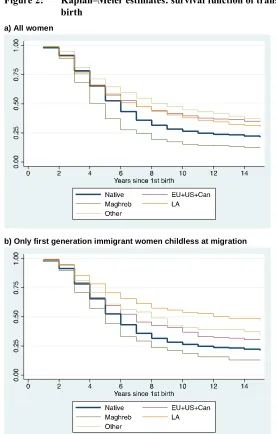
When we look at the progression to second birth (Figure 2a), women of immigrant origin seem slightly less likely to experience this transition over their lifetimes than native Spaniards, with the exception of women from the Maghreb, who display both higher and earlier rates of transition to second birth than Spanish women. When we restrict the comparison to first generation immigrant women that arrived childless (Figure 2b) the general picture remains unchanged, but Latin American women who came to Spain before entering into motherhood become clearly the least likely to transition to a second birth.
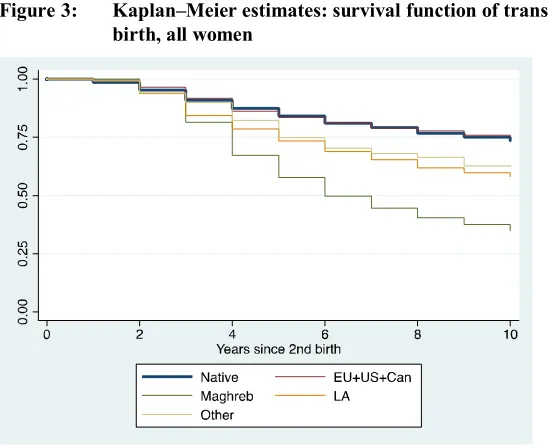
Finally, Figure 3 depicts the transition to third birth. We can observe that all immigrants except those of European background are considerably more likely to have a third child than Spaniards. This is particularly so in the case of first-generation Moroccan women – nearly 70% of those with two children make the transition to a third child in the ten years after the second child – and, to a lesser extent, of first-generation Latin American women. In this case the limited sample size does not allow distinguishing women who came childless to Spain.
11 According to recent Demographic and Health Surveys (DHS) and Reproductive Health Surveys (RHS),
women’s median age at first birth was 21.2 in Ecuador (RHS 2004), 21.6 in Colombia (DHS 2010), 21.1 in Bolivia (DHS 2008), and 21.9 in Peru (DHS 2007).
12 Authors’ calculations based on birth register data.
Figure 1: Kaplan–Meier estimates: survival function of transition to first birth
a) All women
b) Only first generation immigrant women childless at migration
Figure 2: Kaplan–Meier estimates: survival function of transition to second birth
a) All women
b) Only first generation immigrant women childless at migration
Figure 3: Kaplan–Meier estimates: survival function of transition to third birth, all women
Source: Fertility, Family and Values Survey (FFVS-2006). National Immigrant Survey (ENI-2007).
5.2 Multivariate results
5.2.1 Transition to first birth
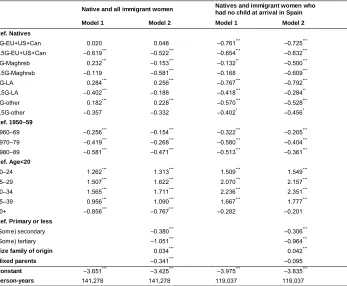
the father of the woman is Spanish-born) as covariates.14 The first panel presents the models pertaining to all immigrant women, regardless of whether they had their first child before or after migration, and the second panel presents the models restricted to immigrant women who arrived childless in Spain.
Table 3: Transition to first birth. Logit discrete-time models
Native and all immigrant women Natives and immigrant women who had no child at arrival in Spain
Model 1 Model 2 Model 1 Model 2
Ref. Natives
1G-EU+US+Can 0.020 0.048 –0.761*** –0.725***
1.5G-EU+US+Can –0.619*** –0.522*** –0.654*** –0.632***
1G-Maghreb 0.232*** –0.153*** –0.132** –0.500***
1.5G-Maghreb –0.119 –0.581*** –0.168 –0.609***
1G-LA 0.284*** 0.256*** –0.767*** –0.792***
1.5G-LA –0.402*** –0.188 –0.418*** –0.284**
1G-other 0.182*** 0.228*** –0.570*** –0.528***
1.5G-other –0.357 –0.332 –0.402* –0.456*
Ref. 1950–59
1960–69 –0.256*** –0.154*** –0.322*** –0.205***
1970–79 –0.419*** –0.268*** –0.580*** –0.404***
1980–89 –0.581*** –0.471*** –0.513*** –0.361***
Ref. Age<20
20–24 1.262*** 1.313*** 1.509*** 1.549***
25–29 1.507*** 1.622*** 2.070*** 2.157***
30–34 1.565*** 1.711*** 2.236*** 2.351***
35–39 0.956*** 1.090*** 1.667*** 1.777***
40+ –0.856*** –0.767*** –0.282 –0.201
Ref. Primary or less
(Some) secondary –0.380*** –0.306***
(Some) tertiary –1.051*** –0.964***
Size family of origin 0.034*** 0.042***
Mixed parents –0.341*** –0.095
Constant –3.651*** –3.425*** –3.975*** –3.835***
Person-years 141,278 141,278 119,037 119,037
Note: * p < 0.10. ** p < 0.05. *** p < 0.01
Source: Fertility, Family and Values Survey (FFVS-2006). National Immigrant Survey (ENI-2007).
14 Unfortunately, ENI-2007 did not collect complete partnership histories or the date of entry into
As expected, Model 1 in the left panel closely replicates the results of the former non-parametric analysis (Figure 1a). All first-generation migrant women, except those coming from developed societies (Europe, United States, Canada), display higher rates of transition to first birth than Spanish-born women. Differences in first birth risks between first-generation migrants and natives should be interpreted as timing rather than level differentials, since previous survival analysis showed that childlessness is relatively uncommon among all of the groups, migrant or otherwise. When it comes to the 1.5 generation the patterns observed are mixed: Daughters of Latin American women who arrived in Spain before age 16 have lower rates of transition to motherhood than native women, whereas the 1.5 generation of Moroccan and other origins have rates similar to that of native Spanish women. Once we control for sociodemographic characteristics, differentials tend to narrow, and the coefficients for the first and 1.5 generations of Moroccan origin turn negative and statistically significant, suggesting that the low educational level and large size of the family of origin that characterize these groups are partly responsible for the observed patterns.
When we limit the analysis to migrant women who were childless when they arrived in Spain (right panel), we observe in Model 1 that all immigrant groups have lower transition rates to first birth than native women, except for the daughters of Moroccan women, for whom differentials with natives are not statistically significant. Nonetheless, once socioeconomic covariates are introduced in the models, the negative coefficient for the 1.5 generation of Moroccan origin becomes statistically significant. The coefficients for the rest of the migrant groups remain relatively unaffected by the controls, possibly because their composition in terms of educational attainment and number of siblings is less disparate than that of Moroccan immigrants when compared to the native population.
In brief, the results suggest that there is a pattern of convergence towards native women’s fertility patterns across immigrant generations, but they also reveal a pattern that we had not anticipated: Women who migrated childless have lower odds of transition to motherhood than their Spanish counterparts once we control for educational level and family-of-origin size.
5.2.2 Transition to second birth
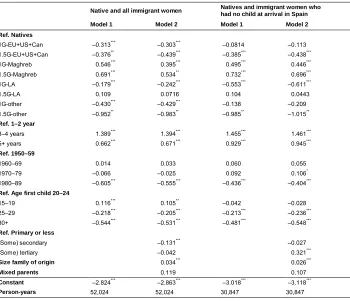
likely to have a second child than native women. Their higher rate of transition to second child remains statistically significant when the sociodemographic covariates are incorporated in the model. By contrast, the rest of the migrant groups display a lower rate of transition to second child. The coefficients are statistically significant for each migrant group, with the exception of the 1.5 generation of Latin America origin. The inclusion of sociodemographic covariates in the model does not substantially alter the results.
Table 4: Transition to second birth. Logit discrete-time models
Native and all immigrant women Natives and immigrant women who had no child at arrival in Spain
Model 1 Model 2 Model 1 Model 2
Ref. Natives
1G-EU+US+Can –0.313*** –0.303*** –0.0814 –0.113
1.5G-EU+US+Can –0.376** –0.439*** –0.385*** –0.438***
1G-Maghreb 0.546*** 0.395*** 0.495*** 0.446***
1.5G-Maghreb 0.691*** 0.534** 0.732*** 0.696***
1G-LA –0.179*** –0.242*** –0.553*** –0.611***
1.5G-LA 0.109 0.0716 0.104 0.0443
1G-other –0.430*** –0.429*** –0.138 –0.209
1.5G-other –0.952** –0.983** –0.985** –1.015**
Ref. 1–2 year
3–4 years 1.389*** 1.394*** 1.455*** 1.461***
5+ years 0.662*** 0.671*** 0.929*** 0.945***
Ref. 1950–59
1960–69 0.014 0.033 0.060 0.055
1970–79 –0.066 –0.025 0.092 0.106*
1980–89 –0.605*** –0.555*** –0.436*** –0.404***
Ref. Age first child 20–24
15–19 0.116*** 0.105** –0.042 –0.028
25–29 –0.218*** –0.205*** –0.213*** –0.236***
30+ –0.544*** –0.531*** –0.481*** –0.548***
Ref. Primary or less
(Some) secondary –0.131*** –0.027
(Some) tertiary –0.042 0.321***
Size family of origin 0.034*** 0.026***
Mixed parents 0.119 0.107
Constant –2.824*** –2.863*** –3.018*** –3.118***
Person-years 52,024 52,024 30,847 30,847
Note: * p < 0.10. ** p < 0.05. *** p < 0.01
Major differentials in the transition to second birth by migrant origin also remain virtually unchanged when we limit the analysis to migrant women who were childless when they arrived in Spain (right panel). Moroccan women who started their family formation process in Spain as well as their daughters display higher rates of progression to second birth than Spanish-born women. By contrast, Latin American women who became mothers in Spain display lower transition rates to second birth, and their daughters show transition rates similar to those of native women.
5.2.3 Transition to third birth
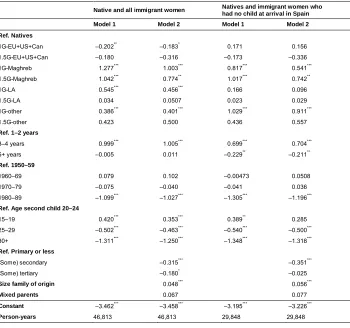
Since the so-called two-child norm is pervasive in Spain and the transition to third birth has become increasingly rare, it is of interest to examine whether immigrant women coming from higher fertility societies exhibit a different pattern. According to the results presented in Table 5, when we examine all immigrant women, regardless of whether they had their children in the society of origin or destination (left panel), the transition to third birth is more common among all first-generation immigrant groups than among Spaniards. The only exception is first-generation migrants from Europe and other developed societies, whose rate of transition to third child is below that of Spaniards. It is worth noting that no differentials with respect to native women’s pattern of transition to third birth are found for either the 1.5 generation of Latin American origin or those of other origins, which might indicate a relatively rapid convergence for these groups of immigrant descendants. By contrast, the daughters of Maghrebian women continue to display higher rates of transition to third birth than natives. However, it should be noted that although we are using large surveys, we still ran into sample size problems when analysing the transition to third birth, particularly among the 1.5 generation because of their young age profile. Results should therefore be taken with caution.
Table 5: Transition to third birth. Logit discrete-time models
Native and all immigrant women Natives and immigrant women who had no child at arrival in Spain
Model 1 Model 2 Model 1 Model 2
Ref. Natives
1G-EU+US+Can –0.202** –0.183* 0.171 0.156
1.5G-EU+US+Can –0.180 –0.316 –0.173 –0.336
1G-Maghreb 1.277*** 1.003*** 0.817*** 0.541***
1.5G-Maghreb 1.042*** 0.774** 1.017*** 0.742**
1G-LA 0.545*** 0.456*** 0.166 0.096
1.5G-LA 0.034 0.0507 0.023 0.029
1G-other 0.386*** 0.401*** 1.029*** 0.911***
1.5G-other 0.423 0.500 0.436 0.557
Ref. 1–2 years
3–4 years 0.999*** 1.005*** 0.699*** 0.704***
5+ years –0.005 0.011 –0.229** –0.211**
Ref. 1950–59
1960–69 0.079 0.102 –0.00473 0.0508
1970–79 –0.075 –0.040 –0.041 0.036
1980–89 –1.099*** –1.027*** –1.305*** –1.196***
Ref. Age second child 20–24
15–19 0.420*** 0.353*** 0.389** 0.285
25–29 –0.502*** –0.463*** –0.540*** –0.500***
30+ –1.311*** –1.250*** –1.348*** –1.318***
Ref. Primary or less
(Some) secondary –0.315*** –0.351***
(Some) tertiary –0.180* –0.025
Size family of origin 0.048*** 0.056***
Mixed parents 0.067 0.077
Constant –3.462*** –3.458*** –3.195*** –3.226***
Person-years 46,813 46,813 29,848 29,848
Note: * p < 0.10. ** p < 0.05. *** p < 0.01
Source: Fertility, Family and Values Survey (FFVS-2006). National Immigrant Survey (ENI-2007).
of educational attainment seems to be more important in determining the timing of first birth than that of second and third births.15 Lastly, having at least one Spanish-born parent only has a slight (negative) effect on the transition to first birth, and not on subsequent transitions.
6. Conclusions and discussion
The childbearing behaviour of immigrants is an important component of population dynamics, particularly in lowest-low and latest-late fertility countries like Spain. Although the contribution of immigrants to the period fertility rate is small, the impact of immigrants’ children (both those born in Spain and those who arrived with their parents or later through family reunification) on deterring population decline and slowing down population aging cannot be dismissed. In addition, from a social point of view, the growing share of Spanish children and youth of immigrant descent is an important driver of sociocultural diversity, and examining the reproductive patterns of immigrants and their descendants may provide relevant clues as to the speed of their integration process. Moreover, from a demographic point of view, a better understanding of the childbearing patterns of different migrant groups and their descendants may serve as an important insight for population projections.
Previous studies have mostly focused on migrants’ fertility behaviour after arrival in the host society. By contrast, in this study we have examined birth transitions over the entire reproductive life of migrants, regardless of whether they took place before or after migration. The descriptive results show that, overall, first-generation migrant women – with the exception of those born in Europe – have had an earlier transition to motherhood than Spaniards. However, their overall rates of transition to second birth – with the exception of women born in the Maghreb – are lower than those of Spaniards. Immigrant women’s rates of transition to third birth, conditional on having had two children, are again higher than those of native women. These parity-specific differentials would have been overlooked in an aggregate fertility analysis.
The results of the multivariate analysis suggest that some observed differentials in the process of family building between immigrant and native women can be partly
15 The effect of educational level on birth transitions is generally negative, but in the transition to second
accounted for by compositional factors, especially the educational levels of migrant groups. This is particularly the case for the transition to first birth among women of Moroccan origin. These results indicate further potential for fertility convergence, as future migrant cohorts are likely to have, on average, a higher educational attainment than earlier cohorts.
With regard to the 1.5 generation, the results confirm a process of intergenerational convergence towards natives’ fertility patterns. Migrants who arrived in Spain as children or adolescents had less and later parity transitions than their mothers. Furthermore, most groups of immigrant descendants have similar or lower odds of parity progression than Spanish-born women. Only descendants of Moroccan immigrants display higher rates of progression to second and third birth than comparable native women. Thus the socialization hypothesis appears to be relevant only for the 1.5 generation of Moroccan origin. For descendants of Latin American immigrants, the convergence with mainstream fertility patterns expected for the second generation is already observed for the 1.5 generation.
7. Acknowledgements
References
Adserà, A. and Ferrer, A. (2014). Immigrants and demography: Marriage, divorce, and fertility. Bonn: Institute for the Study of Labor (IZA Discussion Papers 7982). Adserà, A. and Ferrer, A. (2013). The fertility of recent immigrants to Canada. Bonn:
Institute for the Study of Labor (IZA Discussion Papers 7289).
Adserà, A., Ferrer, A., Sigle-Rushton, W., and Wilson, B. (2012). Fertility patterns of child migrants: Age at migration and ancestry in comparative perspective. The Annals of the American Academy of Political and Social Science 643(1): 160– 189.doi:10.1177/0002716212444706.
Andersson, G. (2004). Childbearing after migration: Fertility patterns of foreign-born women in Sweden. International Migration Review 38(2): 747–775.
doi:10.1111/j.1747-7379.2004.tb00216.x.
Andersson, G., Persson, L., and Obućina, O. (2017). Depressed fertility among descendants of immigrants in Sweden. Demographic Research 36(39): 1149– 1184.doi:10.4054/DemRes.2017.36.39.
Aparicio, R. (2007). The integration of the second and 1.5 generations of Moroccan, Dominican and Peruvian origin in Madrid and Barcelona.Journal of Ethnic and Migration Studies 33(7): 1169–1193.doi:10.1080/13691830701541713.
Aparicio, R. and Portes, A. (2014). Growing up in Spain: The integration of the children of immigrants. Barcelona: La Caixa Foundation (Social Studies Collection No. 38).
Castro-Martín, T. (2002). Consensual unions in Latin America: Persistence of a dual nuptiality system.Journal of Comparative Family Studies 33(1): 35–55.
Castro-Martín, T. and Martín-García, T. (2013). The fertility gap in Spain: Late parenthood, few children and unfulfilled reproductive desires. In: Esping-Andersen, G. (ed.).The fertility gap in Europe: Singularities of the Spanish case. Barcelona: La Caixa Foundation (Social Studies Collection No. 36).
Castro-Martín, T. and Rosero-Bixby, L. (2011). Maternidades y fronteras: La fecundidad de las mujeres inmigrantes en España. Revista Internacional de Sociología 69(M1): 105–137.doi:10.3989/ris.2011.iM1.388.
Castro-Martín, T., Martín-García, T., Abellán, A., Pujol, R., and Puga, D. (2015). Tras las huellas de la crisis económica en la demografía española. Panorama Social
Chiswick, B. and Miller, P. (2001). A model of destination-language acquisition: Application to male immigrants in Canada. Demography 38(3): 391–409.
doi:10.1353/dem.2001.0025.
Devolder, D. and Bueno, X. (2011). Effects of migration on fertility patterns of non-native women in Spain. Barcelona: Centre d’Estudis Demogràfics (Papers de Demografía 382).
Dubuc, S. (2012). Immigration to the UK from high-fertility countries: Intergenerational adaptation and fertility convergence. Population and Development Review 38(2): 353–368.doi:10.1111/j.1728-4457.2012.00496.x. Esping-Andersen, G. (2013). The fertility gap in Europe: Singularities of the Spanish
case. Barcelona: La Caixa Foundation (Social Studies Collection No. 36). Feliciano, C. (2005). Educational selectivity in US immigration: How do immigrants
compare to those left behind? Demography 42(1): 131–152. doi:10.1353/dem. 2005.0001.
Frank, R. and Heuveline, P. (2005). A crossover in Mexican and Mexican-American fertility rates: Evidence of explanations for an emerging paradox. Demographic Research 12(4): 77,104.doi:10.4054/DemRes.2005.12.4.
Garssen, J. and Nicolaas, H. (2008). Fertility of Turkish and Moroccan women in the Netherlands: Adjustment to native level within one generation. Demographic Research 19(33): 1249–1280.doi:10.4054/DemRes.2008.19.33.
Goldstein, J.R., Sobotka, T., and Jasilioniene, A. (2009). The end of ‘lowest-low’ fertility? Population and Development Review 35(4): 663–699. doi:10.1111/j. 1728-4457.2009.00304.x.
González-Ferrer, A. (2007). The process of family reunification among original guest-workers in Germany.Zeitschrift für Familienforschung 19(1): 10–33.
González-Ferrer, A. (2011). Explaining the labour performance of immigrant women in Spain: The interplay between family, migration and legal trajectories.
International Journal of Comparative Sociology 52(1–2): 63–78. doi:10.1177/ 0020715210377153.
González-Ferrer, A., Hannemann, T., and Castro-Martín, T. (2016). Partnership formation and dissolution among immigrants in the Spanish context.
González Ferrer, A., Kraus, E., Cebolla Boado, H., Soysal, Y., and Aratani, Y. (2015). Adolescents’ life plans in the city of Madrid. Are immigrant origins of any importance?Revista Adolescencia y Juventud 2: 25‒49.
Hierro-Hernández, M.J. and Torre-Fernández, M. (2010). ¿Querer es poder? Un análisis de la fecundidad de las mujeres españolas e inmigrantes. Madrid: Fundación Alternativas (Estudios de Progreso 49).
Hobson, B., Hellgren, Z., and Bede, L. (2015). How institutional contexts matter: Migration and domestic care services and the capabilities of migrants in Spain and Sweden. Stockholm: Stockholm University (FamiliesAndSocieties working paper 46).
Holland, J.A. and de Valk, H.A.G. (2013). Ideal ages for family formation among immigrants in Europe. Advances in Life Course Research 18(4): 257–269.
doi:10.1016/j.alcr.2013.08.002.
Kohler, H.-P., Billari, F.C., and Ortega, J.A. (2002). The emergence of lowest-low fertility in Europe during the 1990s.Population and Development Review 28(4): 641–680.doi:10.1111/j.1728-4457.2002.00641.x.
Kraus, E.K. and Castro-Martín, T. (2017). Does migrant background matter for adolescents’ fertility preferences? The Latin American 1.5 generation in Spain.
European Journal of Population.doi:10.1007/s10680-017-9427-3.
Kreyenfeld, M., Andersson, G., and Pailhé, A. (2012). Economic uncertainty and family dynamics.Demographic Research Special Collection 12.
Kulu, H. (2005). Migration and fertility: Competing hypotheses re-examined.European Journal of Population 21(1): 51–87.doi:10.1007/s10680-005-3581-8.
Kulu, H. and González-Ferrer, A. (2014). Family dynamics among immigrants and their descendants in Europe: Current research and opportunities.European Journal of Population 30(4): 411–435.doi:10.1007/s10680-014-9322-0.
Kulu, H., Hannemann, T., Pailhé, A., Neels, K., Krapf, S., González-Ferrer, A., and Andersson, G. (2017). Fertility by birth order among the descendants of immigrants in selected European countries.Population and Development Review
43(1): 31–60.doi:10.1111/padr.12037.
León, M. (2010). Migration and care work in Spain: The domestic sector revisited.
Lievens, J. (1999). Family-formation migration from Turkey and Morocco to Belgium: The demand for marriage partners from the countries of origin. International Migration Review 33(3): 717–744.doi:10.2307/2547532.
Lindstrom, D.P. and Giorguli Saucedo, S. (2002). The short- and long-term effects of US migration experience on Mexican women’s fertility. Social Forces 80(4): 1341−1368.doi:10.1353/sof.2002.0030.
Lundström, K.E. and Andersson, G. (2012). Labor market status, migrant status, and first childbearing in Sweden. Demographic Research 27(25): 719–742.
doi:10.4054/DemRes.2012.27.25.
Miettinen, A., Rotkirch, A., Szalma, I., Donno, A., and Tanturri, M.L. (2015). Increasing childlessness in Europe: Time trends and country differences. Stockholm: Stockholm University (FamiliesAndSocieties working paper 33). Milewski, N. (2007). First child of immigrant workers and their descendants in West
Germany: Interrelation of events, disruption, or adaptation? Demographic Research 17(29): 859–896.doi:10.4054/DemRes.2007.17.29.
Milewski, N. (2010). Immigrant fertility in West Germany: Is there a socialization effect in transitions to second and third births?European Journal of Population
26(1): 297–323.doi:10.1007/s10680-010-9211-0.
Milewski, N. (2011). Transition to a first birth among Turkish second-generation migrants in Western Europe.Advances in Life Course Research 16(4): 178–189.
doi:10.1016/j.alcr.2011.09.002.
OECD (2016). Family Database [electronic resource]. Paris: OECD.http://www.oecd. org/els/family/database.htm
Roig, M. and Castro-Martín, T. (2007). Childbearing patterns of foreign women in a new immigration country: The case of Spain. Population 62(3): 351–380.
doi:10.3917/pope.703.0351.
Scott, K. and Stanfors, M. (2011). The transition to parenthood among the second generation: Evidence from Sweden, 1990–2005. Advances in Life Course Research 16(4): 190–204.doi:10.1016/j.alcr.2011.09.003.
Sobotka, T. (2008). The rising importance of migrants for childbearing in Europe.
Demographic Research 19(9): 225–248.doi:10.4054/DemRes.2008.19.9. Sobotka, T. and Beaujouan, E. (2014). Two is best? The persistence of a two-child
family ideal in Europe. Population and Development Review 40(3): 391–419.
Tobío, C. (2001). Working and mothering: Women’s strategies in Spain. European Societies 3(3): 339–380.doi:10.1080/14616690120079369.
Toulemon, L. (2004). Fertility among immigrant women: New data, a new approach.
Appendix
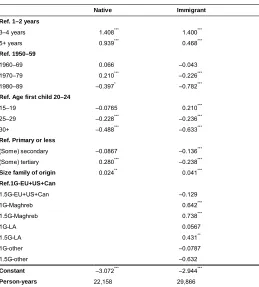
Table A-1: Transition to second birth by immigrant status. Logit discrete-time models
Native Immigrant
Ref. 1–2 years
3–4 years 1.408*** 1.400***
5+ years 0.939*** 0.468***
Ref. 1950–59
1960–69 0.066 –0.043
1970–79 0.210*** –0.226***
1980–89 –0.397* –0.782***
Ref. Age first child 20–24
15–19 –0.0765 0.210***
25–29 –0.228*** –0.236***
30+ –0.488*** –0.633***
Ref. Primary or less
(Some) secondary –0.0867 –0.136***
(Some) tertiary 0.280*** –0.238***
Size family of origin 0.024** 0.041***
Ref.1G-EU+US+Can
1.5G-EU+US+Can –0.129
1G-Maghreb 0.642***
1.5G-Maghreb 0.738***
1G-LA 0.0567
1.5G-LA 0.431**
1G-other –0.0787
1.5G-other –0.632
Constant –3.072*** –2.944***
Person-years 22,158 29,866