VOLUME 38, ARTICLE 48, PAGES 1457
,
1494
PUBLISHED 24 APRIL 2018
http://www.demographic-research.org/Volumes/Vol38/48/ DOI: 10.4054/DemRes.2018.38.48
Research Article
Mixed marriages in Switzerland:
A test of the segmented assimilation hypothesis
Gina Potarca
Laura Bernardi
This publication is part of the Special Collection “A New Look Into the Dynamics of Mixed Couples in Europe,” organized by Guest Editors Amparo González-Ferrer, Laura Bernardi & Alícia Adserà.
© 2018 Gina Potarca & Laura Bernardi.
This open-access work is published under the terms of the Creative Commons Attribution 3.0 Germany (CC BY 3.0 DE), which permits use, reproduction, and distribution in any medium, provided the original author(s) and source are given credit.
1 Introduction 1458
2 Background 1461
2.1 The Swiss context 1461
2.2 Trends across origin groups 1462
2.2.1 Marital union formation 1462
2.2.2 Marital dissolution 1465
2.3 Trends across birth cohort 1465
2.3.1 Marital union formation 1465
2.3.2 Marital dissolution 1467
3 Data and methods 1467
3.1 Data source 1467
3.2 Measurement of variables 1468
3.3 Analytical plan 1470
4 Results 1471
4.1 Descriptive results 1471
4.2 Multivariate analysis: Competing-risks and Cox regression models 1474
4.2.1 Marital union formation 1474
4.2.1.1 Trends across origin groups 1474
4.2.1.2 Trends across birth cohorts 1476
4.2.2 Marital dissolution 1478
4.2.2.1 Trends across origin groups 1478
4.2.2.2 Trends across birth cohorts 1480
4.3 Sensitivity analyses 1481
5 Conclusions 1481
References 1485
Mixed marriages in Switzerland:
A test of the segmented assimilation hypothesis
Gina Potarca1 Laura Bernardi2
Abstract
BACKGROUND
Switzerland hosts one of the largest and most diversified migrant populations in Europe, while currently reinforcing restrictive immigration policies. Knowledge on Swiss immigrant-native marriages, as ultimate signposts of integration, is limited.
OBJECTIVE
We explore the role of origin group and birth cohort in the emergence and dissolution of mixed marriages in Switzerland among both natives and immigrants.
METHODS
Based on a sample of 12,827 respondents from the 2013 Swiss Family and Generations Survey, we fit competing-risks models for entry into first marriage, and Cox proportional hazards models for entry into (first) divorce.
RESULTS
We find evidence of a segmented marriage market, with migrants from neighbouring Western European countries having higher chances of getting and staying married to a Swiss native. As opposed to natives, migrants from younger cohorts are progressively less likely to intermarry.
CONCLUSIONS
In line with segmented assimilation claims, results suggest differences in integration pathways between immigrant groups. Findings also point to the reactive ethnicity of marginalized groups (e.g., Turks and ex-Yugoslavs) in response to an increasingly hostile immigration climate. Decreasing (inter)marriage with natives among young immigrants reflects shifting marriage market conditions over the last decades.
CONTRIBUTIONS
Drawing on rich data, we provide an extensive investigation of intermarriage in Switzerland by examining outcomes of both occurrence and longevity, for both native and immigrant groups. The study focuses on a context with significant recent transformations in population composition and immigration climate, making it compelling to test integration theories and investigate how different groups, as well as younger (versus older) cohorts, intermarry in reaction to such changes.
1. Introduction
Mixed unions, particularly mixed marriages, defined as marital unions between individuals of different ethno-racial ancestry, have been subject to extensive empirical research in the United States (e.g., Choi and Tienda 2017; Fu 2001; Qian and Lichter 2011). As intermarriage scholars often point out, the prevalence and determinants of mixed marriages serve as indicators of the persistence of group boundaries and of the social and cultural distance between ethnic/racial groups (Fu 2001; Kalmijn and van Tubergen 2010; Lucassen and Laarman 2009). Recent patterns of mixed marriage in the United States point to the persistence of a racial hierarchy in partner preferences (Fu 2001), with the degree and the type of ethnic mixing not occurring by chance, but rather corresponding to different trajectories of integration that place blacks at the bottom and Hispanics and Asians in the racial middle (Alba and Nee 2005). While trends in mixed-race marriages have been thoroughly documented in the US literature, research in Europe, usually focused on migrant–native or interethnic unions, has been recently expanding as well (e.g., González-Ferrer 2005; Dribe and Lundh 2008; Kalmijn and van Tubergen 2007; for special collections on the topic see Osanami Törngren, Irastorza, and Song 2016; de Valk and Medrano 2014).
has one of the largest and most socioculturally diverse populations of residents with migratory background in Europe (OECD/EU 2015). In the last few years however, traditional rigid immigration legislation and policies have been reinforced as a consequence of popular votes (e.g., the 2014 poll demanding immigration curbs) and driven by the rising political influence of the right-wing Swiss People’s Party (Abu-Hayyeh, Murray, and Fekete 2014). Notwithstanding its resistance to multiculturalism and integration of foreign residents (Riaño and Wastl-Walter 2006), compared to other immigration countries, Switzerland has a relatively high rate of intermarriage (Lanzieri 2012), as well as a greater openness towards intermarriage among both natives and migrants (Carol 2013).
Little is known however about the specific dynamics of mixed marriages in Switzerland, particularly in response to the diversification of the immigrant population as well as hardening immigration conditions. Whereas the classic assimilation approach to integration (Gordon 1964) would predict propensities of intermarriage that increase over time for all immigrant groups, the segmented assimilation perspective (Portes and Rumbaut 2001, 2006) would suggest different pathways of integration for different groups. A changing marriage market and an unfavorable institutional context of immigration would encourage a reactive ethnicity, understood as strengthened attachment to one’s own ethnic group. The perceived dissonance of a hostile social context increases the salience and the self-consciousness of ethnic/ nativity group boundaries (Rumbaut 2008). A possible reaction may be the rise and reaffirmation of ethnic solidarity and a retreat from intermarrying among younger generations of migrants, similar to the slowing down of mixed marriages between whites and growing immigrant groups (e.g., Asians, Hispanics) in the United States (Qian and Lichter 2011). Nevertheless, there are no comprehensive studies that look at intermarriage patterns and trends to test the classic versus the segmented assimilation theory within the Swiss context of immigration. Only recent work looked at mixed marriages between natives partnered to European Union (15 countries) nationals in Switzerland (Schroedter and Rössel 2014). Nevertheless, the study does not distinguish between native-born and foreign-born migrants and does not address differences between specific European groups (e.g., Western versus Southern). In addition, it only tackles the formation of mixed marriages, leaving aside another important dimension of evaluating the strength of crossing ethnic/nativity boundaries in marriage, namely endurance.
complementary potential explanations (e.g., structural, normative) for changing dynamics in mixed marriage formation and dissolution in Switzerland. In doing so, it asks the following questions: Which immigrant groups are more prone to enter mixed marital unions with natives in Switzerland? And which ones are more likely to exit them? Are younger cohorts of both Swiss immigrants and natives more or less prone to form and dissolve an exogamous marriage3 than older cohorts? Using large-scale Swiss data from the 2013 Family and Generations Survey, we answer these questions by running a series of event history analyses modeling intergroup and intercohort differences in the time until entry into first intermarriage and the time until exit from first intermarriage.
We specifically focus on marriage instead of cohabitation, since the crossing of ethnic/nativity boundaries in marital unions has deeper implications for partners’ well-being and relationship satisfaction (Van Mol and de Valk 2016), as well as for immigrants’ legal integration and acquisition of specific citizenship rights (de Valk and Medrano 2014). The practice of long-term nonmarital cohabitation is also still relatively scarce and potentially selective among certain immigrant groups, such as Turks or North Africans (Kleinepier and de Valk 2016; Pailhé 2015), making it difficult to compare to marriage. Nevertheless, anticipating our findings, we note that cohabitation is more diffused among natives than among migrants (see Footnote 6 later in the text), which potentially alters the marriage market as natives may strongly prefer cohabitation over (or before) marriage, leading to limited partnering choices among certain migrant groups.
Our study advances the literature in several specific ways. First, we extensively test the segmented assimilation theory with reference to mixed marriages, typically applied to racial relations in the United States, within a particular and previously underexplored European context. Switzerland stands out through its large and ever-rising immigrant population and its restrictive immigration rules. Second, we engage in an often neglected two-sided examination of intermarriage in Switzerland by looking at the intermarital choices of both natives and immigrants. Third, previous research on mixed marital unions between immigrants and natives largely focused on prevailing mixed marriages (e.g., Kalmijn and van Tubergen 2007). But gaining a more realistic and comprehensive picture of mixed marital unions and understanding their role in immigrant integration requires the examination of more than one partnership transition at a time and a focus not only on formation, but also on the timing of dissolution associated with such unions (Fu and Wolfinger 2011; Kulu and González-Ferrer 2014; Soehl and Yahirun 2011). A high rate of intermarriage can indicate openness to cross ethnic/nativity boundaries, but a more reliable indicator of the social inclusion of
3 Intermarriage, interethnic marriage/union, and exogamous marriage are used interchangeably throughout the
newcomers is first, whether such unions are preferred over other types of arrangements (i.e., endogamous marriage), and second, how durable they are. Accordingly, we examine two types of events, namely entry into first marriage and dissolution of first marriage.
2. Background
2.1 The Swiss context
As previously noted, Switzerland hosts one of the largest shares of both recent and long-settled migrants in Europe. In 2014, the share of residents with a foreign background accounted for 22% of the total population, higher than the EU average of 10% (Eurostat 2015). When assembling both the foreign-born and the native-born with at least one immigrant parent, the percentage of the population that has some migrant background in Switzerland exceeds 40% (OECD/EU 2015). With many new arrivals in the last 10 to 15 years, its immigrant population has particularly diversified in terms of geographical and cultural background, as well as socioeconomic status (Fibbi, Lerch, and Wanner 2007; Lagana, Chevillard, and Gauthier 2014). Historically, the first influx of immigrants included Italian families, who arrived between 1950 and 1970 under ‘guest-worker’ programs. The Southern European immigrant population soon expanded to also accommodate Spanish and, later, Portuguese unskilled workers. The mid-1980s witnessed the immigration of another group coming from the Balkans, whose share increased substantially in the 1990s on the backdrop of the disintegration of the Federal Republic of Yugoslavia and the armed conflicts in the area. Asylum procedures and subsequent family reunifications substantially increased the number of foreigners from the Balkans (e.g., Kosovars, Bosnians, Serbs, Albanians, Macedonians, Turks), now representing one of the largest foreign communities in Switzerland (Gross 2006). Finally, the most recent inflow of immigrants occurred with the gradual introduction of freedom of movement for the member countries of the European Union (Liebig, Kohls, and Krause 2012). This drew a considerably large influx of highly educated skilled workers from the neighboring countries of Germany, France, and Austria (OECD/EU 2015).
Switzerland for at least 12 years4 and be sufficiently familiar with Swiss customs, culture, and habits. Marrying a Swiss native ensures a fast-track route to citizenship, provided that foreigners have lived in Switzerland for a minimum of five years and have been married to their Swiss spouse for at least three years. When it comes to the acquisition of Swiss citizenship by descent, a child is Swiss at birth if at least one parent is Swiss.5
Previous research indicates that belonging to a certain origin group plays a significant role in the acquisition of citizenship, with applicants from Turkey and the former Yugoslavia running a higher risk of being rejected compared to applicants from Northern or Western European countries, even after controlling for economic status, education credentials, or personal migration history (Hainmueller and Hangartner 2013). However, if eventually granted a Swiss passport, Turks and ex-Yugoslavs have the highest social integration returns to naturalization, such as reporting less discrimination, having plans to stay in Switzerland, being an active member of a social club, or reading Swiss newspapers (Hainmueller, Hangartner, and Pietrantuono 2017). Therefore, for more marginalized groups, gaining Swiss nationality proves more instrumental, given that naturalization provides access to additional resources from which they would otherwise be excluded; this is much less the case for less discriminated groups, who benefit from resources even in the absence of native citizenship (Hainmueller, Hangartner, and Pietrantuono 2017).
In the next section, we characterize the formation and dissolution of mixed marriages in Switzerland as shaped by origin and cohort groups, two factors that we propose enable or constrain marital union formation and ending in various ways.
2.2 Trends across origin groups
2.2.1 Marital union formation
The literature on immigrant adaptation is dominated by two theoretical perspectives: the linear assimilation theory and the segmented assimilation theory. The linear or classic assimilation theory postulates that all immigrant groups follow a steady pathway of acculturation, and that adjustment to the local mainstream becomes stronger with time and across generations (Alba and Nee 1997; Gordon 1964). The segmented
4 As of January 2018, the minimum residency duration is lowered to ten years (State Secretariat for Migration
2016), but conditions are stricter (e.g., a written language test, no naturalization for residents with temporary residence permit).
5 An additional requirement, which is having paternity officially recognized, is necessary if the child is born
assimilation perspective conversely suggests that integration occurs nonlinearly and divergently for different immigrant origin groups (Portes and Rumbaut 2001; Portes and Zhou 1993). Culturally similar and socioeconomically advantaged groups do experience upward assimilation in the classic term. On the opposite side, immigrant groups with lower overall levels of human capital and higher cultural dissonance follow downward assimilation pathways of sociocultural marginalization (Portes and Zhou 1994; Portes and Rumbaut 2001). Downward assimilation scenarios emerge as discrimination, segregation, and bifurcated labour markets make upward mobility pathways unattainable for certain immigrant groups, whose members fall into unemployment, crime, and concentrated poverty (Portes and Rumbaut 2001). Furthermore, a harsh societal and political climate towards immigration can fuel reactive ethnicity (Portes and Rumbaut 2001; Rumbaut 1994; Waters 1994). A reactive ethnic identity entails that origin groups experiencing hostility in the form of discrimination and restrictive integration policies respond by strengthening their identification and solidarity with the in-group and dismissing contact with the natives (Fleischmann, Phalet, and Klein 2011). In between these two types of assimilation lies a proposed intermediary type of selective acculturation, suggested by Portes and Rumbaut (2001), which leads to either upward assimilation or biculturalism (Waters et al. 2010). This pathway is usually linked to groups with low levels of human capital, but with strong embeddedness in a large, supportive, and usually less marginalized ethnic community. Specifically looking at intermarriage, we put forward the hypothesis that the segmented assimilation framework would predict three different outcomes depending on migrants’ integration status: a high propensity to intermarry natives for upwardly assimilated immigrant groups; a lower one for downwardly assimilated, ethnically reactive groups; and an intermediate one for selectively acculturated migrants.
Within the context of Switzerland, the three main immigrant groups, (1) Southern Europeans, (2) former Yugoslavs and Turks, and (3) neighboring Western Europeans, differ not only because of their migration history and the duration of their presence in Switzerland, but more importantly in terms of cultural identity and socioeconomic ranking compared to the native population. Based on previous arguments, such discrepancies should also translate in different propensities to intermarry with natives.
that of immigrants from non-Western immigrant groups (Helbling 2011). While it is true that Western (as well as Southern) European migrants can be regarded as competitors on the labour market, they are hardly perceived as a threat to Swiss cultural values (Kohler 2012). We therefore expect that, compared to other groups, immigrants from neighboring Western European countries will have the highest chances of intermarrying natives when forming their first marital union.
At the other side of the spectrum, immigrants from Turkey and ex-Yugoslavia display a trajectory of downward assimilation, experiencing low levels of sociocultural integration in Switzerland (Kohler 2012; Wanner, Lerch, and Fibbi 2005), as well as in other Western European contexts (Alba 2005). The natives’ cultural accommodation to their Turkish or ex-Yugoslavian partners would require more effort for several potential reasons: disparities in language and religion; the immigrant group’s more rigid ethnic traits, such as predominantly patriarchal family orientations and strong endogamy norms (Carol 2016; Lievens 1998); or reluctance to engage in any form of cohabitation, including as a short trial period before marriage (Bernhardt, Goldscheider, and Goldscheider 2007). In Switzerland, Turks and ex-Yugoslavs also register more negative labour market outcomes, including higher unemployment risks (Lagana, Chevillard, and Gauthier 2014; Liebig, Kohls, and Krause 2012), greater occupational segregation, and higher chances of experiencing discrimination in hiring practices (Fibbi, Lerch, and Wanner 2007; Fibbi et al. 2015). As the theory of segmented assimilation (Portes and Rumbaut 2001) predicts, their systematic social and economic marginalization most likely fosters the need to reaffirm and preserve ethnic boundaries, rejecting social contracts that would imply stepping outside of such barriers. Despite having the strongest legal and social incentives to marry a native, Turks and ex-Yugoslavs are thus expected to be the group that forms exogamous marriages with natives the least.
2.2.2 Marital dissolution
When it comes to the propensity to exit the first marital union, we first expect individuals (both Swiss and non-Swiss) in exogamous marriages to be more likely to divorce than those in endogamous arrangements, as the exogamy hypothesis repeatedly confirmed by previous research indicates (Bratter and King 2008; Kalmijn, Graaf, and Janssen 2005; Milewski and Kulu 2013). Having a different-origin spouse is linked to difficulties agreeing on common interests and lifestyles (Hibbler and Shinew 2002), and the divergence in cultural values fuels partnership strain (Hohmann-Marriott and Amato 2008), which usually leads to divorce (Zhang and Van Hook 2009).
When it comes to specific origin group differences, we expect Turks and ex-Yugoslavs to dissolve their marriage with natives the most. In addition to the higher probability of facing a lifestyle mismatch to the more culturally distant native spouse, the ethnic discrimination experienced by Turks and ex-Yugoslavs is also likely to accelerate separation. Previous research indicates that discriminatory treatment restrains shared pastime activities and impairs the general functionality of intermarried couple’s daily life (Hibbler and Shinew 2002). The least culturally remote and the most socioculturally integrated, Western Europeans would on the contrary be more likely to remain married to their native partner. Southern European migrants, particularly Italians, would also be at a lower risk of separation, but largely reinforced by their Catholic background, cultural norms against union dissolution, and exposure to lower divorce rates (Rosina and Fraboni 2004) in their origin country.
2.3 Trends across birth cohort
2.3.1 Marital union formation
We also anticipate particular cohort differences in the occurrence and stability of Swiss marriages that cross origin boundaries. We once again draw from the classic versus segmented assimilation theoretical perspectives and also append arguments regarding the marriage market opportunity structure.
interaction across ethnic lines, sustained by rising ethnic and racial diversity (Joyner and Kao 2005).
Second, the segmented assimilation theory (Portes and Rumbaut 2001) suggests that integration is halted if migrant groups face an increasingly negative climate of immigration. To these circumstances, immigrants react by reinforcing their ethnic identity and being less open towards engaging with natives. Empirical studies support this view by highlighting stagnation and even decrease in exogamous marriages across cohorts in Switzerland (Schroedter and Rössel 2014), Germany (González-Ferrer 2005), and the United States (Qian and Lichter 2011). In the American context, the retreat in intermarriage is also related to the substantial growth of immigrant populations in recent decades and the coming of age of second and third generations, which caused a ‘replenished’ stock of ethnic minorities (Jiménez 2008), and thus allowed for more opportunities of choosing an endogamous rather than an exogamous partner (Qian and Lichter 2011). Members of larger minority groups can also better identify with the in-group and are subject to more control from third parties, leading to a more prominent inclination towards marrying a coethnic (Kalmijn and Tubergen 2007). Moreover, the advent of online dating as a mainstream channel for finding a partner in the last decade and the overrepresentation of minority groups among Internet daters, as a recent cross-national study including Switzerland (Potarca and Mills 2015) shows, means an easier access and more possibilities for selecting a partner from your own group.
Given the replenishment in immigrant population across decades and its increasingly hostile immigration climate, we contend that intercohort variation in intermarriage in Switzerland would also follow a segmented rather than a classic assimilation pathway. Therefore, based on previous arguments, we expect immigrants from recent cohorts to be less prone to forming exogamous marital unions with Swiss partners than their counterparts from earlier cohorts, particularly when belonging to ethnically reactive marginalized groups (e.g., Turks and ex-Yugoslavs).
2.3.2 Marital dissolution
Moreover, we put forward a normalization of divorce hypothesis in anticipating intermarried individuals from more recent cohorts to have a higher risk of dissolving their union than those from previous cohorts (Bratter and King 2008). Societal permissiveness towards divorce has augmented through the years, and the understanding that ill-fitted unions may end up in divorce encounters little social disapproval among more recent cohorts (Halman and van Ingen 2015). We expect this cohort effect to be at play in both exogamous and endogamous unions. Yet, given the potential for cultural distance in exogamous marriages we discussed above, and given the increase in immigrant populations allows for the possibility of exiting dissatisfactory mixed unions to opt for an in-group partner, exogamous marriages observed among younger cohorts might be even more at risk of separation than endogamous ones.
3. Data and methods
3.1 Data source
We use data from the 2013 Family and Generations Survey (originally Enquête sur les familles et les générations (EFG) 2013), conducted by the Federal Statistical Office (FSO). Its sample includes approximately 10,000 permanent residents in Switzerland, aged 15 to 79 years (the reference date being January 1, 2013). The sample targets native Swiss, migrants with a permanent or annual residence permit (i.e., valid for at least 12 months), and foreign citizens with a short-term residence permit, who have gathered a cumulative length of stay of at least one year. Excluded categories are international civil servants, diplomats and their family members, and foreign citizens seeking asylum.
surveys of individuals and households. A total of 17,288 people (50%) participated in the survey.
We decided to exclude respondents born before 1940 (n = 1,039) to ensure comparability with other European intermarriage studies (e.g., Hannemann et al. 2016), and those born after 1989 (n = 2,055), given a high chance of having incomplete partnership histories. We also removed survey participants who enter cohabitation as their first union and stay partnered (without marrying) until age 45 (n = 206)6 to ensure that, in our analyses, we compare respondents who transition to first marriage to respondents who do not experience any kind of long-term union. After also excluding cases with inconsistencies in reporting dates of partnership transitions, or with missing information on either one of our variables of interest (n = 1,104), the analyses included in this study were based on a final sample of 12,827 respondents.
3.2 Measurement of variables
The dependent variables used in our analyses are the occurrence of first marriage (with a different number of categories depending on origin background, see details below) and the occurrence of first divorce. The type of first marital union is coded as ‘endogamous’ if the respondent’s and partner’s origin match, or exogamous if their origins are different. Among immigrants, we distinguish between two types of exogamous marital unions: with natives and with immigrants from an ethnic group different than their own.
Respondent’s origin and generation type (for immigrants) were computed according to official FSO guidelines (Federal Statistical Office 2015) and used extensive information on current nationality, nationality at birth, country of birth, and both parents’ country of birth. If the individual has current Swiss nationality, was born Swiss, and has at least one parent who was born in Switzerland, the respondent was coded as ‘native.’7 If at least one parent was born abroad and the respondents migrated to Switzerland after the age of 16, they were coded as ‘first generation’ and were assigned the specific origin of the country of the foreign-born parent (or of the mother, in case both parents were foreign-born). If at least one parent was born abroad and respondents came to reside in Switzerland between the ages of 6 and 16, they are coded as ‘1.5 generation’ and are given the foreign-born parent’s/mother’s country of birth as
6 The majority of these couples are native respondents partnered with other natives. Out of the long-term
cohabitating respondents, 18 are Southern European migrants, 13 are from Western Europe, and only three belong to the Turkish and ex-Yugoslavian group.
7 Restrictively considering only respondents with both Swiss-born parents as native and discarding those with
their origin category. If at least one parent was born abroad and respondents came to reside in Switzerland before the age of 6 (or were born in Switzerland), they are coded as ‘second generation’ and receive foreign-born parent’s/mother’s country of birth as their origin. Respondents who acquired Swiss nationality at birth through descent are thus considered as second generation immigrants. The three-category measurement of immigrant generation is in accordance to previous categorizations in intermarriage studies (e.g., González-Ferrer 2005; Min and Kim 2009) and is meant to distinguish between individuals who were subject to different migration experiences and acculturation processes: those who migrated as (young) adults (i.e., first generation), those who experienced migration during middle childhood and adolescence (i.e., 1.5 generation), and finally those who are native-born or who migrated during early childhood (i.e., second generation).
Since the first spouse can be either a current (in 75.4% of cases) or a previous partner (the remaining 24.6% of cases), we gauge partner’s origin by looking at either the current or past spouse’s background. The current partner’s origin is measured via the following variables: current nationality, nationality at birth (either Swiss or foreign), and country of birth. If the partner is currently a Swiss national and had Swiss or double nationality at birth, irrespective of country of birth, he/she is categorized as ‘native.’ If the partner has a non-Swiss nationality at birth, then information on country of birth is used to gauge the partner’s immigrant origin. The origin of previous partners was measured solely by inquiring information on their current nationality. Therefore, if the precedent partner had Swiss nationality, he/she was coded as ‘native,’ whereas if the previous partner had non-Swiss nationality, he/she was categorized as ‘foreign-origin.’ We acknowledge the problematic aspect of having different measurements for current versus previous partners. Sensitivity analyses (not reported) in which the origin of current partners is operationalized in the same way as the origin of past partners (i.e., based on nationality only) revealed that the number of partners with an immigration background that might be misclassified as Swiss is negligible and does not affect the final results. To capitalize on all the information provided in the survey, we keep the original categorization of the current partner (i.e., based on the three indicators of current nationality, nationality at birth, and country of birth).
For both respondents and their partners, we distinguish between five origin groups: (1) natives, (2) Southern Europeans (originating from Italy, Spain, or Portugal), (3) Turks and ex-Yugoslavs, (4) Western Europeans (from Germany, France, or Austria), and (5) other countries. We acknowledge the risks associated with grouping individuals from various national backgrounds into large categories. Data restrictions however prevent us from inspecting intermarriage patterns for specific national-origin groups.8 Nevertheless, the immigrant groups compiled into the category ‘Turks and
Yugoslavs,’ for instance, have similar migration history, as well as comparable levels of socioeconomic integration and cultural distance from the local mainstream (Hainmueller and Hangartner 2013; Kohler 2012). Much of the scientific and public debate in Switzerland also often considers these immigrants and the resulting second generation as one group (Kohler 2012), without making finer, though certainly worthy, distinctions about their specificities. The composite category ‘others’ mainly includes Eastern Europeans (n = 253, 21.2%), other non-neighboring Western Europeans (n = 179, 15%), and respondents with a Latin American background (n = 220, 18.4%). In an earlier draft, we distinguished between European versus non-European ‘other’ immigrants, with results largely coinciding for the two groups. As previously noted, the small subsamples prohibit a detailed examination of intermarital patterns for each specific subgroup. For the sake of capturing the complete picture of Switzerland’s immigrant population (i.e., so that the relative proportions of immigrant groups in our sample more or less reflect the relative distribution of groups in the population), we retain this broad heterogeneous category in our sample, but we do not interpret results associated with it.
We distinguish between five cohort groups, namely respondents born between (1) 1940–1949, (2) 1950–1959, (3) 1960–1969, (4) 1970–1979, and (5) 1980–1989.
Control variables include gender, education (with categories (1) low, (2) medium, and (3) high), and linguistic region (with categories German,9 French, and Italian), and for immigrants only, the timing of marriage (with options (1) marriage before migration and (2) marriage after migration). For the analyses of first divorce, we also include three extra predictors, namely age at first marriage (in years), number of children born while previously married, and type of first marriage.
3.3 Analytical plan
The analyses include event history models that focus on two types of transitions: entry into first marriage and exit from first marriage. Given the possibility of experiencing more than one type of marriage, the transition to first marital union is analyzed within a competing-risks framework (Cleves, Gould, and Marchenko 2016), treating endogamous and exogamous unions (recall there are two types of exogamous unions for migrants: with natives or with other immigrants) as alternative risks. We estimate competing-risks regression based on Fine and Gray’s (1999) proportional subhazards model using thestcrreg command in Stata (StataCorp 2015). Whereas the classical Cox regression centers around a survival function defining the probability of surviving an
9 The Romansh category was recoded into the German category given a low number of observations (i.e.,
event of interest (i.e., not failing) before a given time, the competing-risks regression focuses on the cumulative incidence function, which indicates the probability that one possible type of event of interest happens (i.e., fails) within a given time (Cleves, Gould, and Marchenko 2016). In our case, time of exposure was measured in years, starting at age 15 and censoring either at the year of interview, at age 45, or at a competing event. For migrants, we have three competing-risks regressions with the other two outcomes treated as competing risks; for natives, we estimate two competing-risks regressions with the other outcome treated as competing risk. Both analyses model all competing risks at the same time, while also controlling for a series of key variables.
For exit from first marital union, we followed respondents who experienced the transition to first marriage (n = 3,225 immigrants and n = 6,385 natives) from the starting year of the union until its dissolution. Observations were either censored at the time of interview, 20 years after the start of the marital union, or at the partner’s death. To analyze the transition out of first marriage, we use single decrement models, more specifically Cox proportional hazard models that also control for a series of variables of interest.
To account for the sample design and to reduce nonresponse bias, the samples are adjusted with the weight wtelpers. The weighting is provided by the FSO, and it controls for differential nonresponse rates across marital status (i.e., married or not), nationality (i.e., Swiss or not), sex, age group, and canton of residence. The weights were also calibrated to correspond to the Swiss permanent resident population aged 15– 79 in the year 2013.
Finally, to assess the robustness of our findings, we also run a set of sensitivity analyses. First, we are interested in understanding whether the same conclusions can be drawn when looking at entry and exit from first cohabiting union. Given the low number of respondents cohabiting without eventually marrying (recall n = 206), these analyses mainly refer to respondents in premarital cohabiting unions. Second, we investigate whether using a sample that includes 26.2% of immigrants having married before migration (i.e., not being exposed to the Swiss marriage market) affects our final results. Finally, we assess whether structural factors (e.g., relative group size, sex ratios) impact the overall conclusions of the study.
4. Results
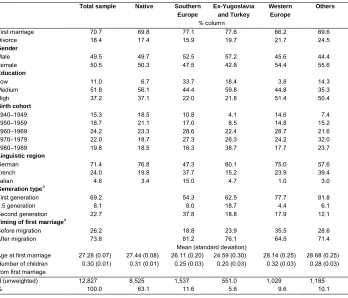
4.1 Descriptive results
11.6% coming from Southern Europe, 9.6% from neighboring Western European countries, and 5.6% from former Yugoslavia and Turkey. Whereas for native respondents the sex ratio is fairly balanced, there appears to be an overrepresentation of men among immigrants originating from Southern Europe and especially from former Yugoslavia and Turkey, and slightly higher numbers of women among neighboring Western Europeans and immigrants from the heterogeneous ‘other’ category. The previous two groups (i.e., Western Europeans and others) are particularly highly educated, to a higher degree compared to other groups of immigrants as well as natives. The lower educated are overrepresented among respondents with a Southern European background, whereas natives and migrants from ex-Yugoslavia and Turkey are more likely to hold medium-level educational degrees. Nevertheless, other sources, based on census data, indicate that migrants from former Yugoslavia or Turkey are less educated than immigrants from Southern Europe, especially when looking at the second generation (Kohler 2012). Our sample thus likely underestimates Turks and ex-Yugoslavs with low educational credentials. Disadvantaged immigrants from this group might have been less likely to participate in the survey due to language restrictions. Conversely, the fact that Italian was one of the languages in which the survey was administered did not operate as filter against lower educated Italians. Our results should therefore be read as conservative given the possible underrepresentation of the most vulnerable members of the Turkish and the ex-Yugoslavian group.
Table 1: Weighted descriptive statistics for the variables used in the analysis of formation and dissolution of mixed marriages in Switzerland (n = 12,827)
Total sample Native Southern Europe
Ex-Yugoslavia and Turkey
Western Europe
Others
% column
First marriage 70.7 69.8 77.1 77.6 66.2 69.6
Divorce 18.4 17.4 15.9 19.7 21.7 24.5
Gender
Male 49.5 49.7 52.5 57.2 45.6 44.4
Female 50.5 50.3 47.5 42.8 54.4 55.6
Education
Low 11.0 6.7 33.7 18.4 3.8 14.3
Medium 51.8 56.1 44.4 59.8 44.8 35.3
High 37.2 37.1 22.0 21.8 51.4 50.4
Birth cohort
1940–1949 15.3 18.5 10.8 4.1 14.6 7.4
1950–1959 18.7 21.1 17.0 8.5 14.8 15.2
1960–1969 24.2 23.3 28.6 22.4 28.7 21.6
1970–1979 22.0 18.7 27.3 26.3 24.2 32.0
1980–1989 19.8 18.5 16.3 38.7 17.7 23.7
Linguistic region
German 71.4 76.8 47.3 80.1 75.0 57.6
French 24.0 19.8 37.7 15.2 23.9 39.4
Italian 4.6 3.4 15.0 4.7 1.0 3.0
Generation typea
First generation 69.2 54.3 62.5 77.7 81.8
1.5 generation 8.1 8.0 18.7 4.4 6.1
Second generation 22.7 37.8 18.8 17.9 12.1
Timing of first marriagea
Before migration 26.2 18.8 23.9 35.5 28.6
After migration 73.8 81.2 76.1 64.5 71.4
Mean (standard deviation)
Age at first marriage 27.28 (0.07) 27.44 (0.08) 26.11 (0.20) 24.59 (0.30) 28.14 (0.25) 28.68 (0.25) Number of children
from first marriage
0.30 (0.01) 0.31 (0.01) 0.25 (0.03) 0.20 (0.03) 0.32 (0.03) 0.28 (0.03)
N (unweighted) 12,827 8,525 1,537 551.0 1,029 1,185
% 100.0 63.1 11.6 5.6 9.6 10.1
4.2 Multivariate analysis: Competing-risks and Cox regression models
4.2.1 Marital union formation
4.2.1.1 Trends across origin groups
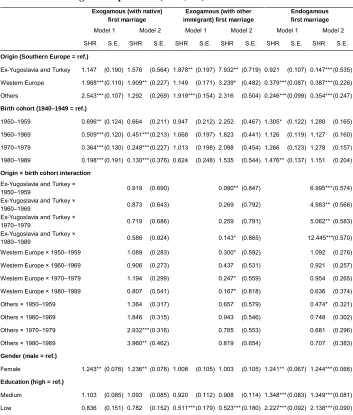
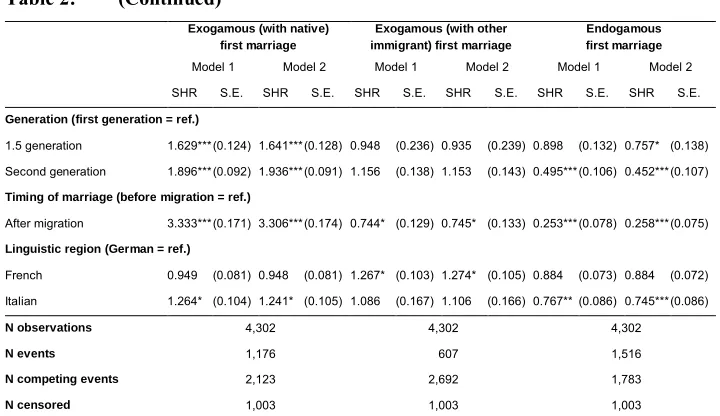
Table 2 reports the estimates (i.e., subhazard ratios) of a competing-risks analysis predicting entry into first marriage, for the subsample of immigrant respondents. Model 1 includes main effects, whereas Model 2 adds an interaction between origin and birth cohort. A subhazard ratio significantly greater than one indicates that the covariate of interest is associated with an increased probability of observing one type of event of interest, holding all other covariates constant. A value less than one signifies that the covariate is linked to a decreased probability of having the event of interest.
Table 2: Competing-risks analysis of first marriage formation among immigrant respondents (n = 4,302)
Exogamous (with native) first marriage
Exogamous (with other immigrant) first marriage
Endogamous first marriage Model 1 Model 2 Model 1 Model 2 Model 1 Model 2 SHR S.E. SHR S.E. SHR S.E. SHR S.E. SHR S.E. SHR S.E. Origin (Southern Europe = ref.)
Ex-Yugoslavia and Turkey 1.147 (0.190) 1.576 (0.564) 1.878** (0.197) 7.932** (0.719) 0.921 (0.107) 0.147***(0.535) Western Europe 1.988***(0.110) 1.909** (0.227) 1.149 (0.171) 3.239* (0.482) 0.379***(0.087) 0.387***(0.226) Others 2.543***(0.107) 1.292 (0.269) 1.919***(0.154) 2.316 (0.504) 0.246***(0.099) 0.354***(0.247) Birth cohort (1940–1949 = ref.)
1950–1959 0.696** (0.124) 0.664 (0.211) 0.947 (0.212) 2.252 (0.467) 1.305* (0.122) 1.280 (0.165) 1960–1969 0.509***(0.120) 0.451***(0.213) 1.068 (0.197) 1.823 (0.441) 1.126 (0.119) 1.127 (0.160) 1970–1979 0.364***(0.130) 0.248***(0.227) 1.013 (0.198) 2.098 (0.454) 1.266 (0.123) 1.278 (0.157) 1980–1989 0.198***(0.191) 0.130***(0.376) 0.624 (0.248) 1.535 (0.544) 1.476** (0.137) 1.151 (0.204) Origin × birth cohort interaction
Ex-Yugoslavia and Turkey ×
1950–1959 0.919 (0.690) 0.090** (0.847) 6.995***(0.574) Ex-Yugoslavia and Turkey ×
1960–1969 0.873 (0.643) 0.269 (0.792) 4.983** (0.566) Ex-Yugoslavia and Turkey ×
1970–1979 0.719 (0.686) 0.259 (0.791) 5.062** (0.583) Ex-Yugoslavia and Turkey ×
1980–1989 0.586 (0.824) 0.143* (0.865) 12.445***(0.570) Western Europe × 1950–1959 1.089 (0.283) 0.300* (0.592) 1.092 (0.276) Western Europe × 1960–1969 0.906 (0.273) 0.437 (0.531) 0.921 (0.257) Western Europe × 1970–1979 1.194 (0.299) 0.247* (0.559) 0.954 (0.265) Western Europe × 1980–1989 0.807 (0.541) 0.167* (0.818) 0.636 (0.374) Others × 1950–1959 1.364 (0.317) 0.657 (0.579) 0.474* (0.321) Others × 1960–1969 1.846 (0.315) 0.943 (0.546) 0.748 (0.302) Others × 1970–1979 2.932***(0.316) 0.785 (0.553) 0.681 (0.296) Others × 1980–1989 3.960** (0.462) 0.819 (0.654) 0.707 (0.383) Gender (male = ref.)
Female 1.243** (0.076) 1.236** (0.078) 1.008 (0.105) 1.003 (0.105) 1.241** (0.067) 1.244***(0.066) Education (high = ref.)
Table 2: (Continued)
Exogamous (with native) first marriage
Exogamous (with other immigrant) first marriage
Endogamous first marriage Model 1 Model 2 Model 1 Model 2 Model 1 Model 2 SHR S.E. SHR S.E. SHR S.E. SHR S.E. SHR S.E. SHR S.E. Generation (first generation = ref.)
1.5 generation 1.629***(0.124) 1.641***(0.128) 0.948 (0.236) 0.935 (0.239) 0.898 (0.132) 0.757* (0.138) Second generation 1.896***(0.092) 1.936***(0.091) 1.156 (0.138) 1.153 (0.143) 0.495***(0.106) 0.452***(0.107) Timing of marriage (before migration = ref.)
After migration 3.333***(0.171) 3.306***(0.174) 0.744* (0.129) 0.745* (0.133) 0.253***(0.078) 0.258***(0.075) Linguistic region (German = ref.)
French 0.949 (0.081) 0.948 (0.081) 1.267* (0.103) 1.274* (0.105) 0.884 (0.073) 0.884 (0.072) Italian 1.264* (0.104) 1.241* (0.105) 1.086 (0.167) 1.106 (0.166) 0.767** (0.086) 0.745***(0.086) N observations 4,302 4,302 4,302
N events 1,176 607 1,516
N competing events 2,123 2,692 1,783 N censored 1,003 1,003 1,003
Note: Weighted data by wtelpers. SHR = subhazard ratio. * p<0.05, ** p<0.01, *** p<0.001.
Source: EFG 2013.
4.2.1.2 Trends across birth cohorts
(Model 1), and second, that this effect is largely driven by ex-Yugoslavs and Turks (Model 2). These results altogether confirm our expectation regarding younger cohorts being less likely to marry natives, a trend potentially driven by enlarged opportunities to inmarry as migrant communities expand. The fact that endogamous tendencies among young cohorts are significantly accentuated for ex-Yugoslavs and Turks substantiates the reactive ethnicity thesis, which predicts strengthened loyalty towards the in-group for marginalized migrants.
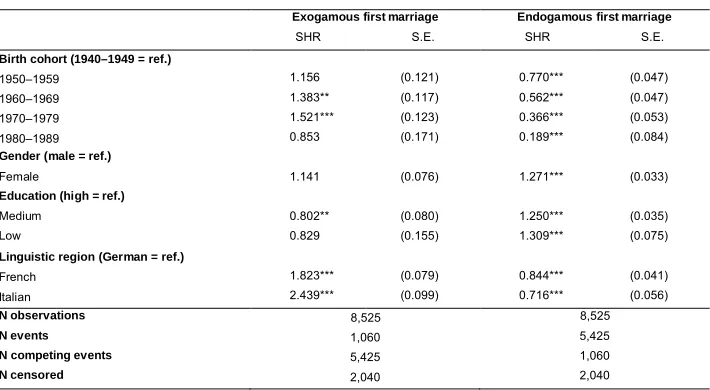
For the native group, we posited that Swiss natives from younger cohorts are more likely to enter exogamous marital unions compared to those from older cohorts. Table 3 presents the results of competing-risks analyses predicting the entry into first marriage for the subsample of native respondents. Findings in Table 3 suggest that Swiss natives born in the 1960s and 1970s have a significantly higher propensity to intermarry than older cohorts. Moreover, native respondents who are born in more recent years are significantly less likely to enter an endogamous marital union. These findings confirm our prediction regarding a generational increase in intermarriage among natives.
Table 3: Competing-risks analysis of first marriage formation among native respondents (n = 8,525)
Exogamous first marriage Endogamous first marriage
SHR S.E. SHR S.E.
Birth cohort (1940–1949 = ref.)
1950–1959 1.156 (0.121) 0.770*** (0.047)
1960–1969 1.383** (0.117) 0.562*** (0.047)
1970–1979 1.521*** (0.123) 0.366*** (0.053)
1980–1989 0.853 (0.171) 0.189*** (0.084)
Gender (male = ref.)
Female 1.141 (0.076) 1.271*** (0.033)
Education (high = ref.)
Medium 0.802** (0.080) 1.250*** (0.035)
Low 0.829 (0.155) 1.309*** (0.075)
Linguistic region (German = ref.)
French 1.823*** (0.079) 0.844*** (0.041)
Italian 2.439*** (0.099) 0.716*** (0.056)
N observations 8,525 8,525
N events 1,060 5,425
N competing events 5,425 1,060
N censored 2,040 2,040
Note: Weighted data by wtelpers. SHR = subhazard ratio. * p<0.05, ** p<0.01, *** p<0.001.
4.2.2 Marital dissolution
4.2.2.1 Trends across origin groups
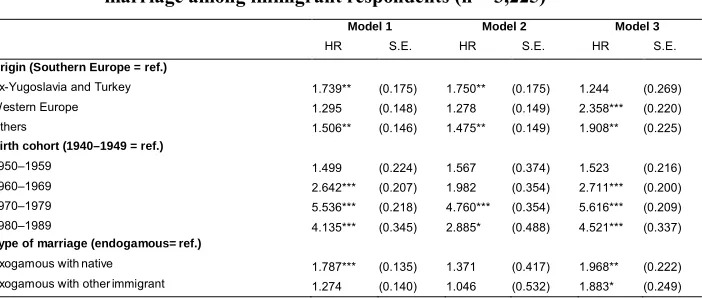
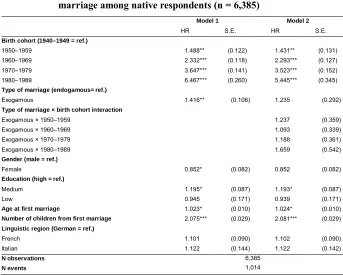
Concerning the risk of divorce, we first hypothesized that exogamous marriages are more prone to dissolve than endogamous ones. Table 4 reports the results of three Cox regression models examining how fast first marital unions dissolve among immigrant respondents. Model 1 estimates the main effects, Model 2 adds an interaction between the type of marriage and cohort, whereas Model 3 supplements the basic analysis with an interaction between the type of marriage and origin group. A Cox proportional hazard model predicting exit from first marriage among native respondents is further reported in Table 5. Findings in both Table 4 and Table 5 give confirmation to the exogamy hypothesis in showing that exogamous marriages (particularly those between natives and immigrants) are significantly more at risk of ending in divorce compared to endogamous ones.
We also anticipated that immigrants from ex-Yugoslavia and Turkey dissolve their marital union with natives the most, while those from Western Europe the least. To examine this, we inspect results in Table 4 (Model 3). The interaction between the type of marital union and origin is highly significant, and we notice that respondents from former Yugoslavia and Turkey who married a native are significantly more likely to divorce. On the other hand, immigrants from neighboring Western European countries are significantly less at risk of dissolving their marriage with a native spouse, confirming once again the segmented assimilation hypothesis.
Table 4: Cox proportional hazard model predicting dissolution of first marriage among immigrant respondents (n = 3,225)
Model 1 Model 2 Model 3 HR S.E. HR S.E. HR S.E. Origin (Southern Europe = ref.)
Ex-Yugoslavia and Turkey 1.739** (0.175) 1.750** (0.175) 1.244 (0.269) Western Europe 1.295 (0.148) 1.278 (0.149) 2.358*** (0.220) Others 1.506** (0.146) 1.475** (0.149) 1.908** (0.225) Birth cohort (1940–1949 = ref.)
1950–1959 1.499 (0.224) 1.567 (0.374) 1.523 (0.216) 1960–1969 2.642*** (0.207) 1.982 (0.354) 2.711*** (0.200) 1970–1979 5.536*** (0.218) 4.760*** (0.354) 5.616*** (0.209) 1980–1989 4.135*** (0.345) 2.885* (0.488) 4.521*** (0.337) Type of marriage (endogamous= ref.)
Table 4: (Continued)
Model 1 Model 2 Model 3 HR S.E. HR S.E. HR S.E. Type of marriage × birth cohort interaction
Exogamous with native × 1950–1959 0.859 (0.495) Exogamous with native × 1960–1969 1.664 (0.456) Exogamous with native × 1970–1979 1.364 (0.456) Exogamous with native × 1980–1989 0.908 (0.852) Exogamous with other immigrant × 1950–1959 1.059 (0.617) Exogamous with other immigrant × 1960–1969 1.334 (0.571) Exogamous with other immigrant × 1970–1979 1.046 (0.580) Exogamous with other immigrant × 1980–1989 3.837 (0.730) Type of marriage × origin interaction
Exogamous with native ×
Ex-Yugoslavia and Turkey 3.264** (0.373)
Exogamous with native ×
Western Europe 0.410** (0.297)
Exogamous with native ×
Others 0.755 (0.301)
Exogamous with other immigrant ×
Ex-Yugoslavia and Turkey 0.875 (0.465)
Exogamous with other immigrant × Western Europe 0.294** (0.387) Exogamous with other immigrant × Others 0.704 (0.332) Gender (male = ref.)
Female 1.004 (0.107) 1.006 (0.107) 1.046 (0.107) Education (high = ref.)
Medium 1.251 (0.119) 1.238 (0.119) 1.284* (0.118) Low 1.040 (0.164) 1.012 (0.165) 1.130 (0.180) Generation (1.5 generation= ref.)
First generation 1.330 (0.220) 1.335 (0.224) 1.194 (0.214) Second generation 1.477 (0.232) 1.453 (0.235) 1.426 (0.230) Timing of marriage (before migration = ref.)
After migration 0.589*** (0.119) 0.597*** (0.118) 0.662*** (0.122) Age at first marriage 1.053*** (0.012) 1.055*** (0.012) 1.048*** (0.012) Number of children from first marriage 2.116*** (0.045) 2.111*** (0.045) 2.074*** (0.044) Linguistic region (German = ref.)
French 1.122 (0.102) 1.113 (0.101) 1.109 (0.104) Italian 1.277 (0.130) 1.241 (0.131) 1.333* (0.129)
N observations 3,225
N events 619
Note: Weighted data by wtelpers. HR = hazard ratio. * p<0.05, ** p<0.01, *** p<0.001.
Table 5: Cox proportional hazard model predicting dissolution of first marriage among native respondents (n = 6,385)
Model 1 Model 2
HR S.E. HR S.E.
Birth cohort (1940–1949 = ref.)
1950–1959 1.488** (0.122) 1.431** (0.131)
1960–1969 2.332*** (0.118) 2.293*** (0.127)
1970–1979 3.647*** (0.141) 3.523*** (0.152)
1980–1989 6.467*** (0.260) 5.445*** (0.345)
Type of marriage (endogamous= ref.)
Exogamous 1.416** (0.106) 1.235 (0.292)
Type of marriage × birth cohort interaction
Exogamous × 1950–1959 1.237 (0.359)
Exogamous × 1960–1969 1.093 (0.339)
Exogamous × 1970–1979 1.188 (0.361)
Exogamous × 1980–1989 1.659 (0.542)
Gender (male = ref.)
Female 0.852* (0.082) 0.852 (0.082)
Education (high = ref.)
Medium 1.195* (0.087) 1.193* (0.087)
Low 0.945 (0.171) 0.939 (0.171)
Age at first marriage 1.023* (0.010) 1.024* (0.010) Number of children from first marriage 2.075*** (0.029) 2.081*** (0.029) Linguistic region (German = ref.)
French 1.101 (0.090) 1.102 (0.090)
Italian 1.122 (0.144) 1.122 (0.142)
N observations 6,385
N events 1,014
Note: Weighted data by wtelpers. HR = hazard ratio. * p<0.05, ** p<0.01, *** p<0.001
Source: EFG 2013.
4.2.2.2 Trends across birth cohorts
4.3 Sensitivity analyses
First, we encounter similar findings and hierarchies when focusing on entry to and exit from their first cohabiting union in supplementary analyses (not shown, but available on request). This is unsurprising given that the majority of cohabiting unions, as previously mentioned, end up transitioning to marriage.
Second, we ran analyses discarding immigrant respondents that married before migration and the results (available from authors) were similar to the ones we reported earlier, in which we control for timing of first marriage. This is again not unexpected given that particularly Western European migrants (i.e., the group more likely to have entered first marriage before migrating to Switzerland, as seen in Table 1) are indeed exposed to the risk of marrying a Swiss native premigration, due to freedom of movement and frequent exchanges across the borders (Schroedter and Rössel 2014).
Third, to explicitly test whether immigrants withdraw from marrying natives as a consequence of either individual preferences or abundant structural opportunities for inmarriage, we would require official information on population composition in each year that events of transitioning into marriage occurred. Unfortunately, the FSO data on population composition per nationality group in Switzerland is only available from 1981 onwards. We thus cannot compare pioneering immigrant cohorts, who usually experience small relative group size and imbalanced sex ratios, to younger cohorts. Nonetheless, supplementary analyses based on a subsample of immigrant respondents for whom information on population composition is known (see Table A-1 in the Appendix) reveal that controlling for marriage market conditions does not fundamentally change the hierarchy of groups when it comes to likelihood of marrying a native. This indicates that previous results are more likely driven by attitudinal shifts than by shifts in marriage market opportunities. A previous study looking at online dating preferences, which are presumably less contingent on structural constraints given the large pool of people to choose from, indicates that younger generations have a decreasing self-reported preference for a Swiss partner (see Potarca and Mills 2015, supplementary material).
5. Conclusions
2001) theories and hypotheses on the role of time-varying marriage market opportunities and social norms in favor of divorce, we examine whether an increasingly heterogeneous yet more restrictive immigration context affects the formation and endurance of intermarriage as ultimate evidence of crossing ethno-racial boundaries between groups.
Using Swiss data on extensively recorded partnership histories, we first analyzed entry into first marital union in a competing-risks framework, and then modeled exit from first marriage using Cox proportional hazard regression. Focusing on both the propensity to enter an exogamous marriage and the risk of its dissolution ensures a more encompassing understanding of which groups cross origin-defined boundaries in marital choices, as well as which ones remain in such marital arrangements in the long run. Marital pairings between individuals with an immigrant background and native Swiss were of particular focus in this study, given that marrying and staying married with a native (as opposed to a member of another immigrant group) is more often regarded as utmost proof of mixing and assimilation (Alba and Nee 2005; Gordon 1964).
The data also indicates that, contrary to linear assimilationist claims (Gordon 1964), but consistent with the theory of segmented assimilation (Portes and Rumbaut 2001), as well as the hypothesis of a replenished immigration population producing a decrease in intermarriage, younger cohorts of immigrants are progressively less likely to enter a mixed marriage with a Swiss native. This suggests that younger cohorts of immigrants might indeed react to recent transformations in marriage market conditions and novel opportunities of interaction, as well as to an increasingly hostile immigration climate. Thus, similar to the United States, there seems to be a certain ‘retreat’ in propensity to marry natives (Qian and Lichter 2011) among growing Swiss immigrant populations. For the often marginalized Turks and ex-Yugoslavs we also notice an increasing propensity to marry endogamously among later cohorts, more so than for other immigrant groups. One explanation could be that progressively adverse Swiss migration policies prompt marginalized groups to respond with a reactive identity mechanism (Portes and Rumbaut 2001; Waters 1994), leading to an accentuated preference for endogamous marriages.
Among the native Swiss however, we noticed the opposite generational trend, meaning a higher likelihood to outmarry among younger generations. This finding could reflect a greater chance of marrying a culturally proximate partner from recent immigration flows from Western Europe, but also an increased willingness to tolerate differences in values or religious or sexual practices, compared to the more culturally constrained older generations (Carol 2016). Significant changes in Swiss citizenship laws in the last two decades, including the possibility of retaining Swiss nationality for native women marrying a foreigner, could additionally explain natives’ increased openness to intermarry.
Finally, our study reveals no intergenerational differences in how likely intermarital unions are to end in divorce. Across all cohorts, exogamous marriages are more susceptible to dissolve than endogamous ones, suggesting that the frailty of intermarriage is unaffected by any shifts in social norms regarding the normalization of divorce, as initially predicted. Mixed marriages not being more likely to dissolve over the cohorts could offset the fact that they are less likely to form over time. A decrease in the stock of intermarriages would thus mainly reflect increased barriers at entry and not necessarily increased incentives to exit.
even lower intermarriage chances, could not participate in the survey. Among other shortcomings, we also record the inability to distinguish between imported (i.e., residing in country of origin) and local (i.e., residing in Switzerland) coethnic partners, particularly among Turks and ex-Yugoslavs. Though the choice and preference for importing spouses seems to have decreased in recent years in other European countries (Germany: González-Ferrer 2005; Belgium: Van Kerckem et al. 2013), it would still be worthwhile to examine this pattern among young generations of Swiss immigrants.
References
Abu-Hayyeh, R., Murray, G., and Fekete, L. (2014). Swiss referendum: Flying the flag for nativism.Race and Class 56(1): 89–94.doi:10.1177/0306396814531706. Adserà, A. and Ferrer, A. (2015). Immigrants and demography: Marriage, divorce, and
fertility. In: Chiswick, B.R. and Miller, P.W. (eds.).Handbook of the economics of international migration. Amsterdam: North-Holland: 315–374.doi:10.1016/
B978-0-444-53764-5.00007-4.
Afonso, A. and Visser, J. (2014). The liberal road to high employment and low inequality? The Dutch and Swiss social models in the crisis. In: Dølvik, J.E. and Martin, A. (eds.).European social models from crisis to crisis. Oxford: Oxford University Press.doi:10.1093/acprof:oso/9780198717966.003.0007.
Alba, R. (2005). Bright vs. blurred boundaries: Second-generation assimilation and exclusion in France, Germany, and the United States.Ethnic and Racial Studies
28(1): 20–49.doi:10.1080/0141987042000280003.
Alba, R. and Nee, V. (1997). Rethinking assimilation theory for a new era of immigration. International Migration Review 31(4): 826–874. doi:10.2307/
2547416.
Alba, R. and Nee, V. (2005). Remaking the American mainstream: Assimilation and contemporary immigration. Cambridge: Harvard University Press.
Bernhardt, E., Goldscheider, F., and Goldscheider, C. (2007). Integrating the second generation: Gender and family attitudes in early adulthood in Sweden.
Zeitschrift für Familienforschung 19(1): 55–70.
Bolzman, C., Fibbi, R., and Vial, M. (2003). Secondas – secondos: Le processus d’intégration des jeunes adultes issus de la migration espagnole et italienne en Suisse. Zurich: Seismo.
Bonilla-Silva, E. (2004). From bi-racial to tri-racial: Towards a new system of racial stratification in the USA. Ethnic and Racial Studies 27(6): 931–950.
doi:10.1080/0141987042000268530.
Bratter, J.L. and King, R.B. (2008). ‘But will it last?’: Marital instability among interracial and same-race couples. Family Relations 57(2): 160–171.
Carol, S. (2013). Intermarriage attitudes among minority and majority groups in Western Europe: The role of attachment to the religious in-group.International Migration 51(3): 67–83.doi:10.1111/imig.12090.
Carol, S. (2016). Like will to like? Partner choice among Muslim migrants and natives in Western Europe. Journal of Ethnic and Migration Studies 42(2): 261–276.
doi:10.1080/1369183X.2014.963037.
Castles, S. (1995). How nation-states respond to immigration and ethnic diversity.
Journal of Ethnic and Migration Studies 21(3): 293–308. doi:10.1080/
1369183X.1995.9976493.
Choi, K.H. and Tienda, M. (2017). Boundary crossing in first marriage and remarriage.
Social Science Research 62(Supplement C): 305–316. doi:10.1016/j.ssresearch.
2016.08.014.
Cleves, M., Gould, W., and Marchenko, Y. (2016).An introduction to survival analysis using Stata, revised third edition. College Station: Stata Press.
de Valk, H.A.G. and Medrano, J.D. (2014). Guest editorial on meeting and mating across borders: Union formation in the European Union single market.
Population, Space, and Place 20(2): 103–109.doi:10.1002/psp.1768.
Dribe, M. and Lundh, C. (2008). Intermarriage and immigrant integration in Sweden: An exploratory analysis. Acta Sociologica 51(4): 329–354.doi:10.1177/00016
99308097377.
Dribe, M. and Lundh, C. (2011). Intermarriage, value context, and union dissolution, Sweden 1990–2005. European Journal of Population / Revue Européenne de Démographie 28(2): 139–158.doi:10.1007/s10680-011-9253-y.
Eurostat (2015). Database [electronic resource]. Luxembourg: European Commission, Eurostat.http://ec.europa.eu/eurostat/data/database.
Federal Statistical Office (2015). Population selon le statut migratoire: Un tiers de la population est issu de la migration [electronic resource]. Neuchâtel: Federal Statistical Office. https://www.bfs.admin.ch/bfs/en/home/statistics/population/ migration-integration.assetdetail.39036.html.
Fibbi, R., Lerch, M., and Wanner, P. (2007). Naturalisation and socioeconomic characteristics of youth of immigrant descent in Switzerland. Journal of Ethnic and Migration Studies 33(7): 1121–1144.doi:10.1080/13691830701541655. Fibbi, R. and Wanner, P. (2008).Condizioni di vita degli Italiani anziani in Svizzera.
Fibbi, R., Wanner, P., Ugrina, D., and Topgul, C. (2015).The new second generation in Switzerland: Youth of Turkish and former Yugoslav descent in Zurich and Basel. Amsterdam: Imiscoe Research.doi:10.5117/9789089648433.
Fine, J.P. and Gray, R.J. (1999). A proportional hazards model for the subdistribution of a competing risk. Journal of the American Statistical Association 94(446): 496–509.doi:10.1080/01621459.1999.10474144.
Fleischmann, F., Phalet, K., and Klein, O. (2011). Religious identification and politicization in the face of discrimination: Support for political Islam and political action among the Turkish and Moroccan second generation in Europe.
British Journal of Social Psychology 50(4): 628–648.doi:10.1111/j.2044-8309.
2011.02072.x.
Fu, V.K. (2001). Racial intermarriage pairings. Demography 38(2): 147–159.
doi:10.1353/dem.2001.0011.
Fu, V.K. and Wolfinger, N.H. (2011). Broken boundaries or broken marriages? Racial intermarriage and divorce in the United States. Social Science Quarterly 92(4): 1096–1117.doi:10.1111/j.1540-6237.2011.00809.x.
González-Ferrer, A. (2005). Who do immigrants marry? Partner choice among single immigrants in Germany. European Sociological Review 22(2): 171–185.
doi:10.1093/esr/jci050.
Gordon, M.M. (1964). Assimilation in American life: The role of race, religion, and national origins. New York: Oxford University Press.
Gross, D.M. (2006). Immigration to Switzerland: The case of the former Republic of Yugoslavia. Washington, D.C.: World Bank (World Bank working paper WPS3880).doi:10.1596/1813-9450-3880.
Hainmueller, J. and Hangartner, D. (2013). Who gets a Swiss passport? A natural experiment in immigrant discrimination. American Political Science Review
107(1): 159–187.doi:10.1017/S0003055412000494.
Hainmueller, J., Hangartner, D., and Pietrantuono, G. (2017). Catalyst or crown: Does naturalization promote the long-term social integration of immigrants?American Political Science Review 111(2): 256–276.doi:10.1017/S0003055416000745. Halman, L. and van Ingen, E. (2015). Secularization and changing moral views:
European trends in church attendance and views on homosexuality, divorce, abortion, and euthanasia. European Sociological Review 31(5): 616–627.
Hannemann, T., Kulu, H., Rahnu, L., Puur, A., Obućina, O., González-Ferrer, A., Hărăguş, M., Neels, K., Van den Berg, L., Potarca, G., Bernardi , L., Pailhé, A. (forthcoming). Coethnic marriage versus intermarriage among immigrants and their descendants: A comparison across seven European countries using event-history methods. Demographic Research.
Helbling, M. (2010). Switzerland: Contentious citizenship attribution in a federal state.
Journal of Ethnic and Migration Studies 36(5): 793–809. doi:10.1080/1369183
1003764334.
Helbling, M. (2011). Why Swiss-Germans dislike Germans.European Societies 13(1): 5–27.doi:10.1080/14616696.2010.533784.
Hibbler, D.K. and Shinew, K.J. (2002). Interracial couples’ experience of leisure: A social network approach. Journal of Leisure Research 34(2): 135–156.
doi:10.1080/00222216.2002.11949966.
Hohmann-Marriott, B.E. and Amato, P. (2008). Relationship quality in interethnic marriages and cohabitations. Social Forces 87(2): 825–855. doi:10.1353/sof.
0.0151.
Jiménez, T.R. (2008). Mexican immigrant replenishment and the continuing significance of ethnicity and race.American Journal of Sociology 113(6): 1527– 1567.doi:10.1086/587151.
Joyner, K. and Kao, G. (2005). Interracial relationships and the transition to adulthood.
American Sociological Review 70(4): 563–581. doi:10.1177/0003122405070
00402.
Kalmijn, M., de Graaf, P.M., and Janssen, J.P.G. (2005). Intermarriage and the risk of divorce in the Netherlands: The effects of differences in religion and in nationality, 1974–1994.Population Studies 59(1): 71–85.doi:10.1080/00324720
52000332719.
Kalmijn, M. and van Tubergen, F. (2007). Ethnic intermarriage in the Netherlands: Confirmations and refutations of accepted insights. European Journal of Population/Revue Européenne de Démographie 22(4): 371–397. doi:10.1007/
s10680-006-9105-3.
Kalmijn, M. and van Tubergen, F. (2010). A comparative perspective on intermarriage: Explaining differences among national-origin groups in the United States.
Kasearu, K. and Kutsar, D. (2011). Patterns behind unmarried cohabitation trends in Europe. European Societies 13(2): 307–325. doi:10.1080/14616696.2010.493
586.
Kleinepier, T. and de Valk, H.A.G. (2016). Ethnic differences in family trajectories of young adult women in the Netherlands: Timing and sequencing of events.
Demographic Research 35(24): 671–710.doi:10.4054/DemRes.2016.35.24. Kohler, P. (2012). Cultural integration in Switzerland. In: Algan, Y., Bisin, A.,
Manning, A., and Verdier, T. (eds.). Cultural integration of immigrants in Europe. Oxford: Oxford University Press. doi:10.1093/acprof:oso/97801996
60094.003.0007.
Koopmans, R., Michalowski, I., and Waibel, S. (2012). Citizenship rights for immigrants: National political processes and cross-national convergence in Western Europe, 1980–2008. American Journal of Sociology 117(4): 1202– 1245.doi:10.1086/662707.
Kulu, H. and González-Ferrer, A. (2014). Family dynamics among immigrants and their descendants in Europe: Current research and opportunities. European Journal of Population 30(4): 411–435.doi:10.1007/s10680-014-9322-0.
Lagana, F., Chevillard, J., and Gauthier, J.-A. (2014). Socioeconomic background and early post-compulsory education pathways: A comparison between natives and second-generation immigrants in Switzerland. European Sociological Review
30(1): 18–34.doi:10.1093/esr/jct019.
Lanzieri, G. (2012). Mixed marriages in Europe 1990–2010. In: Doo-Sub, K. (ed.).
Cross-border marriage: Global trends and diversity. Seoul: Korea Institute for Health and Social Affairs: 81–122.
Levy, R., Widmer, E., and Kellerhals, J. (2002). Modern family or modernized family traditionalism? Master status and the gender order in Switzerland. Electronic Journal of Sociology 6(4): 6.
Liebig, T., Kohls, S., and Krause, K. (2012). The labour market integration of immigrants and their children in Switzerland. Paris: OECD Publishing (OECD social, employment, and migration working papers 128). doi:10.1787/5k9fj
js1m2d2-en.
Lievens, J. (1998). Interethnic marriage: Bringing in the context through multilevel modelling.European Journal of Population/Revue Européenne de Démographie
Lucassen, L. and Laarman, C. (2009). Immigration, intermarriage, and the changing face of Europe in the post war period. History of the Family 14(1): 52–68.
doi:10.1016/j.hisfam.2008.12.001.
Milewski, N. and Kulu, H. (2013). Mixed marriages in Germany: A high risk of divorce for immigrant-native couples. European Journal of Population 30(1): 89–113.
doi:10.1007/s10680-013-9298-1.
Min, P.G. and Kim, C. (2009). Patterns of intermarriages and cross-generational in-marriages among native-born Asian Americans.International Migration Review
43(3): 447–470.doi:10.1111/j.1747-7379.2009.00773.x.
Muttarak, R. and Heath, A. (2010). Who intermarries in Britain? Explaining ethnic diversity in intermarriage patterns.British Journal of Sociology 61(2): 275–305.
doi:10.1111/j.1468-4446.2010.01313.x.
OECD/EU (2015).Indicators of immigrant integration 2015: Settling in. Paris: OECD Publishing.doi:10.1787/9789264234024-en.
Osanami Törngren, S., Irastorza, N., and Song, M. (2016). Toward building a conceptual framework on intermarriage. Ethnicities 16(4): 497–520.
doi:10.1177/1468796816638402.
Pailhé, A. (2015). Partnership dynamics across generations of immigration in France: Structural vs. cultural factors. Demographic Research S18(16): doi:10.4054/
DemRes.2015.33.16.
Perelli-Harris, B., Berrington, A., Sánchez Gassen, N., Galezewska, P., and Holland, J.A. (2017). The rise in divorce and cohabitation: Is there a link?Population and Development Review 43(2): 303–329.doi:10.1111/padr.12063.
Portes, A. and Rumbaut, R.G. (2001). Legacies: The story of the immigrant second generation. Berkeley: University of California Press.
Portes, A. and Rumbaut, R.G. (2006). Immigrant America: A portrait, 3rd edition.
Berkeley: University of California Press.
Portes, A. and Zhou, M. (1993). The new second generation: Segmented assimilation and its variants. Annals of the American Academy of Political and Social Science
530(1): 74–96.doi:10.1177/0002716293530001006.