Stochastic Dependence of Decryption Failures
Georg Maringer1?, Tim Fritzmann1?, and Johanna Sep´ulveda2
1 Technical University of Munich, Munich, Germany
{georg.maringer,tim.fritzmann}@tum.de
2 Airbus Defence and Space GmbH, Taufkirchen, Germany
Abstract. Learning with Errors (LWE) and Ring-LWE (RLWE) prob-lems allow the construction of efficient key exchange and public-key en-cryption schemes. However, while improving the security through the use of error distributions with large standard deviations, the decryption fail-ure rate increases as well. Currently, the independence of individual coef-ficient failures is assumed to estimate the overall decryption failure rate of many LWE/RLWE schemes. However, previous work has shown that this assumption is not correct. This assumption leads to wrong estimates of the decryption failure probability and consequently of the security level of the LWE/RLWE cryptosystem. An exploration of the influence of the LWE/RLWE parameters on the stochastic dependence among the coeffi-cients is still missing. In this paper, we propose a method to analyze the stochastic dependence between decryption failures in LWE/RLWE cryp-tosystems. We present two main contributions. First, we use statistical methods to analyze the influence of fixing the norm of the error distribu-tion on the stochastic dependence among decrypdistribu-tion failures. The results have shown that fixing the norm of the error distribution indeed reduces the stochastic dependence of decryption failures. Therefore, the indepen-dence assumption gives a very close approximation to the true behavior of the cryptosystem. Second, we analyze and explore the influence of the LWE/RLWE parameters on the stochastic dependence. This exploration gives designers of LWE/RLWE based schemes the opportunity to com-pare different schemes with respect to the inaccuracy made by using the independence assumption. This work shows that the stochastic depen-dence depends on three LWE/RLWE parameters in different ways: i) it increases with higher lattice dimensions (n) and higher standard devia-tions of the error distribution (pk/2); and ii) it decreases with higher modulus (q).
Keywords: Lattice-based Cryptography·Stochastic Dependence· Cor-relation·Decryption Failure Rate.
1
Introduction
Post-Quantum cryptographic schemes based on the Learning with Errors (LWE) and the Ring-LWE (RLWE) problems exhibit a non-vanishing decryption failure rate. In order to decrease this failure rate without degrading the security level,
?
frequently Error-Correcting Codes (ECC) are used [5]. A low decryption failure rate does not only reduce the amount of re-transmissions but is also essential to avoid attacks which are capable to exploit these failures [4]. Therefore, a small decryption failure rate is desirable or in some settings even mandatory. The intuitive question is how to determine the decryption failure rate. The quantifi-cation of this failure rate is not straightforward due to the correlation between the coefficients of the noise term. Despite within RLWE schemes the coefficients of polynomials are sampled independently, their product does not keep the in-dependent nature between the coefficients.
When no ECC is applied, simple inequalities, such as the Fr´echet inequality, can be used to determine an upper bound of the overall decryption failure rate. For schemes that make use of an ECC, previous works assumed the coefficients to fail independently in order to compute the overall failure rate [11, 6]. How-ever, the influence of the correlation on the failure rate and the validity of the independence assumption is still an open research question.
First discussions about the correlation were made in Hila5 [11], LAC [6], and [5]. In [3], it is shown that the influence of the correlation for the NIST submission LAC is larger than expected and therefore the failure rate was un-derestimated. The authors experimentally verified that the norms of certain polynomials are major contributors to the stochastic dependence. Conditioning the failure probabilities on these norms reduces the stochastic dependence on average. Assuming that the aforementioned averaged result also works for a sin-gle fixed norm, the LAC team decided to fix the norms to a specific value for the second round of the NIST competition. However, to the best of our knowledge, the influence of fixing the norms to a specific value on the stochastic dependence has not been analyzed so far. The constraint of fixing the norms significantly reduces the possible space of error polynomials. Therefore, stochastic indepen-dence when a specific value for the norms is chosen has to be analyzed. Moreover, previous works have not analyzed the influence of the RLWE parametersn (lat-tice dimensions), q (modulus), and k (related to the standard deviation of the error distribution) on the stochastic dependence of decryption failures.
In this work, we analyze the origin of the stochastic dependence of decryption failures and the effect of fixing the norms to their expected values. Moreover, we analyze the influence of the RLWE parameters on the applicability of the independence assumption. We introduce various measures for quantifying the stochastic dependence between random variables and statistically estimate them. The methods in this work are applied on RLWE schemes but are also suitable for LWE schemes.
2
Preliminaries
2.1 Notation
All polynomials in this paper are printed in bold and are an element of the ring
R=Zq[x]/(xn+ 1), where n andq are both integers. The polynomials can be
represented as a =Pn−1
i=0 aixi, where all coefficients ai are reduced after each
operation moduloq. Leta←−$ Sdenote the sampling process from a distribution
S. Letχkbe a centered binomial distribution with standard deviationσ=
p
of polynomials is defined as kZk2 := pP
kkzkk22. Let PX be a distribution on
a random variable X. Its support supp(PX) denotes the set of all a such that
PX(a)>0.
2.2 Ring Learning With Errors (RLWE)
The RLWE problem was introduced by Lyubashevskyet al.in [8] as a possibility of speeding up cryptographic constructions based on the LWE problem proposed by Regev in [10]. The hardness of this problem relies on recovering the secret polynomialsfrom b=a·s+e, where the coefficients of the secret polynomial
s and error polynomial e are usually sampled from a discrete Gaussian or a centered binomial distribution, and the coefficients of the public polynomiala
from a large uniform distribution. Moreover, it is known to be a hard problem to distinguish (a,b) from a uniform sample inR × R. RLWE instances are used as the main building blocks for several post-quantum cryptographic schemes.
2.3 Algorithmic Description
This subsection describes the general structure and basic principles of RLWE based schemes.
RLWE-based schemes are mainly defined by the parameters (n, q, k), where
ndetermines the degree of the elements inR,qis the modulus, andkdetermines the variance of the error distribution. The selection of the different parameter values creates different instances of the RLWE problem and influences the secu-rity level, key/ciphertext sizes, failure rate, and as we show in this work also the stochastic dependence between decryption failures.
A PKE/KEM system based on RLWE is composed of three major opera-tions: key-generation, encryption and decryption. These operations are shown in Algorithm 1, Algorithm 2 and Algorithm 3, respectively.
The key generation creates the private key sk = s and the public key
pk = (b, seed). It is composed of three steps. The first step generates the pub-lic polynomial a by using a cryptographic pseudo random number generator that is initialized with a truly random seed. All coefficients of a are uniformly distributed between 0 and q−1. In the second step, the sampling of the secret polynomialsand the error polynomialeare performed. The coefficients of these polynomials are usually taken from a binomial distribution, which is centered at zero, having outcomes in [−k, k] modq. After the sampling process, in the third step, the RLWE instanceb=as+eis computed.
During the encryption operation, any plaintextm is transformed into a ci-phertext c = (u,v). It is composed of three steps. The first step generates the polynomial a as well as the secret and error polynomialss0, e0 and e00. In the second step, before hiding the messagemin the RLWE instancev, the message is encoded into a polynomial. During this step, redundancy can be added to allow error correction after decryption. Finally, in the third step, the two RLWE instancesuandv are created and can be sent securely over a public channel.
The decryption operation retrieves the hidden messagemfromc. It is com-posed of two steps. In the first step, the largest noise termass0is removed from
Algorithm 1: Key Generation
seed←− {$ 0,1}256
a←GenA(seed)
s,e←−$ χk
b←as+e
Result:pk= (b,seed),sk=s
Algorithm 2: Encryption
Input:pk= (b,seed),m∈ {0, . . . ,255}32
a←GenA(seed)
s0,e0,e00←−$ χk
u←as0+e0
v←bs0+e00+ Encode(m)
Result:c= (u,v)
Algorithm 3: Decryption
Input:c= (u,v),sk=s
ˆ
m←Decode(v−us)
Result:mˆ
3
Decryption Failures
As already indicated in Subsection 2.3, the efficient usage of an RLWE scheme has intrinsically a certain probability that the message m is not retrieved cor-rectly after the decryption process. The large termass0inv−us=es0−e0s+
e00+ Encode(m) cancels out and only a relatively small difference noise term remains additively on the encoded message
d=es0−e0s+e00 . (1)
Another representation of this noise term is
d=STC+G , (2)
where
S=
−s e
, C=
e0 s0
, G=e00 . (3)
A coefficient fails if its absolute valueabs(di)> qt, where the thresholdqtis
usuallyq/4 anddidenotes the coefficients ofd. Throughout this work, the event
of a failure in thei-th coefficient is denoted asFi and a successful decryption is
denoted asSi. If an algebraic ECC is applied, up tot erroneous coefficients can
errors do not affect the security of the scheme [5]. However, CCA-secure PKE schemes require a much lower failure rate. Many schemes aim for failure rates that are lower than 2−128(e.g., [2, 1]). The reason is that decryption failures can be exploited by an attacker as shown in [4].
4
The Stochastic Dependence Problem
The computation of the exact value of the failure rate of RLWE schemes turns out to be not straightforward. The reason is the stochastic dependence between the coefficients of the difference noise termd, which emerges from the two poly-nomial multiplicationses0 ande0s.
In the past, for many algorithms based on the RLWE problem it was con-sidered a valid assumption that the coefficients ofdfail independently [11, 6, 5]. However, it was later shown that this is not the case in general. In [3], it was shown experimentally that the stochastic dependence between decryption fail-ures for the parameters used in LAC leads to an overestimation of the security level. This effect has to be taken into account when choosing RLWE parameters.
4.1 Origin of the Stochastic Dependence
In this section, it is described why the stochastic dependence between coefficients of the polynomials within LWE/RLWE-based algorithms occurs.
Letc∈ Rbe the product of two polynomialsa,b∈ R
c=a·b mod (xn+ 1) . (4)
Thek-th coefficient ofcis then given by
ck= k
X
i=0
aibk−i− n−1 X
i=k+1
aibn−i+k . (5)
A closer look at the first two coefficients of the productc0 and c1 already shows that there is a dependence between the coefficients.
c0=a0b0−a1bn−1−a2bn−2−a3bn−3− · · · −an−1b1 (6)
c1=a0b1+a1b0−a2bn−1−a3bn−2− · · · −an−1b2 (7)
Note that both coefficients are composed from the same coefficients inaand
b, e.g.,a0is used as a factor in the first product of each sum.
4.2 Influence of the Correlation on the Failure Rate
The calculation of the failure rate for a single coefficient can be determined ex-actly by convolving probability distributions in order to obtain the distribution ofdi= (CTS+G)i as described in [5]. For LWE/RLWE schemes all coefficients
have the same failure probabilitypb=P[|(CTS+G)i|> q/4]. As described in
coefficients, the decryption fails. If no error correction is applied, simple inequal-ities, such as the Fr´echet inequality, can be used to determine an upper bound of the overall failure rate. This bound does not require independent coefficients. If the noise termsdi would be independent, the failure rate could be exactly
determined by
P[df] = 1−(1−pb)n . (8)
The problem of calculating the failure rate of the scheme gets more difficult when an ECC is applied. Current works assumed that the correlation between the coefficients is very low and has only a minor influence on the results [11, 7, 5]. This allows to calculate the overall failure rate for RLWE based systems that use an ECC by the formula
P[df] = 1− t
X
i=0 n
i
pib(1−pb)n−i . (9)
4.3 Reducing the Stochastic Dependence
In [3] is stated that the main sources of the stochastic dependence of decryption failures are the norms of S and C. They assumed that the decryption failures are independent conditioned on fixed values ofkSk2and kCk2.
If the decryption failuresF0, . . . , Fn−1 are assumed to be mutually indepen-dent conditioned on the norms ofS andC the following equation holds:
P(F0, . . . , Fn−1| kSk2,kCk2) = n−1
Y
i=0
P(Fi| kSk2,kCk2) (10)
If this assumption would be not only an approximation but rather exact, fixing the norms of S and C would entirely remove the stochastic dependence between decryption failures.
In the first round submission of the NIST-PQC, LAC used the centered bi-nomial distribution as the error distribution. This sampling is in the following referred to as Round 1 sampling. In order to sample a polynomial according to the error distribution, each coefficient is sampled independently and identically. As the independence assumption was experimentally shown not to be applicable in that case [3] and due to proposed low Hamming weight attacks [6], for the second round submission the amount of−1s, +1s and 0s in each error polyno-mial was fixed to their expected value according to the error distribution. This technique fixes its Hamming weight as well. This sampling is in the following referred to as Round 2 sampling.
Equation (10) is only an approximation and its applicability has only been checked experimentally averaged over all possible sets of norms of S and C. However, for one specific norm-pair of S andC this has not been done so far. As a fixed norm-pair only occurs with small probability this step is essential.
5
Methods for Quantifying the Stochastic Dependence
how the parameters of LWE/RLWE schemes affect this phenomenon. In Sub-section 5.1, the selection of the statistical approach to quantify the stochastic dependence between random variables is motivated. In Subsection 5.2 different measures for the stochastic dependence of random variables are introduced.
5.1 Statistical Estimation of Stochastic Dependence
The joint probability distribution of the product coefficients after the multipli-cation of two polynomials in Ris unknown. To analytically compute this joint probability distribution is not straightforward, especially if various error dis-tributions are considered. Fortunately, it is possible to estimate properties of random variables using statistical methods even if the respective random vari-able is unknown, e.g. the estimation of the expectation of a random varivari-ableX
by taking the mean of N samples (x1, . . . , xN)
X = 1
N
N
X
k=1
xk (11)
which converges to the mean value if the variance ofX is finite.
In this work, we propose a method which is based on statistical measure-ments as well. Our framework works for different kinds of error distributions. Therefore, we generate samples ofs,e,s0,e0ande00 according to the error dis-tribution. With each set of those samples the computation described in Eq. (1) is performed. Due to limited simulation time only the stochastic dependence between the first two coefficients of the result (d0 andd1) is considered for the measures discussed in Section 5.2. However, the ideas shown in this work can be extended to more than two coefficients.
We consider the random variablesX andY which map the respective values of d0 and d1 to the set {S, F}, where S denotes a successful decryption and
F decryption failure. We formalize this for the random variable X. ForY, the formalism works accordingly.
X :Zq → {S, F} (12)
d07→
F, ifabs(d0)> qt
S, else (13)
This means that there are four events possible for the joint outcome of X and
Y, F0F1, F0S1, S0F1 and S0S1. The first letter denotes the outcome ofX and the second letter the outcome of Y. The joint probability distribution PXY
and the marginal distributions PX and PY are estimated using histograms by
measuring the occurrence the respective outcome and dividing it by the number of samples. The measures for stochastic dependence introduced in Section 5.2 are then computed from the estimated distributions.
5.2 Stochastic Dependence Calculation: Pearson Correlation,
l1-Distance and Mutual Information
between two random variablesXandY. It is crucial to find appropriate measures for stochastic dependence between random variables. In this section, we intro-duce three measures for stochastic dependence: Pearson correlation,l1-distance, and mutual information.
The Pearson correlation coefficient measures the linear dependency between two random variables. It is defined by Eq. (14).
ρ(X, Y) := p Cov(X, Y)
V ar(X)V ar(Y) (14)
Empirically the correlation coefficient is obtained by sampling long indepen-dent iindepen-dentically distributed sequences of the random variables X and Y and computing
rxy:=
Pn−1
i=0(xi−x)(yi−y)
q Pn−1
i=0(xi−x)2 q
Pn−1
i=0(yi−y)2
(15)
wherex= 1nPn−1
i=0 xiand y=n1Pn− 1 i=0 yi.
The definition of the Pearson correlation coefficient only uses moments up to second order of the respective random variables. This means that even if the Pearson correlation betweenX andY is zero the random variables are not necessarily independent. However, if X and Y are stochastically independent their Pearson correlation coefficient is zero.
Therefore, in the following alternative measures for stochastic dependence are presented. Perhaps the most intuitive measure is thel1-distance, defined as
d(PXY, PXPY) :=kPXY −PXPYk1= X
a∈X,b∈Y
|PXY(a, b)−PX(a)PY(b)| (16)
where X and Y denote the sets of possible outcomes of the random variables,
PXY their joint distribution andPX,PY the marginal distributions of the
ran-dom variables.
The definition already shows that two random variablesXandY are stochas-tically independent if and only ifd(PXY, PXPY) = 0. As the distance between
the joint distributionPXY and the product of the marginal distributionsPXPY
is summed over all possible outcomes, the l1-distance is an obvious candidate for a measure of stochastic dependence.
Another possible measure of stochastic dependence is mutual information. It was introduced by Shannon in [12] and shows similar properties to the l1 -distance. The mutual informationI(X;Y) is defined as
I(X;Y) := X (a,b)∈supp{PXY}
PXY(a, b) log2 P
XY(a, b)
PX(a)PY(b)
. (17)
6
Experimental Results
Subsection 6.1 presents the influence of fixing the norm of the error distribu-tion in LAC on the stochastic dependence of decrypdistribu-tion failures. Subsecdistribu-tion 6.2 shows the influence of the LWE/RLWE parameter sets (n, q, k) on the stochastic dependence of decryption failures. The analysis in this work is performed for the parameters used within the LAC-cryptosystem but the proposed methodology can be applied to any RLWE-based system.
6.1 Fixing the norm of the error distribution in LAC
Table 1 shows the failure probabilities, the absolute value of the Pearson correla-tion, thel1-distance and the mutual information for LAC128 and LAC256. The results show a decrease of the failure probabilities for the sampling performed in the second round submission of LAC in the NIST-PQC . The statistical results for all previously introduced measures for stochastic dependence decrease for Round 2 sampling and therefore indicate less stochastic dependence.
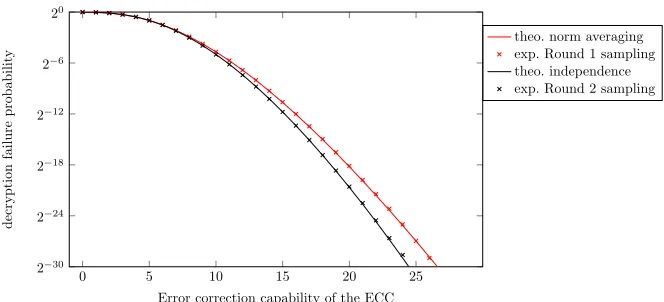
Figure 1 and Fig. 2 show the maximal failure rate for a given error correction capability of the ECC for LAC128 and LAC256, respectively. Both figures show four different data sets: 1) theoretical results only assuming stochastic indepen-dence of decryption failures conditioned on the norms of S and C (method in [3]); 2) experimental results using Round 1 sampling of LAC; 3) theoretical re-sults using the independence assumption; 4) experimental rere-sults using Round 2 sampling of LAC (fixed Hamming weight). The figures for both parameter sets show that the experimental results for Round 2 sampling perfectly match the theoretical results using the independence assumption. Therefore, we conclude that the stochastic dependence between decryption failures was significantly re-duced compared to Round 1. This is in accordance with the results presented in Table 1. As a result, the independence assumption approximates the real behaviour of decryption failures significantly better for Round 2 sampling com-pared to Round 1 sampling. Therefore, we consider the independence assumption to be valid for Round 2 sampling.
Table 1.Results for LAC128 and LAC256 (1st/2nd Round), 1011samples
Error distribution Pearson(abs)l1-distance I P[F0F1] P[F0S1] P[S0F1] P[S0S1]
LAC128 Round 1 8.852e-06 3.248e-09 5.477e-11 9.230e-09 9.170e-05 9.178e-05 0.99982 LAC128 Round 2 5.083e-06 1.805e-09 1.900e-11 7.430e-09 8.874e-05 8.879e-05 0.99982
LAC256 Round 1 1.032e-04 2.288e-06 7.546e-09 3.201e-05 5.575e-03 5.575e-03 0.98882 LAC256 Round 2 6.077e-06 1.347e-07 2.633e-11 3.143e-05 5.572e-03 5.572e-03 0.98882
6.2 Influence of the LWE Parameter Set (n, q, k) on the Stochastic Dependence
0 5 10 2−30
2−24 2−18 2−12 2−6 20
Error correction capability of the ECC
decryption
failure
probabilit
y
theo. norm averaging exp. Round 1 sampling theo. independence exp. Round 2 sampling
Fig. 1.Decryption failure probability depending on the error correction capability of the ECC (LAC-128)
0 5 10 15 20 25
2−30 2−24 2−18 2−12 2−6 20
Error correction capability of the ECC
decryption
failure
probabilit
y
theo. norm averaging exp. Round 1 sampling theo. independence exp. Round 2 sampling
Fig. 2.Decryption failure probability depending on the error correction capability of the ECC (LAC-256)
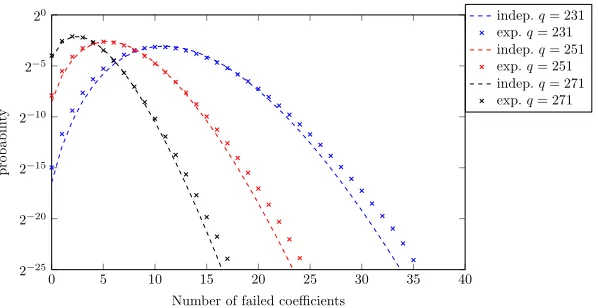
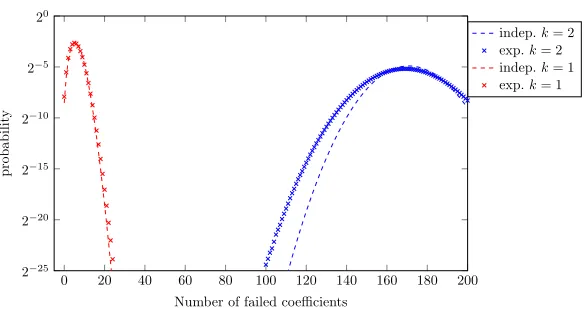
LAC256 having (n, q, k) = (1024,251,1) is used as a reference. Proceeding from this reference set each parameter has been varied to determine the respective pa-rameter’s influence on failure rate and stochastic dependence. In each figure, the experimentally determined decryption failure rates are compared with theoreti-cal results obtained using the independence assumption. It is hard to analyze the influence ofk for different values in LAC as its dependence on the failure prob-ability is extremely high. Therefore, in Appendix A experiments for NewHope parameters with increased variance of the error distribution are depicted. In ad-dition to Figures 3, 4 and 5, Table 2 shows the results obtained by the methods introduced in Section 5. Both results show that a higher decryption failure rate also leads to a larger deviation of the experimental data from the independence assumption. Therefore, larger values for n and k and smaller values for q in-crease the stochastic dependence of decryption failures and the independence assumption approximates the exact behaviour of decryption failures worse.
algorithms. The probability of obtaining large norms inS andC increases with largernandk. The decryption failure rate increases with larger norms ofS and
C and decreases with largerq. A decryption failure can only occur if the norms of S andC are larger than a certain threshold which depends on q. Obtaining a decryption failure in one coefficient reduces the possible set of norms (and increases the probability for higher norms), which increases the chance of a decryption failure in other coefficients. Correct decryption of a coefficient in comparison only changes the probabilities of the norms ofS and C. Therefore, as shown in the figures the stochastic dependence between decryption failures increases with higher n and k and lower q. As a consequence the inaccuracy implied by using the independence assumption for computing the failure rate of a cryptographic scheme is higher for schemes which rely on strong ECCs to obtain a low decryption failure rate.
0 5 10 15 20 25 30
2−25 2−20 2−15 2−10 2−5 20
Number of failed coefficients
probabilit
y
indep.n= 512 exp.n= 512 indep.n= 768 exp.n= 768 indep.n= 1024 exp.n= 1024
Fig. 3.Number of failed coefficients for fixedq= 251, andk= 1
0 5 10 15 20 25 30 35 40
2−25 2−20 2−15 2−10 2−5 20
Number of failed coefficients
probabilit
y
indep.q= 231 exp.q= 231 indep.q= 251 exp.q= 251 indep.q= 271 exp.q= 271
0 20 40 60 80 100 120 140 160 180 200 2−25
2−20 2−15 2−10 2−5 20
Number of failed coefficients
probabilit
y
indep.k= 2 exp.k= 2 indep.k= 1 exp.k= 1
Fig. 5.Number of failed coefficients for fixedn= 1024,q= 251
Table 2.Pearson correlation,l1−distance and mutual information for different param-eter sets (n,q,k). 1011 samples, except for parameter set (1024,251,2) - 109 samples, due to faster saturation of measures of stochastic dependence.
Parameter set Pearson(abs)l1-distance I P[F0F1] P[F0S1] P[S0F1] P[S0S1]
(512,251,1) 8.852e-06 3.248e-09 5.477e-11 9.230e-09 9.170e-05 9.178e-05 0.99982 (768,251,1) 5.445e-05 3.017e-07 2.105e-09 2.005e-06 1.387e-03 1.387e-03 0.99722 (1024,251,1) 1.032e-04 2.288e-06 7.546e-09 3.201e-05 5.575e-03 5.575e-03 0.98882 (1024,231,1) 1.414e-04 5.976e-06 1.406e-08 1.180e-04 1.068e-02 1.068e-02 0.97853 (1024,251,1) 1.032e-04 2.288e-06 7.546e-09 3.201e-05 5.575e-03 5.575e-03 0.98882 (1024,271,1) 6.897e-05 7.640e-07 3.384e-09 7.947e-06 2.777e-03 2.777e-03 0.99444 (1024,251,1) 1.032e-04 2.288e-06 7.546e-09 3.201e-05 5.575e-03 5.575e-03 0.98882 (1024,251,2) 5.063e-04 2.411e-04 1.371e-07 2.751e-02 0.13817 0.13817 0.69616
7
Conclusion
Acknowledgments. G. Maringer’s work was supported by the German Re-search Foundation (Deutsche Forschungsgemeinschaft, DFG) under Grant No. WA3907/4-1.
References
1. Alkim, E., Avanzi, R., Bos, J., Ducas, L., de la Piedra, A., P¨oppelmann, T., Schwabe, P., Stebila, D.: NewHope: Algorithm Specifications And Supporting Doc-umentation (2018), https://newhopecrypto.org/data/NewHope 2018 12 02.pdf 2. Avanzi, R., Bos, J., Ducas, L., Kiltz, E., Lepoint, T., Lyubashevsky, V.,
Schanck, J.M., Schwabe, P., Seiler, G., Stehl´e, D.: CRYSTALS-Kyber: Algo-rithm Specifications And Supporting Documentation (2019), https://www.pq-crystals.org/kyber/data/kyber-specification-round2.pdf
3. D’Anvers, J.P., Vercauteren, F., Verbauwhede, I.: The impact of error dependencies on ring/mod-lwe/lwr based schemes. Tech. rep., Cryptology ePrint Archive, Report 2018/1172 (2018)
4. Fluhrer, S.R.: Cryptanalysis of ring-lwe based key exchange with key share reuse. IACR Cryptology ePrint Archive2016, 85 (2016)
5. Fritzmann, T., P¨oppelmann, T., Sepulveda, J.: Analysis of error-correcting codes for lattice-based key exchange. In: International Conference on Selected Areas in Cryptography. pp. 369–390. Springer (2018)
6. Lu, X., Liu, Y., Jia, D., Xue, H., He, J., Zhang, Z.: Supporting documentation: LAC (2017), https://csrc.nist.gov/Projects/Post-Quantum-Cryptography/Round-2-Submissions
7. Lu, X., Liu, Y., Jia, D., Xue, H., He, J., Zhang, Z.: Supporting documentation: LAC (2017), https://csrc.nist.gov/Projects/Post-Quantum-Cryptography/Round-1-Submissions
8. Lyubashevsky, V., Peikert, C., Regev, O.: On ideal lattices and learning with errors over rings. In: Gilbert, H. (ed.) Advances in Cryptology – EUROCRYPT 2010. pp. 1–23. Springer Berlin Heidelberg, Berlin, Heidelberg (2010)
9. McEliece, R.: The theory of information and coding. Cambridge University Press (2002)
10. Regev, O.: On lattices, learning with errors, random linear codes, and cryptography. In: Proceedings of the Thirty-seventh Annual ACM Symposium on Theory of Computing. pp. 84–93. STOC ’05, ACM, New York, NY, USA (2005). https://doi.org/10.1145/1060590.1060603, http://doi.acm.org/10.1145/1060590.1060603
11. Saarinen, M.J.O.: Supporting documentation: HILA5 (2017),
https://csrc.nist.gov/Projects/Post-Quantum-Cryptography/Round-1-Submissions
A
Influence of
k
on the Stochastic Dependence
0 5 10 15 20 25 30 35
2−25 2−20 2−15 2−10 2−5 20
Number of failed coefficients
probabilit
y
indep. k=52 exp. k=52 indep. k=48 exp. k=48 indep. k=44 exp. k=44 indep. k=40 exp. k=40
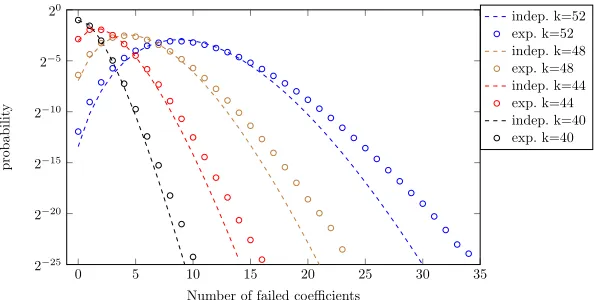
Fig. 6.Number of failed coefficients for fixedn= 1024,q= 12289
As mentioned in Subsection 6.2, NewHope parameters with an increased variance of the error distribution are used to show the influence of k on the stochastic dependence of decryption failures with finer granularity.
Figure 6 shows the influence of the variance of the error distribution on the probability of the number of decryption failures. The results show that increasing the variance increases the failure rate. It is also shown that the deviation between independence assumption and experimentally determined curves is increased for larger k.
Table 3 shows the Pearson correlation,l1-distance, and mutual information fork= 40 andk= 52. The results show an increase of the stochastic dependence whenkis increased.
Table 3.Pearson correlation,l1−distance and mutual information for different stan-dard deviations of the error distribution (1.8·109 samples)
Parameter set Pearson(abs)l1-distance I P[F0F1] P[F0S1] P[S0F1] P[S0S1]