Medk:,UouH1al ullhe 1�lallIk H�p\lbl" ,,' Itau
Vulurne 3 Number ).� l' .. yi1. & Zenrcsr:1U 13(011
Fall & Wintcr 1'111')
VITRECTOMY IN CHRONIC UVEITIS
HAMID AHMADIEH, MD, HAMID SAJJADI, MD, MOHSEN
AZARMINA, MD,
AND
HOOSHANG FAGHIHI, MD
From Ihe Depllrlme/1I oJ Opllflwlmology, LIl/Jbaji"III'jad Medical C('/lfi.'r, Shflhid Br:lwslui Ullil'enilY oJ Medical Sci('/IcL'J, Tehrall. Islall/ic Rt'pl/blic oJ /,.atl.
ABSTRACT
Vitrectomy was performed on
25eyes in
21
patients with chronic uveitis
from various etiologies. Postoperative follow up averaged
22.8months with
visual improvement in
24
of
25eyes.
In this retrospective study, the techniques employed and the beneficial
effect of vitrectomy alone or vitrectomy combined with cataract surgery
(Iensectomy in most cases) on improving vision and decreasing the number
and severity of recurrent attacks of uveitis are reviewed. Also, the indica
tions of surgery, the effect of the surgical procedure on intraocular pressure,
the prognostic factors and the management of complications are discussed.
MJ/RI, Vol.3, No.3 & 4,113-117,1989INTRODUCTION
Chronic uveitis frequently leads to cataract forma tion and vitreous organization. Angle closure glauco ma, traction retinal detachment, cystoid macular ede ma, and ocular hypotony are other important com plications which are seen in uveitic eyes.
Surgical removal of cataract in these eyes is compli cated by iris atrophy, posterior synechiae, bleeding from abnormal iris vasculature. and severe postopera tive inflammation. I
This article reviews the indications, surgical techni ques and the results or vitrectomy combined with cataract surgery or vitrectomy alone in 25 eyes of 21 patients suffering from chronic uveitis.
PATIENTS AND METHODS
The records of 25 eyes of 21 patients with chronic uveitis that had consecutively undergone pars plana or pars plicata vitreclomy alone or combined with c�llar act surgery were reviewed.
There were 11 females and 10 males with an average age of 21 years (range rivc to 61 years). The patients were followed postoperatively for an average period of 22.8 months (range six to 48 months). The diagnosis of uveitis was classified as pars planitis (three eyes), Behcel's syndrome (four eyes), .lRA-induced uveitis
(six eyes). Fuch's heterochromic iridocyclitis (five eyes) and idiopathic pan uveitis (seven eyes).
All patients considered for surgery had a visual acuity of 20/200 or less except case Sb who had a visual acuity of 20180 before the operation (Table f).
The duration of symptoms ranged fro 111 one year to 16 years with an average of
3.2
years.Clinically significant lens opacity was prescnt in 22 eyes preoperatively. Moderate vitreous opacity includ ing vitreous veil was present in case of Fuch's heter ochromic iridocyclitis, and condensation of vitreous,
secondary to longstanding vitritis was found in cases of pars planitis and panuveitis, Fresh vitreous hemor rhage was visible in all cases of JRA uveitis.
The important associated ocular pathology con sisted of band keratopathy in five eyes (including all
JRA
cases). posterior synechiae in 13 eyes (includingrable I. Prcuperlltive vision or 25 eyes undcr�olng vitrectomy with Uf without Clltaruct surgery
Visiun
2U12U-2(1I40 2015U-20/100 2u/2UU-CF
I-IM -LP
Towl
Number
16 8
25
%
4% 64')'0 32%
100%
all cases of JRA and Beche!'s syndrome but no post
erior synechiae in cases of Fuch's heterochromic iri
docyclitis and pars planitis). severe ocular hypotony
(lOP
< �mmHg) in seven eyes (cases 6. Xa. 811.
12.15.
17. 19). ocular hypertension (lOP> 22 mml-Ig) in one
eye (case 1) and rhegmntogenous retinal detachment in
one eye (case 15).
Preoperative evaluation of all patients included
medical history. routine eye examination ancl lahora
tory investigations. Prior to surgery. thorough ex
amination of the peripheral retina was done. In many of
the cases. the peripheral retina could be examined with
scleral depression despite significant media haziness. If
found necessary. contact A and B scan cchography was
used to determine the degree of vitreous opncification.
status of the retina, thickening of the choroid and the
presence of a cyclilic membrane.
Preoperative administration of steroid via topical.
subtenon and systemic routes was accomplished
10minimize the inflammation. Some of the patients re
ceived an intramuscular injection of hydrocortisone 50
mg. six hours and
IOUmgone hour before the beginning
of the su rgery. 111 t raoperative in jectioll of hydrocort i
sone was accomplished via IV drip.
Surgical Tc
c
hnhluc:The patients were prepared with maximum dilation
although in most cases posterior synechiae prevented
good dilation. The 2U gauge sclerotomy incisions were
made with a disposable knife at
In.12 and 2 o'clock
meridians. 3-3.5 n1l11 from surgical limbus. Pars plicaw
approach was chosen in patients six years old or
younger.
120'c1ock meridian sclerotomy was used for
infusion cannula and 10 and 2 o'clock meridian sclor
otomics were used for vitrcclOmy probe and fiberoptic
light pipe. The posterior synechiae were broken with
the tip of the vitreclOmy probe: the probe was passed
betwcen the iris and the anterior lens capsule and the
adhesions werc released. A few drops of ten times
diluted mixture of epinephrine and atropine were
injected around the pupil and immediately suctioned.
If the pupil still remained miotic, sphincterectomy and
pupilloplasty was performed.
Cataract Surgery:
Cataract surgery was combined
with vitrectomy in 22 eyes. Lensectomy was done with
vitrectomy probe in 16 eyes and by ultrasonic frag
mentation in two eyes. Both the anterior and posterior
capsules were removed. In a 6 1
year old patient (case
5), ICCE was dnne followed by vitreclOmy in the same
session. In three eyes (cases 10. 11,20). the extracapsu
lar method was chosen for extraction of the nucleus and
then the remnunts of cortex as well as the anterior and
posterior capsules were removed via the closed pars
plana approach.
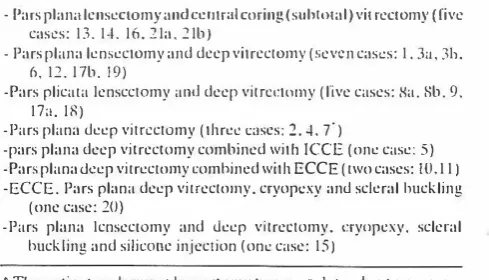
Table II. SUlllmar)' ofthc surgical prucedures pcrformcd for 25 c.\'cs
- Pars plan'llcnseclOmy and CCllt rOIl coring (sull1ll1al) vit rectomy (rive cases: 13.1·1. Ill.1Ia. :!Ib)
- Pars plana lensectomy and dccp vitrcctol11Y (!:ievcn cas!.!s: 1.3:1.311. 6.11. I7b. 19)
-Pars plicata IenscclOmy amI deep vitn:L:ttJIllY (live cases: Xa. Sb. 9. 17,..IR)
-Pars plana ueep viln:clOmy (threc C<lScs: 2. -I. 7')
-pars plana deep vitrcctomy combined with leCE (one case: 5) -Pars planalkep vitrectol11Y comhilH.:d with ECCE (two cases: 10.11) -ECCE. Pars plana deep vitrectolllY. cryop!.!xy anu sckral huck ling
(one case: 20)
-Pars plana 1cnseclOmy and Jeep vitreclomy. t:rynpexy. scleral huck ling and siliwllc injection (on..: case: 15)
• The patit:nt unuerwcnl knsectorny Iwo years I,Lter dUL' to progress urlhe lens opat::ity.
Vitrectomy:
In cases of Fuch's heterochromic
cyclitis only core vitrectomy was done. Deep vilrec
tomy was accomplished in other cases. Peeling of the
prcrctinal mcmbranes was carried out when nccessary
witll the aid of intraocular forceps. In case 15 with
associated retinal detachment and PVR. deep vitrec
tomy as well as scleral buckling. cryopexy and silicone
oil injection was performed. The retina was realtached
and silicone oil removal was done three months later.
The procedures for all25 eyes have been summarized in
Table II. The infusion solution (BSS) ustlally contained
dexamethasone 8 /Lglml as well as gentamicin 4 /Lglml.
Alternatively. intraocular injection of 400 /Lg of de
xamelhasone and 100 J.Lg of gentamicin was done in the
end of the surgical procedure. After closure of the
sclerotomy sites and conjunctiva. subtenon injection of
40 mg of long acting methylprednisolonc acetate and 40
mg of gentamicin was carried out.
Postoperative Treatment:
Postoperalive treatment
was with topical steroids. antibiotics and cycloplcgics
plus systemic steroids which were gradually tapered
and then discontinued in most c[tses aftersubsidencc of
all inflammatory reactions. The ilverage time of cessa
tion of topical steroids was 9 months after the opera
tion. Systemic steroids were tapered and stopped one
month after the surgery except in five patients (cases 2,
10.
II.17. 19) in whom because of postoperative
exacerbations. low doses of oral steroids were con
tinucd. administered every other day.
RESULTS
The preoperative and postoperative evaluations of
25 eyes with chronic uveitis treated by pars plana or
pars plicata vitrectomywith or without cataract surgery
are shown in Table 111.
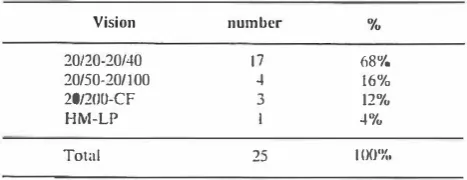
The visual results after surgical treatment are shown
in Tables IV and V. Vision of 20140 or better was
Vitrectomy In Chronic Uveitis
Table III. Prcopcratil'C ,md poslopcr:lIivc c\':lluations (If 15 eyes wilh chronic uvcitis undergoing pars pluna/purs plicala vilrcclomy with or without cataract surgery
Duration of Poslopcr.
Case Sex/Age Diagnllsis Symptums Preoperative . I . .lIive Visual
(yenfs) ()'cOIrs) VISIJ:I aCUIty lIeuily
FIX JRA 3 lWJOII 20110U
2 F/S IdiopathiL' lOt-fUU lW4lJ rmlluvcilis
3a FIIJ hJiopalitic 4 00:201·100 2W2tl panu\'citis
3b FIIJ Idiop;Hhic 4 OS:2fV8UU 211120 paml\'Cilis
4 MJ2H Pars HM 101 .. HI
planitis
5 F161 Idiopathic 20140U 20125 panuvcilis
6 MJIJ Idiopathic 2 LP 201.1UU
panu\'cilis
7 �VIX Pars 2 20/S(X) 20/4()
planitis
Sa FI6 JRA OO:H M 20130
Rb FIn JRA I OS:20/S() 10125
9 F/6 JRA I CFall0cm 20/S0
IU M/4() Beheel 9 HM lOJRO
II M/46 Bechet 16 201400 201·10
12 M/.18 Bcheet 4 LP 201X()O
13 M125 Fuch's 2 CFat 50cm 20/25
14 M/23 FucJl's 4 CFal20cm ZUl20
15 F126 Idiopathic 3 CFal20 cm 2U/SO
pan uveitis
16 M125 FllCh's 3 LP 20/25
17a F/6 JRA 4 OO:LP 20/.1U
1 7b F/9 JRA 7 OS:2012f){] 20/25
IS F/5 Pars I 20/4()U 201]0
p1 anilis
19 rvtI16 Bechet 2 LP LP
20 FI39 Idiopathic 2tl1S00 2U1100
21<1 F122 2 00:20/2tHJ 10110
lib FI21 Fuch's 2 OS:2U/400 111125
achieved in 17 of25 eyes (68%) but visual improvemenl occurred in 24 of 25 eyes (96%). The reasons for postoperative vision less than 20/40 are shown in Table VI. All of the eyes with preoperative diagnosis of Fuch's helerochromic iridocyclitis reached the final visual acuily of 20/25 or 20120. The only patient with no postoperative improvement in his visual acuity had the diagnosis of Behcel's syndrome (case 19). Severe optic atrophy and retinal ischemia were present as sequelae of longstanding occlusive vasculitis in this patient's eye. Rubeosis iridis eventually occurred.
Complications: The only intraoperative complica tion was severe hemorrhage in case 12 which originated from the dense cyclitic membrane but was successfully controlled.
pre all. Post 01'
lOP 101' Date of PustopcruUyc Subsequent
mmHg llullHg OPCnllioll COInplicatiolls surgery
27 9 12I241X6 RO Scleral huck ling Cyc]ocryulhcrapy 12 14 111141S5
II 12 J 0/29/S6
II 12 IIWX7
12 III 4f221S7
IJ 12 12J3/H6
4 IU 7/27185
10 14 11/23185 progress of Ll.!nsectomy
lens opacity 6 [5 4118/R8 Vitreous
hemorrhagl.! 4 14 51 I 81SS
9 10 1216188
10 I� '1J1�/S9
13 12 [/3[/S8
2 2 31 [/X6 Exuuativc RD
I� 14 5111/X5 Peripheral Cryotherapy relinaileilr of the tear 8 12 S/61X6
3 10 4112186 Silicone oil
removal 10 10 4110187
Zero R 12116/85
8 X 91 121SS
10 14 2121/87
4 Zero 1/30mX Ruhcosis iridis
hypotony (4 12 5114/88
10 15 9129/88 Fungal Deep vilrcctorny
cndophthalmitis 10 1 4 41291S7
Posloperative complications included:
1)
rhegma togenous retinal detachment in case 1 which occurred five monlhs after combined lensectomy-vilreclomy bUI retina became reattached following scleral buckling, 2) immediate postoperative exudative retinal detach ment in case 12 that resolved 10 days later,3)
progress of lens opacity in case 7 who had undergone vitreclomy alone; lensectomy was done two years after the first operation, (4) a peripheral horseshoe tear was found in case 13 six months after lensectomy-vitrectomy. Trans conjunctival cryotherapy of the lear was performed, 5) postoperative vilreous hemorrhage (rebleeding) occurred in case 8a a few days after surgery but was spontaneously absorbed, 6) fungal endophthalmitis occurred in case 21a but this complication wasTahle IV. I'oslnpcrativc visual rC5ultsctJIlsidcrilig the type and etinlllgYllf uveilis
Uingu()sis Nu ltJ/20�10/�O lO/:,O-20/JIIO 10/20n·CF HM-LP
Funcil"silc(crochromiccyciitis 5 St 1011'1..)
Pars planitis 3 3( ilIOn!.,)
JRA (, -1(67%) 2(33[1.,)
Bchcct's symJromc ·1
fully managed with medical treatment and deep vitrcc tomy. The final visual acuity reached 20120.
Postoperative Intraocular Pressure: The intraocu
lar pressure remained high and uncontrolled despite medications postoperatively, necessitating the per
formance of cyclocryotherapy in case I.
Ocular hypotony persisted only in two cases (cases 12, 19) but it was eliminated in the other five eyes which had suffered from hypotony preoperatively.
Exacerbations: Recurrence of inflammation occurred postoperatively in six eyes (cases 2, 10, 11, 17a, 17b and 19) but the exacerbations were mild and easily controlled. Low doses of oral steroids (predniso lone) were continued as every other day administration in these patients.
DISCUSSION
During the past decade, there has been increasing evidence that vitrectomy has a significant therapeutic role in the management of chronic uveitis.
Diamond and Kaplan' first reported the results of combined lensectomy and vitrectomy in 15 eyes of 13 patients. The follow up period of their patients was short but postoperative improvement in vision of all of the operated eyes was observed. Previously, the final results of conventional intracapsular or extracapsular lens extraction performed for complicated cataract of uveitic eyes had been disappointing because of numer ous complications which frequently followed the surgery, including severe postoperative innammation, development of pupillary and cyclitic membranes, aggravation of vitreous haziness, traction retinal de tachment, macular edema, ocular hypotony, and occa sionally phthysis bulbi.
Regarding the type and etiology of uveitis, we reached the following conclusions:
The final results in cases of Fuch's heterochromic cyclitis were excellent.
No preoperative active- neovascularization of the vitreous base was present in our pars planitis cases. All of them had postoperative visual acuities of 20/40 or better and none required further surgery.
All of our JRA cases had early onset, pauciarticular type of the disease. Band keratopathy, posterior
1 (25%) l(15'r..) 1(25%) 1 (25'Yu)
sjmechiae, complicated cataract and fresh vitreous hemorrhage originating from cyclitic membrane were present in each of these cases preoperatively. Half of the operated eyes suffered from preoperative severe ocular hypotony. The hypotony was eliminated follow ing lensectomy-vitrectomy. The case with preopera tive glaucoma needed antiglaucoma medications post operatively and even cyclocryotherapy was required. All of our J RA cases achievcd postoperative vision of 20/100 or better, two-thirds of them gaining visual acuities of 20/40 or better.
Cases of Behcel's syndrome usually have poor visual prognosis. It is due to the presence of oplie atrophy, chorioretinal scars and severe retinal ische mia secondary to chronic, inappropriately trealed occlusive vasculitis.
Regarding the reasons for postoperative vision less than 20/40, it is noteworthy to consider amblyopia as a significant factor in cases of early onset JRA.
Different formsof maculopathy, e.g, macular puck er, macular choriorctinal scars and healed retinal detachments with previous macular involvement had a significant role in decreasing the postoperative vision of our cases.
Optic atrophy contributed to decreased postopera tive vision in the cases of Bechel's syndrome.
In summary, 24 of25 eyes with chronic uveitis from various etiologies which underwent pars plana/pars plicata vitrectomy with or without cataract surgery had
improvement in their vision postoperatively. 68% of
these cases attained visual acuities of 20/40 or better. These eyes were made as quiet as possible before the operalion by means of topical, periocular and systemic steroids. The surgical precedure did not lead to aggravation of the innammation. On the cOnlmry it
Table V. Postoper.lth·e visual results in 25 eyes undergoing vitrcc tomy with or without cataract surgery
Vision number %
20/20-20/40 17 68"/Q
20150-201100 4 16"/ ..
20/2IJU-CF 3 12%
HM-LP 1 4%
Total 25 100%
Vitrectomy In Chronic Uveitis
Table VI. Reasons for vision less thun 20/40 in 25 eyes undergoing vilrcctomy wilh or without cataract surgery
Case 1 Band keralopathy t amblyopia, previous RD with macular
involvement
Cnsc 6 Amblyopiil, macular pucker Case 9 Amblyopia
Case 10 Panial optic anophy. previous macular choriorctinal scar Case 12 Optic atrophy. previous mtlcuiar choriorctinal scar
Case 15 Band kcratopathy. previous RD
Case 19 Severe optic atrophy, occlusion Bf all vessels. extensive choriorctinal scars
Case 20 Band kcralopalhy, mtlcular pucker
had a good effect on the uveitis course, decreasing the frequency and severity of exacerbations. Also, it had a beneficial effect on the intraocular pressure, eliminat ing the preoperative hyopotony in most cases.
REFERENCES
I. Foster CS. Fang LP, Singh G: Calaract surgcI")' and intraocul'lf lens implantation in patients with uveitis. Ophthalmology 1989;
96: 281·288.
2. DiamondJO, Kaplan Hl: Lenscctomy and vitrcctomyforcompli cat cd catamct secondary to uveitis. Arch ophthi.llmol 1979;
1798-1804.
3. Diamond 10, Kaplan Hl: Uveitis: effect of vitrectomycombincd
with lensectomy. Ophthalmology 1979; 86 : 1320-1327. 4. Kaplan HJ, Diamond JG, Brown SA: Vitrectomy in experimental
uveitis. Arch. OphthalmoJ 1979; 97: 331-340.
5. Belmont JB, Michelson JB: Vitrcctomy in uveitis Dssociated with ankylosing spondylitis. Am J Ophthalmol 1982; 94: 300-304. 6. Nolthenius PA, Deutman AF: Surgical treatment of the complica
tions of chronic uveitis. Ophthalmologica 1983; 186: 11-16. 7. NobeJR, Kokoris N, Oiddie KR, elaJ: Lensectomy-vilrectomy in
chronic uveitis. Retina 1983; 3: 71-76.
8. Girard U, Rodriguez], Mailman ML, et al: Cataract and uveitis management by pars plana lenseclomy and vitreclomy by ultra sonic fragmcmation. Retina 1985;5: 107-117.
9. Mieler WF, Brain RW, Lewis H, et a1: Vitrectomy in the
management of peripheral uveitis. Ophth;'llmology, 1988; 95:
859-864.
10. Flynn HW, Oi.lvis lL, Culbertson WW: Purs plana lensectomy and vitrcctomy forcomplicated cataracts injuvenile rhcumalOid arthritis. Ophthalmology 1988; 95: 1114·1119.
11. Foster CS: Vitrectomy in the management of uveitis. Ophthal mology 1988.95: 1011-1012.