Open Access
Research article
A rapidly evolving secretome builds and patterns a sea shell
Daniel J Jackson
1,2, Carmel McDougall
1,4, Kathryn Green
1, Fiona Simpson
3,
Gert Wörheide
2and Bernard M Degnan*
1Address: 1School of Integrative Biology, University of Queensland, Brisbane Qld 4072, Australia, 2Department of Geobiology, Geoscience Centre, University of Göttingen, Goldschmidtstr.3, 37077 Göttingen, Germany, 3Institute of Molecular Biosciences, University of Queensland, Brisbane Qld 4072, Australia and 4Department of Zoology, University of Oxford, Tinbergen Bldg., South Parks Road, Oxford OX1 3PS, UK
Email: Daniel J Jackson - [email protected]; Carmel McDougall - [email protected];
Kathryn Green - [email protected]; Fiona Simpson - [email protected]; Gert Wörheide - [email protected]; Bernard M Degnan* - [email protected]
* Corresponding author
Abstract
Background: Instructions to fabricate mineralized structures with distinct nanoscale architectures, such as seashells and coral and vertebrate skeletons, are encoded in the genomes of a wide variety of animals. In mollusks, the mantle is responsible for the extracellular production of the shell, directing the ordered biomineralization of CaCO3 and the deposition of architectural and color patterns. The evolutionary origins of the ability to synthesize calcified structures across various metazoan taxa remain obscure, with only a small number of protein families identified from molluskan shells. The recent sequencing of a wide range of metazoan genomes coupled with the analysis of gene expression in non-model animals has allowed us to investigate the evolution and process of biomineralization in gastropod mollusks.
Results: Here we show that over 25% of the genes expressed in the mantle of the vetigastropod
Haliotis asinina encode secreted proteins, indicating that hundreds of proteins are likely to be contributing to shell fabrication and patterning. Almost 85% of the secretome encodes novel proteins; remarkably, only 19% of these have identifiable homologues in the full genome of the patellogastropod Lottia scutum. The spatial expression profiles of mantle genes that belong to the secretome is restricted to discrete mantle zones, with each zone responsible for the fabrication of one of the structural layers of the shell. Patterned expression of a subset of genes along the length of the mantle is indicative of roles in shell ornamentation. For example, Has-sometsuke maps precisely to pigmentation patterns in the shell, providing the first case of a gene product to be involved in molluskan shell pigmentation. We also describe the expression of two novel genes involved in nacre (mother of pearl) deposition.
Conclusion: The unexpected complexity and evolvability of this secretome and the modular design of the molluskan mantle enables diversification of shell strength and design, and as such must contribute to the variety of adaptive architectures and colors found in mollusk shells. The composition of this novel mantle-specific secretome suggests that there are significant molecular differences in the ways in which gastropods synthesize their shells.
Published: 22 November 2006
BMC Biology 2006, 4:40 doi:10.1186/1741-7007-4-40
Received: 27 July 2006 Accepted: 22 November 2006
This article is available from: http://www.biomedcentral.com/1741-7007/4/40
© 2006 Jackson et al; licensee BioMed Central Ltd.
Background
The ability to synthesize rigid, mineralized structures is an essential trait to the majority of metazoan taxa. Verte-brates, echinoderms, mollusks, arthropods, brachiopods, bryozoans, annelids, cnidarians and sponges, amongst others, construct a spectacular diversity of endo- and exo-skeletons as well as sensory and protective structures from a range of minerals [1]. The importance of this trait is highlighted by the observation that the so called 'Cam-brian explosion' was accompanied by the diversification of biomineralization mechanisms [2-4], despite the fact that several lineages possessed this ability before the end of the Proterozoic [5]. It is currently unknown whether the molecular mechanisms used to create these structures have been inherited from an ancestral biomineralization repertoire, invented de novo, or are the result of an unprecedented lateral genetic transfer [6].
The evolutionary origins, mode of construction, pattern-ing and physical properties of the molluskan shell have held the attention of scientists for centuries, however the molecular mechanisms by which these structures are con-structed are only now beginning to be elucidated [7-9]. The mollusk shell is assembled extracellularly and is an
ensemble of CaCO3 and organic macromolecules
(pro-teins, glycopro(pro-teins, lipids and polysaccharides), which are secreted by the mantle epithelium. The anterior edge of the mantle tissue underlies the lip of the shell and directs the ordered biomineralization of the different structural layers of the shell and controls the patterning of architectural and color features. While the structure and function of a number of shell matrix proteins have recently been characterized [7,10-17], the regulatory mechanisms that govern these shell-building processes remain largely unknown.
It has long been acknowledged that the diversity of shell types found in gastropod, bivalve and scaphopod mol-lusks are achieved through the ordered secretion of pro-teins and other molecules along the length of mantle [18-21], however the full complexity and role of differential gene activity in the mantle remains undescribed. The color, structure and geometric pattern of a sea shell is a historical record of the incorporation of proteins into the shell matrix and onto its surface, and directly reflects the gene expression activity of the mantle during the life of a
mollusk [22]. Using the vetigastropod Haliotis asinina
(tropical abalone) as a model, we sought to determine the complexity of the mantle transcriptome. Abalone shells are composed of three structurally-distinct layers: (i) the inner nacreous (flat pearl) layer, consisting of layers of aragonitic tablets encased within organic sheaths; (ii) the calcitic prismatic layer, also containing organic macro-molecules; and (iii) the outer periostracum, a thin organic veneer that protects and decorates the shell [23]. The
ante-rior edge of the abalone mantle epithelium is convoluted and partitioned into discrete zones that produce each of these layers [24]. Within each of these zones are a number of cell types, which contribute to the construction and patterning of the shell [25,26].
Here we assess the complexity of gene expression in the H. asinina mantle, and explore the regulatory and structural factors that contribute to the construction of the shell. Pre-vious studies have demonstrated that the organic compo-nent of the shell (often comprising less than 5% by dry weight) is essential to its construction, and confers its remarkable physical properties. For example, Lustrin-A [11,27] is thought to impart fracture resistant, elastomeric properties to the nacreous layer, while macromolecules isolated from calcitic or nacreous environments can direct the type of polymorph of CaCO3 that will be deposited in vitro [28-30]. Unfortunately, shell matrix proteins are often insoluble, highly acidic or complexed with miner-als, making their purification very difficult [31]. To gain a broader understanding of the molecular processes that underlie seashell construction, we have analyzed expressed sequence tags (ESTs) from the mantle of juve-nile H. asinina. This approach allows for the identification of gene products that are not necessarily incorporated into the shell, but are nonetheless crucial for CaCO3 precipita-tion and other biomineralizaprecipita-tion events within the pallial space adjacent to the mantle. Other mantle-localized, secreted gene products not involved in biomineralization will also be detected by this methodology. We have
com-pared this EST set with the recently sequenced L. scutum
(Patellogastropoda) genome in order to infer the degree of evolutionary conservation between shell building secretomes within one molluskan class.
Results and discussion
Structure of H. asinina shell and mantle
The juvenile shell of H. asinina is an ideal model system with which to study the molecular events of shell con-struction and patterning. A complex but regular chromatic pattern adorns the outermost layer of the shell, the perios-tracum. Here, a series of dots (either blue or orange) are laid down on top of the ridges of the shell. The color of the dot will be blue if it overlies a brown/red background, or orange if it overlies a cream background (Figure 1a–c). This model system is such that it allows for the spatial mapping of gene expression profiles within the mantle to patterning and structural events at the leading edge of the shell.
anterior edge. Between the two main folds (the inner and outer folds) lies the periostracal groove (Figure 1e–g), into which the periostracum is secreted and then extruded onto the dorsal surface of the shell. We have identified a second minor fold within the mantle of H. asinina that we have termed the anterior crease of the outer fold (Figure 1e, f and 1h). Although we cannot yet assign a specific function to this structure, the fact that it possesses an abundance of microvilli (Figure 1h) suggests that it is actively secreting substances responsible for shell or peri-ostracum construction.
Mantle expressed sequence tags
We have sequenced 530 randomly selected clones from a cDNA library constructed from the juvenile mantle tissue of the tropical abalone, Haliotis asinina (Linnaeus). These sequences are available under GenBank accession num-bers DW986183 to DQ298397. This tissue was taken from juveniles maintained in warm water (26–28°C) that were rapidly depositing shell material, approximately 50
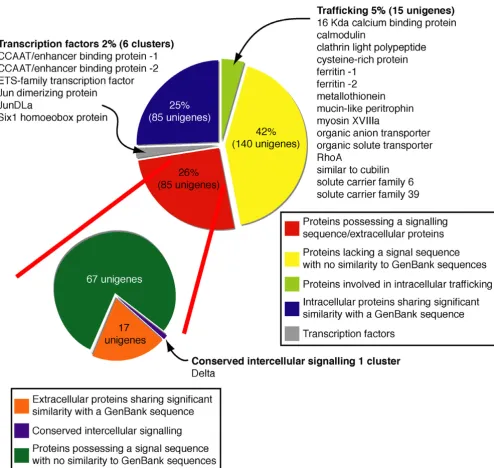
μm per day [32]. From this survey, we have identified 331 unique EST clusters (unigenes) that are expressed in the mantle (Figure 2; Additional file 1). Based on the presence of conserved signal sequences and similarity to secreted proteins in GenBank (Figure 2) we conservatively estimate that 26% of these (85 unigenes) encode secreted proteins. Amongst the 140 unigenes that lack both significant sim-ilarity to sequences lodged in public databases (Figure 2) and a signal sequence, some may be secreted via mecha-nisms alternative to the classical signal peptide pathway. Of the 106 intracellular unigenes that encode proteins with significant similarity to GenBank sequences, 15 encode trafficking and mineral binding proteins, and are likely to represent mechanisms essential for the supply of
shell building components. For example, based upon in
situ hybridization analyses (see below) and previous stud-ies on bivalves [33,34], ferritin and calmodulin are likely to be playing fundamental and evolutionarily ancient roles in shell construction within the Mollusca.
When compared with EST surveys in other metazoan tis-sues (e.g. various mouse [35], pufferfish [36] and human [36,37] proteomes), a markedly higher proportion (~two-fold) of the genes expressed in the abalone mantle encode secreted proteins. By extrapolation, we estimate that hun-dreds of proteins are released extracellularly from the mantle, and contribute to the fabrication of the shell. This estimate however needs to take into consideration non-biomineralizing secreted proteins that do not possess sim-ilarity with previously described GenBank sequences. This estimate is in marked contrast to the current number of biomineralizing proteins isolated from the shells of other gastropods and bivalves. With efforts chiefly focused on the characterization of proteins from the nacreous layer [38-41], fewer than 20 protein families have been shown
The tropical abalone as a model for understanding molluskan biomineralization
Figure 1
to contribute to shell formation to date [7,8]. Strikingly, of the 85 unigenes that encode putative secreted proteins in the Haliotis asinina mantle, 67 (80% of the secretome) do not share significant similarity to any sequences in GenBank (Figure 2). However, several novel secreted open reading frames (ORFs) possess motifs comparable to pro-teins in other organisms, such as GGYGLGL repeats – sim-ilar to the elasticity regions of Spidroin, an elastomeric
spider silk protein [42] – and proline-rich repeats (LXPLSXIPVXXPXAX) as found in plant cell walls [43]. In comparison, 140 of the 246 intracellular genes (57%) do not match sequences in GenBank.
Interestingly, BLAST alignments between H. asinina
man-tle ESTs and genomic trace sequences from the gastropod
L. scutum, which is estimated to be sequenced to 8×
cover-Categorization of 331 genes expressed in the H. asinina mantle
Figure 2
age and is currently being assembled [44], reveals that only 13 of the 67 (19%) novel secreted proteins in Haliotis
appear to have identifiable homologues in the Lottia
genome (Additional file 2). These 13 genes may be involved in conserved aspects of shell construction in gas-tropods and possibly other mollusks. In contrast, the remaining 54 novel secreted proteins are likely to either represent genes that evolved after these gastropod lineages split, have been lost in the Lottia lineage or a combination of these two scenarios. Likewise, many previously discov-ered molluskan shell matrix genes do not have clear
homologues in the Lottia genome (See Additional File 3
for results of these searches against Lottia genome traces). The few shell matrix proteins, such as Lustrin [11], Perlu-cin [45] and Mucoperlin [46], are likely to be conserved components of molluskan shells, although their general function in shell fabrication and evolutionary origins are currently unknown. Together, these data suggest that the complex secretome involved in mollusk shell construc-tion is encoded primarily by rapidly evolving genes.
Localized expression of mantle genes
In order to infer the function of a subset of these ESTs, we selected 22 for spatial expression analysis on the basis of whether they were novel, predicted to be secreted, pos-sessed repetitive domains and/or shared significant simi-larity with a gene likely to play a role in biomineralization (Figure 3). Of these, 11 are novel and one appears to have
a homologue only in the Lottia genome (i.e.
gastropod-specific; Figure 3M). The spatial expression patterns of these 22 mantle ESTs reveals a diversity of territories and cell types in the mantle (Figure 3), and highlights the modular nature of the mantle tissue [24]. Some of these (9 of 22) are expressed homogenously in one or more zones responsible for the creation of different shell layers. For example, LustrinA, first isolated from Haliotis rufescens, the gene product of which contributes to the elastomeric properties of the nacreous layer [11,27,47-50], is expressed, along with two other novel genes, in the man-tle territory responsible for the production of the inner nacreous layer (Figure 3X–Z). Other evolutionarily con-served genes, including calmodulin and a calcium-bind-ing protein, are expressed continuously along the length of the mantle within both the inner fold and the anterior crease of the outer fold (Figure 3I–L), while others, such as ferritin, are expressed only in the outer fold (Figure 3M, N). The shared spatial expression of ferritin and calmodu-lin genes between the Bivalvia and Gastropoda suggests they play a conserved role in the formation or modifica-tion of the periostracum [34,51]. The remaining 13 genes analyzed here are restricted to specific mantle territories and are expressed discontinuously along the length of the mantle; either in the inner fold alone (Figure 3E–G), the inner mantle fold and the anterior crease of the outer fold (Figure 3H), the anterior crease of outer fold alone (Figure
3O–V), or the anterior zone of the outer fold the mantle (Figure 3W). The dynamic spatial expression of these genes along the length of the mantle, regardless of precise zone, implies that they are contributing to the patterning of shell structure and/or coloration [52,53].
Blue pigmentation gene
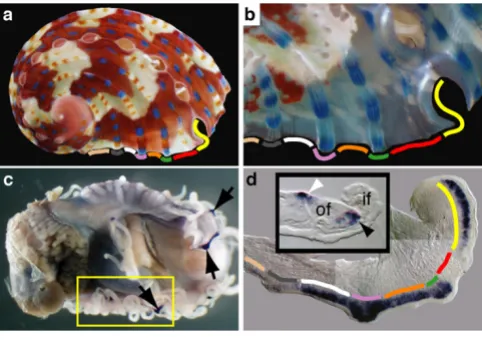
Has-sometsuke (HasSom) is the only gene in this study to be expressed in the anterior zone of the outer fold of the mantle (Figure 3W and 4) and the only gene to map pre-cisely to a shell pigmentation pattern (Figure 4). HasSom
transcripts are only detected in territories of the mantle that underlie regions of the shell that are producing blue dots and fields of red, which become blue upon de-calci-fication (Figure 1). Blue dots (Figure 1a) correspond to zones of high HasSom expression relative to regions of red (Figure 4). The relative abundance (blue dot or red field) or absence (cream field) of this single gene product is con-sistent with a role in creating the juvenile shell pattern. Interestingly, BLAST alignments indicate the derived Som-etsuke protein shares weak similarity to the ependymins, a family of rapidly evolving extracellular glycoproteins previously only found in deuterostomes ([[54]; Supple-mentary Figure 1] and Additional File 4). There is cur-rently no evidence of this protein family encoded in ecdysozoan and basal metazoan genomes; we could not detect an ependymin gene within the Lottia, Nematostella, Amphimedon or Hydra genomes. Ependymin is highly expressed in vertebrate cerebrospinal fluid [55] and may be involved in echinoderm tissue regeneration [56]. With disparate roles in these three phyla and apparent loss from many genomes, it is difficult to infer the ancestral role of this protein in the Bilateria. However, various functional features of this protein, including its ability to bind cal-cium [57] and to undergo polymerization into insoluble fibrils [55] support a role for Sometsuke in shell construc-tion and patterning.
Conclusion
The spatial expression profiles of the genes surveyed here support the supposition that specific mantle zones influ-ence the crystal morphology of discrete layers of the mature shell. Underlying these structural differences is a zone-specific secretome. It appears likely that highly dynamic gene expression patterns along the length of a given mantle zone contribute to shell patterning. In the case of juvenile H. asinina, these patterns include: the ridge and valley architecture; the periodic formation of respiratory pores, the regular deposition of blue and orange colored dots on the ridges, and the swathes of cream and red/brown fields that cover the shell. The
cor-respondence of HasSom expression with shell coloration
under-Modular spatial expression of mantle ESTs
Figure 3
standing the molecular basis of structural and color pat-terning.
The modular design of the molluskan mantle [24,58], along with distinct patterning mechanisms within each zone, allows for immense variation in shell structure and pattern in shell-building mollusks. This morphogenetic system, combined with a complex and rapidly evolving secretome, as revealed here, is likely to have provided the foundation from which the incredible diversity of mol-luskan shell shapes and patterns has evolved. Despite the advantages of this approach to the rapid identification of novel biomineralizing proteins, it must be pointed out that common post-translational modifications (glycosyla-tion, lipid transfer etc.) that are likely to greatly increase the diversity of the organic matrix, will not be detected by this approach, and further underscores the fact that we are some way from a detailed understanding of how nature generates these functional and beautiful structures.
Methods
Library construction, sequencing and EST annotation
A directionally cloned cDNA library was constructed from total RNA extracted from the mantle tissue of ten 7–15
mm juvenile H. asinina using a BD Biosciences SMART
library construction kit. Phages were converted into plas-mid DNA following the manufacturer's instructions and
sequenced using ABI chemistry v 3.1 [59]. EST sequences were clustered using ClustalW [60,61] and inspected visu-ally to yield consensus contiguous sequences and a non-redundant collection of ESTs. ESTs were first annotated based on SWISSPROT and NCBI nucleotide, protein and EST database searches at the National Center for Biotech-nology Information (NCBI) using the BLAST [62] family of programs [63] and classified according to function [64]. At the time of writing 900,172,457 L. scutum traces were available from the NCBI trace archive [65]. These traces were downloaded and searched against our dataset using the standalone BLAST package (TBLASTx and TBLASTn algorithms with default gap costs and the BLOSUM62 matrix). Putative ORFs were identified in ESTs either through sequence similarity or ORF Finder [66] and manual inspection. Among the novel ESTs (those ESTs sharing no significant similarity with publicly available sequences) only ORFs larger than 50 codons, encoded by the positive strand, and beginning with a methionine residue were accepted. All conceptually derived protein sequences were assessed for the presence of a leader sequence using the SignalP 3.0 [67] server [68] and were classified into extracellular or intracellular cate-gories. An EST encoding a novel protein was only accepted as destined for secretion if both SignalP 3.0 algorithms (neural network and hidden Markov model) identified the presence of a signal peptide and a cleavage site, and if the Markov model probability was higher than 90% (in most cases this was >95%). Sequences are deposited at NCBI under accession numbers DW986183 to
DW986511. Has-vm2 and Has-lustrin have accession
num-bers DQ298397 and DQ298402 respectively.
In situ hybridization, histology and electron microscopy
Juveniles (1–10 mm) of H. asinina were relaxed with 1 M
MgCl2 in seawater and then fixed for 1 h in 4%
parafor-maldehyde, 0.1 M 3-(N-morpholino) propane sulfonic
acid pH 7.5, (MOPS), 2 mM MgSO4, 1 mM
ethylenegly-coltetra-acetic acid (EGTA) and 0.5 M NaCl. Fixed animals were then washed five times with 100% ethanol and stored in 75% ethanol at -20°C. All DIG-labeled ribo-probes were produced using either SP6, T3 or T7 RNA polymerase and a PCR amplicon of the desired clone. Sev-eral sense controls were performed with probes of various GC contents and lengths to assess background patterns. Endogenous alkaline phosphatase activity of the mantle tissue was also assessed and found not to be present fol-lowing the in situ procedure. Whole mount in situ hybrid-ization (WMISH) was performed as previously described [69] usually at a hybridization temperature of 62°C.
Sec-tions (6 μm) were produced by mounting juveniles that
had undergone WMISH in EPON 812 and sectioning using a Leica Ultracut T. Prior to WMISH shells were removed by incubation in 1× PBS, 4% paraformaldehyde and 350 mM EDTA. Gene expression within the mantle
HasSom expression correlates with shell pigmentation
Figure 4
HasSom expression correlates with shell pigmenta-tion. (a) Juvenile H. asinina shell prior to whole mount in situ
hybridization against HasSom. (b) The same shell partially decalcified. (c) Dorsal view of shell-less juvenile illustrating
HasSom expression (arrows). (d) Dissected portion of the mantle (corresponding to the boxed region in c). Coloured lines indicate corresponding regions of the shell and perios-tracum in (a) and (b). A cross section (insert) shows HasSom
was correlated to shell patterning activity by photograph-ing individual shells prior to decalcification and relatphotograph-ing this to WMISH results.
For transmission electron microscopy, juveniles were relaxed as described above and mantle tissue was dis-sected and processed according to [70]. Briefly, tissue was
prefixed in low osmium (0.05% OsO4 in 4%
glutaralde-hyde, 0.2 M Na cacodylate, 0.1 M NaCl and 0.35 M sucrose, pH 7.2) for 10 min. This was followed with a pri-mary fixation in the same fixative, but lacking osmium, for 1 h. The tissue was then washed twice in buffer (0.3 M NaCl and 0.2 M Na cacodylate, pH 7.2) before a post
fix-ation in osmium (1% OsO4, 0.3 M NaCl and 0.2 M Na
cacodylate, pH 7.2) for 1 h. Samples were then dehy-drated through a graded series of ethanol, embedded in EPON 812 and 60 nm sections taken using a Leica Ultracut T. Sections were stained with uranyl acetate and lead citrate and viewed in a JEOL JEM 1010 transmission electron microscope at 80 kV.
For scanning electron microscopy, whole juveniles with the shell removed were fixed and dehydrated as described above, then infiltrated and dried overnight in hexameth-yldisilisane. Juveniles and unfixed shells were mounted on stubs, sputter-coated with platinum and viewed in a JEOL JSM 6300 scanning electron microscope at 15 kV.
Authors' contributions
DJJ contributed to the conception and design of the project, analysis and interpretation of the data, carried out molecular genetic studies, phylogenetic analyses and drafted the manuscript. CM conducted molecular genetic studies. KG conducted histological and electron micros-copy studies. FS contributed to the conception and design of the project and the analysis of EST data. GW contrib-uted to the conception and design of the project and drafted the manuscript. BMD contributed to the concep-tion and design of the project, analysis and interpretaconcep-tion of the data and drafted the manuscript.
Additional material
Acknowledgements
This work was supported by grants from the Australia Research Council and The University of Queensland to B.M.D. and the German Research Foundation (DFG, Project Wo896/4-1 COSMAP) to G.W. The QDPI Bri-bie Island Aquaculture Research Centre kindly provided research support and provision of culturing facilities. Oliver Voigt kindly assisted with Perl scripts. Lottia genomic sequences used in this study are in the public domain. We acknowledge the significant contribution of US Department of Energy Joint Genome Institute and the Lottia sequencing group in producing this genomic resource.
References
1. Dove PM, De Yoreo JJ, Weiber S, (Eds): Biomineralization Mineralogi-cal Society of America; 2004.
2. Marshall CR: Nomothetism and understanding the Cambrian "explosion". Palaios 2005, 13:195-196.
3. Knoll AH: Biomineralization and evolutionary history. Rev Mineral Geochem 2003, 54:329-356.
4. Morris SC: The Cambrian "explosion": slow-fuse or megaton-nage? Proc Natl Acad Sci USA 2000, 97:4426-4429.
5. Porter SM, Meisterfeld R, Knoll AH: Vase-shaped microfossils from the Neoproterozoic Chuar group, Grand Canyon: a classification guided by modern testate amoebae. J Paleontol-ogy 2003, 77:409-429.
6. Kirschvink JL, Hagadorn JW: A grand unified theory of biominer-alization. In The Biomineralisation of Nano- and Micro-Structures Edited by: Weinheim BE. Wiley; 2000:139-150.
7. Marin F, Luquet G: Molluscan shell proteins. Comptes Rendus Palevol 2004, 3:469-492.
8. Wilt FH, Killian CE, Livingston BT: Development of calcareous skeletal elements in invertebrates. Differentiation 2003, 71:237-250.
Additional File 1
Table 1: Complete list of H. asinina mantle ESTs and associated TBLASTX and BLASTN results.
Click here for file
[http://www.biomedcentral.com/content/supplementary/1741-7007-4-40-S1.doc]
Additional File 2
Table 2: Genes reported to be involved in molluskan biomineralization that were searched against the Lottia scutum genome.
Click here for file
[http://www.biomedcentral.com/content/supplementary/1741-7007-4-40-S2.doc]
Additional File 3
Table 3: H. asinina mantle ESTs and biomineralization genes that share significant similarity with a Lottia scutum genomic trace.
Click here for file
[http://www.biomedcentral.com/content/supplementary/1741-7007-4-40-S3.doc]
Additional File 4
Fig. 5: Phylogenetic analysis of Has-sometsuke (HasSom). (a) An unrooted parsimony tree (1000 bootstrap replicates) and (b) an unrooted Bayesian phylogram (200,000 generations, 1,000 burn in trees) illustrate the divergent nature of both Haliotis asinina and Strongylocentrotus purpuratus ependymin-like sequences from previously reported epend-ymin sequences. In agreement with a previous phylogenetic analysis [56], the echinoderms Lytechinus variegatus and Holothuria glaberima form a clade in association with the mammalian and Xenopus sequences. The amphioxus and Strongylocentrotus purpuratus sequences were not included in this previous analysis. (c) The protein alignment used to gen-erate the trees shown in (a) and (b). Accession numbers are indicated. Alignments were created with both ClustalW and Dialign, compared and manually optimized. Arrows indicate conserved cysteine residues that are characteristic of the ependymin proteins [54]. Red arrow indicates the presence of a cysteine residue only in the H. asinina, S. purpuratus and amphioxus sequences. Asterisk indicates the loss of a cysteine residue in S. purpuratus. Figures following alignments are percentage identities and percentage positives respectively and were generated by significant pair-wise bl2seq alignments between HasSom and each individual sequence. Click here for file
9. Wilt FH: Developmental biology meets materials science: morphogenesis of biomineralized structures. Dev Biol 2005, 280:15-25.
10. Weiner S, Sagi I, Addadi L: Choosing the crystallization path less traveled. Science 2005, 309:1027-1028.
11. Shen XY, Belcher AM, Hansma PK, Stucky GD, Morse DE: Molecu-lar cloning and characterization of lustrin A, a matrix pro-tein from shell and pearl nacre of Haliotis rufescens. J Biol Chem 1997, 272:32472-32481.
12. Duplat D, Puissegur M, Bedouet L, Rousseau M, Boulzaguet H, Milet C, Sellos D, Van Wormhoudt A, Lopez E: Identification of cal-conectin, a calcium-binding protein specifically expressed by the mantle of Pinctada margaritifera. FEBS Lett 2006, 580:2435-2441.
13. Weiss IM, Gohring W, Fritz M, Mann K: Perlustrin, a Haliotis lae-vigata (Abalone) nacre protein, is homologous to the insulin-like growth factor binding protein N-terminal module of ver-tebrates. Biochem Biophys Res Comm 2001, 285:244-249.
14. Mann K, Weiss IM, Andre S, Gabius H-J, Fritz M: The amino-acid sequence of the abalone (Haliotis laevigata) nacre protein perlucin. Detection of a functional C-type lectin domain with galactose/mannose specificity. Eur J Biochem 2000, 267:5257-5264.
15. Miyamoto H, Miyashita T, Okushima M, Nakano S, Morita T, Matsu-shiro A: A carbonic anhydrase from the nacreous layer in oys-ter pearls. Proc Natl Acad Sci USA 1996, 93:9657-9660.
16. Samata T, Hayashib N, Konoa M, Hasegawac K, Horitad C, Akerad S: A new matrix protein family related to the nacreous layer formation of Pinctada fucata. FEBS Lett 1999, 462:225-229. 17. Addadi L, Joester D, Nudelman F, Weiner S: Mollusk shell
forma-tion: a source of new concepts for understanding biominer-alization processes. Chemistry – A European Journal 2006, 12:980-987.
18. Lowenstam HA, Weiner S, (Eds): On Biomineralization Oxford, Oxford University Press; 1989.
19. Weiner S, Traub W: Macromolecules in mollusk shells and their functions in biomineralization. Phil Trans Royal Soc London B- Biol Sci 1984, 304:425-&.
20. Wainwright SA: Stress and design in bivalved mollusc shell. Nature 1969, 224:777-779.
21. Kniprath E: Ontogeny of the molluscan shell field – a review. Zoologica Scripta 1981, 10:61-79.
22. Brusca RC, Brusca GJ: Invertebrates Second edition. Sinauer; 2002. 23. Saleuddin ASM, Petit HP: The mode of formation and the
struc-ture of the periostracum. In The MolluscaVolume 4. Edited by: Saleuddin ASM, Wilbur KM. New York. Academic Press; 1983. 24. Jolly C, Berland S, Milet C, Borzeix S, Lopez E, Doumenc D: Zonal
localization of shell matrix proteins in mantle of Haliotis tuberculata (Mollusca, Gastropoda). Mar Biotech 2004, 6:541-551.
25. Saleuddin ASM: An electron microscopic study of the forma-tion and structure of the periostracum in Astarte (Bivalvia). Can J Zoology 1974, 52:1463-1471.
26. Bevelander G, Nakahara H: An electron microscope study of the formation and structure of the periostracum of a gastropod, Littorina littorea. Calc Tiss Int 1970, 5:1-12.
27. Zhang B, Wustman BA, Morse D, Evans JS: Model peptide studies of sequence regions in the elastomeric biomineralization protein, lustrin A. I. The Cdomain consensusPG, -NVNCT-motif. Biopolymers 2002, 63:358-369.
28. Thompson JB, Paloczi GT, Kindt JH, Michenfelder M, Smith BL, Stucky G, Morse DE, Hansma PK: Direct observation of the transition from calcite to aragonite growth as induced by abalone shell proteins. Biophys J 2000, 79:3307-3312.
29. Falini G, Albeck S, Weiner S, Addadi L: Control of aragonite or calcite polymorphism by mollusk shell macromolecules. Sci-ence 1996, 271:67-69.
30. Zaremba CM, Belcher AM, Fritz M, Li YL, Mann S, Hansma PK, Morse DE, Speck JS, Stucky GD: Critical transitions in the biofabrica-tion of abalone shells and flat pearls. Chem Mater 1996, 8:679-690.
31. Gotliv BA, Addadi L, Weiner S: Mollusk shell acidic proteins: in search of individual functions. Chem Biochem 2003, 4:522-529. 32. Jackson D, Williams KC, Degnan BM: Suitability of Australian
for-mulated diets for aquaculture of the tropical abalone Haliotis asinina Linnaeus. J Shellfish Res 2001, 20:627-636.
33. Li S, Xie LP, Zhang C, Zhang Y, Gu MZ, Zhang RQ: Cloning and expression of a pivotal calcium metabolism regulator: cal-modulin involved in shell formation from pearl oyster (Pinctada fucata). Comp Biochem Physiol B 2004, 138:235-243. 34. Zhang Y, Meng QX, Jiang TM, Wang HZ, Xie LP, Zhang RQ: A novel
ferritin subunit involved in shell formation from the pearl oyster (Pinctada fucata). Comparative Biochemistry and Physiology B
2003, 135:43-54.
35. Grimmond SM, Miranda KC, Yuan Z, Davis MJ, Hume DA, Yagi K, Tominaga N, Bono H, Hayashizaki Y, Okazaki Y, et al.: The mouse secretome: functional classification of the proteins secreted into the extracellular environment. Gen Res 2003, 13:1350-1359.
36. Klee EW, Carlson DF, Fahrenkrug SC, Ekker SC, Ellis LBM: Identify-ing secretomes in people, pufferfish and pigs. Nucleic Acids Research 2004, 32:1414-1421.
37. Clark HF, Gurney AL, Abaya E, Baker K, Baldwin D, Brush J, Chen J, Chow B, Chui C, Crowley C, et al.: The Secreted Protein Discov-ery Initiative (SPDI), a large-scale effort to identify novel human secreted and transmembrane proteins: A bioinfor-matics assessment. Gen Res 2003, 13:2265-2270.
38. Katti KS, Katti DR, Pradhan SM, Bhosle A: Platelet interlocks are the key to toughness and strength in nacre. J Mat Res 2005, 20:1097-1100.
39. Nassif N, Pinna N, Gehrke N, Antonietti M, Jager C, Colfen H: Amorphous layer around aragonite platelets in nacre. Proc Natl Acad Sci USA 2005, 102:12653-12655.
40. Lin A, Meyers MA: Growth and structure in abalone shell. Mat Sci Eng A 2005, 390:27-41.
41. Fu G, Valiyaveettil S, Wopenka B, Morse DE: CaCO3 biominerali-zation: acidic 8-kDa proteins isolated from aragonitic aba-lone shell nacre can specifically modify calcite crystal morphology. Biomacromolecules 2005, 6:1289-1298.
42. van Beek JD, Hess S, Vollrath F, Meier BH: The molecular struc-ture of spider dragline silk: folding and orientation of the protein backbone. Proc Natl Acad Sci USA 2002, 99:10266-10271. 43. Wilson RC, Long F, Maruoka EM, Cooper JB: A new proline-rich
early nodulin from Medicago truncatula is highly expressed in nodule meristematic cells. Plant Cell 1994, 6:1265-1275. 44. JGI sequencing plans [http://www.jgi.doe.gov/sequencing/cspseq
plans.html]
45. Weiss IM, Kaufmann S, Mann K, Fritz M: Purification and charac-terization of Perlucin and Perlustrin, two new proteins from the shell of the mollusc Haliotis laevigata. Biochem Biophys Res Comm 2000, 267:17-21.
46. Marin F, Corstjens P, de Gaulejac B, de Vrind-De Jong E, Westbroek P: Mucins and molluscan calcification. Molecular characteri-zation of mucoperlin, a novel mucin-like protein from the nacreous shell layer of the fan mussel Pinna nobilis (Bivalvia, Pteriomorphia). J Bio Chem 2000, 275:20667-20675.
47. Wustman BA, Weaver JC, Morse DE, Evans JS: Characterization of a Ca(II)-, mineral-interactive polyelectrolyte sequence from the adhesive elastomeric biomineralization protein lustrin A. Langmuir 2003, 19:9373-9381.
48. Wustman BA, Morse DE, Evans JS: Structural analyses of polye-lectrolyte sequence domains within the adhesive elasto-meric biomineralization protein Lustrin A. Langmuir 2002, 18:9901-9906.
49. Smith BL, Schaffer TE, Viani M, Thompson JB, Frederick NA, Kindt J, Belcher A, Stucky GD, Morse DE, Hansma PK: Molecular mecha-nistic origin of the toughness of natural adhesives, fibres and composites. Nature 1999, 399:761-763.
50. Wustman BA, Weaver JC, Morse DE, Evans JS: Structure-function studies of the Lustrin A polyelectrolyte domains, RKSY and D4. Conn Tiss Res 2003, 44:10-15.
51. Li S, Xie LP, Ma ZJ, Zhang RQ: cDNA cloning and characteriza-tion of a novel calmodulin-like protein from pearl oyster Pinctada fucata. FEBS J 2005, 272:4899-4910.
52. Meinhardt H, Prusinkiewicz P, Fowler DR: The Algorithmic Beauty of Sea Shells Berlin Springer-Verlag; 1995.
53. Meinhardt H, Klinger M: A model for pattern formation on the shells of molluscs. J Theoretical Biol 1987, 126:63-89.
Publish with BioMed Central and every scientist can read your work free of charge "BioMed Central will be the most significant development for disseminating the results of biomedical researc h in our lifetime."
Sir Paul Nurse, Cancer Research UK
Your research papers will be:
available free of charge to the entire biomedical community
peer reviewed and published immediately upon acceptance
cited in PubMed and archived on PubMed Central
yours — you keep the copyright
Submit your manuscript here:
http://www.biomedcentral.com/info/publishing_adv.asp
BioMedcentral 55. Shashoua VE: Monomeric and polymeric forms of ependymin:
a brain extracellular glycoprotein implicated in memory consolidation processes. Neurochem Res 1988, 13:649-655. 56. Suarez-Castillo EC, Medina-Ortiz WE, Roig-Lopez JL, Garcia-Arraras
JE: Ependymin, a gene involved in regeneration and neuro-plasticity in vertebrates, is overexpressed during regenera-tion in the echinoderm Holothuria glaberrima. Gene 2004, 334:133-143.
57. Ganss B, Hoffmann W: Calcium-binding to sialic acids and Its effect on the conformation of ependymins. Eur J Biochem 1993, 217:275-280.
58. Winther RG: Varieties of modules: kinds, levels, origins, and behaviors. J Exp Biol 2001, 291:116-129.
59. Sambrook J, Russell DW: Molecular cloning: a laboratory manual 3rd edition. Cold Spring Harbor, New York Cold Spring Harbor Labora-tory Press; 2001.
60. Chenna R, Sugawara H, Koike T, Lopez R, Gibson TJ, Higgins DG, Thompson JD: Multiple sequence alignment with the Clustal series of programs. Nucleic Acids Res 2003, 31:3497-3500. 61. ClustalW [http://www.ebi.ac.uk/clustalw/index.html]
62. Altschul SF, Madden TL, Schaffer AA, Zhang J, Zhang Z, Miller W, Lip-man DJ: Gapped BLAST and PSI-BLAST: a new generation of protein database search programs. Nucleic Acids Res 1997, 25:3389-3402.
63. BLAST [http://www.ncbi.nlm.nih.gov/BLAST/]
64. Lee Y-H, Huang GM, Cameron RA, Graham G, Davidson EH, Hood L, Britten RJ: EST analysis of gene expression in early cleavage-stage urchin embryos. Development 1999, 126:3857-3867. 65. Trace archive [http://www.ncbi.nlm.nih.gov/Traces/trace.cgi?] 66. ORF finder [http://www.ncbi.nlm.nih.gov/gorf/orfig.cgi]
67. Dyrlov Bendtsen J, Nielsen H, von Heijne G, Brunak S: Improved prediction of signal peptides: SignalP 3.0. J Mol Biol 2004, 340:783-795.
68. SignalP 3.0 [http://www.cbs.dtu.dk/services/SignalP/]
69. Giusti AF, Hinman VF, Degnan SM, Degnan BM, Morse DE: Expres-sion of a Scr/Hox5 gene in the larval central nervous system of the gastropod Haliotis, a non-segmented spiralian lopho-trochozoan. Evol Dev 2000, 2:294-302.
70. Eisenman EA, Alfert M: A new fixation procedure for preserving the ultrastructure of marine invertebrate tissues. J Microscopy