R E S E A R C H A R T I C L E
Open Access
Best practice for motor imagery: a systematic
literature review on motor imagery training
elements in five different disciplines
Corina Schuster
1,2, Roger Hilfiker
3, Oliver Amft
4,5*, Anne Scheidhauer
1, Brian Andrews
6,7, Jenny Butler
2,
Udo Kischka
1,8and Thierry Ettlin
1,9Abstract
Background:The literature suggests a beneficial effect of motor imagery (MI) if combined with physical practice, but detailed descriptions of MI training session (MITS) elements and temporal parameters are lacking. The aim of this review was to identify the characteristics of a successful MITS and compare these for different disciplines, MI session types, task focus, age, gender and MI modification during intervention.
Methods:An extended systematic literature search using 24 databases was performed for five disciplines: Education, Medicine, Music, Psychology and Sports. References that described an MI intervention that focused on motor skills, performance or strength improvement were included. Information describing 17 MITS elements was extracted based on the PETTLEP (physical, environment, timing, task, learning, emotion, perspective) approach. Seven elements describing the MITS temporal parameters were calculated: study duration, intervention duration, MITS duration, total MITS count, MITS per week, MI trials per MITS and total MI training time.
Results:Both independent reviewers found 96% congruity, which was tested on a random sample of 20% of all references. After selection, 133 studies reporting 141 MI interventions were included. The locations of the MITS and position of the participants during MI were task-specific. Participants received acoustic detailed MI instructions, which were mostly standardised and live. During MI practice, participants kept their eyes closed. MI training was performed from an internal perspective with a kinaesthetic mode. Changes in MI content, duration and dosage were reported in 31 MI interventions. Familiarisation sessions before the start of the MI intervention were mentioned in 17 reports. MI interventions focused with decreasing relevance on motor-, cognitive- and strength-focused tasks. Average study intervention lasted 34 days, with participants practicing MI on average three times per week for 17 minutes, with 34 MI trials. Average total MI time was 178 minutes including 13 MITS. Reporting rate varied between 25.5% and 95.5%.
Conclusions:MITS elements of successful interventions were individual, supervised and non-directed sessions, added after physical practice. Successful design characteristics were dominant in the Psychology literature, in interventions focusing on motor and strength-related tasks, in interventions with participants aged 20 to 29 years old, and in MI interventions including participants of both genders. Systematic searching of the MI literature was constrained by the lack of a defined MeSH term.
* Correspondence: [email protected]
4
Faculty of Electrical Engineering, Technical University Eindhoven, Eindhoven, The Netherlands
Full list of author information is available at the end of the article
Introduction
In sports psychology, there is evidence that mental prac-tice (MP) can accelerate learning and improve motor skills. In their extensive meta-analysis in 1983, Feltz and Landers included single-group interventions with pre-and post-tests (tests before pre-and after the interventions), and studies with multiple groups to compare an MP group versus controls [1]. They summarised 60 studies regardless of their quality and methods. Analysis of effect sizes showed that performing MP is not as good as physical practice (PP) but is better than doing no practice at all. In their revised meta-analysis in 1988, they replicated the previous results [2].
MP can be considered an umbrella term that includes various mental training interventions. In recent years, researchers have started to use the term‘motor imagery’ (MI) to specifically address the imagination of moving specific body parts.
Over the past two decades, the publication of MP lit-erature has increased tremendously, from 122 publica-tions up to 1980 to a total of 20,011 publicapublica-tions in 2009 (PubMed search on 12 April 2010 with the search term
‘mental practice’). The MI technique has been adopted in other research areas (education, medicine, music and sports), where the beneficial effect of MI added to PP has been confirmed, and 27 reviews summarise the research findings in those fields [1-27]. Despite the different review foci (for example, history and development of MI, theoretical concepts of MI functioning and effectiveness evaluation), all reviews attribute a beneficial effect to MI when added to PP. In some reviews, the methodological procedure lacked a systematic approach.
Aim of the current systematic literature review
None of the published reviews have analysed the design of the MI training session (MITS) to determine success-ful MI intervention techniques, such as the position of the person during MI, the number of MI trials, and the instruction mode and type. However, the MITS design is of vital importance for researchers and clinicians planning to implement MI interventions adapted to par-ticipant health status, age and gender. In this systematic literature review, we extracted and analysed 17 MITS elements based on the PETTLEP (physical, environment, timing, task, learning, emotion, perspective) approach. Furthermore, we analysed seven temporal parameters, including duration times and number of repetitions. In total, we analysed five disciplines in which MI repre-sents an important training strategy.
Imagery models and frameworks in the education and psychology literature
Hall described the cognitive processes and neural basis of MI in a review on educational literature, based on a
MEDLINE search [7]., and proposed a six-stage procedure for explicit learning of surgical skills: task definition, prior learning, mental rehearsal, reflection, problem solving and reality check.
In psychology, various tasks, participant groups and reporting statistics have been considered for MI. Driskell
et al. summarised the effects of MP and determined under which conditions MI was most effective [13]. They defined five conditions of interest: 1) type of task, 2) retention interval, 3) experience level of trainees, 4) length of practice and 5) type of control group. The results of their meta-analysis showed a positive effect of MI when the following criteria were met: examination mainly of the cognitive aspects of the task performance, short retention interval, participants being novices to the task, and the MI session being about 20 minutes or shorter. They reported a non-significant trend for larger effects of MI compared with a non-treatment group and with an equivalent control treatment group.
Imagery models and frameworks in the sports literature
Integrative Model in Sport (MIIMS) includes four MI outcomes: 1) motor learning and performance; 2) motivation, self-confidence and anxiety; 3) strategies and problem-solving; and 4) injury rehabilitation. The scheme aimed to combine different imagery types (visual, kinaesthetic, olfactory, tactile and auditory) to create a complete mental version of the movement [26].
Motor imagery in medicine
MI research from sports psychology has been used in medicine, particularly in neurological rehabilitation [11-13]. Literature reviews have evaluated the overall beneficial effect of MI [5,9,11], but none has described the MITS elements or temporal parameters. In this review, we analysed the MITS elements and temporal parameters that have been successfully used in different disciplines: Education, Medicine, Music, Psychology and Sports (in this review, we use the term‘Sports’for all studies that include athletes as participants and the term
‘Psychology’for all studies including healthy participants who are not athletes).
Methods
Search terms and search strategy
Search terms were identified by a previous search of databases (including PubMed) and internet search engines (including Google and Google Scholar). Addi-tionally, each searched database was checked for pre-defined MeSH terms, and where available, these terms were integrated into the search strategy. The following terms were used: ‘mental imagery’, ‘mental practice’,
‘mental rehearsal’,‘mental movements’,‘eidetic imagery’,
‘visual imagery’,‘guided imagery’, ‘motor imagery’ and
‘mental training’. The Appendix provides the complete search strategy for Scopus. The Scopus search strategy was adapted to individual databases and trial registers to account for specific vocabulary and syntax rules. No restrictions were made regarding year of publication, study design or age of the study population.
Study identification
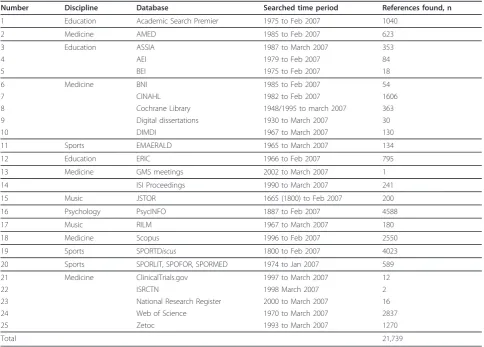
Table 1 provides an overview of all databases, trial and dissertation registers, and conference proceedings searched. Database retrievals were imported into a reference management software package (EndNote; Thomson Reuters, Carlsbad, CA, USA). In total, 21,739 references were retrieved in February 2007. The litera-ture search was repeated in June 2010 for references published between spring 2007 and 2010 in the largest databases of each discipline: the Education Resources Information Center (ERIC), Scopus, Répertoire Inter-national de Littérature Musicale (RILM), PsycINFO and SPORTDiscus. This search resulted in 5,741 additional references.
Study selection criteria
The references were selected for review inclusion based on the following criteria:
•Any design of quantitative intervention studies with a focus on imagining movements.
•Studies that included healthy volunteers, students, children, professionals, athletes or patients from any discipline.
• Study intervention that focused on motor skill, performance or strength improvement.
The following exclusion criteria were used:
•Mental practice not related to movements (audition, odour, any kind of visual imagery with static pictures).
•Mental practice based on a computer-animated tech-nique (virtual reality).
•Mental practice used during a functional magnetic resonance imaging (fMRI) session.
• Mental practice carried out during hypnosis or psychotherapy (guided imagery, eidetic imagery).
•Mental practice used as mental rotation or diagnos-tic tool.
•Suggested frameworks without participant evidence or experience.
•Publication language other than English or German.
Selection process
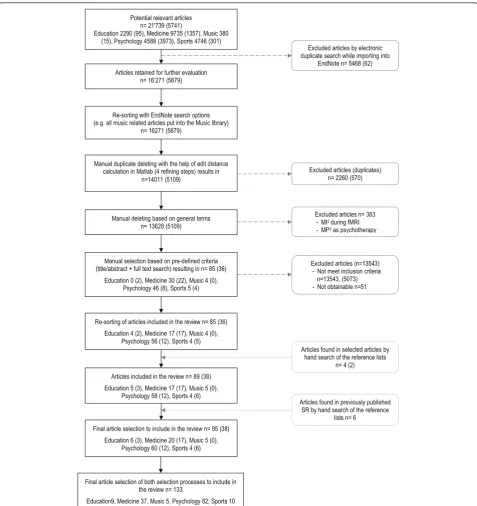
During the manual selection process (Figure 1), articles were evaluated based on title, abstract or keywords. Two of the authors (CS and RH) reviewed the articles; CS evaluated all references, and RH evaluated a ran-domly selected proportion (20%) of the initial number of references selected from each discipline. Full texts were ordered if no decision could be made based on the available information. If one reviewer could not reach a decision for a reference, this reference was discussed by both reviewers, and if both reviewers had not been able to agree on a decision (which was not the case in this investigation) a third reviewer (JB) would have been consulted.
Owing to the large number of references, EndNote search options were used to eliminate studies based on the exclusion criteria.
To confirm the selection congruency between both independent reviewers, the inter-rater congruency was calculated. Reviewer agreement ranged between 78% and 100% (average 96%) for the five disciplines. Because some studies reported more than one MI intervention, the total exceeded the number of included studies. Each MI intervention was subsequently analysed as an independent investigation.
Data extraction
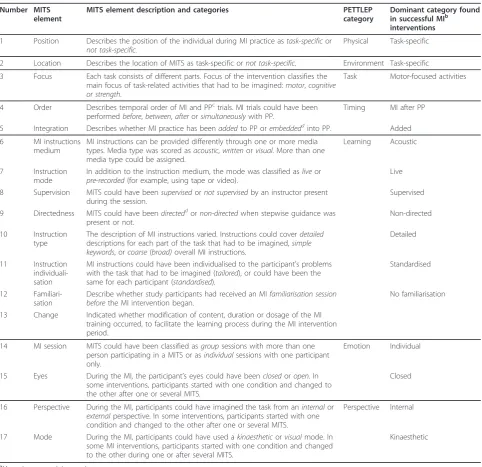
(RB, AS, CS) and checked for accuracy (CS). Table 2 summarises all extracted information. Figure 2 illustrates the temporal parameters and the MITS terminology.
Study quality rating
Two rating lists were used because studies with different quantitative designs were included. The Physiotherapy Evidence Database (PEDro) list was used to evaluate randomised controlled trials (RCTs) (maximum of ten points) and non-RCTs (maximum of eight points) [32]. For case series or single cases experimental designs, the 11-point Single Case Experimental Design (SCED) scale was used [33]. All studies were rated by CS based on detailed rating guidelines. Studies received one point for each fulfilled methodological criterion on the respective rating list. The higher the achieved score, the better the study quality.
Data analysis
Raw information was extracted into Excel (Microsoft Corp., Redmond, WA, USA). After coding and classifica-tion, MI intervention data was imported into statistical analysis software packages (SPSS versions 16 and 17 (SPSS Inc., Chicago, IL, USA), MATLAB version 2009b (The MathWorks Inc., Natick, MA, USA)) for frequency ana-lyses, frequency and mean comparison tests and visualisa-tion. MI intervention data was not pooled or analysed for significant differences because of the variability in experi-mental settings and missing information in MI interven-tion descripinterven-tions. The heterogeneity between MI interventions was also present in standard deviations of temporal parameters. All MI interventions were classified into two categories: positive change (129 MI interventions, 91.5%), and no or negative change from pre- to post-test (12 MI interventions, 8.5%). MITS elements and temporal Table 1 Overview of searched databases, trial and dissertation registers and conference proceedings, and the
number of references found
Number Discipline Database Searched time period References found, n
1 Education Academic Search Premier 1975 to Feb 2007 1040
2 Medicine AMED 1985 to Feb 2007 623
3 Education ASSIA 1987 to March 2007 353
4 AEI 1979 to Feb 2007 84
5 BEI 1975 to Feb 2007 18
6 Medicine BNI 1985 to Feb 2007 54
7 CINAHL 1982 to Feb 2007 1606
8 Cochrane Library 1948/1995 to march 2007 363
9 Digital dissertations 1930 to March 2007 30
10 DIMDI 1967 to March 2007 130
11 Sports EMAERALD 1965 to March 2007 134
12 Education ERIC 1966 to Feb 2007 795
13 Medicine GMS meetings 2002 to March 2007 1
14 ISI Proceedings 1990 to March 2007 241
15 Music JSTOR 1665 (1800) to Feb 2007 200
16 Psychology PsycINFO 1887 to Feb 2007 4588
17 Music RILM 1967 to March 2007 180
18 Medicine Scopus 1996 to Feb 2007 2550
19 Sports SPORTDiscus 1800 to Feb 2007 4023
20 Sports SPORLIT, SPOFOR, SPORMED 1974 to Jan 2007 589
21 Medicine ClinicalTrials.gov 1997 to March 2007 12
22 ISRCTN 1998 March 2007 2
23 National Research Register 2000 to March 2007 16
24 Web of Science 1970 to March 2007 2837
25 Zetoc 1993 to March 2007 1270
Total 21,739
parameters of studies with positive change were sum-marised under the term‘average positive MI intervention’ and used for comparison in three analyses.
First, trend analyses were performed to identify MITS elements for MI interventions with positive results ver-sus no changes or negative results. Further analyses aimed to identify changing trends in MITS element
frequencies in MI interventions with positive results for five different disciplines, integration approaches, MI training focus, session type, age and gender groups and MI intervention modifications. Secondly, the c2 was used to test for significant differences between actual and expected observation frequencies for each MITS element. The tests were performed if 20% of the )LQDODUWLFOHVHOHFWLRQRIERWKVHOHFWLRQSURFHVVHVWRLQFOXGHLQ
WKHUHYLHZQ
(GXFDWLRQ0HGLFLQH0XVLF3V\FKRORJ\6SRUWV 5HVRUWLQJRIDUWLFOHVLQFOXGHGLQWKHUHYLHZQ
(GXFDWLRQ0HGLFLQH0XVLF 3V\FKRORJ\6SRUWV 0DQXDOGXSOLFDWHGHOHWLQJZLWKWKHKHOSRIHGLWGLVWDQFH
FDOFXODWLRQLQ0DWODEUHILQLQJVWHSVUHVXOWVLQ Q
0DQXDOVHOHFWLRQEDVHGRQSUHGHILQHGFULWHULD WLWOHDEVWUDFWIXOOWH[WVHDUFKUHVXOWLQJLQQ
(GXFDWLRQ0HGLFLQH0XVLF 3V\FKRORJ\6SRUWV 5HVRUWLQJZLWK(QG1RWHVHDUFKRSWLRQV HJDOOPXVLFUHODWHGDUWLFOHVSXWLQWRWKH0XVLFOLEUDU\
Q
0DQXDOGHOHWLQJEDVHGRQJHQHUDOWHUPV Q
)LQDODUWLFOHVHOHFWLRQWRLQFOXGHLQWKHUHYLHZQ
(GXFDWLRQ0HGLFLQH0XVLF 3V\FKRORJ\6SRUWV $UWLFOHVLQFOXGHGLQWKHUHYLHZQ
(GXFDWLRQ0HGLFLQH0XVLF 3V\FKRORJ\6SRUWV $UWLFOHVUHWDLQHGIRUIXUWKHUHYDOXDWLRQ
Q ¶ 3RWHQWLDOUHOHYDQWDUWLFOHV
Q
(GXFDWLRQ0HGLFLQH0XVLF 3V\FKRORJ\6SRUWV
([FOXGHGDUWLFOHVE\HOHFWURQLF GXSOLFDWHVHDUFKZKLOHLPSRUWLQJLQWR
(QG1RWHQ
([FOXGHGDUWLFOHVGXSOLFDWHV Q
([FOXGHGDUWLFOHVQ 0,GXULQJI05,
03DVSV\FKRWKHUDS\
([FOXGHGDUWLFOHVQ 1RWPHHWLQFOXVLRQFULWHULD Q 1RWREWDLQDEOHQ
$UWLFOHVIRXQGLQVHOHFWHGDUWLFOHVE\ KDQGVHDUFKRIWKHUHIHUHQFHOLVWV
Q
$UWLFOHVIRXQGLQSUHYLRXVO\SXEOLVKHG 65E\KDQGVHDUFKRIWKHUHIHUHQFH
OLVWVQ
Figure 1The literature selection process. Numbers in brackets indicate references retrieved from the search in June 2010. MI = motor
expected frequency showed an amount of 5 or more [34]. Thirdly, for temporal parameters, normal distribu-tion was tested using the Kolmogorov-Smirnov test, and variance homogeneity was confirmed by the Levene test. Depending on the test results, group means were com-pared using Student t-test or Mann-Whitney U-test. The tests were used if at least five observations were available to estimate the statistic. For all temporal para-meters, group means were compared against the average positive MI intervention.
For all statistical tests p ≤ 0.05 was considered significant.
Results
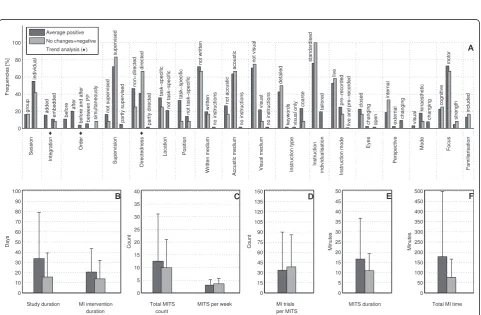
The bar charts of plot A (Figure 3; Figure 4; Figure 5; Figure 6; Figure 7; Figure 8; Figure 9; Figure 10; Figure 11; Figure 12; Figure 13; Figure 14; Figure 15) show the frequencies of MI interventions that reported details on MITS elements. For each MITS element, one or more categories were considered; for example, for the Table 2 Overview of extracted MITS elements
Number MITS element
MITS element description and categories PETTLEP category
Dominant category found in successful MIb interventions
1 Position Describes the position of the individual during MI practice astask-specificor not task-specific.
Physical Task-specific
2 Location Describes the location of MITS as task-specific ornot task-specific. Environment Task-specific
3 Focus Each task consists of different parts. Focus of the intervention classifies the main focus of task-related activities that had to be imagined:motor,cognitive or strength.
Task Motor-focused activities
4 Order Describes temporal order of MI and PPctrials. MI trials could have been performedbefore,between,afterorsimultaneouslywith PP.
Timing MI after PP
5 Integration Describes whether MI practice has beenaddedto PP orembeddeddinto PP. Added
6 MI instructions
medium
MI instructions can be provided differently through one or more media types. Media type was scored asacoustic,writtenorvisual. More than one media type could be assigned.
Learning Acoustic
7 Instruction
mode
In addition to the instruction medium, the mode was classified asliveor pre-recorded(for example, using tape or video).
Live
8 Supervision MITS could have beensupervisedornot supervisedby an instructor present during the session.
Supervised
9 Directedness MITS could have beendirecteddornon-directedwhen stepwise guidance was present or not.
Non-directed
10 Instruction
type
The description of MI instructions varied. Instructions could coverdetailed descriptions for each part of the task that had to be imagined,simple keywords, orcoarse(broad)overall MI instructions.
Detailed
11 Instruction
individuali-sation
MI instructions could have been individualised to the participant’s problems with the task that had to be imagined (tailored), or could have been the same for each participant (standardised).
Standardised
12
Familiari-sation
Describe whether study participants had received an MIfamiliarisation session beforethe MI intervention began.
No familiarisation
13 Change Indicated whether modification of content, duration or dosage of the MI
training occurred, to facilitate the learning process during the MI intervention period.
14 MI session MITS could have been classified asgroupsessions with more than one person participating in a MITS or asindividualsessions with one participant only.
Emotion Individual
15 Eyes During the MI, the participant’s eyes could have beenclosedoropen. In some interventions, participants started with one condition and changed to the other after one or several MITS.
Closed
16 Perspective During the MI, participants could have imagined the task from aninternalor externalperspective. In some interventions, participants started with one condition and changed to the other after one or several MITS.
Perspective Internal
17 Mode During the MI, participants could have used akinaestheticorvisualmode. In some MI interventions, participants started with one condition and changed to the other during one or after several MITS.
Kinaesthetic
a
Motor imagery training session. b
Motor imagery. c
Physical practice. d
0,WULDOV SHU0,76
0,76SHUZHHN
6WXG\GXUDWLRQ 0,LQWHUYHQWLRQGXUDWLRQ
7RWDO0,76FRXQW 0,76
GXUDWLRQ
Figure 2Overview of extracted and calculated temporal parameters. MI = motor imagery; MITS = motor imagery training session; total MI
time: = (total MITS count) × (MITS duration).
0 20 40 60 80 100
Frequencies [%]
A
group
individual
added
embedded before
after
before and after between PP simultaneously
not supervised
supervised
partly supervised
non−directed
directed
partly directed
task−specific
not task−specific
task−specific
not task−specific
not written
written
no instructions
not accustic
acoustic
no instructions
not visual
visual
no instructions
detailed
keywords visual only
coarse
standardised
tailored
live
pre−recorded
live and pre−recorded
closed
changing open
internal
external
changing
visual
kinaesthetic
changing
cognitive
motor
strength
included
Session
Integration
Order
Supervision
Directedness
Location Position
Written medium Accustic medium Visual medium Instruction type Instruction individualisation
Instruction mode
Eyes
Perspective
Mode Focus
Familiarisation
♦ ♦ ♦
0 5 10 15 20 25 30 35 40
Count
C
Total MITS count
MITS per week 0 15 30 45 60 75 90 105 120 135 150
Count
D
MI trials per MITS 0
10 20 30 40 50 60 70 80 90 100
Days
B
Study duration MI intervention duration
0 50 100 150 200 250 300 350 400 450 500
Minutes
F
Total MI time 0
5 10 15 20 25 30 35 40 45 50
Minutes
E
MITS duration Average positive
No changes+negative
Trend analysis (♦)
Figure 3Comparison of motor imagery (MI) interventions with positive results versus no change or negative results. The figure shows
0 20 40 60 80 100 Frequencies [%] A group individual added embedded before after
before and after between PP
simultaneously not supervised supervised partly supervised non−directed directed partly directed task−specific
not task−specific task−specific
not task−specific not written written no instructions not accustic acoustic no instructions not visual visual no instructions detailed
keywords visual only
coarse
standardised
tailored
live
pre−recorded
live and pre−recorded
closed changing open internal external changing visual kinaesthetic changing cognitive motor strength included Session Integration Order Supervision Directedness Location Position
Written medium Accustic medium Visual medium Instruction type Instruction individualisation Instruction mode
Eyes Perspective Mode Focus Familiarisation ♦ ♦ ♦ 0 5 10 15 20 25 30 35 40 Count C Total MITS count
MITS per weekο 0 15 30 45 60 75 90 105 120 135 150 Count D MI trials per MITS 0 10 20 30 40 50 60 70 80 90 100 Days B
Study duration MI intervention duration 0 50 100 150 200 250 300 350 400 450 500 Minutes F
Total MI time 0 5 10 15 20 25 30 35 40 45 50 Minutes E MITS duration SD 30 Average positive Education (ο) Trend analysis (♦)
Figure 4Comparison of average positive motor imagery (MI) intervention versus discipline-specific MI interventions in Education. The
figure shows the frequencies of motor imagery training session (MITS) and temporal parameter statistics for successful interventions. Categories of MITS elements added up to 100% if an element was reported for all interventions considered in this analysis.. For temporal parameters, bars show mean and positive SD.♦= Indicate changing trend of MITS element frequencies (see main text for detailed description);ο,Δ,∇= indicate significant results of the statistical tests against the average positive MI intervention.
0 20 40 60 80 100 Frequencies [%] A group individual added embedded before after
before and after between PP
simultaneously not supervised supervised partly supervised non−directed directed partly directed task−specific
not task−specific task−specific
not task−specific not written written no instructions not accustic acoustic no instructions not visual visual no instructions detailed
keywords visual only
coarse
standardised
tailored
live
pre−recorded
live and pre−recorded
closed changing open internal external changing visual kinaesthetic changing cognitive motor strength included Session Integration Order Supervision Directedness Location Position Written medium Accustic medium
Visual medium Instruction type Instruction individualisation
Instruction mode Eyes Perspective Mode Focus Familiarisation ο ♦ ο ♦ 0 5 10 15 20 25 30 35 40 Count C Total MITS count
MITS per week
ο ο SD 29 0 15 30 45 60 75 90 105 120 135 150 Count D MI trials per MITS 0 10 20 30 40 50 60 70 80 90 100 Days B
Study duration MI intervention duration ο ο SD 49 0 50 100 150 200 250 300 350 400 450 500 Minutes F
Total MI timeο
SD 510 0 5 10 15 20 25 30 35 40 45 50 Minutes E MITS duration Average positive
Medicine (ο) Trend analysis (♦)
Figure 5Comparison of average positive motor imagery (MI) intervention versus discipline-specific MI interventions in Medicine. The
figure shows the frequencies of motor imagery training session (MITS) and temporal parameter statistics for successful interventions. Categories of MITS elements add to 100%, if an element was reported for all interventions considered in this analysis. For temporal parameters, bars show mean and positive standard deviation (SD).♦= Indicate changing trend of MITS element frequencies (see main text for detailed description);ο,
MITS element‘session’, the categories‘group’and‘ indi-vidual’were analysed. The categories of MITS elements added up to 100% if an element was reported for all MI interventions in the respective analysis. Relevant trends in MITS elements, as reported in the text below, were marked in plots A to F in the same figures. For tem-poral parameters, bars show mean and positive SD.
Study characteristics
In total, 133 studies were included in the analysis, reporting 141 MI interventions in five disciplines: Edu-cation (9 Interventions), Medicine (37), Music (5), Psy-chology (79) and Sports (11). For the studies published between 1941 and 2010, there were peaks in 1989/1990 (8 publications), in 2004 (18) and 2007 to 2009 (38). In Medicine, MI publications first appeared in 2000, with a steady increase until 2010. These studies originated from Europe, Australia/New Zealand, the Americas, Asia, and the Middle East.
The study designs comprised 91 randomised con-trolled trials (RCTs), 22 concon-trolled clinical trials (CCTs), 15 case series (CSs) and 13 single-case research designs (SCRDs). Study quality was rated on a 10-point scale for
RCTs (4 to 9), an 8-point scale for CCTs (3 to 6), an 11-point scale for CSs (4 to 11), and on an 11-point scale for SCRDs (7 to 10).
On average, RCTs and CCTs scored 6 on the 10-point PEDro scale, whereas CSs and SCRDs scored 6 and 8, respectively, on the 11-point SCED scale (on both, higher scores indicate better quality). Examples of MI instructions were available for 29 MI interventions, and changes in MI content during the MI intervention per-iod were reported in 31 MI interventions. An overview of essential study characteristics is provided for each discipline separately (Table 3, Table 4, Table 5, Table 6 and Table 7).
Comparison of MI interventions with positive results versus no change or negative results: how should a successful MI intervention be implemented?
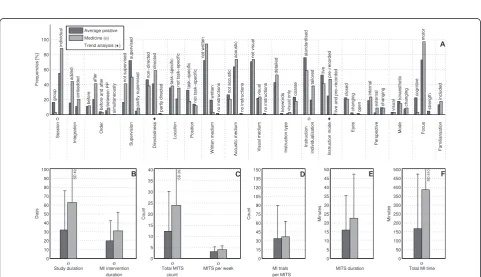
The MITS elements for all MI interventions were com-pared (Figure 3A). Frequency analyses of MI interven-tions with positive results revealed a number of key MITS elements present in a successful intervention design: MI was performed in individual sessions and added after PP; MI sessions were supervised and not
0 20 40 60 80 100
Frequencies [%]
A
group
individual
added embedded
before
after
before and after between PP
simultaneously
not supervised
supervised
partly supervised
non−directed
directed
partly directed
task−specific
not task−specific
task−specific
not task−specific
not written
written
no instructions
not accustic acoustic
no instructions
not visual
visual
no instructions
detailed
keywords visual only
coarse
standardised
tailored
live
pre−recorded
live and pre−recorded
closed
changing open
internal
external
changing
visual
kinaesthetic
changing
cognitive
motor
strength
included
Session
Integration
Order
Supervision Directedness
Location Position
Written medium
Accustic medium
Visual medium Instruction type Instruction individualisation Instruction mode
Eyes
Perspective
Mode Focus
Familiarisation
♦ ♦
0 5 10 15 20 25 30 35 40
Count
C
Total MITS count
MITS per week 0 15 30 45 60 75 90 105 120 135 150
Count
D
MI trials per MITS 0
10 20 30 40 50 60 70 80 90 100
Days
B
Study duration MI intervention duration
SD 74
0 50 100 150 200 250 300 350 400 450 500
Minutes
F
Total MI time 0
5 10 15 20 25 30 35 40 45 50
Minutes
E
MITS duration Average positive
Music
Trend analysis (♦)
Figure 6Comparison of average positive motor imagery (MI) intervention versus discipline-specific MI interventions in Music. The
figure shows the frequencies of motor imagery training session (MITS) and temporal parameter statistics for successful interventions. Categories of MITS elements add to 100%, if an element was reported for all interventions considered in this analysis. For temporal parameters, bars show mean and positive standard deviation (SD).♦= Indicate changing trend of MITS element frequencies (see main text for detailed description);ο,
directed; locations of MITS and the position of the par-ticipants during MI were both task-specific; parpar-ticipants received acoustic and detailed MI instructions, which were mainly standardised and live; during MI practice, participants kept their eyes closed.; the perspective used during MI practice was chosen from an internal view combined with a kinaesthetic MI mode; and MI inter-ventions were mainly investigated with motor-focused tasks.
Only 17 reports mentioned an MITS for familiarisa-tion before the MI intervenfamiliarisa-tion began. The reporting rate of all MITS elements ranged between 26% for the description of closed or open eyes to 95% for MI instruction individualisation. The most frequently reported MITS elements in successful MI interventions are listed in Table 2.
MI interventions with no change or with negative results predominantly used directed MITS. If MI inte-gration was reported, MITS wereembedded between or performedsimultaneouslywith physical trials. Owing to the lack of reporting, the ordering of MI and PP could not be identified in 90% of all MI interventions. Only two MI interventions mentioned an MITS for
familiarisation before MI intervention began. For the subsequent analyses only successful MI interventions with positive results were considered.
MI interventions with positive results had almost twice the duration of MI interventions with no change or negative results: study duration (34 days), MI inter-vention duration (21 days), total MITS count (13), (the number 13 stands for the number of MITS in MI inter-ventions with positive results)MITS duration (17 min-utes) and total MI time (178 minmin-utes). By contrast, MI interventions with no change or negative results had a larger number of MITS per week (3) and a larger num-ber of MI trials per MITS (34).
Comparison of positive MI interventions in five different disciplines: how do different disciplines use MI?
In the described analyses, only positive MI interventions were considered. The two disciplines with the youngest participants were Psychology (aged up to 9 years) and Sports (10 to 19 years). Most MI interventions were car-ried out with students (20 to 29 years) in Education, Psychology, Music, and Sports. Participants aged 50 and older were included only for Medicine and Psychology.
0 20 40 60 80 100
Frequencies [%]
A
group
individual
added
embedded before
after
before and after between PP
simultaneously
not supervised
supervised
partly supervised
non−directed
directed
partly directed
task−specific
not task−specific
task−specific
not task−specific
not written
written
no instructions
not accustic
acoustic
no instructions
not visual
visual
no instructions
detailed
keywords visual only
coarse
standardised
tailored
live
pre−recorded
live and pre−recorded
closed
changing open
internal
external
changing
visual
kinaesthetic
changing
cognitive
motor
strength included
Session
Integration
Order
Supervision Directedness
Location Position
Written medium
Accustic medium
Visual medium Instruction type Instruction individualisation Instruction mode
Eyes
Perspective
Mode Focus
Familiarisation
ο ο
0 5 10 15 20 25 30 35 40
Count
C
Total MITS count
MITS per week
ο 0
15 30 45 60 75 90 105 120 135 150
Count
D
MI trials per MITS 0
10 20 30 40 50 60 70 80 90 100
Days
B
Study duration MI intervention duration
ο 0
50 100 150 200 250 300 350 400 450 500
Minutes
F
Total MI time 0
5 10 15 20 25 30 35 40 45 50
Minutes
E
MITS duration Average positive
Psychology (ο)
Trend analysis (♦)
Figure 7Comparison of average positive motor imagery (MI) intervention versus discipline-specific MI interventions in Psychology.
Gender-specific investigations were carried out in Medi-cine, Psychology and Sports.
Detailed discipline-specific frequency analyses of MITS elements revealed the following differences (ita-lics) from the average positive MITS.
For Education, participants (Figure 4A-F) performed MI predominantlybefore physical practice (PP) during
directedMITS. Three MITS elements showed both cate-gories: position of participants during MITS (task-speci-fic and not task-speci(task-speci-fic), instruction mode (life and pre-recorded), and perspective (internal and external). MI content focused oncognitivetask-related activities. MI mode was not reported. Regarding the temporal para-meters in Education, the study and MI intervention duration and the total MI time were less than half of those in the average positive MI intervention, but the MITS duration was twice as long as in the average posi-tive MITS. The number of MI trials per MITS was not reported.
MI interventions in Medicine (Figure 5A-F), the MI interventions predominantly used directed MITS with
pre-recorded MI instructions. All temporal parameters had longer durations and total counts compared with
the average positive MITS, especially for study and MITS duration, total MITS count and total MI time.
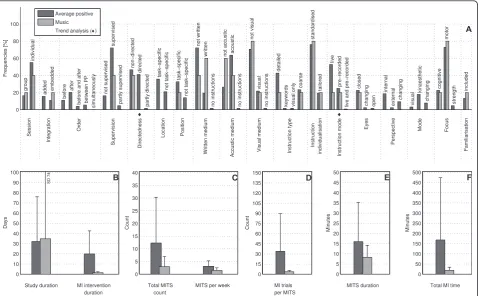
MI interventions in Music (Figure 6A-F) tended to be
embedded into PP. MI instructions in Music were
mainly written. Instruction mode and type allowed for more than one categorisation. Location of the MITS, and the MI perspective and mode used were not described. Almost all temporal parameters had lower durations and numbers than in the average positive MITS, particularly the number of MI trials per MITS, but the study duration was higher for MI interventions in Music.
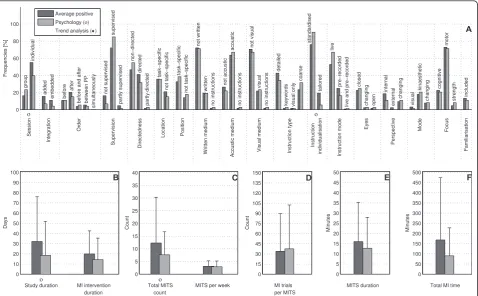
MI interventions in Psychology (Figure 7A-F) most closely resembled the average positive MITS with simi-lar distributions of MITS elements in instruction type and in MI perspective. MI interventions had the same number of MITS per week to the average positive MITS, but shorter MI intervention and MITS duration. Total MI time was half of that of the average positive MI intervention.
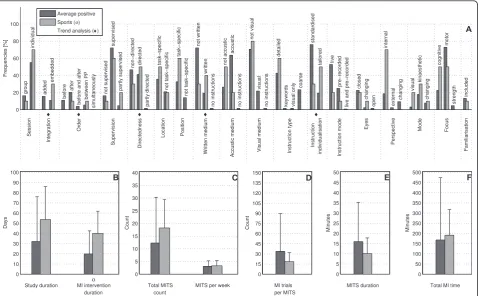
MI interventions in Sports (Figure 8A-F) reported
embeddedanddirectedMITS, [andafterorbetweenPP. Instructions during MITS were tailoredand inwritten 0
20 40 60 80 100
Frequencies [%]
A
group
individual
added
embedded
before
after
before and after
between PP
simultaneously
not supervised
supervised
partly supervised
non−directed directed
partly directed
task−specific
not task−specific
task−specific
not task−specific
not written
written
no instructions
not accustic
acoustic
no instructions
not visual
visual
no instructions
detailed
keywords visual only
coarse
standardised
tailored live
pre−recorded
live and pre−recorded
closed
changing
open
internal
external
changing
visual
kinaesthetic
changing
cognitive
motor
strength
included
Session
Integration
Order
Supervision Directedness
Location Position
Written medium
Accustic medium
Visual medium Instruction type Instruction individualisation Instruction mode
Eyes
Perspective
Mode Focus
Familiarisation
♦ ♦ ♦ ♦ ♦
0 5 10 15 20 25 30 35 40
Count
C
Total MITS count
MITS per week 0 15 30 45 60 75 90 105 120 135 150
Count
D
MI trials per MITS 0
10 20 30 40 50 60 70 80 90 100
Days
B
Study duration MI intervention duration
ο 0
50 100 150 200 250 300 350 400 450 500
Minutes
F
Total MI time 0
5 10 15 20 25 30 35 40 45 50
Minutes
E
MITS duration Average positive
Sports (ο)
Trend analysis (♦)
Figure 8Comparison of average positive motor imagery (MI) intervention versus discipline-specific MI interventions in Sports. The
figure shows the frequencies of motor imagery training session (MITS) and temporal parameter statistics for successful interventions. Categories of MITS elements add to 100%, if an element was reported for all interventions considered in this analysis. For temporal parameters, bars show mean and positive standard deviation (SD).♦= Indicate changing trend of MITS element frequencies (see main text for detailed description);ο,
form. Study and MI intervention duration were almost twice as long as those in the average positive MI inter-vention. MI trials in a Sports MITS were only half of the number of the average positive MITS.
Comparison of added and embedded MI integration approaches: does a specific set of MITS element for each method exist?
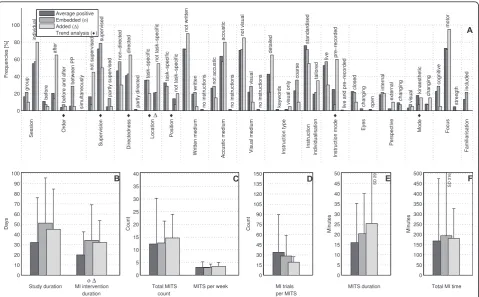
This analysis was performed in successful MI interven-tions, which included PP in the study design. Of the 34 retrieved MI interventions, 20 described an added and 14 an embedded MI training method (Figure 9A-F). There was a preference for added MITS to be directed
usingpre-recorded instructions.Neitherthe locations of MITS nor the position of the participants during MI practice were task-specific. Added MITS used a kinaes-thetic ormixed MI mode. MI training embedded into PP tended to be supervised, and was implemented
betweenphysical trials of the same task. Most MI inter-ventions did not report details on location and position.
The averages of the temporal parameters of both cate-gories (addedandembedded) differed from those of the
average positive MI intervention; however, there was wide variation between MI interventions. The duration of the study MI intervention and MITS duration were longer for both categories than in the average positive MITS, but the number of MI trials per MITS was lower. MITS duration was longer in the added than in the embedded training methods.
Comparison of MI interventions with different MI training focus: is MI particularly suited to one training focus?
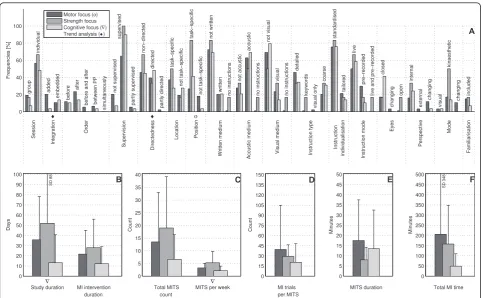
Based on the primary focus of activities that were imagined, positive MI interventions were categorised into motor-focused (94), cognitive-focused (29) and strength-focused (6) activities. Compared with motor and cognitive-focused MI interventions, which were mainly published between the 1970s and 2010, the majority of strength-focused MI interventions were published in 1991 and in the period 2004 to 2009. Motor- and strength-focused MI interventions were often designed according to the average positive MITS (Figure 10A-F). Strength-focused MI interventions were investigated in healthy participants aged 20 to 39 years
0 20 40 60 80 100
Frequencies [%]
A
group
individual
before
after
before and after
between PP
simultaneously
not supervised
supervised
partly supervised
non−directed
directed
partly directed
task−specific
not task−specific
task−specific
not task−specific
not written
written
no instructions
not accustic
acoustic
no instructions
not visual
visual
no instructions
detailed
keywords visual only
coarse
standardised
tailored
live pre−recorded
live and pre−recorded
closed
changing open
internal
external changing visual kinaesthetic changing
cognitive
motor
strength
included
Session
Order
Supervision Directedness
Location Position
Written medium
Accustic medium
Visual medium Instruction type Instruction individualisation Instruction mode
Eyes
Perspective
Mode Focus
Familiarisation
♦ ♦ ♦ ♦Δ ♦ ♦ ♦
0 5 10 15 20 25 30 35 40
Count
C
Total MITS count
MITS per week
0 15 30 45 60 75 90 105 120 135 150
Count
D
MI trials per MITS 0
10 20 30 40 50 60 70 80 90 100
Days
B
Study duration MI intervention duration
οΔ 0
50 100 150 200 250 300 350 400 450 500
Minutes
F
Total MI time
SD 316
0 5 10 15 20 25 30 35 40 45 50
Minutes
E
MITS duration
SD 29
Average positive Embedded (ο) Added (Δ) Trend analysis (♦)
Figure 9Comparison of average positive motor imagery (MI) intervention versus MI integration approaches. The figure shows the
only. Motor-focused MI interventions had the highest number of MI trials per MITS and the longest MITS duration and total MI time.
Cognitive-focused MI interventions differed from the average positive MI intervention: there was a preference for MITS to be embedded and directed. Cognitive-focused MI interventions had shorter durations and lower numbers in all temporal parameters compared with motor-focused MI interventions.
Comparison of MI interventions with different MI session types: do group sessions require a different design from individual ones?
This analysis could be performed for 37 positive MI interventions that reported details. In total, 21 MI inter-ventions described MITS in group sessions, and 71 in individual sessions (Figure 11A-F).
Group MITS tended to bedirectedandembedded into PP, and included MI practice before and after PP.
Neither the locations of the MITS nor the position of the participants during MI practice were task-specific. Both the MI perspective used during MI practice and the MI mode changed. Total MI time and number of MI trials per session were only half those of the average positive MI intervention.
For the individual sessions, we investigated two options: directed and non-directed MITS. Compared with the average positive MI intervention, individual ses-sions had larger values for many of the temporal para-meters, particularly total MI time.
Comparison of MI interventions with regard to participant age: did the implementation differ for particular age groups?
Participant age in successful MI interventions was classi-fied into seven categories: up to 9 years (2 interven-tions), 10 to 19 years (18), 20 to 29 years (63), 30 to 39 years (13), 40 to 49 years (2), 50 to 59 years (9), and 60 and older (20). Two MI interventions did not mention the age of the participant and were thus not considered in this analysis.
There were only two MI interventions with partici-pants aged up to 9 years, published in 1973 [35] and 2004 [36]. Both were studies in Psychology, which con-sidered healthy children of both genders with an average age of 6 and 9 years, respectively, and were supervised
with acousticinstructions. Rapp and Schoder described the MI intervention as a non-directed group session withlive andstandardisedinstructions. Childrenclosed
their eyes during MI as they imagined a motor-focused task [35]. No further details were provided. Takteket al. designed the MI intervention as adirectedsession with
pre-recordedinstructions [36]. Participants used a task-specificposition during MI,closedtheir eyes and used a
kinaesthetic MI mode when imagining a
cognitive-focusedtask. MI trials were preformed before PP trials using standardisedanddetailedinstructions. Temporal parameters differed between both investigations.
The MI interventions (n = 18) with teenagers (10 to 19 years) were in the fields of Psychology and Sports. Investigations were designed asdirected individual ses-sions. Where reported, MI was practiced eitherbefore, orbefore and after PP. Participants received their MI instructions in written form. Only the number of MI trials per MITS was less than that in the average posi-tive MI intervention (Figure 12A-F).
The MI interventions (n = 63) with participants aged between 20 and 29 years most closely resembled the average positive MI intervention. Deviations were observed in three temporal parameters: study duration and total MI time were two-thirds of those in the aver-age positive MI intervention, and participants performed more MI trials per session than in the average positive MI intervention.
MI interventions (n = 13) with participants aged between 30 and 39 years were mainly designed asadded
MITS with MI practice before PP andcoarse (broad)MI instructions. MI mode was reported in two MI interven-tions as kinaesthetic and changing mode, respectively. Four temporal parameters had twice the duration or fre-quency than in the average positive MI intervention: study duration, MITS duration, total MITS count and total MI time. The number of MI trials per session was lower than those of the average positive MI intervention. Only two MI interventions could be classified in the age group 40 to 49 years [37,38]. The MI intervention described by Vergeer and Roberts was performed with healthy participants of both genders [37]. MITS ele-ments resembled those of the average positive MI inter-vention, withgroupsessions and a multimodal approach for MI instructions (written, visual and acoustic). The second article, published by Guillot et al., described an MI intervention with participants (male and female) who had burns [38]. The authors used added, indivi-dual,supervisedanddirectedMITS. Participant received
detailed,tailoredandwritteninstructions.
The MI interventions (n = 9) with participants aged between 50 to 59 years were directed MITS (Figure 13A-F). Neitherthe locations of the MITS nor the posi-tion of the participants during MI practice were task-specific. Internal and external MI perspective options were offered. Achanging MI mode was preferred. Tem-poral parameters had almost twice the duration of MI study and MI intervention than in the average positive MI intervention.
elements from those of the average positive MI inter-vention. Temporal parameters had a longer study dura-tion and total MI time.
Comparison of MI interventions with regard to
participant’s gender: should gender-specific settings be considered for MITS implementation?
Gender-specific analyses of positive MI interventions showed the following distribution: sixty-nine MI inter-ventions with participants of both genders, eight MI interventions with female participants only and thirty-four MI interventions with male participants only. Gen-der-specific investigations were carried out in Medicine, Psychology and Sports.
The MI interventions with participants of both gen-ders (n = 69) were designed according to the average positive MI intervention. They had the longest study duration and total MI time and the largest number of MI trials per session compared with gender-specific MI interventions (Figure 14A-F).
The MI interventions (n = 8) with female participants only were primarily designed asembedded MITS with
MI trialsbetween PP trials. The locations of the MITS were bothtask-specificandnon-task-specific. MI instruc-tions were liveor pre-recorded. MI interventions with female participants were investigated with mainly cogni-tive-focused tasks. The MITS duration and number of MI trials were lower than those of MI interventions with both genders and with male participants only; how-ever, the duration of the MI intervention was longer.
The MI interventions (n = 34) with male participants used task-specificornon-task-specific positions, and the MI mode selected was the changing mode. Temporal parameters closely resembled those of the average posi-tive MI intervention.
Analyses based on change in content, duration and dosage of MI training: what MITS element variations have been investigated?
Successful MI interventions were categorised with regard to change in MI intervention during the total MI intervention period into change (n = 31) and no change (n = 38). Change in MI intervention could include three domains: MI dosage, MI content and MI time. MI
0 20 40 60 80 100
Frequencies [%]
A
group
individual
added
embedded before
after
before and after between PP
simultaneously
not supervised
supervised
partly supervised
non−directed
directed
partly directed
task−specific
not task−specific
task−specific
not task−specific
not written
written
no instructions
not accustic
acoustic
no instructions
not visual
visual
no instructions
detailed
keywords
visual only
coarse
standardised
tailored
live
pre−recorded
live and pre−recorded
closed
changing
open
internal
external
changing
visual
kinaesthetic
changing
included
Session
Integration
Order
Supervision Directedness
Location Position
Written medium
Accustic medium
Visual medium Instruction type Instruction individualisation Instruction mode
Eyes
Perspective
Mode
Familiarisation
♦ ♦ ο
0 5 10 15 20 25 30 35 40
Count
C
Total MITS count
MITS per week∇
0 15 30 45 60 75 90 105 120 135 150
Count
D
MI trials per MITS 0
10 20 30 40 50 60 70 80 90 100
Days
B
Study duration MI intervention duration ∇
SD 88
0 50 100 150 200 250 300 350 400 450 500
Minutes
F
Total MI time
SD 348
0 5 10 15 20 25 30 35 40 45 50
Minutes
E
MITS duration Motor focus (ο)
Strength focus Cognitive focus (∇) Trend analysis (♦)
Figure 10Comparison of motor imagery (MI) interventions with different MI focus. The figure shows the frequencies of motor imagery
interventions were excluded from the analysis if a change was not clearly described (n = 55) or if the cate-gorisation was not applicable (n = 5) due to the study design.
Only minor differences were found between categories (Figure 15A-F). MI interventions with a change during the MI intervention period included directed MITS. Duration of study and MI intervention, total MITS count, and total MI time were almost twice those of the average positive MI intervention. MI interventions with-out a change during the MI intervention period were designed as embeddedMITS with shorter study dura-tion, lower number of MI trials and lower total MI time than in the average positive MI intervention.
Discussion
Summary of findings
A question frequently raised by clinicians is ‘How should motor imagery be done?’. Our literature review aimed to answer this question and to describe which elements characterise successful MITS. It was not our intention to evaluate the effectiveness of MI or to com-pare effect sizes, as this has already been addressed in
other literature reviews [1,6,11,13]. The results of the trend analyses revealed changes in the frequencies of the MITS elements, which represent important varia-tions between MI intervenvaria-tions. In addition, the review identified differences between the studies with positive results and those with no changes or negative results. Thus, the trend analyses might help clinicians to imple-ment MI interventions successfully. By contrast, thec2 test revealed general frequency distribution differences only, which were often caused by frequency variations and did not represent actual trend changes. Owing to limitations in the reporting rates, thec2 test for MITS elements and the group mean comparison tests for tem-poral parameters could not be applied in many cases. We expect that our trend analyses in combination with the statistical test would be able to serve as indicators for potential future research directions.
Our analyses considered the differences in specific dis-ciplines (Education, Medicine, Music, Psychology, Sports), MI integration types (added/embedded), session types (individual/group), focus of the task (motor, cogni-tive, strength), age, gender groups (female, male, both ) and change in content, duration and dosage. From 141
0 20 40 60 80 100
Frequencies [%]
A
added
embedded before after before and after
between PP
simultaneously
not supervised
supervised
partly supervised
non−directed directed
partly directed
task−specific
not task−specific
task−specific
not task−specific
not written
written
no instructions
not accustic
acoustic
no instructions
not visual
visual
no instructions
detailed
keywords visual only
coarse
standardised
tailored
live
pre−recorded
live and pre−recorded
closed
changing open
internal
external
changing
visual
kinaesthetic
changing
cognitive
motor
strength
included
Integration
Order
Supervision Directedness
Location Position
Written medium
Accustic medium
Visual medium Instruction type Instruction individualisation Instruction mode
Eyes
Perspective
Mode Focus
Familiarisation
♦ ♦ ♦ ♦ ♦ ο ♦ ♦
0 5 10 15 20 25 30 35 40
Count
C
Total MITS count
MITS per week
0 15 30 45 60 75 90 105 120 135 150
Count
D
MI trials per MITS 0
10 20 30 40 50 60 70 80 90 100
Days
B
Study duration MI intervention duration
0 50 100 150 200 250 300 350 400 450 500
Minutes
F
Total MI time
SD 380
0 5 10 15 20 25 30 35 40 45 50
Minutes
E
MITS duration Average positive
Individual session (ο) Group session Trend analysis (♦)
Figure 11Comparison of average positive motor imagery (MI) intervention versus different MI session types. The figure shows the
MI interventions, data were extracted and analysed for 17 MITS elements based on the PETTLEP approach and 7 temporal parameters.
MI intervention outcome
The comparison of the MI interventions with positive results versus those with no change or negative results provided the basis for all subsequent analyses. An aver-age positive MI intervention was derived comprising MITS elements and temporal parameters. Characteris-tics of the average positive MI intervention were seen in studies in Psychology, in interventions with motor-focused or strength-motor-focused tasks in all disciplines, in interventions with participants aged 20 to 29 years old, and in interventions with both genders. Four MITS ele-ments differed between the MI interventions with posi-tive results and those with no change or negaposi-tive results: order (embedded/simultaneous), directedness (directed), number of MITS per week (n = 3) and num-ber of MI trials per MITS (n = 34). We hypothesise that several of these elements jointly inhibit positive results. Depending on the length of a MITS and the experience level of the participant, the most frequent number of
MITS per week chosen in successful MI interventions was three.
Data analyses determined that the average MITS dura-tion was 17 minutes, with 34 MI trials per MITS. Both of these temporal parameters were also retrieved in the review of Feltz and Landers, published in 1983 [1], which yielded similar values. Our results suggest that not more than two MI trials per minute per MITS might be performed.
MI interventions with no change or negative results were present in all four study designs (RCT, CCT, CS and SCRD), with a higher average quality score for SCRDs than for RCTs. Therefore, it cannot be con-cluded that a certain design leads to a negative outcome. Discipline-specific intervention adaptation
The use of imagery originated in the field of Psychology, with investigations dating back to publications in 1880 and 1897 [39,40]. Presumably, MITS adaptations were necessary to direct each step of a surgical procedure in Education, to tailor imagery tasks to the needs of parti-cipants in Medicine, to use written instructions (musical notes) in Music, and to embed MI between PP trials as
0 20 40 60 80 100
Frequencies [%]
A
group
individual
added embedded before after
before and after between PP
simultaneously
not supervised
supervised
partly supervised
non−directed
directed
partly directed
task−specific
not task−specific
task−specific
not task−specific
not written
written
no instructions
not accustic
acoustic
no instructions
not visual
visual
no instructions
detailed
keywords visual only
coarse
standardised
tailored
live
pre−recorded
live and pre−recorded
closed
changing open
internal
external
changing
visual
kinaesthetic
changing
cognitive
motor
strength
included
Session
Integration
Order
Supervision Directedness
Location Position
Written medium
Accustic medium
Visual medium Instruction type Instruction individualisation Instruction mode
Eyes
Perspective
Mode Focus
Familiarisation
♦ ♦ ♦ ♦ ♦ ♦ ♦
0 5 10 15 20 25 30 35 40
Count
C
Total MITS count
MITS per week
SD 49
0 15 30 45 60 75 90 105 120 135 150
Count
D
MI trials per MITS 0
10 20 30 40 50 60 70 80 90 100
Days
B
Study duration MI intervention duration
SD 72
0 50 100 150 200 250 300 350 400 450 500
Minutes
F
Total MI time
SD 854
0 5 10 15 20 25 30 35 40 45 50
Minutes
E
MITS duration
SD 44
Average positive Age: 10 − 19 yrs Age: 20 − 29 yrs Age: 30 − 39 yrs Trend analysis (♦)
Figure 12Comparison of average positive motor imagery (MI) intervention versus different age groups (1). The figure shows the
recovery breaks during an intensive training day in Sports.
In the current review, the positive MI interventions were mainly performed after PP. This result stands in contrast to the reported order of performing MI trials before PP in the meta-analysis of Feltz and Landers and the investigation of Etnier and Landers [1,41]. No over-all conclusion on the reported order could be derived because of its dependency on the aim of the MI train-ing, such as the learning of a new motor task, its adap-tation, preparation for performance of a known motor task, achievement of peak performance, and memorisa-tion of performance aspects.
Temporal parameters varied between disciplines. The longest study and MI intervention durations and the highest total number of MITS were seen in Medicine and Sports. Some of these variations could be explained by their very nature. For example, in Medicine, time to learn and perform the MI was required, reflecting sys-tem impairments, older age of the participants and chronic pain, whereas in Sports, MITS can be part of the daily training routine. The longest MITS duration
could be found in Music, reflecting the length of the music pieces that were imagined. Medicine and Psychol-ogy had the highest numbers of MI trials per MITS. This supports the hypothesis that MI is effective in these fields when the imagined movement is short and simple (for example, one limb movement) to perform, with as many repetitions as possible during a short con-centration period, as described above in the section on MI intervention outcome.
MI session type
The decision to implement MITS as group or individual sessions does not depend on the MI integration approach. Both group and individual sessions included added and embedded MITS. Both classifications were used in positive MI interventions during the entire pub-lication period analysed. The MI intervention duration was longer for group MITS and shorter for individual MITS compared with the positive MITS. We hypothe-sised that the selection of session type was based rather on practical considerations than on scientific reasoning. Further research is needed to evaluate the influence of session type on the effectiveness of MI interventions.
0 20 40 60 80 100
Frequencies [%]
A
group
individual
added
embedded
before
after
before and after
between PP
simultaneously
not supervised
supervised
partly supervised
non−directed
directed
partly directed
task−specific not task−specific
task−specific
not task−specific
not written
written
no instructions
not accustic
acoustic
no instructions
not visual
visual
no instructions
detailed
keywords visual only
coarse
standardised
tailored
live
pre−recorded
live and pre−recorded
closed
changing open internal external
changing
visual
kinaesthetic changing cognitive
motor
strength
included
Session
Integration
Order
Supervision Directedness
Location Position
Written medium
Accustic medium
Visual medium Instruction type Instruction individualisation
Instruction mode
Eyes
Perspective
Mode Focus
Familiarisation
Average positive Age: 50 − 59 yrs
Age: 60+ yrs
0 5 10 15 20 25 30 35 40
Count
C
Total MITS count
MITS per week
0 15 30 45 60 75 90 105 120 135 150
Count
D
MI trials 0
10 20 30 40 50 60 70 80 90 100
Days
B
Study duration MI intervention duration
SD 41
0 50 100 150 200 250 300 350 400 450 500
Minutes
F
Total MI time
SD 250
0 5 10 15 20 25 30 35 40 45 50
Minutes
E
MITS session duration
Figure 13Comparison of average positive motor imagery (MI) intervention versus different age groups (2). The figure shows the
Age groups
Most MI interventions were performed with healthy stu-dents and young adults aged 20 to 29 years old. Hence there is a need for MI techniques and investigation of their effectiveness in young children and middle-aged adults, for which only a few references were found. Jarus and Ratzon reported that children aged 9 years and older adults aged 65 and 70 years benefited more from the combination of MI and PP than did young adults aged 21 to 40 years [42]. The full potential of MI in younger and older participants has not yet been suffi-ciently investigated, as evidenced by the low number of MI investigations found in these age groups.
Gender effect
In the current review gender differences were found in the chosen MITS elements. The results obtained will add to the ongoing debate on gender-dependent MI intervention design. Is it believed that males are better imagers than females, because of the different brain area activation and inhibition [43]. The ‘bottom-up neural strategy’ found in the work of Butler et al. could be related to the visuospatial performance benefit of men,
with larger improvements for men gained from a motor-focused MI intervention compared with women [43]. This hypothesis could have influenced the MI intervention design in studies with female participants, which used mainly cognitive-focused tasks. However, a questionnaire survey given to healthy participants aged 18 to 65 years [44] did not confirm a gender imbalance on imagery usage. Furthermore, Lutz et al. did not detect a gender effect among high- and low-skilled golfers in a putting task after MI [45], nor were gender differences found in an investigation with two widely used imagery questionnaires [46]. In the current review, the study imbalance for female to male participants is 1 to 4.25. Therefore, we hope our analyses will prompt researchers to further explore potential gender differ-ences in, for example, MI ability.
Methodological considerations
The only available MeSH term for searches was‘mental imagery’, which must be considered as an umbrella term for various mental techniques. MI is one technique focusing on movements, which is important in
0 20 40 60 80 100
Frequencies [%]
A
group
individual
added
embedded
before
after
before and after between PP
simultaneously
not supervised
supervised
partly supervised
non−directed
directed
partly directed
task−specific not task−specific
task−specific
not task−specific
not written
written
no instructions
not accustic
acoustic
no instructions
not visual
visual
no instructions
detailed
keywords visual only
coarse
standardised
tailored
live
pre−recorded
live and pre−recorded
closed
changing open
internal
external changing
visual
kinaesthetic
changing
cognitive
motor
strength included
Session
Integration
Order
Supervision Directedness
Location Position
Written medium
Accustic medium
Visual medium Instruction type Instruction individualisation Instruction mode
Eyes
Perspective
Mode Focus
Familiarisation
♦ ♦ ♦∇ ∇ ♦ ♦ ♦
0 5 10 15 20 25 30 35 40
Count
C
Total MITS count
MITS per week∇
0 15 30 45 60 75 90 105 120 135 150
Count
D
MI trials per MITS 0
10 20 30 40 50 60 70 80 90 100
Days
B
Study duration MI intervention duration
0 50 100 150 200 250 300 350 400 450 500
Minutes
F
Total MI time
SD 412
0 5 10 15 20 25 30 35 40 45 50
Minutes
E
MITS duration Both genders
Gender: female Gender: male (∇) Trend analysis (♦)
Figure 14Comparison of motor imagery (MI) interventions with regard to gender. The figure shows the frequencies of motor imagery