Geschke Center
Doctor of Nursing Practice (DNP) Projects Theses, Dissertations, Capstones and Projects
Winter 12-12-2014
Development and Implementation of a Succession
Plan for the Nursing Department in a Community
Hospital
Nadine Mariotti
University of San Francisco, [email protected]
Follow this and additional works at:https://repository.usfca.edu/dnp Part of theNursing Commons
This Project is brought to you for free and open access by the Theses, Dissertations, Capstones and Projects at USF Scholarship: a digital repository @ Gleeson Library | Geschke Center. It has been accepted for inclusion in Doctor of Nursing Practice (DNP) Projects by an authorized administrator of USF Scholarship: a digital repository @ Gleeson Library | Geschke Center. For more information, please [email protected].
Recommended Citation
Mariotti, Nadine, "Development and Implementation of a Succession Plan for the Nursing Department in a Community Hospital" (2014).Doctor of Nursing Practice (DNP) Projects. 39.
Development and Implementation of a Succession Plan for the Nursing Department in a
Community Hospital
Nadine A. Mariotti, DNP(c), MHA, RN, NE-BC
University of San Francisco
DNP Comprehensive Project
K.T. Waxman, DNP, MBA, RN, CNL, CENP
Committee Chairperson
Mary Bittner, DNP, MPA, RN, CENP
Committee Member
A. Christine Delucas, DNP, MPH, RN, NEA-BC
Table of Contents
ACKNOWLEDGEMENT 4
ABSTRACT 5
INTRODUCTION 6
Background Knowledge 6
Local Problem 10
Intended Improvement/Purpose of Change 11
Review of the Evidence 13
Conceptual Framework 19
METHODOLOGY 23
Ethical Issues 23
Planning the Intervention 23
Implementation 25
Planning the study of the Intervention 27
Methods of evaluation 28
Analysis 30
RESULTS 31
Program Evaluation/Outcomes 31
DISCUSSION 32
Summary 33
Interpretation 34
Conclusions 35
OTHER INFORMATION 36
Funding 36
REFERENCES 37
APPENDICES 44
Appendix A 44
Appendix B 53
Appendix C 55
Appendix D 56
Appendix E 59
Appendix F 61
Appendix G 63
Appendix I 65
Appendix J 66
Appendix K 68
Appendix L 69
Acknowledgement
This DNP project paper is an opportunity for me to extend my regards to my committee
chairperson and committee members, my beloved friends, and my family for their untiring
support that they furnished throughout my project. I am grateful to them for their belief in me
and the guidance that they provided me without which I would have never been able to work on
and complete this project. It also signifies my own views and does not closely relate to the
university.
Signature: _______________________________
Abstract
This project identifies nursing leadership vacancies in a community nursing department and
assisted in the planning and implementation of a succession framework to fill the gaps in the
nurse leadership population. Aging nurse leaders are leaving the profession and thus are creating
gaps which need to be filled (Stichler, 2008). The unavailability of respective schools and
negative perceptions of nurses regarding the healthcare sector leads to the lack of interest in the
nursing profession (Nelsey, Brownie, 2012). Factors contributing to burn-out in nursing
departments affect the intentions of nurses to leave and lower satisfaction towards their
profession. The proposed succession plan will act as a resource to identify features that affect
staff morale, clinical competence and staff commitment to their jobs. The current project also
addresses the nurse’s interest in future leadership roles within the organization. This project
allows the implementation and development of strategies to ensure successful succession of
nurses in healthcare. The Plan-Do-Study-Act (PDSA) evaluation model is applied to this project
to evaluate iterative analysis of change to improve succession methods in healthcare. This project
has identified de-motivation, inexperienced staff, lack of corporation or teamwork and increased
workload as possible problems that offer obstacles in implementing the succession plan.
Introduction
Succession planning in healthcare has been lackluster. Developing such a program in a
community hospital can be vital to its existence. It has been described in the business, human
resources, healthcare and nursing literature that succession planning is an urgent need to be
addressed. Especially nursing due to the aging workforce, the nursing shortage, the increased
dependence on nurse managers, increased complexity of patient care and the increase number of
patients who qualify for services afforded to them by the Affordable Care Act. Community
hospitals are facing workforce shortages for filling professional positions for nurses. Vacant
positions left unfilled can be additionally problematic. Cortese, Colombo, & Ghislieri (2010)
pointed out that nurses with poor educational preparation were likely to report low level of job
satisfaction. This project provides a rationale to identify relationships between factors that cause
decreased job satisfaction among nurses and thus, predisposes the organization to face challenges
to find better replacements for nurses leaving their positions. This project details the journey of
one community hospital on the pathway to a viable succession planning program.
Background Knowledge
Leadership development through succession planning is a business strategy that has
gained recent attention in nursing because of the dearth of qualified individuals able to assume
administrative positions vacated by baby boomer retirees (Cadmus, 2006; Kim & Thompson,
2012; United States Department of Labor: Bureau of Labor, 2013; Westphal, 2009). Succession
planning dates from the 14th century and was initially related to family businesses and how
management of the business was to be passed down to future generations (Lansberg, 1988). In
the mid-20th century, succession planning was disseminated succession planning into the
performance, progress, and potential for advancement to greater responsibility (Christensen,
1979; Koch, 1978; Trow, 1961). As corporate organizations began focusing on replacing senior
leadership positions, they initially targeted only chief executive officers (CEOs) but eventually
realized that the ongoing stability of the organization benefited from a structured process that
identified and prepared all potential future leaders.
The benefits of having an in-place succession-planning program have been described by a
number of authors (Brunero, Kerr, & Jastrzab, 2009a; Fennimore & Wolf, 2011; Glasgow,
Weinstock, Lachman, Suplee, & Dreher, 2009; Martin & Schmidt, 2010). Kim & Thompson
(2012) reported that high-performing healthcare organizations utilized leadership succession
planning programs to retain intellectual capital by identifying and supporting employees with
potential for promotion. Successful succession programs include strategies that target knowledge
transfer among workers and provide a forum for the acquisition of new capabilities (Crumpacker
& Crumpacker, 2007). McAlearney (2005) noted that structured leadership development
programs increase the caliber and quality of the workforce through mentoring, coaching, and
educating leaders. The use of succession planning in healthcare organizations was not
documented in the literature until 2000 (Carriere, Muise, Cummings, & Newburn-Cook, 2009a)
and almost exclusively targeted chief executive officers and other top-level administrative
leadership (Redman, 2006). Citations concerning the implementation of succession planning in
nursing were not published until at least five years later (Collins, 2009; Redman, 2006). A
number of interrelated issues are now driving the need for a formalized process to prepare
nursing’s future leaders. In addition to the aging nursing workforce, the healthcare industry is
growing, fueled by a simultaneously aging population (Cadmus, 2006; United States Department
The nursing shortage is ongoing; schools of nursing are unable to keep up with demand
due to a lack of experienced nursing faculty (Jacob & Sánchez, 2011; Mennick, 2008). The
number of nurses interested in leadership roles is diminishing; the American Organization of
Nurse Executives (AONE) reports an average vacancy rate for nurse-managers as high as 8.3%
nationwide (Zastocki & Holly, 2010). Nurse Managers thrust into leadership positions without
adequate preparations tend to burnout. Because work-life balance is important to the next
generation of leaders, they are not necessarily interested in committing to the long work hours
they see their supervisors putting in (Donelan, Buerhaus, DesRoches, Dittus, & Dutwin, 2007;
Keys, 2014). In 2010, the census reported that more than one-third of the population reported
race and ethnicity other than non-Hispanic whites, representing a 29% increase from 2000 to
2010. Succession planning can potentially serve as a forward-looking business strategy to
increase diversification in leadership positions (Whitman & Valpuesta, 2010). While the issue of
ethnic diversity is of growing concern in healthcare leadership because of the changing
population of patients seeking services, there is little specific focus on promoting ethnic diversity
in leadership (Sporing, Avalon, & Brostoff, 2012). Diversification in healthcare organizations is
a business strategy intended to increase access to services. Ideally the workforce should be
reflective of the population it serves. Whitman and Valpuesta (2010) contend that an ethnically
diverse healthcare workforce improves the quality of care provided because the communication
between staff and clients improves.
For some leaders, retiring or leaving a leadership position compares to writing a will or
planning one’s own funeral. This dynamic suggests that succession planning may be hard to
implement as it addresses the emotional issues associated with change for retiring CEO’s, as well
Developing a succession plan for some leaders can be difficult due to ego related concerns or an
inability to relinquish power, which makes it difficult to think of leaving. Oftentimes,
organizations political issues or competing priorities replace the importance of finding and
mentoring a successor. Succession plans should not occur when a leader announces their
departure, but as soon as they are selected for the position.
Effective succession planning encourages the leader to consciously acknowledge a “life
after the leadership transition” making it less difficult to implement the process (Davis, 2005).
Succession planning is only effective when used well and is supported by the CEO’s who believe
in and value the plan. This literature review addresses the concerns of succession planning at all
organizational levels within the healthcare industry. The healthcare industry is in the midst of a
human resource crisis. The healthcare industry is comprised of business organizations in a
variety of settings including: managed care, long-term care, hospitals, ambulatory care and home
healthcare. The workforce crisis began in the 1990s and continues to grow. The market for
healthcare workers continues to escalate as the workforce ages and there is a decline in the
number of new workers. The healthcare industry did not invest in leadership development
historically to the same extent as leading companies in other sectors (Abrams & Bevilacqua,
2006).
According to Garman, Tyler, & Darnall (2003), effective healthcare leadership requires
administrators to master a host of complex interpersonal skills, including persuasion, negotiation,
conflict management and understanding diverse perspectives. In healthcare, the gap is widening
between the supply and demand for a skilled workforce and healthcare industries are competing
among themselves in this talent war. In an effort to become an employer of choice, healthcare
planning and development activities, and ensure employee accountability to ensure that their
organization has the leadership talent required to succeed over time (Rothwell, 2005). An
investment in leadership development and training programs helps the healthcare industry
develop an organizational culture that maximizes its performance and is adaptive to market
challenges (Abrams & Bevilacqua, 2006).
This project addresses the problem of workforce shortages in nursing which has a
significant impact on the ability to fill vacant places in nursing positions. The workforce shortage
for registered nurses and their leaders is influenced by supply and demand of nurses and
adequate provision of salary and benefits. Moreover, the availability of nursing programs,
undesirable working hours, negative perception of work environment, aging of nurse leaders and
nursing not considered as a rewarding career has predisposed the nurses to leave the nursing
profession (Mulholland, Anionwu, Atkins, Tappern, & Franks, 2008). A research study
conducted by the Center for Health Workforce Studies acknowledged 23 states in America with
nursing shortage (Buerhaus, 2009). California is one of the states mentioned in this report. This
project identified the problem of workforce shortages for professional nursing in the United
States and California, thereby addresses the issue to ensure quality provision of care in a
community hospital located in Los Angeles.
Local Problem
The hospital is a 127 - bed community hospital located in an underserved area of the city.
The community it serves is largely Hispanic. Presently, it has been difficult to recruit and retain
staff nurses and those in leadership positions. The nursing leadership team currently has a
leadership vacancy for the Intensive Care Unit. This position has been open four months with
The present staff at this hospital is not motivated to engage in any succession planning
initiatives. As the present staff resign or retire, replacements will be carefully screened prior to
hiring to ensure they will fit in the new hospital culture. These nurses will assist with the dilution
of the old culture while working towards a new and more desirable culture.
Due to an increased inpatient volume, the Chief Nursing Officer (CNO) has requested
and received approval to post open positions on a hiring website called CareerBuilders. Since
the postings, there have been a number of qualified candidates who have applied. Some of these
candidates are in various stages of the hiring process. During the hiring process, the candidates
will be given information regarding succession planning opportunities. The interviewers will
elicit the candidates’ willingness and motivation to advance to leadership positions. With respect
to leadership positions, it is costly to recruit outside talent. It would be more cost effective to
identify and mentor internal candidates for open leadership vacancies.
Intended Improvement/Purpose of Change
The intended Improvement/Purpose of Change of this project is to develop and
implement a succession plan for the nursing department that is cost effective. The phenomenon
of succession is crucial for the success of any organization. Leaders develop and execute policies
designed to ensure that the organizational goals are being addressed and fulfilled. Succession,
like in any other institution, is necessary for growth and development of a healthcare
organization. Change in the workforce and replacement in leadership positions is an event which
occurs in every organization. The selection, hiring and orientation of new nurses into healthcare
are significant organizational objectives, which are necessary for improving quality of services
(De Gieter, Hofmans, & Pepermans, 2011). Nurses are leaders, supervisors, managers, and
them. The process of succession is vital as the change which, left to chance, can be risky for the
healthcare organization. Hospitals require the right person, at the right time for the right
position.
The ill preparation of the organization to make decisions can lead to wide range of
consequences for the nurses, service users, and the healthcare setting itself. The process of
succession is mandatory for the welfare and well-being of any organization (Nooney, Unruh, &
Yore, 2010). Changes in the leadership and subsequent resident positions among nurses, is the
transference of skills, passion and authority from one individual to another in a clinical setting.
Buerhaus (2009) had identified the factors that contribute to burnout in nursing department and
further evaluated the intentions of nurses to leave, and satisfaction towards their job.
According to Abrams and Bevilacqua (2006), the benefits of succession planning for
healthcare organizations include the creation of organizational legacy to retain workplace
knowledge and maintain strong leadership, which in turn is a catalyst for long term high
performance. The benefits are numerous which include:
• Preservation of workplace culture, norms and traditions
• Return on investments, money savings
• Higher patient satisfaction rates
• Improved physician satisfaction and increased referrals
• Positive employee identification with the healthcare system
• Operational metrics improvement
• Financial metrics improvement
Review of the Literature
The literature review identified research works by searching keywords as individual
terms and combination: nursing leadership, succession plans, nursing succession, leadership
succession, and succession management. CINAHL, Medline, PubMed, Google Scholar,
ProQuest databases and references of retrieved articles. The search included articles written in
English published up to September 2014. An abundance of literature was retrieved using the
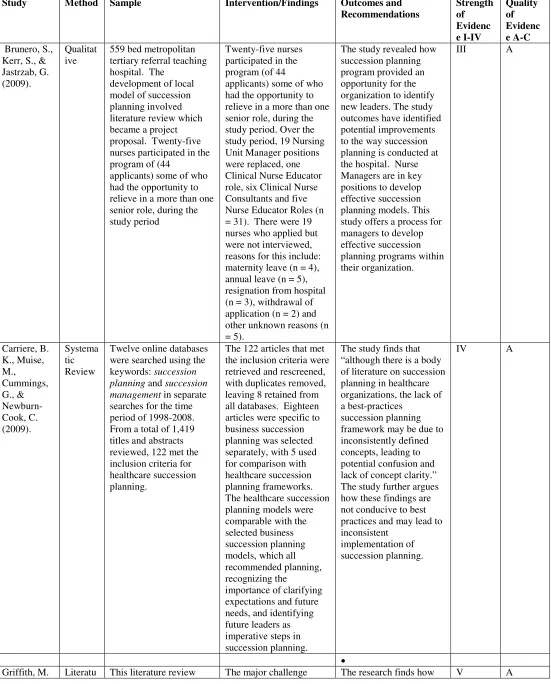
keywords. For summary of the evidence, please refer to the Evidence Table in Appendix A.
Brunero, Kerr, & Jastrzab's (2009) qualitative study reported on a locally organized
model of succession planning in a 550-bed general hospital in Australia. The study
acknowledges the need for a more formal approach to successful planning in nursing. Their
succession-planning model made use of literature and consultation with their senior staff. The
consultation with the senior staff identified that (1) there exists no formal structure or process for
succession planning; (2) there is a potential for financial implications; (3) a program/process
needs to be developed in the hospital; (4) knowledge and skills of staff need to be developed; and
(5) an evaluation process if succession planning is needed to occur. Evaluation of the model was
a four-part approach that included customer satisfaction, program progress, effective placement
and organizational result perspectives. Nurses who were successful in obtaining their new role
were later surveyed after 6 weeks. Their study made use of descriptive statistics, which included
data on numbers of placements and types of positions filled. A checklist was utilized for
evaluating the program of succession planning. There were 44 applicants but only 25 nurses
participated in the program, with 31 positions succeeded to. The nurses who participated
reported benefits such as increased sense of career planning and greater understanding of their
organization a way to identify new leaders. Nurse Managers and the nursing management are in
the key positions to develop effective succession planning models.
Carriere, Muise, Cummings, & Newburn-Cook's (2009) integrative systematic review
found that though there is a body of literature in succession planning in healthcare organizations,
there is a lack of best-practices succession planning framework that perhaps maybe due to
inconsistently defined concepts, leading to potential confusion and lack of concept clarity. The
findings of the study show no best-practices framework for implementation. The study suggests
that to mitigate knowledge loss, current CNO’s and healthcare leaders need to integrate
succession planning with organizational needs through the development and promotion of its
resources into future leadership positions.
Griffith's (2012) literature review summarized and evaluated succession planning
initiatives in nursing. The analysis of literature allowed the proposal of a new, comprehensive
succession-planning model for nursing. The study suggested that an effective succession
planning must be viewed as an interrelated process that involves identifying, developing, and
mentoring/coaching potential nurse leaders. Griffith acknowledges how though this process
might look like a continuum, it is not to be a closed loop. In synthesizing and analyzing
literature, Griffith created a model that has three areas, which includes academia, academic
preparation, and practice. Vital efforts must be made for both academia and practice to
complement each other as effective succession planning in nursing is an interrelated process
between these areas. The study revealed that effective succession planning must exist as a
continuum that is rooted with well promising recruits.
Hosis, Plummer, & Connor (2012) examined seven Saudi Arabian hospitals with a
sequential explanatory research design conducted in two phases. A survey was distributed to 449
front line and middle-nursing managers. 245 (55%) questionnaires were returned. The study’s
main objective was to examine the visions of nurse managers and leaders for succession planning
as well as examine associated policies and practices for Saudi Arabian and expatriate nurse
managers in Saudi Arabian hospitals. The result of the study found a significant shortage of
Saudi nurse managers at all seven participating hospitals relative to the number in the overall
nursing management workforce who participated in the research. The study ascertained that the
need for succession planning was clear, although comments were said to be sometimes cautious.
The implementation of succession planning does not depend strictly on the leaders or managers,
as the responsibility must be shared with the organization. The study acknowledges the
impossibility of having effective and sufficient nurse managers and leaders without having a
sophisticated system that considers their selection, abilities and development; and provides them
with education and support to assume their managerial role efficiently (Hosis et al., 2012).
Effective succession planning is built on the framework of a solid organization vision and
mission through formal identification by leadership.
Karaevli & Hall (2003) study is based on interviews with representatives from 13
organizations known for their succession planning and talent identification programs, such as
British Petroleum, Boeing Corporation and the United States Army. They conclude with an
analogy about the drunk who lost his wallet in the woods and was looking for it under the
lamppost. When asked why he was looking in a place so far from where he lost it, he said,
“Because that’s where the light is.” In their search for future executive talent, there is tendency to
look where it is easy to look. In application to the nursing discipline, acknowledging that
Kim (2012) made use of the 2008 AHA Annual Hospital Survey to identify hospitals with
and without succession planning, and other hospital characteristics. Of the sample hospitals,
1,501 hospitals (72.6%) had succession planning, while the remaining 567 hospitals (27.4%) did
not. There exist a difference in characteristics between hospitals with and without leadership
succession planning. Hospitals with succession planning were more likely than hospitals without
succession planning to be members of multi-hospital systems (62.0% vs. 35.2%) or networks
(40.7% vs. 30.9%), accredited by the now Joint Commission (73.2% vs. 39.0%), members of
Council of Teaching Hospitals (COTH) (8.8% vs. 3.7%), and bigger in terms of bed size (202 vs.
104). Hospitals with succession planning were more likely to be located in urban areas (82.4%
vs. 55.3%) and markets with higher per capita income ($33,778 vs. $30,212), compared to those
without succession planning. The study identified five key points which includes (1) Effective
succession planning is the heart of leadership development and an essential business strategy
because it enhances the ability to achieve orderly transitions and maintain productivity levels; (2)
The results of this study are consistent with previous studies that exhibit a positive association of
previous years’ performance with internal succession planning; (3) The key to successful
succession planning lies in building a solid foundation of profitability; (4) Having successors
ready to fill key vacancies helps improve operational condition and the bottom line, and thus,
gives a competitive edge in the market; and (5) Preparing successors for leadership may
determine which organizations simply survive and which thrive and lead their markets down the
road.
Patrician, Oliver, Miltner, Dawson, & Ladner (2012) examined nurturing charge nurses
for future leadership roles. The study acknowledges the impending crisis in chief nursing officer
groomed for future advanced leadership positions in healthcare organizations. The purpose of
their study was to understand the development needs for the charge nurse role. The result found
that charge nurses often receive little or no training for assuming positions of leadership and
offers suggestion for enhancement of preparation. The challenges charge nurses reported facing
were grouped into four themes which included—managing staff performance, role clarity,
powerlessness in regard to system complexity, and lack of leadership support. The study’s
findings identified opportunities for CNOs and nurse managers to develop leaders of the future
among the ranks of charge nurses. Steps should be considered to make the charge nurse role
consistent throughout the organization, facilitating role clarification and peer support
opportunities. The study argues for instituting formal peer support groups for new charge nurses
as it can be beneficial. CNOs could also explore their organizational talent pool by providing
charge nurses the opportunity to shadow them and nurse managers in their daily work to identify
this untapped level of future leaders as evidence supported the effectiveness of mentorship
programs in succession planning.
Sverdlik (2012) surveyed two groups of nurse leaders to design a Nursing Leadership
Program. The first group was the Nursing Leadership Team at Broward Health Medical Center
(N=22). The second group was a convenience sample of Nurse Leaders in the South Florida
Community (N=21). As nursing leaders retire and leave the profession, who will take their
place? The question is not just about the number of nurses who will take on leadership roles; it is
about the preparation required to be successful. Formal succession planning is a crucial part of
strategy to ensure that nursing leadership positions, at all levels, are filled with qualified
candidates. The target group for the Nursing Leadership Development Program was Assistant
participating in the program. Sixty-six percent (44/67) of current Assistant Nurse Managers
responded to the survey. Of the 44 who responded, 15 (34%) expressed interest in participating.
Ultimately, 6 Assistant Nurse Managers were selected to participate in the Nursing Leadership
Development Program with one who did not complete the program. Sverdlik (2012)
acknowledged how organizations can benefit from having current staff prepared to move into
leadership positions. This allows the maintenance of smooth operations, supported organizational
goals, continuity improving quality care and maintaining regulatory compliance. The short,
nine-week program is both cost effective and efficient. Lessons learned from the program can be
incorporated into the participant’s current role while a limited time is spent off their unit. The
study further argues that succession-planning programs should be placed in all levels of
leadership and all disciplines. Interdisciplinary programs can foster improved teamwork and
collaboration within an organization. The program application revealed that the cost of formal
succession planning program is significantly less, in terms of time and money, as opposed to
recruiting external candidates to fill leadership positions. Mentoring is also the key to successful
succession planning.
Titzer, Phillips, Tooley, Hall, & Shirey's (2013) synthesis of literature shows that despite
the clear benefits of succession planning, studies show that resource allocation for proactive,
deliberate development of current and future nurse leaders is lacking. The study suggests that to
increase succession-planning implementation and ensure dedicated resource allocation, strategic
and deliberate evaluation methods, including cost benefit analysis (CBA) and balance score card
(BSC) metrics are recommended. Finances was also in Trepanier & Crenshaw's (2013) theme as
they acknowledge how a formal succession planning process is crucial to the financial and
Conceptual Framework
The phrase “succession planning” has many meanings in terms of development and
replacement. Uses of the concept are found in the literature of human resource management
training, employee coaching (Karsten, Baggot, Brown, & Cahill, 2010), family business
inheritance (Lansberg, 1988), political survival, financial planning (Christensen, 1979), academic
environment training and development (Glasgow et al., 2009) and ecological succession.
As generations of nurse leaders leave the workforce and healthcare organizations
continue to grow, the need for initiatives supporting succession planning becomes increasingly
important. Preparation for leadership replacement begins with a vision and is vitalized by a
mission to move the organization toward its objectives. Skilled individuals who fit the culture of
the organization are essential to the planning process. Succession planning promotes growth and
development among nurse leaders at all levels of the healthcare system. Nurse leaders play
important roles in facilitating the delivery of high quality professional nursing care, in staff
retention, and in the cost of care (Shirey, 2011). Although many healthcare organizations have
begun to realize the value of having qualified individuals to promote into leadership positions
vacated by attrition, promotions, and transfers, there are relatively few formal education
programs that specifically target leadership development of current nurses with the potential to
progress into more complex leadership positions. Furthermore, research on succession planning
and its ability to promote ethnic diversity in healthcare organizations is limited.
Bandura’s (1977) theory was used to describe the context in which participants would
have an opportunity to experience various scenarios prior to assuming advanced positions.
Humans are affected by their environment and tend to act within the framework of their
and execution of succession planning programs. The ability of healthcare professionals to
successfully carry out a succession planning program is further explained by Bandura Social
Learning Theory. His theory suggests that other humans learn through interactions with others
within a social context. This very process is reflected in the coaching and mentoring involved in
formal succession planning programs. In combination, these two frameworks describe the
relationship and connectivity of the four themes and eleven subthemes derived from the data
collected from the six participating healthcare organizations. The factors are essential to the
establishment, structuring, and sustainability of a successful succession planning program.
Bandura introduced the concept of modeling which is used in the process of mentoring.
Role playing is a part of modeling. This allows the novice nurse to practice responses to various
situations prior to being in the real world. The new nurse learns how to handle various situations
that can be played out in a management position. He/she learns from their mentor what the
expectations are, the language to use as well as demeanor and vocal tone. A colleague had
devised computer generated simulations for nurses to practice these tools.
According to Woolfe (2002) the concept of succession planning dates back to biblical
times and the wisdom Jesus exercised in his leadership role as he carefully picked twelve
disciples, which allowed him to develop additional leaders. The transition from leader to leader
was both smooth and rocky; however, the chosen future leader’s mission and vitality was kept
intact. It also kept their leadership engine powerful. Today, organizations realize the value of
having competent leaders as well as a pool of potential leaders from which to pick at any given
time, leaders with the skills necessary to remain successful in today’s global economy. Smart
all of its “high potentials” so that if an emergency or planned move occurred, there would be
people in place to accept the role of leadership.
The U. S. government has a succession plan in place in case of the death, impeachment,
or resignation of our top executives. We are all too familiar with this scenario through the cases
of John F. Kennedy, Richard Nixon, Spiro Agnew, and Bill Clinton. (U.S. Const. art. II, § 1).
However, succession planning exists for a reason, and smart companies ensure that they too have
a succession plan in place that addresses all contingencies, even the “unthinkable” (Woolfe 2002).
Inevitable changes and challenges occur within the workforce of an organization and may
include disability, death, natural disasters, relocation, downsizing, separations terminations and
retirements. A mentorship training program is one strategy in succession planning that is
designed to address workplace needs. Succession planning is a very important human resource
model that helps with workforce planning needs and builds bench strength within an
organization (Rothwell, 2005).
It includes mentoring new leadership and developing a plan to transfer organizational
power to younger employees. According to Rothwell (2005) succession planning can be helpful
and minimize disruption when senior employees leave an organization. Succession planning is a
proactive approach that helps leaders deal with unexpected changes and has been defined in
many different ways. However, for the purposes of this literature review, this researcher will use
the definition coined by McWilliams (2005), succession planning management is an effort
designed to ensure the continued effective performance of an organization, division, department,
or work group by making provisions for the development, replacement, and strategic application
of key people over time. Added to the vocabulary of succession planning is technical succession
organization, division, department, or work group by making provisions for distilling, preserving,
maintaining and communicating the fruits of the organization’s institutional memory and unique
experience over time (Rothwell & Poduch, 2004).
The most popular framework for understanding succession planning is described by
William Rothwell, Ph.D. Rothwell (2005) defines succession planning as an effort designed to
ensure the continued effective performance of an organization, division, department, or work
group by making provision for the development, replacement and strategic application of key
people over time in efforts to preserve, maintain and communicate the institutional memory and
unique experience over time. Succession planning is an evolving human resource model that
cannot be a one-time activity. It is an ongoing examination of what the organization should stop,
start and continue (McWilliams, 2005). Organizations should examine themselves to identify
potential leadership candidates. Kesler (2002) calls this analyzing leadership “bench strength”
and consulted with 25 major companies observing various approaches to succession planning.
He concluded that replacement planning was obsolete in today’s workforce and that succession
planning includes a comprehensive set of assessment and development practices that support the
entire workforce for identifying talent at all levels of the organization while nurturing talent and
potential at all levels. He found that leadership development has been observed for more than 25
years in Fortune 500 companies such as General Electric, Exxon and a few others as they
developed best practices for developing future leaders. In 1973, Walter Mahler wrote Executive
Continuity, one of the first reports detailing reports of how leading corporations planned for the
replacement of key executives and found succession planning to be an important complement to
Methodology Ethical Issues
There were no ethical issues identified for the development and implementation of a
succession plan for the nursing department at a community hospital. This project was not a
research study, but a project in which to promote a change in practice to benefit nurses, hospital
and finally the patients. Approval for this non-research project was granted by the University of
San Francisco Doctorate of Nursing Practice department on January 24, 2014.
Planning the Intervention
The intervention was planned once consent from the chief executive officer was received.
A communication plan can be found in Appendix B. The Human Resource department was also
consulted for adherence to corporate and governmental regulations. The CNO was the driving
force behind this intervention. The directors of the various nursing units agreed that the
intervention was necessary to provide the necessary replacements for vacant positions. The
Human Resource departments provide consultative services for the project.
With the lack of in-house candidates for the vacant positions and a dearth of external
candidates, a discussion ensued regarding the opportunity for the organization to develop its own
pool of candidates. When the present staff was queried regarding the vacancies, no one wanted
the role. Some of the reasons given for the lack of interest in moving up were being exempt
would reduce their income, loss of overtime, had to work five days a week, unable to have a
second job and just not interested. The author embarked on a literature search for information on
succession planning for non-executive nursing positions. The information that was discovered
was shared with the Chief Executive Officer, Chief Nursing Officer and nursing directors. Titzer
intelligence, command of financial language and have the ability to communicate. These
additional skills are not always part of the nurse manager orientation program. Therefore, a plan
to develop our staff was initiated.
The first items to be identified were who were the candidates; what leadership vacancies
were open; the corporate and nursing culture.
The candidates identified as potential leaders were the 14 charge nurses from the various
nursing units and from the two shifts. The nurses already exemplified their ability to act as
leaders on their respective units. Most of the nurses had completed their BSN degrees and some
were considering continuing on for their MSN. The hospital does offer tuition reimbursement
and all of those nurses participated in that program.
The author identified two vacancies on the hospital nursing leadership team. And one
corporate opening was identified. These were the manager of intensive care unit and manager of
emergency department. Additionally, the system director of perioperative services was the
vacant corporate position.
The culture at the hospital was one that rewarded excellence at the bedside with
promotion but not necessarily with leadership education and mentoring. With this in mind, the
hospital had some nurses that were reluctant charge nurses. This meant that the charge nurse was
competent in their role but did not relish it. Other charge nurses were incompetent due to their
inability to separate friendship from workplace concerns as well as being unable to shift from
direct patient care to a supervisory role.
The aim of this project was to have an in-house supply of able and willing candidates for
the various leadership vacancies. These candidates would be encouraged to attend paid education
formal, like continuing education classes as well as informal such as shadowing a charge nurse.
Mentoring would also be involved in the process. Potential mentors would be recruited for their
aptitude for this process. Eller, Lev, & Feurer (2014) found eight themes that contribute to a
successful mentoring relationship. These components are (1) open communication and
accessibility; (2) goals and challenges; (3) passion and inspiration; (4) caring personal
relationship; (5) mutual respect and trust; (6) knowledge exchange; (7) independence and
collaboration; and (8) role modeling.
Competencies were also developed for these leadership positions. These included a
Succession Planning Initiative Memo (Appendix C), a Leadership Style Questionnaire
(Appendix D), Leadership Skills Questionnaire (Appendix E), a New Hire Succession Survey
(Appendix F), a List of Developmental Activities (Appendix G), an Individual Assessment
Summary Profile (Appendix H), and an Individual Development Plan (Appendix I). The
Association of Nurse Executives (AONE) has published competency domains for nurse
managers and those were used in development of the templates.
Budget was also a consideration as this project needed to be budget neutral. Human
resources were consulted for the cost of recruitment, orientation and retention figures.
Implementation
The project was implemented over a six month period. The author desired to have the
entire hospital community informed of the project and its goal. An informational presentation
was developed and present to various hospital committees (Appendix J). Those committees
included the following: Governing Board, Medical Executive Committee, Professional Practice
A questionnaire was developed and presented at a charge nurse meeting. This
questionnaire was an attempt to gauge the interest of the charge nurses for leadership mentoring
and education. There were 14 charge nurses present. They were asked to complete the
questionnaire and return to the author within a week. Once the completed questionnaire was
received additional resources were assembled. Based on their responses educational programs
on leadership, mentoring and the like would be developed in conjunction with our educational
vendor and in-house educator. Additionally, succession planning would be discussed during new
hire employee orientation.
The charge nurses returned none of the initial questionnaires to the author. This author
believes this was due to the format of the questionnaire as it called for a narrative rather than the
use of Likert scale. Based on the previous discussion of lack of internal candidates, none were
interested in the increase of responsibility. Hence, a new and different approach needed to be
developed. The original questionnaire took a narrative approach and the revised questionnaire
used a Liker scale to gauge interest.
During this time corporate approved the hospital request to post 15 new RN positions.
This was an excellent opportunity to hire new employees that exhibited the qualities that the
hospital wished to capture and promote. The revised questionnaire and a letter announcing the
initiative was given to all new RN employees that were hired. These new hires all had BSN
degrees and expressed an interest in continuing their education. At the time this paper was
written the results are promising, at least these new hires have expressed an interest in the
Planning the study of the Intervention
Planning the study of the intervention required a redesign of the initial questionnaire.
The written timeline of this project is found in the Gantt chart (Appendix K). The project was
slow to start due to the fact that the meetings with the governing board and the other committees
were dependent on when they met. These committees need not meet every month. The author
informed that body prior to the other committees.
Trepanier and Crenshaw (2013) have found that organizations who have a formal
succession plan in place experience continuity in strategic leadership, promote effective
operations and enjoy improved quality of care. These authors also state that there are other
benefits to having a succession program which include the improved retention rates, increased
staff engagement and an improved financial performance.
Looking at the particular breakdown of the work, the project managers in nursing are
more likely to recognize that if the project will be completed in due time, will it occur in the
predictive order, are some of the elements that will cause problems by occurring before estimated
time (Jung & Woo, 2004). For example, the cost of recruiting new nurses have been known to
increase before the hiring process gets completed. This problem was assessed by allowing the
breakdown of integrated sections of the plan, into a control group that will evaluate the
construction of the project in order of: planning hiring process; offering incentive based payrolls
for motivations; and then; the implementation of precise training and educational programs in
clinical practice (Griffith, 2012). The work breakdown structure can be summarized in Appendix
L.
The implementation of succession planning requires systemic thinking and time-to-time
replace their leaders in nursing. The quality of healthcare depends on various human and
non-human resources, and both the quality and quantity of health services will be assessed on mix
resources. Studies suggest that hospital-based nurses’ productivity is determined by both the bed
capacity of the community hospital and average severity level of the patient pathologies (Cope,
2010).
Financial resources and budgeting also determine the construction of strategies for local
systems and community hospitals. Resources can be evaluated by considering the demographic
characteristics and prevalence of the diseases in the community (Cope, 2010). The resources to
execute and deliver healthcare interventions require forecasting tools to guide human resource
planning activities. Planning for leadership positions needs to be identified during the yearly
budgeting process.
According to Cope (2010) also found that nurse managers, who received their assistance
from immediate directors and the HR department, implicated the planning. However, this allows
the nurses to generate planning requests and be responsible for administration of the process.
This process is determined by the state of annual budget and availability of financial reservoirs.
The strategic plan will also help to demonstrate the forecasting needs of the clinical unit and to
hire nurses for the coming year. In addition, healthcare organization also requires capacity
analysis tools to support tight monitoring and evaluation of nursing succession plan.
Methods of evaluation
The plan-do-study-act method of evaluation was used for this project. The focus of this
type of evaluation is a small test of change. This method is a well-organized, quick approach for
testing improvements based on the four components of plan, do, study and act. According to
the subject being tested, planned action, when the test will start, who will observe, how long the
test will last and expected outcome. The do part is the actual implementation of the small test of
change. The study phase is the time to reflect on the outcomes. The act phase is when the
decision to continue or not is determined.
Based on this method when the first questionnaire was not completed as predicted, the
author needed to review the evidence and decide whether or not the project was worth continuing.
Since succession planning is imperative to maintaining a pipeline of candidates for leadership
positions, it was decided to revise the questionnaire from a narrative form to a Likert scale form.
Additionally, since nursing department culture was to be changed, the questionnaire was to be
given to all new nurse hires for completion. These revisions created a noticeable difference.
Approximately 75% of the new nurse hires completed the questionnaire. Approximately
two-thirds of those nurses were interested in a succession plan program.
The project should decrease the cost of recruitment, which would result in reduction of
expenses. At present, the cost of recruitment for one charge nurse vacancy is $141,500. This
cost would remain static over three years resulting in a three year cost average of $424,500.
Under the succession plan, the recruitment cost would remain the same for the first year.
However, due to a reduction in fees for recruiters and advertising, the cost to fill a charge nurse
vacancy would decrease significantly to $24,750 in years 2 and 3 under the succession plan. The
potential savings for three years would be $233,500 (Appendix M). Implementation of a
succession plan would be not only be financially beneficial, but also encourage nurse retention
Analysis
With due diligence and attention, the succession plan program at this hospital will
continue to be built. The nursing department culture will continue to evolve over time. The
process will continue to evolve and shape the organization. Succession planning programs
cannot exist in a vacuum, the entire hospital needs to be involved and committed to achieving
this goal.
Limitations of the project in implementing the succession plan care are as follows.
• The primary implication for this strategic plan is to relate nursing leadership
shortages to the implementation of a career plan. However, during this project, the
author has identified de-motivation, inexperienced staff, lack of cooperation or
teamwork and increased workload as possible problems that will provide
obstacles in implementing the succession plan.
• Due to the shortage of nurses, it may be difficult to have people for various
specialized positions. The hospital has had difficulty in recruitment due to the
location as well as the benefit and compensation packages it offers.
• Lack of interest of the new generation of nurses in a career pathway, as they
consider it irrelevant to climb the ladder of success or to get promoted.
• The resistance to change by the practicing nurses when they understand the
concepts of inappropriate professional attitudes, favoritism conflict and poor
communication. These act as a barrier to implement succession planning in
healthcare.
• Finance is also one of the constraints along with the budget allocation that have
hospital has a contract with a private educational company for training. Also the
hospital has received a training grant from the state of California in the amount of
$150,000 that can be used for this endeavor.
The major hindrances for beneficial implementation of a succession plan are the inability
to schedule nurses for educational classes due to the nursing shortage and the nurses’ motivation
to attend.
Results
Program Evaluation/Outcomes
In order to develop and implement a succession plan for the nursing department,
significant literature does exist in the form of documented evidence. Nurses quit frequently due
to aging leaving behind a substantial vacancy and space. This project was conducted in a
community hospital which is located in an underserved area of Los Angeles. There are many
solutions that are available to identify the increased frequency of burn-out in the healthcare and
lack of better successors to refill the gaps in the nursing profession (Sullivan & Garland, 2010)
Nurses have looked towards other professions due to better pay scales offerings offered
or work environments. Thus, there is a need to develop and practice a succession plan in this
community hospital, which will allow the healthcare entity to identify and mentor potential
candidates for future positions (Haslam & Ryan, 2008). As the Chief Nursing Officer, the goal of
the author was to develop and implement a succession plan for the nursing department. This
community hospital has had difficulty in recruiting professional applicants for various nurse
leader positions. The development of a comprehensive strategy would decrease chances for
extensive searches for recruiting nurses and will shorten the on boarding processes. This plan
department. Candidates are recruited, challenged and mentored in order to assess their
competencies needed to evaluate for leadership positions. This succession plan eventually
reduces the time wastage in filling the vacancies.
Historically, nurse leadership applicants were assessed on the basis of their superior
clinical skills. This succession planning project provides a pathway for leadership development
which can potentially improve staff nurse morale and staff retention rates. As a consequence of
improper succession planning, the aging nurses’ population is leaving healthcare, and these
shortages have resulted into an inadequate staffing and poor performance in all aspects of
healthcare delivery (Sullivan & Garland, 2010). Nurses will be recruited based upon their skills,
education, clinical experience, and leadership qualities. According to Haslam and Ryan (2008),
the most important event in addressing leadership insufficiencies in healthcare is to recruit
employees who have demonstrated leadership abilities. The participants were analyzed on their
strong educational backgrounds, specifically on problem solving and group learning techniques.
This project incorporated the identification of various types of leaders like operational or
strategic leadership characteristics (Cortese et al., 2010). These participants were assessed
through self-assessments for competencies, mechanisms to evaluate competencies and ability to
identify leadership gaps in healthcare organization.
Discussion
Succession planning is a vital component in preparing healthcare organizations for a
changing environment in which a growing number of aging leaders are retiring or reorganizing
their careers. If organizations wish to increase their efficiency and remain competitive, the
appropriate systems must be in place to manage talent. The absence of formal succession
about successful in-place programs were the driving forces for this grounded theory qualitative
study. The purpose of the study was to explore the implementation of succession planning
programs in healthcare organizations for aspiring nurse leaders to understand how the programs
are established, structured, and sustained. A review of the literature revealed limited information
on succession planning programs in healthcare organizations and, of those, only a few research
studies addressed programs for aspiring nurse leaders. Programs that were identified in the
literature described interdisciplinary approaches and focused mainly on higher level job positions
such as CNO, CFO, COO, and CEO.
Summary
This study fills a gap in the literature by describing how healthcare organizations with
successful succession planning programs prepare nurses for future leadership positions. Study
findings indicate that succession planning programs allow for the selection and grooming of
individuals who fit the culture of the organization. The individual’s work ethic, performance, and
relationships with other healthcare professionals are already established and validated by past
and current job performance. This research reinforces the importance of continuing to educate
and prepare qualified nurse leaders as the current generation of nurse leaders begins to retire.
While formal succession planning programs consist of many important elements, the findings of
this study indicate that success is heavily dependent on the presence of an executive champion, a
designated program director, and the availability of a committed group of nurse and mentors.
When examined as a process, succession planning consists of multiple components that, in
combination, can profoundly influence organizational performance and individual employee
A formal succession planning process provides a healthcare organization with a ready
pipeline of qualified individuals who can move into leadership positions as they become vacant.
The role of a succession planning program in the leadership development process is integral to
the success of the organization. The program serves as the gatekeeper for policy implementation,
knowledge transfer, formal coaching and mentoring, and career development opportunities.
Individuals appreciate their organization’s confidence in them and the investment in their
professional growth and development. While specific actions to increase racial and ethnic
diversity in leadership positions were absent in more than half of the healthcare organizations
participating in this study, the data revealed unanimous awareness of the importance of diversity
and that meticulous and focused efforts were needed to rectify the deficiency. The hospital made
an effort to recruit nurses that mirror the community in which the hospital serves but was not
successful.
Interpretation
Succession planning is crucial to the hospital viability today. But the culture of the
organization plays a major role in the implementation and success of the any project in the
organization. The present apathetic culture needs to be changed to ensured continued use of the
program.
The succession planning program needs to become part of the culture of the hospital to
succeed. This can be accomplished by hiring the employees that will contribute to the changing
culture instead of hiring those that will be resistant to any change. Dilution is a method to aid in
changing the culture. It is essential that the hiring director/managers and the nurse recruiter
Conclusions
Succession planning is essential to maintain workplace culture and ensure competent
nursing leadership. Effective succession planning matches the organization’s available talent to
its future needs. Succession planning provides that leadership decisions are performed in a
systematic manner. It is a constant, avoids crisis and provides incentive for continuous
performance improvement in a cost effective manner. The specific conclusions and implications
based on the findings from this project include the following: Environmental forces that were
important drivers in the development of these succession planning programs included an aging
leadership team with no replacements in the pipeline and a rapidly changing healthcare market.
Individuals critical to the success of these succession programs were executive champions,
designated program directors, and a cadre of willing mentors. Allocation of resources was found
to be critical to the development and sustainability of a successful succession planning program.
Individuals targeted for these programs were from the charge nurse group and have
demonstrated leadership talent, were top performers in their work environment, and were
moderately motivated and engaged in professional organizations. The institution interviewed for
this project was not successful in achieving a diverse pool of candidates for their programs with
the current staff. The author forecasts that with the recently hired staff that result will be
reversed. Content for the succession programs emphasized business management, effective
communications, labor relations and cultural awareness, resolving conflict and leading change.
Outcomes identified by each of the organizations included the ability to fill their leadership
positions more quickly.
Having a succession planning program linked to the organization’s vision and career
to fill vacant positions. Leadership development through a formal succession planning program
contributes to employee satisfaction and improves the organization’s overall outcomes.
Unexplored opportunities exist for establishing and maintaining a diverse racial/ethnic mix in
healthcare organizations’ leadership team.
Other Information Funding
References
Abrams, M., & Bevilacqua, L. (2006). Building a leadership infrastructure: the next step in the
evolution of hospital systems. Health Care Strategic Management, 24(4), 1–13.
Brunero, S., Kerr, S., & Jastrzab, G. (2009a). The development and evaluation of a succession
planning programme in nursing, in Australia. Journal of Nursing Management, 17(5), 576–
583.
Brunero, S., Kerr, S., & Jastrzab, G. (2009b). The development and evaluation of a succession
planning programme in nursing, in Australia. Journal of Nursing Management, 17(5), 576–
83. doi:10.1111/j.1365-2834.2009.00990.x
Buerhaus, P. (2009). The recession and the nursing shortage. OR Manager, 25(5), 5–6.
Cadmus, E. (2006). Succession planning: multilevel organizational strategies for the new
workforce. Journal of Nursing Administration, 36(6), 298–303.
Carriere, B. K., Muise, M., Cummings, G., & Newburn-Cook, C. (2009a). Healthcare succession
planning: an integrative review. Journal of Nursing Administration, 39(12), 548–555.
Carriere, B. K., Muise, M., Cummings, G., & Newburn-Cook, C. (2009b). Healthcare succession
planning: an integrative review. The Journal of Nursing Administration, 39(12), 548–55.
doi:10.1097/NNA.0b013e3181c18010
Christensen, C. R. (1979). Management succession in small and growing enterprises. Arno Press
Boston.
Collins, S. K. (2009). Succession planning: perspectives of chief executive officers in US
Cope, P. (2010). Succession Planning & Management: Understanding the Whole Picture.
Retrieved October 21, 2014, from
http://www.slideshare.net/lgdavitian/succession-planning-management-understanding-the-whole-picture
Cortese, C. G., Colombo, L., & Ghislieri, C. (2010). Determinants of nurses’ job satisfaction: the
role of work-family conflict, job demand, emotional charge and social support. Journal of
Nursing Management, 18(1), 35–43. doi:10.1111/j.1365-2834.2009.01064.x
Crumpacker, M., & Crumpacker, J. M. (2007). Succession planning and generational
stereotypes: should HR consider age-based values and attitudes a relevant factor or a
passing fad? Public Personnel Management, 36(4), 349–369.
Davis, J. (2005). Changes at the top. Are you ready. Behavioral Health Management, 25(6), 23–
26.
De Gieter, S., Hofmans, J., & Pepermans, R. (2011). Revisiting the impact of job satisfaction and
organizational commitment on nurse turnover intention: an individual differences analysis.
International Journal of Nursing Studies, 48(12), 1562–9.
doi:10.1016/j.ijnurstu.2011.06.007
Donelan, K., Buerhaus, P., DesRoches, C., Dittus, R., & Dutwin, D. (2007). Public perceptions
of nursing careers: the influence of the media and nursing shortages. Nursing Economic$,
26(3), 143–150.
Eller, L. S., Lev, E. L., & Feurer, A. (2014). Key components of an effective mentoring
relationship: A qualitative study. Nurse Education Today, 34(5), 815–820.
Fennimore, L., & Wolf, G. (2011). Nurse manager leadership development: leveraging the
Garman, A. N., Tyler, J. L., & Darnall, J. S. (2003). Development and validation of a
360-degree-feedback instrument for healthcare administrators. Journal of Healthcare
management/American College of Healthcare Executives, 49(5), 307–321.
Glasgow, M. E. S., Weinstock, B., Lachman, V., Suplee, P. D., & Dreher, H. M. (2009). The
benefits of a leadership program and executive coaching for new nursing academic
administrators: One college’s experience. Journal of Professional Nursing, 25(4), 204–210.
Griffith, M. B. (2012). Effective succession planning in nursing: a review of the literature.
Journal of Nursing Management, 20(7), 900–11. doi:10.1111/j.1365-2834.2012.01418.x
Haslam, S. A., & Ryan, M. K. (2008). The road to the glass cliff: Differences in the perceived
suitability of men and women for leadership positions in succeeding and failing
organizations. The Leadership Quarterly, 19(5), 530–546.
Hosis, K. Al, Plummer, V., & Connor, M. O. (2012). management article Nursing Management in
Saudi Arabia : evaluating strategies for succession planning. Asia Pacific Journal of
Health Management, 19–27.
Jacob, S. R., & Sánchez, Z. V. (2011). The challenge of closing the diversity gap: development of
Hispanic nursing faculty through a health resources and services administration minority
faculty fellowship program grant. Journal of Professional Nursing, 27(2), 108–113.
Jung, Y., & Woo, S. (2004). Flexible work breakdown structure for integrated cost and schedule
control. Journal of Construction Engineering and Management, 130(5), 616–625.
Karaevli, A., & Hall, D. T. (2003). Growing leaders for turbulent times: is succession planning
up to the challenge? Organizational Dynamics, 32(1), 62–79.
Karsten, M., Baggot, D., Brown, A., & Cahill, M. (2010). Professional coaching as an effective
Kesler, G. C. (2002). Why the leadership bench never gets deeper: Ten insights about executive
talent development. Human Resource Planning, 25(1), 32–45.
Keys, Y. (2014). Looking ahead to our next generation of nurse leaders: Generation X Nurse
Managers. Journal of Nursing Management, 22(1), 97–105.
Kim, T. H. (2012). Succession Planning in Hospitals And the Association. Nursing Economic$,
30(1), 14–21.
Kim, T. H., & Thompson, J. M. (2012). Organizational and market factors associated with
leadership development programs in hospitals: a national study. Journal of Healthcare
Management, 57(2), 113.
Koch, J. L. (1978). Managerial succession in a factory and changes in supervisory leadership
patterns: A field study. Human Relations, 31(1), 49–58.
Lansberg, I. (1988). The succession conspiracy. Family Business Review, 1(2), 119–143.
Martin, J., & Schmidt, C. (2010). How to keep your top talent. Harvard Business Review, 88(5),
54–61.
McAlearney, A. S. (2005). Exploring mentoring and leadership development in health care
organizations: Experience and opportunities. Career Development International, 10(6/7),
493–511.
McWilliams, A. (2005). Mentoring for succession: Countering aging work force issues. Paper,
Carl Vinson Institute of Government, University of Georgia, Athens.
Mennick, F. (2008). Many Experienced Nurses Plan to Leave the Profession. AJN The American
Journal of Nursing, 108(7), 20.
Mulholland, J., Anionwu, E. N., Atkins, R., Tappern, M., & Franks, P. J. (2008). Diversity,