by
http://ssrn.com/abstract=573421
Rafael Rob and Tadashi Sekiguchi
“Reputation and Turnover”
PIER Working Paper 04-032
Penn Institute for Economic Research Department of Economics University of Pennsylvania 3718 Locust Walk Philadelphia, PA 19104-6297 [email protected] http://www.econ.upenn.edu/pier
Reputation and Turnover
∗
Rafael Rob
†Tadashi Sekiguchi
‡August 4, 2004
Abstract
We consider a repeated duopoly game where eachfirm privately chooses its investment in quality, and realized quality is a noisy indicator of the
firm’s investment. We focus on dynamic reputation equilibria, whereby consumers ‘discipline’ a firm by switching to its rival in the case that the realized quality of its product is too low. This type of equilibrium is characterized by consumers’ tolerance level - the level of product quality below which consumers switch to the rivalfirm - andfirms’ investment in quality. Given consumers’ tolerance level, we determine when a dynamic equilibrium that gives higher welfare than the static equilibrium exists. We also derive comparative statics properties, and characterize a set of investment levels and, hence, payoffs that our equilibria sustain.
Keywords: Reputation, consumer switching, moral hazard, repeated games.
JEL classification numbers: C73, D82, L14, L15
∗Part of this research was conducted while Sekiguchi was visiting the University of
Pennsyl-vania. Sekiguchi thanks the University of Pennsylvania for its kind hospitality. Rob acknowl-edges NSF support under grant numbers 98-12681 and 01-36922, and Sekiguchi acknowlacknowl-edges financial supports from the Nomura Foundation for Academic Promotion and the Inamori Foundation. We are grateful to Michihiro Kandori, Hitoshi Matsushima, and Yossi Spiegel for helpful discussions. We are also grateful to Ray Deneckere and an anonymous referee for constructive suggestions. We presented the paper at the 2001 Decentralization conference, the 2001 Summer meetings of the Econometric Society, Kyusyu University, the University of Michigan, the University of Tokyo and Hitotsubashi University, where we received many useful comments. Remaining errors are, regrettably, our own.
†Department of Economics, University of Pennsylvania, 3718 Locust Walk, Philadelphia,
PA 19104-6297, USA. E-mail address: [email protected]
‡Institute of Economic Research, Kyoto University, Yoshida Honmachi, Sakyo-ku, Kyoto
1
Introduction
This paper studies markets in which the quality of a product or a service varies over time, and in which consumers’ expectations about future quality are deter-mined by past quality. Firms in such markets are subjected to turnover; afirm that suffers a low quality realization loses favor in the eyes of consumers and, as a result, loses market share and profits. Our objective here is to set up and analyze a model focusing on this turnover phenomenon.
The point of view we take is that the presence of turnover disciplines firms in a world of moral hazard. Consider a world in which the quality of a firm’s product is influenced by its investments, and in which these investments are private information. Assume also that consumers cannot ascertain quality at the point of purchase and that the legal system does not provide an effective and/or timely protection. Then, the equilibrium quality of products is prone to be minimal and, in particular, below the quality that is socially optimal. If consumers buy the product repeatedly, however, then the option to turn their business over to otherfirms has the potential to rectify this problem. Indeed, in such circumstances, a firm invests in quality because the delivery of high quality today generates high demand and high profits tomorrow, whereas the delivery of low quality results in low demand and low profits. Our purpose here is to make precise this intuition and study it systematically in the context of an oligopoly.
This line of research relates to two strands of literature. Thefirst strand is the IO literature that originated with Klein and Leffler (1981), where the disci-plinary role of markets wasfirst recognized (see also Shapiro (1983)). Compared to this literature we make explicit the phenomenon of turnover. Afirm’s price, volume of sales, and stock market valuation allfluctuate over time because of the noise in quality, and these fluctuations are endogenous to the model. We also offer a unified and systematic analysis of a variety of duopoly games, in-cluding some of the most traditional games encountered in the IO literature. This allows us to link details of the competitive interaction betweenfirms (mar-ket size, cost of investing in quality, degree of product differentiation, the noisy connection between investments and realized quality, etc.) and the nature of turnover equilibria.
A second strand of relevant literature is that on repeated games with imper-fect monitoring, found in papers such as Fudenberg, Levine and Maskin (1994). This literature shows the full potential of repeated interaction to sustain out-comes that are unsustainable under one-shot interaction, and allows general (and arbitrarily complex) strategies to achieve that. Compared with this latter literature we concentrate on particular, simple strategies that are in the spirit of the IO literature. Then we characterize equilibria via standard marginal con-ditions, and use familiarfixed point arguments to prove their existence. Using this tractable approach we perform various comparative statics and quantitative exercises, and study welfare properties.
In greater detail, the turnover mechanism we study is characterized by a threshold realized quality level that we callconsumers’ tolerance level. If afirm delivers this, or higher, quality level, consumers believe that thisfirm is likely to deliver high quality in the future; otherwise, consumers believe that thefirm is likely to deliver low quality. We embed this belief into a dynamic duopoly model in whichfirms and consumers are strategic players. Firms invest in quality and consumers form beliefs about future investments, based on last period’s realized quality, and these beliefs determine consumers’ purchasing behavior. Using this framework we derive three sets of the results.
Thefirst set of results deals with existence and uniqueness of an equilibrium of the type described above. Given some tolerance level, we derive a closed form expression, written in terms of model primitives, which characterizes a set of investment levels that constitute equilibria. This allows us to pin down a con-dition under which positive investments are sustainable in equilibrium, so that some dynamic equilibrium is better than the static equilibrium that would occur without repeated purchase. The condition we state relates to the cost of quality provision (requiring it to be sufficiently low), although, as we comment, anal-ogous condition can be stated relating to consumers’ demand curve (requiring it to be sufficiently high). Hence, the question whether a dynamic equilibrium under repeated purchase improves upon the static equilibrium is settled by di-rect reference to model primitives. We also derive a condition under which the equilibrium (with positive investments) is unique for a given tolerance level. This condition, too, relates to model primitives.
The second set of results deals with comparative static properties of the equilibrium which is characterized by the largest investment level among all equilibria. Here we again take advantage of the simple characterization of the equilibrium set, and show that the ‘largest’ equilibrium is increasing with the discount factor. We also show that the largest equilibrium may increase or decrease in consumers’ tolerance level, depending on properties of the noise dis-tribution, and we elicit sufficient conditions under which one or the other occurs. Our analysis here is related to recent literature on monotone comparative stat-ics (see Milgrom and Roberts (1990)) and, more specifically, to the property that afirm’s best response curve shifts uniformly upwards or downwards when certain parameters change. As such our approach is easily extendable to other parametric changes, for instance, relating to cost or demand conditions.
The third set of results deals with welfare properties of the model. We delineate a set of investment levels and, thereby, a set of welfare levels that are sustainable via turnover equilibria iffirms are sufficiently patient. Our analysis indicates that noisy observation of investments constrains the set of welfare levels that one can sustain via turnover equilibria. Finally, we show that a simple generalization of the turnover mechanism can do no better in terms of welfare.
Many of our results are illustrated numerically, using three parametric exam-ples. Among other things, we illustrate the nature offluctuations that turnover
equilibria induce, which includes the duration of selling high and low quality products, period profits and stock market valuations. We also show how to numerically determine parameter values under which the best constrained equi-librium is achieved.
The rest of the paper is organized as follows. The next section is divided into three subsections. In thefirst subsection we set up a generally specified period game that is played in each period. In the second subsection we outline three IO-type examples that are special cases of the period game. In the third subsection we show how the period game is embedded into an infinitely repeated game. Section 3 introduces the concepts of tolerance level and turnover equilibria, and analyzes afirm’s problem when consumers’ belief is based on a tolerance level. Section 4 is divided into two parts. In thefirst part we prove existence and uniqueness of turnover equilibria, given consumers’ tolerance level. In the second part the results are numerically illustrated. Section 5 studies comparative statics properties of the model, which includes sensitivity of equilibria with respect to the discount factor and consumers’ tolerance level. Section 6 characterizes a set of welfare levels that are sustained via turnover equilibria with patientfirms, and shows that one can do no better via what we call tournament equilibria, which are, essentially, a generalization of turnover equilibria. Section 7 concludes with further discussion of related literature and suggestions for future work.
2
The Model
We consider an infinite horizon model in discrete time, and index time periods by t = 1,2,· · ·. There are two identical, risk-neutral firms who produce and sell to a continuum of price taking, risk-neutral consumers. Firms are indexed byi, j = 1,2 and play a two-stage game within each period. The game is as follows.
2.1
The Period Game
In thefirst stagefirms move simultaneously, choosing their investments, which determine the average quality of their products. We letxi ≥0 denote firm i’s
investment and x denote either firm’s investment. The cost of choosing x is
c(x). We assume c(0) =c0(0) = 0,c0(x)>0 andc00(x)>0 for allx > 0, and
c0(∞) =∞. xis afixed cost: it affects the quality ofall units afirm sells and is independent of the number of these units. We assume that xi is privately
chosen by firm i and is unobservable to firm j or to any consumer. We letyi
denote consumers’ and firm j’s belief about xi. We discuss later how yi’s are
determined.
In the second stage firms move simultaneously again, choosing either the quantity they sell or the price they charge (but not both). Since the formulation encompasses both possibilities we refer to quantity or price generically as an
Then, depending on the choice of actions, the market clears andfirms’ period profits are determined. The way the market clears depends on (z1, z2) and
(y1, y2) but not on (x1, x2), which is not publicly observed, and has no effect
onfirms’ period payoffs gross of c(xi) (which has already been sunk). We let
ui(z1, z2;y1, y2) denote firm i’s gross period payoff, when firms’ action profile
is (z1, z2) and when they are believed to have chosen (y1, y2). These ui’s are
symmetric, i.e.,
u1(z1, z2;y1, y2) =u2(z2, z1;y2, y1).
Once the market clears and consumers consume the products, the quality of these products is realized. The realized quality of all units that afirm sells (if at all) is the same and is publicly observed.1 We assume that iffirmi’s investment
isxi, then the realized quality of its productsqi is
qi=xi+²i,
where²i is a noise term. We denote the joint c.d.f. of (²1, ²2) byG(²1, ²2). G
has a full support on (−∞,∞)×(−∞,∞), a (0,0) mean, and is symmetric,
G(², ²0) = G(²0, ²). Hence the marginal c.d.f. of²
1 is same as that of ²2. We
denote it byF(²),f(²) being its p.d.f. We assume thatF is twice continuously differentiable, and that for any ² >0, f0(−²)>0> f0(²), so that f is hump-shaped with a single peak at ² = 0.2 Since q
i has a full support (−∞,∞)
under any feasible investment profile, it cannot serve as a sure signal thatfirm
ideviated from some (in fact any) investment level.
For afixed (y1, y2), the profit functions, ui(z1, z2;y1, y2) for i= 1,2,
deter-mine a static game in whichfirms compete in zi’s. Let us denote this game by
Γ(y1, y2), and let us make the following assumptions about its equilibria. We
later exhibit three standard models of duopoly, where these assumptions are satisfied.
Assumption 1 (i) Each Γ(y1, y2)has a unique pure strategy equilibrium,
(z1∗(y1, y2), z∗2(y1, y2)).
(ii) For i= 1,2, let
πi(y1, y2)≡ui(z1∗(y1, y2), z2∗(y1, y2);y1, y2).
Thenπi(y1, y2)’s are continuous in(y1, y2).
(iii) Let
∆(x)≡π1(x,0)−c(x)−π1(0, x).
1If afirm does not sell anything, we set the realized quality of its products to be zero.
This specification is for the sake of concreteness, and our results are independent of how this quality is specified.
2One special case here is when²
1and²2are independent of each other, and have the same density function,f.
Then∆0(0)>0and there exists an x <∞so that
{x|∆(x)>0}= (0, x).
We rule out collusion betweenfirms in terms of the actions (z1, z2).
There-fore, Assumption 1(i) says that once a belief isfixed at (y1, y2), the only rational
behavior forfirms to follow is (z∗
1(y1, y2), z2∗(y1, y2)). Assumption 1(ii) says that
equilibrium payoffs are continuous in beliefs. Assumption 1(iii) concerns the profit differential ∆between one of the firms that we label the “high quality
firm” (or HQ) and that chooses a positive investment, and the otherfirm that we label the “low qualityfirm” (or LQ) and that chooses zero investment. Then, Assumption 1(iii) says that the HQfirm gets a higher net period profit (than the LQfirm) as long as its investment is positive, but not too high. If the in-vestment of HQ is too high, the cost of this inin-vestment overwhelms the quality advantage it gives rise to, so HQ ends up with lower profits. While 1(iii) is written fromfirm 1’s viewpoint, by symmetry, it also holds forfirm 2.
Iffirms choose (x1, x2) and if beliefs are correct, (y1, y2) = (x1, x2), then the
equilibrium play in the second stage determines social welfare for the period. Let us denote it by W(x1, x2). If we let expected consumers’ surplus under
(y1, y2) = (x1, x2) beS(x1, x2), we have
W(x1, x2) =S(x1, x2) +π1(x1, x2) +π2(x1, x2)−c(x1)−c(x2). (1)
One establishes the existence of a maximizer (xo
1, xo2) to (1) under the usual
assumptions. We call this maximizer the second-best investment pair. The wel-fare level that corresponds to (xo1, xo2) results from product-market competition, which is imperfect and yields a price that is, in general, not equal to marginal cost; this is the reason we call (xo1, xo2) the ‘second best’. We also define the
third best investment levelx∗ as the one for which (x∗,0) maximizes (1) over all (x,0)’s. Since the investment of one firm is constrained to equal zero un-der the third best, the welfare level associated with the third best is lower (in general) than the second best welfare level.
2.2
Examples
Now we present three parametric examples of period games that satisfy all our assumptions. The cost of investment in all three examples is quadratic,
c(x) =x2, and the variable manufacturing cost is 0.3
3These examples contain parameters, and the values of these parameters determine what type of equilibria arise in the dynamic game that we introduce later (see Section 4). The parameters can also be used to determine how equilibria vary with these parameters.
Example 1 (Cournot with heterogeneous consumers) There is a con-tinuum of consumers, uniformly distributed on the interval [0, a] with density 1. A consumer att∈[0, a] is referred to as a typet consumer. Each consumer buys zero or one unit, and the gross utility that a typetconsumer derives from one unit of quality q product ist+q. If the consumer buys this product and payspfor it, her net utility ist+q−p. If a consumer (of any type) does not buy, her net utility is zero. Hence a type-tconsumer buys a product of expected quality q only if p≤t+q. If a consumer (of any type) has a choice between two products (q1, p1) and (q2, p2), she chooses the one with the higher qi−pi
as long as that product gives her a positive surplus; otherwise she does not buy anything.
Let us fix the investment vector (x1, x2) and analyze the Cournot game
between firms. In this example, firm i’s action zi is quantity to sell and the
cost of producing this quantity is 0 (it can be any constant independent of (x1, x2)). Given the quantity vector (z1, z2), together with a belief (y1, y2), the
prices of the two firms are determined so that the market clears. Namely, all consumers who are willing to buy at these prices are served, and bothfirms get rid of the supplies they offer. If bothfirms sell positive quantities, this means consumers are indifferent between buying the product offirm 1 andfirm 2. The market-clearing prices that have these properties are
pi=a−Z+yi (2)
fori= 1,2, whereZ =z1+z2. Since the marginal cost of production is zero,
we obtain, from (2), the following second stage payofffunctions
ui(z1, z2;y1, y2) =zi(a−Z+yi), i= 1,2.
Given these payofffunctions one verifies that Assumptions 1(i)-(ii) are satisfied. Indeed the unique period equilibrium is such that
(z∗1(y1, y2), z2∗(y1, y2)) = ¡a+y1 2 ,0 ¢ ify1> a+ 2y2 ¡ 0,a+y2 2 ¢ ify2> a+ 2y1 ¡a+2y1−y2 3 , a+2y2−y1 3 ¢ otherwise and (π1(y1, y2),π2(y1, y2)) = ³(a+y 1)2 4 ,0 ´ ify1> a+ 2y2 ³ 0,(a+y2)2 4 ´ ify2> a+ 2y1 ³ (a+2y1−y2)2 9 , (a+2y2−y1)2 9 ´ otherwise, (3)
which, as required, is continuous in (y1, y2). Moreover, using (3) one verifies
that the profit differential is
∆(x) = ½ 2 3x(a−x) if x < a a2−3x2+2ax 4 if x > a . (4)
(4) shows that∆(x) is concave and
∆0(0) = 2a
3 >0>xlim→∞∆
0(x),
which imply that Assumption 1(iii) is also satisfied. Indeed, x = a in this example.
To compute welfare, let usfirst note thatS(x1, x2) +π1(x1, x2) +π2(x1, x2)
is equal to Z z∗ 1+z2∗ 0 (a−z)dz+z1∗x1+z∗2x2 = 8a 2+ 8a(x 1+x2) + 11x21+ 11x22−14x1x2 18 .
Sincec(x) =x2, social welfare net of investments in quality is
W(x1, x2) = 8a2+ 8a(x 1+x2) + 11x21+ 11x22−14x1x2 18 −(x 2 1+x22) = 8a 2+ (x 1+x2)[8a−7(x1+x2)] 18 . (5)
From (5) we see that any (xo
1, xo2) such that
xo1+xo2=4a 7 is a second best investment pair. In particular, (4a
7,0) is a second best pair and,
thus,x∗= 4a
7 is the third best. In this example, therefore, the third best social
welfare coincides with the second best level.
Example 2 (Bertrand with homogenous consumers) In this example,
there is a continuum of identical consumers whose measure isa. Again, they have unit demands, and the gross benefit to a consumer who buys one unit of a quality-qproduct isq. If the consumer payspfor this product her net benefit isq−p. Thus, if a consumer buys from afirm which is believed to have chosen investment y and if the consumer pays price p, the consumer’s expected net benefit isy−p. If a consumer buys nothing she gets zero net benefit.
In this game firms compete in prices at the second stage, so zi denotes
firm i’s price. Variable costs continue to be zero. Given a price vector (z1, z2)
and a belief (y1, y2), all consumers buy from thefirm that gives them a higher
consumer’s surplus, i.e., they choose the i for which yi −zi is maximal and
non-negative (otherwise they don’t buy). Ify1−z1=y2−z2≥0 andyi> yj,
consumers buy fromfirmi; ify1=y2,z1=z2, andyi−zi≥0,consumers divide
equally betweenfirms. Since variable costs are zero, the gameΓ(y1, y2) is similar
to the Bertrand game with different quality levels and, in its equilibrium, afirm that is believed to provide the higher quality product makes sales, while its
competitor makes no sales. As a result, if it is believed thatyi> yj, thenfirmi
serves the whole market at the priceyi−yj, and we haveπi(y1, y2) =a(yi−yj)
and πj(y1, y2) = 0. Clearly πi(y1, y2)’s are continuous. Moreover, the profit
differential is
∆(x) =ax−x2=x(a−x),
which is concave and
∆0(0) =a >0>∆0(∞),
so Assumption 1 is again satisfied.
Concerning welfare, the social welfare function in this example is
W(x1, x2) =amax{x1, x2}−c(x1)−c(x2).
This function is maximized if one of thexi’s is chosen to equal zero, while the
other is chosen to satisfyc0(x∗) = 1. This givesx∗=a/2 for the quadratic cost case. Furthermore, in this example iffirm ichooses xi >0 and firm j chooses
xj = 0 and if consumers’ belief is correct, thenfirmifully extracts consumers’
surplus. But, then, firm i’s objective coincides with the social objective, so there is no distortion in the second stage. Hence, the third best in this example coincides with thefirst best.
Example 3 (Bertrand with heterogeneous consumers) One curious
fea-ture of the previous example is that in its equilibrium onefirm makes all the sales, while the other firm sells zero. This feature is due to the assumption of homogeneous consumers. The present example assumes heterogeneous con-sumers, so that the equilibrium has the more realistic feature that both firms make positive sales.
There is again a continuum of consumers whose measure is 1, but they are not identical. Instead, consumers are uniformly distributed on [0,1] and are indexed by t. A type t consumer derives gross utility tq from one unit of a quality-q
product, and net utility oftq−pif she payspfor this product. Consumers buy at most one unit and choose the product that gives them a higher consumer’s surplus, provided this surplus is non-negative (otherwise they don’t buy). The minimum quality that afirm supplies isa≥0, so that if 0≤x≤a, the resulting average quality is aand ifx > a, the resulting average quality is x. The cost of investingxis c(x) = (x−a)2. Therefore, it is wasteful for afirm to choose
x∈[0, a).
In this example there is a unique equilibrium in which the highest types buy the high quality product, lower types buy the low quality product and the lowest types don’t buy anything. Ify1> y2, equilibrium prices are
z∗ 1(y1, y2) =y1 2(y1−y2) 4y1−y2 , z∗ 2(y1, y2) =y2 y1−y2 4y1−y2
and equilibrium payoffs are π1(y1, y2) = 4y1 y1(y1−y2) (4y1−y2)2 , π2(y1, y2) =y2 y1(y1−y2) (4y1−y2)2 . (6)
As equation (6) shows, theπi(y1, y2)’s are continuous in (y1, y2). Furthermore,
(6) shows that equilibrium profits and quantities of both firms are positive as long asy2>0, which holds if a >0. Regarding the profit differential we have
∆(x) = (x−a) · x 4x−a−(x−a) ¸ .
∆is therefore single peaked and positive overx≥aif and only if
a≤x < x≡5a+ 1 +
√
9a2+ 10a+ 1
8 .
So Assumption 1 is satisfied here too. Concerning welfare we have
W(x,0) = 6x 3 −ax22 −a 2x (4x−a)2 −(x−a) 2.
This function is single peaked overx≥aand has a unique maximizer x∗. Before concluding this subsection, let us note that if the period game de-scribed in subsection 2.1 is played just once, thenfirms are subject to the usual moral hazard problem, i.e., the unique equilibrium is forfirms to invest 0. In-deed, suppose that (x1, x2) is an equilibrium investment pair of the static (two
stage) game. Then (y1, y2) = (x1, x2) is the only consistent belief given such an
equilibrium. As a result,firmiearns the gross profit ofπi(x1, x2), regardless of
how much it invests in quality. Given that,firms optimally choose to invest 0. Thus (0,0) is the only equilibrium investment profile. Therefore, in a static play
firms do not invest in quality. In the next section we show that this conclusion is no longer true in a dynamic play: we identify conditions under whichfirms do invest in equilibrium, and conditions under which the equilibrium implements, in fact, the third best efficient outcome (which, as we saw in the examples, is sometimes the second best or even thefirst best).
2.3
The Repeated Game
The period game specified in subsection 2.1 is played every period, t= 1,2, ... Firms and consumers observe all realized qualities andfirms observe their own investments and actions in the past. They evaluate the stream of per-period payoffs according to the long run weighted average of these period payoffs, where the weight on profits received at tis (1−δ)δt−1, δ∈(0,1) being the common discount factor. That is, the long run payoffto afirm from the stream of (short run) period payoff(πt)∞t=1 is
v= (1−δ)
∞
X
t=1
3
Turnover Equilibrium
We focus on certain sequential equilibria of the repeated game that we call
turnover equilibria. A turnover equilibrium has the feature that one firm is believed to invest more than the other firm in quality. If the quality this firm delivers is above some threshold level, this belief is maintained into the next period. Otherwise, consumers are ‘disappointed’ and their belief is turned over, i.e., they start believing that the other firm is the one that invests more in quality.
More precisely, a turnover equilibrium is characterized by a pair (xH, q), the
outcome of which is as follows. In each period, one firm is believed to invest
xH in product quality. We call thisfirm thehigh quality firm, or, in short, the
HQ firm of that period. The other firm is called the low quality firm, or, in short, the LQfirm, and it is believed to invest 0. In each period, the HQ firm optimally choosesxH, while the LQfirm optimally chooses 0 (the optimality of
these choices is verified later). Given consumers’ belief (which is either (xH,0) or
(0, xH), depending on whichfirm is HQ), the market clears in the way described
in subsection 2.1. As discussed earlier, market clearing is independent offirms’ actual investments in quality, so that if HQ deviates fromxH this has no effect
on market clearing.
The rule that specifies who is the HQfirm in each period is as follows. The HQfirm of period 1 isfirm 1.4 Let a period t >1 and the HQfirm of period
t−1 be given. If the realized quality of the HQfirm in periodt−1 was aboveq, thisfirm continues to be the HQ firm of periodt. Otherwise, turnover occurs, and it becomes the LQ firm of period t, and the firm that was the LQ firm of periodt−1 becomes the HQfirm of periodt. We refer toq as consumers’ tolerance level. Note that the realized quality of the LQfirm has no influence on the occurrence of turnover.
Next we determine the conditions required to make the strategy profile cor-responding to the above description a sequential equilibrium of the repeated game. LetvH and vL be the average long run payoffs of HQ and LQ,
respec-tively, given (xH, q) and given the discount factorδ. Since turnover occurs with
probabilityF(q−xH), these payoffs are determined by the following equations
vH = (1−δ)πH+δ[F(q−xH)vL+ (1−F(q−xH))vH] (7)
vL= (1−δ)πL+δ[F(q−xH)vH+ (1−F(q−xH))vL], (8)
whereπH≡π1(xH,0)−c(xH) andπL≡π1(0, xH).
From (7) and (8) we get
vH−vL=
(1−δ)∆(xH)
1−δ[1−2F(q−xH)]
. (9)
4That, obviously, is an arbitrary specification; a ‘twin’ equilibrium exists wherebyfirm 2 is the HQfirm of period 1.
Since turnover is independent of the realized quality of LQ, there is no in-centive constraint for LQ: it is just optimal for LQ to choose its static best response; namely, 0. The only incentive constraint is for HQ: it must be in HQ’s best interest to choose xH. So let us study the best response problem
facing HQ. Assume HQ faces the beliefy. Its choice ofxhas no effect onyand, hence, has no effect on HQ’s gross period payoff, which is π1(y,0). The only
effect thatxhas is on the costc(x) and on the turnover probabilityF(q−x). Consequently, the objective of HQ is
(1−δ)[π1(y,0)−c(x)] +δ[F(q−x)vL+ (1−F(q−x))vH].
After some rearrangement and substitution from (9), HQ’s objective is to max-imize
−(1−δ)c(x)−δF(q−x) (1−δ)∆(y)
1−δ[1−2F(q−y)]+ (1−δ)π1(y,0) +δvH (10) with respect tox. Considering an interior maximum, the first-order condition is:
−c0(x) +δf(q−x) ∆(y)
1−δ[1−2F(q−y)]= 0. (11) LetR(y) be the set of solutions (possibly empty or multi valued) to (11). Our
first result states a condition under which there is a unique solution to (11), which is in fact the maximizer to (10). Furthermore, the condition guarantees that this solution is continuous iny.
Lemma: Assume q < 0 andy < x, where xis defined in Assumption 1.
ThenR(y) is a singleton, and is the maximizer of (10). Furthermore,R(y) is continuous iny.
Proof. Since f0(q−x)>0 for q < 0 and ∆(y)≥0 for y < x, q < 0 and
y < xguarantee that HQ’s objective is strictly concave overx≥0. HenceR(y) characterizes a unique maximizer of (10). Furthermore, sincec0(∞) =∞, the optimalx can be no larger than somex <e ∞. Therefore, the theorem of the maximum applies, and the result follows.
From this point onward we limit attention to q <0 and y < x, in order to take advantage of thefirst-order approach and the continuity ofR.
A turnover equilibrium is defined now by thefixed point requirement that
R(xH) =xHor, equivalently, (xH, q) is aturnover equilibriumifxHis a solution
to
h(x)≡ −c0(x) +δf(q−x) ∆(x)
1−δ[1−2F(q−x)] = 0. (12) We also say thatxH is a turnover equilibrium under q if (xH, q) is a turnover
equilibrium. In subsequent sections we study the existence of a turnover equi-librium, and then establish its comparative statics properties.
0 0.5 1 1.5 2 2.5 3 1 2y 3 4
Figure 1: Two best response curves for Example 2 whenf(²) = 12e² for² < 0,
δ= 0.9,q=−1 anda= 10,20
4
Existence
In this section we prove the existence of a turnover equilibrium, which is equiv-alent to the existence of a solution to (12) or a fixed point to R(x) =x. To start with, let us note that a trivial turnover equilibrium exists forany fixed tolerance levelq; namely, (0, q). Consumers’ belief in this equilibrium is so low (i.e.,y = 0) thatfirms investx= 0 in quality - irrespective of consumers’ tol-erance level. The outcome of this equilibrium is an indefinite repetition of the static equilibrium of the period game.
4.1
General Results
Obviously, we are interested in ensuring the existence of more efficient equilibria, i.e., equilibria with xH > 0. To illustrate what it takes to ensure that such
equilibria exist, we depict two best response curvesR, for Example 2 under two different parameterizations. This is shown in Figure 1, where both curves are drawn for example 2 underf(²) = 12e² for² <0,δ= 0.9,q=−1. One curve -the low one - is drawn for low demand, i.e., it specifiesa= 10 and, consequently, it lies everywhere below the 450line, except aty= 0. The other curve is drawn
for high demand, i.e., it specifiesa= 20 and, consequently, it rises above the 450line for smally’s. Both curves are hump shaped, and lie below the 450 line
for largey’s.
Comparing the two curves, we see that the low demand curve intersects the 450line only once at y= 0 and yields only the trivial equilibrium, whereas the
high demand curve intersects the 450 line also at a positive y, so it yields a
nontrivial equilibrium. The conclusion we draw from this is that to ensure the existence of a nontrivial equilibrium it suffices to ensure thatRis steep enough
at y = 0, and one way to ensure that is to require that demand is sufficiently high.
An analogous way to ensure the existence of a nontrivial equilibrium, which is the approach we take in Proposition 1, is to require that the investment cost function is sufficiently low (at least for small investments). Then the incentive to invest is strong, which produces the same effect, i.e., it makes the best response curve steep aty= 0. More precisely, we invoke the following assumption:
Assumption 2 c00(0) = 0.
A natural family of cost functions that satisfy Assumption 2 isc(x) =kxα
forα>2 and any k >0. Ifα≤2, this assumption is obviously not satisfied, but we can still ensure the existence of an equilibrium by requiringkto be small enough. This again will have the effect of making R have a slope greater than 1 aty= 0, which is all that one needs to get a nontrivial equilibrium.
Proposition 1 Suppose Assumption 2 holds. Then, for any q < 0 and δ ∈
(0,1),
(i) anxH>0exists so that (xH, q)is a turnover equilibrium under δ, and
(ii) the set of allxH’s such that (xH, q)is a turnover equilibrium is compact.
Proof. As stated above, we want to show that there is a positivexfor which
R(x) =x. Let usfirst observe that, since∆(x) = 0, we have 0 =R(x)< x. Invoking Assumptions 1 and 2 together with∆(0) = 0, we also have that
h0(0) =δf(q) ∆0(0)
1−δ[1−2F(q)] >0.
Hence, there exists anx1>0 such thath(x1)>0. (12) shows thath(x1)>0
impliesR(x1)> x1. Therefore, sinceR(x1)> x1 andR(x)< x, and since Ris
continuous, there exists anxH, 0< x1< xH < x, so thatR(xH) =xH. Hence
(i) is proven.
SinceR is continuous, the set of itsfixed points is closed. The above argu-ment shows that anyfixed point xH must satisfy xH < x <∞, i.e., the set of
fixed points is bounded. This proves (ii).
Note that Proposition 1 places no restrictions onδ. As long asc00(0) = 0 and
q <0 the existence of a nontrivial turnover equilibrium is guaranteed no matter how smallδ is. This is not to say that the equilibriumxH does not depend on
δ; it certainly does. However, the mere existence of a nontrivial equilibrium is independent of the value ofδ.
Since the equilibriumxH in the above proof is generated as afixed point of
a continuous function and since a continuous function may have more than one
1 shows, however, that the nontrivial equilibriumis unique in some examples, and the next result generalizes this observation. To prove this result we need an extra assumption, which is
Assumption 3 ∆c0((xx)) is decreasing inx.
Suppose the investment cost in Examples 1, 2 and 3, which we specified in subsection 2.2, is cubic rather that quadratic,c(x) =x3(withc(x) = (x−a)3in
Example 3). Then, all three examples satisfy Assumptions 2 and 3 under this cost specification. This shows that the next result holds non-vacuously.
Proposition 2 Suppose Assumptions 2 and 3 hold. Then, for anyq <0, there
exists aδ such that for any δ≤δ, the nontrivial turnover equilibrium underq
is unique.
Proof. Fix some q <0 andδ ∈ (0,1). Then, by Assumption 2 and
Propo-sition 1, we know that a nontrivial turnover equilibrium exists. So let x > 0 be such an equilibrium. Then it must satisfy thefixed point requirement (12), which is rewritten as
1 =δ f(q−x)
1−δ[1−2F(q−x)]
∆(x)
c0(x). (13)
Let us evaluate the derivative of the RHS of (13) at thisx. Differentiating the RHS and using the equality to simplify, we obtain
−ff0((qq−x) −x) + µ ∆(x) c0(x) ¶0 c0(x) ∆(x)+ 2δf(q−x) 1−δ[1−2F(q−x)]. (14) Sinceq <0 is fixed, bothf(q−x) and f0(q−x) are continuous and bounded away from 0 forx∈[0, x], which implies thatγ≡minx∈[0,x]f
0(q−x)
f(q−x) >0. Also,
x >0 together with assumption 3 imply that³∆c0((xx)) ´0 c0(x)
∆(x) is well defined and
non-positive. Furthermore,x∈[0, x] and the single-peakedness off imply that
2δf(q−x) 1−δ[1−2F(q−x)] ≤
2δf(0)
1−δ . Putting these three facts together we conclude that
(14) is no larger than
−γ+2δf(0)
1−δ . (15)
Let δ be such that (15) is negative for all δ ≤ δ. Then, the function on the RHS of (13) is negatively sloped at any point at which it crosses the horizontal line with height equal to 1. This implies there can be at most one such crossing point, i.e., the equilibrium is unique.
The analysis, therefore, shows that the multiplicity of turnover equilibria for afixed q is possible, under Assumptions 2 and 3, only for a large δ. This is analogous to Folk-Theorem-type results, where the multiplicity of equilibria is shown for largeδ’s, but not (necessarily) for small δ’s. One major difference, however, is that for any δ, whether it is small or not, we have a nontrivial turnover equilibrium with a positive investment level.
4.2
Numerical Illustration of the Dynamic
As described earlier, turnover equilibria are characterized by the turnover of consumers’ belief. In addition, they exhibit the turnover of more tangible vari-ables such as prices and quantities. Consider, in particular, the three examples introduced in subsection 2.2. Then, when afirm loses its HQ status and becomes LQ, the average quality of its products deteriorates, it loses market share, it re-ceives a lower price, it earns lower period profit, and its stock market valuation goes down. Therefore, the well being offirms is subject to fluctuations; a firm gets large period profits for a while, then it gets small profits, only to eventually return to its large profit state. In this subsection we numerically illustrate the
fluctuations that a turnover equilibrium induces. We do this by selecting one particular example and assigning numerical values to its parameters. Then, we solve for the nontrivial equilibrium of this example, and compute the values of various endogenous variables that are associated with this equilibrium.
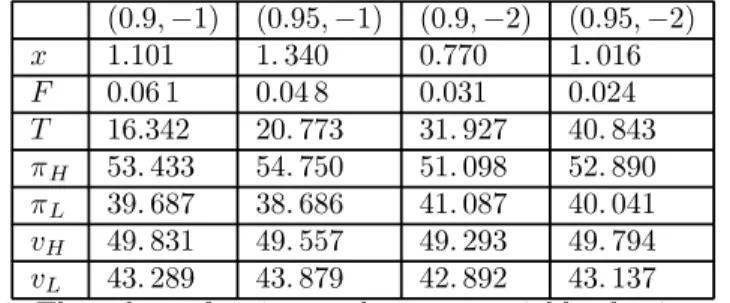
To be specific we adopt the following procedure. Given some q and δ we determine the equilibrium investment levelxH from equation (12). Then, we
compute the turnover probability,F =F(q−xH), the duration of being in the
HQ (and the LQ) state,T = F1, the period profit of HQ and LQ,πH andπL,
and the corresponding average long run profit,vH andvL. Also, since there are
multiple equilibria, depending on whichqis the equilibrium tolerance level, we illustrate our results for 2 differentqvalues. Relatedly, we illustrate our results for 2 different discount factors. All these computations are done for Example 1 with cubic cost,a= 20, and f(²) =1
2e
² for² <0. We report the results in the
following table. (0.9,−1) (0.95,−1) (0.9,−2) (0.95,−2) x 1.101 1.340 0.770 1.016 F 0.06 1 0.04 8 0.031 0.024 T 16.342 20.773 31.927 40.843 πH 53.433 54.750 51.098 52.890 πL 39.687 38.686 41.087 40.041 vH 49.831 49.557 49.293 49.794 vL 43.289 43.879 42.892 43.137
Table 1: The values of various endogenous variables for 4 parameter configurations.
As this table shows, equilibrium investments increase inδand q. The next section provides an analytical counterpart to these numerical results, giving conditions under which these results hold in general.
5
Comparative Statics
This section studies the comparative static properties of turnover equilibria. Our approach here bears some resemblance to the literature on monotone com-parative statics; see Milgrom and Roberts (1990). In particular, we show that
changes in certain parameters shift the best response curve R upwards at all points of its domain, which makes the largest equilibrium shift upwards as well. Note, however, thatR itself is not upward sloping and the underlying game is not supermodular. Nonetheless, it is still possible to prove and take advantage of the property that the best response curve shifts uniformly in our setting.
To pursue this approach we assume that a nontrivial turnover equilibrium exists, and that the set of equilibria is compact. Proposition 1 provides a set of sufficient conditions to ensure that. Given this assumption, we know that a largest turnover equilibrium exists for any pair (δ, q). We denote this turnover equilibrium by x(δ, q), and prove comparative statics results with respect to this equilibrium. Since our approach is to show that changes in parameters shiftR, we make the dependence ofRon (δ, q) explicit in this section and write
R(y;δ, q).
5.1
Patience
We start by studying the effect offirms’ patience parameterδon the equilibrium investment in quality. The following result conforms with the usual intuition that more patientfirms try harder to keep a good reputation, which they do by investing more in quality.
Proposition 3 Fix aq <0. Thenx(δ, q)is increasing inδ.
Proof. We first show thatR(y;δ, q) is increasing inδfor (arbitrarily) fixedy
andq <0. In other words, we show that for anyδ∈(0,1) andδ0 >δ,
R(y;δ0, q)≥R(y;δ, q). (16)
Letx=R(y;δ, q). Then (16) immediately follows ifx= 0, so let us assume otherwise. Then (11) implies that
−c0(x) +δf(q−x) ∆(y)
1−δ[1−2F(q−y)]= 0. (17) One readily verifies that the LHS of (17) is increasing in δ (note that (17) requires that∆(y)>0). Therefore (17) implies
−c0(x) +δ0f(q−x) ∆(y)
1−δ0[1−2F(q−y)] ≥0, (18) sinceδ0>δ. Since HQ’s objective is concave, (18) implies thatR(y;δ0, q)≥x=
R(y;δ, q).
Specializing this toy=x(δ, q), we get
R(x(δ, q);δ0, q)≥R(x(δ, q);δ, q) =x(δ, q),
where the last equality follows from the definition ofx(δ, q). SinceR(x;δ0, q) = 0 for all sufficiently largex’s, there exists anxH ≥x(δ, q) so thatR(xH;δ0, q) =
5.2
Tolerance Level
Next, we determine howx(δ, q) varies withq. The question we ask is whether less tolerant consumers, a larger q, encourage or discourage the HQ firm to invest more in quality.
The effect of an increase in qis not as clear cut as the effect of an increase inδ. An increase inqeither raises or lowers the marginal return to investment,
δf(q−x)1 ∆(y)
−δ[1−2F(q−y)], and, therefore, either raises or lowers the best response
curve,R. This depends on which of two opposing effects dominates. Thefirst effect is that an increase inqincreases the marginal probabilityf(q−x) that a turnover is averted, and this increases the marginal return to investment. The second effect is that an increase inqincreases the rate of turnover in the industry,
F(q−x). This decreases the payofffrom averting turnover and, thus, decreases the marginal return to investment. In general either effect maybe stronger than the other, depending on model primitives. Given this, our approach here is to elicit sufficient conditions under which one effect dominates the other, so that the overall effect of a change inqhas a definitive sign.
These sufficient conditions involve the hazard rate function
H(²)≡ f(²)
F(²),
which partially summarizes the two effects discussed above.5
Ourfirst result here is that if H is increasing, then investments increase in
q. We state the condition and the result as follows.
Assumption 4 For any ² <0,
H0(²)≥0.
SinceHis the derivative of logF, Assumption 4 is equivalent to logconvexity ofF.
Proposition 4 Suppose Assumption 4 holds. Then for any δ, x(δ, q) is
in-creasing inq on(−∞,0).
Proof. Fix someδ∈(0,1) andq1< q2<0, and letx1=x(q1,δ),x2=x(q2,δ).
Since the assertion immediately holds if x1 = 0, let us assume x1 >0, so we have:
−c0(x1) +δf(q1−x1) ∆
¡
x1¢
1−δ£1−2F¡q1−x1¢¤ = 0. (19)
5Although they are not formally used in our proofs, two interpretations ofHmay help explain its role. Thefirst interpretation is that His the long run return to an increase in investments, assuming consumers follow cutoffrules. The second interpretation is thatHis the probability that a small increase in investment averts turnover - conditional on the event that turnover is about to occur.
Let’s rewrite (19) as −c0(x1) + δ∆ ¡ x1¢ 1−δ f(q1−x1)+H(q21δ−x1) = 0. (20)
Now, since f(q11−x1) and H(q11−x1) are both decreasing inq1, we infer that
−c0(x1) + δ∆ ¡ x1¢ 1−δ f(q2−x1)+H(q22δ−x1) ≥0 or that −c0(x1) +δf(q2−x1) ∆ ¡ x1¢ 1−δ£1−2F¡q2−x1¢¤ ≥0.
Consequently, R(x1;δ, q2) ≥ x1. Therefore, as in the proof of Proposition 3,
there exists anxH ≥ x1 so that R(xH;δ, q2) = xH, which implies that x2 ≥
x1.
Examples of logconvex distributions include f(²) = 12e² for ² <0, which is
the distribution underlying Figure 1 and the numerical illustration in subsection 4.2. Then, logF(²) =² (up to an additive constant), which is indeed (weakly) convex. More generally, consider the family of functions
F(²) = ½ 1 2exp [−g(−²)] if² <0 1−1 2exp [−g(²)] if²≥0, (21)
where g : [0,∞) →R is a twice continuously differentiable function for which
g(0) = 0, g(∞) = ∞, andg0(²) > 0> g00(²). Any member from this family satisfies
H0(²) =−g00(−²)>0.
for any² <0. Another example of a member from this family is constructed by lettingg(²) = log(²+ 1).
We next consider the case whereHis decreasing, i.e., the case of a logconcave
F. For this case we prove a partial converse to Proposition 4. It is a converse because we prove that investments decrease rather than increase in q. It is partial because we have to impose one extra restriction, namely, thatfirms are sufficiently patient.
The proof of Proposition 4 makes clear why an extra restriction is needed. Indeed, if we look at equation (20) we see - under logconcavity - that an increase inq1affects f(q11−−δx1) and H(q21δ−x1) in opposite directions (which is not the case
under logconvexity). However, if δ is sufficiently large, the effect on H(q12δ−x1)
dominates, and investments decrease inq1. In proving our next result one follows the same logic as in the proof of Proposition 4, except for the qualification we just mentioned. Consequently, we state the result and provide only a sketch of the proof.
Assumption 5 For any ² <0,
H0(²)<0. (22)
Proposition 5 Suppose Assumption 5 holds. Then, for any M > 0, there
exists aδso that for anyδ≥δ,x(δ, q)is decreasing in qon (−M,0).
Sketch of the Proof. Since the interval [−M,0] is compact for any fixed
M >0, there existsδsuch that 1−δ
f(²) + 2δ
H(²)
is increasing in ² on [−M,0] for anyδ ≥ δ. Now the result follows, if wefix
δ≥δ andq’s on (−M,0) and apply the same argument employed in the proof of Proposition 4.
In analogy with logconvexity, Assumption 5 is satisfied for distributions of the form given in (21), except that g is required to be convex rather than concave, and that it satisfies
(g0(²))2−g00(²)>0. (23) (23) is necessary to ensure that f0(²) > 0 for ² < 0. Concrete examples in-clude g(²) = exp (²)−1. We also note that many textbook examples have a logconcave c.d.f; this includes the normal and the extreme value distribution,
F(²) = exp [−exp (−β²)], whereβ >0.
6
Welfare
We conclude our analysis by characterizing a set of investment levels that can be sustained by turnover equilibria for some tolerance level and for sufficiently patientfirms. Proposition 6 Let X∗= ½ x >0 : sup q<0 H(q−x)∆(x)>2c0(x)> inf q<0H(q−x)∆(x) ¾ . (24)
Then for anyx∈X∗, there exists a δ such that for anyδ≥δ, there exists a q
so that(x, q) is a turnover equilibrium.
Proof. Fix somex∈X∗. Then, by (24), there existq0, q00<0 so that
H(q0−x)∆(x)>2c0(x)> H(q00−x)∆(x).
Therefore, there exists aδ, so that for anyδ≥δ,
δf(q0−x)
1−δ[1−2F(q0−x)]∆(x)> c0(x)>
δf(q00−x)
(25) implies that for anyδ≥δ,there exists aq <0 such that
c0(x) = δf(q−x)∆(x) 1−δ[1−2F(q−x)],
which is (12). Hence,xis a turnover equilibrium under qandδ.
Proposition 6 delineates a set of investment levels and, therefore, a set of welfare levels that are asymptotically (asδ→1) sustainable via turnover equi-libria. In particular, ifx∗ ∈ X∗, then some turnover equilibrium sustains the
third best investment levelx∗, the socially optimal investment level of onefirm
given that the otherfirm chooses zero. Remember that the LQfirm invests zero in any turnover equilibrium, so this is the best outcome we can hope for from the turnover mechanism. One implication of Proposition 6 is that ifx∗ ∈/ X∗,
then efficiency or even constrained efficiency is not attainable - even if we let
δ→1. This implication is analogous to results reported in Radneret al. (1986), except that they analyze a partnership game.
Let us numerically illustrate the possibility of implementingx∗by calculating
a restriction on parameter values that ensures it. Let us consider Example 1. Then∆(x) = 2x(a3−x), c(x) =x2andx∗=4a
7. Let us also assume logconcavity
(Assumption 5 or (22)). Therefore, ifx∗is implementable, the RHS of (24) says
we must have
4x∗> H(−x∗)2x∗(a−x∗)
3 , (26)
which, after some manipulations, is equivalent to 14 a > H µ −47a ¶ . (27)
Now, if we specify F, we can pin down a closed-form restriction on a. For example, letF(²) = exp [−exp (−²)]. ThenH(²) =e−², so (27) reads
14 a >exp µ 4a 7 ¶ ,
which holds if and only ifa <2.81. Furthermore, since limx→−∞H(x) =∞,
the LHS of (24) is automatically satisfied, so a < 2.81 is sufficient to ensure thatx∗ is implementable. As another example, if we specifyF(²) = exp£−²2¤, we getH(²) =−2². Then (26) is equivalent to
14
a >2
4a
7,
which holds if and only if a < 3.5. Again, since limx→−∞H(x) = ∞, this
condition is also sufficient.
Equation (24) helps us better understand the idea that noise in the observa-tion of behavior acts as an obstacle to achieving efficiency. For example, suppose
F is normally distributed: f(x) =√1 2πσe
−x2
2σ2, whereσis its variance. Since F
is logconcave, it is easily seen that
sup q<0 H(q−x) =H(−x) = f(−x) F(−x), (28) inf q<0H(q−x) = 0.
In general,H(−x) depends onσin a complicated way, but (28) implies that lim x→0H(−x) = r 2 π 1 σ,
which is decreasing inσ. Hence, to the extent thatx∗is close to zero, a smaller σmakesx∗∈X∗more likely to happen. In this way, our analysis suggests that
the smaller the noise is, the more likely it is thatx∗ is implementable.
As stated earlier, Proposition 6 delineates a set of investment levels that are implementable via turnover equilibria. A bigger set is potentially imple-mentable if one allows for arbitrary strategies, including those that depend in complex ways on history. Such strategies might be too complicated for con-sumers to carry out, however, so it is interesting to determine whether a simple generalization of turnover implements a bigger set of investments. Specifically, let us consider the strategy whereby the realized qualitydifferencebetween the two firms determines turnover. This generalized mechanism ‘pitches’ one firm against the other, so we refer to it as a ‘tournament’ mechanism. To be con-crete, letxL andxH be the investments of LQ and HQ, and let qL and qH be
their realized qualities. Define a tournament mechanism by the property that turnover occurs if and only ifqH−qL< q for someq.6 The question we address
now is whether equilibria under the tournament mechanism implement a posi-tive investment by LQ and, if so, whether these equilibria improve social welfare - compared with turnover equilibria. Our last result provides a negative answer to these questions and, thereby, provides a partial justification for focusing on the turnover mechanism.
Proposition 7 Assume xL >0 and xH > 0. Then there exists no q so that
(xL, xH, q)is a tournament equilibrium.
Proof. Suppose to the contrary that there exists a q under which (xH, xL)
is a tournament equilibrium. LetGb be the c.d.f. of ²1−²2 and let bg be the
corresponding p.d.f. By symmetry,Gb is also the c.d.f. of ²2−²1. Thus, given
(xH, xL), turnover occurs with probability Gb(q−xH+xL) in each period on
the equilibrium path.
For this equilibrium, we have the following value equations:
vH = (1−δ)πH+δ[Gb(q−xH+xL)vL+ (1−Gb(q−xH+xL))vH] (29)
6Note that ifq <0, then the LQfirm is ‘handicapped’, i.e., it has to deliver a quality which is sufficiently higher, not simply marginally higher, to earn the HQ status.
vL = (1−δ)πL+δ[Gb(q−xH+xL)vH+ (1−Gb(q−xH+xL))vL], (30)
whereπH =π1(xH, xL)−c(xH) and πL =π2(xH, xL)−c(xL). SincexH >0
andxL>0, the following first-order conditions must hold in equilibrium:
(1−δ)c0(xH) =δbg(q−xH+xL)(vH−vL) (31)
(1−δ)c0(xL) =δbg(q−xH+xL)(vH−vL) (32)
However, (31) and (32) implyxH =xL, which in turn impliesvH=vL by (29)
and (30). Hence (31) and (32) reduce to
c0(xH) =c0(xL) = 0.
But this contradictsxH>0 andxL>0.
7
Conclusion and Related Literature
This paper explores the hypothesis that consumers condition their beliefs and, hence, their purchasing behavior on the past performance offirms they buy from. This hypothesis implies that market shares, profits and stock market valuations
fluctuate over time. The hypothesis and its implications apply to a broad set of markets, ranging from markets where the downside risk of experiencing low quality is relatively small, such as restaurants or books, to markets where the downside risk is catastrophic, such as airplane crashes or cars that tip over or equipment that can be dangerous to operate. In closing let us mention some empirical studies and cases that are consistent with our working hypothesis.
One such study is Mitchell (1989), who documents and analyses the poi-soning of Tylenol capsules at the retail level, which took place some 20 years ago. As he shows, Johnson and Johnson reacted by cutting the price of Tylenol by 2.50 dollars (by distributing coupons) and, notwithstanding, lost significant market share and suffered significant loss of stock market valuation. Simi-larly, Chalk (1987) shows that the loss of stock market valuation of airlines in the wake of fatal crashes comes from ‘market discipline,’ as opposed to reg-ulatory and legal penalties. A recent case exhibiting similar features is the Ford/Bridgestone/Firestone debacle, which occupied the popular press during the summer of 2000. As reported in various publications, Bridgestone/Firestone lost market share, which is evidenced by the fact that itfired a significant por-tion of its labor force. While these catastrophic events receive a lot of pub-licity, this phenomenon is certainly not limited to catastrophic losses. For in-stance, Ippolito (1992) documents the reaction of investors to performance in the mutual-fund industry,finding that poor relative performance results in in-vestors shifting their assets to other funds. Recent events in the same industry provide another illustration. Mutual funds that did well for their customers during the 90’s, were later hit by low returns and corruption charges. Cus-tomers lost faith in these companies, withdrew their funds, and moved them to alternative investment channels.
We also suggest several extensions and further relationship to the theoretical literature on reputations. An important approach to reputation, that originated in Kreps and Wilson (1982) and Milgrom and Roberts (1982), stresses the role of adverse selection. Afirm invests in quality because high realized quality is construed as (statistical) evidence that the firm is a good type. We have de-emphasized this approach, focusing instead on a pure moral hazard formulation. One obvious extension, then, is to view the incentive to invest in quality and the consequent turnover through these (adverse selection) lens and explore their implications.
There are many other extensions that are possible. Extensions that relate to the way the model is set up, and that constitute robustness checks, include oligopoly with more than twofirms, entry and exit, more general noise struc-tures, and more general turnover strategies. Extensions that relate to practical aspects include the derivation of further predictions of the theory that are, in principle, testable. For example, do profits correlate with the frequency of turnover or with prices and quantities (and how does that relate to ‘fundamen-tals’)? Another possibility is to consider parametric examples in which high quality does not necessarily mean high profit. A high quality product may be geared towards a niche market (e.g., an elite group of customers) and, as such, may generate a high markup, but not high volume of sales and, therefore, not high profits. The interaction between quality, profits and the incentive to build reputation is then an open question. Finally there is the possibility of exploring the disciplinary role of the legal system and how it interacts with market disci-pline. Therefore, while our work provides an analytical framework and answers some questions about the dynamics of reputation and turnover, many other questions await further analysis.
References
[1] Chalk, Andrew, J., Market Forces and Commercial Aircraft Safety, The Journal of Industrial Economics 36 (1987), 61-81.
[2] Fudenberg, Drew, David Levine and Eric Maskin, The Folk Theorem with Imperfect Public Information,Econometrica 62 (1994), 997-1039.
[3] Ippolito, Richard A., Consumer Reaction to Measures of Poor Quality -Evidence from the Mutual Fund Industry,Journal of Law and Economics
35 (1992), 45-70.
[4] Klein, Benjamin and Keith B. Leffler, The Role of Market Forces in As-suring Contractual Performance, Journal of Political Economy 89 (1981), 615-641.
[5] Kreps, David and Robert Wilson, Reputation and Imperfect Information,
Journal of Economic Theory 27 (1982), 253-79.
[6] Milgrom, Paul and John Roberts, Predation, Reputation, and Entry De-terrence,Journal of Economic Theory 27 (1982), 280-312.
[7] Milgrom, Paul and John Roberts, Rationalizability, Learning, and Equilib-rium in Games with Strategic Complementarities,Econometrica58 (1990), 1255-1277.
[8] Mitchell, Mark, L. The Impact of External Parties on Brand-Name Capital: The 1982 Tylenol Poisoning and Subsequent Cases, Economic Inquiry 27 (1989), 601-618.
[9] Radner, Roy, Roger Myerson and Eric Maskin, An Example of a Repeated Partnership Game with Discounting and with Uniformly Inefficient Equi-libria, Review of Economic Studies 53 (1986), 59-69.
[10] Shapiro, Carl, Premiums for High-Quality Products as Returns to Repu-tation, Quarterly Journal of Economics 98 (1983), 659-680.
SSRN-Reputation and Turnover by Rafael Rob, Tadashi Sekiguchi
Paper Stats:
Abstract Views: 1 Downloads: 0
Reputation and Turnover
RAFAEL ROB
University of Pennsylvania - Department of Economics
TADASHI SEKIGUCHI
Kobe University - General
August 4, 2004
PIER Working Paper No. 04-032
Penn Institute for Economic Research (PIER), Research Paper Series
Abstract:
We consider a repeated duopoly game where each firm privately chooses
its investment in quality, and realized quality is a noisy indicator of the
firm’s investment. We focus on dynamic reputation equilibria, whereby
consumers ‘discipline’ a firm by switching to its rival in the case that
the realized quality of its product is too low. This type of equilibrium is
characterized by consumers’ tolerance level - the level of product quality
below which consumers switch to the rival firm - and firms’ investment in
quality. Given consumers’ tolerance level, we determine when a dynamic
equilibrium that gives higher welfare than the static equilibrium exists.
We also derive comparative statics properties, and characterize a set of
investment levels and, hence, payoffs that our equilibria sustain.
SSRN-Reputation and Turnover by Rafael Rob, Tadashi Sekiguchi
JEL Classifications: C73, D82, L14, L15 Working Paper Series
Abstract has been viewed 1 times
Contact Information for RAFAEL ROB (Contact Author)
Email address for RAFAEL ROB
University of Pennsylvania - Department of Economics 3718 Locust Walk
Philadelphia , PA 19104 United States
215-898-6775 (Phone) 215-573-2057 (Fax)
Contact Information for TADASHI SEKIGUCHI
Email address for TADASHI SEKIGUCHI Kobe University - General
2-1, Rokkodai-cho, Nada-ku Kobe, 657-8501
Japan
SSRN Resources
To search for other abstracts in the SSRN archival database, click here.
To order a membership to an SSRN Network or to subscribe to one or more of SSRN's journals, go to our online subscription request form.
To go to SSRN's main web site (www.ssrn.com), click here.