Techniques of the simplex basis LU factorization update
Daniela Renata Cantane1
Electric Engineering and Computation School (FEEC), State University of Campinas (UNICAMP), São Paulo, Brazil
Aurelio Ribeiro Leite de Oliveira2
Institute of Mathematics, Statistics and Science of Computation (IMECC), State University of Campinas (UNICAMP), São Paulo, Brazil
Christiano Lyra Filho3
Electric Engineering and Computation School (FEEC), State University of Campinas (UNICAMP), São Paulo, Brazil
Abstract
The objective of this work is to compare the developed LUfactorization update with results from MINOS. This technique, use a matrix columns static reordering and they are rearranged in accordance with the increasing number of nonzero entries and triangularized, leading to sparse basis factorization without computational effort to reorder the columns. Only the columns factorizations actually modified by the change of basis are carried through due to matrix sparse structure. Computational results in Matlab for problems from the Netlib show that this is a very promising idea, since there is no need to refactorize the matrix in the tested problems.
Keywords: linear optimization, sparse matrix, factorization update, simplex.
1. Introduction
The efficient solution of large-scale linear systems is very important for solving linear optimization problems. These systems can be approached through generic methods as, for example, LUfactorization of the basis and its update, or through the problem specific structure exploitation, as in the network flow problem [5].
In [2] the column reordering in the combined cutting stock and lot sizing problems [8] is done in such a way that the resulting matrix is block diagonal. Therefore, it is easy to factor the base, resulting in little fill-in. Through the static reordering of columns, it is possible to obtain a sparse factorization of the basis, without any overhead to determine the order of the columns, since the base columns follow the given ordering.
In theLUupdate, the floating-point operations originated by the column that leaves the base are undone, in the reverse order of the factorization, always considering sparsity.
Finally, it is necessary to compute the factored columns after the entering column, also considering the sparse pattern.
1 Av. Albert Einsten, 400, CEP: 13083-852, Campinas, SP, Brazil. E-mail: [email protected] 2 Sérgio Buarque de Holanda, 651, CEP: 13081-970, Campinas, SP, Brazil. E-mail: [email protected] 3 Av. Albert Einsten, 400, CEP: 13083-852, Campinas, SP, Brazil. E-mail: [email protected]
For the combined problem, results obtained in [2] have shown that this approach is fast and robust, introducing insignificant accumulated rounding errors in worst case situations, after thousands of iterations.
2. LUFactorization Update Methods
TheLUfactorization update technique with partial pivot was proposed by [1]. Two variants of this algorithm proposed in [9] aim to balance the sparsity and numeric stability in the factorization. The latter variant is an improvement over the former.
Several basic matrixLUfactorization update was implemented [10] (in portuguese) with the objective to balance data original sparsity, it is conclude that theLU factorization update number carried through in the following iterations it influences considerably in the solved time of the problems, in the fill-ins and even iterations numbers of the simplex method.
In [7], theLUfactorization update proposed by [6] and its application in the simplex update basis method is described in detail. Moreover, it presents the ideas of an efficient implementation proposed by [11], which is a good combination of the symbolic and numerical phase of the pivoting and presents a compromise between sparsity and numerical stability. Other techniques updates are describe in [4].
3. Implementation Issues
The objective of the implementation developed here is to simulate simplex iterations using the static reordering and theLUupdate adopted in [2] for general linear optimization problems.
The base sequence obtained from MINOS is used in the simulation. A procedure for finding the initial basis, “Crash” base described in [7] and the leaving and entering columns of the basis from MINOS' output was implemented. The matrix is triangularized, the columns are reordered according to the number of nonzero entries, in increasing order, leading to sparse factorizations without computational effort to obtain the order of columns, since the reordering of the matrix is static and basis columns follow this ordering.
Two column update approaches are used in the implementation and the number of nonzero entries for each one is compared. When the entering column e in the basis follows the static ordering the approach is calledU1. In the second approach, calledU2, the entering column e entries in the basis in the position of the leaving columnl. The notation UMINOS is the used for MINOS results.
In the U1 approach, aLUfactorization of the basis considering its sparsity, calledF1, is performed. Only the factored columns actually modified by the change of the basis are carried through. Notice that there is no changes in column k located after the entering and/or leaving column if LU(k,e)0 or LU(k,l)0 due to sparse structure of columns involved. In the UMINOS approach, a complete LU factorization of the basis to simulate the MINOS’
factorization, calledFMINOS, is carried through.
The introduced error estimation in the factorization was computed with the objective of verify the robustness of theLU factorization method. Each factorization is completely undone in every simplex method iteration. Thus, the operations are performed in the reverse order of theLUfactorization and the matrix that will simulate the basis factorization update is obtained from the one being factored from the very first column. Therefore, the original basis
is obtained with some amount of numerical error and the accumulated errors are a worst case estimation for each iteration.
4. Numerical Experiments
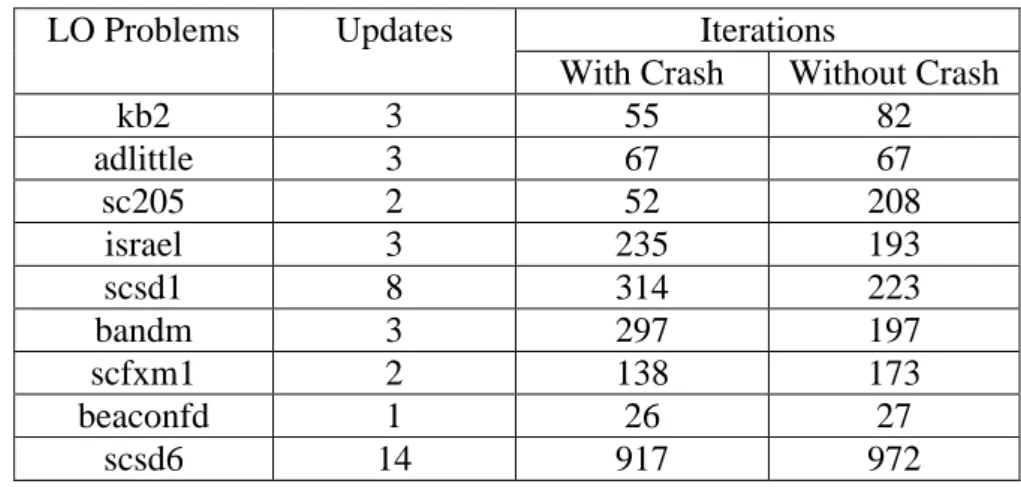
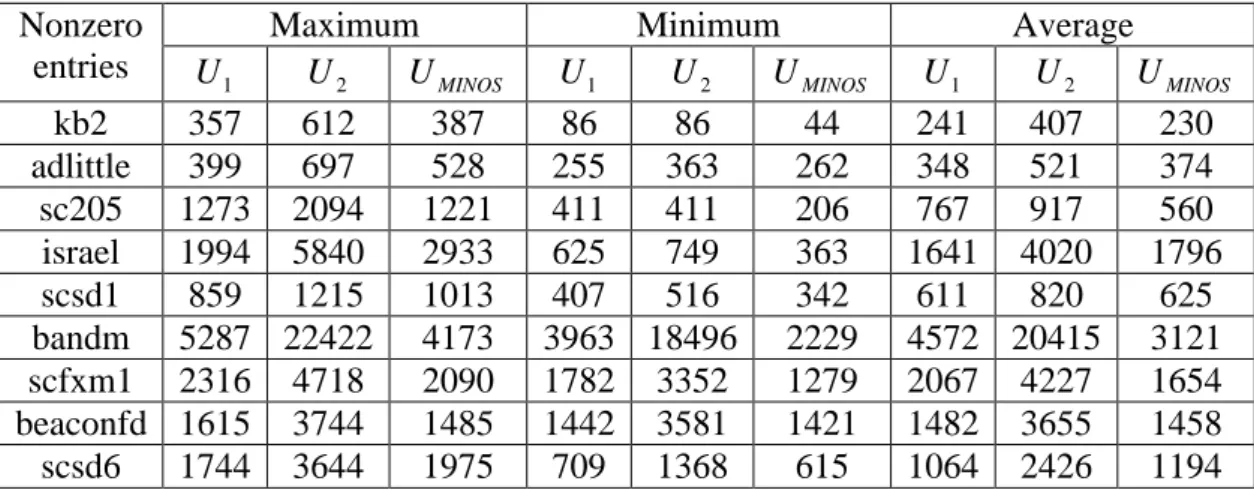
Initially, it was carried through numeric experiments for verifying the efficiency of the basis column update approaches presented in the previous section. Table 1 shows iterations (phase 2) and factorizations number of a subset of Netlib problems. Tables 2 and 3 show the nonzero number entries of the basis factorization of the same linear optimization problems using and not using the Crash basis, respectively.
Iterations LO Problems Updates
With Crash Without Crash
kb2 3 55 82 adlittle 3 67 67 sc205 2 52 208 israel 3 235 193 scsd1 8 314 223 bandm 3 297 197 scfxm1 2 138 173 beaconfd 1 26 27 scsd6 14 917 972
Table 1: Linear optimization problems data.
Maximum Minimum Average
Nonzero
entries U1 U2 UMINOS U1 U2 UMINOS U1 U2 UMINOS
kb2 353 460 406 179 210 130 271 332 257 adlittle 406 501 501 297 314 248 348 393 367 sc205 1242 1795 897 676 677 439 898 1109 644 israel 2187 6116 3536 1606 2740 1612 1957 4382 2173 scsd1 689 1274 907 421 577 371 537 881 602 bandm 5508 9674 4163 3240 3818 1977 4439 6422 3076 scfxm1 2250 4721 2059 1988 3397 1364 2096 4006 1692 beaconfd 1423 1845 1217 1396 1610 1194 1396 1610 1194 scsd6 1618 2997 1934 734 1294 580 1053 1968 1168
Maximum Minimum Average Nonzero
entries U1 U2 UMINOS U1 U2 UMINOS U1 U2 UMINOS
kb2 357 612 387 86 86 44 241 407 230 adlittle 399 697 528 255 363 262 348 521 374 sc205 1273 2094 1221 411 411 206 767 917 560 israel 1994 5840 2933 625 749 363 1641 4020 1796 scsd1 859 1215 1013 407 516 342 611 820 625 bandm 5287 22422 4173 3963 18496 2229 4572 20415 3121 scfxm1 2316 4718 2090 1782 3352 1279 2067 4227 1654 beaconfd 1615 3744 1485 1442 3581 1421 1482 3655 1458 scsd6 1744 3644 1975 709 1368 615 1064 2426 1194
Table 3: Nonzero entries number without crash basis.
The U1basis update approach reduces up to 52% for the problem scfxm1 and 78% for the problem bandm nonzero entries, in comparison to theU2approach in the Tables 2 and 3, respectively. Thus, U1 is used to carry through the LU factorization proposed in this work. The U1 update approach is a little more dense that the UMINOSupdate in a few cases, but as we
shall see it not need to refactorize the base. Thus, it probably will be faster than other approaches.
The Table 4 shows the flop number (floating point operation count) of each factorization presented in the previous section. MINOS' Crash option is turned off.
Maximum Average Total
Flop
Number F1 FMINOS F1 FMINOS F1 FMINOS kb2 2289 3624 1462 1693 119873 138836 adlittle 2492 5358 2103 2646 140909 177309 israel 12585 30456 10010 12039 1922010 2311507 scsd1 5279 11829 3635 4346 810552 969254 bandm 41178 88358 27961 21238 5508392 4183852 scfxm1 13919 21071 12436 11979 2151433 2072447 beaconfd 9701 9948 8898 9785 240233 264184 scsd6 10298 23511 6199 8158 6025711 7930057 Table 4: Flops number of LU factorization.
TheF1 factorization, proposed in this work, reduces the flop number with respect to the FMINOS factorization.
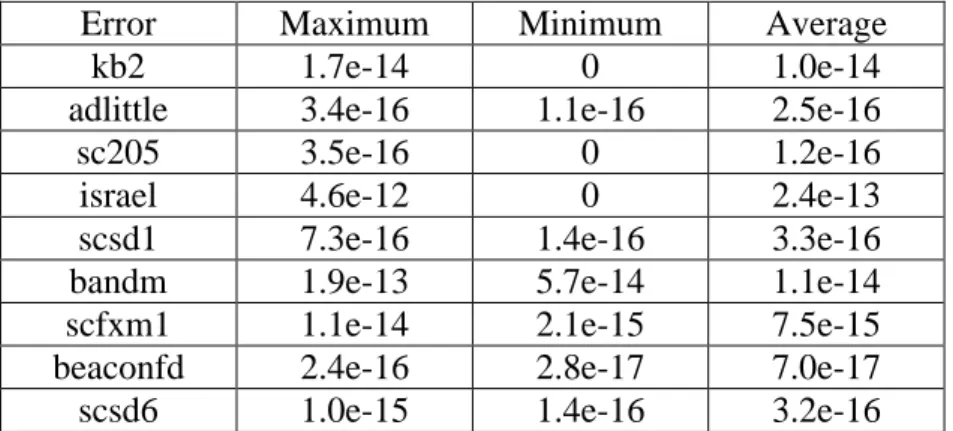
In Table 5, the error estimate introduced by these operations was verified, computing the norm of the difference between the basis obtained by completely undoing the factorization and the original basis obtained directly from the constraint matrix.
Error Maximum Minimum Average
kb2 1.7e-14 0 1.0e-14
adlittle 3.4e-16 1.1e-16 2.5e-16
sc205 3.5e-16 0 1.2e-16
israel 4.6e-12 0 2.4e-13
scsd1 7.3e-16 1.4e-16 3.3e-16
bandm 1.9e-13 5.7e-14 1.1e-14
scfxm1 1.1e-14 2.1e-15 7.5e-15
beaconfd 2.4e-16 2.8e-17 7.0e-17
scsd6 1.0e-15 1.4e-16 3.2e-16
Table 5: Error estimate of updated basis without crash basis.
It can be concluded that the factorization update proposed method is very robust. The maximum accumulated error in the worst case is of the order of 1012, that is, in this approach it is not necessary at all to refactorize the basis any time, as it is usually done by the tradicional methods due to robustness and sparsity considerations.
5. Conclusions
In this work a static reordering of matrix columns is proposed, leading to simplex base with sparseLUfactorizations and inexpensive factorization updates. The reordering has no initialization or updating costs since there is no need to reorder the columns in the factorization.
Stable results are present in Table 5. It is safe to conclude that no periodical factorization is needed for these problems as it is usually for updating schemes [4] and [7]. As a result, if the starting basis is the identity, is not necessary to compute anyLUfactorization at all.
In spite of the new basis update approach obtain a little less sparse basis than MINOS, it does not need to perform periodic refactorizations. Thus, it will probably obtain better running time in the same computational environment since it takes less computational effort. For future work this approach and factorization will be integrated to an implementation such as MINOS or GLPK.
Acknowledgement
This research was sponsored by the Foundation for the Support of Research of the State of São Paulo (FAPESP) and the Brazilian Council for the Development of Science and Technology (CNPq).
References
[1] R. Bartels, A stabilization of the simplex method, Numer. Math., 16 (1969), pp. 414–434.
[2] G. Bressan and A. Oliveira, Fast iterations for the combined cutting-stock and lot-sizing problems, Anais da IX International Conference on Industrial Enginnering and Operations Management, Arq. TI0601, (2003), pp. 1–8.
[3] G.Bressan and A. Oliveira, Reordenamento eficiente das colunas básicas na programação de lotes e cortes, Pesquisa Operacional, 4 (2004), pp. 323–337.
[4] I. Duff, A. Erisman and J. Reid, Direct methods for sparse matrices, Clarendon Press, Oxford, 1986.
[5] J. L. Kennington and R. V. Helgason, Algorithms for Network Programming, Wiley, New York, 1980.
[6] H Markowitz, The elimination form of the inverse and its applications to linear programming, Management Science, 3 (1957), pp. 255–269.
[7] I. Maros, Computational Techniques of the Simplex Method, Kluwer Academic Publishers, 2003.
[8] S. L. Nonas and A. Thorstenson, A combined cutting-stock and lot-sizing problem, Operations Research, 120 (2000), pp. 327--342.
[9] J. Reid, A sparsity-exploiting variant of the Bartels-Golub decomposition for linear programming bases, Mathematical Programming, 24 (1982), pp. 55–69.
[10] C. T. L. Silva, Problemas de Otimização Linear Canalizados e Esparsos, Dissertação de Mestrado, ICMC - USP, 2002.