International Mathematical Forum, 5, 2010, no. 18, 861 - 868
Estimating the Mean and Variance of
Activity Duration in PERT
N. Ravi Shankar1, K. Surya Narayana Rao2, V. Sireesha1 1
Department of Applied Mathematics ,GIS GITAM University, Visakhapatnam, India
2
Department of Mathematics, Al-Ameer College of Engineering & IT Visakhapatnam,India
Abstract
The traditional PERT (Program Evaluation and Review Technique) model uses beta distribution as the distribution of activity duration and estimates the mean and the variance of activity duration using “pessimistic”, “most likely” and “optimistic” time estimates proposed by an expert. In the past several authors have modified the original PERT estimators to improve the accuracy. In this paper, on the basis of the study of the PERT assumptions, we present an improvement of these estimates. At the end of the paper, an example is presented to compare with those obtained using the proposed method as well as other method. The comparisons reveal that the method proposed in this paper is more effective in determining the activity criticalities and finding the critical path.
Keywords: Estimating the mean and the variance of activity times; Beta distribution; PERT; Critical Path
1.
Introduction
In recent years, the range of project management applications has greatly expanded. Project management concerns the scheduling and control of activities
in such a way that the project can be completed in as little time as possible [1,2]. PERT [12] is a well known technique with proven value in managing large-scale projects. In 1959, the creators of PERT [12] considered beta distribution
, , , 0. ) ( ) ( ) ( ) ( ) ( ) ( ) ( 1 1 1 > < < − − − Γ Γ + Γ = − + − − α β β α β α β α β α b y a a b y b a y y fy (1)
as an adequate distribution of the activity duration y where α and β are parameters of the beta distribution. They suggested the estimates of the mean and variance values ( 4 ), 6 1 b m a+ + = μ (2) ( ) , 36 1 2 2 a b− = σ (3) where a,m and b are the “optimistic”, “most likely” and “pessimistic” activity time estimates respectively determined by a specialist. In the last five decades, numerous attempts have been made to improve the PERT analysis based on the subjective determination of a, m and b. By using PERT, managers are able to obtain[9,10,11] :
(i) A graphical display of project activities. (ii) An estimate of how long the project will take.
(iii) An indication of which activities are the most critical for timely project completion.
(iv) An indication of how long any task can be delayed without delaying
the project.
There are, indeed, few areas as open until now to such a sharp criticism as in PERT applications.One of the criticism about PERT estimates as pointed by Clark[10] , Grubbs[11] and Sasieni[8] is that the estimates eq.(2) and eq (3), which are based on the three activity times a, m and b cannot be obtained directly from (1), implying a lack of a sound theoretical basis. Ginzburg [6] assumed p+q = z (constant) as an extension of earlier assumptions, saying, on the basis of statistical analysis and some other intuitive arguments, the creators of PERT [12]
assumed that p + q ≅ 4. In [13], Ravi Shankar and Sireesha generalize the
assumption on parameters in original PERT and obtained new approximation for the mean and variance of a PERT activity duration distribution. Based on beta activity time distribution, we assumed p = qz and obtained new approximations for the mean and the variance of activity time in PERT. By comparison with actual values, it was shown that the proposed approximations have the lowest average absolute error compared to the existing ones.
The rest of this paper is organized as follows. In Section 2, we briefly review Original and Ginzburg’s PERT approximations. In Section 3, we proposed PERT approximation. In Section 4, we given a numerical example for PERT approximations. In section 5 we summarizes contributions of this paper.
Estimating the mean and variance 863
2 Traditional and Ginzburg’s PERT approximations
2.1 Traditional PERT approximation
Since in PERT applications aand b of the density function (1) are either known or subjectively determined, we can always transform the density function to a standard form, (1 ) ,0 1, , 0, ) ( ) ( ) ( ) ( 1 − 1 < < > Γ Γ + Γ = − − α β β α β α α β x x x x f (4) where . a b a y x − − =
Note that simple relations
a b a m m a b a b a y x y x y x − − = − = − − = μ , σ σ , μ (5) hold.
Let α-1 = p , β-1 = q. The density function (4) becomes
(1 ) ,0 1, , 1, ) 1 ( ) 1 ( ) 2 ( ) ( − < < >− + Γ + Γ + + Γ = x x x p q q p q p x f p q (6)
with the mean, variance and mode as follows :
2 1 + + + = q p p x μ , (7) , ) 3 ( ) 2 ( ) 1 )( 1 ( 2 2 + + + + + + = q p q p q p x σ (8) . q p p mx + = (9) From (6) and (9) we obtain
. ) 1 ( ) 1 ( ) 1 ( ) 2 ( ) ( − (1/ −1) + Γ + Γ + + Γ = xp x p mx q p q p x f (10)
Thus value mx, being obtained from the analyst’s subjective knowledge, indicates
the density function. On the basis of statistical analysis and some other intuitive arguments, the creators of PERT assumed [2] that
p+q ≅ 4. (11) It is from that assertion that estimates (2) and (3) were finally obtained, according to (6) – (9).
2.2
Ginzburg’s [6] PERT approximation
Ginzburg[6] showed that the PERT assumptions (11) is poor because the actual standard deviation may be considerably smaller than 1/6 , especially in the tails of the distribution[7,8]. In order to make the assumption more flexible, he assumed that the sum p+q in (6) is approximately constant but not predetermined; i.e., relation
p + q ≅ Z = constant (12) From (9) we obtain
p= Zmx , (13)
and values μx and σx2 are
, 2 1 ) ( + + = Z Zm m x x x μ (14) ) 3 ( ) 2 ( 1 ) ( 2 2 2 2 2 + + − + + = Z Z m Z m Z Z m x x x x σ (15) To satisfy the main PERT assumption the average value σx2(mx) for 0 < mx <1
has to be equal to 1/36; i.e.,
36 1 ) ( 1 0 2 =
∫
σx mx dmx (16) Substituting (15) in (16), integrating and solving (16) for Z, obtained Z = 4.55. Approximating Z to 4.5 and gettingp = 4.5 mx, q = 4.5 (1-mx) (17)
from (12) and (13) , finally obtained
(1 ) . ) 5 . 4 5 . 5 ( ) 1 5 . 4 ( ) 5 . 6 ( ) ( 4.5mx 4.5(1 mx) x x x x m m x f − − − Γ + Γ Γ = , (18)
with the mean and variance
13 2 9 + = x x m μ , (19) (22 81 81 ), 1268 1 2 2 x x x = + m − m σ (20) For the general beta distribution of the activity time, estimates (19) and (20) are transformed to , 13 2 9 2a m b y + + = μ (21) 22 81 81 . 1268 ) ( 2 2 2 ⎥ ⎥ ⎦ ⎤ ⎢ ⎢ ⎣ ⎡ ⎟ ⎠ ⎞ ⎜ ⎝ ⎛ − − − − − + − = a b a m a b a m a b y σ (22)
Estimating the mean and variance 865
By assuming that p =1, q = 2 and m= 3 2a+b
, he further improved these estimates
when the estimated mode of the activity time is located in the tail of the distribution as follows. μy =0.2(3a+2b) (23) 2 ( )2 0.04( )2 1268 40 a b a b y = − ≅ − σ (24)
Thus estimates (2) and (3) are replaced by estimates (21) and (24).
3. Proposed PERT approximation
Let z
q p
= (constant)where p and q are equal to α-1 and β-1 respectively. By substituting p = qz in (7) - (9) we obtain 2 1 + + + = q qz qz x μ (25) 1 + = z z mx (26) ) 3 ( ) 2 ( ) 1 )( 1 ( 2 2 + + + + + + = q qz q qz q qz x σ (27) From (27) , 2 3 ) 1 ( z q z x + ≅ σ (28) We assume that original PERT assumption,
6 1
=
x
σ , to solve (28) using (26) to
obtain the following values for p and q.
p=36m2x(1−mx), (29) q=36mx(1−mx)2 (30) Substituting p and q values in (7) and (8) we obtain
2 ) 1 ( 36 1 ) 1 ( 36 2 + − + − = x x x x x m m m m μ (31)
(
)
(
)
(
36 (1 ) 2) (
36 (1 ) 3)
1 ) 1 ( 36 1 ) 1 ( 36 2 2 2 + − + − + − + − = x x x x x x x x x m m m m m m m m σ (32)Using relations (5) in (31) and (32) and also substituting
3
2a b
my
+
= which is
used by Ginzberg[7] in variance σy2, we obtain
2 2 ) ( 2 ) )( ( 36 ) )( ( ) )( ( 36 a b m b a m a b a b m m b a m y − + − − − + + − − = μ (33)
2 2 ) ( 03 . 0 b a y = − σ (34) Thus estimates (2) and (3) are replaced by estimates (33) and (34).
4. Numerical Example
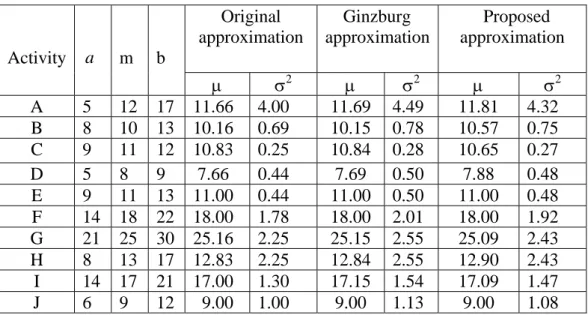
The data for activities is represented in table I including mean and variance estimates for original , Ginzburg and proposed approximations. The estimated project duration has approximately same value by using the original, Ginzburg and proposed methods.
Table I. Mean and variance estimates
5. Conclusion
Based on beta activity time distribution, we obtained new approximations for the mean and the variance of activity time in PERT. By comparison with actual values, it was shown that the proposed approximations are identical with the existing ones. The estimated project duration has approximately same value by using the original, Ginzburg and proposed methods.
Activity a m b Original approximation Ginzburg approximation Proposed approximation μ σ2 μ σ2 μ σ2 A 5 12 17 11.66 4.00 11.69 4.49 11.81 4.32 B 8 10 13 10.16 0.69 10.15 0.78 10.57 0.75 C 9 11 12 10.83 0.25 10.84 0.28 10.65 0.27 D 5 8 9 7.66 0.44 7.69 0.50 7.88 0.48 E 9 11 13 11.00 0.44 11.00 0.50 11.00 0.48 F 14 18 22 18.00 1.78 18.00 2.01 18.00 1.92 G 21 25 30 25.16 2.25 25.15 2.55 25.09 2.43 H 8 13 17 12.83 2.25 12.84 2.55 12.90 2.43 I 14 17 21 17.00 1.30 17.15 1.54 17.09 1.47 J 6 9 12 9.00 1.00 9.00 1.13 9.00 1.08
Estimating the mean and variance 867
References
[1] Chen,C.T. and Huang,S.F.,(2007), “Applying fuzzy method for measuring criticality in project network”, Information Sciences,177,2448-2458.
[2] Azaron, A., Katagiri, H., Sakawa,M., Kato,K. and Memariani,A.,(2006), “A multiobjective resource allocation problem in PERT networks”, European Journal of Operational Research, 172, 838-854.
[3] Stevenson,W.J.(2002),Operation Management, seventh edition, McGraw-Hill.
[4] Roy, G. Nava, P. and Israel, S. (2002) , “Integrating system analysis and project management tools”, International Journal of Project management ,20, 461-468
[5] Avraham, S., (1997), “Project segmentation- a tool for project management”, International Journal of Project Management, 15, 15-19.
[6] Ginzberg, DG.,(1988), “On the distribution of activity time in PERT”, Journal of the Operations Research Society”,39,767-771.
[7] Farnum, N.R. and Stanton, L.W.,(1987), “Some results concerning the estimation of beta distribution parameters in PERT”, Journal of Operations Research Society, 38,287-290.
[8] Sasieni, M.W.,(1986), “A note on PERT times”, Management Science, 32,1652-1653.
[9] Moderi, J.J. and Rodgers, E.G., (1968), “Judgment estimates of the moments of PERT type distributions”, Management Science, 15, B76-B83.
[10] Clark, CE.,(1962), “The PERT model for the distribution of an activity time”, Operations Research, 10,405-406.
[11] Grubbs, FE.,(1962), “Attempts to validate certain PERT statistics or ‘picking on PERT”, Operations Research, 10, 912-915.
[12] Malcolm D.G., Roseboom J.H., and Clark C.E., (1959), Application of a technique of research and development program evaluation, operations research, 7 , 646-669.
[13] Ravi Shankar N.,and Sireesha V.,(2009), An Approximation for the Activity Duration Distribution, Supporting Original PERT ,Applied Mathematical Sciences, Vol. 3, no. 57, 2823 – 2834.