Takustraße 7 D-14195 Berlin-Dahlem Germany
Konrad-Zuse-Zentrum
f ¨ur Informationstechnik Berlin
DIETRICH
HAUPTMEIER
SVEN
O. KRUMKE
J ¨
ORGRAMBAU
The Online Dial-a-Ride Problem under
Reasonable Load
THE ONLINE DIAL-A-RIDE PROBLEM UNDER REASONABLE LOAD DIETRICH HAUPTMEIER1, SVEN O. KRUMKE1, AND J ¨ORG RAMBAU1
ABSTRACT. In this paper, we analyze algorithms for the online dial-a-ride prob-lem with request sets that fulfill a certain worst-case restriction: roughly speak-ing, a set of requests for the online dial-a-ride problem is reasonable if the re-quests that come up in a sufficiently large time period can be served in a time period of at most the same length. This new notion is a stability criterion imply-ing that the system is not overloaded.
The new concept is used to analyze the online dial-a-ride problem for the minimization of the maximal resp. average flow time. Under reasonable load it is possible to distinguish the performance of two particular algorithms for this problem, which seems to be impossible by means of classical competitive anal-ysis.
1. INTRODUCTION
It is a standard assumption in mathematics, computer science, and operations research that problem data are given. However, many aspects of life are online. Decisions have to be made without knowing future events relevant for the current choice. Online problems, such as vehicle routing and control, management of call centers, paging and caching in computer systems, foreign exchange and stock trading, had been around for a long time, but no theoretical framework existed for the analysis of online problems and algorithms.
Meanwhile, competitive analysis has become the standard tool to analyze online-algorithms [4, 6]. Often the online algorithm is supposed to serve the requests one at a time, where a next request becomes known when the current request has been served. However, in cases where the requests arrive at certain points in time this model is not sufficient. In [3, 5] each request in the request sequence has a release time. The sequence is assumed to be in non-decreasing order of release times. This model is sometimes referred to as the real time model. A similar approach was used in [1] to investigate the online dial-a-ride problem—OLDARPfor short— which is the example for the new concept in this paper.
Since in the real time model the release of a new request is triggered by a point in time rather than a decision of the online algorithm we essentially do not need a total order on the set of requests. Therefore, for the sake of convenience, we will speak of request sets rather than request sequences.
In the problem OLDARPobjects are to be transported between points in a given metric space X with the property that for every pair of points(x,y)∈X there is a path p :[0,1]→X in X with p(0) =x and p(1) =y of length d(x,y). An important special case occurs when X is induced by a weighted graph.
1Konrad-Zuse-Zentrum f¨ur Informationstechnik Berlin, Department Optimization, Takustr. 7,
D-14195 Berlin-Dahlem, Germany. Email:{hauptmeier,krumke,rambau}@zib.de
Research supported by the German Science Foundation (grant 883/5-3).
A request consists of the objects to be transported and the corresponding source and target vertex of the transportation request. The requests arrive online and must be handled by a server which starts and ends its work at a designated origin vertex and which moves along the paths in G. The server picks up and drops objects at their starts and destinations. It is assumed that neither the release time of any future request nor the number of requests is known in advance.
A feasible solution to an instance of the OLDARP is a schedule of moves (i.e., a sequence of consecutive moves in X together with their starting times) in X so that every request is served and that no request is picked up before its release time. The goal of OLDARPis to find a feasible solution with “minimal cost”, where the notion of “cost” depends on the objective function used.
Recall that an online-algorithm A is called c-competitive if there exists a con-stant c such that for any request set σ(or request sequenceσif we are concerned with the classical online model) the inequality A(σ)≤c·OPT(σ) holds. Here,
X(σ) denotes the objective function value of the solution produced by algorithm
X on inputσ andOPT denotes an optimal offline algorithm. Sometimes we are dealing with various objectives at the same time. We then indicate the objective obj in the superscript, as inXobj(σ).
Competitive analysis of OLDARPprovided the following (see [1]):
• There are competitive algorithms (IGNORE andREPLAN, definitions see below) for the goal of minimizing the total completion time of the schedule.
• For the task of minimizing the maximal (average) waiting time or the max-imal (average) flow time there can be no algorithm with constant com-petitive ratio. In particular, the algorithmsIGNOREandREPLAN have an unbounded competitive ratio.
We do not claim originality for the actual online-algorithmsIGNORE andRE -PLAN; instead we show a new method for their analysis. As the reader will see in the definitions, both REPLAN and IGNOREare straight-forward online strategies based on the ability to solve the offline version of the problem to optimality or a constant-factor approximation thereof.
The first—to the best of our knowledge—occurrence of the strategy IGNORE
can be found in the paper by Shmoys, Wein, and Williamson [13]: They show a fairly general result about obtaining competitive algorithms for minimizing the total completion time in machine scheduling problems when the jobs arrive over time: If there is aρ-approximation algorithm for the offline version, then this im-plies the existence of a 2ρ-competitive algorithm for the online-version, which is essentially theIGNOREstrategy. Recall that aρ-approximation algorithm is a poly-nomial algorithm that always finds a solution that is at mostρtimes the optimum objective value. The results from [13] show that IGNORE-type strategies are 2-competitive for a number of online-scheduling problems. The strategy REPLAN
is probably folklore; it can be found also under different names like REOPT or
OPTIMAL.
It should be noted that the corresponding offline-problems with release times (where all requests are known at the start of the algorithm) areNP-hard to solve for the objective functions of minimizing the average or maximal flow time—it is even
NP-hard to find a solution within a constant factor from the optimum [11]. The offline problem without release times of minimizing the total completion time is polynomially solvable on special graph classes butNP-hard in general [8, 2, 7, 10].
THE ONLINE DIAL-A-RIDE PROBLEM UNDER REASONABLE LOAD 3
If we are considering a continuously operating system with continuously arriv-ing requests (i.e., the request set may be infinite) then the total completion time is meaningless. Bottom-line: in this case, the existing positive results cannot be applied and the negative results tell us that we cannot hope for performance guar-antees that may be relevant in practice. In particular, the two algorithmsIGNORE
andREPLANcannot be distinguished by classical competitive analysis.
The point here is that we do not know any notion from the literature to describe what a particular set of requests should look like in order to allow for a continu-ously operating system. In queuing theory this is usually modelled by a stability assumption: the rate of incoming requests is at most the rate of requests served. To the best of our knowledge, so far there has been nothing similar in the existing the-ory of discrete online-algorithms. Since in many instances we have no exploitable information about the distributions of requests we want to develop a worst-case model rather than a stochastic model for stability of a continuously operating sys-tem.
Our idea is to introduce the notion of ∆-reasonable request sets. A set of re-quests is∆-reasonable if—roughly speaking—requests released during a period of time δ≥∆can be served in time at mostδ. A set of requests R is reasonable if there exists a ∆<∞such that R is∆-reasonable. That means, for non-reasonable request sets we find arbitrarily large periods of time where requests are released faster than they can be served—even if the server has the optimal offline schedule. When a system has only to cope with reasonable request sets, we call this situation reasonable load. Section 3 is devoted to the exact mathematical setting of this idea. We now present our main result on the OLDARPunder∆-reasonable which we
prove in Sections 4 and 5.
Theorem 1.1. For the OLDARPunder∆-reasonable load,IGNOREyields a maxi-mal and an average flow time of at most 2∆, whereas the maximal and the average flow time of REPLANare unbounded.
The algorithms IGNORE and REPLAN have to solve a number of offline in-stances of OLDARP, which is in generalNP-hard, as we already remarked. We will show how we can derive results forIGNOREwhen using an approximate algo-rithm for solving offline instances of OLDARP (for approximation algorithms for offline instances of OLDARP, refer to [8, 2, 7, 10]). For this we refine the notion
of reasonable request sets again, introducing a second parameter that tells us, how “fault tolerant” the request set is. In other words, the second parameter tells us, how “good” the algorithm has to be to show stable behavior. Again, roughly speaking, a set of requests is (∆,ρ)-reasonable if requests released during a period of timeδ≥∆ can be served in time at mostδ/ρ. Ifρ=1, we get the notion of∆-reasonable as described above. Forρ>1, the algorithm is allowed to work “sloppily” (e.g., em-ploy approximation algorithms) or have break-downs to an extent measured byρ and still show a stable behavior.
2. PRELIMINARIES
Let us first sketch the problem under consideration. We are given a metric space (X,d). Moreover, there is a special vertex o∈X (the origin). Requests are triples r= (t,a,b), where a is the start point of a transportation task, b its end point, and t its release time, which is—in this context—the time where r becomes known. A
transportation move is a quadruple m= (t,a,b,R), where a is the starting point and b the end point, and t the starting time, while R is the set (possibly empty) of requests carried by the move. The arrival time of a move is the sum of its starting time and d(a,b). A (closed) transportation schedule is a sequence(m1,m2, . . .)of transportation moves such that
• the first move starts in the origin o;
• the starting point of miis the end point of mi−1;
• the starting time of mi carrying R is no earlier than the maximum of the arrival time of mi−1and the release times of all requests in R.
• the last move ends in the origin o.
An online-algorithm for OLDARPhas to move a server in X so as to fulfill all
re-leased transportation tasks without preemption (i.e., once an object has been picked up it is not allowed to be dropped at any other place than its destination), while it does not know about requests that come up in the future. In order to plan the work of the server, the online-algorithm may maintain a preliminary (closed) transporta-tion schedule for all known requests, according to which it moves the server. A posteriori, the moves of the server induce a complete transportation schedule that may be compared to an offline transportation schedule that is optimal with respect to some objective function (competitive analysis). For a detailed set-up see [1].
We start with some useful notation.
Definition 2.1. The offline version of r= (t,a,b)is the request roffline:= (0,a,b).
The offline version of R is the request set
Roffline:=©roffline : r∈Rª.
An important characteristic of a request set with respect to system load consid-erations is the time period in which it is released.
Definition 2.2. Let R be a finite request set for OLDARP. The release spanδ(R) of R is defined as
δ(R):=max
r∈Rt(r)−minr∈Rt(r).
Provably good offline-algorithms exist for the total completion time and the weighted sum of completion times. How can we make use of these algorithms in order to get performance guarantees for minimizing the maximum (average) waiting (flow) times? We suggest a way of characterizing request sets which we want to consider “reasonable”.
3. REASONABLELOAD
In a continuously operating system we wish to guarantee that work can be ac-complished at least as fast as it is presented. In the following we propose a mathe-matical set-up which models this idea in a worst-case fashion. Since we are always working on finite subsets of the whole request set, the request set itself may be infinite, modeling a continuously operating system.
We start by relating the release spans of finite subsets of a request set to the time we need to fulfill the requests.
THE ONLINE DIAL-A-RIDE PROBLEM UNDER REASONABLE LOAD 5
Definition 3.1. Let R be a request set for the OLDARP. A weakly monotone func-tion
f :
½
R → R,
δ 7→ f(δ);
is a load bound on R if for any δ∈Rand any finite subset S of R with δ(S)≤
δ the completion time OPTcomp(Soffline) of the optimum schedule for the offline version Sofflineof S is at most f(δ). In formula:
OPTcomp(Soffline)≤ f(δ).
Remark 3.2. If the whole request set R is finite then there is always the trivial load
bound given by the total completion time of R. For every load bound f we may set f(0)to be the maximum completion time we need for a single request, and nothing better can be achieved.
A “stable” situation would easily obtained by a load bound equal to the identity x7→x on R. (By “stable” we mean that the number of unserved requests in the system does not become arbitrarily large.) In that case we would never get more work to do than we can accomplish. If it has a load bound equal to a function id/ρ, where id is the identity and whereρ≥0, thenρmeasures the tolerance of the request set: assume we have an offline-algorithm at our disposal that is by a factor ρworse than the optimal offline algorithm then we can still accomplish all the incoming work by using the IGNORE-heuristic: compute aρ-approximate schedule for the set R of all released but unserved requests. The load bound and the performance guarantee ensure that the schedule takes no longer thanρ·∆(R)/ρ=
∆(R). Thus, the set of requests that are released in the meantime has a release span no larger than∆(R), and we can proceed by computing aρ-approximate schedule for that set.
However, we cannot expect that the identity (or any linear function) is a load bound for OLDARPbecause of the following observation: a request set consisting
of one single request has a release span of 0 whereas in general it takes non-zero time to serve this request. In the following definition we introduce a parameter describing how far a request set is from being load-bounded by the identity.
Definition 3.3. A load bound f is (∆,ρ)-reasonable for some∆,ρ∈Rif
ρf(δ)≤δ for allδ≥∆
A request set R is (∆,ρ)-reasonable if it has a (∆,ρ)-reasonable load bound. For
ρ=1, we say that the request set is∆-reasonable.
In other words, a load bound is (∆,ρ)-reasonable, if it is bounded from above by id(x)/ρfor all x≥∆and by the constant function with value∆/ρotherwise.
Remark 3.4. If ∆ is sufficiently small so that all request sets consisting of two or more requests have a release span larger than ∆then the first-come-first-serve strategy is good enough to ensure that there are never more than two unserved requests in the system. Hence, the request set does not require scheduling the requests in order to provide for a stable system.
In a sense, ∆is a measure for the combinatorial difficulty of the request set R. Thus, it is natural to ask for performance guarantees for algorithms in terms of this parameter. This is done for the algorithmIGNOREin the next section.
4. BOUNDS FOR THEFLOWTIMES OFIGNORE
We are now in a position to prove bounds for the maximal resp. average flow time in the OLDARP for algorithm IGNOREstated in Theorem 1.1. We start by recalling the algorithmIGNOREfrom [1]
Definition 4.1 (Algorithm IGNORE). AlgorithmIGNORE works with an internal buffer. It may assume the following states (initially it is IDLE):
IDLE: Wait for the next point in time when requests become available. Goto
PLAN.
BUSY: While the current schedule is in work store the upcoming requests
in a buffer (“ignore them”). Goto IDLE if the buffer is empty else goto PLAN.
PLAN: Produce a preliminary transportation schedule for all currently
avail-able requests R (taken from the buffer) minimizing comp for Roffline. (Note: This yields a feasible transportation schedule for R because all requests in R are immediately available.) Goto BUSY.
We assume that IGNORE solves offline instances of OLDARP employing aρ -approximation algorithm.
Let us consider the intervals in whichIGNOREorganizes its work in more detail. The algorithm IGNORE induces a dissection of the time axis Rin the following way: We can assume, w.l.o.g., that the first set of requests arrives at time 0. Let
δ0=0, i.e., the point in time where the first set of requests is released (these are processed byIGNOREin its first schedule). For i>0 letδi be the duration of the time period the server is working on the requests that have been ignored during the lastδi−1time units. Then the time axis is split into the intervals
[δ0=0,δ0],(δ0,δ1],(δ1,δ1+δ2],(δ1+δ2,δ1+δ2+δ3], . . .
Let us denote these intervals by I0,I1,I2,I3, . . .. Moreover, let Ribe the set of those requests that come up in Ii. Clearly, the complete set of requests R is the disjoint union of all the Ri.
At the end of each interval Ii we solve an offline problem: all requests to be scheduled are already available. The work on the computed schedule starts imme-diately (at the end of interval Ii) and is done δi+1 time units later (at the end of interval Ii+1). On the other hand, the time we need to serve the schedule is not
more thanρtimes the optimal completion time of Rioffline. In other words:
Lemma 4.2. For all i≥0 we have
δi+1≤ρ·OPTcomp(Rioffline).
Let us now recall and prove the first statement of Theorem 1.1.
Theorem 4.3. Let ∆>0 and ρ≥1. For all instances of OLDARP with (∆,ρ )-reasonable request sets,IGNOREemploying aρ-approximate algorithm for solving offline instances of OLDARPyields a maximal flow time of no more than 2∆. Proof. Let r be an arbitrary request in Rifor some i≥0, i.e., r is released in Ii. By construction, the schedule containing r is finished at the end of interval Ii+1, i.e., at mostδi+δi+1time units later than r was released. Thus, for all i>0 we get that
THE ONLINE DIAL-A-RIDE PROBLEM UNDER REASONABLE LOAD 7
If we can show that δi ≤∆ for all i>0 then we are done. To this end, let f :R→Rbe a(∆,ρ)-reasonable load bound for R. ThenOPTcomp(Rioffline)≤ f(δi) becauseδ(Ri)≤δi.
By Lemma 4.2, we get for all i>0
δi+1≤ρOPTcomp(Rioffline)≤ρf(δi)≤max{δi,∆}.
Usingδ0=0 the claim now follows by induction on i. ¤ The statement of Theorem 1.1 concerning the average flow time of IGNORE
follows from the fact that the average is never larger than the maximum.
Corollary 4.4. Let ∆>0. For all∆-reasonable request sets algorithm IGNORE
yields a average flow time no more than 2∆.
5. ADISASTROUS EXAMPLE FORREPLAN
We first recall the strategy of algorithm REPLAN for the OLDARP. Whenever a new request becomes available, REPLANcomputes a preliminary transportation schedule for the set R of all available requests by solving the problem of minimiz-ing the total completion time of Roffline.
Then it moves the server according to that schedule until a new request arrives or the schedule is done. In the sequel, we provide an instance of OLDARP and a ∆-reasonable request set R such that the maximal and the average flow time
REPLANmaxflow(R)is unbounded, thereby proving the remaining assertions of The-orem 1.1.
Theorem 5.1. There is an instance of OLDARPunder reasonable load such that
the maximal and the average flow time of REPLANis unbounded.
Proof. In Figure 1 there is a sketch of an instance for the OLDARP. The metric space is a path on four nodes a,b,c,d with origin a; the length of the path is`, the distances are d(a,b) =d(c,d) =ε, and hence d(b,c) =`−2ε. At time 0 a request from a to d is issued; at time 3/2`−ε, the remaining requests periodically come in pairs from b to a and from c to d, resp. The time distance between them is`−2ε.
We show that for `=18ε the request set R indicated in the picture is 223` -reasonable. Indeed: it is easy to see that the first request from a to d does not influence reasonability. Consider an arbitrary set Rkof k adjacent pairs of requests from b to a resp. from c to d. Then the release spanδ(Rk)of Rkis
δ(Rk) = (k−1)(`−2ε).
The offline version Rkofflineof Rkcan be served as follows: first, move the server to c, the starting point of the upper requests: this contributes cost`−ε. Next, serve all the upper requests and go back to c: this contributes cost k×2ε. Then, go down to b, the starting point of the lower requests: this contributes another`−2εto the cost. Now, serve the first lower requests: the additional cost for this isε. Finally, serve the remaining lower requests at an additional cost of(k−1)·2ε. In total, we have the following:
G 0 t ε ε ε ` ε ε ε 3/2`−ε `−2ε `−2ε a b c d
FIGURE1. A sketch of a(223`)-reasonable instance of OLDARP
(`=18ε). The horizontal axis holds the time, the vertical axis depicts the metric space in which the server moves. A request is denoted by an arrow from its starting point to its end point hori-zontally positioned at its release time.
In order to find the smallest paramter ∆ for which the request set Rk is ∆ -reasonable we solve for the integer k−1 and get
k−1= » 2` `−6ε ¼ =3. Hence, we can set∆to
∆:=OPTcomp(R4offline) =223`. Now we define f : R → R, δ 7→ ( ∆ forδ<∆, δ otherwise.
By construction, f is a load bound for R4. Because the time gap after which a new pair of requests occurs is certainly larger than the additional time we need to serve it (offline), f is also a load bound for R. Thus, R is∆-reasonable, as desired. Now: how does REPLAN perform on this instance? In Figure 2 we see the track of the server following the preliminary schedules produced by REPLAN on the request set R.
The maximal flow time ofREPLANon this instance is realized by the flow time of the request(3/2`−ε,b,a), which is unbounded.
Moreover, since all requests from b to a are postponed after serving all the re-quests from c to d we get that REPLANproduces an unbounded average flow time
as well. ¤
In Figure 3 we show the track of the server under the control of the IGNORE -algorithm. After an initial inefficient phase the server ends up in a stable operating mode. This example also shows that the analysis ofIGNOREin Section 4 is sharp.
THE ONLINE DIAL-A-RIDE PROBLEM UNDER REASONABLE LOAD 9 G 0 t ε ε ε ` ε ε ε 3/2`−ε `−2ε `−2ε
FIGURE2. The track of theREPLAN-server is drawn as a line in the diagram: at each point in time t we can read off the position of the server by looking at the height of the line at the horizontal position t. Because a new pair of requests is issued exactly when the server is still closer to the requests at the top all the requests at the bottom will be postponed in an optimal preliminary sched-ule. Thus, the server always returns to the top when a new pair of requests arrives.
FIGURE3. The track of theIGNORE-server.
6. HOW ABOUT REPLANNING WITH A DIFFERENT OBJECTIVE?
It is quite a natural question to ask whether modified replan strategiesFLOWRE -PLANorMAXFLOWREPLANthat repeatedly minimizes the average resp. maximal flow times on the known request sets would give a reasonable bound on the maxi-mal and average flow times in the online situation.
We mentioned already that the offline problem of minimizing the average flow time is very hard. In the offline problem thatFLOWREPLANhas to solve, however,
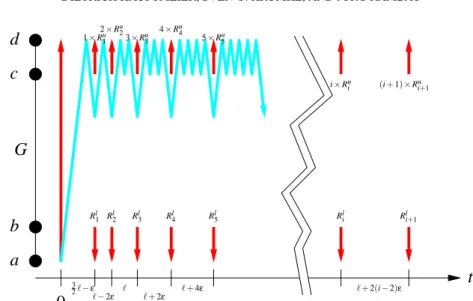
G t a b c d 0 3 2`−ε `+4ε i×Rui (i+1)×Rui+1 Rl i+1 Rl i `+2(i−2)ε Rl 5 Rl 4 Rl 3 Rl 2 Rl 1 `−2ε ` `+2ε 2×Ru 2 1×Ru 1 3×Ru3 4×Ru 4 5×Ru 5
FIGURE4. The track of theFLOWREPLAN-server on a the exam-ple from Theorem 6.1.
all requests have release times in the past. It is then easy to see that the problem is equivalent to the minimization of the average completion time counted from the point in time where the planning takes place. Moreover, since the average flow time is larger by the “average age” of the requests, the performance guarantees of approximation algorithms minimizing the average completion time carry over. Still, in our computational experience minimization of the average completion time takes more time than minimizing the total completion time.
Anyway: the following result shows that even under reasonable load we cannot expect a worst case stable behaviour ofFLOWREPLAN.
Theorem 6.1. There is an instance of OLDARPunder reasonable load such that the maximal and average flow times of FLOWREPLANare unbounded.
Proof. We construct a set of requests in the same metric space as in the previous Section 5 as follows:
• At time 0 we issue again one request from a to d.
• At time T0:=3/2`−εwe issue a pair of requests Ru1 from c to d and Rl1 from b to a.
• At time Ti+1:=Ti+`+2(i−2)εwe issue
– a set of i “upper” requests Rui+1from c to d and
– one “lower” request Rli+1from b to a. Figure 4 sketches the construction.
For`=18εthis request set is again 223`-reasonable since we have increased the time intervals between the release times of the requests by the additional amount that is needed to serve the additional copies of upper requests.
At time Ti, for all i>0,FLOWREPLANhas still to serve as many upper requests as there are lower requests. Thus, at Ti the schedule with minimum average flow time for the currently available requests serves the upper requests first. Hence, the requests at the bottom have to wait for an arbitrarily long period of time.
THE ONLINE DIAL-A-RIDE PROBLEM UNDER REASONABLE LOAD 11
In order to prove the assertion concerning the average flow time we consider the result f(RN)that FLOWREPLANproduces on the input set RN which contains all requests up to time TN.
The sum of all flow times fΣ(RN)is dominated by the waiting times of the lower requests. That is, it is a least
fΣ(RN)≥ N
∑
k=1 N∑
i=k (`+2(i−2)ε) ≥ N∑
k=1 N∑
i=k (i−2)ε.The number of requests #RNin RN is #RN=1+ N
∑
k=1 (k+1), so that f(RN) = fΣ(RN) #RN N−→→∞∞,which completes the proof. ¤
A strategy that minimizes just the maximal flow time does not make a lot of sense since sometimes this only determines which request is to be served first; the order in which all the other requests are scheduled is unspecified. Thus, the most sensible strategy in this respect seems to be the following: consider an of-fline instance of the dial-a-ride problem. The vector consisting of all flow times of requests in a feasible solution ordered decreasingly is the flow vector. All flow vec-tors are ordered lexicographically. The online strategyMAXFLOWREPLANfor the online dial-a-ride problem does the following: whenever a new request becomes availableMAXFLOWREPLANcomputes a new schedule of all yet unserved requests minimizing the flow vector.
It is an open problem what the performance of this strategy is under∆-reasonable load. In practice, however, it is probably too difficult to solve the offline problem with this objective function.
7. REASONABLE LOAD AS A GENERAL FRAMEWORK
We introduced the new concept of reasonable request sets, using as example the problem OLDARP. However, the concept can be applied to any combinatorial online problem with (possibly infinte) sets of time stamped requests, such as on-line scheduling, e.g., as described by Sgall [12], or the Onon-line Traveling Salesman Problem, studied by Ausiello et.al. [3].
The algorithms IGNORE and REPLAN represent general “online paradigms” which can be used for any online problem with time-stamped requests. We notice that the proof of the result that the average and maximal flow and waiting times ofIGNOREare bounded by 2∆has not explicetly drawn on any specific property of OLDARP—this result holds for all combinatorial online problems with requests
given by their release times.
The proof that the maximal flow and waiting time of a∆-reasonable request set is unbounded forREPLANis equally applicable to the Online Traveling Salesman Problem by Ausiello et.al. [3]. We expect that the same is true for any “sufficiently
difficult” online problem with release times—for very simple problems, such as OLDARPon a zero dimensional space, the result trivially does not hold.
8. CONCLUSION
We have introduced the mathematical notion∆-reasonable describing the com-binatorial difficulty of a possibly infinite request set for OLDARP. For reasonable
request sets we have given bounds on the maximal resp. average flow time of al-gorithmIGNOREfor OLDARP; in contrast to this, there are instances of OLDARP
where algorithm REPLAN yields an unbounded maximal and average flow time. One key property of our results is that they can be applied in continuously working systems. Computer simulations have meanwhile supported the theoretical results in the sense that algorithmIGNOREdoes not delay individual requests for an arbi-traryly long period of time, whereasREPLANhas a tendency to do so [9].
While the notion of ∆-reasonable is applicable to minimizing maximal flow time, it would be of interest to investigate an average analogue in order to prove non-trivial bounds for the average flow times.
REFERENCES
[1] Norbert Ascheuer, Sven O. Krumke, and J ¨org Rambau, The online transportation problem, Preprint SC 98-34, Konrad-Zuse-Zentrum f ¨ur Informationstechnik Berlin, 1998.
[2] Mikhail J. Atallah and S. Rao Kosaraju, Efficient solutions to some transportation problems
with applications to minimizing robot arm travel, SIAM Journal on Computing 17 (1988),
849–869.
[3] Georgio Ausiello, Esteban Feuerstein, Stefano Leonardi, Leen Stougie, and Maurizio Talamo,
Competitive algorithms for the traveling salesman, Proceedings of the 4th Workshop on
Algo-rithms and Data Structures (WADS’95), Lecture Notes in Computer Science, vol. 955, August 1995, pp. 206–217.
[4] Allan Borodin and Ran El-Yaniv, Online computation and competitive analysis, Cambridge University Press, 1998.
[5] Esteban Feuerstein and Leen Stougie, On-line single server dial-a-ride problems, Manuscript, submitted for publication, 1998.
[6] Amos Fiat and Gerhard J. Woeginger (eds.), Online algorithms: The state of the art, Lecture Notes in Computer Science, vol. 1442, Springer, 1998.
[7] Greg N. Frederickson and D. J. Guan, Nonpreemptive ensemble motion planning on a tree, Journal of Algorithms 15 (1993), 29–60.
[8] Greg N. Frederickson, Matthew S. Hecht, and Chul Kim, Approximation algorithms for some
routing problems, SIAM Journal on Computing 7 (1978), 178–193.
[9] Martin Gr¨otschel, Dietrich Hauptmeier, Sven O. Krumke, and J ¨org Rambau, Simulation studies
for the online dial-a-ride-problem, Preprint SC 99-09, Konrad-Zuse-Zentrum f ¨ur
Information-stechnik Berlin, 1999.
[10] Dietrich Hauptmeier, Sven O. Krumke, J ¨org Rambau, and Hans C. Wirth, Euler is standing in
line—dial-a-ride problems with fifo-precedence-contraints, Preprint SC 99-06,
Konrad-Zuse-Zentrum f¨ur Informationstechnik Berlin, 1999.
[11] Hans Kellerer, Thomas Tautenhahn, and Gerhard Woeginger, Approximability and
nonapprox-imabiblity results for minimizing total flow time on a single machine, Proceedings of the
Sym-posium on the Theory of Computing, 1996.
[12] Jiˇr´i Sgall, Online scheduling, Online Algorithms: The State of the Art (Amos Fiat and Ger-hard J. Woeginger, eds.), Lecture Notes in Computer Science, vol. 1442, Springer, 1998. [13] David B. Shmoys, Joel Wein, and David P. Williamson, Scheduling parallel machines on-line,
THE ONLINE DIAL-A-RIDE PROBLEM UNDER REASONABLE LOAD 13
{DIETRICHHAUPTMEIER, SVENO. KRUMKE, J ¨ORGRAMBAU}, KONRAD-ZUSE-ZENTRUM FUR¨ INFORMATIONSTECHNIKBERLIN, TAKUSTR. 7, 14195 BERLIN, GERMANY
E-mail address:{hauptmeier,krumke,rambau}@zib.de