JENNA: a Jamming Evasive Network-coding
Neighbor-discovery Algorithm for Cognitive Radio Networks
Alfred Asterjadhi
‡and Michele Zorzi
‡‡
Department of Information Engineering, University of Padova
via G. Gradenigo 6/B, I-35131, Padova (PD), Italy
E-mail:
{
aasterja, zorzi
}
@dei.unipd.it
Abstract—Cognitive radios operate in a particularly challeng-ing wireless environment. In such an environment, besides the strict requirements imposed by the opportunistic co-existence with licensed users, cognitive radios may have to deal with other concurrent (either malicious or selfish) cognitive radios which aim at gaining access to most of the available spectrum resources with no regard to fairness or other behavioral etiquettes. By taking advantage of their highly flexible RF front-ends, they are able to mimic a licensed user’s behavior or simply to jam a given channel with high power. This way these concurrent users (jammers) are capable of interrupting or delaying the neighbor discovery process initiated by a cognitive radio which is interested in using a portion of the available spectrum for its own data communications.
To solve this problem we propose a Jamming Evasive Network-coding Neighbor-discovery Algorithm (JENNA) which assures complete neighbor discovery for a cognitive radio network in a distributed and asynchronous way. We compare the proposed algorithm with baseline schemes that represent existing solutions, and validate its feasibility in a single hop cognitive radio network.
I. INTRODUCTION
Cognitive Radios (CRs) [1] are a promising technology likely to be deployed in the very near future to alleviate the spectrum shortage problem faced by traditional wireless systems [2]. They are equipped with highly flexible radio devices, which can dynamically change their transmission parameters in order to optimally exploit the available spectrum resources at a given geographical area and time.
This increased capability of CRs to self adapt makes them the perfect candidates for opportunistic spectrum access in those bands which are assigned to licensed users (primary radios, PRs) on a long term basis. While these primary radios are enabled to access the licensed spectrum resources anytime and anywhere, within the contractual limits imposed by spectrum management authorities, CRs have to be very cautious while accessing these spectrum resources. That is, CRs have to scan and identify unused spectrum resources in the licensed bands and most importantly they have to guarantee not to interfere with PRs that are operating in their legitimate spectrum resources.
It is well known that this scenario per se is very challenging while deploying a Cognitive Radio Network (CRN) which is going to coexist with one or several PRs in the area [3]. In addition, when considering the natural evolution of cognitive radio networks to more complex systems, the challenges and problems to be faced increase dramatically [4]. More specifi-cally, the inherent capability of CRs to base their decisions on
their “view” of the environment and to learn from experience makes their operation susceptible to a variety of malicious at-tacks. This is possible because the same Artificial Intelligence-based modules that help CRs to operate in an optimal manner may be used by malicious CRs. These malicious CRs, by taking advantage of their software defined radios, may be able to feed the AI modules of normal CRs with false sensory inputs, leading them to a substantially modified perception of the surrounding environment. Consequently, such external or internal modification of their wireless environment perception may result in sub-optimal (or even denial of) operation in a given licensed spectrum. This may happen when multiple CRs are accessing the same limited spectrum resources and any of them, in order to satisfy its bandwidth demands for data communications, can act improperly to gain exclusive access to the available resources.
Techniques such as Primary User Emulation (PUE) at-tacks [5] can be adopted by such CRs to achieve their goal. When launching these types of attacks, a malicious CR (jammer) is capable of mimicking the PR signal’s charac-teristics, leading legitimate CRs to vacate the spectrum as they erroneously believe that the spectrum is being used by a primary user. Distinguishing between PR and PUE signals is extremely challenging as CRs have to be able to promptly extrapolate the received signal features and exchange useful information to implement cooperative detection in order to increase the trustworthiness of their decision.
Another type of jammer does not have selfish purposes but rather behaves maliciously by interrupting legitimate CRs’ operations. These jammers transmit packets that do not obey CR medium access rules, causing denial of operation for any CR that is attempting to access a given licensed band. In addition, these jammers are very effective in disrupting com-munications over a wide spectrum by transmitting jamming signals randomly in frequency and time [6]. In these condi-tions, CRs which operate in an already established CRN can negotiate with each other to isolate the effects of such jammers on their data communications. By observing the behavior of the jammer, exchanging information and voting for different actions, these CRs can take the appropriate countermeasures to guarantee the continuity of their communications.
Hence, in a cognitive radio network, mechanisms such as cooperation, learning and negotiation help CRs to make the necessary decisions to assure communication in very chal-lenging situations. However, the adoption of such mechanisms requires that CRs of the same CRN are aware of each other
and have created a network of trusted CRs.
In order to activate such mechanisms (and most importantly establish a CRN), CRs have to successfully complete the first step during network deployment: the neighbor discov-ery phase. Considering the challenging wireless environment where the generated traffic is highly dynamic and imposes several restrictions to CRs, it is essential that this phase be as quick as possible. Moreover, at neighbor discovery termination, CRs must have obtained sufficient information to enable appropriate mechanisms for their coexistence with other wireless devices in the surroundings. To tackle this problem, we propose a neighbor discovery algorithm for CRNs that has the following benefits: 1) it is fully distributed, 2) it does not need global time-synchronization among nodes, 3) it assures fast neighbor discovery, 4) its dissemination performance does not depend on the label space sizeN, but rather on the actual number of nodesnin the network, 5) it does not need to know the number of nodesnin advance, and 6) it is very robust to different jamming attacks.
The paper is organized as follows. In Section II we present the related work on neighbor discovery algorithms for cog-nitive radio networks. In Section III we describe the net-work model discussing the structure and capabilities of both normal CRs and jammer CRs, and in Section IV we recall the basics of network coding and of the packet forwarding techniques considered in our work. Section V introduces the proposed system architecture and a detailed description of its main components, concluding with a representative example of the algorithm execution. In Section VI we present some performance evaluation results for the protocol with respect to baseline schemes that represent the behavior of existing neighbor discovery protocols. The paper concludes in Section VII with a discussion of the benefits obtained by our algorithm and possible future work.
II. RELATEDWORK
In order to deploy a cognitive radio network, CRs have to discover and exchange information such as neighborhood and spectrum availability with their neighbors. The neighbor discovery process starts when a CR wakes up and begins to broadcast beacons and ends when it receives replies from all its neighbors that are within transmission range.
In traditional ad hoc networks, neighbor discovery is easily implemented as all nodes are tuned on the same channel and follow the rules of a precise wireless standard. For example, to perform neighbor discovery in a Slotted ALOHA wireless network withnnodes, nodes can simply transmit with a given probability pt and listen with probability 1 - ptin each time
slot. This way nodes can rapidly exchange control packets, discovering their neighbors within O(nlogn) time slots if pt = 1/n, which further reduces to O(n) time slots in case
nodes are provided with a collision detection mechanism [7]. We note that discovery protocols relying on a single channel are very susceptible to jamming attacks. Once the jammers are aware of the wireless communication standard being used during neighbor discovery, they can adopt multiple types of jamming attacks to deny access to the medium. To launch a basic attack, that can easily cause neighbor discovery failure,
jammers can simply transmit a continuous signal in that single channel making it impossible for nodes to exchange any type of information [6].
Unfortunately, in cognitive radio networks the neighbor discovery process becomes even more challenging. In such networks, CRs operate over a set of multiple channels which may vary from node to node, depending on their proximity to the PRs and other interference sources. To tackle this problem there have been several proposals in the literature which are based on deterministic [8]–[10] or randomized algorithms [11]. In particular, in [8], [9] the authors propose neighbor discov-ery algorithms for time-synchronous networks which assure neighbor discovery inO(M N)andO(M nlog(N))time slots, respectively, where M is the maximum number of channels, nthe number of nodes andN the size of the label space from which nodes obtain their ids. Another solution is presented in [10], where the algorithm does not require nodes to be globally time-synchronized. In this proposal the time required to elect a leader which subsequently discovers all neighbors is O(N M2). We note that these solutions, being based on
deterministic algorithms, are very susceptible to jamming attacks, as it is very easy to disrupt neighbor discovery once the jammers know the channel hopping pattern followed by the CRs. Hence, these algorithms are not suitable in a wireless environment which might experience any of the following conditions: 1) nodes operate over a wide wireless spectrum i.e., large number of channelsM, 2) there is a jammer with a very basic AI module able to recognize the hopping pattern of a node, 3) the size of the label spaceNis large with respect to the actual number of nodesn. Any subset of these conditions is sufficient to considerably slow down (or disrupt) the neighbor discovery process leading to an incomplete estimation of the network conditions (channel occupancy, traffic requirements, CR’s availability, etc.).
A different approach is proposed in [11]. Here the au-thors assume that nodes are globally time-synchronized (e.g., nodes equipped with GPS modules). They consider different frequency hopping patterns, from single frequency hop to random hop patterns in order to derive fast and energy-efficient neighbor discovery algorithms when nodes have to access a spectrum with a large number of available channels. They show that when using a random algorithm based on single frequency hopping, nodes can assure fastest neighbor discovery. Instead, random hopping over all the available channels gives longest neighbor discovery delay, and other algorithms proposed have intermediate performance. We note that, in the presence of jammers, the best strategy to adopt is random hopping over all channels as it does not require nodes to share information prior to neighbor discovery. In Sections IV and V a similar approach with a random hopping pattern will be represented by the Selfish (SLF) scheme where we assume that CRs know the number of nodes,n, in order to determine when to conclude the neighbor discovery process.
As to neighbor discovery in the presence of jammers, there has been some research in the case of traditional single-channel networks, while for multi-single-channel cognitive radio networks, to the best of the authors’ knowledge, no solutions to this problem have been proposed so far. Hence, JENNA is
the first solution to the neighbor discovery problem in CRNs in the presence of different types of jammers. It also provides fast neighbor discovery, and in certain conditions performs better than with a single channel, as it efficiently exploits the available wireless resources by using network coding for data dissemination.
According to our algorithm, every CR scans the available spectrum resources and maintains a list of channels which are available for communication. Moreover, it gathers additional information for the correct utilization of the spectrum such as channel occupancy, primary users’ identification, selfish CRs that might mimic primary users behavior, etc. Once the CRs have gathered such information, they have to wake up and begin to send control packets in order to discover and disse-minate the acquired information to their neighbors. We use network coding to disseminate control packets in an efficient and reliable way, making it possible to have substantial gains in terms of dissemination delay and robustness with respect to malicious CR attacks. The combination of network coding with random channel hopping sequences makes it possible to obtain an effective neighbor discovery algorithm. It enables the deployment of CRNs in challenging wireless environments in a totally distributed and asynchronous way, fitting very well in the next generation wireless networking paradigm, where cognitive devices should adapt in the best possible way to the wireless environment conditions.
III. NETWORK MODEL
In this section we introduce the network model which will be used throughout the rest of this paper. The electromagnetic spectrum is given under license to P primary users which can access it at any given time and frequency. This spectrum band is subdivided into a set of M orthogonal channels Ctot = {1, . . . , M} available for both primary and CR
communications.
A. Normal cognitive radio model
CRs can access any of the licensed channels c ∈ Ctot
every time they can assure not to interfere with any activity of the PRs. To achieve this, they are capable of sensing the available spectrum with techniques that will be mentioned briefly in Section V-B. CRs are assigned a unique identifier i ∈ {1, . . . , N} and are equipped with a single transceiver. Hence they can only either transmit or receive on a single channel at any given time.
We further assume a time-slotted system where CRs do not require tight global time synchronization. They only require to have similar clock ticks in order to be able to synchronize at the slot boundaries with their neighbors.
B. Jammer cognitive radio model
In Section I we briefly described how and why adversary CRs launch different types of jamming attacks [4] denying channel access to normal CRs for an arbitrary period of time, potentially delaying or totally disrupting the neighbor discovery process of the CRN. In the following we divide
these jammers into two categories based on different properties which are of interest from the neighbor discovery perspective. A static jammer is characterized by the following features: • single-channel operation. It continuously emits radio
sig-nals in a given frequency for a long period of time; • selfish behavior. It aims at illegally reserving spectrum
resources for its own communications;
• improper use of AI-modules. By mimicking PRs signal characteristics, this CR misleads normal CRs into con-cluding that the spectrum is occupied by legitimate PRs. The most representative example is the Primary User Emulation (PUE) attack;
• reduction of available spectrum resources. Because CRs confuse this jammer with a PR, they will have fewer channels to choose from, since channels that are detected as occupied by a PR cannot be used.
A reactive jammer, instead, is characterized by the follow-ing features:
• multi-channel operation. It randomly emits radio signals, hopping over all the available wireless spectrum; • malicious behavior. It aims at corrupting any exchanged
packet in a given frequency and time slot;
• basic operation. It uses a random frequency hopping pattern to access all the channels and transmits high power spectral density signals. Its signal does not try to emulate a PR signal;
• decreased reliability of the available spectrum resources. By accessing all the available spectrum bands, a reactive jammer can significantly degrade the CRN communica-tion’s quality equally in any accessed spectrum band. In these conditions a CR is not able to find an appropriate spectrum band for its communications but it rather has to adopt a robust communication scheme, to minimize the impact of the jamming attack.
From the neighbor discovery point of view, a static jammer is unintentional as it does not explicitly aim at disrupting the neighbor discovery process initiated by the CRN. On the other side, a reactive jammer is intentional as its goal is to disrupt any communication attempt by any CRs which is within its transmission range. Note that, since reactive jammers want to disrupt communications between nodes in a normal CRN, it is reasonable to assume that they get activated as soon as they sense any data exchange by the nodes of a CRN. The very first time CRs begin to exchange packets is to discover their neighbors. Hence it is essential that, during neighbor discovery, CRs take adequate countermeasures to minimize the impact of these jammers.
Let js
c ∈ {1, . . . , Js} represent a static jammer
transmit-ting on channel c and jr ∈ {1, . . . , Jr} a reactive jammer
transmitting randomly in Ctot. For simplicity, we assume
that all jammer CRs have the same communication rangeRj
and that any CRs which happen to be within their range, tuned on the jammed frequency in a given slot, will receive unrecoverable packets, i.e., all packets interfered by a jammer will be considered to be lost.
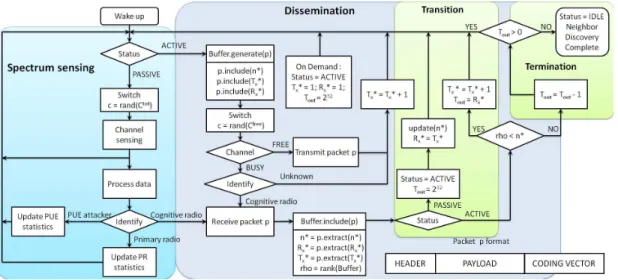
Fig. 1. Block diagram for the proposed neighbor discovery algorithm.T∗
x is the time reference since the beginning of the dissemination phase,R∗xestimates
the duration of the transition phase, andn∗is the estimated number of nodes.
IV. PACKET FORWARDING TECHNIQUES
In this section we give a brief description of network coding and the different forwarding schemes that can be used to implement a randomized neighbor discovery algorithm for cognitive radio networks.
A. Network Coding
One key ingredient of our proposal is random linear network coding [12] which is a particular data processing technique able to efficiently exploit the network capacity to provide fast and reliable data dissemination. In order to have a practical implementation of network coding we use the principles described in [13]. Consider a network wherensource packets
{x1, . . . , xn}need to be broadcast to all nodes in the network.
Every time a nodeiis scheduled for transmission, it generates a random linear combination,yi=P
n
j=1gi,jxj, of the source
packets it has in its buffer, where the packets xj and the
combination coefficientsgi,j are represented as symbols over
a Galois field GF(2q). The symbols g
i,j can be organized
in a vector gi = [gi,1, . . . , gi,n]. This vector, associated to
packetyi, is called the global encoding vector and is included
in the packet header to allow receiving nodes to decode the information stored in the packet. When a node receives an encoded packet yi, it includes it in the buffer and includes
gi as a new row in the decoding matrix. After receiving n
linearly independent combinations the node can decode the source packets by inversion of the decoding matrix.
B. Forwarding schemes for neighbor discovery
Let n ≤ N be the number of CRs which are going to participate in the neighbor discovery process, whereN is the size of the label space for assigning ids to the CRs. Let i∈ {1, . . . , n}denote a generic CR andxi the control packet that
it has generated at the end of the spectrum sensing phase. The control packet is represented as a vector of symbols over the Galois fieldGF(2q)and, when scheduled for transmission, is
included in the node’s buffer where it is going to be processed
as dictated by the transmission strategies. We have that in every slot s ∈ {1, . . . , S} the transmission scheme can be modeled as: y1 .. . yn = g1,1 . . . g1,n .. . . .. ... gn,1 . . . gn,n x1 .. . xn =G x1 .. . xn (1) whereGis the system transfer matrix in slots, andyi is the
control packet which can be transmitted during slot sby CR i. We will consider the following transmission strategies:
• Random Message Selection (RMS): each CR transmits a packet randomly selected among those received so far, with the exception of the first time, when the node sends its own packet. In our model, this is represented by a random permutation matrix G = P which is a square matrix with all zeros and a 1 value per row in a random column.
• Selfish (SLF): each CR transmits only its own control packet. In this caseGis the n×nidentity matrix In. • Network Coding (GF(2q)): each node transmits a random
linear combination of the packets received so far from its neighbors, including its own. As for the RMS case, the first time the node sends its own packet. The transfer matrix contains random coefficients over the Galois field GF(2q), that correspond to the encoded packets received
so far. When enough independent linear combinations have been collected, a node can retrieve the n control packets by inversion of Eq. (1).
We remark that in the RMS and SLF schemes, each node needs to known, i.e., how many packets to expect, so as to be able to understand when the dissemination process is complete. On the other hand, the specific properties of network coding make it possible to estimatenduring the process itself, and a priori knowledge of the number of nodes is not needed in this case. A detailed explanation of this mechanism will be given in Section V-C.
V. JENNA: SYSTEM ARCHITECTURE
In this section we present the system architecture of the proposed jamming evasive network-coding neighbor-discovery algorithm (see Fig. 1). We first give a general description, then focus on its main components and finally give an example of the algorithm execution in a simple CRN.
A. General description
CRs that want to perform neighbor discovery wake up, enter the passive mode, and start the spectrum sensing phase. This phase ends once a generic node decides to perform neighbor discovery entering the dissemination phase during which nodes mutually exchange linear combinations of their packets and which ends when all nodes have received enough coded packets to retrieve the packets generated by any other node. In the following, we describe in more detail each of these phases.
B. Spectrum sensing phase
We assume that initially all CRs in the network are in passive mode. After a CR wakes up, it enters the sensing phase where it stays until it decides or is requested to perform neighbor discovery by some nearby node. During this phase, cognitive radios scan the set of all channelsCtot, following a
random hopping pattern, detecting independently the existence of PRs activity and of possible primary user emulation attack-ers (more generally static jammattack-ers). This can be achieved by using spectrum sensing techniques, such as energy detection, cyclo-stationary feature detection or matched filter detec-tion [14]. The problem of detecting primary user emuladetec-tion attackers can be tackled with techniques such as [15]. As discussed in Section III-B we assume that reactive jammers are not active during this phase as they initiate jamming as soon as they sense activity in a given channel, i.e., when a generic CR begins to broadcast packets for neighbor discovery [6]. At the end of this phase, each node i in the CRN has created a list of free channelsCif ree={c1, c2, . . . , cKi}=Ctot\Cibusy
that i can use for communications, where Cibusy is the set
of channels used by either PRs or static jammers. This list will be included in the control packet along with additional information such as which channels are used by legitimate PRs and PUE attackers, etc.
C. Dissemination phase
This phase starts when a generic CR i begins neighbor discovery, sending its first control packet randomly in a channelc∈Cif ree. The channel hopping pattern used by the
algorithm is a random sequence with a generation seed that is calculated in real time. This way reactive jammers cannot disrupt CRs’ communications even if they gain access to the internal memory of a CR where predefined generation seeds are stored. If a CR j happens to be synchronized in channel c, it receives the packet and enters the active mode. This packet is then included in CRj’s buffer and its corresponding encoding vector is included in the decoding matrix. We note that at the beginning of the dissemination phase CRs are more
oriented on sending their own control packets, in which case a receiving node does not need to perform any decoding. When the received packet is a network coded packet, i.e., it includes information from multiple CRs, the receiving CR adds the corresponding coding vector as a new row of the decoding matrix, and checks whether it is possible to invert it. Note that in general a node does not know the number of neighbors,n, but only the size of the label space {1, . . . , N} from which node ids are taken. For this reason, the encoding vector must haveNentries, each corresponding to a generic id in the whole set. Upon reception of a new coded packet, a node will look at the newly updated version of the coding matrix, where all-zero columns correspond to node ids that have not been assigned to any of the neighbors, or to nodes whose information has not yet been received. After removing these all-zero columns, the node checks whether or not the resulting matrix is invertible. If it is not, the node needs to wait for more coded packets before it can retrieve the original control packets. If instead the matrix can be inverted, the node is able to retrieve the original packets involved. In this case, the node assumes that it has received the full set of packets and, after a time-out interval during which it continues to disseminate packets, it considers the dissemination process complete.
More specifically, the dissemination phase consists of the following three sub-phases.
1) Transition phase: This phase starts at the same time as the dissemination phase, and ends when all CRs participating in the neighbor discovery process have become active. We note that, during this phase, there is dynamic diversity among CRs: a portion of CRs are in passive mode, where they are still sensing the available channels, and the rest of them are in active mode, disseminating the control packets. Hence, this phase is very delicate as it is the moment when reactive jammers are likely to get activated to counteract the neighbor discovery process initiated by active CRs. This is because CRs in passive mode may find their sensing data misleading as they will sense activity caused by reactive jammers in terms of short impulses, hence probably including these channels as not free for communication. However, considering the different signal characteristics of static and reactive jammers, a CR may still be able to distinguish between them. Hence, it can avoid those channels which are used by static jammers (which permanently occupy a certain frequency), while keeping in the list of available channels those used by reactive jammers (which randomly hop and therefore cannot be avoided).
2) Active phase: When all CRs are in the active state, all nodes exchange control packets. This is the active dis-semination phase, which lasts until a node believes that the dissemination process has finished.
3) Termination phase: Once a node is able to invert its decoding matrix as explained above, it enters the termination phase where it decrements theToutcounter. During this time,
nodes are still enabled to transmit and receive packets. This is done for two reasons: (i) to provide a more reliable packet dissemination, as other neighbors might not have yet been able to decode the information stored in their buffers, because they do not have enough linearly independent combinations, and (ii) to help CRs avoid early termination of the neighbor
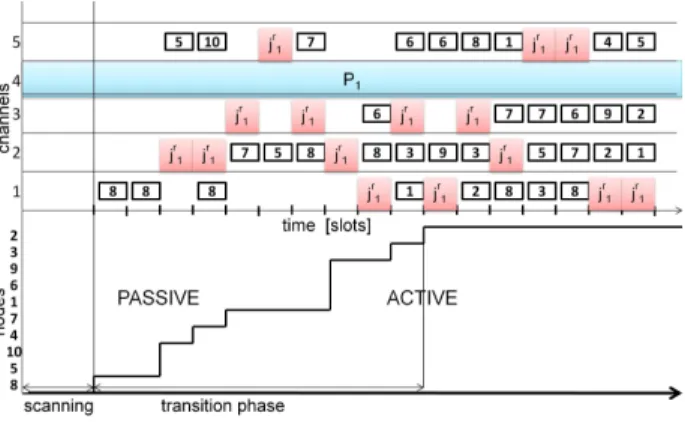
Fig. 2. Example of the neighbor discovery algorithm execution for a CRN with 5 channels, 10 nodes, a reactive jammer jr
1, and a primary user P1 operating in the area of interest.
discovery process. Note in fact that it is possible that a node is able to invert its decoding matrix even though it has not received all packets (i.e., the received coded packets are such that inversion of a submatrix is possible). When this happens, according to our algorithm a node would be led to concluding that the dissemination process is terminated, whereas in fact it is not. If during the time-out period a node receives an innovative coded packet (i.e., a packet that increases the rank of its decoding matrix), then it deduces that the dissemination process is not complete, and goes back to the active state, waiting for more packets. If instead during the time-out period no innovative packets are received, the node concludes that there is no more information to be received. We remark that, thanks to this mechanism, and unlike in the cases of RMS and SLF, our algorithm does not require any prior information about the numbernof nodes involved, but rather it estimates this number as part of the dissemination process itself. Of course, there is always a chance that a node prematurely stops the dissemination process, as described above. However, if the system’s parameters are chosen carefully, and in particular the degree of mixing is sufficiently high and the value of Tout is
sufficiently large, this event occurs with low probability [16], and its effects are negligible.
D. Description by example
To briefly describe the scheme, in Fig. 2 we show the execution of the algorithm in a simple network consisting of 5 channels and 10 CRs which have to coexist with one PR and a reactive jammer active in the area. With reference to Fig. 2, at the beginning, all CRs are in passive mode, scanning all the channels to detect the presence of PRs or static jammers in the area. When the sensing phase finishes, the CRs have their channel list Cif ree = {1,2,3,5} for i ∈ {1, . . . ,10}. Note
that in general the list of available channels may be different for each CR. At a given moment, slot s= 1, CR 8 wakes up and becomes active, sending its control packet on channel 1. This is the first transmitted packet and denotes the beginning of the dissemination and transition phase. The transmission of the packet by CR 8 wakes up jr
1, which happened to be
sensing in channel 1. Hence,jr
1initiates random jamming over
all the available channels with jamming duration equal to the
slot length. In slot 2 the transmission of node 8 successfully reaches nodes 5 and 10, which then enter the active state. In slot 3 we have CR 5 transmitting in channel 5. The control packet generated by CR 5 contains a linear combination of its control packet and the one it received in the previous slot from CR 8. Following this procedure, in slot 10 all CRs are active, which denotes the end of the transition phase. Nodes continue to disseminate information to each other, hopping randomly in the set of available channels (1, 2, 3, 5 in this case) and avoiding to transmit their control packet every time they happen to fall in the same frequency as the reactive jammer (which they can detect by simple carrier sensing before transmission). When a node receives enough packets to decode the information, it initiates the termination phase during which it reduces the time-out counter and continues packet forwarding to help other nodes in the decoding process.
VI. PERFORMANCE EVALUATION
In this section we evaluate and compare the proposed neigh-bor discovery algorithm with respect to the above mentioned baseline schemes, SLF and RMS. We simulate a CRN with different numbers of CRs involved in the neighbor discovery process sharing a set ofM = 30channels with primary users, static and reactive jammers.
Nodes are all within transmission range of each other. Hence, after the sensing phase CRs hop over a similar set of available channels. For the simulation results we assume that this set of channels is the same for all nodes. This is because PRs are assumed to have a transmission range which is higher than that of CRs. Moreover the spectrum is subject to frequent attacks by reactive jammers which, once they have detected CR activity on a channel, begin jamming randomly the available channels to disturb the neighbor discovery pro-cess. We assume that reactive jammers, after being activated, do not sense the medium before transmitting their jamming impulse, hence on a given frequency there can be more than one jammer in a given slot.
A. The impact of network coding on dissemination latency We hereby describe the impact of network coding on the dissemination delay performance. This is shown in Fig. 3 where we plot the dissemination delay, i.e., the average number of slots required for all nodes in the network to discover their neighborhood against different neighbor discovery schemes. As we can see, using network coding provides faster dissem-ination of the control packets, making it possible to finish the neighbor discovery in less time. The achievable improvement with respect to SLF ranges from 3 to 6 times in these settings. Regarding the coding performance we note that coding over Galois fields of higher size does not bring significant gains in terms of dissemination delay, except for the case of a small number of CRs where packet diversity is highly beneficial. As an example, for n = 10, the gain obtained when using coding over GF(16) instead of GF(2) is around 20% and further increases of the Galois field size do not provide any additional gain. This lack of further gains from higher coding sizes comes from the fact that the random hopping pattern that
RMS SLF GF(2) GF(4) GF(16) GF(64) GF(256) 0 100 200 300 400 500 600 700 800
neighbor discovery schemes
dissemination delay [slots]
Cfree = 20, n = 10 Cfree = 20, n = 20 Cfree = 20, n = 40
Fig. 3. Comparison of dissemination latency for RMS, SLF and network coding for different numbers of CRs,n.
CRs follow is already able to provide most of the required diversity for a fast neighbor discovery process.
B. The impact of free channels and number of CRs
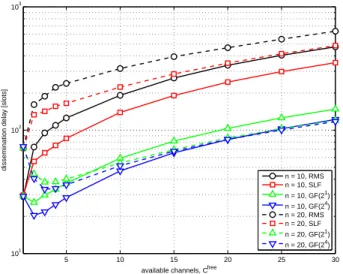
In Figs. 4 and 5 we show the dissemination delay as a function of the number of free channels and the number of CRs in the network, respectively. More specifically, Fig. 4
5 10 15 20 25 30
101 102 103
dissemination delay [slots]
available channels, Cfree
n = 10, RMS n = 10, SLF n = 10, GF(21) n = 10, GF(24) n = 20, RMS n = 20, SLF n = 20, GF(21) n = 20, GF(24)
Fig. 4. Dissemination latency versus number of free channels,Cf reefor
different schemes andn= 10,20.
shows that the dissemination delay increases for all schemes as the number of free channels increases. This is due to random hopping where, with a wide range of free channels, it is more likely that a CR tunes to a channel where there are no other nodes with which to exchange control packets. In addition, as the number of free channels increases, the number of transmitters per slot also increases because, once nodes are randomly allocated over all free channels, one of them is allowed to transmit per channel. With nodes scheduled for transmission more frequently, the opportunities to receive innovative packets diminish accordingly. We note that in the
5 10 15 20 25 30 35 40 45 50 55 60
101
102 103
dissemination delay [slots]
number of nodes, n Cfree = 5, RMS Cfree = 5, SLF Cfree = 5, GF(21) Cfree = 5, GF(24) Cfree = 10, RMS Cfree = 10, SLF Cfree = 10, GF(21) Cfree = 10, GF(24)
Fig. 5. Dissemination latency versus number of CRsnfor different schemes and free channels.
case of network coding the situation is different. Given the number of nodesn, there exists an optimal number of available channelsCf reethat minimizes the dissemination delay. This is
because, with this particular number of free channels, all nodes that are scheduled for transmission bring more innovative packets, maximizing the rate at which the nodes’ buffers rank increases.
In Fig. 5 we observe the same behavior in terms of dis-semination delay with respect to the number of CRs which are involved in the neighbor discovery process. However, we note that network coding is particularly robust in terms of dissemination delay for varying number of CRs in the network, providing comparable performance for a wide range of number of nodes, which is not true in the case of RMS and SLF that suffer particularly in those scenarios where the neighbor discovery has to be performed over a large number of CRs. This behavior can be explained as follows. With more nodes in the network, the number of packets each node needs to collect is correspondingly larger, which obviously tends to increase the dissemination time. This is partially mitigated (for all schemes) by the fact that the number of receiving nodes per channel increases and hence packets are disseminated to more CRs in each slot. Moreover, the performance of the schemes using network coding is further improved by the increased diversity in packet mixing (linear combinations contain information generated by more CRs), which leads to considerably faster control packet dissemination and explains why network-coding based schemes significantly outperform RMS and SLF.
C. The impact of reactive jamming attacks
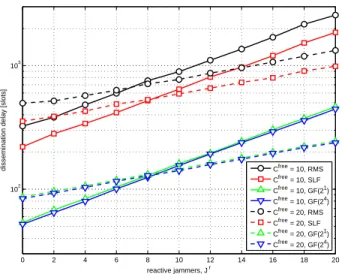
In Fig. 6 we show the performance of the algorithm as a function of the number of reactive jammers which are accessing the available channels randomly over frequency and time. In all cases network coding dissemination is faster with respect to RMS and SLF, with gains that are 6 and 4 times, respectively. We note that this gain is constant with the number of reactive jammers as a packet loss due to reactive jamming
0 2 4 6 8 10 12 14 16 18 20 102
103
dissemination delay [slots]
reactive jammers, J r Cfree = 10, RMS Cfree = 10, SLF Cfree = 10, GF(21) Cfree = 10, GF(24) Cfree = 20, RMS Cfree = 20, SLF Cfree = 20, GF(21) Cfree = 20, GF(24)
Fig. 6. Dissemination latency versus number of simultaneous reactive jammersJrforn= 20andCf ree= 10,20.
has the same effect on the dissemination delay for all schemes under discussion. We also observe that the impact of reactive jammers highly depends on the available spectrum resources which are being accessed by the CRs and the reactive jammers. With the same number of reactive jammers, as the number of available channels decreases the probability to disrupt a packet transmission in a given channel increases, leading to higher neighbor discovery delay.
VII. CONCLUSIONS
In this paper we presented a novel neighbor discovery algorithm which exploits network coding for fast and reliable control packet dissemination. The algorithm provides full neighbor discovery for all CRs in the area and is very robust to various jamming attacks. We compare it with random neighbor discovery schemes representing state of the art solutions. Simulation results show that our proposal brings significant benefits in a variety of wireless environments, ranging from jamming-free to multiple reactive and static jamming scenar-ios.
As a first step, this work identified the benefits of network coding for neighbor discovery in a single-hop network setting. However, it also raised important questions which have to be answered in order to provide a suitable solution for those cases where neighbor discovery has to be implemented in multi-hop networks with high node densities. In such scenarios, network coding can suffer as the decoding matrix size and the encoding vectors associated to the encoded packets can increase since the amount of information to be mixed is proportional to the number of nodes interested in neighbor discovery. Moreover, the scheme can be significantly improved to efficiently exploit very wide spectrum resources where the utilization of random hopping patterns, while being very robust to jamming attacks, decreases the probability that CRs meet in a given spectrum band for information exchange.
Hence, future work is focused on more intelligent channel hopping sequences able to conserve jamming resistance and at the same time improve CR cooperation for a faster neighbor
discovery process. Moreover, the implementation in real de-vices and the development of an extended neighbor discovery algorithm for multi-hop cognitive radio networks would give significant insights on the suitability of the proposed scheme for the generic case of ad hoc CRNs.
ACKNOWLEDGEMENT
Part of this work has been presented at the IEEE CoCoNet3 2010 Workshop. This work was partially supported by the European Commission through the ARAGORN project (FP7 ICT-216856) and by the US Army Research Office through Grant No. W911NF-09-1-0456.
REFERENCES
[1] J. Mitola, “Cognitive Radio: an Integrated Agent Architecture for Soft-ware Defined Radio,” Ph.D. dissertation, Royal Institute of Technology (KTH), 2000.
[2] Federal Communications Commission, “Facilitating Opportunities for Flexible, Efficient, and Reliable Spectrum Use Employing Cognitive Radio Technologies,” 2005.
[3] I. F. Akyildiz, W.-Y. Lee, M. C. Vuran, and S. Mohanty, “NeXt Gener-ation/Dynamic Spectrum Access/Cognitive Radio Wireless Networks: a Survey,” Computer Networks, vol. 50, no. 13, pp. 2127–2159, 2006. [4] T. C. Clancy and N. Goergen, “Security in Cognitive Radio Networks:
Threats and Mitigation,” in International Conference on Cognitive Radio Oriented Wireless Networks and Communications (CrownCom), Singapore, May 2008, pp. 1–8.
[5] R. Chen, J.-M. Park, and J. Reed, “Defense Against Primary User Emulation Attacks in Cognitive Radio Networks,” IEEE Journal on Selected Areas in Communications, vol. 26, no. 1, pp. 25–37, Jan. 2008. [6] W. Xu, W. Trappe, Y. Zhang, and T. Wood, “The Feasibility of Launching and Detecting Jamming Attacks in Wireless Networks,” in Proceedings of the 6th ACM International Symposium on Mobile Ad Hoc Networking and Computing (MobiHoc), New York, NY, USA, 2005, pp. 46–57.
[7] S. Vasudevan, D. Towsley, D. Goeckel, and R. Khalili, “Neighbor Discovery in Wireless Networks and the Coupon Collectors Problem,” in Proceedings of the 15th Annual International Conference on Mobile Computing and Networking (MobiCom), Sept. 2009, pp. 181–192. [8] N. Mittal, S. Krishnamurthy, R. Chandrasekaran, S. Venkatesan, and
Y. Zeng, “On Neighbor Discovery in Cognitive Radio Networks,” Journal of Parallel and Distributed Computing, vol. 69, pp. 623–637, 2009.
[9] S. Krishnamurthy, M. Thoppian, S. Kuppa, R. Chandrasekaran, N. Mit-tal, S. Venkatesan, and R. Prakash, “Time-Efficient Distributed Layer-2 Auto-configuration for Cognitive Radio Networks,” Computer Networks, vol. 52, no. 4, pp. 831–849, 2008.
[10] C. J. L. Arachchige, S. Venkatesan, and N. Mittal, “An Asynchronous Neighbor Discovery Algorithm for Cognitive Radio Networks,” in Proceedings of the 3rd IEEE Symposium on New Frontiers in Dynamic Spectrum Access Networks (DySPAN), Oct. 2008, pp. 1–5.
[11] K. Balachandran and J. H. Kang, “Neighbor Discovery with Dynamic Spectrum Access In Adhoc Networks,” in IEEE 63rd Vehicular Tech-nology Conference (VTC), May 2006, pp. 512–517.
[12] C. Fragouli, J.-Y. Le Boudec, and J. Widmer, “Network coding: an instant primer,” SIGCOMM Comput. Commun. Rev., vol. 36, no. 1, pp. 63–68, 2006.
[13] P. A. Chou, Y. Wu, and K. Jain, “Practical Network Coding,” in 41st Allerton Conference on Communication Control and Computing, Allerton, IL, USA, Oct. 2003.
[14] D. Cabric, S. M. Mishra, and R. W. Brodersen, “Implementation Issues in Spectrum Sensing for Cognitive Radios,” Thirty-Eighth Asilomar Conference on Signals, Systems and Computers, vol. 1, pp. 772–776, Nov. 2004.
[15] Z. Jin, S. Anand, and K. P. Subbalakshmi, “Mitigating Primary User Emulation Attacks in Dynamic Spectrum Access Networks Using Hy-pothesis Testing,” ACM SIGMOBILE Mobile Computing and Commu-nications Review, vol. 13, no. 2, pp. 74–85, Apr. 2009.
[16] A. Asterjadhi, E. Fasolo, M. Rossi, J. Widmer, and M. Zorzi, “Toward Network Coding-Based Protocols for Data Broadcasting in Wireless Ad Hoc Networks,” IEEE Transactions on Wireless Communications, vol. 9, no. 2, pp. 662–673, Feb. 2010.
Alfred Asterjadhi [S’10] received the Bachelor’s degree and Master’s degree
(summa cum laude) in Telecommunications Engineering in 2004 and 2007, respectively, from the University of Padova, Italy. During the Academic Year 2004/2005 he attended several graduate courses of Computer Science at the Rey Juan Carlos University, Madrid, Spain. Since January 2008 he has been a Ph.D. Student at the Department of Information Engineering, University of Padova, Italy. During the first half of 2010 he was on leave at the Department of Computer Science and Engineering at PennState University (USA), working on optimization techniques for cognitive radios and networks. His current research is focused on the design and evaluation of protocols for cognitive radio networks and ad hoc wireless networks.
Michele Zorzi [S’89, M’95, SM’98, F’07] was born in Venice, Italy, in 1966.
He received the Laurea degree and the Ph.D. degree in Electrical Engineering from the University of Padova, Italy, in 1990 and 1994, respectively. During the Academic Year 1992/93, he was on leave at the University of California, San Diego (UCSD), attending graduate courses and doing research on multiple access in mobile radio networks. In 1993, he joined the faculty of the Dipartimento di Elettronica e Informazione, Politecnico di Milano, Italy. After spending three years with the Center for Wireless Communications at UCSD, in 1998 he joined the School of Engineering of the University of Ferrara, Italy, and in 2003 joined the Department of Information Engineering of the University of Padova, Italy, where he is currently a Professor. His present research interests include performance evaluation in mobile communications systems, random access in mobile radio networks, ad hoc and sensor networks, energy constrained communications protocols, cognitive radios and networks, and underwater acoustic communications and networking.
Dr. Zorzi was the Editor-In-Chief of the IEEE WIRELESSCOMMUNICA -TIONSMAGAZINEfrom 2003 to 2005, is currently the Editor-In-Chief of the IEEE TRANSACTIONS ONCOMMUNICATIONS, and serves on the Editorial Boards of the the WILEY JOURNAL OF WIRELESS COMMUNICATIONS
AND MOBILE COMPUTING and the ACM/URSI/KLUWERJOURNAL OF
WIRELESSNETWORKS. He was also guest editor for special issues in the IEEE PERSONALCOMMUNICATIONSMAGAZINE(Energy Management in Personal Communications Systems) and the IEEE JOURNAL ONSELECTED AREAS IN COMMUNICATIONS (Multi-media Network Radios, Underwater Wireless Communication Networks).