No. Experiments Page No.
1 Use of Vernier Callipers 1
2 Use of Micrometer screw gauge 5
3 Use of Spherometer 9
4 Parallelogram law of forces 12
5 Coefficient of static friction 15
6 Determination of Resistance per cm by V – I graph 20
7 Concave Mirror 24
8 Convex Lens 26
9 Convex Mirror 29
10 Focal length of concave lens by convex lens 31
11 Prism 36
12 Use of Travelling Microscope 40
13 – I Refractive index of liquid by concave mirror 43 13 – II Refractive index of liquid by convex lens & plane mirror 45 14 – I Specific heat capacity of liquid 47 14 – II Specific heat capacity of solid 49
15 List of Activity 51
Logarithms and other tables
Logarithms 56
Antilogarithms 58
Natural Sines 60
Natural Cosines 62
Std. XI Sci.
Physics Practical Handbook
Prof. Jyoti D. Deshpande
M.Sc., D.H.E.H.O.D., Ramniranjan Jhunjhunwala College, Ghatkopar
Tar
g
et
PUBLICATIONS PVT. LTD.
Mumbai, Maharashtra
Tel: 022 – 6551 6551
Website:
www.targetpublications.in
www.targetpublications.org
email :
[email protected]
Std. XI Sci.
Physics Practical Handbook
(New Syllabus)©
Target Publications Pvt Ltd.
Second Edition: June 2012
Price: ` 45/-
Printed at:
India Printing Works
42, G.D. Ambekar Marg,
Wadala,
Mumbai – 400 031
Published by
Tar
g
et
PUBLICATIONS PVT. LTD.Shiv Mandir Sabagriha,
Mhatre Nagar, Near LIC Colony,
Mithagar Road,
Mulund (E),
Mumbai - 400 081
Off.Tel: 022 – 6551 6551
PREFACE
Physics has played a major role in the development of science and technology during the years. It covers a wide range of phenomena, from the smallest sub-atomic particles to the largest galaxies. It is the study of matter and energy and the interaction between them. Practical physics has applications in the fields of engineering, medicine, technology etc. In practical physics the student obtain laboratory skills, design experiments and apply instrumentation such as electronic circuits to observe and measure natural phenomena.
To master the science of physics practical one needs to have a complete and thorough knowledge of all the experiments involved. Hence we bring to you “Std. XI Sci. : PHYSICS PRACTICAL HANDBOOK” which covers all the experiments of Std XI. This handbook is writtern according to the syllabus. It includes different sets of experiments with proper steps and neat and labelled diagrams. These experiments help the student to understand the practical applications of many principles and laws involved in Std. XI. The handbook also includes all the useful tables given at the end.
And lastly, we would like to thank all those who have helped us in preparing this book. There is always room for improvement and hence we welcome all suggestions and regret any errors that may have occurred in the making of this book.
A book affects eternity; one can never tell where its influence stops.
Best of luck to all the aspirants!
Your’s faithfully
Publisher
TARGET Publications
Syllabus
Std. XI Sc.: Physics Practical Handbook
SYLLABUS
1. Use of Vernier Callipers.2. Use of Screw gauge.
3. To determine radius of curvature of a given spherical surface by a spherometer. 4. To find the weight of a given body using parallelogram law of vectors.
5. To study the relationship between force of limiting friction and normal reaction and to find co-efficient of friction between a block and horizontal surface.
6. To determine resistance per cm of a given wire by plotting a graph of potential difference versus current.
7. To find the value of ‘v’ for different values of ‘u’ in case of a concave mirror and to find the focal length.
8. To find the focal length of a convex lens by plotting graphs between ‘u’ and ‘v’ or between ‘1/u’ and ‘1/v’.
9. To find the focal length of a convex mirror, using a convex lens. 10. To find the focal length of a concave lens, using a convex lens.
11. To determine angle of minimum deviation for a given prism by plotting a graph between angle of incidence and angle of deviation.
12. To determine refractive index of a glass using a travelling microscope.
13. To find refractive index of a liquid by using (i) concave mirror, (ii) convex lens and plane mirror.
14. To determine specific heat capacity of a given (i) liquid (ii) solid, by method of mixtures.
List of Activities
1. To make a paper scale of given least count, e.g. 0.2 cm, 0.5 cm.
2. To determine mass of a given body using a meter scale by principle of moments. 3. To plot a graph for a given set of data, with proper choice of scales and error bars. 4. To measure the force of limiting friction for rolling of a roller on horizontal plane. 5. To study the variation in range of a jet of water with angle of projection.
6. To measure resistance, voltage (AC/DC), current (AC) and check continuity of a given circuit using multimeter.
7. To observe refraction and lateral deviation of a beam of light incident obliquely on a glass slab.
8. To study the nature and size of image formed by (i) convex lens (ii) concave mirror, on a screen by using a candle and a screen (for different distances of the candle from the lens/mirror).
9. To obatin a lens combination with the specified focal length by using two lenses from the given set of lenses.
TARGET Publications
General Instructions
Std. XI Sc.: Physics Practical Handbook
GENERAL INSTRUCTIONS
1. Before performing the experiment read the experiment at home carefully and take out the points on which you want the clarification from the teacher.
2. Before actually performing an experiment student should know clearly what do determine and by which method.
3. The necessary theory to know the limitations of the method and approximations used in formula should be read.
4. The working table must be clean and apparatus should be placed in such a manner that the part which are to be read or adjusted lie at convenient distance to make the observations.
5. The apparatus must be handled with great care.
6. Read all the precautions before performing the experiment.
7. Before writing down any final observation, take some trial readings and find out the range you are going to cover. Divide the range into equal parts according to the number of readings you are going to take.
8. Since all the measurements are affected by errors of observations repeat your observations at least three times for the same quantity and take the mean value. Sometimes it happens that one of the observed values differs widely from the rest. Reject that value.
9. The proper units to the measured quantity, should be written.
10. Writing of observations on loose sheets should be strictly avoided. The observations should be recorded in the practical note book. There should be no over writing.
11. Always bring compass box, sharpened pencil, eraser, hand book in the Laboratory.
12. Calculations for all observations neatly and with the help of logarithmic tables. Write the result with the proper units.
TARGET Publications
Use of Vernier Callipers
Std. XI Sci. : Physics Practical Handbook
1Diagram - 1
0
5
10
3
4
5
6
7
8
Main Scale
Vernier scale
Main Scale (cm)
Vernier scale
Sphere/Cylinder
Q
′
P
′
P
Q
2
2
Vernier callipers
1
0
1
0
(a)
No zero
error
0
0
5
Main scale
1 cm
10
Vernier scale
Diagram - 2
Diagram - 3
(b)
Negative
zero error
0
0
5
Main scale
1 cm
10
Vernier scale
USE OF VERNIER CALLIPERS
01
EXPERIMENT
Aim:
i.
To find the volume of a sphere and
ii.
To find volume of a hollow cylinder, by using vernier callipers.
Apparatus:
Vernier callipers, sphere, hollow cylinder.
TARGET Publications
Use of Vernier Callipers
Std. XI Sci. : Physics Practical Handbook
2Diagram - 4
(c)
Positive
zero error
0
0
5
Main scale
1 cm
10
Vernier scale
Formula:
i.
Volume of a sphere =
4
r
33
π
Where ‘r’ is radius of sphere
ii.
Volume of cylinder =
π
R
2h
Where ‘R’ is radius of cylinder and ‘h’ is height of cylinder.
Procedure:
i.
Note down the value of one division of main scale (X) and number of divisions on vernier
scale (N). Hence find out least count of vernier callipers (See diagram - 1).
ii.
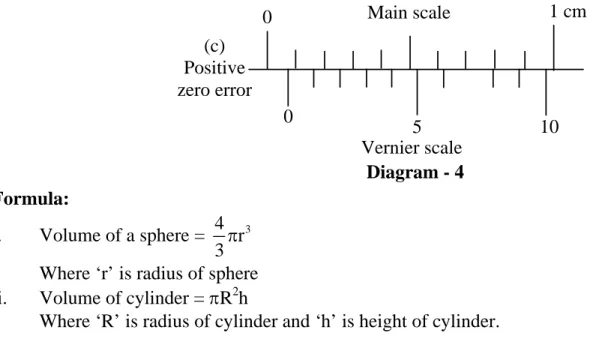
Find zero error of vernier callipers (See diagrams 2, 3, 4).
iii.
To measure the diameter and hence radius of sphere, place the given sphere between the two
jaws of the vernier callipers. Care should be taken that undue pressure on the sphere is
avoided.
iv.
Observe the zero of the vernier scale. It lies between two successive readings of the main
scale. The lesser reading is the main scale reading (M.S.R.) ‘a’
v.
Now count the division of vernier scale which coincides with any of the division of main scale.
This coinciding division of vernier scale is vernier scale division (V.S.D.) ‘n’. Multiply ‘n’ by
least count of vernier callipers to obtain the value of vernier scale reading. This is ‘b’ and it is
b = n
×
least count.
vi.
The total reading is the sum of main scale reading ‘a’ and vernier scale reading ‘b’. This total
reading gives the diameter of the sphere.
vii. Repeat the procedure (iv) to (vi) five times by rotating the sphere to get diameter at different
places. Hence mean diameter and radius can be found out.
viii. Place the cylinder between the two jaws of the vernier callipers. Repeat the procedure (iv) to
(vii). Find out inner diameter and hence radius of the cylinder.
ix.
Measure the height of the cylinder by meter scale.
x.
Apply zero correction due to zero error for every reading.
Observations:
i.
Value of the smallest division on main scale (X) = ……….. cm
ii.
Number of divisions on vernier scale (N) = ………… div
Least count of vernier callipers, L.C. =
X
N
= ……….
iii.
Height of the cylinder = …………. cm
TARGET Publications
Use of Vernier Callipers
Std. XI Sci. : Physics Practical Handbook
3Observation table:
Object
Obs.
No.
M.S.R.
‘a’
(cm)
V.S.D.
n
(div.)
V.S.R.
b = n
×
L.C.
(cm)
Total reading
(a + b)
(cm)
Corrected
reading
(cm)
Sphere
1.
2.
3.
4.
5.
Cylinder
1.
2.
3.
4.
5.
Calculations:
i. Corrected
mean
diameter of sphere = d = …………. cm
∴
Radius of sphere = r =
d
2
= …………. cm
ii.
Corrected mean inner diameter of cylinder = D = …………. cm
∴
Radius of cylinder = R =
D
2
= …………. cm
iii.
Volume of sphere = V =
4
3
π
r
3
= ………… cm
3iv.
Volume of cylinder = V
′
=
π
R
2h = ………… cm
3Result:
i.
Volume of sphere = ……….. cm
3ii.
Volume of cylinder = ………….. cm
3TARGET Publications
Use of Vernier Callipers
Std. XI Sci. : Physics Practical Handbook
4Precautions:
i.
While holding object in the jaws, do not exert undue pressure on it. The jaws should just touch
the object.
ii.
Take number of readings at different positions of the sphere as well as cylinder.
iii.
The upper jaws should just touch the inner diameter of hollow cylinder.
iv.
The coinciding division of vernier scale should be taken accurately, if required magnifying
glass can be used.
TARGET Publications Use of Micrometer screw gauge
Std. XI Sci. : Physics Practical Handbook
5USE OF MICROMETER SCREW GAUGE
02
0 Reference line No zero error Diagram - 2 0 90 Reference line
Negative zero error
Diagram - 3
0 10 Reference line
Positive zero error
Diagram - 4 Diagram - 1 Main Scale Nut Circular Scale Sleeve Thimble Ratchet Projecting cylindrical
metal piece (Anvil)
Object Spindle
U-Shaped metal frame Reference line
EXPERIMENT Aim:
i. To measure the diameter of a wire by using micrometer screw gauge.
ii. To measure the thickness of a metal glass plate by using micrometer screw gauge.
Apparatus:
Micrometer screw gauge, wire and metal plate or glass plate etc.
Diagram:
TARGET Publications Use of Micrometer screw gauge
Std. XI Sci. : Physics Practical Handbook
6Formula:
Cross-sectional area of wire A = πr2 Where r = radius of cross section of wire.
Procedure:
i. Find out the distance (X) through which screw travels on the main scale in five rotations of the circular scale. Hence distance travelled by the circular scale in one rotation is called the pitch of the screw.
ii. Note down the number of divisions on the circular scale. Hence knowing pitch, L.C. (Least count) of the screw can be determined (See diagram - 1).
iii. Find out zero error of micrometer screw. This can be found out as follows:
When the two jaws of micrometer screw gauge are brought in contact with each other without applying undue pressure, the zero on the circular scale should coincide with the reference line on main scale. If this happens there is no zero error (See diagram - 2). If this is not observed then the micrometer screw has zero error.
There are two possibilities
a. Zero of circular scale is above the reference line:
When zero of the circular scale is above the reference line as shown in diagram - 3, then zero error is negative. Count the divisions from zero of circular scale coinciding with reference line (−m). Negative sign is for negative error. The value of zero error can be found out by multiplying it by least count. [(−m) L.C.]
b. Zero of circular scale is below the reference line:
When zero of the circular scale is below the reference line as shown in diagram - 4, then zero error is positive. The division of circular scale coinciding with reference line is noted (+m). Positive sign is for positive error. The value of zero error can be found out by multiplying it by least count. [+(m) L.C.]
Notethat any micrometer screw gauge apparatus can have one and only one possibility out of the three i.e. no zero error, negative zero error and positive zero error. Also zero error is related to the apparatus.
iv. Hold the wire, between the two jaws of micrometer screw gauge, whose diameter is to be found out without applying undue pressure. Note down the reading of the main scale (M.S.R.) or pitch scale (P.S.R.). This is ‘a’.
v. Note down the circular scale reading coinciding with reference line. This is C.S.D. (n). Multiply this by L.C. to obtain circular scale reading (C.S.R.).
vi. The total reading (T) can be found out by adding main scale reading and circular scale reading i.e. T = a + b.
vii. To obtain correct reading, zero error which is found out in procedure (iii) is subtracted from total reading. Thus correct reading of the diameter is obtained.
viii. Five readings of the diameter of the wire are taken by using procedure (iv) to (vii). Hence mean corrected diameter of the wire can be found out.
ix. To find the thickness of the metal plate (or glass plate) instead of the wire, glass or metal plate is held between the jaws of the micrometer screw gauge. The procedure (iv) to (viii) is repeated, resulting in mean thickness of the plate (metal or glass).
TARGET Publications Use of Micrometer screw gauge
Std. XI Sci. : Physics Practical Handbook
7Observations:
i. Distance (X) travelled by the circular scale in five rotations = ………. cm ii. Pitch of the screw = X
5 = ………..
iii. Number of divisions on the circular scale = ………..
iv. L.C. = Pitch
No. of divisions on circular scale = ………… v. Zero error, Z = ± (m) (L.C.) = ………… Observation table: Object Obs. No. M.S.R. ‘a’ (cm) C.S.D. n (div.) C.S.R. b = n × (L.C.) (cm) Total reading T = a + b (cm) Corrected reading = T − Z (cm) Wire 1. 2. 3. 4. 5. Plate 1. 2. 3. 4. 5. Note:
From the diameter of wire, radius of the wire can also be found out and hence cross sectional area of the wire can be calculated. From the last column in the observation, mean diameter of the wire and mean thickness of the plate can be found out.
Result:
i. Diameter of wire = ………. cm
TARGET Publications Use of Micrometer screw gauge
Std. XI Sci. : Physics Practical Handbook
8Precautions:
i. Do not apply undue pressure while turning micrometer screw.
ii. Take number of independent readings by holding the wire in different positions.
iii. Minimise the blacklash error by rotating the screw always in the same direction while taking readings.