Electronic Health Record System Evaluation Based on Patient Safety
Yung Yu (Paul) SU, Khin Than WIN & John FULCHER
Health Informatics Research Centre, University of Wollongong, Australia
Correspondence: [email protected]
Abstract
After describing the general characteristics of Electronic Health Records (EHRs), we consider patient safety. We then proceed to discuss IS evaluation in general terms, followed by HIS system evaluation in particular. The D&M IS Success model, Technology Acceptance model and Task-Technology Fit model are considered as potential candidates for EHR System evaluation. Based upon a critical review of the available literature, we draw some conclusions about the appropriateness of current HIS/EHR evaluation approaches. Finally, we suggest that by incorporating patient safety attributes in any EHR System evaluation framework, then this could lead to improved accuracy, and in turn improved patient care.
1. Introduction
Key considerations for a healthcare organization, apart from the primary one of improved patient care, are cost containment and improving the efficiency of work practices. Health Information Systems have the potential to support these objectives, at the same time as ensuring patient safety. It is therefore imperative that we have means at our disposal to effectively evaluate not only an HIS in a general sense, but more specifically whether the use of Electronic Health Records is helping or hindering the realization of such goals.
2. Electronic Health Record (EHR) Systems
Any computer system where failure could have an negative impact on a person’s health (life threatening in the extreme) , should be regarded as a safety critical system.
Adoption of EHRs can potentially lead to better quality and more efficient healthcare, by way of embedded decision support systems which provide ready access not only to (more complete) information about an individual’s state of health, but also to demographic health information.
EHRs contain sensitive health data of individual patients, thus it is essential that these systems are both secure and error free. Inaccurate or insecure information could be detrimental to the individual and subsequently to the responsible company or organization.
EHR systems include different types of data and information for different users. Information included in health record systems needs to be accurate and health
record systems should be safe so that they assist health care workers to improve clinical outcomes.
Typical information management services provided by EHR systems include: (a) Recommendation services, (which determine appropriate activities in specific clinical circumstance), (b) Documentation services (which involve data collection, storage of observations, assessment and interventions, (c) Registration services (which integrate demographic and administrative data), (d) Explanation services (which enhance the credibility of recommendation services by providing supporting evidence), (e) Calculation services (which measure time intervals, medication dosages and other computational tasks), (f) Communication services (which include standards for data transfer and data security), (g) Effective presentation services (which facilitate data visualization;), and (h) Aggregation services (which associate outcome, diagnosis and specific guidelines) [1].
Accordingly, EHR evaluation needs to consider whether or not workflow processes enhance patient safety.
3. Patient Safety
The Institute of Medicine (IOM) reports that annual deaths resulting from medical error are of the order of 44,000 to 98,000. The IOM defines patient safety as “the prevention of harm to patients where harm can occur through errors of commission and omission.” [2] Now the safety and quality of EHRs are inseparable. This necessitates compliance by all stakeholders with a culture of safety, as well as the development of a HIS with patient safety as a primary focus.
Within the context of patient care, errors of omission, errors of commission, slips and mistakes can be collectively regarded as “human error.” [3] Thus, the most important issue with regard to patient safety is considering how to avoid harm by reducing human error. Accordingly, several organizations in the developed countries have taken responsibility for patient safety, including the US Joint Commission on Accreditation of Healthcare Organizations, the UK National Patient Safety Agency, the Australian Council for Safety and Quality in Health Care, the Japan Council for Quality Health Care and the Taiwan Joint Commission Hospital Accreditation.
For instance, the Joint Commission on Accreditation of Healthcare Organizations establishes annual National Patient Safety Goals for reducing medical errors. In 2006, for example, the JCAHO focused on
both improving the accuracy of patient identification and on improving the effectiveness of communication among caregivers [4]. Such considerations must therefore be incorporated in any evaluation of EHR Systems.
4. EHR System Evaluation
HIS evaluation considers the relationship between people, technology, and the environment. [5]. Being a complex organization, a HealthCare System gathers an enormous amount of medical and administrative data on a daily basis. IT system evaluation within healthcare tests not only the IT itself, but also checks the interaction between the IT and the system user. Moreover, systems need to be evaluated on a case-by-case basis, since they invariably cater to individual needs, and are system-specific [6].
Now while IT can be used in theory to improve patient safety, it will fail to do so if it is poorly designed, is unsuited to the clinical task at hand, or uses unnecessarily complex technology for its own sake - these can all lead to increased error [7]. Hence, it is important to evaluate whether EHRs could reduce medical errors and/or overcome barriers.
Since EHR Systems are an integral part of HealthCare systems generally, the risk of incidents due to medical errors can be mitigated by correct identification of initial system requirements. Moreover, the safety aspects of EHRs can be summarized as: identification, system security, privacy, confidentiality, consent, disaster recovery, storage, back up, retention period, data standards, data interoperability, data integrity, medication, alerts, data entry, attributes of data quality, system quality [8]. It is therefore important to consider the risk features of EHRs because evaluation studies need to review an HIS from the perspectives of quality, value, effects, impacts, and applications [6].
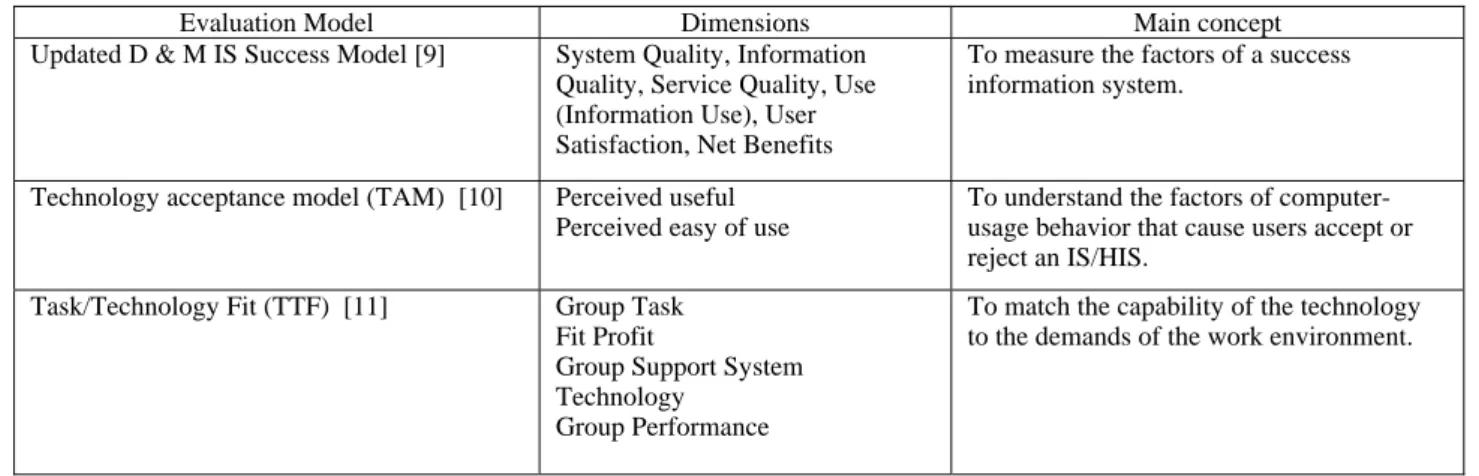
Several IS evaluation models have been developed for IS evaluation in the large, and these are summarized in Table 1. The question naturally arises as to how applicable such models are to HIS evaluation? Actually, some earlier researchers have made some tentative steps in this direction (see for example, [12]).
HIS evaluation needs to consider the following: (1) goals (i.e. what to evaluate); (2) methods (i.e. how to evaluate [13-15]. In this paper we focus on so called “goal-based evaluation” [14] in order to assess current-generation EHRs. More specifically, we use safety attributes as estimation criteria, stressing “EHR success”, the “Task Fit” of EHRs, and “EHR acceptance” (i.e. what to evaluate) in order to explain how to enhance patient safety by using HIS evaluation models in assessing EHRs (i.e. how to evaluate), as summarized in Table 2.
5. Discussion
comprehensive, and incorporates aspects of quality (information, system, and service), user satisfaction, user acceptance (use), and net benefits. It thus could be used to measure the success of EHRs. By contrast, the Technology Acceptance Model focuses on end user acceptance – in the present case, of EHRs. The Task-Technology Fit model attempts to measure the factors which relate the task (i.e. reducing human error) to the underlying technology (i.e. EHRs). TTF could therefore assist in determining whether EHRs assist in reducing human error, and thereby improve the performance and quality of patient care.
Right timing is touted by some researchers as an important consideration, since today’s success may fail a decade later due to previously hidden technology limitations, changes in demand, and so on [16]. Now while several researchers have developed frameworks and the like for HIS evaluation [5,6,12,14,17,18], no standard evaluation method exists for evaluating EHR Systems from the perspective of patient safety.
6. Conclusion
We have already seen how safety and quality are intimately linked. The key suggestion which emerges from our critical review of the HIS evaluation literature is the incorporation of EHR safety attributes in the application of existing HIS evaluation models to measure the effectiveness otherwise of EHR Systems.
In short, we believe that the establishment of a “comprehensive”, “successful”, “high Task Fit”, and “highly acceptable” EHR system will help healthcare organizations not only to improve efficiency and effectiveness but also to reduce medical errors.
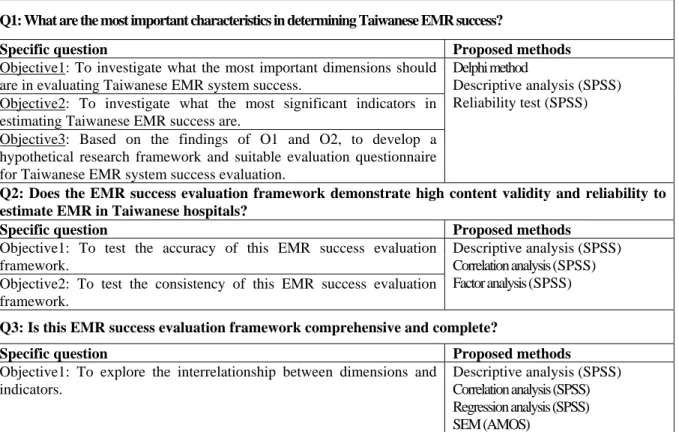
The next phase of our research will involve the testing and validation of our proposed evaluation framework (Figure 1), focusing on EHR systems within the Taiwanese hospital system. The relevant research questions and appropriate methodology to provide answers to these questions are summarized in Table 3.
7. References
[1] R.N. Schiffman, C.A. Brandt, Y. Liaw, and C.G. J., “A Design Model for Computer-Based Guideline Implementation Based on Information Management Services”, J. American Medical Informatics Association, 1999, 6(2), pp.99-103.
[2] Anonymous, “IOM Report: Patient Safety: Achieving a New Standard for Care”, Academic Emergency Medicine, 2005; 12(10), pp. 1011-1012. [3] V.L. Patel , and L.M. Currie, “Clinical Cognition and Biomedical Informatics: Issues of Patient Safety”. J.
[5] E. Ammerwerth, J. Brender, P/ Nykanen, H.-U. Prokosch, M. Rigby, and J. Talmon, “Visions and Strategies to Improve Evaluation of Health Information Systems: Reflections and Lessons Based on the HIS-EVAL Workshop in Innsbruck”. Intl. J. Medical Informatics, 2004, 73(6), pp.479-491.
[6] E. Ammerwerth, S. Graber, G. Herrmann, T. Burkle, and J. Konig, “Evaluation of Health Information Systems: Problems and Challenges”. Intl. J. Medical Informatics, 2003, 71(2-3), pp.125-135..
[7] S.K. Newbold, G.J. Kuperman, S. Bakken, P.F. Brennan, E.A. Mendonca, H.-A. Park, and A. Radenovic, “Information Technology as an Infrastructure for Patient Safety: Nursing Research Needs”, Intl. J. Medical Informatics, 2004, 73(7-8), p.756.
[8] K.T. Win, H. Phung, L. Young, M. Tran, C. Alcock, and K. Hillman, “Electronic Health Record System Risk Assessment: A Case Study from MINET”, Health Technology Management, 2004 33(2), pp.43-48.
[9] W.H. DeLone, and E.R. McLean, “The DeLone and McLean Model of Information System Success: a Ten-Year Update”, J. Management Information Systems, 2003, 19(4), pp.9-30.
[10] F.D. Davis, R.P. Bagozzi, and P.R. Warshaw, “User Acceptance of Computer Technology: a Comparison of Two Theoretical Models”, Management Science, 1989, 35(8), pp.982-1003.
[11] I. Zigurs, B.K. Buckland, J.R. Connolly, and E.V. Wilson, “A Test of Task-Technology Fit Theory for Group Support Systems.”, The DataBase for Advances in Information Systems, 2001, 32(3).
[12] R. Raitoharju, “When Acceptance is Not Enough: Taking the TAM-Model into Healthcare”, Proc. 38th IEEE Intl. Conf. System Sciences, 2005, p.150c.
[13] H. Samela, and P. Turunen, “Evaluation of Information Systems in HealthCare: a Framework and its Application”, 1997. (available online from http://www.tukk.fi/tjt/TUTKIMUS/HCISS/Julkaisusivut /dokumentit/pekka/final.pdf).
[14] S. Cronholm and G. Goldkuhl, “Strategies for Information Systems Evaluation: Six Generic Types”,
Electronic J. Information System Evaluation, 2003, 6(20, pp.65-74.
[15] J.C. Wyatt , nad S.M. Wyatt, “When and How to Evaluate Health Information Systems?”, Intl. J. Medical Informatics, 2003, 69(2-3), pp.251-259.
[16] T. Burkle, E. Ammenwerth, H.U. Prokosch, and J. Dudeck, “Evaluation of Clinical Information Systems: What Can Be Evaluated and What Cannot?”, J. Evaluation in Clinical Practice, 2001, 7(4), pp.373-385. [17] E. Ammenwerth, F. Kaiser, I. Wilhelmy, and S. Hofer, “Evaluation of User Acceptance of Information Systems in HealthCare: the Value of Questionnaires”,
Proc. Medical Informatics Europe Conf. – MIE2003, 2003, St. Malo, France.
[18] E. Ammenwerth, and N. Keizer, “An Inventory of Evaluation Studies of Information Technology in healthcare: trends in Evaluation research 1982-2002.”
Methods of Information in Medicine, 2005, 44(1), pp.44-56.
Table 1. IS Evaluation Models, their Dimensions & Main Concepts.
Evaluation Model Dimensions Main concept
Updated D & M IS Success Model [9] System Quality, Information Quality, Service Quality, Use (Information Use), User Satisfaction, Net Benefits
To measure the factors of a success information system.
Technology acceptance model (TAM) [10] Perceived useful Perceived easy of use
To understand the factors of computer-usage behavior that cause users accept or reject an IS/HIS.
Task/Technology Fit (TTF) [11] Group Task Fit Profit
Group Support System Technology
Group Performance
To match the capability of the technology to the demands of the work environment.
Table 2 Proposed HIS Evaluation Criteria
Goal-based evaluation
“The lack of access to information during decision-making” and “need efficient communication” in patient care
Estimation criteria
(Safety Attributes of EHRs)
1.identification 6.disaster recovery 11.data interoperability 16.attributes of data quality
2.system security 7.storage 12.data integrity 17.system quality
3.privacy 8.back up 13.medication
4.confidentiality 9.retention period 14.alerts
5.consent 10.data standards 15.data entry
goals of an evaluation
(what to evaluate/ IT-system as such)
methods of evaluation
(how to evaluate/called IT-systems in use)
Research Topics Research Purpose Evaluation Models Aims of evaluation
EHRs success To find the success and weakness factors, and workflow processes of EHRs in real medical environment.
Updated DeLone and McLean IS success model (Updated D & M model)
Based on safety attributes to evaluate the success of EHRs with those six dimensions, to enhance the functions of the current EHRs.. EHRs acceptance To recognize, forecast,
describe, and recognize the factors of computer-practice behavior that cause users accept or reject current EHRs.
Technology Acceptance Model (TAM)
Based on safety attributes to predict, explain, and realize the factors of the behavior that cause users accept or reject current EHRs. Task Fit of EHRs It attempts to measure and
predict the fit of acceptance and use of technology in user evaluation of EHRs.
Task Technology Fit (TTF) Based on safety attributes to measure the performance of an current EHRs between technology and task based; to check whether this EHRs could reduce medical error or not.
Table 3 Research questions and proposed methods
Q1: What are the most important characteristics in determining Taiwanese EMR success?
Specific question Proposed methods Objective1: To investigate what the most important dimensions should
are in evaluating Taiwanese EMR system success.
Objective2: To investigate what the most significant indicators in estimating Taiwanese EMR success are.
Objective3: Based on the findings of O1 and O2, to develop a hypothetical research framework and suitable evaluation questionnaire for Taiwanese EMR system success evaluation.
Delphi method
Descriptive analysis (SPSS) Reliability test (SPSS)
Q2: Does the EMR success evaluation framework demonstrate high content validity and reliability to estimate EMR in Taiwanese hospitals?
Specific question Proposed methods Objective1: To test the accuracy of this EMR success evaluation
framework.
Objective2: To test the consistency of this EMR success evaluation framework.
Descriptive analysis (SPSS) Correlation analysis (SPSS) Factor analysis (SPSS) Q3: Is this EMR success evaluation framework comprehensive and complete?
Specific question Proposed methods Objective1: To explore the interrelationship between dimensions and
indicators.
Descriptive analysis (SPSS) Correlation analysis (SPSS) Regression analysis (SPSS) SEM (AMOS)