UC San Diego
UC San Diego Electronic Theses and Dissertations
Title
Building Reliable Software for Persistent Memory Permalink https://escholarship.org/uc/item/0sb2h10k Author Zhang, Lu Publication Date 2019 Peer reviewed|Thesis/dissertation
UNIVERSITY OF CALIFORNIA SAN DIEGO
Building Reliable Software for Persistent Memory
A dissertation submitted in partial satisfaction of the requirements for the degree
Doctor of Philosophy
in
Computer Science (Computer Engineering)
by
Lu Zhang
Committee in charge:
Professor Steven Swanson, Chair Professor Ranjit Jhala
Professor Paul Siegel Professor Geoffrey Voelker Professor Jishen Zhao
Copyright Lu Zhang, 2019 All rights reserved.
The dissertation of Lu Zhang is approved, and it is accept-able in quality and form for publication on microfilm and electronically:
Chair
University of California San Diego
TABLE OF CONTENTS
Signature Page . . . iii
Table of Contents . . . iv
List of Figures . . . vii
List of Tables . . . ix
Acknowledgements . . . x
Vita . . . xii
Abstract of the Dissertation . . . xiii
Chapter 1 Introduction . . . 1
Chapter 2 The NOVA-Fortis File System . . . 6
2.1 Background . . . 9
2.1.1 Non-volatile Memory Technologies . . . 9
2.1.2 NVMM File Systems and DAX . . . 10
2.1.3 File System Consistency and Reliability . . . 12
2.1.4 The NOVA File System . . . 13
2.2 Handling Data Corruption in NOVA-Fortis . . . 15
2.2.1 Detecting and Correcting Media Errors . . . 15
2.2.2 Tick-Tock Metadata Protection . . . 17
2.2.3 Protecting File Data . . . 17
2.2.4 Minimizing Vulnerability to Scribbles . . . 20
2.2.5 Preventing Scribbles . . . 22
2.2.6 Relaxing Data and Metadata Protection . . . 22
2.2.7 Protecting DRAM Data Structures . . . 22
2.2.8 Related and Future Work . . . 23
2.3 Performance Trade-offs . . . 25 2.3.1 Experimental Setup . . . 26 2.3.2 Performance Impacts . . . 27 2.3.3 Microbenchmarks . . . 27 2.3.4 Macrobenchmarks . . . 28 2.3.5 NVMM Storage Utilization . . . 30 2.4 Conclusion . . . 30
Chapter 3 The Pangolin Library . . . 33
3.1 Background . . . 35
3.1.1 Non-volatile Main Memory and DAX . . . 36
3.1.2 Handling NVMM Media Errors . . . 36
3.1.3 NVMM Programming . . . 37
3.2 Pangolin Design . . . 40
3.2.1 Pangolin’s Data Organization . . . 42
3.2.2 Micro-buffering for NVMM Objects . . . 43
3.2.3 Detecting NVMM Corruption . . . 45
3.2.4 Fault-Tolerant Transactions . . . 46
3.2.5 Parity and Checksum Updates . . . 47
3.2.6 Recovering from Faults . . . 49
3.3 Evaluation . . . 50 3.3.1 Evaluation Setup . . . 51 3.3.2 Memory Requirements . . . 52 3.3.3 Transaction Performance . . . 54 3.3.4 Scalability . . . 55 3.3.5 Impacts on NVMM Applications . . . 56
3.3.6 Error Detection and Correction . . . 59
3.4 Discussion . . . 60
3.5 Related Work . . . 61
3.6 Conclusion . . . 62
Chapter 4 PmemConjurer and PmemSanitizer . . . 64
4.1 Background . . . 66
4.1.1 NVMM Programming . . . 66
4.1.2 Program Analysis Frameworks in Clang and LLVM . . . 69
4.2 Design Overview . . . 71
4.2.1 Automatically-checked NVMM Programming Rules . . . . 72
4.2.2 Using PmemConjurer and PmemSanitizer . . . 75
4.3 PmemConjurer . . . 76
4.3.1 NVMM Regions and Region Symbols . . . 76
4.3.2 NVMM Objects and Object Symbols . . . 77
4.3.3 NVMMRegionState and Symbol Mappings . . . 77
4.3.4 Emulating Function Calls and Memory Accesses . . . 79
4.3.5 Rule-checking with NVMMRegionState . . . 80
4.3.6 Limitations of PmemConjurer’s Static Analysis . . . 81
4.4 PmemSanitizer . . . 81
4.4.1 Instrumentation and Runtime Analysis . . . 82
4.4.2 Supporting Threaded Programs . . . 82
4.4.3 Online Reordering Tests . . . 83
4.5 Results . . . 85
4.5.2 Performance . . . 87 4.5.3 False-Negatives . . . 89 4.5.4 False-Positives . . . 90 4.6 Related Work . . . 91 4.7 Conclusion . . . 92 Chapter 5 Conclusion . . . 94 Bibliography . . . 96
LIST OF FIGURES
Figure 2.1: NOVA inode log structure - A NOVA inode log records changes to the inode (e.g., the mode change and two file write operations shown above). NOVA stores file data outside the log. . . 14 Figure 2.2: NOVA-Fortis space layout - NOVA-Fortis’ per-core allocators satisfy requests
for primary and replica storage from different directions. They also store data pages and their checksum and parity pages separately. . . 15 Figure 2.3: Scribble size and metadata bytes at risk - Replicating metadata pages and
taking care to allocate the replicas separately improves resilience to scribbles. 19 Figure 2.4: File operation latency - NOVA-Fortis’ basic file operations are faster than
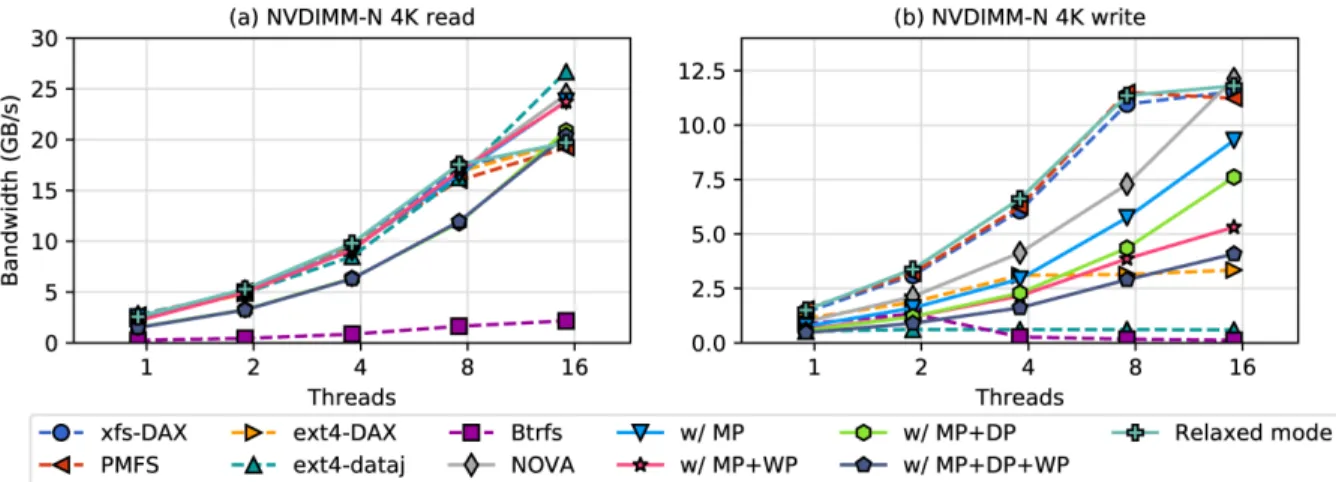
competing file systems except in cases where the other file system provides weaker consistency guarantees and/or data protection. . . 24 Figure 2.5: NOVA-Fortis random read/write bandwidth on NVDIMM-N - Read
band-width is similar across all the file systems except Btrfs, and NOVA-Fortis’ reliability mechanisms reduces its throughput by between 14% and 19%. . 25 Figure 2.6: NOVA-Fortis latencies for NVDIMM-N - Protecting file data is usually more
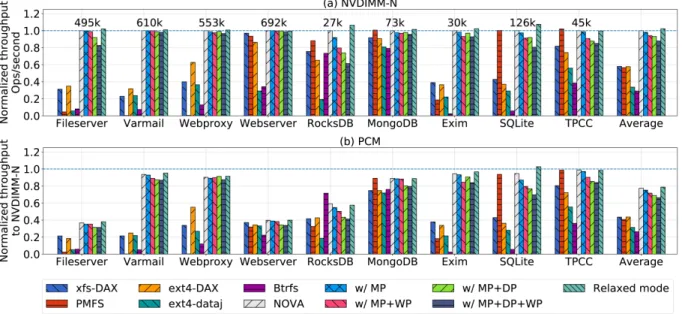
expensive than protecting metadata because the cost of computing checksums and parity for data scales with access size. . . 26 Figure 2.7: Application performance on NOVA-Fortis - Reliability overheads and the
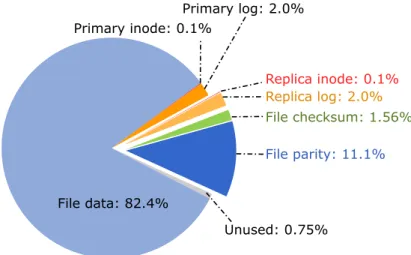
benefits of relaxed mode have less impact on applications than microbench-marks (Figures 2.4 and 2.5). . . 29 Figure 2.8: NVMM storage utilization - Extra storage required for reliability is
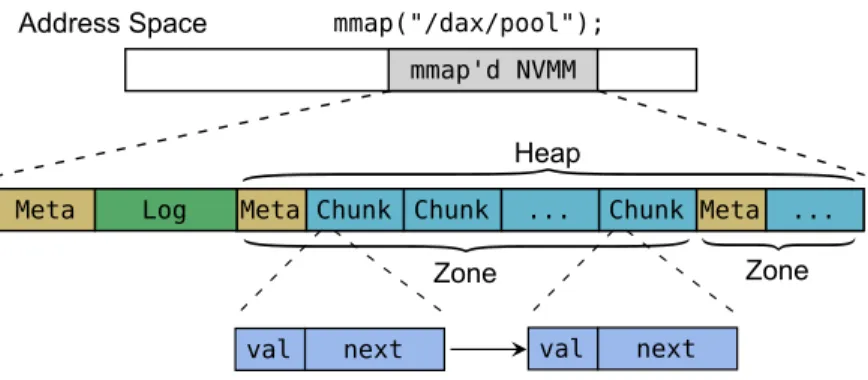
high-lighted to the right. Protecting data is more expensive that protecting meta-data, consuming 12.7% of storage compared to just 2.1% for metadata. . . . 31 Figure 3.1: DAX-mapped NVMM as an object store -Libpmemobjdivides the mapped
space into zones and chunks for memory management. . . 38 Figure 3.2: Data protection scheme in Pangolin - Pangolin protects pool metadata (PM),
zone metadata (ZM), and chunk metadata (CM). . . 41 Figure 3.3: Transaction performance - Each transaction allocates, overwrites, or frees
one object of varying sizes. Pangolin’s latencies are similar to Pmemobj’s. . . 51 Figure 3.4: Scalability - Concurrent workloads randomly overwrite objects of varying
sizes. . . 53 Figure 3.5: Key-value store performance - Each transaction either inserts or removes one
key-value pair from the data store. . . 56 Figure 3.6: Checksum verification impact - Pangolin-MLPC bars are the same as those
in Figure 3.5 for 1M Inserts. The cost of different policies depends strongly on data structures. . . 57 Figure 4.1: An NVMM programming example - The insert function finds the first
unused node in an NVMM linked list to store a key-value pair. . . 67 Figure 4.2: PmemConjurer and PmemSanitizer design overview . . . 72
Figure 4.3: Examples using PmemConjurer and PmemSanitizer . . . 75 Figure 4.4: NVMMRegionState and two-level symbol mapping. This mechanism helps
PmemConjurer recognize changes to the same NVMM region via either
PMEMoidor pointer variables. . . 78 Figure 4.5: PmemConjurer’s analysis flow for the root object in Figure 4.1. . . 80 Figure 4.6: Reordering tests implementation (gists only). . . 84 Figure 4.7: Reletive slowdown using different dynamic analysis tools - PmemSanitizer’s
dynamic analysis causes 4.5×slowdown on average. . . 87 Figure 4.8: Scalability with independent transactions modifying 64-byte objects -
Base-line indicates the throughput of the benchmark without any debugging instru-mentation. . . 88
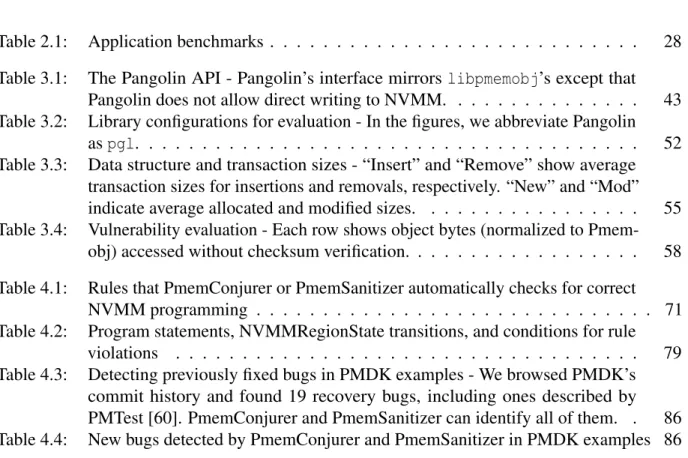
LIST OF TABLES
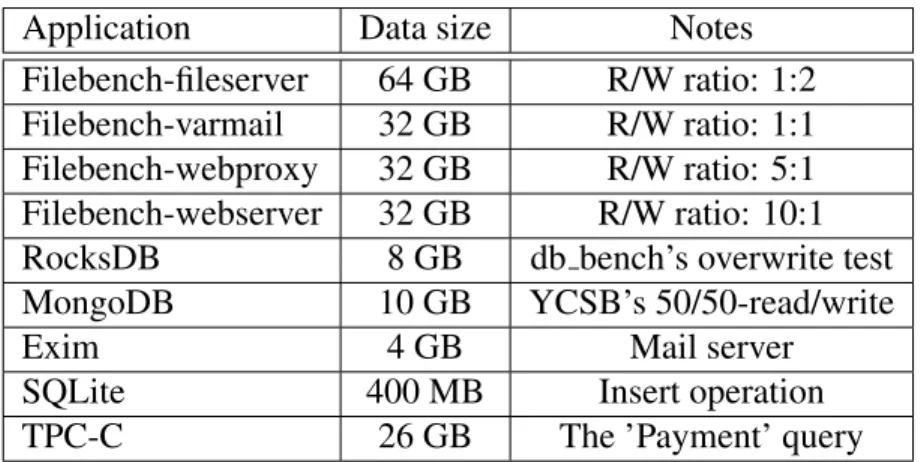
Table 2.1: Application benchmarks . . . 28 Table 3.1: The Pangolin API - Pangolin’s interface mirrors libpmemobj’s except that
Pangolin does not allow direct writing to NVMM. . . 43 Table 3.2: Library configurations for evaluation - In the figures, we abbreviate Pangolin
aspgl. . . 52 Table 3.3: Data structure and transaction sizes - “Insert” and “Remove” show average
transaction sizes for insertions and removals, respectively. “New” and “Mod” indicate average allocated and modified sizes. . . 55 Table 3.4: Vulnerability evaluation - Each row shows object bytes (normalized to
Pmem-obj) accessed without checksum verification. . . 58 Table 4.1: Rules that PmemConjurer or PmemSanitizer automatically checks for correct
NVMM programming . . . 71 Table 4.2: Program statements, NVMMRegionState transitions, and conditions for rule
violations . . . 79 Table 4.3: Detecting previously fixed bugs in PMDK examples - We browsed PMDK’s
commit history and found 19 recovery bugs, including ones described by PMTest [60]. PmemConjurer and PmemSanitizer can identify all of them. . 86 Table 4.4: New bugs detected by PmemConjurer and PmemSanitizer in PMDK examples 86
ACKNOWLEDGEMENTS
I want to thank my advisor Professor Steven Swanson for his support as the chair of my committee. He has guided me through the course of my Ph.D. research, and his advice have helped me overcome the challenges throughout the process. I also want to express my gratitude to Professor Ranjit Jhala, Professor Geoffrey Voelker, Professor Jishen Zhao, and Professor Paul Siegel for their valuable comments as my committee members.
I also want to thank all the members of the Non-volatile Systems Laboratory (NVSL) for the discussions about research ideas and insights. I am especially thankful to Jian Xu, Amirsaman Memaripour, Akshatha Gangadharaiah, Amit Borase, Tamires Brito Da Silva, Andy Rudoff (Intel), and Haolan Liu for their help in the papers that we co-authored.
I heartfully thank my parents, wife, and son for their love and support that have given me the mental strength to go through this challenging journey.
Chapter 1 and Chapter 2 contain material from “NOVA-Fortis: A Fault-Tolerant Non-Volatile Main Memory File System,” by Jian Xu, Lu Zhang, Amirsaman Memaripour, Akshatha Gangadharaiah, Amit Borase, Tamires Brito da Silva, Andy Rudoff and Steven Swanson, which has appeared in the Proceedings of the 26th ACM Symposium on Operating Systems Principles. The dissertation author is one of the two the primary contributors and second author of this paper. The materials are copyright c2017 by Association for Computing Machinery.
Chapter 1 and Chapter 3 contain material from “Pangolin: A Fault-Tolerant Persistent Memory Programming Memory” by Lu Zhang and Steven Swanson, which has appeared in the proceedings of the 2019 USENIX Annual Technical Conference. The dissertation author is the primary investigator and first author of this paper. The materials are copyright c2019 by USENIX Association.
Chapter 1 and Chapter 4 contain content from “Using Static Analysis to Find Non-Volatile Main Memory Programming Bugs” by Lu Zhang, Haolan Liu, Jishen Zhao, and Steven Swanson, which is submitted to the 25th ACM International Conference on Architectural Support for
Programming Languages and Operating Systems (ASPLOS’20). The dissertation author is the primary investigator and first author of this paper.
VITA
2007 B. S. in Electronics Engineering, Shandong University, Ji’nan 2009-2010 Graduate Student Researcher, IMEC, Leuven
2010 M. S. in Embedded Systems, Delft University of Technology, Delft 2010-2012 Hardware Engineer, Intel, Eindhoven
2012-2019 Graduate Student Researcher, University of California, San Diego 2015 Internship, Google, Mountain View
2019 Ph. D. in Computer Science (Computer Engineering), University of Cali-fornia, San Diego
PUBLICATIONS
Lu Zhang, Haolan Liu, Jishen Zhao and Steven Swanson. “Using Static Analysis to Find Non-Volatile Main Memory Programming Bugs”,Submitted to the 25th ACM International Conference on Architectural Support for Programming Languages and Operating Systems (ASPLOS), 2019. Joseph Izraelevitz, Jian Yang, Lu Zhang, Juno Kim, Xiao Liu, Amirsaman Memaripour, Yun Joon Soh, Zixuan Wang, Yi Xu, Subramanya R. Dulloor, Jishen Zhao, Steven Swanson. “Basic Performance Measurements of the Intel Optane DC Persistent Memory Module”,arXiv article on Performance, 2019.
Lu Zhang and Steven Swanson. “Pangolin: A Fault-Tolerant Non-Volatile Main Memory Pro-gramming Library”,2019 USENIX Annual Technical Conference (ATC), 2019.
Jian Xu, Lu Zhang, Amirsaman Memaripour, Akshatha Gangadharaiah, Amit Borase, Tamires Brito Da Silva, Andy Rudoff and Steven Swanson. “NOVA-Fortis: A Fault-Tolerant Non-Volatile Main Memory File System”,The 26th ACM Symposium on Operating Systems Principles (SOSP), 2017.
Moein Khazraee, Lu Zhang, Luis Vega, and Michael Bedford Taylor “Moonwalk: NRE Opti-mization in ASIC Clouds”,The 22nd ACM International Conference on Architectural Support for Programming Languages and Operating Systems (ASPLOS), 2017.
Lu Zhang, Luis Vega and Michael Bedford Taylor. “Power Side Channels in Security ICs: Hardware Countermeasures”,arXiv article on Cryptography and Security, 2016.
ABSTRACT OF THE DISSERTATION
Building Reliable Software for Persistent Memory
by
Lu Zhang
Doctor of Philosophy in Computer Science (Computer Engineering)
University of California San Diego, 2019
Professor Steven Swanson, Chair
Persistent memory (PMEM) technologies preserve data across power cycles and provide performance comparable to DRAM. In emerging computer systems, PMEM will operate on the main memory bus, becoming byte-addressable and cache-coherent. One key feature enabled by persistent memory is to allow software directly accessing durable data using the CPU’s load/store instructions, even from the user-space.
However, building reliable software for persistent memory faces new challenges from two aspects: crash consistency and fault tolerance. Maintaining crash consistency requires the ability to recover data integrity in the event of system crashes. Using load/store instructions to access durable data introduces a new programming paradigm, that is prone to new types of
programming errors. Fault tolerance involves detecting and recovering from persistent memory errors, including memory media errors and scribbles from software bugs. With direct access, file systems and user-space applications have to explicitly manage these errors, instead of relying on convenient functions from lower I/O stacks.
We identify unique challenges in improving reliability for PMEM-based software and propose solutions. The thesis first introduces NOVA-Fortis, a fault-tolerant PMEM file system incorporating replication, checksums, and parity for protecting the file system’s metadata and the user’s file data. NOVA-Fortis is both fast and resilient in the face of corruption due to media errors and software bugs.
NOVA-Fortis only protects file data via theread()andwrite()system calls. When an application memory-maps a PMEM file, NOVA-Fortis has to disable file data protection because
mmap() leaves the file system unaware of updates made to the file. For protecting memory-mapped PMEM data, we present Pangolin, a fault-tolerant persistent object library to protect an application’s objects from persistent memory errors.
Writing programs to ensure crash consistency in PMEM remains challenging. Recovery bugs arise as a new type of programming error, preventing a post-crash PMEM file from recovering to a consistent state. Thus, we design two debugging tools for persistent memory programming: PmemConjurer and PmemSanitizer. PmemConjurer is a static analyzer using symbolic execution to find recovery bugs without running a compiled program. PmemSanitizer contains compiler instrumentation and run-time recovery bug analysis, compensating PmemConjurer with multi-threading support and store reordering tests.
Chapter 1
Introduction
Non-volatile memory (NVM) technologies (e.g., battery-backed NVDIMMs [70] and 3D XPoint [69]) provide data persistence with performance comparable to DRAM. Commercial NVM products that can operate on the system’s main memory bus alongside DRAMs have debuted1. We refer to them as non-volatile main memory (NVMM) or persistent memory (PMEM). They are byte-addressable and cache-coherent. Thus, one key feature of PMEM is to allow software accessing durable data using CPU’s load/store instructions, even from the user-space, similar to how software accesses DRAM nowadays. The combination of PMEM and DRAM enables hybrid memory systems that offer the promise of dramatic increases in storage performance and a more flexible programming model.
While the performance advantages of PMEM are enticing, for applications dealing with mission-critical data, a storage system’s reliability is at least as important as performance. Building reliable software for persistent memory faces new challenges from two aspects: crash consistency and fault tolerance. Crash consistency is the ability to recover data consistency in the events of system crashes. Using load/store instructions and cache-line operations to access durable data and manage persistence introduces a new programming paradigm and that is prone to new
types of programming errors. Fault tolerance involves detecting and recovering from persistent memory faults, including media errors and scribbles from software bugs. With direct access using load/store instructions, file systems and user-space applications have to explicitly manage these errors, instead of relying on convenient functions from lower I/O stacks. Without enhancing applications with fault-tolerance capabilities and testing them for crash-consistency bugs, using persistent memory to store critical data is not reliable.
In this thesis, we investigate software design and debugging techniques that would enhance the reliability of PMEM-based applications. We first focus on how we should redesign existing software components (e.g., file systems) and reuse their interfaces to exploit PMEM’s performance characteristics and accommodate the fault-tolerance challenges it presents. Chapter 2 explains the key differences between conventional block-based file systems and PMEM file systems from a reliability perspective. Then, it introduces NOVA-Fortis, a fast and resilient PMEM file system incorporating replication, checksums, and per-page parity for protecting the file system’s metadata and the user’s file data.
Besides using a file system interface, persistent memory also enables applications to operate on durable data directly from the user-space, bypassing the file system. They can achieve this by memory-mapping (e.g., usingmmap()in Linux) a file in a PMEM-enabled file system such as NOVA-Fortis. Once the operating system creates address mapping, the user-space application can access the file’s content without going through the file system. This direct-access mode from user-space is termedDAX. There is a fundamental conflict between DAX-stylemmap()and file system-based fault tolerance: By design, DAX-mmap()leaves the file system unaware of updates made to the file, making it impossible for the file system to update the protection data for the file. NOVA-Fortis’ solution is to disable file data protection while the file is mapped and restore it afterward. This provides well-defined protection guarantees but leaves file data unprotected when it is memory-mapped. Moving fault-tolerance to user-space programming libraries solves this problem, but presents challenges since it requires integrating fault tolerance into persistent object
libraries that manage potentially millions of small, heterogeneous objects.
To provide fault tolerance for future DAX-style, object-oriented applications, Chapter 3 presents Pangolin, a persistent object library that uses a combination of metadata replication, per-object checksums, parity, and micro-buffering to protect an application’s objects from both media errors and corruption due to software bugs. Pangolin presents programming interfaces similar tolibpmemobj, a persistent object library maintained by Intel, and automatically enables fault-tolerance features with its function calls. Compared tolibpmemobj, performance is similar, and Pangolin provides stronger protection, online recovery, and greatly reduced storage overhead (1% instead of 100%).
Writing programs to ensure crash consistency in PMEM remains challenging. We de-fine recovery bugsas PMEM-specific programming errors that may cause unrecoverable data inconsistency after a crash. Developing PMEM applications without recovery bugs requires programmers to carefully reason about when and in what order data becomes persistent during the program execution, explicitly insert cache-line flushing and memory ordering instructions at proper locations in the source code, and implement recovery methods to restore an PMEM image to a consistent state after a crash. Moreover, it also demands special memory management mechanisms (e.g., atomic, crash-consistent memory allocation) and transaction algorithms that are unique to PMEM programming. Adding the required functionality introduces pervasive changes to existing programming practices, and the subtleties involved open the door to a wide range of recovery bugs.
These challenges illustrate the need for effective recovery bug detecting tools. However, most of existing PMEM debugging tools, such as PMemCheck [45], PMReorder [81], and PMTest [60], share two major limitations: 1) lack of static analysis and 2) poor multi-threading support. Without static analysis, tools must rely on instrumenting a program and running dynamic analysis on a finite set of test cases. Therefore, the instrumentation effort and test case quality significantly limit the testing coverage. Moreover, existing tools often require programmers to
manually annotate the source code with testing constructs, steepening the learning curve, reducing code readability and maintainability, and reducing portability. Finally, current PMEM debugging tools [45, 60, 81] provide little or no support for inter-thread bug analysis. PMemCheck and PMReorder extend Valgrind [76], which serializes all threads with an emulated CPU, and does not consider interactions between threads. PMTest also lacks inter-thread analyses.
Chapter 4 describes PmemConjurer and PmemSanitizer to overcome the limitations of existing PMEM debugging tools. PmemConjurer is a static analyzer that employs symbolic execution to explore a program’s control flow graph and search for recovery bugs. To support inter-thread analysis, PmemSanitizer provides compiler instrumentation that automatically injects dynamic diagnosis code into the program. An instrumented program will execute natively with threading, while PmemSanitizer’s runtime library performs inter-thread analysis and store-reordering tests. The tools can detect many reproduced bugs in the PMDK2repository, and they also discover eight unknown bugs in the example programs of PMDK, a non-trivial amount given the limited availability of real-life persistent memory prgrams. The PMDK maintainers have accepted all of our patches to fix them.
Finally, Chapter 5 concludes the thesis by summarizing the three projects and highlighting their roles in real-life development of PMEM-based applications.
Acknowledgements
This chapter contains material from “NOVA-Fortis: A Fault-Tolerant Non-Volatile Main Memory File System,” by Jian Xu, Lu Zhang, Amirsaman Memaripour, Akshatha Gangadharaiah, Amit Borase, Tamires Brito da Silva, Andy Rudoff and Steven Swanson, which has appeared in the Proceedings of the 26th ACM Symposium on Operating Systems Principles. The thesis author is one of the two the primary contributors and second author of the paper.
This chapter contains material from “Pangolin: A Fault-Tolerant Persistent Memory Programming Memory” by Lu Zhang and Steven Swanson, which has appeared in the proceedings of the 2019 USENIX Annual Technical Conference. The thesis author is the primary investigator and first author of this paper.
This chapter contains material from “Using Static Analysis to Find Non-Volatile Main Memory Programming Bugs” by Lu Zhang, Haolan Liu, Jishen Zhao, and Steven Swanson, which is submitted to the 25th ACM International Conference on Architectural Support for Programming Languages and Operating Systems (ASPLOS’20). The thesis author is the primary investigator and first author of this paper.
Chapter 2
The NOVA-Fortis File System
Integrating NVMMs into computer systems presents a host of interesting challenges. The most pressing of these focus on how we should redesign existing software components (e.g., file systems) to accommodate and exploit the different performance characteristics, interfaces, and semantics that NVMMs provide.
Several groups have proposed new file systems [13, 104, 22] designed specifically for NVMMs and several Windows and Linux file systems now include at least rudimentary support for them [35, 63, 64]. These file systems provide significant performance gains for data access and support “direct access” (or DAX-style) mmap()that allows applications to access a file’s contents directly using load and store instructions, a likely “killer app” for NVMMs.
Despite these NVMM-centric performance improvements, none of these file systems provide the data protection features necessary to detect and correct media errors, protect against data corruption due to misbehaving code, or perform consistent backups of the NVMM’s contents. File system stacks in wide use (e.g., ext4 running atop LVM, Btrfs, and ZFS) provide some or all of these capabilities for block-based storage. If users are to trust NVMM file systems with critical data, they will need these features as well.
block-based file systems and NVMM file systems.
First, the memory controller reports persistent memory media errors as non-maskable interrupts rather than error codes from a block driver. Further, the granularity of errors is smaller (e.g., a cache line) and varies depending on the memory device.
Second, persistent memory file systems must support DAX-style memory mapping that maps persistent memory pages directly into the application’s address space. DAX is the fastest way to access persistent memory since it eliminates all operating and file system code from the access path. However, it means a file’s contents can change without the file system’s knowledge, something that is not possible in a block-based file system.
Third, the entire file system resides in the kernel’s address space, vastly increasing vulnerability to “scribbles” – errant stores from misbehaving kernel code.
Fourth, NVMMs are vastly faster than block-based storage devices. This means that the trade-offs block-based file systems make between reliability and performance need a thorough re-evaluation.
We explore the impact of these differences on file system reliability mechanisms by build-ingNOVA-Fortis, an NVMM file system that adds fault-tolerance to NOVA [104] by incorporating replication, checksums, and RAID-style parity protection.
In applying these techniques to an NVMM file system, we have developed the principle of caveat DAXor (“let the DAXer beware”): Applications that use DAX-stylemmap()must accept responsibility for protecting their data’s integrity and consistency.
Protecting and guaranteeing consistency for DAXmmap()’d data is complex and chal-lenging. The file system cannot fix that and should not try. Instead, the file system should studiously avoid imposing any performance overhead on DAX-style access, except when abso-lutely necessary. For data that is not mapped, the file system should retain responsibility for data integrity.
to most other NVMM file systems: To maximize performance, applications are responsible for enforcing ordering on stores to mapped data to ensure consistency in the face of system failure.
The second consequence arises because NOVA-Fortis uses parity to protect file data from corruption. Keeping error correction information up-to-date for mapped data would require interposing on every store, imposing a significant performance overhead. Instead, NOVA-Fortis requires applications to take responsibility for data protection of data while it is mapped and restores parity protection when the memory is unmapped.
We quantify the performance and storage overhead of NOVA-Fortis’ fault-tolerance mechanisms and these design decisions and evaluate their effectiveness at preventing corruption of both file system metadata and file data.
This chapter makes the following contributions:
1. We identify the unique challenges that thecaveat DAXorprinciple presents to building a fault-tolerant NVMM file systems.
2. We describe a fast replication algorithm calledTick-Tockfor NVMM data structures that combines atomic update with error detection and recovery.
3. We adapt state-of-the-art techniques for data protection to work in NOVA-Fortis and to accommodate DAX-stylemmap().
4. We quantify NOVA-Fortis’ vulnerability to scribbles and develop techniques to reduce this vulnerability.
5. We quantify the performance and storage overheads of NOVA-Fortis’ data protection mechanisms.
We find that the extra storage NOVA-Fortis needs to provide fault-tolerance consumes 14.8% of file system space and reduces application-level performance by between 2% and 38% compared to NOVA. NOVA-Fortis outperforms DAX-aware file systems without reliability
features by 1.5×on average. It outperforms reliable, block-based file systems running on NVMM by 3×on average.
To describe NOVA-Fortis, we start by providing a brief primer on NVMM’s implications for system designers, existing NVMM file systems, key issues in file system reliability, and the NOVA filesystem (Section 2.1). Then, we describe NOVA-Fortis’ (meta)data protection mechanisms in 2.2. Section 2.3 evaluates these mechanisms, and Section 2.4 presents our conclusions.
2.1
Background
NOVA-Fortis targets memory systems that include emerging non-volatile memory tech-nologies along with DRAM. This section first provides a brief survey of NVMM techtech-nologies and the opportunities and challenges they present. Then we describe recent work on NVMM file systems and discuss key issues in file system reliability. Finally, we provide a brief primer on NOVA.
2.1.1
Non-volatile Memory Technologies
Modern server platforms have support NVMM in form of NVDIMMs [70, 39] and the Linux kernel includes low-level drivers for identifying physical address regions that are non-volatile, etc. NVDIMMs are commercially available from several vendors in form of DRAM DIMMs that can store their contents to an on-board flash-memory chip in case of power failure with the help of super-capacitors.
NVDIMMs that dispense with flash and battery backup are expected to appear in systems soon. Phase change memory (PCM) [57, 84], resistive RAM (ReRAM) [25, 98], and 3D XPoint memory technology [69] are denser than DRAM, and may enable very large, non-volatile main memories. Their latencies are longer than DRAM, however, making it unlikely that they will
fully replace DRAM as main memory. Other technologies, such as spin-torque transfer RAM (STT-RAM) [51] are faster, but less dense and may find other roles in future systems (e.g., as non-volatile caches [110]). These technologies are all under active development and knowledge about their reliability and performance is evolving rapidly.
The 3D XPoint memory technology has already appeared [43]. In addition, all major memory manufacturers have candidate technologies that could compete with 3D XPoint. Conse-quently, we expect hybrid volatile/non-volatile memory hierarchies to become common in large systems.
Allowing programmers to build useful data structures with NVMMs requires CPUs to make guarantees about when stores become persistent that programmers can use to guarantee consistency after a system crash [6, 2]. Without these guarantees it is impossible to build data structures in NVMM that are reliable in the face of power failures [103, 12, 102].
NVMM-aware systems provide some form ofpersist barrierthat allows programmers to ensure that earlier stores become persistent before later stores. Researchers have proposed several different kinds of persist barriers [13, 78, 53].
For example, under x86 a persist barrier comprises aclflushorclwb[41] instruction to force cache lines into the system’s “persistence domain” and a conventional memory fence to enforce ordering. Once a store reaches the persistence domain, the system guarantees it will reach NVMM, even in the case of crash. NOVA-Fortis and other NVMM file systems assume that these or similar instructions are available.
2.1.2
NVMM File Systems and DAX
Several groups have designed NVMM file systems [13, 21, 22, 63, 104] that address the unique challenges that NVMMs’ performance and byte-addressible interface present. One of these, NOVA, is the basis for NOVA-Fortis, and we describe it in more detail in Section 2.1.4.
block-based storage devices [7, 9].
NVMM-aware CPUs provide a load/store interface with atomic 8-byte operations rather than a block-based interface with block- or sector-based atomicity. NVMM file systems can use these atomic updates to implement features such as complex atomic data and metadata updates, but doing so requires different data structures and algorithms than block-based file systems have employed.
Since NVMMs reside on the processor’s memory bus, applications should be able to access them directly via loads and stores. NVMM file systems provide this ability via direct access (or “DAX”). DAX allows read and write system calls to bypass the page cache and access NVMM directly. DAXmmap()maps the NVMM physical pages that hold a file directly into an application’s address space, so the application can access and modify file data with loads and stores and use persist barriers to enforce ordering constraints. File systems for both Windows [35] and Linux [63, 64] support DAXmmap().
DAXmmap()is a likely “killer app” for NVMMs since it gives applications the fastest possible access to stored data and allows them to build complex, persistent, pointer-based data structures. The typical usage model would have the application create a large file in an NVMM file system, use mmap() to map it into its own address space, and then rely on a userspace library [12, 103, 82] to manage it.
Building persistent data structures that are robust in the face of system and application failures is a difficult programming challenge and the first inspiration for thecaveat DAXor princi-ple. Building data structures in NVMM requires the application (or library) to take responsibility for allocating and freeing persistent memory and avoiding a host of new bugs that can arise in memory systems that combine persistent and transient state [12].
Applications are also responsible for enforcing ordering relationships between stores to ensure that the application can recover from an unexpected system failure. Conventional
but it is expensive, non-atomic, and only operates on pages. Persist barriers are much faster than
msync()and better-suited to building complex data structures, but they are more difficult to use correctly.
2.1.3
File System Consistency and Reliability
Apart from their core function of storing and retrieving data, file systems also provide facilities to protect the data they hold from corruption due to system failures, media errors, and software bugs (both in the file system and elsewhere).
File systems have devised a variety of different techniques to guarantee system-wide consistency of file system data structures, including journaling [100, 22], copy-on-write [8, 86, 13] and log-structuring [87, 88].
Highly-reliable file systems like ZFS [8] and Btrfs [86] provide two key features to protect data and metadata: The ability to take snapshots of the file system (to facilitate backups) and set of mechanisms to detect and recover from data corruption due to media errors and other causes. Existing DAX file systems provide neither of these features, limiting their usefulness in mission-critical applications. Below, we discuss the importance of each feature and existing approaches.
Data Corruption
File systems are subject to a wide array of data corruption mechanisms including media errors that cause storage media to return incorrect values and software errors that store incorrect data to the media. Data corruption and software errors in the storage stack have been thoroughly studied for hard disks [91, 5, 90], SSDs [68, 75] and DRAM-based memories [92, 97]. The results of DRAM-based studies apply to DRAM-based NVDIMMs, but there have been no (publicly-available) studies of error behaviors in emerging NVMM technologies.
that ECC detects but cannot correct result in uncorrectable media errors. For block-based storage, these errors appear as read or write failures from the storage driver. Intel NVMM-based systems report these media errors via an unmaskable machine-check exception (MCE) (see Section 2.2.1).
Software errors can also cause data corruption. If the file system is buggy, it may write data in the wrong place or fail to write at all. Other code in the kernel can corrupt file system data by “scribbling” [54] on file system data structures or data buffers.
Scribbles are an especially critical problem for NVMM file systems, since the NVMM is mapped into the kernel’s address space. As a result, all of file system’s data and metadata are always vulnerable to scribbles.
We discuss other prior work on file system reliability as it relates to NOVA-Fortis in Section 2.2.8.
2.1.4
The NOVA File System
NOVA-Fortis is based on the NOVA NVMM file system [104]. NOVA’s initial design focused on two goals: Fully exposing the performance that NVMMs offer and providing very strong consistency guarantees – all operations in NOVA are atomic. Below, we describe the features of NOVA that are most relevant to our description of NOVA-Fortis.
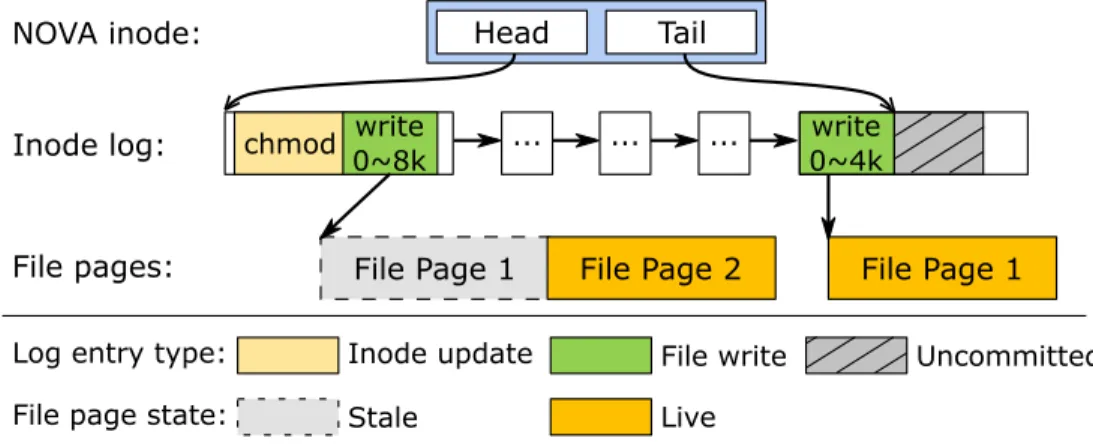
Each inode in a NOVA file system has a private log that records changes to the inode. Figure 2.1 illustrates the relationship between an inode, its log, and file data. NOVA stores the log as a linked list of 4 KB NVMM pages, so logs are non-contiguous. To perform a file operation that affects a single inode, NOVA appends a log entry to the log and updates the pointer to the log’s tail using an atomic, 64-bit store.
For writes, NOVA uses copy-on-write, allocating new pages for the written data. The log entry for a write holds pointers to the newly written pages, atomically replacing them in the file. NOVA immediately reclaims the resulting stale pages.
NOVA inode:
File pages:
Head Tail chmod 0~8kwrite
File Page 1 File Page 2 File Page 1 write
0~4k Inode log:
Inode update File write
Stale Live
Uncommitted ... ... ...
Log entry type: File page state:
Figure 2.1: NOVA inode log structure - A NOVA inode log records changes to the inode (e.g., the mode change and two file write operations shown above). NOVA stores file data outside the log.
directories), NOVA uses small, fixed-size journals (one per core) to store new tail pointers for all the inodes and update them atomically.
NOVA periodically performs garbage collection on the inode logs by scanning and compacting the log. Since the logs do not contain file data, they are shorter and garbage collection is less critical than in a conventional log-structured file system.
To maximize concurrency, NOVA uses per-CPU structures in DRAM to allocate NVMM pages and inodes. It also caches inode metadata in DRAM to minimize accesses to NVMM (which is projected to be slower than DRAM), and uses one DRAM-based radix tree per file to map file offsets to NVMM pages.
NOVA divides the allocatable NVMM into multiple regions, one region per CPU core. A per-core allocator manages each of the regions, minimizing contention during memory allocation.
After a system crash, NOVA must scan all the logs to rebuild the memory allocator state. Since, there are many logs, NOVA aggressively parallelizes the scan. Recovering a 50 GB NOVA file system takes just over 1/10th of a second [104].
Primary allocation
SB ReplicaSB
csum Replica
csum
parity inode Replica
inode log & data Replica
log DZ Replica allocation NVMM NVMM CPU 0
CPU 0 CPU 1CPU 1
...
...
CPU nCPU nCPU 0 CPU 1
...
CPU nFigure 2.2: NOVA-Fortis space layout - NOVA-Fortis’ per-core allocators satisfy requests for primary and replica storage from different directions. They also store data pages and their checksum and parity pages separately.
2.2
Handling Data Corruption in NOVA-Fortis
Like all storage media, NVMM is subject to data and metadata corruption from media failures and software bugs. To prevent, detect, and recover from data corruption, NOVA-Fortis relies on the capabilities of the system hardware and operating system as well as its own error detection and recovery mechanisms.
This section describes the interfaces that NOVA-Fortis expects from the memory system hardware and the OS and how it leverages them to detect and recover from corruption. We also discuss a technique that prevents data corruption in many cases and NOVA-Fortis’ ability to trade reliability for performance. Finally, we discuss NOVA-Fortis’ protection mechanisms in the context of recent work on file system reliability.
2.2.1
Detecting and Correcting Media Errors
NOVA-Fortis detects NVMM media errors with the same mechanisms that processors provide to detect DRAM errors. The details of these mechanisms determine how NOVA-Fortis and other NVMM file systems can protect themselves from media errors.
processors provide via the PMEM low-level NVDIMM driver. Porting NOVA-Fortis to other architectures or operating systems may require NOVA-Fortis to adopt a different approach to error detection.
NOVA-Fortis assumes the memory system provides ECC for NVMM that is similar to (or perhaps stronger than) the single-error-correction/double-error-detection (SEC-DED) scheme that conventional DRAM uses. We assume the controller transparently corrects correctable errors, and silently returns invalid data for undetectable errors.
For detectable but uncorrectable errors, Intel’s Machine Check Architecture (MCA) [40] raises amachine check exception (MCE)in response to uncorrectable memory errors. After the exception, MCA registers hold information that allows the OS to identify the memory address and instruction responsible for the exception.
The default response to an MCE in the kernel is a kernel panic. However, recent Linux kernels include a version of memcpy(), called memcpy mcsafe(), that returns an error to the caller instead of crashing in response to memory-error-induced MCEs, and allows the kernel software to recover from the exception. NOVA-Fortis always uses this function when reading from NVMM and checks its return code to detect uncorrectable media errors. Intel processors do not provide a mechanism for detecting store failures, and the memory controller transparently maps around faulty cells. In rare cases (e.g., an MCE occurring during a page fault), MCEs are not recoverable, and a kernel panic is inevitable.
When the processor hardware detects an uncorrectable media error, it “poisons” a con-tiguous region of physical addresses. The size of this region is thepoison radius(PR) of a media error. We assume PRs are a power of two in size and aligned to that size. Loads to poisoned addresses cause an MCE, and all the data in the PR is lost. The poisoned status of a PR persists across system failures and the PMEM driver collects a list of poisoned PRs at boot. On Intel processors the poison radius is 64 bytes (one cache line), but after boot, Linux reports poisoned regions at 512-byte granularity, so NOVA-Fortis uses 512-byte.
We also assume that NVMM platforms will allow system software to clear a poisoned PR to make the address range usable again. Intel processors provide this capability via the “Clear Uncorrectable Error” command that is part of the Advanced Configuration and Power Interface (ACPI) specification [101].
2.2.2
Tick-Tock Metadata Protection
NOVA-Fortis protects its metadata by keeping two copies of each structure – aprimary
and areplica– and adding a CRC32 checksum to both.
To update a metadata structure, NOVA-Fortis first copies the contents of the data structure into the primary (thetick), and issues a persist barrier to ensure that data is written to NVMM. Then it does the same for the replica (thetock). This scheme ensures that, at any moment, at least one of the two copies is correctly updated and has a consistent checksum.
To reliably access a metadata structure NOVA-Fortis copies the primary and replica into DRAM buffers usingmemcpy mcsafe()to detect media errors. If it finds none, it verifies the checksums for both copies. If it detects that one copy is corrupt due to a media error or checksum mismatch, it restores it by copying the other. If both copies are error free but not identical, the system failed between the tick and tock phases of a previous update, and NOVA-Fortis copies the primary to the replica, effectively completing the interrupted update. If both copies are corrupt, the metadata is lost, and NOVA-Fortis returns an error.
2.2.3
Protecting File Data
NOVA-Fortis adopts RAID-4 parity protection and checksums to protect file data and it includes features to maximize protection for files that applications access data via DAX-style
mmap().
and divides it into PR-sized (or larger) stripe segments, orstrips.
NOVA-Fortis stores a parity strip for each file page in a reserved region of NVMM. It also stores two copies of a CRC32 checksum for each data strip in separate reserved regions. Figure 2.2 shows the checksum and parity layouts in the NVMM.
When NOVA-Fortis performs a read, it first copies each strip of data into DRAM using
memcpy mcsafe(), and calculates its checksum. If this checksum matches either stored copy of the checksum, NOVA-Fortis concludes the file data is correct and updates the mismatched copy of the checksum if needed.
If neither of the checksums match the read data or a media error occurs, NOVA-Fortis attempts to restore the strip using RAID-4 parity, and uses the strip’s checksum to determine if the recovery succeeded. If no other strip in the page is corrupt, recovery will succeed and NOVA-Fortis restores the target strip and its checksums. If more than one strip is corrupt, the file page is lost and the read fails.
Writes and atomic parity updates are simple since NOVA-Fortis uses copy-on-write for data: For each file page write, NOVA-Fortis allocates new pages, populates them with the written data, computes the checksums and parity, and finally commits the write with an atomic log appending operation.
Caveat DAXor: Protecting DAX-mmap’d Data. By design, DAX-stylemmap()lets application modify file data without involving the file system, so it is impossible for NOVA-Fortis to keep the checksums and parity for read/write mapped pages up-to-date. Instead, NOVA-Fortis follows thecaveat DAXorprinciple and provides the following guarantee: The checksums and parity for data pages are up-to-date at all times, except when those pages are mapped read/write into an application’s address space.
We believe this is the strongest guarantee that NOVA-Fortis can provide on current hardware, and it raises several challenges. First users that use DAX-mmap()take on responsibility for detecting and recovering from both media errors (which appear as SIGBUS in user space)
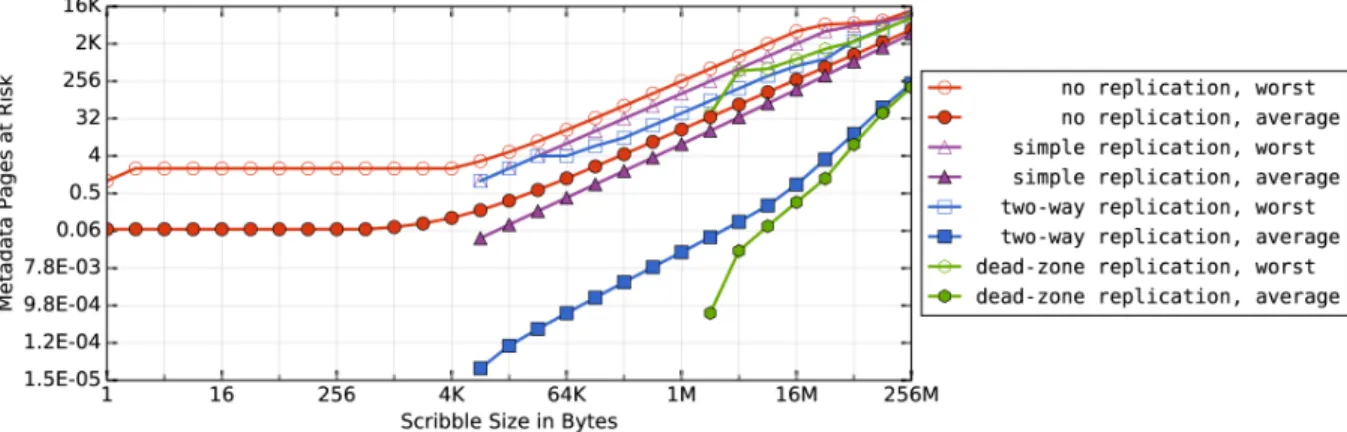
Figure 2.3: Scribble size and metadata bytes at risk - Replicating metadata pages and taking care to allocate the replicas separately improves resilience to scribbles.
and scribbles. This is an interesting challenge but beyond the scope of this chapter. Second, NOVA-Fortis must be able to tell when a data page’s checksums and parity should match the data it contains and when they might not.
To accomplish this, when a portion a file is mmap()’d, NOVA-Fortis records this fact in the file’s log, signifying that the checksums and parity for the affected pages are no longer valid. NOVA-Fortis only recomputes the checksums and parity for dirty pages onmsync()and
munmap(). Onmunmap(), it adds a log entry that restores protection for these pages when the last mapping for the page is removed. If the system crashes while pages are mapped, the recovery process will identify these pages while scanning the logs, recompute checksums and parity, and add a log entry to mark them as valid.
Design Decisions and Alternatives. Using RAID parity and checksums to protect file data is similar to the approach that ZFS [8] and IRON ext3 [83] take, but we store parity for each page rather than one parity page per file [83], and we maintain per-strip checksums instead of a single checksum for a whole stripe [8].
NOVA-Fortis chooses RAID-4 over RAID-5 because RAID-5 intermingles parity and data and would make DAXmmap()impossible since parity bits would end up in the application’s address space.
Alternately, NOVA-Fortis could rely on RAIM [65], Chipkill [38], or other advanced ECC mechanisms to protect file data. These techniques would improve reliability, but they are not universally available and cannot protect against scribbles.
2.2.4
Minimizing Vulnerability to Scribbles
Scribbles pose significant risk to NOVA-Fortis’ data and metadata, since a scribble can impact large, continuous regions of memory. We are not aware of any systematic study of the prevalence of these errors, but scribbles, lost, and misdirected writes are well-known culprits for file system corruption [54, 109, 26]. In practice, we expect that smaller scribbles are more likely than larger ones, in part since the bugs that result in larger scribbles would be more severe and more likely to be found and fixed.
To quantify the risk that these errors pose, we definebytes-at-risk (BAR)for a scribble as the number of bytes it may render irretrievable.
NOVA-Fortis packs log entries in to log pages, and it must scan the page to recognize each entry. Without protection, losing a single byte can corrupt a whole page. For replicated log pages, a scribble that spans both copies of a byte will corrupt the page. To measure the BAR for a scribble of sizeN we measure the number of pages each possibleN-byte scribble would destroy in an aged NOVA-Fortis file system.
Figure 2.3 shows the maximum and average metadata BAR for a 64 GB NOVA-Fortis file system with four protection schemes for metadata: “no replication” does not replicate metadata; “simple replication” allocates the primary and replicas naively and tends to allocate lower addresses before higher address, so the primary and replica are often close; “two-way replication” separates the primary and replica by preferring low addresses for the primary and high addresses for the replica; and “dead-zone replication” extends “two-way” by enforcing a 1 MB “dead zone” between the primary and replica. The dead zone can store file data but not metadata. The more separation the allocator provides, the less likely a scribble will corrupt a pair
of mirrored metadata pages. Figure 2.2 shows an example of NOVA-Fortis two-way allocator with dead zone separation. For each pair of mirrored pages, the dead zone forbids the primary and replica from becoming too close, but data pages can reside between them.
To stress the allocator’s ability to place the primary and replica far apart, we aged the file system by spawning multiple, multi-threaded, Filebench workloads. When each workload finishes, we remove about half of its files, and then restart the workload. We continue until the file system is 99% full.
The data show that even for the smallest 1-byte scribble, the unprotected version will lose up to a whole page (4 KB) of metadata and an average of 0.06 pages. With simple replication, scribbles smaller than 4 KB have zero BAR. Under simple replication, an 8 KB scribble can corrupt up to 4 KB, but affects only 0.04 pages on average.
Two-way replication tries to allocate the primary and replica farther apart, and it reduces the average bytes at risk with an 8 KB scribble to 2.9×10⁻⁵ pages, but the worst case remains the same because the allocator’s options are limited when space is scarce.
Enforcing the dead zone further improves protection: A 1 MB dead zone can eliminate metadata corruption for scribbles smaller than 1 MB. The dead zone size is configurable, so NOVA-Fortis can increase the 1 MB threshold for scribble vulnerability if larger scribbles are a concern.
Scribbles also place data pages at risk. Since NOVA-Fortis stores the strips of data pages contiguously, scribbles that are larger than the strip size may causes data loss, but smaller scribbles do not. NOVA-Fortis could tolerate larger scribbles to data pages by interleaving strips from different pages, but this would disallow DAX-stylemmap(). Increasing the strip size can also improve scribble tolerance, but at the cost of increased storage overhead for the parity strip.
2.2.5
Preventing Scribbles
The mechanisms described above let NOVA-Fortis detect and recover from data corruption. NOVA-Fortis can borrow a technique from WAFL [54] and PMFS [22] to prevent scribbles by marking all of NVMM as read-only and then clearing Intel’s WriteProtect Enable (WP) bit to disableallwrite protection when NOVA-Fortis needs to modify NVMM. Clearing and re-setting the bit takes∼400 ns on our systems.
The WP approach only protects against scribbles from other kernel code. It cannot prevent NOVA-Fortis from corrupting its own data by performing “misdirected writes,” a common source of data corruption in file systems [3].
2.2.6
Relaxing Data and Metadata Protection
Many existing file systems can trade off reliability for improved performance (e.g., the data journaling option in Ext4). NOVA-Fortis can do the same: It provides arelaxed modethat relaxes atomicity constraints on file data and metadata.
In relaxed mode, write operations modify existing data directly rather than using copy-on-write, and metadata operations modify the most recent log entry for an inode directly rather than appending a new entry. Relaxed mode guarantees metadata atomicity by journaling the modified pieces of metadata. These changes improve performance and we evaluate their impact in Section 2.3.
2.2.7
Protecting DRAM Data Structures
Corruption of DRAM data structures can result in file system corruption [19, 109], and NOVA-Fortis protects most of its critical DRAM data structures with checksums. Most DRAM structures that NOVA-Fortis does not protect are short lived (e.g., the DRAM copies we create of metadata structures) or are not written back to NVMM. However, the allocator state is and
exception and it is vulnerable to corruption. The allocator protects the address and length of each free region with checksums, but it does not protect the pointers that make up the red-black tree that holds them, since we use the kernel’s generic red-black tree implementation.
2.2.8
Related and Future Work
Below, we describe proposed “best practices” for file system design and how NOVA-Fortis addresses them. Then, we describe areas of potential improvement for NOVA-Fortis.
Is NOVA-Fortis Ferrous?
InteRnally cONistent (IRON) file systems [83] provide a set of principles to that lead to improved reliability. We designed NOVA-Fortis to embody these principles:
Check error codes. Uncorrectable ECC errors are the only errors that the NVMM memory system delivers to software (i.e., via MCEs). NOVA-Fortis usesmemcpy mcsafe()for all NVMM loads and triggers recovery if it detects an MCE. NOVA-Fortis also interacts with the PMEM driver that provides low-level management of NVDIMMs. For these calls, we check and respond to error codes appropriately.
Report errors and limit the scope of failures. NOVA-Fortis reports all unrecoverable errors asEIOrather than callingpanic().
Use redundancy for integrity checks and distribute redundancy information. NOVA-Fortis’ tick-tock replication scheme stores the checksum for each replica with the replica, but it is careful to allocate the primary and replica copies far from one another. Likewise, NOVA-Fortis stores the parity and checksum information for data pages separately from the pages themselves.
Type-aware fault injection. For testing, we built a NOVA-Fortis-specific error injec-tion tool that can corrupt data and metadata structures in specific, targeted ways, allowing us to test NOVA-Fortis’ detection and recovery mechanisms.
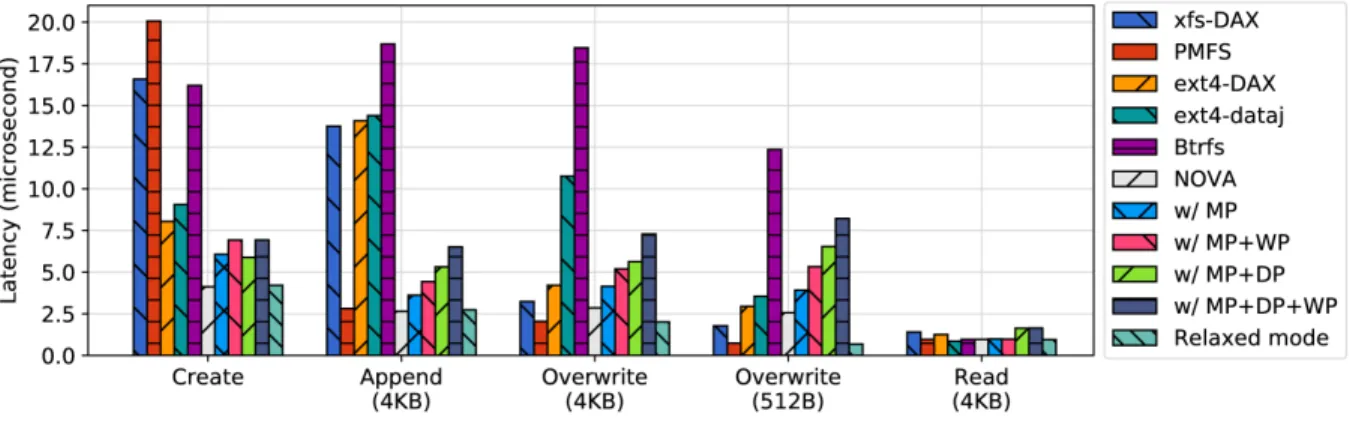
Figure 2.4: File operation latency - NOVA-Fortis’ basic file operations are faster than competing file systems except in cases where the other file system provides weaker consistency guarantees and/or data protection.
Areas for Improvement
There are several additional steps NOVA-Fortis could take to further improve reliability. We do not expect any of them to have a large impact on performance or storage overheads.
Sector or block failures in disks are not randomly distributed [4], and errors in NVMM are also likely to exhibit complex patterns of locality [67, 97]. For instance, an NVMM chip may suffer from a faulty bank, row, or column, leading to a non-uniform error distribution. Or, an entire NVDIMM may fail.
NOVA-Fortis’ allocator actively separates the primary and replica copies of metadata structures to eliminatelogicallocality, but it does not account for how the memory system maps physical addresses onto the physical memory. A layout-aware allocator could, for instance, ensure that replicas reside in different banks or different NVDIMMs.
NOVA-Fortis cannot keep running after an unrecoverable MCE (since they cause a
panic()), but it could recover any corrupted data during recovery. The PMEM driver provides a list of poisoned PRs on boot, and NOVA-Fortis can use this information to locate and recover corrupted file data during mount. Without this step, NOVA-Fortis will still detect poisoned metadata, since reading from a poisoned PR results in a recoverable MCE, and NOVA-Fortis
Figure 2.5: NOVA-Fortis random read/write bandwidth on NVDIMM-N - Read bandwidth is similar across all the file systems except Btrfs, and NOVA-Fortis’ reliability mechanisms reduces its throughput by between 14% and 19%.
reads all metadata during recovery. Poisoned file data, however, could accumulate over multiple unrecoverable MCEs, increasing the chances of data loss.
Finally, NOVA-Fortis does not scrub data or metadata. PMEM detects media errors on reboot, but if a NOVA-Fortis file system ran continuously for a long time, undetected media errors could accumulate. Undetected scribbles to data and metadata can accumulate during normal operation and across reboots.
2.3
Performance Trade-offs
NOVA-Fortis’ reliability features improve its resilience but also incur overhead in terms of performance and storage space. This section quantifies these overheads and explores the trade-offs they allow.
Metadata Protection Data Protection Write Protection
Figure 2.6: NOVA-Fortis latencies for NVDIMM-N - Protecting file data is usually more expensive than protecting metadata because the cost of computing checksums and parity for data scales with access size.
2.3.1
Experimental Setup
We implemented NOVA-Fortis for Linux 4.10, and use the Intel Persistent Memory Emulation Platform (PMEP) [22] to emulate different types of NVMM and study their effects on NVMM file systems. PMEP supports configurable latencies and bandwidth for the emulated NVMM, and emulatesclwbinstruction with microcode. In our tests we configure the PMEP with 32 GB of DRAM and 64 GB of NVMM, and choose two configurations for PMEP’s memory emulation system: We use the same read latency and bandwidth as DRAM to emulate fast NVDIMM-N [89], and set read latency to 300 ns and reduce the write bandwidth to 1/8th of DRAM to emulate slower PCM. For both configurations we setclwbinstruction latency to 40 ns.
We compare NOVA-Fortis against five other file systems. Ext4-DAX, xfs-DAX and PMFS are the three DAX-enabled file systems. None of them provides strong consistency guarantees (i.e., they do not guarantee that all operations are atomic), while NOVA does provide these guarantees. To compare to a file system with stronger guarantees, we also compare to ext4 in data journaling mode (ext4-dataj) and Btrfs running on the NVMM-based block device. Ext4 and xfs keep checksums for metadata, but they do not provide any recovery mechanisms for NVMM
media errors or protection against stray writes.
2.3.2
Performance Impacts
To understand the impact of NOVA-Fortis’ reliability mechanisms, we begin by measuring the performance of individual mechanisms and basic file operations. Then we measure their impact on application-level performance.
We compare several version of NOVA-Fortis: We start with our baseline, NOVA, and add metadata protection (“MP”), data protection (“DP”), and write protection (“WP”). “Relaxed mode” weakens consistency guarantees to improve performance and provides no data protection (Section 2.2.6).
2.3.3
Microbenchmarks
We evaluate basic file system operations: create, 4 KBappend, 4 KBwrite, 512 B
write, and 4 KBread. Figure 2.4 measures the latency for these operations with NVDIMM-N configuration. Data for PCM has similar trends.
Createis a metadata-only operation. NOVA is 1.9×to 5×faster than the existing file systems, and adding metadata protection increases the latency by 47% compared to the baseline.
Appendaffects metadata and data updates. Adding metadata and data protection increase the latency by 36% and 100%, respectively, and write protection increases the latency by an additional 22%. NOVA-Fortis withfull protection(i.e., “w/ MP+DP+WP”) is 59% slower than NOVA.
For overwrite, NOVA-Fortis performs copy-on-write for file data to provide data atomicity guarantees, and the latency is close to that of append. For 512 B overwrite, NOVA-Fortis has longer latency than other DAX file systems since its requires reading and writing 4 KB. Full protection increases the latency by 2.2×. Relaxed mode is 3.8× faster than NOVA since it performs in-place updates. Forreadoperations, data protection adds 70% overhead because it
Table 2.1: Application benchmarks
Application Data size Notes
Filebench-fileserver 64 GB R/W ratio: 1:2 Filebench-varmail 32 GB R/W ratio: 1:1 Filebench-webproxy 32 GB R/W ratio: 5:1 Filebench-webserver 32 GB R/W ratio: 10:1 RocksDB 8 GB db bench’s overwrite test MongoDB 10 GB YCSB’s 50/50-read/write
Exim 4 GB Mail server
SQLite 400 MB Insert operation
TPC-C 26 GB The ’Payment’ query
verifies the data checksum before returning to the user.
Figure 2.6 breaks down the latency for NOVA-Fortis and its reliability mechanisms. For
create, inode allocation and appending to the log combine to consume 48% of latency, due to inode/log replication and checksum calculation. For 4 KB append and overwrite, data protection has almost the same latency as memory copy (memcpy nocache), and it accounts for 31% of the total latency in 512 Boverwrite.
Figure 2.5 shows FIO [1] measurements for the multi-threaded read/write bandwidth of the file systems. For writes, NOVA-Fortis’ relaxed mode achieves the highest bandwidth. With sixteen threads, metadata protection reduces NOVA-Fortis bandwidth by 24% compared to the baseline, data protection reduces throughtput by 37%, and enabling all of NOVA-Fortis’ protection features reduces bandwidth by 66%. For reads, all the file systems scale well except Btrfs, while NOVA-Fortis data protection incurs 14% overhead on 16 threads, due to checksum verification.
2.3.4
Macrobenchmarks
We use nine application-level workloads to evaluate NOVA-Fortis: Four Filebench [99] workloads (fileserver, varmail, webproxy, and webserver), two key-value stores (RocksDB [24] and MongoDB [71]), the Exim email server [23], SQLite [96], and TPC-C running on
Shore-Figure 2.7: Application performance on NOVA-Fortis - Reliability overheads and the benefits of relaxed mode have less impact on applications than microbenchmarks (Figures 2.4 and 2.5).
MT [50]. Fileserver, varmail, webproxy and Exim are metadata-intensive workloads, while other workloads are data-intensive. Table 2.1 summarizes the workloads.
Figure 2.7 measures their performance on our five comparison file systems and several NOVA-Fortis configurations, normalized to the NOVA throughput on NVDIMM-N. NOVA-Fortis outperforms xfs-DAX and ext4-DAX by between 3% and 4.4×. PMFS shows similar performance to NOVA on data-intensive workloads, but NOVA-Fortis outperforms it by a wide margin (up to 350×) on metadata-intensive workloads. Btrfs provides reliability features similar to NOVA-Fortis’, but it is slower: NOVA-Fortis with all its protection features enabled outperforms it by between 26% and 42×. NOVA-Fortis achieves larger improvement on metadata-intensive workloads, such as varmail and Exim.
Adding metadata protection reduces performance by between 0 and 9% and using the WP bit costs an additional 0.1% to 13.4%. Enabling all protection features reduces performance by between 2% and 38%, with write-intensive workloads seeing the larger drops. The figure also shows that the performance benefits of giving up atomicity in file operations (“Relaxed mode”)
are modest – no more than 6.4%.
RocksDB sees the biggest performance loss with NOVA-Fortis with all protections enabled because it issues many non-page-aligned writes that result in extra reads, writes, and checksum calculation during copy-on-write. Relaxed mode avoids these overheads, so it improves performance for RocksDB more than for other workloads.
For the PCM configuration, fileserver, webserver and Rocks-DB show the largest perfor-mance drop compared to NVDIMM-N. Fileserver and RocksDB are write-intensive and saturate PCM’s write bandwidth. Webserver is read-intensive and PCM’s read latency limits performance. Btrfs outperforms other DAX file systems on Rocks-DB because this workload does not call
fsyncfrequently, allowing it to leverage the page cache.
Compared to other file systems, NOVA-Fortis is more sensitive to NVMM performance, because it has lower software overhead and reveals the underlying NVMM performance more directly. Overall, NOVA outperforms other DAX file systems by 1.75×on average, and adding full protection reduces performance by 12% on average compared to NOVA.
2.3.5
NVMM Storage Utilization
Protecting data integrity introduces storage overheads. Figure 2.8 shows the breakdown of space among (meta)data structures in an aged, 64 GB Fortis file system. Overall, NOVA-Fortis devotes 14.8% of storage space to improving reliability. Of this, metadata redundancy accounts for 2.1% and data redundancy occupies 12.7%.
2.4
Conclusion
We have used NOVA-Fortis to explore the unique challenges that improving NVMM file system reliability presents. The solutions that NOVA-Fortis implements provide protection against media errors and corruption due to software errors.
File parity: 11.1% File data: 82.4% File checksum: 1.56% Replica log: 2.0% Replica inode: 0.1% Unused: 0.75% Primary inode: 0.1% Primary log: 2.0%
Figure 2.8: NVMM storage utilization - Extra storage required for reliability is highlighted to the right. Protecting data is more expensive that protecting metadata, consuming 12.7% of storage compared to just 2.1% for metadata.
The extra storage required to implement these changes is modest, but their performance impact is significant for some applications. In particular, the cost of checking and maintaining checksums and parity for file data incurs a steep cost for both reads and writes, despite our use of very fast (XOR parity) and hardware accelerated (CRC) mechanisms. Providing atomicity for unaligned writes is also a performance bottleneck.
These costs suggest that NVMM file systems should provide users with a range of protection options that trade off performance against the level of protection and consistency. For instance, NOVA-Fortis can selectively disable checksum based file data protection and the write protection mechanism. Relaxed mode disables copy-on-write.
Making these policy decisions rationally is currently difficult due to a lack of two pieces of information. First, the rate of uncorrectable media errors in emerging NVMM technologies is not publicly known. Second, the frequency and size of scribbles has not been studied in detail. Without a better understanding in these areas, it is hard to determine whether the costs of these techniques are worth the benefits they provide.
provide strong reliability guarantees while providing high performance and supporting DAX-style
mmap(). It also makes a clear case for developing special file systems and reliability mechanisms for NVMM rather than blithely adapting existing schemes: The challenges NVMMs presents are different, different solutions are appropriate, and the systems built with these differences in mind can be very fast and highly reliable.
Acknowledgments
This chapter contains material from “NOVA-Fortis: A Fault-Tolerant Non-Volatile Main Memory File System,” by Jian Xu, Lu Zhang, Amirsaman Memaripour, Akshatha Gangadharaiah, Amit Borase, Tamires Brito da Silva, Andy Rudoff and Steven Swanson, which has appeared in the Proceedings of the 26th ACM Symposium on Operating Systems Principles. The dissertation author is one of the two the primary contributors and second author of this paper. The materials are copyright c2017 by Association for Computing Machinery.
Chapter 3
The Pangolin Library
A key feature of NVMM is support for direct access, or DAX, that lets applications perform loads and stores directly to a file that resides in NVMM. DAX offers the lowest-possible storage access latency and enables programmers to craft complex, customized data structures for specific applications. To support this model, researchers and industry have proposed various persistent object systems [12, 103, 82, 59, 36, 66, 48, 14].
Building persistent data structures presents a host of challenges, particularly in the area of crash consistency and fault tolerance. Systems that use NVMM must preserve crash-consistency in the presence of volatile caches, out-of-order execution, software bugs, and system failures. To address these challenges, many groups have proposed crash-consistency solutions based on hardware [74, 85, 73, 77], file systems [13, 22, 104, 105], user-space data structures and libraries [107, 93, 12, 103, 82, 36, 14], and languages [79, 18].
Fault tolerance has received less attention but is equally important: To be viable as an enterprise-ready storage medium, persistent data structures must include protection from data corruption. Intel processors report uncorrectable memory media errors via a machine-check exception and the kernel forwards it to user-space as aSIGBUSsignal. To our knowledge, Xuet al.[105] were the first to design an NVMM file system that detects and attempts to recover from