Apple and Grape IPM Extension Focus Groups
Funded by the NYS IPM Program, Cornell Cooperative Extension, Cornell University
Project Leaders:
Juliet Carroll, NYS IPM Program, Cornell University Tim Weigle, NYS IPM Program, Cornell University
Cooperators:
Faruque Zaman, Suffolk County Cornell Cooperative Extension, Cornell University Dan Gilrein, Suffolk County Cornell Cooperative Extension, Cornell University
Shannon K. Moran, Suffolk County Cornell Cooperative Extension, Cornell University Alice Wise, Suffolk County Cornell Cooperative Extension, Cornell University
Anna Wallis, Eastern NY Commercial Horticulture Program, Cornell University Dan Donahue, Eastern NY Commercial Horticulture Program, Cornell University Sarah Eve Rohwer, Eastern NY Commercial Horticulture Program, Cornell University James O'Connell, Eastern NY Commercial Horticulture Program, Cornell University Tess Grasswitz, Lake Ontario Fruit Program, Cornell University
Craig Kahlke, Lake Ontario Fruit Program, Cornell University Matt Wells, Lake Ontario Fruit Program, Cornell University
Mario R. Miranda Sazo, Lake Ontario Fruit Program, Cornell University Elizabeth Marie Tee, Lake Ontario Fruit Program, Cornell University Hans C. Walter-Peterson, Finger Lakes Grape Program, Cornell University Gillian Trimber, Finger Lakes Grape Program, Cornell University
Luke L. Haggerty, Lake Erie Regional Grape Program, Cornell University Andy Muza, Lake Erie Regional Grape Program, Pennsylvania State University Kevin Martin, Lake Erie Regional Grape Program, Pennsylvania State University Tim E. Martinson, Section of Horticulture, Cornell University
Chris Gerling, Dept of Food Science, Cornell University
Abstract:
Extension educators are involved in delivering IPM information to grape and apple growers and met to explore issues, challenges and priorities for apple and grape IPM in Geneva, NY on January 25-26, 2017. A free flowing agenda generated discussion and we were able to document opportunities and barriers to IPM adoption and establish ways to work together to promote IPM in apple and grape production. Our desired outcome of developing an interconnected group working to promote IPM adoption on apple and grape farms was successful as project participants overwhelmingly voted they would like to continue meeting once or twice a year whether in person, or electronically, to discuss IPM programming.
Background and justification:
Apple and grape IPM programs have been ongoing across New York State for many years. Several newly hired Extension educators in regional Cornell Cooperative Extension programs are involved in delivering IPM information to grape and apple growers. These new personnel wanted to meet as a group and explore the issues, challenges and priorities for IPM in apple and grape production. Some concerns put forward are that not enough IPM is being implemented on fruit farms and that emphasis is placed primarily on chemical management of arthropod pests
and plant diseases. At the same time, some apple and grape growers have expressed an interest in dialing back on chemical inputs in favor of other approaches to pest management. We see this as an opportunity in conducting focus groups on apple and grape IPM with Extension educators. This will allow all of us to broadly discuss IPM, the IPM needs of Extension educators, and their IPM priorities. Our overarching goal is to determine how best the NYS IPM Program can work with Extension educators to foster greater IPM adoption in apple and grape production.
Objectives:
1. Conduct focus groups with the apple and grape Extension educators to discuss IPM. 2. Project Evaluation.
Procedures, results and discussion:
Objective 1. Conduct focus groups with the apple and grape Extension educators to discuss IPM.
A two-day focus group meeting was held January 25-26, 2017 in Jordan Hall, NYS AES, Geneva, NY. Members of Cornell Cooperative Extension Regional Agriculture fruit programs; Juliet Carroll, Fruit IPM Coordinator, and Tim Weigle, Grape and Hops IPM Specialist, NYS IPM Program; Tim Martinson, Statewide Viticulture Specialist, and Chris Gerling, Extension Enologist attended. The first day participants split out by commodity. Juliet Carroll moderated the apple session and Tim Weigle the grape session with discussion on the following topics.
• Overview of grape or apple industry in each region • Participant perception of the apple or grape IPM program • Apple and grape IPM needs in each region
• IPM Tools used by participants in their position • Barriers to implementation of IPM
• IPM Programming needs in the short, intermediate and long term
On the second day the two commodity groups met jointly to discuss the identified barriers of IPM adoption and how the two groups could work together to overcome them, as well as where the programming for the NYS Fruit IPM Program needs to be in the future.
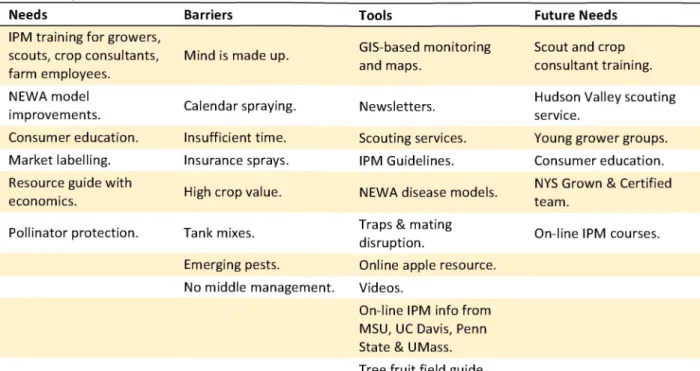
The discussion of the first day focused on the categories of Needs, Barriers, Tools and Future Needs and was used to start the discussion for the second day. The results of the first day discussion are in Table 1 for apple IPM and in Table 2 for grape IPM.
Barriers to IPM adoption identified by the commodity groups have not changed a great deal over the years. There is still the perception that both apple and grape growers are hesitant to
implement IPM due to the perceived risks to crop quality and yield. Producers of high value crops (fresh market apples and vinifera grapes) believe that the high value warrants calendar sprays (they have worked in the past and will continue to work). Whereas producers of processing apples or bulk grapes for juice, jams, jellies and wine feel that IPM is too costly in terms of labor and newer materials to be able to justify, due to the lower value of their crops. The availability of inexpensive spray materials was identified also as a barrier to implementation of IPM practices that look at resistance management and the use of newer, more selective and more expensive pesticides.
Table 1. Results of First Day's Discussion by the Apple IPM Focus Group. Listed in no particular order or relationship.
Needs Barriers Tools Future Needs
IPM training for growers, scouts, crop consultants, farm employees.
Mind is made up. GIS-based monitoring and maps.
Scout and crop consultant training. NEWA model
improvements. Calendar spraying. Newsletters.
Hudson Valley scouting service.
Consumer education. Insufficient time. Scouting services. Young grower groups. Market labelling. Insurance sprays. IPM Guidelines. Consumer education. Resource guide with
economics. High crop value. NEWA disease models.
NYS Grown & Certified team.
Pollinator protection. Tank mixes. Traps & mating
disruption. On-line IPM courses. Emerging pests. Online apple resource.
No middle management. Videos.
On-line IPM info from MSU, UC Davis, Penn State & UMass. Tree fruit field guide.
Table 2. Results of First Day's Discussion by the Grape IPM Focus Group. Listed in no particular order or relationship.______________________________
Needs Barriers Tools Future Needs
Fix grape berry moth (GBM).
Don't see economic
sense. NEWA.
N E W A
-evapotranspiration data, predictive bud hardiness. Commodity pricing -
both on the high (vinifera) and low end (Concord and bulkjuice).
Make sure biocontrol and Fix NEWA biofix for GBM. TracGrape. cultural practices are
represented. Refill Wayne Wilcox plant
pathology position. Growers risk averse.
IPM fact sheets as foundation info.
Make NEWA site easier to navigate.
Training in using models on NEWA.
Wine maker can make IPM decisions more difficult.
IPM Elements for new
growers. Record keeping software. Integrate Mesonet
stations into NEWA. Growers get nervous. Grape Guidelines. Increase reliability of Inexpensive spray IPM Flip Book (MSU weather data on NEWA. materials. publication). Adoption of better Growers don't want to CAPS - especially for spraying techniques. change what works. virus testing.
Andrew Landers and Tom Lack of understanding by Crop Updates, electronic
Burr positions. growers. newsletters.
GIS - especially for future growers.
Education was seen as critical for both the short term and long term needs for both apple and grape IPM programming. The apple commodity group indicated that the majority of IPM is implemented through consultants while the grape group indicated that consultants played a much smaller part in IPM programming, which was developed and implemented by extension
educators working with the growers and/or grape processor field staff.
The Network for Environment and Weather Apps (NEWA) was identified as a valuable tool by both commodity groups. Areas for improvement of NEW A identified by both groups included weather data reliability, the effect of data reliability on tools used by growers, enhancement of current tools (i.e. grape berry moth phenology), new tools, and integrating the NYS Mesonet weather data into NEWA. Training in the use of models found on NEWA was identified as a short term and future need.
Objective 2. Project evaluation.
Project participants completed an evaluation at the end of the meeting to assist in planning for future meetings. Evaluations were submitted by 18 participants with nine representing apples and nine representing grapes. Five participants cover IPM as their main area. Six other
participants indicated their position had IPM responsibilities, as well as programming for horticulture, business management and post-harvest while seven participants did not have any direct responsibilities for IPM programming. All but two participants thought the IPM focus group meetings should be continued on a yearly, or twice yearly basis with Geneva being a good location for the meeting.
Some suggestions on how to improve the meetings and IPM programming in general included: rotate meetings among regions; hold meetings using video conferencing software like Zoom; include faculty, consultants and growers on an every-other-meeting basis; have more goal- oriented discussions with time to break into smaller discussion groups. Only one respondent felt that the differences between apple and grape IPM was enough to warrant separate meetings for the commodity groups.
The take home message from both the evaluation and the discussion from the second day of the focus group was:
This type o f meeting is very useful because IPM cannot be looked upon as a
separate entity; it is interwoven into the day-to-day decisions made by both apple
and grape growers across New York State.
Project location(s):
The Apple and Grape IPM focus group meeting was held at the NYSAES in Geneva, NY. However, as shown in the map below, 34 counties in New York State and one in Pennsylvania were represented by the members of the Cornell Cooperative Extension Regional Agriculture Programs involved in apple and grape programming.
■ □ □ □ □ ■
Lake Erie Regional Grape Program Lake Ontario Fruit Program Finger Lakes Grape Program Southern Tier Agriculture Program
Eastern NY Commercial Florticulture Program Suffolk County Cornell Cooperative Extension
Map courtesy of NYS IPM Program nvsipm.cornell.edu/agriculture/fruits/cce-programs
Resources developed:
We developed a database of Current IPM Needs, Barriers to IPM Adoption, IPM Tools Currently Being Used and Future IPM Programming needs.
As one participant stated in their evaluation,