CEC Theses and Dissertations College of Engineering and Computing
2018
Probabilistic Clustering Ensemble Evaluation for
Intrusion Detection
Steven M. McElwee
Nova Southeastern University,[email protected]
This document is a product of extensive research conducted at the Nova Southeastern UniversityCollege of Engineering and Computing. For more information on research and degree programs at the NSU College of Engineering and Computing, please clickhere.
Follow this and additional works at:https://nsuworks.nova.edu/gscis_etd Part of theComputer Sciences Commons
Share Feedback About This Item
This Dissertation is brought to you by the College of Engineering and Computing at NSUWorks. It has been accepted for inclusion in CEC Theses and Dissertations by an authorized administrator of NSUWorks. For more information, please [email protected].
NSUWorks Citation
Steven M. McElwee. 2018.Probabilistic Clustering Ensemble Evaluation for Intrusion Detection.Doctoral dissertation. Nova Southeastern University. Retrieved from NSUWorks, College of Engineering and Computing. (1044)
Probabilistic Clustering Ensemble Evaluation for Intrusion Detection
by
Steven M. McElwee
A dissertation submitted in partial fulfillment of the requirements for the degree of Doctor of Philosophy
in
Information Assurance
College of Engineering and Computing Nova Southeastern University
Probabilistic Clustering Ensemble Evaluation for
Intrusion Detection
by
Steven M. McElwee 2018
Intrusion detection is the practice of examining information from computers and
networks to identify cyberattacks. It is an important topic in practice, since the frequency and consequences of cyberattacks continues to increase and affect organizations. It is important for research, since many problems exist for intrusion detection systems. Intrusion detection systems monitor large volumes of data and frequently generate false positives. This results in additional effort for security analysts to review and interpret alerts. After long hours spent reviewing alerts, security analysts become fatigued and make bad decisions. There is currently no approach to intrusion detection that reduces the workload of human analysts by providing a probabilistic prediction that a computer is experiencing a cyberattack.
This research addressed this problem by estimating the probability that a computer system was being attacked, rather than alerting on individual events. This research combined concepts from cyber situation awareness by applying clustering ensembles, probability analysis, and active learning. The unique contribution of this research is that it provides a higher level of meaning for intrusion alerts than traditional approaches.
Three experiments were conducted in the course of this research to demonstrate the feasibility of these concepts. The first experiment evaluated cluster generation
approaches that provided multiple perspectives of network events using unsupervised machine learning. The second experiment developed and evaluated a method for detecting anomalies from the clustering results. This experiment also determined the probability that a computer system was being attacked. Finally, the third experiment integrated active learning into the anomaly detection results and evaluated its effectiveness in improving the accuracy.
This research demonstrated that clustering ensembles with probabilistic analysis were effective for identifying normal events. Abnormal events remained uncertain and were assigned a belief. By aggregating the belief to find the probability that a computer system was under attack, the resulting probability was highly accurate for the source IP addresses and reasonably accurate for the destination IP addresses. Active learning, which
simulated feedback from a human analyst, eliminated the residual error for the destination IP addresses with a low number of events that required labeling.
To the giants of research on whose shoulders I stood to see a little farther, it has been a privilege to build upon the foundation you have laid.
To Dr. James Cannady, my sincerest gratitude for allowing me to build upon your work in intrusion detection and for your willingness to serve as my dissertation committee chair.
To my dissertation committee, who provided constructive criticism throughout the process, thank you for your patience and for your feedback. You have helped to improve my research skills.
To Allison, my loving and supportive wife, thank you for sacrificing our time together for late study nights and for trips to Florida. I could not have accomplished this without your encouragement and understanding.
To my children, who themselves have grown and accomplished so much since I started this pursuit, thank you for encouraging me along the way. Remember to continue to learn, regardless of your age.
v
Abstract ii
List of Tables vi
List of Figures vii
Chapters 1. Introduction 1 Background 1 Problem Statement 2 Dissertation Goal 2 Discussion 3
Relevance and Significance 6 Barriers and Issues 7
Definition of Terms 9 List of Acronyms 12 Summary 13
2. Review of the Literature 15
Overview of Reviewed Topics 15 Cyber Situation Awareness 16 Intrusion Detection 22
Probabilistic Intrusion Detection 31 Clustering Ensembles 36
Intrusion Detection Datasets 52 Summary 58
3. Methodology 59
Introduction 59 Solution Design 60
Experiment 1: Cluster Generation 65
Experiment 2: Probabilistic Anomaly Detection 68 Experiment 3: Active Learning 71
Resource Requirements 72 Summary 73
4. Results 75
Introduction 75
Experiment Design and Implementation 76 Input Dataset Analysis and Preparation 79 Experiment 1: Cluster Generation 82
Experiment 3: Active Learning 97 Summary 101
5. Conclusions, Implications, Recommendations, and Summary 103
Conclusions 103 Implications 105 Recommendations 106 Summary 108 References 147 Appendices
A. Source Code Availability and Usage 115 B. Dataset Descriptions 119
C. Python Package Versions 125
vii
Tables
1. Summary of Cyber Situation Awareness Literature 19
2. Summary of Machine Learning Approaches to Intrusion Detection 23
3. Summary of Co-Occurrence Cluster Evaluation Approaches 45
4. Summary of Median Partition Clustering Evaluation Approaches 49
5. Summary of Intrusion Detection Dataset Research 55
6. Original and Derived NSL-KDD Dataset Label Distributions 80
7. UNSW-NB15_1 Dataset Label Distributions 82
8. Distribution of Attack and Normal Records in Sample Partition 85
9. Prediction of P(A) by srcip and dstip 94
10. P(A) Accuracy for Ten Runs 96
11. NSL-KDD Attributes and Datatypes 120
12. UNSW-NB15 Attributes and Datatypes 122
13. Python Package Versions 125
14. Experiment 2, Run 1 Results 127
15. Experiment 2, Run 2 Results 129
16. Experiment 2, Run 3 Results 131
17. Experiment 2, Run 4 Results 133
18. Experiment 2, Run 5 Results 135
19. Experiment 2, Run 6 Results 137
21. Experiment 2, Run 8 Results 141
22. Experiment 2, Run 9 Results 143
ix
Figures
1. Multiple ways to cluster a deck of cards 4
2. Clustering ensemble overview 5
3. Confusion matrix for binary classification 29
4. Overview clustering ensembles with formal notation 39
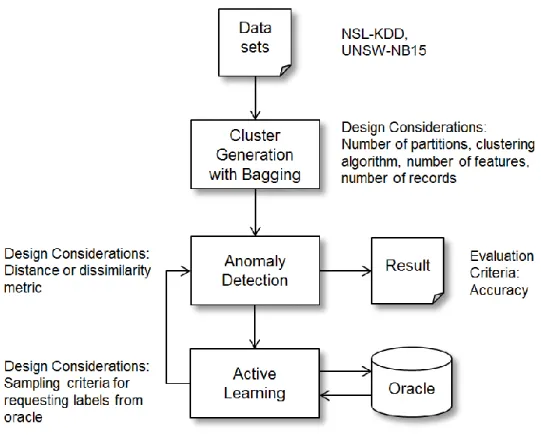
5. High level solution design 60
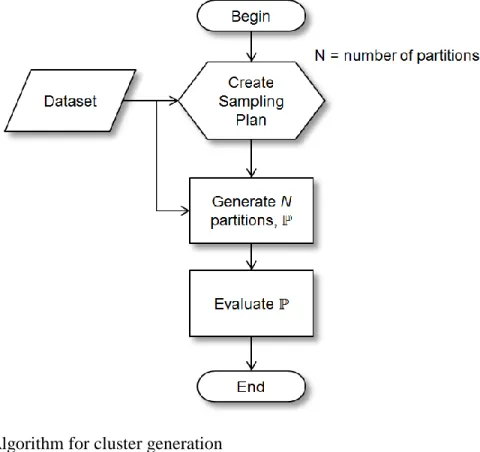
6. Algorithm for cluster generation 67
7. Algorithm for probabilistic anomaly detection 69
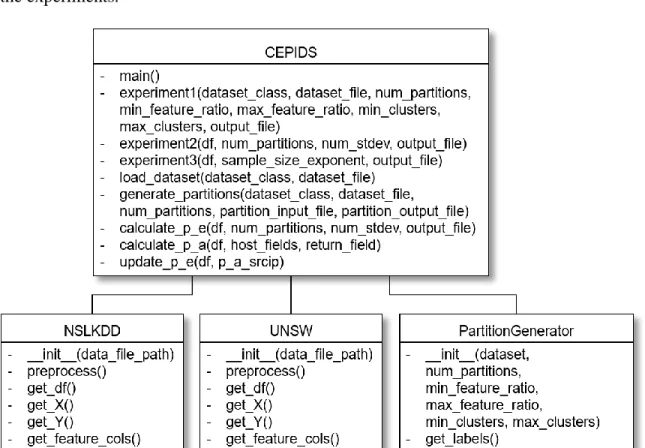
8. Class diagram 76
9. Graph of votes for NSL-KDD dataset 89
10. Graph of votes for UNSW-NB15 dataset 90
11. Pseudocode for active learning algorithm 98
Chapter 1
Introduction
Background
Intrusion detection systems identify cyberattacks. Malicious or criminal
cyberattacks take an average of 229 days to detect, and the length of time to detect and
contain an attack increases the cost of response (Ponemon Institute, 2016). Consequently,
detecting cyberattacks quickly is vital for organizations. Because of the volume of
intrusion alerts, cyberattacks are sometimes miscategorized in the large number of alerts
that require human analyst review (Julisch, 2003). After long hours of review, analysts
make mistakes, and alerts may be miscategorized (Sawyer et al., 2014). Further, human
analysts make inaccurate decisions and use preconceived biases when dealing with
probabilistic reasoning (Tversky & Kahneman, 1974). Most intrusion detection research
has focused on identifying individual events and has not provided meaning in the broader
perspective of cyber situation awareness (CSA) (Sommer & Paxson, 2003; Erbacher,
Frincke, Wong, Moody, & Fink, 2010; Sommer & Paxson, 2010; Tadda & Salerno,
2010). Detecting intrusions at the individual event level is prone to high false positive
rates and overfitting (Sommer & Paxson, 2010). Thus, new approaches to intrusion
detection are needed to provide better support for human decision-making under
uncertain conditions.
This research developed a system for anomaly-based intrusion detection. The
system was under attack or had been compromised. The novelty of this research was the
application of clustering ensembles, probability analysis, and active learning to extend
research in intrusion detection. This research also incorporated relevant concepts from
CSA to add meaning to intrusion alerts.
Problem Statement
There is currently no approach to intrusion detection that reduces the workload of
human analysts by providing a probabilistic prediction that a computer is experiencing a
cyberattack. Intrusion detection systems monitor increasingly large datasets that represent
interconnected devices and sensors (Saeed, Ahmadinia, Javed, & Larijani, 2016;
Al-Hamadi & Chen, 2015; Ali & Al-Shaer, 2015). The alerts generated by intrusion
detection systems require human review to evaluate the accuracy of the alerts and to
determine an appropriate course of action (Julisch, 2003). A significant problem is that
intrusion alerts often have high false-positive rates, since intrusions are rare in large
datasets (Kruegel, Mutz, Robertson, & Valeur, 2003; Scott, 2004). Thus, security analysts
become fatigued and make poor decisions after spending hours reviewing alerts (Sawyer
et al., 2014). Improvements in intrusion detection systems are needed to reduce
false-positives, improve the context of alerts, and reduce the burden on human analysts.
Dissertation Goal
The goal of this research was to improve anomaly-based intrusion detection by
adding meaning to alerts through the use of probabilistic clustering ensembles. Adding
level. This research developed a method to reduce the workload of security analysts by
focusing on the computer systems most likely experiencing attacks. The results of this
research will allow security analysts to better prioritize their monitoring activity, which
has been found to be important in practice (McElwee, Heaton, Fraley, & Cannady, 2017).
Discussion
An important objective of this research was to apply clustering ensembles to
intrusion detection. There is not one correct way to cluster network information to
identify anomalies. Instead, there are multiple perspectives that, when taken together,
improve accuracy. This idea is supported from prior research, which acknowledges that
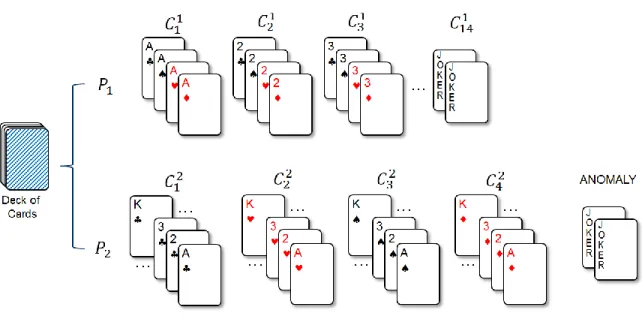
“clustering is in the eye of the beholder” (Estivill-Castro, 2002, p. 65). To illustrate this idea, consider that a reasonable person is given a deck of playing cards, with 52 cards of
four suits, and two joker cards. The person is given direction to cluster the cards into
meaningful groups. There are a wide variety of ways that the person might cluster the
cards. The person might cluster the cards using an obvious feature, such as the face value,
by grouping together all the aces in one group, the twos in another group, the threes in
another group, and so on. Such a grouping results in 13 clusters of four cards each and a
cluster with two jokers. The person might opt for four clusters, where each cluster is
identified by the suit of the card, specifically diamonds, hearts, clubs, and spades. This
grouping results in four clusters with 13 cards in each. In this case, the jokers do not
cluster well, but may be considered anomalies. The person might group the cards using a
feature derived from outside information, such as grouping the cards needed to assemble
kings, and aces for playing the game of pinochle. The second group is those not needed to
play that game. Figure 1 illustrates this example using two sample clusterings.
Figure 1. Multiple ways to cluster a deck of cards
From the playing card example above, it is obvious that there is not one correct
way to cluster the cards. Each clustering result has different meaning for different
reasons. A wide variety of clustering results is possible based on the features chosen to
create the groups. Even the anomalies, as represented in 𝑃2 by the jokers, are only anomalies because of the meaning the person placed on the clustering. Thus, in some
clustering approaches, the jokers cluster well, but in others they appear to be anomalies.
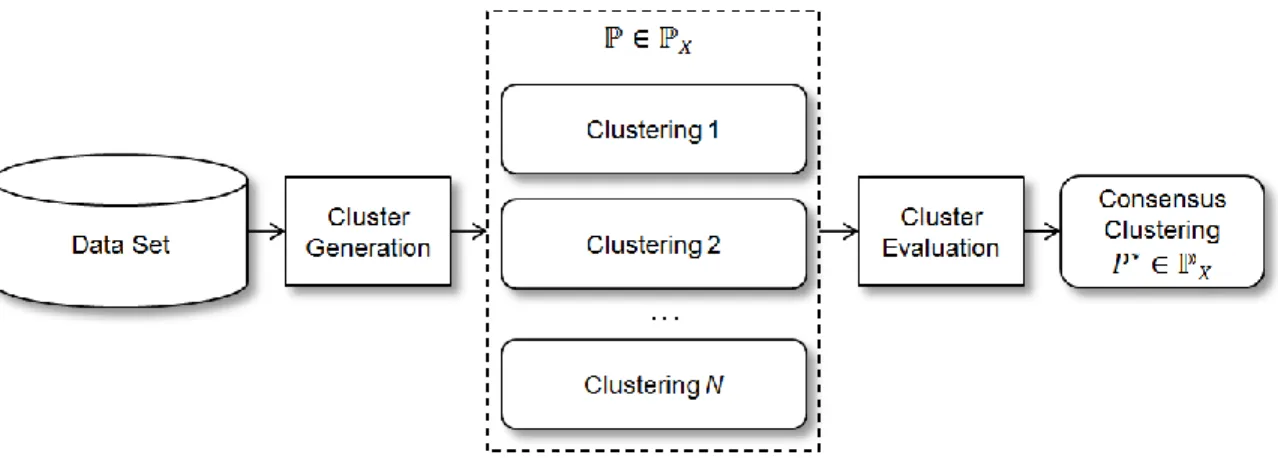
This research used clustering ensembles, which use many different clusterings of
the data to create a clustering solution that works best (Strehl & Gosh, 2002; Fred & Jain,
2005). Figure 2 illustrates the general approach to clustering ensembles. The first stage
generates a diverse set of clustering solutions, ℙ, from among all possible clustering solutions, ℙ𝑋. The second stage evaluates the results to arrive at a final clustering solution, 𝑃∗.
Figure 2. Clustering ensemble overview
This research used clustering ensembles because of their potential to be useful for
intrusion detection, since they enable unsupervised machine learning using multiple
sources of information, including domain knowledge, in the final clustering solution
(Strehl & Ghosh, 2002). Ensemble approaches to machine learning have proven to be
successful in resisting adversarial evasion (Šrndić & Laskov, 2014; Wang, Wang, Zheng, & Zhao, 2014). Evasion is a tactic to conduct cyberattacks without being detected. There
have been few applications of clustering ensembles to intrusion detection (Weng, Jiang,
Shi, & Wu, 2007; Gao, Zhu, & Wang, 2010). Other related studies have shown that
clustering ensembles have the potential to be effective when applied to intrusion
detection. Lazarevic and Kumar (2005) used an approach similar to clustering ensembles,
called feature bagging, and found it to be successful for intrusion detection. Hou, Chen,
Tas, Demihovskiy, and Ye (2015) found that clustering ensembles were better for the
detection of malware than single base clustering algorithms.
The importance of adding meaning to alerts is established in prior research.
Sommer and Paxson (2003) found that adding context to intrusion detection improved
intrusion detection can find what is abnormal, but generate false positives, because they
lack meaning (Sommer & Paxson, 2010). As a result, security analysts must evaluate
binary indications of cyberattacks with insufficient meaning to make appropriate
decisions. Thus, this research created a semantic level that better represents how human
analysts evaluate security alerts.
Computer network intrusions are generally a multi-step process that requires an
attacker and a victim. (Zhou, Leckie, & Karunasekera, 2010). Understanding the meaning
and significance of network events requires an understanding of the coordination of
events (Zhou et al., 2010). The connection of these events is often uncertain and requires
probabilistic reasoning. Thus, this research used probability analysis to evaluate if a
computer system was being attacked.
Relevance and Significance
Intrusion detection is an important topic in research as well as in practice, and
identifying cyberattacks quickly is important for reducing response costs (Ponemon
Institute, 2016). Unfortunately, intrusion alerts are sometimes missed because of the
volume that must be reviewed (Julisch, 2003). After long hours of reviewing security
alerts, human analysts make poor decisions, and alerts may be miscategorized (Sawyer et
al., 2014). Humans tend to make inaccurate decisions and use preconceived biases when
dealing with probabilistic reasoning (Tversky & Kahneman, 1974). In addition,
adversarial tactics and evasion require new approaches for the identification of malicious
activity (Šrndić & Laskov, 2014; Wang et al., 2014). As a result, improving intrusion detection is a relevant topic for continued research to provide better support for
decision-making under uncertain conditions. Given the importance of intrusion detection and the
limitations of human judgement, this research provides context for analysts, so they can
make better decisions. The results of this research may be used to augment security
analyst capabilities for responding to intrusion alerts.
Barriers and Issues
This research addressed several barriers and issues that are present in
anomaly-based intrusion detection research. First, anomaly-anomaly-based intrusion detection is prone to
high false-positive rates. This is largely due to the imbalanced nature of intrusion
detection data, since there are large amounts of data, but only a few intrusion events
(Scott, 2004). The base rate fallacy stipulates that when events of interest are rare, even
highly accurate detection systems may have a high false positive rate (Kruegel et al.,
2003). This research addressed this issue by focusing on the probability that a computer
system was being attacked rather than on determining the accurate classification of
individual events (Li, Ou, & Rajagopalan, 2010; Tadda & Salerno, 2010).
A second issue in intrusion detection research is overfitting. To achieve higher
accuracy, researchers may over-train learning algorithms or use too much training data to
be generalizable for novel anomalies. This is because machine learning algorithms are
more suitable for detecting similarities than for detecting anomalies (Sommer & Paxson,
2010). Overfitting may also result from the selection of a dataset that contains too many
duplicate records, such as the popular KDD Cup 1999 dataset (Tavallaee, Bagheri, Lu, &
Ghorbani, 2009). Since ensemble approaches to machine learning are less susceptible to
A third issue in intrusion detection is adversarial evasion. To avoid detection,
attackers may attack the intrusion detection system itself. Attacks against intrusion
detection systems include evasion, tampering, and denial of service (Laskov &
Lippmann, 2010; Šrndić & Laskov, 2014; Wang et al., 2014; Vasilomanolakis,
Karuppayah, Mühlhäuser, & Fischer, 2015). Evasion amplifies the problem of overfitting
by preventing the detection of novel attacks (Sommer & Paxson, 2010). To address this
problem, this research used ensemble approaches, since they have been found effective in
resisting adversarial evasion (Šrndić & Laskov, 2014; Wang et al., 2014). In addition, this
research applied active learning, which has been shown to allow adaptation to evasive
techniques (Miller et al., 2014).
A fourth issue in intrusion detection research is the use of a suitable dataset for
evaluation. Most early intrusion detection research used the KDD Cup 1999 dataset,
which was prepared from a DARPA packet capture for a KDD competition (Cao, Hoang,
Nguyen, 2013). The KDD Cup 1999 dataset has been criticized because of its duplicate
records, its outdated information because of older technologies, and its high volume of
records (Qian, Xu, & Shi, 2006; Tavallaee et al., 2009; Creech & Hu, 2013). To address
this problem, a variety of researchers have created new intrusion detection evaluation
datasets. None of the newer datasets has received as much widespread popularity and
adoption as KDD Cup 1999. This research included a literature review of publicly
available intrusion detection datasets. As a result, the NSL-KDD dataset was used for
preliminary evaluation and the UNSW-NB15 dataset for evaluation with a more
Definition of Terms
Accuracy: The ratio of the number of true positive and true negative results compared to
the number of all results.
Active Learning: A semi-supervised machine learning approach in which a subset of
unknown data is selected and presented to an oracle for labeling during training.
Alert: A notification or warning, which in the context of intrusion detection, represents a
potential cyberattack.
Anomaly: An event that deviates from a normal event.
Attack: An aggressive action against a computer system that may include unauthorized
modification of files to allow unauthorized access to system information,
unauthorized access or modification of user information, unauthorized
modification of information in network components, or unauthorized use of
system resources, including unauthorized account creation (Chebrolu, Abraham,
& Thomas, 2005).
Bagging: A machine learning method that provides a random subset of features and
records to a machine learning algorithm with a goal of reducing overfitting.
Bayes Theorem: Methods of probabilistic inference that calculate a prior probability of a
hypothesis based on evidence gathered from observations (Kruegel et al., 2003).
Bayesian Networks: Directed acyclic graphs, where each node in the graph represents a
conditional probability table (Kruegel et al., 2003).
Clustering: Finding natural groupings in data such that data within each cluster is most
similar to other data in that cluster and most dissimilar to the data of other clusters
Clustering Ensemble: An approach to clustering that uses combinations of multiple
partitions of clustering results to find a consensus partition that improves accuracy
compared to an individual clustering result (Topchy, Jain, & Punch, 2005; Ayad
& Kamel, 2010).
Cyber Situation Awareness: A specialized application of situation awareness that
applies to the analysis of cyberattacks and their impact on computer and network
operations (Li et al., 2010; Erbacher et al., 2010).
Cyberattack: See Attack.
Ensemble: A multi-learner system, where each component learner attempts to solve the
same task as the others (Strehl & Ghosh, 2002).
Evasion: Deceiving an intrusion detection system or rending it ineffective through the
modification of training or testing data (Šrndić & Laskov, 2014; Wang et al.,
2014; Laskov & Lippman, 2010).
False Positive: In the context of intrusion detection, a condition in which a predicted
class indicates an attack, but the actual class was normal.
Intrusion Detection: The practice of examining information from computers and
networks that are to be protected in order to identify attacks against those
computers and networks (Debar, Dacier, & Wespi, 1999).
KDD Cup 1999: A dataset that has been widely used in intrusion detection research.
Machine Learning: A field of computer science that uses algorithms to learn patterns
without being programmed with predefined rules.
Mirkin Distance: An algorithm for comparing two clusters by counting the number of
Oracle: An entity that represents a knowledgeable human subject matter expert and is
able to provide the correct label for a data record in response to a query.
Overfitting: A modeling error in which a machine learning algorithm is trained to match
a particular set of data but is not generalizable to other sets of data.
Partition: A set of clusters that represent the results from a single clustering algorithm.
Security Analyst: A job function that specializes in cyber defensive operations in the
context of a business or organization.
Security Monitoring: A job function of security analysts for detecting and responding to
potential cyberattacks.
Signature: A predefined pattern that matches characteristics of attacks.
Situation Awareness: The perception of information in an environment for a given time
and space, the comprehension of the meaning of that information, and the
projection of the future conditions in order to enable effective selection of an
appropriate course of action (Endsley, 1995; Tadda & Salerno, 2010).
Supervised Machine Learning: An approach to machine learning in which records with
known classes are used to train an algorithm so that it can then predict an output
for records with unknown classes.
Unsupervised Machine Learning: An approach to machine learning in which no
List of Acronyms
ANMI: Average Normalized Mutual Information
CSA: Cyber Situation Awareness
CSPA: Cluster-Based Similarity Partitioning Algorithm
CSV: Comma Separated Value
CTBN: Continuous Time Bayesian Networks
CVSS: Common Vulnerability Scoring System
DARPA: Defense Advanced Research Projects Agency
DOS: Denial of Service
EM: Expectation Maximization
FN: False Negative
FP: False Positive
GPU: Graphics Processing Unit
HGPA: Hypergraph Partitioning Algorithm
IDS: Intrusion Detection System
KDD: Knowledge Discovery in Databases
LAC: Locally Adaptive Clustering
LAN: Local Area Network
MCLA: Meta Clustering Algorithm
NM: Normalized Mutual Information
NMF: Nonnegative Matrix Factorization
QMI: Quadratic Mutual Information
SCANN: Stacking, Correspondence Analysis and Nearest Neighbor
SVM: Support Vector Machine
TN: True Negative
TP: True Positive
WBPA: Weighty Bipartite Partition Algorithm
WSBPA: Weighted Subspace Bipartite Partitioning Algorithm
WSPA: Weighty Similarity Partition Algorithm
Summary
This chapter introduced an approach to anomaly-based intrusion detection using
clustering ensembles. This chapter described how this research approached the problems
of too much data and high false positives rates. Finally, this chapter established the goal
of shifting the focus of intrusion detection from individual events to higher level of
meaning. This research explored how to predict the probability that a computer system
was under attack to enable security analysts to make better decisions under uncertain
conditions.
The remainder of this dissertation report provides the supporting background for
this research and describes the methodology that was used. Chapter 2 reviews the
literature that established the basis for this research. Chapter 3 describes the experiments
conducted to test the effectiveness of clustering ensembles with probabilistic analysis for
intrusion detection as well as the testing approaches for evaluating the results. Chapter 4
research, the implications for future research, and recommendations for building upon the
Chapter 2
Review of the Literature
Overview of Reviewed Topics
The focus of this research was to develop an intrusion detection system that
provides meaning for intrusion alerts by using clustering ensembles and probabilistic
analysis. To accomplish this research, the following areas of literature were examined to
synthesize these concepts:
• Cyber Situation Awareness (CSA)
• Intrusion Detection
• Probabilistic Intrusion Detection
• Clustering Ensembles
• Intrusion Detection Datasets
Each of these areas has an established body of existing research. The following
sections describe the importance of each of these areas, review relevant research studies
in each topic, and synthesize the key concepts needed for building a foundation for this
Cyber Situation Awareness (CSA)
Background
Situation awareness is the perception of information in an environment for a given
time and space. It comprehends the meaning of information and projects the future
conditions to enable the effective selection of a course of action (Endsley, 1995; Tadda &
Salerno, 2010). Situation awareness is an essential function in various fields that require
the interpretation of information about the environment for effective decision-making
(Endsley, 1995). The goals of situation awareness are to identify what is happening, why
it is happening, what will happen next, and what can be done about it (Erbacher et al.,
2010). Seminal work in situation awareness was conducted by Endsley (1995) and
resulted in a theoretical model for use in discussion and future research. Endsley (1995)
developed a three-level model of situation awareness. At the first level, situation
awareness deals with perceiving the elements of the current situation. After the elements
are collected, the second level entails comprehension of the current situation. This second
level includes correlation and integration of data to achieve a higher level of
understanding (Erbacher et al., 2010). Finally, the third level focuses on projecting a
future state and the potential impact on future operations (Erbacher et al., 2010).
Decision-making regarding a course of action occurs after all three levels are developed
to some extent by analysts.
CSA is a specialized application of situation awareness that applies to a first-level
analysis of cyberattacks and their impact on computer and network operations (Li et al.,
2010; Erbacher et al., 2010). Improving CSA increases the effectiveness of security
interpretation of raw security events to identify malicious actors, legitimate users, and
system abnormalities in the context of system operating conditions and known
vulnerabilities (Erbacher et al., 2010).
Review of CSA Literature
Ensdley (1995) introduced the theory of situation awareness to address the
problem that there was no underlying theory that supported moving from discrete
observations to a comprehension of the overall situation. As a result, Endsley (1995)
defined a model for situation awareness to support future discussion and research. The
model contains three levels of situation awareness that are driven by goals, objectives,
and preconceived ideas: Level 1 deals with perceiving the elements of the current
situation; Level 2 entails comprehension of the current situation; and Level 3 focuses on
projecting a future state.
Ehrbacher et al. (2010) built upon Endsley’s (1995) research by applying the
model to CSA. Using cognitive task analysis, Ehrbacher et al. (2010) addressed the need
for improved decision making for security analysts. The results of this study found that
CSA includes impact identification, damage assessment, recovery, projection to the
future, as well as characterization of attacks and attackers (Erbacher et al., 2020). To
uncover the collaborative processes for threat analysts, Ahrend, Jirotka, and Jones (2016)
conducted interviews with threat analysts on their day-to-day practices. This study found
that too much data leads to decisions made with uncertainty and that information is
critical for reducing uncertainty at all stages of CSA (Ahrend et al., 2016). In addition,
past investigations. As a result, biases from past incidents may incorrectly inform future
decisions when evaluating alerts.
Gutzwiller, Hunt, and Lange (2016) used cognitive task analysis for studying
CSA but focused on determining the goals and information elements needed to make
decisions. The results demonstrated that CSA requires abstraction at several levels: 1) the
network as well as its architecture and state; 2) the world, including emergent threats,
abnormal behaviors, and attack signatures; and 3) the team, with a focus on how teams
work and how they hand-off work to each other (Gutzwiller et al., 2016). Similarly,
Newcomb, Hammell, and Hutchinson (2016) found that high levels of abstraction were
necessary to enable decision making in their experimental study that addressed the
problem of too many intrusion alerts for analysts to evaluate. Bartnes, Moe, and
Heegaard (2016) studied CSA with a goal of improving security incident response. Their
study used semi-structured interviews and found that, since there is an absence of major
events during normal operating conditions as well as a low priority for training, security
analysts are not prepared for incidents when they occur (Bartnes et al., 2016).
Rajivan and Cooke (2017) explored team-level CSA, including human
collaboration and information sharing. Using constructs of shared mental models,
transactive memory, and interactive team cognition, this study used a combination of
cognitive task analysis and event analysis of systemic teamwork (EAST) to empirically
test the results (Rajivan & Cooke, 2017). This study found that the role of teamwork is
important for CSA at every level of cybersecurity defense (Rajivan & Cooke, 2017).
Zhong et al. (2017) captured the cognitive processes of security analysts involved in
to the triage process to provide context for alerts (Zhong et al., 2017). In addition, this
study created a system with a user interface that automatically identified the information
that analysts required for decision-making (Zhong et al., 2017).
Table 1 summarizes literature from empirical CSA studies. Results from these
studies are important in characterizing the meaning of intrusion alerts in the context of
CSA.
Table 1
Summary of CSA Literature
Study Problem Methodology Findings or Contributions
Erbacher et al. (2010) Need for improved decision making for security analysts Cognitive task analysis
CSA goals include impact
identification, damage assessment, recovery, projection to the future, and characterization of attacks and attackers. Ahrend et al. (2016) Uncover collaborative processes for threat analysts Interviews with threat analysts on day-to-day practices
Too much data leads to making decisions under uncertainty. Information is critical to reducing uncertainty at all stages. Analysts rely upon what they remember from their own past investigations.
Gutzwiller et al. (2016) Determine the goals and information elements needed for CSA Cognitive task analysis
Abstraction for CSA includes: 1) the network and its architecture and state; 2) the world, including emergent threats, abnormal
behaviors, and attack signatures; 3) and the team, with a focus on how the team works and hands-off work to each other.
Table 1
Summary of CSA Literature (cont.)
Study Problem Methodology Findings or Contributions
Newcomb et al. (2016) Too many intrusion alerts for security analysts to evaluate Experimental study
CSA requires a high level of abstraction to enable decision-making. CVSS scores are not a good indicator of vulnerabilities for CSA.
Bartnes, Moe, & Heegaard (2016) How to improve security incident response Semi-structured interviews
Absence of major events prevents preparation for security incidents, and training for security incidents is not a priority in organizations.
Rajivan & Cooke (2017) Understanding the role of teamwork in CSA Cognitive task analysis and event analysis of systemic teamwork
Teamwork is important for improving CSA at every level of cybersecurity defense processes. Limitations in teamwork have a detrimental impact on defense.
Discussion
CSA must consider the network topology (Brynielsson et al., 2016),
vulnerabilities (Erbacher et al., 2010), cyber personas (Brynielsson et al., 2016), and the
current threat landscape (Gutzwiller et al., 2016). In addition, CSA must include a time
component that considers near real-time events, mid-term events, and long-term events
(Brynielsson et al., 2016). Taking all of this information and the various time views into
account, CSA requires a high level of abstraction that enables human decision-making
(Ergacher et al., 2010; Gutzwiller et al., 2016; Newcomb et al., 2016).
In addition to technical security monitoring systems, CSA relies upon a variety of
techniques for understanding current and projected conditions. These techniques include:
(Bhatt, Yano, Amorim, & Gustavsson, 2014), Bayesian networks (Franke & Brynielsson,
2014), and the diamond model (Al-Mohannadi et al., 2016). CSA requires both statistical
techniques for understanding events and human knowledge to learn about novel attacks
(Tadda & Salerno, 2010).
CSA is a challenging practice for a variety of reasons. Most current work in
cybersecurity monitoring focuses on single, isolated attacks and does not develop a full
comprehension of the current situation or the projected state (Tadda & Salerno, 2010).
The volume of computer and network data and alerts makes it impossible for security
analysts to know the detailed operation of each computer in a network (Li et al., 2010).
CSA relies upon uncertain, imperfect information (Li et al., 2010). As new information
becomes available, security analysts must update their existing beliefs to address the
uncertainty (Tadda & Salerno, 2010). In addition, CSA is challenging because, under
normal conditions, there is an absence of major security incidents. As a result, security
analysts often lack preparation, training, and documentation to support CSA when
Intrusion Detection
Background
Intrusion detection is the practice of examining information from computers and
networks to identify attacks (Debar et al., 1999). Intrusion detection identifies anomalies
that represent computer network intrusions or uses signature-based approaches that detect
patterns that match known intrusion techniques (Mukherjee, Heberlein, & Levitt, 1994).
An important factor in detecting intrusions is deciding the source of data that will be
monitored. Intrusion detection systems generally perform either network-based or
host-based intrusion detection (Mukherjee et al., 1994). A variety of attacks may be found by
intrusion detection systems, including: 1) unauthorized modification of files to allow
unauthorized access to system information; 2) unauthorized access or modification of
user information; 3) unauthorized modification of information in network components;
and 4) unauthorized use of system resources, including unauthorized account creation
(Chebrolu et al., 2005).
Intrusion detection systems are divided into signature-based detection and
anomaly detection. Signature-based systems rely upon predefined patterns that match the
characteristics of attacks. Anomaly detection learns normal patterns and detects patterns
that have not been encountered or predefined. Both signature-based detection and
anomaly detection have advantages and disadvantages (Chebrolu et al., 2005). Intrusion
detection is also categorized by the means in which data is collected as either
network-based or host-network-based. Xiao, Chen, and Chang (2014) provide a more comprehensive
listing of types of intrusion detection systems, including: 1) network-based, 2)
Table 2
Summary of Machine Learning Approaches to Intrusion Detection
School of Thought
Algorithms Research Studies
Symbolist Decision trees, random forests
Sinclair, Pierce, & Matzner (1999); Zhang, Zulkernine, & Haque (2008); Sindhu, Geetha, & Kannan (2012); McElwee (2017)
Connectionist Neural networks, self-organizing maps, deep neural networks
Cannady (1998); Rhodes, Mahaffey, & Cannady (2000); Stopel, Boger, Moskovitch, Shahar, & Elovici (2006); Ahmad, Abdullah, & Alghamdi (2009); Daliran, Nassiri, & Latif-Shabgahi (2010); Sindhu et al. (2012); McElwee & Cannady (2016); McElwee et al. (2017)
Evolutionary Immune system, evolutionary neural networks, genetic
programming
Dasgupta & González (2002); Han & Cho (2005); Song, Heywood, & Zincir-Heywood (2005); Toosi & Kahani (2007); Sindhu et al. (2012)
Bayesian Bayesian networks, naïve Bayes
Valdes & Skinner (2000); Kruegel et al. (2003); Feng, Guan, Guo, Gao, & Liu (2004); Gowadia, Farkas, & Valtorta (2005); Tylman (2008); Perdisci, Ariu, Fogla, Giacinto, & Lee (2009); Xu & Shelton (2010); Koc, Mazzuchi, & Sarkani (2012); Yassin, Udzir, Muda, & Sulaiman (2013)
Analogistic Support vector machine (SVM)
Mukkamala, Janoski, & Sung (2002); Chen, Hsu, & Shen (2005); Tsang, Kwok, & Cheung (2005); Khan, Awad, & Thuraisingham (2007)
Machine learning approaches can be divided into five primary schools of thought,
as shown in Table 2: symbolist, connectionist, evolutionary, Bayesian, and analogistic
(Domingos, 2015, p. 239). The symbolist approach uses inverse deduction with
approaches like decision trees. The connectionist approach commonly applies neural
was inspired by Alan Turing (1950) and uses principles of biological evolution like
random populations, mutation, and survival of the fittest. Bayesians, on the other hand,
rely on probabilistic inference, as developed by Thomas Bayes and formalized by
Pierre-Simon Laplace (McGrayne, 2014, p. 159). Finally, the analogistic approach relies on the
similarity between objects and uses tools like support vector machines (Domingos, 2015,
p. 239).
Review of Literature on Machine Learning for Intrusion Detection
Pioneering work in intrusion detection began with Denning and Neumann (1985)
and was further developed by Denning (1987). This work sought to detect abnormal
patterns of system behaviors that may represent security violations. This initial work
resulted in an expert system that was expanded upon by Lunt (1990) and was
subsequently developed into network-based intrusion detection (Heberlein et al., 1990).
The remainder of this subsection reviews literature that applied machine learning to
intrusion detection, excluding Bayesian approaches, which are covered in the next
section. This literature review is presented in chronological order, but in most cases, the
literature does not build upon previous research. Instead each applies different types and
combinations of machine learning to the general problem of intrusion detection pioneered
by Denning and Neumann (1985).
Cannady (1998) conducted pioneering work in the application of machine
learning to intrusion detection. This study applied neural networks to supervised misuse
detection and achieved a detection accuracy of 97.5% for testing data. Sinclairet al.
(1999) used both symbolist and evolutionary approaches by combining decision trees and
useful for defining network connection rules that could be used to create expert systems
(Sinclair et al., 1999). Applying neural networks in a novel approach, Rhodes et al.
(2000) applied Kohonen self-organizing maps to unsupervised intrusion detection. This
study found that training self-organizing maps based on normal operating conditions
allowed the unsupervised detection of buffer overflow attacks, which had not been
present in the training data (Rhodes et al., 2000). Using evolutionary approaches,
Dasgupta and González (2002) used an immune system model for intrusion detection and
found that positive characterization was more precise than negative characterization but
required more resources.
Mukkamala et al. (2002) applied SVMs to intrusion detection and evaluated their
effectiveness using the KDD Cup 1999 dataset. Their study compared the results of
SVMs to neural networks and found that the accuracy was comparable, but SVMs were
limited by their binary output (Mukkamala et al., 2002).
Julisch and Dacier (2002) and Julisch (2003) studied how to cluster intrusion
detection system alerts for root cause analysis. These studies found that by iteratively
identifying alerts that could be categorized as low criticality or false positives, clustering
reduced the quantity of alerts that required review by human analysts (Julisch & Dacier,
2002; Julisch, 2003).
Chen et al. (2005) used SVMs and compared their accuracy to neural networks.
Although Mukkamala et al. (2002) found comparable results between SVMs and neural
networks, Chen et al. (2005) found that SVMs outperformed the neural networks in terms
Han and Cho (2005) applied evolutionary neural networks to intrusion detection
using the IDEVAL dataset. This study found that using an evolutionary algorithm for
defining the structure of the neural network reduced the required training time and
improved detection accuracy (Han & Cho, 2005). Also using an evolutionary approach,
Song et al. (2005) used genetic programing and applied it to the KDD Cup 1999 dataset.
They found that hierarchical genetic programming was successful in detecting previously
unseen attacks (Song et al., 2005).
Using an analogistic approach, Tsang et al. (2005) used SVMs for intrusion
detection. They introduced a new algorithm, called a Core Vector Machine, which
reduced the computational complexity of the training process (Tsang et al., 2005). Stopel
et al. (2006) compared neural networks, k-nearest neighbor, and decision trees to detect
computer worms. They found that both neural networks and k-nearest neighbor had
similar accuracy and that neural networks performed classification faster than k-nearest
neighbor (Stopel et al., 2006). Neural networks are generally slower to train than other
algorithms because of many iterations of back propagation, so their conclusion that
neural networks were faster to train is surprising.
Several researchers have combined multiple machine learning methods for
detecting intrusions. As an example, Khan et al. (2007) combined hierarchical clustering
with support vector machines and found that it improved the overall accuracy. Similarly,
Toosi and Kahani (2007) combined soft computing methods for classification with a
genetic algorithm for fuzzy inference and found that this combination successfully
detected normal events and denial of service attacks. Zhang et al. (2008) combined
detection. They found that the combination had a higher detection rate and a lower false
positive rate than either independent approach (Zhang et al., 2008).
Hu, Hu, Xie, and Maybank (2009) found that hierarchical graph-theoretic
clustering was effective in active learning for intrusion detection. Ahmad et al. (2009)
focused on detecting denial of service attacks using neural networks. They found that
neural networks were capable of very high detection rates, except for teardown attacks
(Ahmad et al., 2009). Daliran et al. (2010) used neural networks for intrusion detection
but used them for detection of malicious code in a honeypot environment. They found
that neural networks achieved 80% accuracy when using labeled data from this
environment (Daliran et al., 2010).
Sindhu et al. (2012) combined three different schools of thought by applying
genetic algorithms, neural networks, and decision trees simultaneously. This study used
the genetic algorithm for feature selection, followed by a neural network for
preprocessing the data (Sindhu et al., 2012). Finally, this study used a decision tree to
classify the data and found that it had a higher detection rate than using either a neural
network or a C4.5 classifier independently (Sindhu et al., 2012).
Clustering is another machine learning approach that has been applied to intrusion
detection. Dubey and Dubey (2015) used clustering to preprocess data for machine
learning for intrusion detection. Li, Kao, Zhang, Chuang, and Yen (2015) also used
clustering but applied it to network flow data, which was effective in detecting botnet
activity. Silva and Hruschka (2016) found that SLS-IBkM clustering was effective for
data streams, including the KDD Cup 1999 dataset. Expanding upon the work of Rhodes
(2016) focused on preprocessing intrusion detection data for imbalanced datasets. They
found that filtering normal events and using Principal Component Analysis for feature
reduction prior to training Kohonen self-organizing maps improved the detection
accuracy and reduced the clustering time (McElwee & Cannady, 2016).
McElwee (2017) applied active learning to random forest classification by
beginning with unlabeled data and presenting a subset of the data to an oracle for
labeling. This study found that by using k-means clustering to select a sample for the
oracle, 90% the KDD Cup 1999 records could be classified accurately by manually
labeling 0.13% of the total records (McElwee, 2017). Finally, expanding on the approach
of Julisch (2003) in categorizing alerts, McElwee et al. (2017) applied deep neural
networks to classifying alerts from a signature-based intrusion detection system and
found that they were highly accurate for categorizing alerts. This approach was
successful for assigning alerts to the appropriate security analysts as well as for
automating routine reporting tasks (McElwee, Heaton, Fraley, & Cannady, 2017).
Discussion
Regardless of the approach used, intrusion detection systems can be evaluated
using several different measures. Koc et al. (2012) highlight important evaluation criteria,
including accuracy, error rate, and the area under receiver operating characteristics
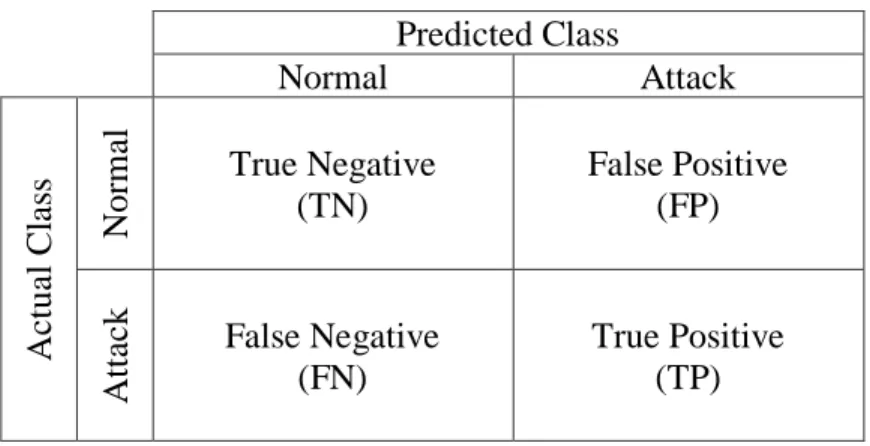
(ROC) curve. For binary classification, Figure 3 shows the possible outcomes of intrusion
Predicted Class Normal Attack A ct ua l Cl as s N orm al True Negative (TN) False Positive (FP) A tt ac k False Negative (FN) True Positive (TP)
Figure 3. Confusion matrix for binary classification
Using the criteria shown in Figure 3, it follows that accuracy can be defined as the
number of true positives (TP) and true negatives (TN) divided by all possible outcomes:
𝐴𝑐𝑐𝑢𝑟𝑎𝑐𝑦 = 𝑇𝑃 + 𝑇𝑁
𝑇𝑃 + 𝑇𝑁 + 𝐹𝑃 + 𝐹𝑁 (1)
Further, it follows that, given the accuracy, the error rate can be described as:
𝐸𝑟𝑟𝑜𝑟 𝑅𝑎𝑡𝑒 = 1 − 𝐴𝑐𝑐𝑢𝑟𝑎𝑐𝑦 (2) Intrusion detection is an area of research that faces several on-going challenges.
One of the most important research challenges is the reduction of false positives. Most
false positives are generated because of under-specified signatures, intent guessing, and
limited abstraction capability (Gowadia et al., 2005). To address the problem of false
positives, some studies have focused on identifying the attackers rather than including all
events across all computers and users (Burroughs, Wilson, & Cybenko, 2002). In
addition, intrusions are rare and may be hidden in massive amounts of data (Scott, 2004).
As a result, the prior probability of an attack is very low, so even a highly accurate
Another challenge in intrusion detection is the large amount of data and the
repetitive work of analyzing and prioritizing the events. Sawyer et al. (2014) found that
after prolonged monitoring activity, there was a noticeable drop in the accuracy of
security analysts. Thus, for routine monitoring of intrusion detection alerts, solutions that
require less human interaction are beneficial. The amount of data is voluminous and
contains redundant features, which also makes detection difficult for intrusion detection
systems because of imbalanced and irrelevant data (Chebrolu et al., 2005).
Finally, intrusion detection systems may be considered high value targets for
attackers. Intrusion detection systems are subject to adversarial evasion, including
deceiving the intrusion detection system or rendering it ineffective (Šrndić & Laskov,
2014; Wang et al., 2014). Laskov and Lippman (2010) found that adversaries may
attempt to modify the training or testing data to alter the detection results. As a result,
intrusion detection must utilize robust classifiers capable of dealing with attacks and
Probabilistic Intrusion Detection
Background
Probabilistic methods for intrusion detection apply statistical formulas and
algorithms. Bayes theorem refers to methods of probabilistic inference that were initially
developed by Thomas Bayes and later formalized by Pierre-Simon Laplace (McGrayne,
2014, p. 159). The purpose of Bayes theorem and Bayesian networks is to allow the
calculation of a prior probability of a hypothesis based on evidence gathered from
observations (Kruegel et al., 2003). Bayesian updating is the process of estimating the
probability of a hypothesis given that an event has been observed (Kruegel et al., 2003;
Chivers, Clark, Nobles, Shaikh, & Chen, 2013). Bayesian approaches also allow the
combination of information from several sources (Scott, 2004; Chivers et al., 2013).
Bayesian methods are preferable over frequency-based statistics for intrusion
detection, since frequency-based methods are more prone to evasion (Swarnkar &
Hubballi, 2016). In addition, Bayesian methods provide a simple way to include prior
information (Scott, 2004) and allow knowledge representation that enables reasoning
with uncertain information (Chebrolu et al., 2005). Probabilistic methods, like Bayes
theorem, allow intrusions to be detected based on soft evidence, or beliefs, rather than
hard evidence (Gowadia et al., 2005). This allows attacks to be presented as probabilities
rather than as binary decisions (Gowadia et al., 2005).
Probabilistic methods help to address the challenges of intrusion detection, in that
there are massive amounts of data, but criminal intrusions are rare (Scott, 2004). This
accurate intrusion detection system will have a high false positive rate (Kruegel et al.,
2003). In formal terms:
P(𝐵|𝐴) = P(𝐴|𝐵)P(𝐵)
P(𝐴) (3)
Thus, if the prior probability of an actual intrusion event, P(B), is extremely low,
it will force P(B|A) to be low, making detection more challenging. Perdisci et al. (2009)
found that a false positive rate for imbalanced data must therefore be 10-5 or lower. As a
result, detecting intrusions for rare attacks is more challenging than for common attacks,
since one of the goals of intrusion detection is to keep false alarms low (Pajouh,
Dastghaibyfard, & Hashemi, 2017).
One probabilistic approach is the use of Bayesian networks, which are directed
acyclic graphs, where each node in the graph represents a conditional probability table
(Kruegel et al., 2003). Another probabilistic approach is naïve Bayes, which is the
simplest Bayesian classifier and performs well for datasets that have conditional
independence of their features (Koc et al., 2012). A variation of naïve Bayes is hidden
naïve Bayes, which creates an additional layer to represent a hidden parent for each node
(Koc et al., 2012).
Bayesian approaches show promise for intrusion detection, but there are many
challenges as well. One problem with Bayesian networks is their node ordering
requirement, which may require expert knowledge to develop (Chebrolu et al., 2005) or
the use of an additional algorithm that can estimate the node ordering (Gowadia et al.,
2005). Another challenge with some Bayesian approaches is the computational
complexity, especially for Type 2 algorithms, where the order is not given, which exhibit
suboptimal models that require large training datasets, which may not be available in
intrusion detection for rare attacks, thus requiring additional methods to alleviate this
constraint (Xiao et al., 2014).
Review of Probabilistic Intrusion Detection Literature
Helman and Liepins (1993) provided a foundational paper for statistical-based
intrusion detection that other researchers have built upon. Valdes and Skinner (2000)
addressed the shortcomings of anomaly and signature-based detection by modeling
attacks as hypothesis and using events to adapt probabilities. This study found that
combining signature-based and anomaly-based intrusion detection using probabilities
improved the detection of distributed attacks (Valdes & Skinner, 2000).
Bayesian networks have been applied to intrusion detection in a variety of
research studies. Kruegel et al. (2003) used full Bayesian networks to model
interdependencies of events and found a reduction in false alerts. Feng et al. (2004) found
that dynamic Bayesian networks for recognizing time-varying plans were effective for
predicting normal and anomalous call sequences. Gowadia et al. (2005) used agent
graphs and Bayesian networks to evaluate beliefs, rather than hard values. This study
found that Bayesian networks can be created by asking experts to create directed acyclic
graphs either manually or by using an algorithm (Gowadia et al., 2005). Tylman (2008)
combined misuse and anomaly detection methods, similar to Valdes and Skinner (2000).
This combined approach used Bayesian classification of Snort alerts at the session level
Perdisci et al. (2009) applied Bayesian methods to combine the results of an
ensemble of support vector machine classifiers. The goal of this research was to reduce
false positives, and the results demonstrated high accuracy, especially for shellcode and
polymorphic attacks (Perdisci et al., 2009). Xu and Shelton (2010) used continuous time
Bayesian networks (CTBN) for anomaly detection. This application of Bayesian
networks focused purely on event timing and outperformed existing methods for anomaly
detection (Xu & Shelton, 2010).
Koc et al. (2012) used hidden naïve Bayes for improving the accuracy of intrusion
detection. This study found that hidden naïve Bayes outperformed naïve Bayes for
accuracy and error rate while maintaining the simplicity of naïve Bayes (Koc et al.,
2012). Chivers et al. (2013) focused specifically on the problem of detecting insider
attacks. This research study combined sources using hypotheses and Bayesian updating
and found that updating beliefs based on evidence is effective in detecting attacker nodes
(Chivers et al., 2013).
Yassin et al. (2013) used k-means clustering to separate data and subsequently
used Bayes classification. Their study found that using clustering as an initial step
significantly reduced the false positive rate and increased the true negative rate (Yassin et
al., 2013). Xiao et al. (2014) addressed the shortcoming of Bayesian networks using an
ensemble approach. Bayesian network model averaging selects the best network from a
set of trained networks and performs better than regular Bayesian networks or naïve
Bayes (Xiao et al., 2014). Bayesian network model averaging requires less data for
Swarnkar and Hubballi (2016) used multinomial Bayesian one-class classifiers of
n-grams with probability trees to address the shortcomings of frequency-based and
one-class one-classifiers. Although this approach had a high detection rate, it was accompanied
with a moderately high false positive rate and high computational complexity (Swarnkar
& Hubballi, 2016). As a result, this approach is not suitable for intrusion detection, since
moderately high false positive rates for highly imbalanced datasets results in much lower
overall accuracy (Kruegel et al., 2003). To address the problem of high computational
complexity and the problem of imbalanced datasets, Pajouh et al. (2017) used two-tier
classification with linear discriminant analysis. This study found that linear discriminant
analysis provided optimal feature reduction and made naïve Bayes more efficient for
classification (Pajouh et al., 2017).
Discussion
Several important themes can be established from previous research. First,
intrusion detection using probabilistic methods should avoid generalization across an
entire dataset, since it makes it easier for criminals to hide (Scott, 2004). For example,
data can be segmented to look at anomalies per user (Scott, 2004; Dash, Reddy, & Pujari,
2011) or per host (Burroughs et al., 2002; Chivers et al., 2013). Second, time is an
important element that should be considered, with a preference to more recent behaviors
(Scott, 2004; Xu & Shelton, 2010; Chivers et al., 2013). Third, categorical data has been
shown to perform better than parametric or continuous data for probabilistic methods for
probabilistic methods were successful in combining information from several sources,
which is useful for aggregating event-level information to create a more abstract level.
Clustering Ensembles
Background
The purpose of clustering is to understand natural groupings in data (Jain, 2010).
Clustering algorithms divide data into clusters, such that the data within each cluster is
most similar to other data in the cluster, and the data between clusters is most dissimilar
to that of other clusters (Zhou & Tang, 2006). Clusters in data appear in various shapes,
sizes, sparseness, and degrees of separation (Fred & Jain, 2005). Clustering identifies
natural structures in data when the structure, the number of clusters, or shapes of the
clusters may be unknown (Dimitriadou, Weingessel, & Hornik, 2001). Thus, clustering is
a primary technique for unsupervised machine learning (Zhou & Tang, 2006). In addition
to finding natural groupings and structure in data, clustering can perform natural
classification or compression of data into cluster prototypes (Jain, 2010).
A wide variety of clustering algorithms exist, but most can be placed into four
categories. First, iterative square-error partitional clustering, such as k-means clustering,
finds a distance between centroids and data elements and does not impose a structure on
the data (Frossyniotis, Likas, & Stafylopatis, 2004; Jain, 2010). Since iterative
square-error partitional clustering uses a distance measure, it creates hyperspherical clusters and
does not identify novel cluster shapes (Fred & Jain, 2005). Second, hierarchical
clustering organizes data into nested sequences of groups that can be visualized as trees
(Frossyniotis et al., 2004). Third, density-based clustering finds the densest regions of the
clustering uses spatial data mining techniques to subdivide a hyperspace into sections that
represent clusters (Frossyniotis et al., 2004).
Clustering is considered a difficult problem (Jain, 2010). As a form of
unsupervised learning, it is hard to select a clustering method in advance that can identify
the same clusters that match those identified by a human expert (Ayad & Kamel, 2008).
Clustering results for different clustering algorithms may be very different using the same
data (Jain, 2010). Further, different clustering runs using the same clustering algorithm
can have different results because of different initialization parameters (Dimitriadou et
al., 2001).
There is no best clustering algorithm (Jain, 2010). No single algorithm exists that
can identify all of the cluster shapes and structures (Fred & Jain, 2005). No clustering
method is available that will find the correct underlying structure for all data sets
(Vega-Pons & Ruiz-Shulcloper, 2011, p. 337). As a result, researchers have found it is best to
use several different clustering algorithms on a given data set and see what works best
(Fred & Jain, 2005). Clustering algorithms are generally optimization problems that
reduce mean-square error, minimize some other type of error, or use similarity functions
(Dimitriadou et al., 2001). The quality of clustering can be evaluated using R-squared,
intra-over inter-variation quotient, BD-index, and SD validity index (Frossyniotis et al.,
2004).
Ensemble approaches have been applied to address many of the challenges
associated with clustering. An ensemble is a multi-learner system, where each component
learner attempts to solve the same task as the others (Strehl & Ghosh, 2002). Clustering
2001; Hadjitodorov, Kuncheva, & Todorova, 2006). The goal of clustering ensembles is
to find a combination of multiple partitions that improves the overall clustering of the
data (Topchy et al., 2005). As a result, clustering ensembles find a consensus partition
that improves that accuracy of individual clustering results (Ayad & Kamel, 2010).
Different clustering algorithms produce different clustering results, and different
runs of the same algorithm provide different results, because of different initialization
parameters. Thus, using multiple clustering approaches simultaneously helps to find the
best clustering solution (Frossyniotis et al., 2004; Jain, 2010). The benefit of clustering
ensembles is that the decision of a group may be more reliable than that of any individual
(Vega-Pons & Ruiz-Shulcloper, 2011, p. 338). As a result, clustering ensembles reduce
the risk of picking the wrong clustering method for a given dataset (Hadjitodorov et al.,
2006).
Previous research has applied clustering ensembles to face recognition, character
recognition, scientific image analysis, and medical diagnosis (Zhou & Tang, 2006).
Research has also evaluated clustering ensembles with large datasets and has found an
improvement in clustering, even for incomplete partitions (Lourenco et al., 2015).
Clustering ensembles can find the right number of clusters in data (Dimitriadou et al.,
2001; Ayad & Kamel, 2010). They also improve the quality and robustness of clustering
(Strehl & Ghosh, 2002; Topchy et al., 2005; Vega-Pons & Ruiz-Shulcloper, 2011, p. 365;
Lourenco et al., 2015). Clustering ensembles identify hidden structures in data (Bakker &
Heskes, 2003) and find clusters of arbitrary and complex shapes (Dimitriadou et al.,
2001; Frossyniotis et al., 2004; Hadjitodorov et al., 2006). As a result, they enable new
of their diversity of clustering solutions, clustering ensembles, are more generalizable
than individual clustering algorithms (Zhou & Tang, 2006). Finally, clustering ensembles
can be implemented in a distributed computing environment, allowing them to scale well
for large ensembles (Strehl & Ghosh, 2002).
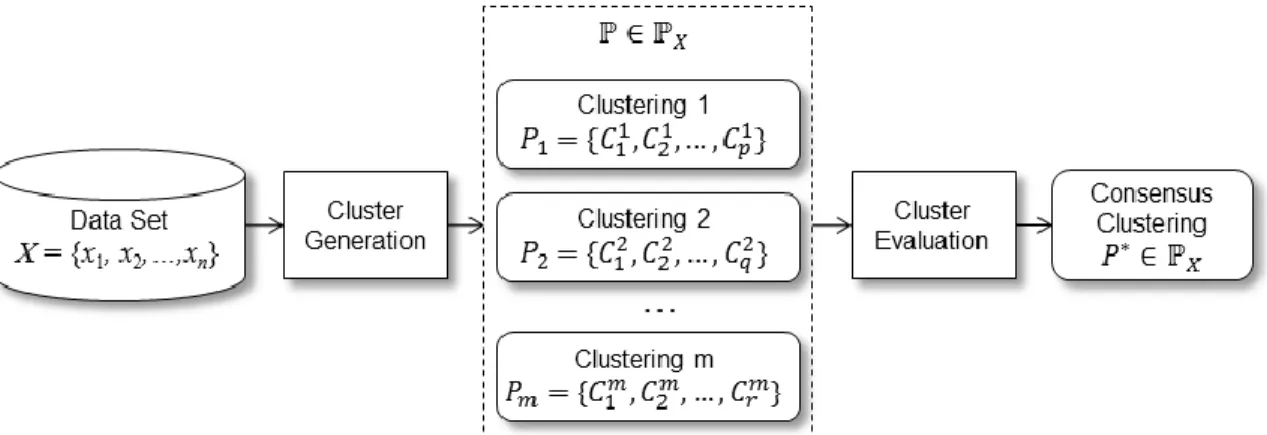
Clustering ensembles can be viewed as a two-step process. The first step is to
generate the various clustering results, also known as partitions, and the second step is to
evaluate the results using a consensus function (Topchy, Law, Jain, & Fred, 2004;
Vega-Pons & Ruiz-Shulcloper, 2011, p. 338). Figure 4 shows how these two steps fit into the
overall concept of clustering ensembles and the notations that are used in this paper,
which have been adapted from Vega-Pons and Ruiz-Shulcloper (2011, p. 339).
Figure 4. Overview clustering ensembles with formal notation
In this notation, 𝑋 = {𝑥1, 𝑥2, … , 𝑥𝑛} is a set of objects in which each 𝑥𝑖 is a multi-dimensional tuple of α dimensions and where 𝑖 = 1 … 𝑛. ℙ𝑋 is the set of all
possible partitions in X, and ℙ = {P1, P2,…., Pm} is the set of partitions generated by the