COOPERATION
PROGRAMME
North Sea Region Programme 2014 - 2020
Cooperation programmes under the European territorial
cooperation goal
CCI 2014TC16RFTN005
Title North Sea
Version 1.0
First year 2014
Last year 2020
Eligible from 01-Jan-2014
Eligible until 31-Dec-2023
EC decision number EC decision date MS amending decision number MS amending decision date MS amending decision entry into force date NUTS regions covered by the operational programme
BE21 - Prov. Antwerpen BE23 - Prov. Oost-Vlaanderen BE25 - Prov. West-Vlaanderen DE50 - Bremen DE60 - Hamburg DE91 - Braunschweig DE92 - Hannover DE93 - Lüneburg DE94 - Weser-Ems DEF0 - Schleswig-Holstein DK01 - Hovedstaden DK02 - Sjælland DK03 - Syddanmark DK04 - Midtjylland DK05 - Nordjylland NL11 - Groningen NL12 - Friesland (NL) NL13 - Drenthe NL21 - Overijssel NL23 - Flevoland NL32 - Noord-Holland NL33 - Zuid-Holland NL34 - Zeeland
NO01 - Oslo Og Akershus NO02 - Hedmark Og Oppland NO03 - Sør-Østlandet
NO04 - Agder Og Rogaland NO05 - Vestlandet
NO06 - Trøndelag NO07 - Nord-Norge
SE224 - Skåne län SE23 - Västsverige
SE31 - Norra Mellansverige UKC1 - Tees Valley and Durham
UKC2 - Northumberland and Tyne and Wear UKE1 - East Yorkshire and Northern Lincolnshire UKE2 - North Yorkshire
UKE3 - South Yorkshire UKE4 - West Yorkshire
UKF1 - Derbyshire and Nottinghamshire
UKF2 - Leicestershire, Rutland and Northamptonshire UKF3 - Lincolnshire
UKH1 - East Anglia UKH3 - Essex UKJ4 - Kent
UKM2 - Eastern Scotland UKM5 - North Eastern Scotland UKM6 - Highlands and Islands
1. STRATEGY FOR THE COOPERATION PROGRAMME’S CONTRIBUTION TO THE UNION STRATEGY FOR SMART, SUSTAINABLE AND INCLUSIVE GROWTH AND THE ACHIEVEMENT OF ECONOMIC, SOCIAL AND
TERRITORIAL COHESION
1.1 Strategy for the cooperation programme’s contribution to the Union strategy for smart, sustainable and inclusive growth and to the achievement of economic, social and territorial cohesion
1.1.1 Description of the cooperation programme’s strategy for contributing to the delivery of the Union strategy for smart, sustainable and inclusive growth and for achieving economic, social and territorial cohesion.
North Sea Region 2014-2020: Vision
Joining efforts to lead the way to stronger, more sustainable economies and societies around the North Sea
Summary
The following strategy charts the way that the current situation in the North Sea region has been brought together with European and national policies to define a programme of action for the North Sea Region programme 2014-2020. It builds on extensive experience of cooperation within the region and of the results that can realistically be achieved, while also respecting calls for delivering tangible results and long-term impact.
The programme aims to embed greater cooperation in working practices across the North Sea Region (NSR) as a way of tackling joint challenges, pooling expertise and building lasting links between businesses and institutions throughout the NSR.
The programme has been prepared against the background of slow recovery from the economic crisis as outlined in the section on the socio-economic situation. This has created pressures on financing as well as ever greater demands for high quality projects that complement other national and regional initiatives. The section on lessons from the past shows how the programme will respond to these needs.
In content terms, the crisis has underlined the relevance of the Europe 2020 policy framework and the preceding Lisbon Agenda: The North Sea Region needs to strengthen its knowledge economy so there are more businesses generating growth and jobs in sectors where the NSR can maintain a strong competitive position in global markets. Efforts to promote this change should focus on SMEs, which represent the vast majority of businesses in NSR economies but where innovation capacity often needs to be
increased. The strategy explores these challenges in more detail and considers how the policy responses suggested in the Commission’s Europe 2020 strategy can be applied to the North Sea Region. The strategy ends with a short summary of how these elements come together in the four priorities selected.
The strategy also recognises that there are a number of other threats to the long-term stability and well-being of the region. Climate change and environmental degradation could undo progress in other areas if they are left unchecked. This strategy therefore
and the more detailed information in the priorities Eco-Innovation and Sustainable North Sea Region also address wider environmental issues such as wise management of natural resources, water and air quality, pollution and biodiversity. The measures suggested acknowledge that human interests and environmental interests must be balanced to achieve sustainable development.
The programme addresses transport as a special theme. The North Sea Region is the international trade hub for most of the continent because of its deep water ports. The transport sector is therefore a major contributor to the region’s economy and provides essential links to the outside world. However, it faces enormous challenges if it is to break the reliance of transport on fossil fuels particularly given that transport flows continue to increase. This trend is also found at a local and regional level, as transport systems have generally been based around car and truck use. By having a specific priority on transport - Green Transport and Mobility – the programme aims to bring focus and new impetus to efforts to demonstrate how the North Sea Region can start to move away from fossil fuels for transport.
Ambitious themes have been selected for the programme but the budget to address them is limited. Obviously, making significant, lasting change on issues such as carbon reduction will require contributions from many sources. Links and coordination with other EU funding programmes and policy initiatives are therefore included in the relevant section of the Cooperation Programme. Compared to these other schemes, transnational cooperation specifically focuses on the territorial integration of the North Sea Region. It addresses current barriers, such as uncoordinated sectoral policies, mismatches between administrative boundaries and functional boundaries, insufficient use of stakeholder knowledge and views, and a lack of long-term visions for planning and objective setting. By taking their starting point in the territory and all of the relevant influencing factors on the territory, transnational projects should transcend administrative and sectoral barriers, and actively pursue horizontal coordination (across sectors) and vertical coordination (across different levels of administration). In this way, transnational cooperation can
make a real difference by demonstrating what is possible as well as delivering real change through practical action in regional and local communities. The strategy therefore closes with some examples of the sorts of action that have been effective in the past and can provide inspiration for North Sea Region 2014-2020.
Designation of the area covered by the strategy
This strategy covers the North Sea Region (NSR) comprising the whole of Norway and Denmark, the eastern parts of the United Kingdom, three provinces of the Flemish Region of Belgium, the north western regions of Germany, the northern and western parts of the Netherlands and the south western area of Sweden (See Annex 29). All regions are on or close to the coast of the North Sea itself. The NSR covers an area of some 664,000 km2 and approximately 60 million people.
Analysis of the current socio-economic situation in the strategy area[i]
The North Sea Region is a patchwork of varied territory extending from the remote islands and fjords at the northern edge of Europe through to the densely packed cities of Europe's core region with its concentrations of research and economic output. It includes some of Europe's most sparsely populated areas and some of its most heavily populated centres. It contains centres of national and regional importance, ranging from capital
overall terms, however, the NSR is characterised by the importance of small and
medium-sized towns with a particular reliance on towns of less than 20,000 inhabitants. The size and population of NSR cities continues to rise steadily. This is partly because people continue to leave rural areas.
The major factor influencing economic performance across the programme area is still the economic crisis, which has triggered major economic change across the region and substantial changes in macro-economic policy. Macro-economic impact has varied. Germany, Norway and Sweden have managed to maintain relatively stable economic performance. The national economies of the UK, Denmark, Belgium and the
Netherlands, on the other hand, were significantly affected by the crisis and have demonstrated only limited levels of economic recovery.
Everywhere the crisis has fed through to the real economy, impacting on both export sectors and domestic consumption. Problems have also spread from the manufacturing to the public sector, particularly affecting the funding of public sector jobs and the
provision of services. In a number of countries, structurally weaker regions are among those which have been most seriously affected by the crisis and many are still lagging seriously in the recovery.
The policy response to the economic crisis across all governments has been focused on the national and international dimensions rather than regional. This response has had two main goals:
• To stabilise the banking sector and the financial system
• To rebuild business and consumer confidence and to stimulate consumption and investment
Specific responses have been shaped in part by the degree and character of the
downturn’s impact on individual countries, but also by the macro-economic situation of each country before the crisis. In some NSRP partner countries, public finances are relatively sound and budgets for regional economic policy have even increased in recent years (e.g. Sweden). In others, austerity measures have been introduced to restore balance in the government finances and reduce debt ratios, which has impacted on regional policy budgets and co-financing, e.g. in the UK. The Netherlands made significant (€18 billion) budget cuts in 2010.
This situation emphasises the need for stimulating growth in all parts of the NSR through initiatives such as those outlined in this programme. However, the economic crisis also raises challenges in this respect, such as meeting financial commitments and mobilising project partners. National government concerns over value for money and effectively managing limited financial resources are also leading to an increasing interest in coordinating external sources of funding (such as EU Cohesion policy finding) and maximising their impact.
All NSR economies are looking for new opportunities for high value growth. There is an acceptance that this will be achieved through developing the knowledge economy, and all countries have programmes for raising skill levels, stimulating knowledge economy business start-ups and encouraging research. Nevertheless, it has often been difficult to commercialise the innovations needed to create and maintain strong positions in global industry and although the NSR performs very well in an EU context, it still trails behind
has led to initiatives to promote ever greater coordination of research with business skills and knowledge in an effort to generate new products, quality jobs and maintain the region’s prosperity.
Socially the recent crisis has generated a paradoxical situation. In the long-term there could be a shortage of workers in the NSR. There is an ageing population with people on average living longer and smaller numbers of young people to take their place on the labour market. In the short-term, however, there are large pockets of youth and long-term unemployment and this brings with it a significant risk that these people may be
permanently excluded from the labour market. Moreover, a proportion of the jobs that NSR economies have generated over recent years have been in very low pay segments of the economy. Such trends risk creating divisions in North Sea societies and stress the need to ensure that economic recovery is not limited to skilled workers in urban areas. The economic situation has also put some pressure on the environment. Public spending on the environment has generally decreased slightly[ii] and it is not always easy to maintain support for long-term environmental goals when faced with the need to provide an immediate economic stimulus. Major climate change mitigation and adaptation initiatives are, however, still needed to protect NSR countries. In many cases further efforts are also needed to strike a better balance human needs and the long-term sustainability of the NSR environment.
In many respects the NSR faces these challenges from a position of strength. All of the NSR countries are highly developed[iii] with strong educational and health infrastructure, a generally well-trained workforce, prosperous economies, which perform strongly in the knowledge economy, and good levels of ICT infrastructure and literacy. Long histories of trade and migration have created strong economic and cultural links. Good transport infrastructure supports physical links across the region. There is a shared interest in developing renewable energy and other green technologies and the NSR is amongst the global leaders in these industries. This means also that the NSR is in a good position to use the solutions it develops to the challenges outlined in the programme as an engine for growth and new opportunities.
Lessons from the past
This is the fourth North Sea Region programme. Since the start of the first programme, cooperation in the region has matured and intensified. This has meant that with each programme period it has been possible to raise ambitions for the impact and durability of the projects funded, and the new North Sea Region programme will continue this
progression. Thematically, the programme builds on positions of strength, developing on proven successes and complementing these with new themes based on the current
analysis.
It is also possible to define a number of characteristics that projects under the new programme should fulfil. New projects will be:
• Based on the shared or complementary needs of all partners. It is not possible to put together partnerships based only on a loose thematic umbrella with no joint implementation. Projects should instead be built around a clearly defined and agreed set of needs with a clear definition of the requirements and skills that each partner brings into the partnership. Projects allow all participating regions to pool
the resources used on their particular challenges – and allow them to learn from assisting other regions.
• Reliant on joint implementation. The value of cooperation lies in bringing in knowledge and new perspectives from other partners. Results should be based on joint action.
• Focused on delivering progress on core programme goals. Every programme objective has a clear output and a related programme target. These targets give a clear direction for all activities and the results expected but leave freedom for projects to define their precise activities based on partner needs and the evolving situation in the programme area.
• Implementing EU policy. Projects have been successful in taking the objectives and visions of European policy in different sectors and defining specific actions and processes to achieve these goals on the ground. Projects should continue to give practical shape to policy in this way by developing synergies with existing national and regional initiatives and also integrating the outputs of relevant projects under other Interreg programmes and all other funding programmes. • Innovative. Some projects work directly with ‘innovation’ by supporting the
development of new products and services for the market. All projects are expected to be ‘innovative’ by rethinking standard approaches and using the skills, knowledge and experience available in the partnership to develop
completely new approaches. In many cases innovative approaches for a partner will involve the transfer of ideas from another partner or ‘tweaks’ to existing solutions but programme funds should not support ‘business as usual’.
• Based on demonstrating and proving what is possible. Research is an important part of the programme but it is important to stress that the programme focus is on demonstrating practical developments for the NSR and working through the barriers to making these developments a reality. Projects must therefore focus on demonstrating and testing new ideas. Where projects are based on planning and cannot demonstrate their recommendations (e.g. due to the high cost of the infrastructure involved), projects must be developed and delivered together with the main stakeholders who ultimately make funding decisions in order to ensure support for implementation after the project has ended.
• Limited and specific in the changes they wish to generate. Some earlier projects have been over-ambitious in the range of issues they wish to tackle. This tends to lead to a loss of focus. Projects should therefore carefully define the need they will address even where this means that other important issues must be left out. • Inspiring national and regional policy and practices. Programme funding is
limited but its ambition is to positively influence the whole programme area. This requires that the positive effects of results are not limited to the project
partnership but are communicated to the most important stakeholders in order to secure a durable legacy after the end of the project.
• Allowed to fail. Projects should expect to succeed but also be able to draw lessons from failures and share these with others – without the risk of financial penalty for the work they have done. Projects need to be able to take risks and innovate. It is also important that projects focus on delivery rather than administration and that unclear rules and procedures do not lead to unnecessary errors. This has also led to changes in programme administration including:
• Attempts to simplify the application process to reduce the work put into unsuccessful ideas and provide more uniform funding for detailed application
development. This might include piloting a two-step application procedure where projects will get formal feedback on their proposed objectives, activities and results, and a decision on whether to proceed to the second step
• Use of a flat rate for overhead costs to avoid calculation errors and differences of interpretation between control and audit bodies
• Clearer rules and procedures and investigation of new channels for communicating requirements such as audio-visual materials
• Moves towards paperless administration and automation of as many processes as possible based on positive experiences from the 2007-2013 period
• Adoption wherever possible of harmonised documents, procedures and rules between all transnational programmes
• Reduction in the number of programme indicators to raise confidence in the usefulness and relevance of the system
• Use of different approaches to group projects on related themes (e.g. clustering and portfolio management) in order to share information and highlight the results being achieved
• Assistance to projects to identify programmes, policies and stakeholders working with related themes
• Provide regular opportunities for contact between projects for exchange of learning and experiences
Main challenges and untapped potentials
The summarised overview of challenges and opportunities provided below builds on a more detailed SWOT analysis (Annex 1) discussed and agreed with the Member States in preparation for the programming process, and a series of consultation and evaluation exercises with programme stakeholders. This process is described in more detail in section 5.2.
Economic situation and innovation
Increasingly innovation is carried out not as a closed off activity within individual companies, but rather in partnerships with other companies, customers and researchers. Many larger companies have embraced this potential but SMEs often lack the capacity to organise such a process and effective partners to engage with. Transnational cooperation offers companies an effective framework for establishing partnerships and a wider circle of relevant partners, as well access to successful methods from other countries.
Main strengths[iv]:
• Very strong performance on most innovation support indicators (level of R&D, educational attainment etc.)
• Strong capacity in a number of key sectors with a very strong innovation potential Main weaknesses:
• Insufficient commercialisation of innovative ideas
• Need for increased knowledge exchange between businesses, entrepreneurs and knowledge institutions
Main opportunities
• Developing innovation support between countries and regions in the programme area
• Sharing innovation facilities and resources
• Stimulating transnational product and service development activities
• Unresolved societal challenges (e.g. climate change, aging population, alternative fuels) provide strong impetus for innovation
Main threats
• Lack of funding and support • Fragmented approaches • Global competition
The NSR remains one of the most prosperous parts of the EU despite the impact of the financial crisis. Most countries are now recovering economically though there have been considerable variations in the depth and timing of recession in different countries (Annex 2) and significant differences in how regions have been affected (Annex 3). Some
regions have indeed avoided recession entirely. Despite the difficulties of recent years, however, no region has a GDP of less than 75% of the EU average and many regions are considerably above the EU average.
Economic activity and growth are predominantly found in urban areas. This pattern and the accompanying movement of population away from rural areas seem set to continue. It is estimated that the proportion of the NSR population living in urban areas is already as high as 97.5% in some countries (Belgium). Even in a country with a lower proportion of urban population (Germany), the rate is already 76.3%[v]. While larger cities play an important role as growth hubs this needs to be balanced against the danger of over-concentrating growth in a very small number of locations (Annex 4).
Unemployment in the region is still relatively low as a whole but there are major regional differences. Agder and Rogaland (Norway) had the lowest 2012 rate at 2.7% while in Tees Valley and Durham the rate was 11.6%. The worst affected regions tend also to have relatively high levels of youth unemployment and long-term unemployment[vi]. One of the worst hit sectors is manufacturing where new technologies and global competition continue to have a major impact and the recent recession in many countries has strengthened pre-existing negative trends. Agriculture and fisheries still play a major role in the economies of many North Sea regions outside urban areas but labour markets in these sectors continue to shrink (Annex 5). In many places there has been a successful shift towards higher-value knowledge based activities. This has created more and better-paid employment opportunities but tends to be concentrated in urban areas. Jobs have also been lost in the service industries as a result of the recession though financial and business services and communication are still the strongest growth sectors. In parts of the region low paid jobs, such as in the tourism sector, are the main factor contributing to the lower levels of GDP recorded rather than a lack of employment.
The countries of the North Sea Region represent the innovation core of Europe (Annex 6) and occupy six of the top eight spots in EU innovation performance[vii]. This success is based on a number of strengths in national research and innovation systems and in particular on strong business innovation measures and the role of the higher education
levels are also high, there is a good research and innovation infrastructure and the environment for business start-ups is generally supportive. A number of sectors such as energy, environmental sciences and nanotechnology can be identified as national positions of strength with considerable overlaps between countries and a consequent potential for greater collaboration on development activities (Annex 7).
The NSR cannot, however, afford to be complacent about innovation. National scores on innovation performance parameters vary considerably[x] and on some indicators North Sea Region countries actually perform below the EU average[xi]. For example, some countries rate badly on SME and gazelle[xii] company performance[xiii], which is a cause for concern given the dominance of SMEs in the NSR economy and the need to stimulate innovation in such companies. The NSR needs to maintain the pace and spread of innovation but instead cutbacks are in some cases resulting in stagnation or even decline in innovation performance[xiv].
Emerging economies are moving fast to close skill gaps and develop strong positions in knowledge intensive roles such as design, engineering, high technology manufacturing, education and specialist services. Niche markets will therefore be lost unless NSR
businesses ensure that they innovate to maintain market advantage. Innovation also needs to open up new industries based particularly on exploiting the world class research carried out in the region. The business world in the NSR needs to be an active part of this process and as far as possible eventual commercial benefits should remain in the region. SMEs in particular must be offered a supportive environment for innovation.
Public service innovation is also an important opportunity. In many countries, finances for the public sector are under severe pressure and there is a need to deliver public services more effectively and efficiently. Digitalisation especially offers the opportunity to improve services to citizens while reducing costs especially in remoter and rural areas. Maintaining a good level of essential services in such areas is one of the main keys to the balanced development of the North Sea Region as a whole.
Environmental situation and sustainable growth
The countries of the North Sea Region face many shared environmental threats such as climate change impacts, the need to reduce Greenhouse Gas emissions, degradation of the maritime environment, and the spread of air and water borne pollutants. New solutions need to be found and these can benefit greatly from pooling knowledge and to find new solutions.
Main strengths:
• High level of environmental monitoring and management • Strong position on environmental technologies
• Number and range of natural landscapes and resources Main weaknesses:
• Unsustainable energy and industrial practices • High number of degraded habitats and ecosystems • Many vulnerable coastal and waterside areas Main opportunities:
• High degree of awareness and support for environmental action
• Strong experience and knowledge for developing new green technologies and processes
• Strong economic potential of green economy Main threats:
• Short-term economic development needs override more sustainable approaches • Effective solutions do not yet exist for some challenges
• Accident / natural disaster / climate related events
The North Sea Region has a rich natural environment with a varied coastline, river estuaries, wetlands, woods, hills and mountains providing a valuable and varied
landscape. The quality of the natural habitats is recognised and protected through a large number of Natura 2000 sites and numerous national and regional conservation schemes. The estuaries of south-east England, Scotland, Zeeland, the Scheldt and the Wadden Sea are of particular ecological and natural value with an extraordinary variety of species. The natural landscape is a valuable resource and the basis for many economic activities ranging from tourism to extraction industries.
The NSR has a strong tradition in environmental policy. All countries have an advanced system of monitoring and regulating environmental issues but there are still challenges requiring joint action. These include managing water supply, biodiversity and other resources which are under threat. Parts of the land and sea areas in the NSR are amongst the busiest territories for transport and economic activity in the world. As a result, there are concerns about the long-term sustainability of development in terms of both the rate at which resources are being used and the effects that emissions and pollutants are having on ecosystems[xv]. The North Sea itself provides a stark example as many commercially fished species are currently being exploited beyond safe biological limits and fishing methods cause substantial damage to other species and to the seabed. Many land-based ecosystems face similar pressures.
There are also long-term threats to the environment linked to climate change. Sea levels rose on average by 19 cm last century[xvi] and the rate has accelerated to more than 3 mm a year[xvii]. It is very likely that rates will increase for the rest of the century[xviii]. It is almost certain that global average temperatures will rise by at least 1.5oC in the same period though there is a strong possibility that increases could be higher[xix]. Planning for these changes is difficult because they are not uniform. Some impacts may even offer opportunities for the NSR such as improved conditions for some kinds of agriculture and the opening up of Arctic sea routes to the Far East. However, many parts of the programme area lie just above or even below the current sea level and are at serious risk. Even regions where there are few low-lying areas tend to have heavy concentrations of population and essential infrastructure in the low lying areas. Climate change is already causing negative impacts on the programme area. These effects need to be tackled and include loss of coastal land, salination of fresh water supplies, increased levels of erosion, subsidence and drought. The most dangerous and dramatic effect for the NSR is expected to be a significant increase in the frequency and severity of storms and associated flood risks. Adaptation measures are needed and in many cases require major planning and investment efforts and difficult prioritisation especially where current land uses are untenable in the long-term.
The long-term solution to these challenges is a reduction in carbon emissions. The programme area has high levels of emissions and when emissions from imported goods are included, only Sweden is below the EU27 average[xx]. On a global scale, this means that the North Sea Region has some of the very highest per capita emissions and should demonstrate its commitment to improving performance. Current policy should deliver a 40% reduction in GHG (Greenhouse Gas) emissions by 2050 against 1990 levels on EU level but targets require an 80% reduction over the same period[xxi]. Achieving these targets will require action in all sectors of the economy. Transport is tackled in a separate priority due to the scale of the challenge and the importance of the sector in the NSR but all sectors need to look at potential for ever greater carbon reduction (Annex 8).[xxii]
There are also opportunities in this situation. Knowledge and technologies for sustainable solutions are already in existence and can be applied in order to direct current economic activities into more sustainable directions. This will place much less pressure on the natural environment and in many cases lead to long-term cost savings as well. The region is strong in green economic activity and should showcase the potential of spreading the use of these approaches much more widely.
The ‘green economy’ is one:
…that results in improved human well-being and social equity, while significantly reducing environmental risks and ecological scarcities. It is low carbon, resource efficient and socially inclusive. Its growth in income and employment is driven by public and private investments which reduce carbon emissions and pollution, enhance energy and resource efficiency and prevent the loss of biodiversity and ecosystem services.[xxiii]
The aim of programme activity should be to show through piloting how resource use and carbon emissions can be significantly reduced and/or how non-renewable resources can be substituted with renewable and preferably local materials.
Transport situation
The planning of new and improved international transport routes requires the cooperation of all main stakeholders from the point of origin to the destination. For local and regional transport, there is an urgent need to work together to develop more sustainable new ideas.
Main strengths:
• Major international trade routes performing a ‘gateway’ function for the European Union
• Good transport infrastructure and major transport operators • Knowledge and willingness to improve sustainability Main weaknesses:
• Reliance on conventionally fuelled road transport • Many routes are heavily congested
• Many elements for increased multimodal transport are already in place including under-used infrastructure
• Strong research capacity on transport issues
• Strong business interest and significant market opportunities Main threats:
• Lack of funding and knowledge
• Technology gaps – lack of solutions for some challenges
• Continued supply of cheap conventional fuels may lead to a timid introduction of sustainable alternatives
• Remoter regions may fall further behind if they suffer a relative fall in accessibility compared to core regions[xxiv]
Accessibility and mobility are important factors in promoting and maintaining economic growth and employment in the NSR. Accessibility varies across the NSR and depends mostly on how close a region is to the 'core' of Europe (Annex 9). The NSR includes extremes from high-density and highly accessible urbanised areas located in or adjacent to the central part of Europe (e.g. Randstad, Flanders, Essex, Hamburg), to remote, low-density and island areas (e.g. in Scotland, Norway and Sweden).
The NSR occupies a unique position in the European transport sector: The majority of goods passing through the region are on their way to or from other parts of Europe and the majority of EU international trade passes through the NSR. This gateway function means that transport decisions in the NSR can influence modal choice over much of the continent.
Overall, the transport network is well integrated into both national and international transport systems. The gateways into the NSR are primarily the ports and airports, with a smaller role played by High Speed Train links. There are a small number of international gateways, notably the sea ports at Rotterdam, Antwerp and Hamburg and the airports at Schiphol and Stansted, but the NSR is largely reliant on smaller regionally important hubs.
Short sea shipping remains an important mode of transport in the NSR. Lack of cargoes has forced some ports to shut down commercial operations but this has helped make the remainder more efficient and increase competitiveness. Regional airports have found a new lease of life as lower cost airlines pioneer new routes and changes in aircraft
technology makes operating smaller aircraft more cost effective. Regional air links are of vital importance for remote areas such as in Norway and northern Scotland but play only a limited role in Denmark, the Netherlands and Germany, due to shorter distances or better railway services.
In parts of the NSR inland waterways still have a significant unrealised potential for sustainable transport corridors and as feeder lines for sea ports. The inland waterways system in the countries of the NSR covers a total of 16,378 kilometres but only in the Netherlands and Flanders and to some extent in Germany are significant volumes of goods transported. In general, the NSR has a well-developed railway system, but many parts of the system face capacity problems particularly for transportation of goods. Whilst there is a general move to restricting new road building in favour of more
Personal transport, especially for shorter journeys, is dominated by private cars and current development trends are exacerbating this problem. Over the last 50 years urban areas in Europe have grown by approximately 78% but population has increased by just 33%[xxv]. In the NSR this has led to extensive urban sprawl because of low density residential builds in suburban areas. Such developments have created ever greater car use and the NSR is now faced with a major challenge in maintaining mobility while trying to move away from conventionally fuelled vehicles.
Achieving overall Green House Gas (GHG) reduction targets has so far been possible without major changes to transport but this will no longer be possible for the new targets for 2030[xxvi]: Transport must start to reduce emissions as other sectors can no longer achieve easy gains that will compensate for increasing transport CO2. Given the NSR’s key role in the sector, there is a particular interest in finding solutions for delivering these reductions without an excessive loss of mobility. Due to the lifetime of transport
infrastructure, solutions that are planned and introduced now will probably still be in place in 2050[xxvii] – and must therefore start to move strongly in the direction of meeting the environmental requirements likely to be in force then. The programme can showcase these new solutions to potential users and in this way try to speed up the adoption of more environmentally friendly forms of transport.
Identification of the challenges and potentials to be addressed in the framework of European Territorial Cooperation
Transnational cooperation is primarily focused on the joint action of sub-national
partners to improve the efficiency and effectiveness of policy delivery in order to address the main challenges facing the North Sea Region. The aim is to pool knowledge and resources in partnerships to provide practical solutions on improving the economic, social and environmental situation in the North Sea Region, and to make these solutions available as widely as possible across the NSR. Although projects will often be built around individual cases, work on these local cases should be regarded as a tool for validating new working methods that can be applied much more widely across the North Sea Region. The programme budget reflects this focus and means that it is not realistic to fund major infrastructure investments or directly fund improvements for large numbers of individual citizens or businesses: The programme aims rather to serve as a catalyst. These features have been used to define the fields of action appropriate for the North Sea Region programme.
It is also important to note that the Europe 2020 strategy is the main strategic guidance for the 2014-2020 programme. The Europe 2020 strategy defines in some detail appropriate actions for cooperation in the North Sea Region based on detailed socio-economic analyses of all of the participating Member States. The programming process has therefore involved bringing together these Commission and national analyses with the views expressed by programme stakeholders. This process is described below. The Europe 2020 Strategy requires action on three fronts:
• Smart growth – Developing an economy based on knowledge and innovation • Sustainable growth – Promoting a more resource efficient, greener and more
competitive economy
• Inclusive growth – Fostering a high-employment economy delivering economic, social and territorial cohesion
The programme will provide a forum for organisations from across the NSR to pool existing good practices and experiment on how to deliver the aims of the strategy in their day-to-day work. Current national performance on the Europe 2020 aims is measured against five core targets (Annex 10). The North Sea Region generally performs well on these targets and can build on this strength but there are gaps[xxviii]. In particular:
• The region trails on Europe 2020 targets for smart growth (as measured by GDP investment in R&D – Annex 11).[xxix] There is a need to strengthen the
knowledge economy through more and/or better education and training, innovation and research, and better use of research outputs
• The region does not meet Europe 2020 sustainability targets in terms of energy efficiency (Annex 12). There is a need to enhance sustainability by reducing Greenhouse Gas (GHG) emissions and resource use
The detailed background documents on Europe 2020[xxx] confirm these needs and also raise other issues which are highlighted in the NSR SWOT analysis such as the need to: · Replace jobs being lost to lower cost economies
· Adjust the labour market and welfare services to a much smaller working population
· Scale back resource use to more sustainable levels · Adjust to climate change
· Transform the transport system from dependence on fossil fuels[xxxi]
All countries have also negotiated a national set of priority actions with the European Commission. The main challenges for North Sea Region countries are set out in Annex 15[xxxii]. The situation in each country is very similar: There is a need to strengthen the knowledge economy through more and/or better education and training, innovation and research, and better use of research outputs. Almost all countries also need to enhance sustainability by reducing GHG emissions and/or resource use.
This shared set of needs for the programme area is reinforced in the section of the national position papers which deals specifically with issues of relevance to European Territorial Cooperation (Annex 16).[xxxiii] According to European Commission and national analysis, the main areas of shared interest with a strong cooperation potential are therefore:
• Innovation support (knowledge transfer, product development etc.) – All countries
• Sustainable growth (energy, environment and climate change) – All countries • Maritime sector – All countries
• Smart specialisation and clustering – Majority
These themes therefore form the core of the new programme.
Establishment of the ranking of the identified challenges and potentials
which were presented to regional stakeholders in the summer of 2013 (see 5.2 for more details of this process and an overview of the organisations consulted). Stakeholders were asked to rank the issues presented and to add further themes if necessary. This resulted in the following prioritisation:
Innovation – 5 key themes were presented and ranked as follows:
1. Use the strong potential of the public sector in e.g. energy, water, health, public transport and education to bring new solutions to market
2. Support innovation in the public and voluntary sectors
3. Improve private sector research levels and the take up of research results by the business sector
4. Assist businesses to increase comptetitivesness and enter international markets 5. Address fragmentation and duplication in the innovation system
Environment – 6 key themes were presented and ranked as follows:
1. Protecting the environment and promoting resource efficiency through
protecting and restoring biodiversity, soil protection and restoration and promoting ecosystem services including NATURA 2000 and green infrastructures
2. Promoting climate change adaptation, risk prevention and management through supporting investment for adaptation to climate change
3. Supporting the shift towards a low carbon economy in all sectors through promoting research, innovation and adoption of low-carbon technologies
4. Promoting innovative technologies to improve environmental protection and resource efficiency in the waste sector, water sector, soil protection or to reduce air pollution
5. Supporting industrial transition towards a resource efficient economy and promoting green growth
6. Promoting investment to address specific risks, ensuring disaster resilience and developing disaster management systems
Transport – 3 key themes were presented and ranked as follows:
1. Support the expansion of effective multi-modal transport alternatives in the programme area and assist them in increasing freight flows
2. Support the introduction and take up of new cleaner transport technologies and solutions
3. Ensure that remoter parts of the programme area are effectively linked up to core European networks
The last challenge under each theme had only moderate to weak backing and these were not taken further with the exception of the accessibility theme under transport. Answers here revealed a very clear geographical bias with respondents from the well-connected southern part of the programme area seeing no need for support to accessibility projects. As a result this theme was retained but with reduced focus. On the basis of these
responses, the programme has been developed around four inter-linked priorities:
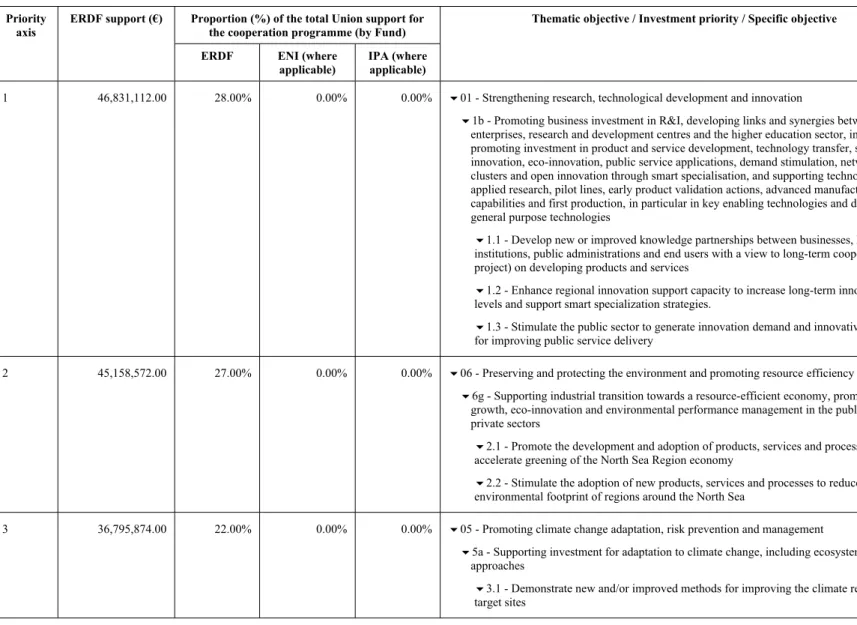
1. Thinking Growth: Supporting growth in North Sea Region economies - Knowledge transfer; Innovation capacity building; Innovation demand stimulation; Innovative public service delivery
2. Eco-Innovation: Stimulating the green economy - Carbon reduction; Promoting green economic activity
3. Sustainable North Sea Region: Protecting against climate change and preserving the environment – Climate change adaptation; Ecosystem management
4. Promoting green transport and mobility - Carbon reduction through multimodal and maritime freight transport; Sustainable transport solutions
A more detailed description of the issues to be tackled can be found under each priority.
Identification of the challenges and potentials to be addressed in the framework of European Territorial Cooperation in the 2014-2020 programming period
Priority Axis 1 - Thinking Growth: Supporting growth in North Sea Region economies
Thinking Growth focuses on how the North Sea Region can promote sustainable economic growth through innovation. All actions are particularly targeted towards support for SMEs. As well as being by far the largest category of businesses in the NSR, it is also here that innovation capacity is generally weakest. Three specific objectives are supported.
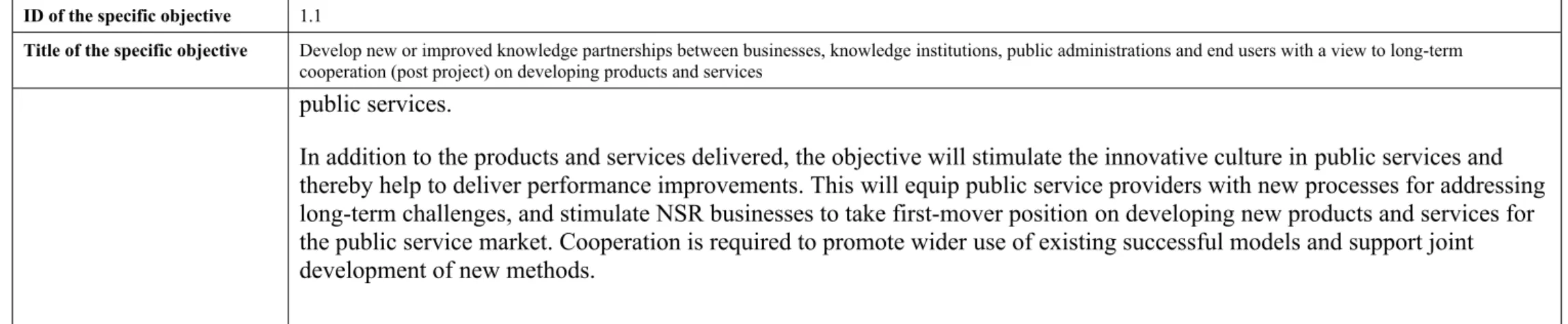
1.1 Develop new or improved knowledge partnerships between businesses, knowledge institutions, public administrations and end users with a view to long-term cooperation (post project) on developing products and services
This objective aims to address the identified needs of:
• Ensuring better knowledge exchange between knowledge institutions and businesses
• Increasing R&D expenditure especially in the private sector
• Increasing the number of new commercial products and services developed by businesses in the NSR
Activities will cover exchange of knowledge on how to engage businesses and
researchers in active knowledge partnerships, and how to ensure that this involvement leads to the development of new products and services, which will result in creating growth and jobs. Cooperation should also facilitate transnational innovation processes by establishing long-term links between related businesses, and between businesses and knowledge institutions in different countries. It is essential for the success of all actions
under this objective that they move beyond networking and stimulate new product development processes rooted in business needs.
1.2 Enhance regional innovation support capacity to increase long-term innovation levels and support smart specialization strategies
A region’s innovation capacity depends on the successful combination of a wide range of factors including education, types of sectors present, research intensity and the support of public authorities. The objective will support:
• Joint analysis of gaps in regional innovation capacity and development of methods to address them
• Long-term coordination around, for example, joint training offers, shared R&D infrastructure etc.
• Cooperation to identify new innovation potential outside existing innovation hotspots
It is important that innovation in the North Sea Region is not limited to a relatively small number of urban innovation hotspots. There is a need to look for new economic
opportunities in many sectors of the economy and regardless of location so as to ensure continued livelihoods for people throughout the NSR. This innovation should be place-based: firmly rooted in the capacities and realistic potentials of each region.
Transnational cooperation should be used to address disadvantages of location, scale and resources by pooling knowledge and facilities to address common challenges.
1.3 Stimulate the public sector to generate innovation demand and innovative solutions for improving public service delivery
The public sector is a major part of the economy in all NSR countries. The need for innovation arises from requirements to maintain service levels against a background of shrinking budgets and in many cases, an increasing demand for services. Transnational cooperation will:
• Share knowledge on how services are delivered and how innovation can improve this through, for example, increased digitalisation
• Analyse the need for new products and services to address shared challenges such as the ageing population, movement to urban areas, the need for greater efficiency etc.
• Support collaboration on how to stimulate businesses to deliver innovative solutions that can reduce the burden on public services
Efficiency and cost reduction in public service delivery are also important for the competitiveness of the NSR. This objective builds on strong stakeholder support for measures that promote public service innovation. It should at the same time stimulate private sector product development by promoting improvements to currently available products and services as part of procurement procedures.
Priority Axis 2 - Eco-Innovation: Stimulating the green economy
The Eco-innovation priority addresses the need to develop new approaches that can promote the more sustainable use of resources and reduce carbon emissions. Major investments and research programmes are currently running on both themes and will
provide significant long-term change. The aim of this objective is maintain momentum by spreading awareness of practical steps that can already be taken and promoting the take up of new technologies and processes. The NSR is still a world leader in renewable energy technologies and green industry and should also consolidate this position. There are two specific objectives:
2.1 Promote the development and adoption of products, services and processes to accelerate greening of the North Sea Region economy
Greening in this context does not refer only to support for traditional green sectors of the economy but rather to improvements in sustainability in any part of the NSR economy. Clearly this is a long-term process and the aim of this objective is to provide inspiration and show what can be achieved by applying new sustainable approaches. This should result in a developing body of transnational good practice on how to increase resource efficiency. This can also lead to reduced carbon emissions and manufacturing costs. Actions will include:
• Pilots to identify resource savings through innovative industrial design and manufacturing processes
• Pilots to experiment with new uses of renewable and locally sourced materials • Increased recycling of non-renewable materials supported by improved lifecycle
design
• Awareness raising of greening methods and results
People in the North Sea Region consume on average 16 tonnes of materials and throw away 6 tonnes every year[xxxiv]. This objective also supports coordinated action which will influence behavior and reduce these figures to more sustainable levels.
2.2 Stimulate the adoption of new products, services and processes to reduce the environmental footprint of regions around the North Sea
This objective addresses the need to increase renewable energy generation and reduce overall energy use. Transnational cooperation should help partner regions to:
• Identify viable opportunities for installing additional renewables infrastructure • Pilot installation of newer renewable technologies such as wave power and blue
energy
• Demonstrate the application of smart grid technologies as a way of saving energy and integrating more renewable power in the energy mix
• Reduce overall energy use by changing behaviour and increasing take-up of energy saving technologies
Energy is a complex issue with many stakeholders, regulations and limitations. Projects should help partners to identify realistic options within these constraints and demonstrate the carbon reductions that can be achieved, building on the many good examples
available of regional and district energy planning and implementation. There is also considerable scope for exchange on energy saving techniques and technologies. Cost-effective retro-fitting of older buildings is one area of considerable potential but this objective should also support partners to experiment with identifying completely new areas where carbon savings are realistic.
Priority Axis 3 - Sustainable North Sea Region: Protecting against climate change and preserving the environment
3.1 Demonstrate new and/or improved methods for improving the climate resilience of target sites
All of the analyses cited above flag climate change as a major issue for the NSR and this is confirmed by programme stakeholders. The most pressing need in terms of adaptation in the NSR is better flood control but other actions must ensure that all kinds of
landscapes and the marine environment are resilient to increased temperatures, more frequent and more severe extreme weather events, and changes to natural cycles and processes. This objective therefore addresses:
• Exchange of knowledge on the latest flood defence construction techniques targeting especially ‘build with nature’ methods
• Improved environmental and catchment management to improve the flood resilience of NSR landscapes
• Exchange of knowledge and demonstrations of new urban planning and infrastructure approaches to improve resilience
• Adoption of new and/or improved methods for tackling other effects of climate change such as drought, increased nutrient leaching and invasive species
Projects should also address the cost of such measures and how they can be integrated with other land uses in order to achieve the overall goal of stimulating more extensive adaptation investments.
3.2 Develop new methods for the long-term sustainable management of North Sea ecosystems
A robust natural environment provides food and resources, as well as regulating water and air quality and nutrient cycles. It is an essential element of quality of life, and protects against the most severe effects of climate change. Although awareness and actions to manage environmental threats have improved significantly over recent years, there are still serious challenges that have to be addressed if NSR environments are to continue to provide these functions. Actions under this objective should stimulate an exchange of knowledge and joint action to:
• Develop and implement long-term strategies for sustainable management of North Sea landscapes and the North Sea itself
• Develop and test new methods and technologies for tackling environmental problems
• Use participatory processes to win stakeholder support for environmental measures including promoting understanding of ecosystem services
Priority Axis 4: Green Transport and Mobility
NSR economies and societies are dependent on goods transport and the mobility of workers. For many years this has meant trucks for goods and cars for people and in most cases economies and societies have been planned around these solutions. These forms of transport are still overwhelmingly dependent on fossil fuels. This gives rise to serious concerns about carbon emissions and long-term fuel supplies and costs. In addition there
reverse these trends have been disappointing: road freight and car use continue to increase. This objective seeks to demonstrate where alternative solutions can be made to work, and to lay some of the groundwork for longer-term solutions where alternative fuels might offer a viable alternative for mass transport.
4.1 Develop demonstrations of innovative and/or improved transport and logistics solutions with potential to move large volumes of freight away from long-distance road transportation
The majority of international trade into the EU travels by ship through North Sea ports. Many goods are immediately transferred onto trucks although a significant proportion do already travel by rail or ship for the next stage of their journey until road becomes the only viable option for the last part of the journey. Improving the sustainability of long distance transport requires that more sustainable routes are available from transport hubs like ports and that these routes extend as far as possible into the hinterland to minimize the number of cargoes transferred to road and keep the road part of the journey as short as possible. If viable routes are established they can also be used for journeys from the hinterland to the transport hubs and also for shipment of goods between locations in the NSR and to other EU locations. Transnational cooperation is needed to:
• Identify viable multimodal routes and goods flows, and the barriers to wider use of these routes.
• Pilot solutions to remove these barriers
• Ensure that NSR services and routes link up to the major corridors being promoted by the European Union (TEN-T)
• Support the development of improved logistics solutions to facilitate these developments
All actions under this priority must have a strong strategic orientation based on action along the length of the transport chain concerned rather than just at isolated locations. Where infrastructure investments are supported it must be demonstrated that these will remove or mitigate important bottlenecks in the transport chains concerned and should realistically lead to increased multimodal traffic.
4.2 Stimulate the take-up and application of green transport solutions for regional freight and personal transport
Multimodal solutions apply mostly to long distance goods transport. Shorter journeys and personal transport generally require a different set of solutions. Transnational cooperation should be used to:
• Demonstrate the potential of immediately available solutions such as car-sharing, multi-use vehicles, and non-conventional fuels for urban public transport and freight distribution systems
• Continue to promote and prepare for the wider roll out of alternative fuels for privately owned vehicles
• Support other long term solutions like changes to planning rules and practices to reduce travel need and promote healthier forms of mobility
This objective is ambitious and tackles very complex challenges. The programme will therefore encourage applications from partnerships willing to take a lead and implement
systems in order to increase working knowledge of the steps needed and the benefits available.
Identification of the results sought for addressing challenges and tapping into potentials in the framework of the European Territorial Cooperation in the 2014-2020 programme
Authorities, businesses and communities are the users of policies and can make them work in practice. North Sea Region 2014-2020 aims to empower these users by joining forces and introducing innovative solutions that can make policy ambitions for the region a reality. The programme also provides a channel to report back to decision-makers on these experiences and influence the direction of future developments.
The description of each specific objective under the four priorities contains output indicators showing the main benefits that projects are expected to deliver within the project lifetime. These outputs should be seen as a ‘proof-of-concept’, validating the project’s approach by delivering progress on one or more core parameter.
The result indicators for each specific objective reflect the programme’s long-term intention to improve performance in each priority theme across the whole programme area or large parts of it. They attempt to capture the extent to which the outcomes of individual projects have been integrated into policies and practices, and how they therefore have a positive influence across the NSR as a whole.
Main target groups and types of projects envisaged
Participation in the programme is not limited to specific types of organization and will rather be decided based on:
· The ability of a partner to contribute to the outputs and results identified for the specific objective
· The extent to which the partnership can influence development in the wider programme area (i.e. not just a local effect)
· The overall balance of the partnership in terms of geography, expertise and competence (are the participating organisations able to influence the theme?)
· The ability of the partners to live up to the formal requirements for the programme There are differences between the legal status (public, private etc.) of parallel
organisations in different countries. Legal status does not, however, have a bearing on whether an organisation can participate but may affect the terms of participation especially for private sector bodies. Potential beneficiaries will include (the list is non-exhaustive):
· Public authorities and their agencies– National, regional, municipal and local administrations, regional development agencies, industrial parks and incubators, regional environmental agencies etc.
· Knowledge institutions – Universities, colleges, research centres, technology centres, providers of professional training, schools, consultants, cluster managers etc. · Enterprises – Including social enterprises and with a particular focus on small and medium sized enterprises
· Civil society – Associations, NGOs, charities, community organisations etc. In addition, many objectives have a clear sectoral focus, which should be reflected in partnerships (transport, energy etc.). Projects should however also take an inclusive approach involving stakeholders from different levels (local, regional etc.), from different institutions (government, research, business, civil society etc.) and with backgrounds in different relevant disciplines depending on the topic of the project (water management, agriculture, urban planning, creative industries etc.). Within these criteria, partners should be selected based on their potential contribution to the project theme. Not all target group representatives need to be involved in the partnership. Alternative methods of participation include membership of working groups and expert groups, acting as the subject of pilot and demonstration actions etc. Projects should ensure the effective involvement of the end-users of all deliverables. End users are diverse and range from citizens to decision-makers, entrepreneurs and consumers.
Projects should be planned around a programme of joint activities to deliver the required result. Successful examples of different types of projects include (the list is
non-exhaustive):
Projects with a focus on testing and training
For example, a problem or issue is raised in one or more of the partner countries and the entire project partnership works on developing a joint solution based on their regional or national experiences. This is typically tested at one or more of the partner country locations and in the best cases solutions are taken up in the long term by more than one of the partner countries. Some projects have applied this to training and have developed courses on a transnational basis for use by all regions around the North Sea.
Projects with investments and pilot actions
‘Pilot’ or ‘demonstration’ investments test a new or improved approach with clear and measurable differences to standard practices. These investments must be relevant to wider project and programme goals and must be rooted in the joint activities of the partnership. The best of the investments in past periods have piloted completely new ideas but even those offering only small adjustments to existing ideas can greatly benefit the regions concerned and provide very concrete proof of the value of continued
cooperation.
Development of best practice
Some projects primarily focus on knowledge transfer and exchange of experience within a transnational environment. Here networks and clusters have been created or improved to exchange knowledge between institutions in different countries. Joint discussions and continuous exchange have enabled the creation of jointly developed models and action plans that have been adapted for use by each partner region to enhance the work being undertaken by their organisation or region.
Development of new models, strategies
Projects may aim at changing national and regional policy and strategies for managing a certain theme. For such projects it is vital that all main stakeholder groups are involved in strategy development and especially the authorities which are mandated to adopt or change policy on the issue in question.
Up-scaling and expansion of new solutions
Some projects focus on the wider scale adoption of ideas that have already been tested in other locations and contexts. This is an acceptable approach provided that it can be demonstrated that adoption of these solutions will deliver better performance for participating regions against one of the programme’s specific objectives. Such projects should be designed to act as a bridge between testing and general adoption of the approach in question. Living laboratory approaches are one example.
All projects must observe the principles of inclusive and sustainable growth. As a result all projects should take account of the impacts of issues such as ageing populations, lack of relevant skills, social exclusion, the need to improve governance, and location
disadvantages.
Projects are invited to indicate how they comply with the regional innovation strategies
Linkages and synergy effects
The programme operates in a complex framework of related European, national and regional policies and frameworks. Section 6 of the Cooperation Programme contains an overview of how North Sea Region activities should harmonise with related programmes, funds and Regional Innovation Strategies, and the particular added value that
transnational cooperation is expected to deliver. The Strategic Review prepared by EPRC as part of the ex-ante evaluation contains details of main regional development policies. As part of the project development phase, projects should orient their proposals with these other funds to avoid duplication of effort and ensure that project ideas are being targeted towards the most appropriate programme.
The wider policy context has informed the development of the OP and will continue to do so though the detailed guidance to project developers produced for each call for applications. During programme implementation a number of mechanisms are also in place to ensure the development of synergies between North Sea Region projects and results, and related activities under other programmes. These include:
• Coherence checks of all applications against latest policy by Steering Committee members and national sub-committees
• Events and publications to inform North Sea Region stakeholders about interesting developments
• Meetings with representatives of programmes outside Interreg (e.g. through Interact)
• Clustering of project results and facilitating contacts with stakeholders outside the programme
In addition, the programme monitors the implementation of coordination mechanisms in neighbouring areas such as the EU Strategy for the Baltic Sea Region and the Atlantic
Strategy. Project links with these strategies are encouraged where there is a clear benefit for the North Sea Region. The option to allocate up to 20% of programme funds to partners from outside the programme area may be used in such cases where it can be satisfactorily demonstrated that external partners provide inputs not available within the programme area.
1.1.2 Justification for the choice of thematic objectives and corresponding investment priorities, having regard to the Common Strategic Framework, based on an analysis of the needs within the programme area as a whole and the strategy chosen in response to such needs, addressing, where appropriate, missing links in cross-border infrastructure, taking into account the results of the ex-ante evaluation
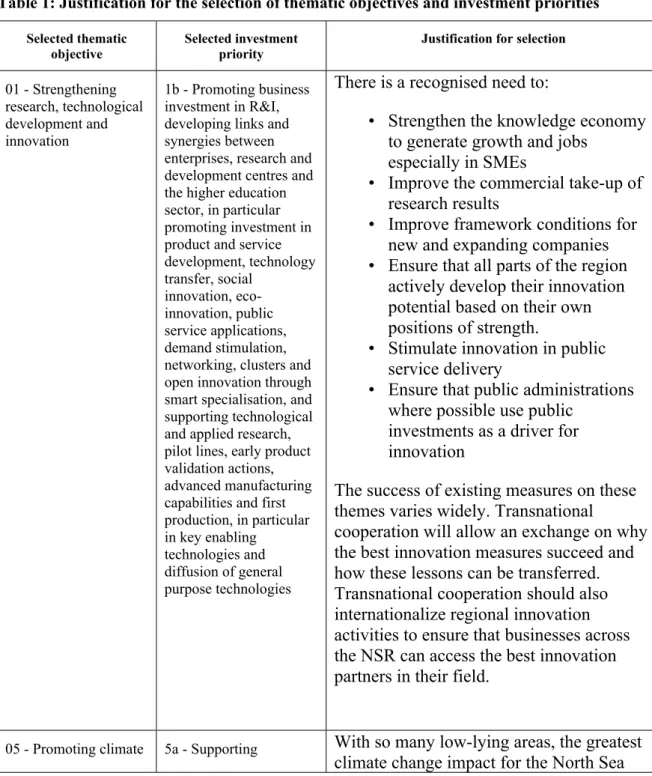
Table 1: Justification for the selection of thematic objectives and investment priorities
Selected thematic
objective Selected investment priority Justification for selection
01 - Strengthening research, technological development and innovation 1b - Promoting business investment in R&I, developing links and synergies between enterprises, research and development centres and the higher education sector, in particular promoting investment in product and service development, technology transfer, social innovation, eco-innovation, public service applications, demand stimulation, networking, clusters and open innovation through smart specialisation, and supporting technological and applied research, pilot lines, early product validation actions, advanced manufacturing capabilities and first production, in particular in key enabling
technologies and diffusion of general purpose technologies
There is a recognised need to:
• Strengthen the knowledge economy to generate growth and jobs
especially in SMEs
• Improve the commercial take-up of research results
• Improve framework conditions for new and expanding companies • Ensure that all parts of the region
actively develop their innovation potential based on their own positions of strength.
• Stimulate innovation in public service delivery
• Ensure that public administrations where possible use public
investments as a driver for innovation
The success of existing measures on these themes varies widely. Transnational
cooperation will allow an exchange on why the best innovation measures succeed and how these lessons can be transferred. Transnational cooperation should also internationalize regional innovation activities to ensure that businesses across the NSR can access the best innovation partners in their field.