THE MASTERY LEARNING MANUAL
CHAPTER 1 INTRODUCTION TO MASTERY LEARNING
Introduction by Carla Ford 1
Perspective on Training:
Mastery Learning in the Elementary School 2
CHAPTER 2 AN OVERVIEW OF MASTERY LEARNING 4
Philosophy and Rationale of Mastery Learning 4
The Theory of Leaning in Mastery Learning 10
Mastery Learning Research and Practice 12
The Chicago Mastery Learning Reading Program 13
The PRC Mastery Learning Field Trials 13 CHAPTER 3 THE CORE MASTERY LEARNING COMPONENTS
Preparing Students and Parents for Mastery Learning 14
Creation and Organization of Objectives 16
Initial Presentation 24
Presenting the Lesson 24
Developing High Expectations 27
Gage's "Teacher Should" Statements 35
Formative Testing 36
Development and Selection of Formative Tests 36
Administering the Formative Test 39
Analyses of Formative Tests / Record keeping 40
Using Multiple Sources of Formative Tests 41
Correctives 45
Strategies for Reteaching 45
Principles for Small Group Instruction in
Beginning Reading 47
Providing Enrichment for Masters 51
Moving on to the Next Unit 52
Dealing with Persistent NonMasters 53
The Summative Test 53
CHAPTER 4 CASE EXAMPLES
CHAPTER 5 CHECKING IMPLEMENTATION
Why Some Programs Fail 55
Mastery Learning Checklist 57
Implementation Assessment Battery 59
CHAPTER 6 FREQUENTLY ASKED QUESTIONS 76
APPENDICES
Chicago Mastery Learning Reading
Short Term Impact of a Mastery Learning Preventive Intervention on Early Risk Behaviors
CHAPTER ONE
INTRODUCTION BY CARLA FORD
The Baltimore City Public School system, long concerned with issues of improving learning and enhancing children's feelings of success and competency, has, over time, attempted to define and apply teaching procedures believed to be of value in the educational process. One such strategy, conceptualized by Benjamin Bloom as "Mastery Learning", has received favorable attention from our school system due to its positive impact on learning and self-esteem. Of particular interest to us are: (1) the identification of ways to enhance the learning process; and (2) the design, development and implementation of supporting staff development activities.
Over the last five years, the Baltimore City Public Schools and the Prevention Research Center of the Johns Hopkins School of Hygiene and Public Health have been working together to implement an enhanced Mastery Learning program in schools throughout the Eastern District. The "Mastery Learning Manual" represents our collective thoughts
concerning concepts, procedures and methods found to be most effective in utilizing and applying Mastery Learning as an instructional strategy. Insomuch as results from the first years of study show that this strategy was indeed successful in increasing learning, this manual is viewed as an important step in institutionalizing concepts of the model.
I am grateful to the administrators and teachers whose participation in the project enable us to test ideas and develop this manual. A special note of appreciation is extended to Mrs. Vera A. Newton, early childhood specialist, for her outstanding contributions to the
development of the model, training of staff, preparation of this manual, and dedication to children and families throughout the Baltimore City Public Schools.
Carla Brewington Ford, M.Ed Supervisor
PERSPECTIVE ON TRAINING: MASTERY LEARNING IN THE ELEMENTARY SCHOOL This training is developed for elementary school teachers interested in implementing mastery learning in their classrooms. It will cover recent theory and research in mastery learning, a critical analysis of current mastery learning programs, the development of teaching strategies necessary to implement mastery learning, and actual material preparation associated with a mastery learning program.
The goals of the training are:
1) To reinforce and strengthen knowledge in the following: a) Clearly stating objectives and instructional goals
b) Ensuring clear linkage between objectives, teaching, and testing c) Communicating high expectations for success
d) Packaging small, sequenced instructional units e) Maintaining the basic teach-test-correct-test cycle f) Pre-setting unit mastery standards
g) Keeping clear and updated records of student progress in a form understandable to the students, and providing immediate feedback
h) Committing to staff development and assuring successful implementation
2) To develop a more group-based approach to mastery such that the entire class do not proceed to the next unit until the majority of students have fulfilled the learning objectives of the current unit (80% achieving 80%-85% of objectives). Therefore, more than one formative test may be necessary to assure such a standard has been achieved.
3) To develop a flexible corrective process tailored to specific weaknesses of students. The key to the effectiveness of mastery learning lies in systematic provision and use of
correctives. Corrective instruction, by its very nature, must be targeted toward particular learners and particular learning problems or difficulties. This process will be flexible in terms of:
a) Time:
The time line for correctives will allow for thelikelihood of more time needed for the
corrective process during the early units and more efficient use of time with each additional unit. The efficiency results from students meeting the prerequisites and therefore displaying increased time-on task.
b) Grouping Strategy:
The grouping strategies will include whole group instruction, small group instruction, peer tutoring, and individual tutoring. Decisions will be made in light of formative testing item analyses and available resources. The grouping of students for correctives will depend solely on formative test feedback with allowed movement from mastery to non-mastery subgroups. Group membership should not remain stable.
c) Variety:
A major goal of training and development will be to increase the variety of correctives available to the teacher. These correctives, clearly linked to specific objectives and test items, will focus on alternatives to previous instructional techniques.
A systematic linking of objectives, test items, error prescriptions, and correctives will be developed and reinforced through an instructional management model.
Students who attain mastery on the first formative test will be involved with extended learning opportunities in the same subject, or preferably, they will be involved in peer tutoring of the non-mastery students.
4) To familiarize the teacher in the theory, assumptions, and applied research on mastery learning. In addition, the specific teaching strategies will be the focus of an extensive staff development and follow-up period.
CHAPTER TWO
PHILOSOPHY AND RATIONALE OF MASTERY LEARNING
Those interested in using the mastery learning approach first need to understand that it has two components.
One component of mastery learning is its educational philosophy -- its set of beliefs about learning and teaching. These beliefs are what shape the methods of mastery learning and the attitudes of the teachers who use the mastery approach. This section is devoted to explaining these beliefs.
The other component of mastery learning is its method of instruction. Mastery learning involves a set of clear steps for selecting content, teaching, and determining students' progress. None of these steps is new in itself, but as a package they are extremely effective in enabling most students to learn well. These various steps will be enumerated later in the manual.
The beliefs on which mastery is based are very different from what many educators were taught over the years about learners and learning. They are bold, optimistic statements, and to some they might at first seem naive and even foolish. The reader is asked to suspend doubts and to remain open to these beliefs. Experience indicates that the teacher who firmly rejects the mastery philosophy while using the mastery method of instruction will find the program quite mechanical and soon give up. The teacher who enthusiastically embraces the mastery philosophy brings the method alive and produces startling results in the classroom. And the teacher who is somewhere in the middle-- who isn't sure about the beliefs, but is willing to try the method and remain open-- becomes a believer over time as a result of what happens with his or her students.
Basic Assumptions
The belief system of mastery learning starts from two basic assumptions:
1) Virtually all students can learn all important academic content to a level of excellence.
2) The primary function of schools is to define learning objectives, and to help all students to achieve them.
These assumptions imply that an effective teacher or school system will not produce a bell-shaped curve of student learning, with a few good students, many mediocre ones, and a substantial proportion of failure. Instead, the measure of effectiveness of teachers, schools, or school systems will be how close they can come to getting 95% of their students up to the levels that are now reached by only about a tenth of the students.
The main developer of the theory and practice of mastery learning has been Benjamin Bloom, an educator at the University of Chicago. In the preface to his recent book, Human Characteristics and School Learning, Bloom explains the stages of belief that he went through before arriving at the assumptions explained above. These seem worth describing because they are the stages many will experience in moving from the beliefs that are now generally accepted to those of mastery learning.
The first stage Bloom describes is one where he believed that some students are good learners and that's how it will always be. The good learners can learn more in terms of both quantity and quality -- that is, they can cover more material, learn more complex content, learn faster, and retain better than poor learners. What follows from this belief is an educational system that tries to sort the good learners from the poor ones, and to teach each group that which it is capable of learning. In such a system, the difference in achievement between the good and poor learners grow greater with every year the students are in school.
The above is a fairly accurate description of what happens now in most American schools. Bloom, however, says this is not what has to happen -- it is simply a result of what most educators believe and the way they teach.
The second stage Bloom describes is one where he believed that all students can eventually learn and retain equally complex or difficult material, but that some will learn much faster than others. This belief would suggest an educational system where the really important content is taught to everyone (with some taking longer than others to learn it), and then the faster learners get lots of enrichment.
Early mastery learning approaches were based on the above belief. However, after years of research with these approaches, Bloom found to his surprise results that led him to his third, and current, set of beliefs. He found that, if students are given favorable learning conditions, even the differences in their rate of learning disappear. In other words, if the schools do their job right, 95% of all students are capable of learning the same amount of material to the same level of difficulty at the same rate and with the same attitude toward learning. This is the belief statement that is now the central core of mastery learning. Bloom states it this way: "most students become very similar with regards to learning ability, rate of learning, and motivation for further learning -- when provided with the favorable learning conditions."
Individual Differences
Many people who are trying to understand mastery learning become confused at this point about what the approach is saying about individual differences. Do Bloom and the other supporters of mastery learning really believe that all students are the same? Don't they see the different skills that even preschoolers bring with them to the classroom? Don't they read the literature about different learning styles? Don't they recognize and value each child's uniqueness? Isn't there something un-American about seeking to make individual differences in learning vanish?
The answer to this set of questions has several parts. First, advocates of mastery learning are well aware that students now enter school with different skills, and that there exist great differences in achievement between different school systems, schools, and classes. Their point is that these differences are not inevitable -- rather, they are a product of the way our society, homes, and schools operate.
Second, mastery learning advocates agree that children may have different styles of learning. They agree that children may need to learn in different ways, but that does not have to result in different levels, rates, or attitudes toward learning.
Third, they point out that what looks like a difference among students in rate of learning is usually really a difference in proportion of time spent on task. In a typical 45 minute period, "good" students might spend 90% of the time really learning, while "slow" students might be spending only 33%. Again, then, these differences can be made to vanish if educators can find teaching approaches which increase the "slow" learners' time on task.
Finally, mastery advocates are not trying to deny or eliminate each person's uniqueness. They agree that people have different personalities, preferences, values, perspectives, strengths, and problems, and that these are healthful differences. However, they see no reason why these have to translate into achievement differences which then put many people at a great disadvantage throughout their life.
Another way of looking at this belief is this. Any group of students will always enter a learning situation with a great many individual differences in everything from preparation in the subject, to learning style, to personality. Teachers can regard these differences as important in determining success, and use them to excuse different levels of achievement at the end of the learning experience. Or, they can assume that all students can achieve at the same high level, and use knowledge of their differences to help determine the most
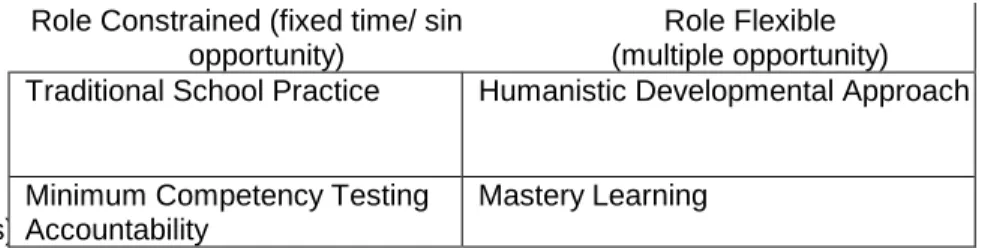
ROLE SYSTEM GOAL SYSTEM Role Constrained (fixed time/ sin
opportunity)
Role Flexible (multiple opportunity) Goal Implicit (vague referenced
assessment; private variable standards)
Traditional School Practice Humanistic Developmental Approach
Goal Directed (criterion referenced assessment; public fixed standards)
Minimum Competency Testing Accountability
Mastery Learning
Figure 2.1 A framework of Organizational Variables that Affect Instructional Operations
effective ways to help each student learn. The second approach is the way mastery learning looks at individual differences.
Bloom makes a similar point in his books when he talks about America's commitment to equality of educational opportunity. What he says is that phrase has traditionally been interpreted to mean that all children, despite their differences, should get equal educational
inputs. This system results in greatly different levels of achievement. The mastery approach calls for educators to reinterpret "equality of educational opportunity" to mean a commitment to equal educational outcomes. Each child should have a lesson, a class, a level of schooling that will ensure approximately equal chances to succeed in the years to come.
Organizational Perspective
From an organizational perspective mastery learning represents a shift from the time and role based structure of student task assignment in traditional school practice to an outcome and goal based one. In traditional schools students proceed on a fixed schedule and student certification is vague-referenced and privately defined. In the mastery learning systems, however, student assessment is criterion referenced (based on students' achieving stated goals) and publicly defined, and students get multiple opportunities to master stated learning objectives.
Figure 2.1 shows how instructional models are constrained by their student evaluation/certification/promotion system and how mastery learning and traditional school practice fall under these constraints. We see that mastery learning takes us from an exclusionary instructional model, where success and advancement are reserved for those who can meet whatever vaguely defined standards in a predetermined amount of time on their first attempt, to an inclusionary model where access to success is open for all.
Group-Paced vs. Individualized Instruction
Given the above description, one might assume that mastery learning would be most effective as an individualized program. It is certainly possible to individualize with mastery, and many mastery approaches are based on such a system. However, the mastery approach advocated by Bloom and by this manual is based on group-paced instruction.
Group-paced instruction basically means trying to move the whole class through a body of content together. It can include whole-group presentations, work with small groups or student teams, and help for individual students. However, small group work and help for individuals will almost always be done with the goal of bringing these students to the same level as the rest of the class. The overall objective will be for the class to master content together.
For students who are well-prepared and master quickly, group-pacing means that they will spend time doing enrichment activities, as well as helping other students who haven't mastered. These enrichment activities are an extension of the concepts the whole class is working on, and allow the students both to reinforce the concepts and to apply them in new ways.
Individualized learning, on the other hand, means that all students are taught in one style (usually through a programmed or highly structured set of materials). Most importantly, they are allowed to proceed at their own rates. This means that students with stronger entry characteristics and/or students who learn well independently end up learning far more than their classmates. Students who are just as capable but whose style of learning is different often fall further and further behind.
This program advocates group-pacing for several reasons. First, philosophically, the program starts with the goal of equalizing educational outcomes. The goal is not to "move every child at his or her own pace"; the goal is for every student to master the same body of knowledge.
Second, group-paced instruction builds a strong sense of community in the classroom, and a climate that is supportive of learning. Students become committed to the goal that everyone will master, and give one another strong encouragement, help, and recognition.
Finally, group-paced instruction is more practical than individualization. Good individualization requires a degree of preparation and a pupil-teacher ratio that are simply not realistic.
Group-paced instruction has definite advantages in terms of equalizing educational outcomes, of building group feeling in the classroom, and of being efficient and practical. Bloom is quick to point out, however, that it also has what he calls "built-in error." That is, no one lesson can ever be just right for all 33 students in the room. For that reason, a key feature of the mastery approach is diagnosing these errors, and correcting them right away. These "correctives" will be explained later on in the manual.
Basic Elements of the Approach
It seems useful to outline here the elements of mastery instruction and to relate them back to the rationale explained above. All of these steps are described in detail in chapter 3, with many examples, so the discussion of them at this point will be brief. The steps are presented in the order experienced by the student; they are implemented by the teacher in a somewhat different sequence.
Element I: Define what is to be learned
This element refers to the second basic assumption of mastery -- that the primary task of schools is to define what should be learned, and to see to it that all students reach this level. The learning objectives are at this point determined by the individual teacher, using whatever curriculum guides, textbooks, or level tests are available. What is important is that both the teacher and the students understand and focus on the objectives.
Element II: Teach the material
Initial teaching in a mastery classroom will look much like that of any effective teacher. Material may be presented through lectures, demonstrations, discussions, films, or whatever approach the teacher finds most appropriate. However, two other features will be evident. First, goals for the lesson will be clearly stated. This provides the cues that Bloom says are part of quality instruction. Second, the teacher will explicitly let the students know that s/he believes all the students can learn the material well, and expects them to do so.
Element III: First Formative test
After all the material for the unit has been presented (which might take one class period or several weeks), the teacher gives a formative or practice test to see what the students have and haven't learned. This test does not count toward a grade; rather, it is a way of letting both the students and the teacher know where more work is needed. This is the step that provides the feedback needed and identifies the errors in group instruction.
Element IV: Learning alternatives
Next, students are provided with learning alternatives. Those who had trouble with the formative test will be re-taught in new ways to correct the errors of the group instruction. Those who have already mastered the material will participate in enrichment activities, and/or help other students.
Element V: Second Formative Test (or Retest)
After the learning alternatives have been completed, the teacher gives a second test on the same material. Assuming that most of the students master, the class is then ready to move on to new material. (Additional steps for dealing with students who still haven't mastered will also be discussed.)
Element Vl: Summative Test
This test is given every several units. It is designed to test students' overall learning thus far. It will tell the teacher how much the students have retained.
THE THEORY OF LEARNING IN MASTERY LEARNING
The mastery philosophy has a theory of learning that helps to explain the difference between what happens now in schools and what could happen. Bloom summarizes the theory in the following chart:
Bloom describes the learning process through three categories: the characteristics of the student, the instruction, and the learning outcomes.
Important student characteristics are of two types. First, there are "cognitive entry behaviors," which means the student's degree of preparation in the particular subject being taught. This does not mean generalized intelligence or general school preparation - concepts that Bloom feels are not useful in looking at how a student does in a particular learning experience. Second, there are ''affective entry characteristics," or how the student feels about him or herself as a learner, about the particular subject being taught, and about school in general.
Learning Tasks
Level and Type of Achievement
In looking at instruction, Bloom identifies four key factors that determine the quality of instruction for a given learner: 1) cues about what is to be learned; 2) encouragement of student participation; 3) reinforcement of learning, and 4) feedback about correct and incorrect responses. (These will be explained when we discuss the components of mastery learning in more detail.)
In terms of learning outcomes, he sees three important categories: First, there is the level and type of achievement that results from the learning experience. Second, there are the affective outcomes-- the student's attitude toward what went on, and toward future work in that subject.
The charts below illustrate the way this theory describes the progress of two different students through the same learning experiences -- say, long division. In this example, Shirley comes to the situation with positive cognitive and affective entry characteristics. She is well-prepared in terms of her skills in number facts and the concept of division. She thinks of herself as good at learning math and has a positive attitude toward math class and school. Judy, on the other hand, is poorly prepared in terms of number facts and the concept of division, sees herself as a poor math student, and dislikes math class and/or school.
If both students receive similar instruction, it is clear that the learning outcomes will be very different. Shirley will in all likelihood come out with a positive attitude. Judy, however, will probably learn slowly, spend less time on task, achieve limited success, and leave the experience feeling even more negative than she did when she started. Unless changed, this process will be repeated lesson after lesson, day after day, year after year.
It is easy to see that the eventual difference between Shirley's and Judy's math achievement is likely to be very large. What is significant about Bloom's approach is that he does not think it useful to explain that difference by saying that Shirley is more intelligent than Judy. He says instead that the learning conditions were more favorable for Shirley than for Judy. These factors are more useful to focus on, because they are ones that the teacher can do something about.
The mastery approach seeks to erase the difference between Shirley's and Judy's learning outcomes at several points in this process. It starts by assuming that Judy is as capable of learning the material as Shirley is, but that Judy's cognitive and affective entry characteristics must be improved. This means that it is the teacher's job to help her upgrade the skills that are prerequisites for learning long division, and to offer encouragement that will help her have a more positive view of her ability to learn the material. Then the approach calls on the teacher to be sure that the instructional methods are ones that reach not only Shirley, but Judy as well. This may mean teaching the same material more than once, and in different ways. Given this kind of mastery approach, Judy can come out with as much knowledge as Shirley and with a whole new attitude toward learning math. After several such positive experiences, Judy should be learning as quickly as Shirley.
MASTERY LEARNING RESEARCH AND PRACTICE
Previous implementations of Mastery Learning in school environments, such as the Chicago Mastery Reading Program for primary schools and the program by the City Colleges of Chicago, have proven successful in many areas. Some of the more significant findings to come form these field studies of mastery learning are as follows:
1. Properly implemented, mastery learning strategies have been useful in increasing the level of achievement of students who meet the minimum standards of participation. Higher levels of retention and future application of skills have been documented. One critical finding is that general measures of aptitude fail to predict summative achievement within the mastery strategy, demonstrating that feedback and corrective strategies can overcome the specific history of the learner.
2. Many studies have attempted to study more than the achievement outcome of the learner. Particularly exciting are the results which demonstrate the level of involvement and the use of time under varying instructional conditions. These studies have shown that the investment of extra time early in the sequence is balanced by a payoff of more effective use of time at the later stages of learning. Moreover, this higher degree of active learning time is due to the student's internalization of instructional processing skills, such
as ability to evaluate, correct, and reward one's own learning. The student tends to have more control over his/her learning and becomes more self-reliant in the processing of instruction. 3. Finally, there are important affective consequences. Using mastery learning techniques, the learner tends to become more interested in the content being learned and feels more competent as a learner. This research has paralleled the findings of positive affective consequences under direct teaching approaches of compensatory education interventions (Project Follow Through). In addition, recent evidence suggests that extended time under mastery conditions during the primary school years can have an impact on more general affective characteristics which parallel the dimensions of positive mental health. It is likely that these concerns, the motivation for future learning and the impact on personal adequacy, will have an effect comparable to the cognitive outcomes of the mastery strategy on the student's adaptation to future learning experiences.
THE CHICAGO MASTERY LEARNING READING PROGRAM
Included in this section of the manual is an overview of the mastery learning reading program implemented in Chicago in 1981. While there are minor elemental and procedural differences between the Chicago and Baltimore programs, the substantial similarities between the two, both in terms of their underlying philosophies and in the key process of the teach-test-reteach-retest cycle, far outweigh the differences. We include the Chicago Mastery Learning Reading (CLMR) program here as an example of how this philosophy and methodology have been successfully implemented in another district.
One difference in the two programs is their relative structuredness. The Baltimore perspective allows much more flexibility for the teacher -- and it also requires more teacher planning. However, despite not having the manuals and books, the Baltimore teacher might wish to adopt or work into his/her own plan some of the activities and/or techniques mentioned in the CMLR overview -- such as SQUIRT, for example. The reader will find that many of these suggestions are echoed in other parts of this manual and are consistent with the Baltimore perspective. CMLR might even serve as a model for a teacher's in-class implementation.
THE PRC MASTERY LEARNING FIELD TRIALS
From 1985-1988, a large scale field study of the effectiveness of the enhanced mastery learning training was conducted within the Baltimore City Public Schools. The major focus of the study was the impact of the enhanced mastery learning training on student achievement, concentration, and self reports of depression. The enhanced mastery learning training utilized the materials covered in this manual in the context of thirty hours of staff development and the provision of a variety of supplementary materials to the reading curriculum. The study demonstrated that such training could have a positive impact on achievement and to a lesser extent on concentration and depression. However, a link between improved achievement and decreased levels of depression was noted, suggesting the possibility that continued improvement in achievement through mastery learning could result in important mental health outcomes.
PREPARING STUDENTS AND PARENTS FOR MASTERY LEARNING
Even though mastery learning probably incorporates elements of teaching which you have previously used, it will be important to inform the students right from the start that this will be a mastery learning classroom and that it will be different from many other classes they have been in. One might say, for example:
"Students, this year we will be using a different approach from what you might be used to. This is a mastery learning classroom. That means that I will be operating under the strong belief that each and every one of you can learn whatever is taught here. You will all learn each topic we study so well that on the tests everyone is expected to get an A or a B. I want you to know that I believe each of you is capable of learning to a mastery level. That means I will be pushing you very hard, but it also means that if you try, if you follow the assignments and are here, there is no reason why you can't achieve mastery.
"You're probably wondering how this is going to work. There are several important steps which aren't really all that mysterious. First, I'm going to tell you very clearly exactly what it is I want you to learn. I'll be doing this every day so no one should be confused about what we are studying. Second, after we learn our lessons, I'll give you a practice test, but the purpose of this test is only to let you know precisely what you've learned and what you haven't learned yet. Then you'll have a chance to study what you don't know, but this time you'll study it differently. Maybe you'll use a different book, or maybe one of your classmates will explain it to you. The fourth step is the retest -- everyone gets a chance to take a second test and I'm pretty sure by that point you'll almost all be ready to achieve mastery. And if by some chance you haven't gotten it yet, then we'll find a way for you to learn some more and then take a third test. Your grade will be based on thelast test you take; the practice test or tests will just be to used to show you and me what you have learned and what you still need work on."
The methods teachers can use to explain how mastery learning will work depends on the grade level. Some teachers have used bulletin boards and posters to publicize and emphasize that theirs is a mastery learning class. These posters can contain simple slogans like, "Mastery learning means YOU will achieve excellence." Other teachers have used the first day of class to walk through the steps in mastery learning with the students.
Many teachers use charts to record the class's progress in mastery learning. Some charts show the percentage of students getting mastery on each unit while other charts list each student's name and place an "M" beside it for each unit where mastery is achieved. Another teacher uses a piece of construction paper for each unit, listing the topic and then writing the name of each child who achieve mastery.
The important thing is to let students know: (1 ) that this is a mastery class; (2) what mastery learning is and how it works; and (3) that you will be keeping close watch on how
well the class does. It will enhance the process if the class develops a real spirit about both individual mastery and that of the whole class.
The effectiveness of the mastery approach can be further enhanced by enlisting the understanding and support of the parents. There are various ways to do this. Some teachers have sent a letter home explaining the basic aspects of mastery learning and how they, the parents, can help. Other teachers have explained mastery learning to the parents at the end of the first report period when conferences are held. Another means would be to call a class meeting of the parents at the beginning of each school year. In the cases of the letter and the class meeting, it is necessary to secure the permission and support of the building administrator. When informing the parents about mastery, the teacher should not give them the sense that their children are being experimented on. Rather, s/he should emphasize the goals and methods of the approach, just as was done with the students.
Parents can be helpful by asking their students questions about the subject matter content which has been specified by the teacher. Probably the most helpful thing parents can do is to assist their children in reviewing the first formative test and to see what still has to be learned. In a few cases, for example, teachers have operated under a fixed schedule so that parents know to look for the first test, say, every other Thursday evening.
While it is helpful to explain mastery learning to the parents and to enlist their support, it should be noted that the success of this approach does not depend upon their involvement. Students can achieve mastery even if their parents do not take an active role in the process. Mastery has been reached by many students whose parents were uninformed and non-supportive.
It is quite possible that some parents of better prepared students will indicate that they don't want their child held back by other students. In this case it will be useful to indicate to them three things: (1) the research evidence has shown that in the long run mastery benefits not only the poorly prepared students, but the entire class; (2) students who achieve mastery will be provided with enrichment sheets, projects, and exercises that will enhance their in-depth learning; and (3) the chance to help others enhances a student's sense of self and develops in him/her a valuable social skill.
CREATION AND ORGANIZATION OF OBJECTIVES
The first task in planning a mastery learning course is to define exactly what the students are expected to learn and at what level this learning is to take place. These learning objectives are an important part of any form of teaching, but they are fundamental to mastery learning. Not only do they serve to focus instructional activities, but in mastery learning they also serve as a basis for developing formative tests and corrective activities.
Teacher Decision Making
The first step in defining objectives for a mastery learning course is to identify the final learning goal. The teacher (or curriculum developer if this is not the same person), within the institutional constraints of his/her school district, has to decide at what level his/her students are to be able to perform at the end of the year or term. There are several factors that will influence this decision. Figure 3.1, based on the work of Richard J. Shavelson, illustrates how teachers make preinstructional decisions.
come from sources such as previous class performance, informal observation, and reports from other teachers. Teachers can use these cues about students to determine their interests, preparedness in the subject area, and other entry characteristics.
Preinstructional decisions about what and how to teach can also be influenced by teachers' personal educational beliefs and cognitive styles. Teachers can have widely varying opinions on which cognitive skills are important, or the relative importance of affective goals (how the students feel about content, themselves, and others) and cognitive goals (subject matter knowledge). Such differences will affect their decisions relative to their final goal.
Shavelson's model suggests that the nature of instructional tasks is another source of influence on instructional decisions. The fact that a particular text or curriculum is available may make some instructional strategies more appropriate than others. Curriculum packages may also tend to make some student cues more important than others.
Teachers must be aware of how they make decisions, not just operate on some vague theories. Just as important, teachers must consciously monitor progress toward their goals. Making decisions on long term objectives is a dynamic process. Student feedback during the course of the year, either through explicit comments or subtle behavior, may legitimately change some goals as new student cues are discovered.
Learning Units
After determining the final learning goal, the teacher must identify the specific elements of this goal. What specifically must a student know or be able to do in order to be considered to have achieved the level defined in the final learning goal? Ideally, each of these elements can be taught as a single unit or will have natural breaks where units can begin and end.
Next, the teacher must sort these learning units into some order of presentation. In determining the starting point and the general schedule for the course, the teacher must consider not only the relative importance of the elemental objectives, but also their logical sequencing. For example, it is necessary to determine whether some of these objectives involve skills that must be mastered before one can pursue another objective. Other considerations for the first or early units include brevity, types of skills needed, probability of success, and anxiety-arousal properties.
Unit Objectives: Table of Specifications
Once one has decided how the material for the course of a year will be placed into units and how these units will be sequenced, one has to determine what the specific objectives are for each unit. Table 3.1 gives a list of types of content that the teacher might want each student to know for each unit. However, when organizing the objectives for a unit the teacher must determine not only what content and what types of content the students are to know, but also what the student is expected to be able to do with it.
According to Benjamin Bloom there are several categories or levels of learning, with knowledge being just the lowest of these. Table 3.2 gives a list of the different levels of educational objectives. Thus, if a teacher would like his/her students to be able to apply a certain content element to a different situation, s/he will have to list application of that content as one of the learning objectives; s/he would have to teach application of that content.
When preparing learning objectives many teachers have found it helpful to use a table of specifications. Figure 3.2 shows an example of one such table. Thus, preparing the objectives for a unit involves no more than listing all the terms, all the facts, the concepts, the rules and principles, and the processes and procedures that the teacher expects the students to know by the end of the unit, and then indicating whether s/he expects them to also be able to perform translations, applications, analyses and/or syntheses on the content presented.
The table of specifications can also be used to illustrate relationships among content elements. Figure 3.3 shows three learning tasks with different degrees of interrelatedness. The teacher might find that in some units there is hardly any relationship among the content elements, while for others there is a complex structure of interrelatedness. A particular translation, for example, might involve understanding of two processes and three facts, which in turn depends on knowing the definitions of several terms. And that ability to translate might be required to make a certain application. By drawing lines between related elements the teacher can keep track of all these relationships so that s/he can develop them for the students.
If a unit is fairly long, the teacher might want to put a date next to each term, fact, etc. for when s/he wants to introduce that objective. It is important that the teacher have a clear and specific idea -- and clearly convey to his/her students that idea -- of not only what the unit objectives are, but what the lesson objectives are
for
each day.The table of specifications will also aid in preparing the formative tests. One key to mastery learning is that the formative test must be a diagnostic as to how well the students have grasped the learning objectives. It must test for only the knowledge and performance stated in the objectives, and it must test for all the knowledge and performance stated in the objectives. It is a good idea, then, to prepare the formative test about the same time that one prepares the learning objectives for a unit, using the table of specifications as a sort of checklist of material to be included in the tests.
A table of specifications can also be useful as a guide during teaching activities. It can help the teacher to focus on what is to be taught. However, it does not free the teacher from developing lesson plans. Just having objectives of what the students should learn is not enough; it is still up to the teacher to determine how s/he and his/her students will achieve those objectives. Thus, included with the learning objectives should be information on how the unit will proceed . Will it involve lectures, films, class participation, etc.? The teacher will find that having his/her learning objectives clearly delineated will aid in selecting methods of instruction.
Whatever method the teacher decides to use in planning the unit s/he must realize the usefulness of precise and measurable learning objectives. The objectives help the teacher focus and stay on task, but, in addition, when a student knows precisely what s/he is expected to learn, and when s/he knows how and when these objectives are achieved, his/her learning is greatly enhanced.
INITIAL PRESENTATION
This phase of the mastery learning format is under the teacher's control. The individual teacher decides how the lesson will be taught and how many periods it will take. Usually s/he follows much of what s/he has typically done in the past when teaching this unit. His or her own experiences with what approach went well previously is most important. (Generally, teachers have found that if they are doing a one week unit, the initial presentation takes 2-3 periods while that for a two-week unit will take approximately 6-7 periods.)
Though the mastery learning program allows total freedom for the teacher regarding curriculum and instruction, studies have shown that there are certain teacher behaviors that either help or hinder students in achieving academic gains. The reader is encouraged to look carefully over the guidelines to developing high expectations and Gage's "teacher should" statements and included in sections 3b and 3c of this chapter.
3a. Presenting the Lesson First Day
On the first day of each unit, mastery teachers begin by presenting an overview of the unit which is very explicit and specific. They let the students know what content is to be learned and what operations (translation, application, etc.) are to be performed on this content. Furthermore, they tell them how teacher and student will know if they really know and understand the ideas and skills which were taught. ("I will know that you have mastered this when you are able to...")
It is also useful to tell the students how the unit will proceed. This means indicating whether the unit will include lectures, films, teamwork or whatever. At the secondary level, an outline or a schedule including the materials to be used would be helpful. Another useful announcement is the planned dates for the formative tests. Finally, it is useful to explain why this unit is important and how it ties in with other units.
Some teachers use the bulletin board as a means for highlighting the unit, even emphasizing some of the more important skills and concept. Other teachers hand out copies of their table of specifications, including their lesson plans for that unit, but they must be sure to go over the table with the students. Either mode can be useful in summarizing the unit in preparation for the test and in helping students who were absent.
Each Day
1. First Step in Each Day's Lesson: State Goals
Mastery learning depends on the students having a clear idea at the start of each lesson what it is they will be learning that day. Once again, the mastery teacher is specific and explicit. Also, s/he makes sure to include that component of the goal statement that indicates what it is the student will be able to do. ("Today we are going to learn the first step in adding decimals, and you and I will know you have learned it because you will be able to do the five problems I give you in 10 minutes.")
Some teachers write the goal for the day on the board. They read it, have students read it and/or copy it in their notebooks, or whatever; but in some very explicit way the students must know right from the top what they are expected to learn. This is similar to the practice many teachers have of writing the "goal for today" or the practice of using behavioral objectives.
Stating the goal once will not suffice in most cases. The students will probably find it very helpful if the goal is repeated and expressed in different ways several times throughout the lesson.
One of the things mastery teachers have said over and over again is how helpful it has been to them and to their students to be very clear each day about the goal for that particular lesson. Doing this helps to organize them and encourages them and the students to focus and to use their time well.
It is useful to keep in mind five criteria for effective goal statements: a) Be specific.
b) Have a behavioral component: "You will be able to..." c) Be clear -use language that makes sense to the students. d) Use language that has a pep talk tone to it.
e) Focus on what is to be learned and not what is to be covered.
There are other points to be made about goal statements. Sometimes when doing a "discovery" lesson the teacher does not want to say right away what the learning for today is. In this case, it is vital to express the learning in clear and specific terms at the end of the lesson.
Also, there are times when the teacher is just introducing a concept or skill and will want to say something to the effect: "Today, we're going to introduce the theory. This is
a difficult concept, and it will take some time to understand it. I expect that you will be pretty confused still at the end of the lesson. Don't be upset about that now.”
Third, mastery teachers often refer back to the unit goals when they state the lesson goal. This helps the students place the lesson in context and identify later where they got confused on a test.
Teachers sometimes question the point of expressing specific goal statements to students. They feel that by telling students specifically what they have to learn, they are making it too easy for them or giving it away. The whole point of mastery learning, however, is that the mastery teacher wants all students to learn; s/he wants to make the learning possible to all. She is not interested in weeding students out.
The mastery teacher is reminded that his/her goals will not be limited to rote learning. They can and should include abstract ideas and higher-order thinking processes. For example, "Today you will be learning to think critically about new ideas. By the end of the period, you should be able to write down two specific questions about a new topic."
2. Second Step in Each Day's Lesson: Present the Lesson
The teacher presents the lesson the way s/he would normally. The thing to keep in mind is to teach toward one's objectives, perhaps using the table of specifications to help one focus.
Some people are under the misapprehension that mastery learning means day-in, day-out dry, routine teaching. Any instructional approach, including mastery learning, requires creative, varied, appropriate teaching strategies and materials. In writing their mastery units, teachers generally consider what it is they are going to teach, think back to previous experiences with the content, and then decide on materials and techniques that are appropriate, interesting, and relevant. Some goals to keep in mind include (a) attracting the students' attention, (b) getting students involved in the learning process, and (c) encouraging the students to keep them actively engaged in the learning process for a period of time sufficient for learning to occur.
3. The Third Step in Each Day's Lesson: Summarize
One of the steps which many teachers fail to reach in their lessons is summarizing. Often, the lesson takes longer than anticipated. Papers and books are collected and assignments given without any time being available for review.
There is much evidence around now, both hard data and anecdotes of classroom experiences, that using a brief period of time at the end of the lesson for summarizing can
be extremely helpful to the learning process. Learning is reinforced if students have to express in some form what it is that they learned that day -- or even what it is that they still do not understand. While it is best for each student to make his/her own summary, it is also clear that just listening to another's summary is helpful.
Summarizing is another important procedure in mastery learning that helps students (and teachers) be very clear about what it is that they are expected to learn, and to monitor progress.
There are many different ways to encourage students to summarize the day's lesson. Students can write a sentence or two in their notebook; they can orally complete the sentence stub: "Something I learned today in Biology is..."; they can share with a partner their learning for the day; they can keep a daily written log of what they've learned. Or, the teacher can summarize the lesson; s/he or the students themselves can state what learning they saw other students achieving; s/he can keep an "I think I saw you learn" poster for each class; etc. In addition, or instead, the teacher can ask a series of questions, some of which can be answered by a show of hands. For example, "What did we learn today? Who thinks that he or she didn't get it? Where is the confusion?"
3b. Developing High Expectations
This manual has stressed the fact that for mastery learning to work in the classroom, the teacher must be willing both to accept the basic assumptions of mastery learning and to implement the methodology. Just to go though the motions is not enough. There must be some understanding of the theory, and there must also be belief that all students really can master the subject. Thus, in addition to knowing the theory and implementing methodology, working on conveying positive expectations is another important role for the teacher.
There has been increasing evidence that expectations play an important role in the teaching-learning process. When teachers (and others such as parents, administrators, and peers) expect high achievement from students, the students are likely to perform well. When expectations are low, the students often respond by performing poorly. The expectations becomes a self-fulfilling prophecy.
Three recent highly acclaimed studies of effective schools all pinpointed expectations as a major factor in helping students achieve greater academic gains. These three studies are: 1) the Brookover study of Michigan schools; 2) the Edmonds study of effective schools; and 3) the Ritter study of London inner city secondary schools. In addition, recent summaries of expectations research by Earline Sloan and E. Jacobsen and R. Rosenthal show that the great majority of research studies now demonstrate that expectations do make an important difference. Finally, widely recognized practitioners like Marcus Foster also state that high expectations are a necessary ingredient in the move to help schools raise the academic achievement level of students.
Given the powerful effect of the expectations dynamic, the question becomes how to help teachers convey expectations that are high. One way of doing this is to encourage teachers to develop the attitude that students are capable of high achievement -- that is, to encourage them to adopt the underlying assumptions of mastery learning. However, there is a second way to encourage teachers to convey high expectations that is even more specific and direct. Researchers have identified the specific teacher behaviors and school policies and practices that convey expectations that are high and expectations that are low. The behaviors are ones that teachers can learn to identify in themselves and to change. Thus, teachers can make helpful changes not only at an attitudinal level, but at a behavioral level as well.
Low expectations are a powerful negative force. Summaries of hundreds of classroom observations show some teachers conveying low expectations all day long, and others conveying high expectations to one group and low expectations to another without being at all conscious that they were treating the groups differently. Experience indicates that when these behaviors are changed, the effect on student learning is very positive. There are teachers who have changed some of their expectation behaviors and dramatically raised the achievement level of many students.
Before describing those behaviors which convey high expectations, two general comments need to be made. First, the teachers reading this list should not assume that each and every one of these is applicable to them and their situation. By presenting a fairly lengthy list the manual is attempting to indicate the breadth of the topic, but it is leaving it up to the reader to determine which, if any, are ones s/he needs to look at. Second, behaviors which convey expectations can be fairly subtle and sometimes unconscious. They often reflect a teacher's own school experience and/or the norms of the school s/he works. Because these behaviors are often unconscious, the teacher might want to get some "outside" observations of his or her teaching. That outsider's view can come from student observations and feedback, from fellow teachers' observations from a video of the class, and from the teacher's own notes.
1.) Use of Time
Teacher Behaviors That Convey High Expectations
Teacher Behaviors That Convey Low Expectations
• Start on time • Start late, end early • Few interruptions • Many interruptions
• Demand that students be on task • Allow students to be off task • Specific, challenging time limits • Open-ended time limits
The teacher with high expectations conveys the attitude that time is very valuable, and must not be wasted. This happens in several ways. First the teacher maximizes time spent on learning by starting promptly, allowing few interruptions, and handling noninstructional duties (like taking roll) very quickly. Second, the teacher insists that the students be actually involved in learning - not daydreaming or fooling around. Third, the teacher sets clear time limits for tasks: "Here are ten questions to be completed before the bell rings."
The teacher with low expectations conveys a "What's the use in hurrying?" kind of attitude. This teacher tends to get started late, to permit many interruptions, and to tolerate behavior that is off the learning task (especially when that behavior is not disruptive). Another way this teacher may express low expectations is by failing to impose challenging time limits. This gives students the message that they aren't expected to get much accomplished -and they respond accordingly.
2.) Goal Stating and Summarizing
Teacher Behaviors That Convey High Expectations
Teacher Behaviors That Convey Low Expectations
• Goal Statements are • Goal Statements are
-Frequent -Infrequent
-Clear -Unclear
-Specific -General
Teachers who expect students to do well tend to make, both at the beginning and the end of the lesson, many more statements that indicate what the students are expected to learn. When these statements are frequent, clear, specific, and challenging, they carry the message that the teacher expects results, and they guide the students in their learning.
When their expectations are low, teachers tend to indicate what pages and exercises are to be done, but not what skills or concepts are to be learned or to be studied this period. The message conveyed is more like, "Keep yourself busy," than, "Here's what I expect you to
learn.
3. Input
Teacher Behaviors That Convey High Expectations
Teacher Behaviors That Convey Low Expectations
• Lots of input • Little input
• High proportion of new material • Little new material; much review • Challenging work • Easy work
A teacher with low expectations for a class takes 10-15 minutes to start a lesson, puts an assignment on the board with almost no explanations, does much review, and ends the lesson well before the bell. One gets the overwhelming impression of "What's the use?".
With a different class for whom expectations are high, a teacher demands that the whole class come to attention immediately, tells them what they have to learn today, provides many explanations of the new material, does some reviewing, and summarizes the lesson, as well as assigns homework that s/he expects to be done or else.
Over time the effects of this differential treatment are substantial. Students of whom teachers have high expectations end up receiving more time on input, and more challenging input. In contrast, students of whom little is expected have little access to new learning. Under these circumstances it is clear that the achievement level of the two groups will grow further and further apart.
4.) Types of Questions
Teacher Behaviors That Convey High Expectations
Teacher Behaviors That Convey Low Expectations
• More questions • Few questions
• More higher-order questions • Rote questions
With students of whom they expect a lot, teachers tend to ask a variety of questions, including many higher order questions. Examples of the latter category are: Under what circumstances?; How can you tell?; What are the possible values?; What are the effects of?; What evidence can you find?; and Why?
With students of whom they expect little, teachers tend to ask predominantly rote type questions which can be answered in one or two words or a short sentence. This means that these students are not encouraged to do much thinking, nor are they given an opportunity to show that they might know more than the teacher suspects. The message conveyed is "Why ask them when they won't know it anyway?".
5.) Wait Time. Pursuing Questions
Teacher Behaviors That Convey High Expectations
Teacher Behaviors That Convey Low Expectations
• Wait Time: Wait 3-6 seconds after a question
• Wait Time: Wait under 1 second aft a questions
• Pursuing Questions: Pursue if answer is wrong or incomplete
• Pursuing Questions: Move on if answer is wrong or incomplete
Wait time refers to the amount of time the teacher gives a student to answer a question. Believe it or not, the teacher with low expectations tends to give the student less than 1 second between asking the question and going on to someone else. Teachers with high expectations tend to wait 4-5 seconds. Waiting conveys the message, "I know you can come up with the answer." Moving on suggests, "You'll never get it..
In addition, after a student has answered, teachers with high expectations tend to wait a few more seconds to see if the extra time won't induce students to add more or to amplify their answer. If the answer is wrong, they stick with the student and try to help him or her come up with the right answer. On the other hand, a teacher with low
expectations tends to move on to another student when s/he hears a wrong answer, or an answer that is incomplete.
6.) Encouraging Students to Express Confusion Teacher Behaviors That Convey High Expectations
Teacher Behaviors That Convey Low Expectations
• Set climate where students aren’t afraid to ask
• Climate where students are afraid of looking stupid
• Give students a clear sense of what they are supposed to be learning
• No clear sense of what students are to be learning
• Demand that students be on task • Allow students to be off task • Specific, challenging time limits • Open-ended time limits
A key factor in promoting learning is creating an atmosphere in which students feel free to express confusion or make mistakes. Teachers with high expectations encourage and allow students to admit confusion. A key to success of mastery learning lies in identifying students' confusion about a concept as soon as it occurs, and then correcting it right away.
With students not expected to learn, the expression of confusion is not accepted as a positive sign. When a student gets a wrong answer, the question is not rephrased, nor is the student encouraged to ask questions.
7.) Feedback
Teacher Behaviors That Convey High Expectations
Teacher Behaviors That Convey Low Expectations • Feedback • Feedback -Frequent -Infrequent -Specific -Vague -Immediate -Delayed -Differentiated -Undifferentiated
-Recognizes progress -Ignores Progress
Teachers with high expectations tend to give lots of very specific feedback to students' oral and written responses. If something is wrong, they let the student know
what it is. Teachers with low expectations tend to give less feedback, and when they do, it is likely to be vague. For example, on a written test they will just give a grade, but not indicate what was wrong or why. In effect, they are saying, "I really didn't even expect you to be able to say anything," or, "It's not worth the effort to correct this paper."
Teachers with high expectations also make their feedback immediate. Tests, homework, and class work are marked in class or returned the next day. Teachers with low expectations about a class or group or student tend to return papers days or even weeks later. Such feedback on their work is almost worthless to the students.
Another key difference is that feedback from teachers with low expectations is often undifferentiated - that is, it doesn't let the student know whether the response was right or wrong. Typical examples are comments like, "Nice try," or no comment at all. When their expectations are high, teachers are much more likely to let the student know whether the answer is right or wrong. Another aspect of this is that teachers with high expectations tend to give balanced feedback that recognizes progress at the same time that it identifies errors. ("You've mastered _. Now what you need to work on is .") When teachers have low expectations, if they give differentiated feedback, it tends to emphasize the negative.
8.) Nonverbals
Teacher Behaviors That Convey High Expectations
Teacher Behaviors That Convey Low Expectations
• Facial expression • Dull or negative expression • Eye contact • Little eye contact
• Use of names • Limited action zone
Teachers give off many nonverbal cues which say either, "I know you can do it," or, "I've given up on you." When teachers have high expectations, they smile more at the students, maintain more eye contact, and call them by name more often.
Repeated observations also indicate that teachers who move about a classroom tend to place themselves physically close to those individuals or groups they believe are better students. The teacher tends not to stand close to those students s/he are nor capable of not learning a much.
CONCLUSION
This section has provided a description of the behaviors by which teachers convey high or low expectations. We have seen how teachers' expectations and behaviors have a strong impact on the students' attitude and on the overall structure of the class.
Teachers can make significant improvements by targeting one or two behaviors that they want to change. The reader is encouraged to select a couple of behaviors to work on while implementing the mastery units.
3c. Gage's "Teacher Should" Statements
The following are some teacher behaviors that the teacher can use to promote better learning:
Teachers should have a system of rules that allows pupils to attend to their personal and procedural needs without having to check with the teacher.
Teachers should move around the room a lot, monitoring pupils' seat work and communicating to them an awareness of their behavior while also attending to their academic needs.
When pupils work independently, teachers should insure that the assignments are interesting and worthwhile, yet still easy enough to be completed by each third-grader working without teacher direction.
Teachers should keep to a minimum such activities as giving directions and organizing the class for instruction. Teachers can do this by writing the daily schedule on the board, insuring that pupils know where to go, what to do, etc.
In selecting pupils to respond to questions teachers should call on a student by name before asking the question, as a means of insuring that all pupils are given an equal number of opportunities to answer questions.
With less academically oriented pupils teachers should always aim at getting the child to give some kind of response to a question. Rephrasing, giving clues, or asking a new question can be useful techniques for bringing forth some answer from a previously silent pupil or one who says "I don't know" or answers incorrectly.
During reading group instruction teachers should give a maximal amount of brief feedback and provide fast-paced activities of the "drill" type.
One way to sum up many of the implications of the research, as embodied in these "teacher should" statements, is to say that teachers should organize and manage their classes so as to optimize "academic learning time" -- time during which pupils are actively and productively engaged in their academic tasks. And one way to do this is to avoid time-wasting activities, such as waiting in line to have papers corrected or to receive further instructions.
FORMATIVE TESTING
While the initial presentation provided by the teacher might be appropriate for many of the students, usually, there will be some who because of different learning styles or entry characteristics will not master the material initially. The purpose of the formative test then, is to quickly and systematically identify these students, and, more specifically, to identify what the particular areas of problem are, so that appropriate correctives can be applied to them.
4a.Development and Selection of Formative Tests
In the teach-test-correct-test cycle of mastery learning there should be at least two formative tests prepared for each unit. The second test will be given to those students who did not show mastery on the first formative test after the correctives have been implemented. Depending on the teacher's judgment, sometimes, it might be necessary to prepare more than two tests if a substantial portion (more than 20%) of the class still do not master after the second test.
It is vital that all the formative tests for a given unit be parallel in structure. The test format and type of content should be consistent. For example, if the first test was multiple choice, the students should not be expected to write essay answers on the retest. The type of content and format of a test usually affect the cognitive levels involved, and if the teacher wants his/her students to use a particular cognitive skill for a that unit, then such skills should be explicit in the lesson objectives and all the tests should test for it. Generally, teachers develop the different sets of test for a unit at the same time. This makes it easier to check for different structure among the tests.
Criteria for Effective Formative Tests
There are five criteria that should be kept in mind as the teacher begins to develop formative tests.
Criterion 1 ) The test should be a valid. systematic measure of the objectives the teacher chooses. To be valid it must really measure the learning objectives the teacher is after. This means that s/he must be sure all the objectives s/he sets are tested. It also means that the teacher must not test things that were not in the objectives. If the teacher is using a table of specifications for the objectives, this becomes a matter of matching test items with items in the table. If the test does not match the original objectives, one or the other must be changed to bring them into line. Beyond matching test items with objectives,